

Upskilling and Reskilling: Building a Future-Ready Workforce


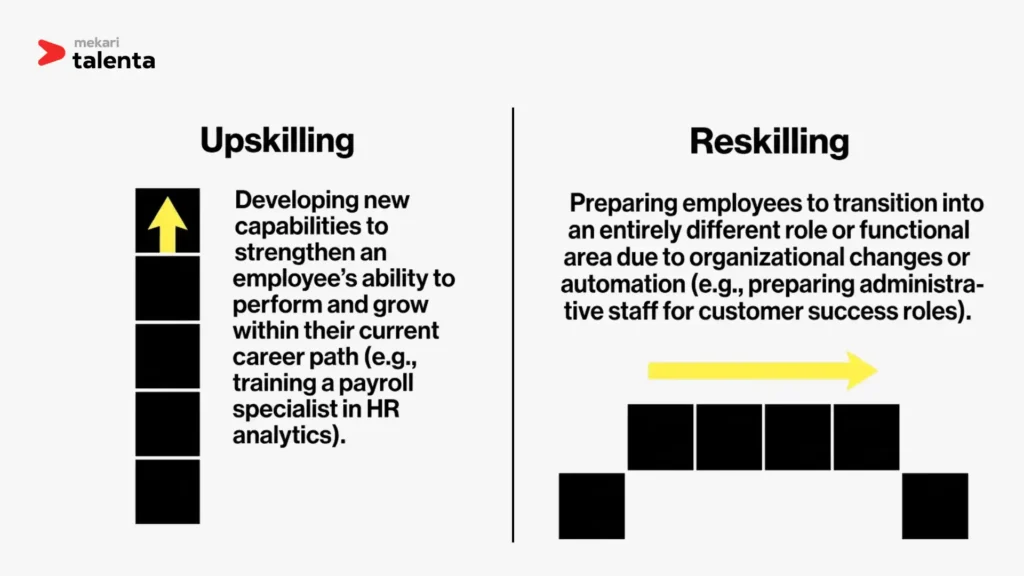
- Upskilling helps employees strengthen capabilities within their current roles, while reskilling prepares them to transition into different functions or career paths.
- Examples of upskilling and reskilling include training finance teams in AI-assisted analytics or preparing administrative employees for digital operations and workforce planning roles.
Workforce transformation is accelerating as organizations adapt to AI adoption, digital operations, and rapidly changing business demands.
As a result, upskilling and reskilling initiatives are becoming increasingly important for maintaining workforce readiness, closing capability gaps, and supporting long-term business continuity.
Many roles now require broader technical capability, stronger analytical thinking, and higher adaptability compared to only a few years ago.
At the same time, skill shortages are becoming increasingly difficult to solve through recruitment alone, especially for emerging and future-critical roles.
This article will explain the meaning of upskilling and reskilling, their differences, business impact, workplace trends, implementation challenges, and practical strategies for building effective workforce development programs.
What Are Upskilling and Reskilling?
Although both focus on talent development, upskilling and reskilling serves a different strategic purpose and addresses different talent challenges.
What Is Upskilling?
Upskilling is the process of developing new capabilities that strengthen an employee’s ability to perform and grow within their current career path.
It usually focuses on expanding technical expertise, leadership capability, digital literacy, communication, or analytical skills that align with evolving business needs.
Many companies integrate upskilling into ongoing employee training initiatives to prepare teams for automation, data-driven operations, and changing customer expectations.
Effective upskilling programs are closely connected to daily work activities so employees can immediately apply newly acquired skills to improve productivity, collaboration, and decision-making.
What Is Reskilling?
Reskilling is the process of preparing employees to transition into entirely different roles or functional areas due to organizational changes, workforce transformation, or emerging business priorities.
It often involves structured learning paths, mentoring, cross-functional exposure, and capability assessments designed to build competence in a new discipline.
Reskilling commonly becomes necessary when companies adopt new technologies, restructure operations, or face talent shortages in critical functions.
Strong reskilling strategies also support employee retention by creating internal mobility opportunities that reduce dependency on external hiring during periods of rapid change.
The Difference Between Upskilling and Reskilling
Understanding the distinction is important because each approach requires different learning structures, timelines, investment priorities, and success measurements.
Many organizations implement both simultaneously as part of broader workforce transformation and succession planning initiatives.
| Aspect | Upskilling | Reskilling |
|---|---|---|
| Primary Objective | Improve capabilities within an existing role or career track | Prepare employees for a different role or function |
| Focus Area | Deepening or expanding current expertise | Building entirely new competencies |
| Typical Trigger | Technology upgrades, process changes, or higher performance expectations | Workforce restructuring, automation, talent shortages, or business transformation |
| Employee Movement | Usually remains within the same department or specialization | Often involves transition to another team, function, or operational area |
| Learning Scope | Incremental and role-specific | Broader and more foundational |
| Time Horizon | Short to medium term | Medium to long term |
| Common Examples | Training a payroll specialist in HR analytics or AI-assisted reporting | Preparing administrative staff for digital operations or customer success roles |
| Business Impact | Improves productivity, quality, and employee experience | Strengthens workforce adaptability and long-term workforce sustainability |
| Performance Measurement | Often tied to performance appraisal outcomes and skill development goals | Usually linked to role transition readiness and workforce planning targets |
| Talent Strategy Connection | Supports career progression and leadership pipeline development | Helps reduce skill shortages and stabilize talent acquisition costs |
Why Upskilling and Reskilling Have Become Business Priorities
The urgency around reskilling and upskilling has accelerated significantly over the last few years. Workforce transformation is no longer driven solely by digitalization initiatives or operational efficiency targets.
Global labor market disruption, AI adoption, demographic shifts, and changing employee expectations are reshaping how companies approach workforce planning and long-term capability development.
These shifts are forcing organizations to rethink how talent is developed, deployed, and retained across business functions.
1. Technology Adoption Is Reshaping Job Requirements
AI, automation, cloud systems, and data-driven operations are changing the composition of work faster than traditional workforce planning cycles can adapt.
Many roles now require employees to combine technical proficiency with analytical thinking, adaptability, and decision-making skills that were previously associated only with leadership positions.
This transformation is especially visible in operational, finance, customer support, and administrative functions where repetitive tasks are increasingly automated.
Employees are expected to work alongside AI-powered systems, interpret insights from dashboards, and manage more strategic responsibilities.
As a result, companies are redesigning employee onboarding and learning frameworks to accelerate digital capability development much earlier in the employee lifecycle.
The challenge is not limited to technology teams.
Organizations that fail to continuously upgrade workforce capabilities often experience slower adoption of new systems, operational bottlenecks, and widening capability gaps between departments.
2. Global Skill Gaps Are Increasing Faster Than Hiring Capacity
Across industries, companies are facing growing difficulty in securing experienced talent for emerging roles. Demand for AI specialists, cybersecurity professionals, data analysts, sustainability experts, and digital project managers continues to outpace labor market supply.
External recruitment alone can no longer solve workforce shortages at scale.
Many organizations are discovering that internal capability development delivers faster and more sustainable results than relying heavily on external talent acquisition.
Employees who already understand internal systems, workflows, compliance structures, and operational culture usually transition more effectively into evolving roles than newly hired candidates.
This shift is also changing how companies approach performance appraisal and career mobility. Rather than evaluating employees only based on current role output, many businesses now assess learning agility, adaptability, and future skill potential as part of succession planning discussions.
Workforce planning has become increasingly skills-based rather than position-based.
At the same time, employees themselves are becoming more aware of skill obsolescence risks. Continuous learning opportunities are now strongly connected to employee engagement because workforce confidence is increasingly tied to long-term career relevance and employability.
Read also: A Complete Guide of Succession Planning – Process, Strategy, Example
3. Workforce Stability Now Depends on Career Development Opportunities
The relationship between employees and employers has changed significantly after the global workforce disruptions of recent years.
Career growth, learning access, and internal mobility opportunities now play a major role in workforce stability and retention outcomes.
Employees are more likely to leave companies when they believe their skills are stagnating or becoming outdated. In many industries, employee attrition is closely linked to limited career visibility rather than compensation alone.
This is why reskilling and upskilling initiatives are increasingly integrated into broader employee experience strategies.
Organizations with mature workforce development frameworks often use personalized learning pathways, cross-functional assignments, mentoring structures, and management by objective systems to align business priorities with employee growth plans.
These approaches help employees understand how new skills contribute to future career progression rather than viewing training as an isolated compliance activity.
Reskilling initiatives have also become important tools for workforce redeployment during operational transformation.
Instead of relying solely on layoffs or external recruitment during restructuring, companies can transition employees into adjacent functions through targeted development pathways and structured capability assessments.
In many cases, this approach reduces disruption while preserving institutional knowledge that would otherwise be lost through workforce turnover.
Benefits of Upskilling and Reskilling for Organizations
Reskilling and upskilling initiatives create measurable business value when they are aligned with operational priorities, workforce planning, and long-term capability development.
The impact extends beyond learning outcomes because workforce capability directly influences productivity, retention, adaptability, and organizational stability.
1. Stronger Workforce Productivity and Operational Performance
Continuous capability development helps employees adapt faster to operational changes, adopt new technologies more effectively, and contribute more independently to business objectives.
Organizations that consistently invest in employee training often experience smoother process transitions and higher execution quality across teams.
This productivity improvement becomes especially visible during digital transformation projects where employees are expected to operate new systems, analyze data more effectively, and manage increasingly cross-functional responsibilities.
Many organizations now integrate learning targets into management by objective frameworks so workforce development directly supports operational KPIs and business outcomes.
2. Higher Employee Retention and Lower Attrition Risk
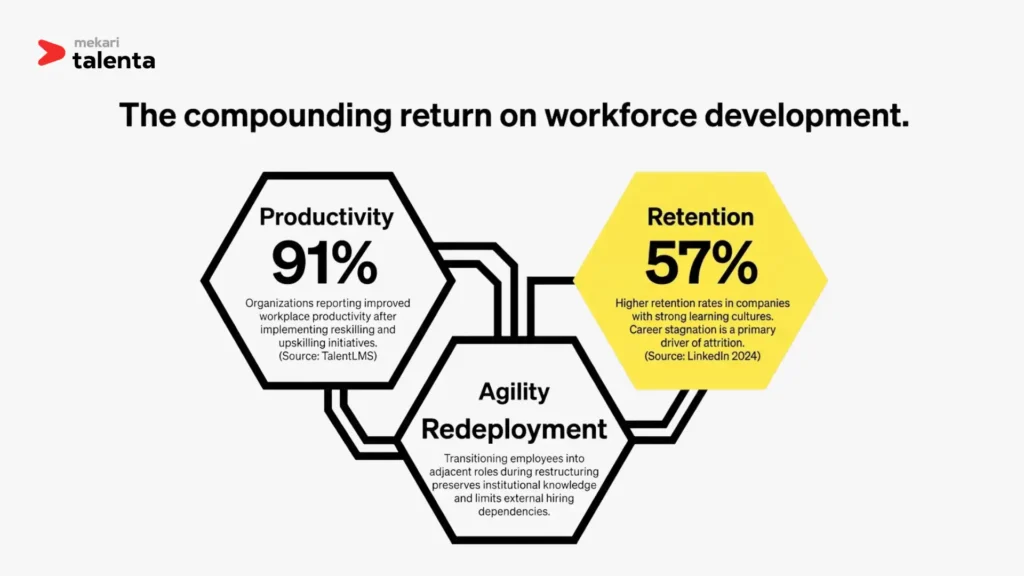
Career development opportunities have become one of the strongest factors influencing workforce stability. Employees are more likely to remain with organizations that provide visible growth pathways, internal mobility opportunities, and long-term skill development support.
This directly affects employee attrition because career stagnation is one of the most common reasons high-performing employees seek opportunities elsewhere.
Companies that prioritize workforce development also strengthen employee engagement by helping employees see a clearer connection between their current responsibilities and future career progression.
Reskilling programs are particularly valuable during operational restructuring because they allow organizations to redeploy employees into adjacent roles instead of relying entirely on external hiring or workforce reductions.
Read also: Employee Retention: Driving Growth Through Talent Sustainability
3. Greater Workforce Agility and Long-Term Business Readiness
Business priorities can shift rapidly due to technology adoption, market changes, regulatory developments, or operational restructuring.
Organizations with adaptable workforces are generally able to respond faster because employees can transition into evolving responsibilities more efficiently.
This is why many organizations increasingly treat workforce development as part of long-term business continuity planning rather than standalone learning initiatives.
Companies that build internal mobility pipelines are often able to fill critical skill gaps faster while preserving institutional knowledge and reducing dependency on external hiring.
Many businesses also integrate capability development into performance appraisal and performance improvement plan processes to identify employees who can transition into future-critical roles through targeted learning pathways and structured development support.
Common Challenges in Upskilling and Reskilling Initiatives
Although many organizations recognize the importance of workforce development, executing reskilling and upskilling initiatives successfully is often far more difficult than designing the strategy itself.
Many programs fail to deliver measurable impact because capability development requires alignment across workforce planning, operational priorities, leadership support, and employee readiness simultaneously.
1. Difficulty Identifying Actual Skill Gaps
One of the most common problems in workforce development initiatives is the inability to accurately identify existing workforce capabilities and future skill requirements.
Many organizations still rely on outdated job descriptions, inconsistent competency frameworks, or manual assessments that fail to reflect how roles are evolving in real business environments.
This issue becomes more complicated when job scopes evolve faster than organizational structures. Employees often perform responsibilities outside their formal job descriptions, especially after digital transformation projects, automation initiatives, or operational restructuring.
As a result, companies may invest heavily in employee training programs that do not actually address the most urgent operational capability gaps.
Another challenge is that workforce capability data is frequently fragmented across performance appraisal systems, learning platforms, recruitment data, and department-level assessments.
Without centralized visibility, organizations struggle to prioritize which capabilities should be developed first and which employees are most ready for reskilling pathways.
2. Limited Time and Operational Capacity for Learning
Many organizations underestimate how difficult it is for employees and managers to balance operational responsibilities with continuous learning requirements.
Even when training budgets are available, employees often lack sufficient time, managerial support, or workload flexibility to participate consistently in development programs.
This challenge is especially common in fast-paced operational environments where teams are already managing aggressive performance targets, tight deadlines, and workforce shortages.
Learning initiatives are often deprioritized during peak operational periods because managers focus primarily on short-term delivery outcomes.
The issue becomes more severe when capability development is treated as an additional responsibility rather than integrated into daily workflows.
Employees may complete mandatory training modules, but without practical application opportunities, knowledge retention and skill adoption remain low.
Organizations that successfully scale reskilling initiatives usually redesign workload distribution, create dedicated learning hours, integrate mentoring into operational activities, and align development goals with performance management processes. Without structural support, learning initiatives frequently become inconsistent and difficult to sustain.
3. Resistance to Change and Workforce Anxiety
Reskilling and upskilling initiatives often create uncertainty among employees, especially when workforce transformation is connected to automation, AI adoption, or organizational restructuring.
Employees may worry that new technology will reduce the relevance of their existing expertise or create pressure to adapt faster than they feel prepared for.
This resistance is rarely caused by learning itself. In many cases, employees disengage because they do not clearly understand how the new skills connect to future career opportunities, compensation growth, or internal mobility pathways.
When communication is unclear, workforce development programs can unintentionally increase uncertainty instead of strengthening employee engagement.
Manager behavior also plays a major role. Employees are significantly less likely to participate actively in development programs when direct managers do not prioritize learning discussions, coaching, or career planning conversations.
This is why successful organizations usually train managers to become active capability-development partners rather than relying solely on centralized learning teams.
Upskilling and Reskilling Trends in Modern Workplaces
Workforce development strategies have changed significantly over the past few years. Traditional training models that focused on periodic classroom sessions or compliance-based learning are increasingly being replaced by continuous, skills-based capability development approaches.
This shift is being driven by rapid AI adoption, evolving workforce expectations, labor market shortages, and the growing need for organizations to build more adaptable talent structures.
As a result, reskilling and upskilling initiatives are becoming more integrated with workforce planning, career mobility, and operational transformation strategies.
1. AI Literacy Is Becoming a Core Workforce Requirement
One of the biggest workplace trends is the expansion of AI-related capability development beyond technical teams. Organizations are increasingly treating AI literacy as a baseline workforce capability rather than a specialized skill reserved for data or engineering functions.
This trend is reshaping how organizations design employee training programs. Many companies now include AI fundamentals, prompt engineering, data interpretation, automation workflows, and responsible AI usage in broader workforce development initiatives.
Employees across finance, operations, HR, customer service, and marketing functions are increasingly expected to work alongside AI-powered systems as part of daily operations.
Organizations are also placing greater emphasis on human-centered capabilities such as critical thinking, adaptability, communication, and decision-making because these skills become more valuable as automation expands.
Workforce development strategies are no longer focused only on technical proficiency. The priority is building employees who can adapt continuously as job requirements evolve.
2. Skills-Based Workforce Planning Is Replacing Traditional Role-Based Models
Another major trend is the shift from job-title-based workforce management toward skills-based workforce planning.
Instead of viewing employees primarily through static job descriptions, organizations are increasingly mapping workforce capabilities based on transferable skills, learning agility, and future role potential.
This trend is influencing both talent acquisition and internal mobility strategies. Many organizations now use skills assessments, capability taxonomies, and AI-driven talent intelligence platforms to identify employees who can transition into adjacent roles through targeted reskilling pathways.
As a result, career progression is becoming less dependent on linear promotion structures. Employees increasingly move laterally across departments, project teams, and operational functions to build broader skill portfolios.
Organizations benefit because they can fill emerging capability gaps more quickly while improving workforce flexibility and long-term succession readiness.
This approach also changes how companies conduct performance appraisal discussions. Managers are increasingly evaluating employees based on adaptability, learning velocity, and cross-functional capability development instead of focusing only on current-role performance metrics.
Read also: Strategic Workforce Planning: Benefits and Implementation
3. Internal Mobility and Personalized Learning Are Expanding Rapidly
Organizations are increasingly investing in internal mobility ecosystems that connect employees with learning opportunities, short-term projects, mentoring access, and future role pathways.
Workforce development is becoming more personalized as companies recognize that employees have different learning speeds, career interests, and capability gaps.
This trend is closely connected to changing employee expectations. Employees increasingly expect clearer career visibility, structured growth pathways, and continuous development opportunities as part of the overall employee experience.
Many organizations now use AI-driven learning platforms to recommend personalized development paths based on employee roles, career interests, capability gaps, and business priorities.
As a result, learning access is increasingly perceived as an employee benefit that supports long-term employability, workforce engagement, and career sustainability.
At the same time, reskilling initiatives are becoming more integrated into workforce redeployment strategies.
During operational transformation or restructuring, companies increasingly prioritize transitioning employees into adjacent functions through structured development pathways to preserve institutional knowledge and reduce dependency on external hiring.
Best Practices for Building Effective Upskilling and Reskilling Programs
Many workforce development initiatives fail because organizations focus too heavily on training delivery while overlooking operational integration, workforce readiness, and long-term capability planning.
Effective reskilling and upskilling programs require far more than providing access to online courses or learning platforms.
Successful organizations usually treat workforce development as an ongoing business capability strategy that is tightly connected to operational priorities, internal mobility, leadership readiness, and workforce planning.
Below are some of the most effective practices commonly implemented in modern workplaces.
1. Start With Business-Critical Capability Gaps
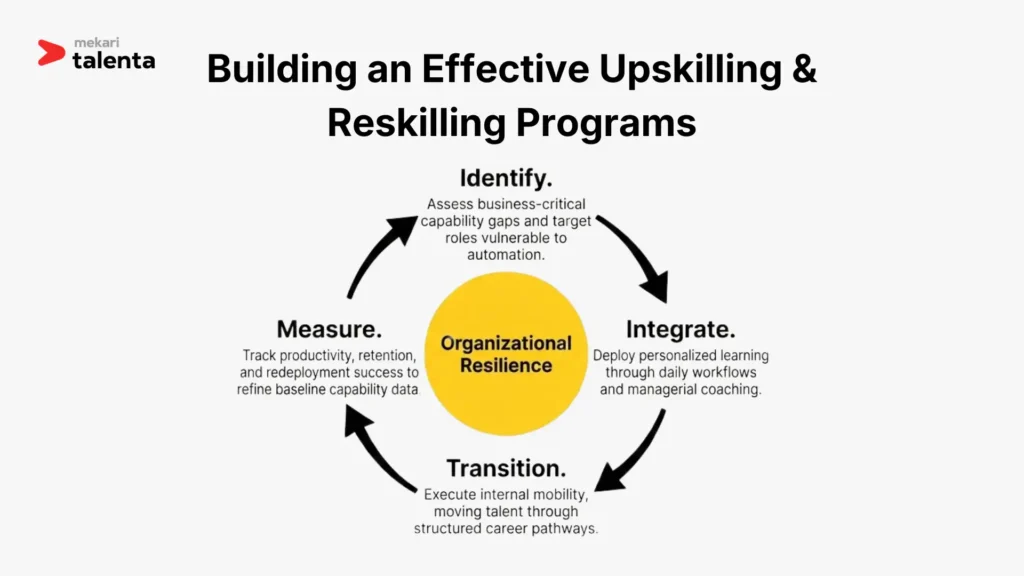
One of the biggest mistakes organizations make is launching broad learning initiatives without clearly identifying which capabilities are most urgent for future business continuity.
Effective workforce development programs usually begin with operational analysis rather than training vendor selection.
High-performing organizations typically assess:
- Which roles are most vulnerable to automation or process redesign
- Which future-critical capabilities are hardest to hire externally
- Which departments face the highest workforce dependency risks
- Which skills directly affect revenue, compliance, productivity, or customer delivery
This approach helps organizations prioritize development investments more accurately. Instead of assigning generic learning programs across all departments, companies can focus resources on the capabilities that create the highest operational impact.
Many organizations also combine workforce analytics, performance appraisal insights, and manager assessments to identify employees with strong learning agility and transition potential. This allows reskilling initiatives to become more targeted and scalable.
2. Integrate Learning Into Daily Workflows
One of the most common reasons learning initiatives fail is because employees are expected to complete development activities separately from their operational responsibilities. In reality, employees retain skills more effectively when learning is embedded directly into daily work activities.
Organizations with mature capability development frameworks often use project-based learning, rotational exposure, mentoring, shadowing, and cross-functional assignments instead of relying exclusively on formal classroom training. Employees learn faster when they apply new skills immediately within real operational environments.
This is especially important during digital transformation initiatives where employees are expected to adopt new systems while maintaining performance targets.
Companies that successfully manage large-scale workforce transitions usually redesign operational workflows to create practical learning opportunities during implementation phases.
Manager involvement is also critical. Employees are significantly more likely to complete development pathways when managers regularly discuss progress, assign stretch responsibilities, and connect learning outcomes to career progression opportunities.
3. Build Clear Internal Mobility Pathways
Employees engage more actively in reskilling and upskilling programs when they understand how new capabilities contribute to future career opportunities.
Learning initiatives become significantly more effective when organizations provide transparent career pathways and realistic role transition visibility.
Many successful organizations now publish internal capability frameworks that show:
- Skills required for adjacent roles
- Recommended learning pathways
- Expected proficiency levels
- Potential career transition timelines
This creates stronger employee engagement because workforce development becomes connected to tangible growth opportunities rather than isolated training activities.
Internal mobility frameworks also help organizations reduce dependency on external hiring during periods of rapid operational change.
Employees who already understand internal systems, organizational structures, and business processes often adapt faster to adjacent roles compared to newly hired external candidates.
Companies with strong mobility cultures also tend to improve employee retention because employees can visualize long-term career progression without needing to leave the organization to access growth opportunities.
4. Treat Managers as Capability Development Partners
Many workforce development initiatives underperform because capability building is treated as the sole responsibility of learning teams.
In reality, direct managers heavily influence whether employees apply, sustain, and expand newly acquired skills over time.
Organizations with effective development cultures usually train managers to:
- Conduct regular capability-development conversations
- Identify transferable strengths and skill gaps
- Recommend practical development assignments
- Support coaching and mentoring activities
- Align learning goals with team priorities
This approach strengthens accountability while making development discussions part of normal operational management instead of separate HR-driven activities.
Managers also play a major role in identifying employees who may benefit from a performance improvement plan that focuses on capability development rather than purely corrective action.
In many cases, performance gaps emerge because employees lack exposure, coaching, or evolving technical competencies rather than motivation alone.
5. Measure Workforce Impact Beyond Training Completion
Many organizations still evaluate learning effectiveness primarily through participation rates or course completion metrics. These measurements rarely reflect actual business impact.
More mature organizations evaluate workforce development initiatives using operational indicators such as productivity improvements, internal mobility rates, leadership readiness, project delivery capability, employee retention, and workforce adaptability during organizational change.
The most effective organizations also track whether employees are successfully applying new capabilities within operational environments after completing development programs.
This often includes manager feedback, project outcomes, capability assessments, and role-transition readiness evaluations.
Long-term workforce development success is usually visible through stronger succession pipelines, lower employee attrition, faster adaptation to business changes, and improved organizational resilience during periods of transformation.
6. Align Career Pathing With Workforce Development Strategies
Reskilling and upskilling programs become far more sustainable when they are connected to structured career pathing frameworks.
Employees are significantly more motivated to develop new capabilities when they understand how those skills contribute to future career progression, internal mobility opportunities, and long-term professional growth.
Many organizations struggle with low learning participation because employees see training as an additional task rather than part of a meaningful career trajectory.
This is especially common when learning programs are disconnected from promotion pathways, succession planning, or role transition opportunities.
Organizations with mature workforce development strategies usually map career pathways alongside capability requirements for future-critical roles.
Instead of defining career progression only through hierarchy or tenure, they identify the technical, leadership, operational, and cross-functional competencies required for movement into adjacent positions.
For example, employees in operational coordination roles may be guided toward workforce planning, business operations, or analytics positions through structured development pathways that include:
- targeted training
- mentoring exposure
- rotational assignments
- project ownership
- capability assessments
This approach creates stronger alignment between workforce planning and employee growth expectations. Employees gain clearer visibility into the skills they need to develop, while organizations build stronger internal talent pipelines for evolving business needs.
Reference
Employee Upskilling Is Vital in Rapidly Evolving Job Market – Gallup
Upskilling And Reskilling: A Smart Investment For Business Growth – Forbes
Frequently Asked Questions (FAQs)
What types of employees are usually prioritized for reskilling initiatives?
What types of employees are usually prioritized for reskilling initiatives?
Organizations often prioritize employees whose roles are highly affected by automation, operational restructuring, or evolving technology adoption. Employees with strong adaptability, collaboration skills, and institutional knowledge are usually considered strong candidates for reskilling pathways. Companies also commonly focus on employees working in functions facing declining demand or changing operational requirements. This approach helps preserve workforce stability while supporting internal mobility.
Is upskilling only focused on technical or digital skills?
Is upskilling only focused on technical or digital skills?
No. Although digital and AI-related capabilities are becoming increasingly important, many upskilling initiatives also focus on leadership, communication, strategic thinking, stakeholder management, and problem-solving skills. Organizations often combine technical and human-centered capability development because both are necessary in modern workplaces. Cross-functional collaboration and adaptability are now considered equally important as technical expertise in many roles.
How do organizations encourage employees to participate in learning programs?
How do organizations encourage employees to participate in learning programs?
Successful organizations usually connect learning opportunities with career progression, internal mobility, and performance discussions rather than positioning training as a standalone activity. Many companies also provide personalized learning pathways, mentoring access, project-based learning opportunities, and manager support to increase participation. Employees are generally more engaged when they can clearly see how capability development contributes to future growth opportunities. Recognition and leadership involvement also play major roles in sustaining participation.
What is the difference between reskilling and workforce redeployment?
What is the difference between reskilling and workforce redeployment?
Reskilling focuses on developing new competencies so employees can transition into different roles, while workforce redeployment refers to the actual movement of employees into new functions or operational areas. In many cases, reskilling becomes part of broader redeployment strategies during restructuring or business transformation. Organizations often use structured learning pathways and capability assessments before employees formally move into new positions. This helps reduce operational disruption and improves transition readiness.