

Defining Talent Acquisition: Building a Sustainable Hiring Pipeline


-
Talent acquisition is a long-term workforce strategy focused on attracting, hiring, and retaining talent aligned with current and future business needs.
-
Talent acquisition teams manage workforce planning, candidate sourcing, hiring strategy, employer positioning, and talent pipeline development to support long-term organizational capability.
Workforce challenges have become increasingly difficult to solve through hiring alone. Many companies are simultaneously managing leadership gaps, rising attrition, shifting workforce expectations, and growing pressure to secure specialized talent faster than competitors.
Hiring decisions now affect operational continuity, long-term capability development, workforce stability, and business scalability across multiple functions at once.
As labor markets continue evolving, organizations are rethinking how talent acquisition supports not only recruitment goals, but also workforce planning, retention, and organizational growth readiness.
This article will discuss talent acquisition, including strategies, processes, trends, challenges, and best practices used to build sustainable workforce capability.
What Is Talent Acquisition?
Talent acquisition is a long-term workforce strategy focused on identifying, attracting, selecting, and retaining talent that aligns with current operational priorities and future business direction.
Unlike transactional hiring activities, talent acquisition involves continuous market mapping, workforce forecasting, succession readiness, and candidate relationship management across multiple talent segments.
The function typically operates in close coordination with business leaders, finance, workforce planning teams, and department heads to anticipate capability gaps before they affect execution.
This includes evaluating future leadership pipelines, critical technical skills, geographic expansion needs, and evolving workforce expectations.
Strong acquisition practices directly affect employee experience because candidate impressions often shape long-term engagement and retention outcomes after hiring.
In many companies, talent acquisition teams also contribute insights into workforce mobility, compensation competitiveness, diversity targets, and hiring efficiency metrics.
Their work increasingly intersects with broader people initiatives such as onboarding, employee training, and long-term capability development planning.
Talent Acquisition vs. Recruitment
Many companies still use the terms talent acquisition and recruitment interchangeably, even though both functions operate with different objectives, planning horizons, and business impact.
Here are the key differences between these two:
In short, recruitment is primarily focused on filling open positions within a defined timeframe.
Meanwhile, talent acquisition operates as a broader workforce strategy that continuously aligns hiring activities with long-term organizational priorities, future capability requirements, and workforce sustainability.
This broader approach allows companies to anticipate talent shortages earlier, improve hiring consistency across departments, reduce employee attrition, and strengthen long-term workforce quality instead of repeatedly addressing hiring gaps under urgent timelines.
Read also: A Guide to Employee Recruitment: Process & How to Hire 60% Faster
Why Talent Acquisition Matters?
Hiring quality has become one of the strongest predictors of operational continuity, workforce stability, and long-term organizational performance.
Talent acquisition directly influences how quickly teams can scale, how effectively managers execute business priorities, and how sustainable workforce performance remains during periods of growth, restructuring, or market change.
Below are several reasons why talent acquisition has become a critical business function.
1. Hiring Decisions Directly Affect Financial Performance
Poor hiring decisions create operational disruption that extends far beyond recruitment costs.
When critical roles remain vacant for extended periods or new hires fail to perform effectively, teams often experience productivity slowdowns, increased manager workload, delayed project execution, and additional replacement costs.
In many organizations, hiring inefficiencies also create secondary issues such as delayed onboarding, overloaded managers, inconsistent performance appraisal outcomes, and prolonged capability gaps across departments.
2. Talent Acquisition Strongly Influences Retention and Workforce Stability
Retention problems often begin long before employees submit resignations. Misaligned hiring decisions, weak role clarity, poor candidate-job fit, and unrealistic hiring expectations commonly contribute to early employee attrition within the first year of employment.
Strong talent acquisition functions usually reduce these risks by improving candidate assessment quality, aligning hiring managers around clearer success profiles, and creating more realistic hiring expectations during the recruitment process. These practices contribute directly to employee retention, stronger employee engagement, and healthier long-term workforce planning.
3. Workforce Quality Determines Long-Term Organizational Capability
Sustainable business growth depends heavily on workforce quality, adaptability, and leadership readiness.
Talent acquisition increasingly focuses on identifying candidates with learning agility, collaboration capability, and long-term growth potential rather than evaluating candidates solely based on technical qualifications.
This shift explains why many companies now integrate hiring strategies with broader workforce initiatives such as employee training, learning management system adoption, leadership development, objective key results alignment, and succession planning.
Talent acquisition has become increasingly connected to long-term capability building rather than short-term staffing activity alone.
Key Usage Examples of Talent Acquisition
Talent acquisition strategies are applied differently depending on workforce priorities, business expansion plans, operational challenges, and capability requirements.
Below are several common scenarios where talent acquisition plays a critical role in maintaining workforce continuity and organizational readiness.
1. Scaling Hiring During Business Expansion
When companies open new business units, expand into new markets, or launch additional operational functions, talent acquisition teams are responsible for building scalable hiring pipelines within limited timelines.
This often includes workforce forecasting, location-based talent mapping, compensation benchmarking, and coordination across multiple hiring managers simultaneously.
2. Building Leadership Succession Pipelines
Talent acquisition is frequently used to strengthen future leadership readiness for critical roles that are difficult to replace externally.
Teams may proactively identify leadership candidates months before vacancies occur to reduce operational disruption and preserve institutional knowledge continuity.
3. Hiring Specialized or Hard-to-Fill Roles
Certain positions require highly specific technical expertise, certifications, or industry experience that may exist within a limited talent pool.
In these situations, talent acquisition teams usually combine market intelligence, passive candidate outreach, and long-term relationship building to improve hiring success rates.
4. Supporting Workforce Transformation Initiatives
During digital transformation, restructuring, or operating model changes, organizations often require new workforce capabilities that existing teams may not fully possess.
Talent acquisition helps accelerate capability shifts by targeting candidates with experience in automation, analytics, cross-functional collaboration, and change management environments.
Pillars of Talent Acquisition
Successful talent acquisition strategies are typically built around three interconnected pillars that influence workforce quality, hiring sustainability, and long-term retention outcomes.
Each pillar affects different stages of the employee lifecycle, yet all three must operate in alignment to create a stable and scalable workforce system.
Pillar 01
Attraction
Building strong talent visibility through employer positioning, workforce reputation, and candidate engagement.
Pillar 02
Selection
Identifying candidates with the right technical capability, adaptability, and long-term workforce fit.
Pillar 03
Attrition
Monitoring workforce turnover patterns to improve retention quality and long-term hiring effectiveness.
Attraction
Attraction focuses on how organizations position themselves in the talent market and how effectively they generate interest from qualified candidates.
This pillar involves far more than publishing vacancies. It includes workforce reputation, compensation competitiveness, career growth visibility, candidate communication quality, and overall employer branding consistency.
Strong attraction strategies usually depend on clear workforce value propositions supported by authentic employee experience narratives.
Candidates increasingly evaluate workplace flexibility, leadership quality, development opportunities, and organizational stability before applying.
As competition for skilled talent becomes more aggressive, organizations with weak market positioning often experience higher hiring costs and slower hiring cycles.
Attraction also depends heavily on operational consistency. Delayed interview scheduling, unclear job expectations, and fragmented candidate communication frequently reduce offer acceptance rates even when compensation remains competitive.
Selection
Selection determines how effectively organizations identify candidates who can perform successfully both immediately and over the long term.
Mature selection processes typically evaluate technical capability, collaboration style, adaptability, leadership potential, and alignment with operational expectations rather than relying solely on resume screening.
Many hiring failures occur because organizations overemphasize technical qualifications while underestimating behavioral fit, manager compatibility, and learning agility.
Structured interviews, competency-based assessments, case studies, and cross-functional evaluations are increasingly used to improve hiring accuracy and reduce future performance issues.
Selection quality also affects downstream workforce processes. Poor candidate-job alignment often contributes to low engagement, inconsistent productivity, early resignations, and eventual performance improvement plan implementation within the first year of employment.
Attrition
Attrition measures how effectively organizations retain employees after hiring decisions are made.
High employee turnover often signals deeper issues related to hiring quality, management capability, workload sustainability, compensation competitiveness, or career progression limitations.
Talent acquisition teams increasingly analyze attrition data to identify patterns connected to specific departments, managers, locations, or hiring channels.
These insights help organizations refine candidate profiles, improve hiring assessments, and adjust workforce expectations before turnover problems escalate further.
Attrition analysis also plays an important role in long-term workforce planning. Teams with persistent turnover usually experience productivity instability, rising recruitment costs, delayed capability development, and lower workforce morale over time.
As a result, retention metrics are now commonly treated as indicators of talent acquisition effectiveness rather than solely operational workforce metrics.
Core Talent Acquisition Process
Talent acquisition requires a structured process that aligns hiring activities with workforce priorities, operational timelines, and long-term capability planning.
Effective hiring systems are rarely built around isolated recruitment activities. Instead, they operate as interconnected processes where workforce planning, candidate evaluation, onboarding readiness, and retention considerations continuously influence one another.
Below are the core stages commonly found in mature talent acquisition operations.
1. Workforce Planning and Hiring Forecasting
The process typically begins with workforce planning rather than vacancy requests. Business leaders and talent teams evaluate current workforce capacity, projected business growth, turnover trends, expansion plans, and future capability requirements to identify upcoming hiring needs.
This stage often includes succession mapping, headcount allocation discussions, compensation benchmarking, and workload analysis across departments.
Organizations with stronger forecasting capability usually experience lower emergency hiring pressure and better workforce stability because hiring decisions are made earlier instead of reacting only after operational disruption occurs.

2. Talent Sourcing and Candidate Attraction
After workforce priorities are established, talent acquisition teams begin building candidate pipelines through multiple sourcing channels.
This may include job platforms, referral programs, professional communities, campus partnerships, executive search firms, and passive candidate outreach.
At this stage, candidate perception becomes highly important. Candidates often evaluate organizations long before entering interview stages, which means communication quality, hiring responsiveness, role clarity, and employer branding consistency significantly influence application conversion rates.
High-performing talent acquisition teams usually maintain ongoing candidate relationships even when immediate vacancies do not exist.
This approach becomes especially valuable for leadership roles, specialized technical positions, and business-critical functions where qualified talent availability remains limited.
3. Candidate Assessment and Selection
Selection processes are designed to evaluate both immediate job capability and long-term workforce fit. Beyond technical qualifications, organizations increasingly assess collaboration ability, adaptability, communication style, problem-solving approach, and leadership potential.
Structured interview frameworks help reduce inconsistent hiring decisions across departments. Many organizations now combine competency-based interviews, case studies, behavioral assessments, panel interviews, and technical simulations to improve hiring accuracy.
4. Offer Management and Hiring Coordination
Once candidates are selected, hiring teams move into compensation discussions, offer approvals, negotiation management, and joining coordination.
Delays during this stage commonly result in offer drop-offs, particularly for high-demand candidates managing multiple opportunities simultaneously.
Successful hiring coordination depends heavily on operational speed and internal alignment between recruiters, hiring managers, finance teams, and department leadership.
In many organizations, offer-stage inefficiencies create unnecessary candidate loss despite strong earlier recruitment performance.
Transparent communication also becomes increasingly important during this stage. Candidates typically evaluate organizational professionalism based on responsiveness, process clarity, and decision-making consistency before accepting offers.
5. Employee Onboarding and Early Integration
Talent acquisition effectiveness extends beyond signed offer letters. Early employment experiences strongly influence retention outcomes, productivity ramp-up speed, and long-term engagement levels.
Strong employee onboarding processes usually include role expectation alignment, structured learning plans, manager check-ins, operational system access preparation, and integration into team workflows from the first day onward.
Organizations that fail to manage onboarding effectively often experience early-stage disengagement and preventable turnover.
6. Retention Monitoring and Workforce Evaluation
Modern talent acquisition functions increasingly monitor post-hiring outcomes to evaluate hiring effectiveness over time.
This includes analyzing retention rates, quality-of-hire indicators, internal mobility trends, engagement results, and manager satisfaction metrics.
Attrition patterns often reveal weaknesses within earlier hiring stages. For example, recurring turnover within specific roles may indicate unrealistic job expectations, poor manager alignment, weak selection criteria, or compensation gaps.
Organizations with mature talent acquisition systems continuously refine hiring strategies using workforce analytics instead of treating hiring as a standalone recruitment cycle.
Common Talent Acquisition Challenges
Talent acquisition challenges have become increasingly interconnected with workforce transformation, changing employee expectations, economic uncertainty, and ongoing skill shortages across global labor markets.
Many organizations are no longer struggling only to attract talent. They are also facing growing pressure to retain employees, maintain workforce stability, and adapt hiring strategies to rapidly evolving business needs.
Below are several talent acquisition challenges currently creating significant impact across global organizations.
1. Persistent Talent Shortages in Critical Skills
One of the most significant workforce challenges globally remains the shortage of qualified talent for highly specialized and business-critical roles.
Areas such as AI, cybersecurity, data analytics, cloud infrastructure, and digital operations continue experiencing aggressive hiring competition with limited talent supply.
The issue has become increasingly complex because required skills are evolving faster than traditional workforce development cycles.
Many organizations now struggle to balance external hiring with internal reskilling efforts while competing against global employers targeting the same talent pools simultaneously.
2. High Employee Attrition Despite Competitive Compensation
Compensation alone is becoming less effective as a long-term retention strategy. Many organizations continue experiencing elevated turnover rates even after increasing salaries, bonuses, and financial incentives.
Employees increasingly evaluate workplace flexibility, leadership quality, career mobility, workload sustainability, organizational culture, and development opportunities alongside compensation.
In several industries, professionals are leaving high-paying positions due to burnout, limited growth visibility, and dissatisfaction with work structures.
This shift is forcing organizations to rethink retention strategies beyond compensation competitiveness alone.
3. Balancing AI-Driven Efficiency With Human-Centered Hiring
Organizations are rapidly integrating AI into sourcing, screening, scheduling, and recruitment analytics to improve hiring efficiency and manage growing application volumes.
However, increasing automation also introduces concerns around hiring fairness, candidate trust, and depersonalized recruitment experiences.
Many organizations are still determining how to balance operational efficiency with personalized candidate engagement, especially for leadership hiring and high-value workforce segments where relationship quality strongly influences hiring outcomes.
4. Reactive Hiring and Weak Workforce Forecasting
Many organizations continue operating with highly reactive hiring models where recruitment activities only begin after operational gaps emerge.
This approach often creates rushed hiring decisions, increased workload pressure, inconsistent candidate quality, and prolonged vacancy periods.
Without stronger workforce forecasting capability, organizations frequently struggle to anticipate capability gaps, succession risks, or future hiring demand early enough to build sustainable talent pipelines.
Read also: 10 Recruitment Process Optimization Steps to Improve Hiring Efficiency
Talent Acquisition Trends
Talent acquisition strategies continue to evolve alongside changing workforce expectations, digital transformation initiatives, labor market shifts, and growing pressure to build more adaptable workforces.
Hiring teams are now expected to support workforce agility, long-term capability planning, and retention outcomes simultaneously instead of focusing solely on recruitment execution.
Below are several major trends currently reshaping talent acquisition practices across large organizations.
1. Skills-Based Hiring Is Replacing Credential-Driven Hiring
Organizations are increasingly prioritizing demonstrable skills, capability assessments, and practical experience over traditional degree requirements
This shift is largely driven by widening skills gaps, faster technology adoption cycles, and the need to expand access to qualified talent pools.
This trend also affects internal workforce management. Organizations increasingly align hiring with internal mobility programs, upskilling initiatives, and workforce capability mapping to maximize existing talent potential before hiring externally.
2. AI Is Becoming Embedded Across the Hiring Lifecycle
Artificial intelligence is now deeply integrated into sourcing, screening, interview scheduling, candidate engagement, workforce analytics, and hiring forecasting processes.
Hiring teams increasingly use AI tools to manage growing application volumes, automate repetitive tasks, and improve recruitment efficiency.
The growing importance of AI literacy is also influencing hiring requirements themselves.
Several organizations now assess candidates based on adaptability to AI-enabled work environments, digital collaboration capability, and data-driven decision making instead of evaluating only role-specific technical expertise.
3. Multi-Generational Workforce Hiring Is Becoming More Complex
Organizations now manage workforces that may include employees from four to five generations simultaneously, each with different communication styles, career expectations, technology preferences, and workplace priorities.
Talent acquisition strategies increasingly require more personalized candidate engagement approaches to address these differences effectively.
Younger candidates often prioritize flexibility, career acceleration, and development opportunities, while more experienced professionals may place greater emphasis on stability, leadership influence, healthcare benefits, or work-life integration.
Standardized recruitment messaging has become less effective across increasingly diverse workforce demographics.
As a result, hiring teams are redesigning candidate communication, benefits positioning, onboarding structures, and career development pathways to accommodate broader workforce expectations while maintaining operational consistency.
Read also: 10 Recruitment Strategies for Multi-Generational Workforce in Today’s Workplace
4. Internal Mobility Is Becoming a Core Hiring Strategy
Organizations increasingly treat internal talent marketplaces and workforce redeployment as critical parts of talent acquisition strategy.
Rather than relying exclusively on external recruitment, companies are investing more heavily in identifying transferable skills within existing workforces.
This trend is heavily influenced by rising recruitment costs, ongoing skills shortages, and pressure to improve workforce retention.
Internal mobility often reduces hiring timelines while preserving institutional knowledge and long-term workforce continuity.
5. Workforce Analytics and Talent Intelligence Are Becoming Centralized
Talent acquisition decisions are becoming increasingly data-driven. Organizations now rely more heavily on labor market intelligence, compensation analytics, attrition forecasting, hiring funnel analysis, and workforce capability mapping to support hiring decisions.
Modern talent acquisition functions are expected to operate with stronger forecasting capability, faster workforce visibility, and more predictive hiring insights.
This shift allows organizations to anticipate workforce risks earlier and align hiring strategies more closely with long-term operational priorities.
How to Build an Effective Talent Acquisition Strategy
Building an effective talent acquisition strategy requires far more than improving recruitment speed or increasing application volume.
Hiring systems must be designed to support workforce scalability, capability continuity, leadership readiness, and long-term retention under constantly changing business conditions.
As workforce expectations, technology adoption, and labor market dynamics continue to evolve, organizations need talent acquisition strategies that are flexible, data-driven, and deeply integrated with operational planning.
Below are several key approaches commonly used to strengthen talent acquisition effectiveness at scale.
1. Shift From Vacancy-Based Hiring to Workforce Planning
Many hiring inefficiencies begin when recruitment activities only start after vacancies appear. Mature talent acquisition strategies typically operate through continuous workforce forecasting instead of reactive hiring requests.
This involves analyzing business expansion plans, turnover risks, productivity capacity, succession exposure, and future skill requirements several quarters ahead.
Workforce planning discussions should involve department leaders, finance teams, and operational stakeholders so hiring priorities remain aligned with broader business objectives.
Organizations that strengthen forecasting capability usually reduce emergency hiring pressure, lower dependency on external agencies, and improve hiring quality because candidate pipelines are developed earlier.
2. Build Skills-Based Hiring Frameworks
As skill requirements evolve faster than traditional job structures, organizations increasingly need hiring systems that evaluate adaptability and capability potential instead of relying heavily on credentials alone.
Effective strategies often redesign job descriptions around business-critical competencies, transferable skills, and measurable outcomes rather than narrow experience requirements.
Structured assessments, simulations, and competency-based interviews help improve hiring consistency across departments while reducing bias in candidate evaluation.
This approach becomes particularly important for digital transformation initiatives, cross-functional roles, and positions where technical requirements change rapidly over time.
3. Develop Multi-Generational Hiring Approaches
Candidate expectations are becoming increasingly diverse across different workforce demographics. A single recruitment communication style rarely works effectively for all talent segments anymore.
Organizations with stronger hiring performance usually personalize candidate engagement based on career stage, leadership level, and workforce expectations.
Early-career professionals often prioritize growth visibility, flexibility, and development opportunities, while experienced candidates may focus more on strategic influence, organizational stability, and leadership autonomy.
This also affects interview design, onboarding structure, benefits positioning, and career path communication.
Companies that fail to adapt their hiring approach to changing workforce expectations often experience lower offer acceptance rates and weaker long-term retention outcomes.
4. Integrate AI Carefully Into Recruitment Operations
AI-driven hiring tools can significantly improve sourcing efficiency, candidate screening speed, and recruitment coordination.
However, automation should support recruiter decision-making rather than replace human evaluation entirely.
Strong implementation strategies usually focus AI usage on administrative and analytical tasks such as scheduling, talent matching, sourcing recommendations, and recruitment analytics.
Human involvement remains essential during behavioral evaluation, leadership assessment, stakeholder alignment, and final hiring decisions.
Organizations also need clear governance standards around AI usage to maintain hiring fairness, transparency, and candidate trust as automated recruitment processes become more common.
5. Strengthen Internal Mobility and Workforce Visibility
External recruitment alone is rarely sufficient to sustain long-term workforce capability. Many organizations now prioritize internal mobility as part of their broader employee recruitment strategy to reduce hiring costs and preserve institutional knowledge.
This requires stronger visibility into employee capabilities, performance history, leadership potential, and development readiness across departments.
Companies increasingly use workforce analytics, capability inventories, and career mapping systems to identify employees who can transition into emerging business roles through targeted development programs.
In many cases, internal hiring pipelines also improve employee engagement because employees gain clearer visibility into career progression opportunities inside the organization.
6. Align Talent Acquisition With Long-Term Employee Experience
Hiring outcomes are heavily influenced by what employees experience after joining. Organizations that separate recruitment from onboarding, development, and retention processes often struggle with workforce continuity over time.
Effective talent acquisition strategies usually operate in close alignment with employee experience initiatives, leadership development, performance management systems, and workforce capability planning.
Candidate expectations established during recruitment should remain consistent throughout onboarding and long-term employment experiences.
This alignment becomes especially important for improving retention quality, reducing early-stage turnover, and maintaining workforce stability during periods of organizational growth or transformation.
Talent Acquisition Best Practices for Large-Scale Organizations
As organizations grow across multiple business units, hiring challenges often involve inconsistent recruitment standards, fragmented workforce planning, slower decision-making, overlapping approval structures, and uneven candidate experiences across departments.
Strong talent acquisition practices help organizations maintain hiring quality and workforce consistency even when hiring volumes, operational demands, and workforce structures continue expanding.
1. Standardize Hiring Frameworks Across Business Units
One of the most common hiring issues in large organizations is inconsistent recruitment execution between departments.
Different interview standards, evaluation methods, and approval processes often lead to uneven hiring quality and unpredictable candidate experiences.
High-performing organizations usually implement centralized hiring frameworks while still allowing flexibility for role-specific requirements.
This includes standardized competency models, interview scorecards, evaluation criteria, and candidate communication guidelines.
Standardization also improves workforce analytics quality because hiring data becomes easier to compare across departments, functions, and locations.
2. Treat Hiring Managers as Active Talent Partners
Talent acquisition effectiveness depends heavily on hiring manager capability. Many recruitment delays and hiring failures originate from unclear role expectations, inconsistent interview participation, delayed approvals, or weak candidate evaluation discipline from business stakeholders.
Organizations with stronger hiring outcomes typically invest in hiring manager enablement programs focused on structured interviewing, candidate assessment, bias reduction, and workforce planning alignment.
Recruiters and hiring managers should operate as collaborative workforce partners rather than functioning independently throughout the hiring process.
3. Build Continuous Talent Pipelines Before Demand Peaks
Reactive hiring creates operational pressure, especially for leadership positions, technical specialists, and high-volume workforce requirements.
Waiting until vacancies occur usually increases recruitment costs and reduces candidate quality under tight hiring timelines.
Mature talent acquisition teams continuously maintain candidate pipelines through networking, passive talent engagement, internship partnerships, succession mapping, and long-term relationship management.
This approach becomes particularly valuable during expansion periods, restructuring initiatives, or sudden workforce turnover spikes where hiring demand can increase rapidly within short timeframes.
4. Monitor Post-Hiring Outcomes, Not Just Recruitment Metrics
Many organizations still evaluate talent acquisition performance primarily through time-to-fill or hiring volume metrics.
While operational efficiency remains important, these metrics alone rarely reflect hiring quality accurately.
Stronger talent acquisition functions monitor post-hiring indicators such as retention rates, manager satisfaction, productivity ramp-up speed, internal mobility progression, and early turnover patterns.
These insights help identify weaknesses in sourcing quality, candidate assessment accuracy, onboarding effectiveness, or role expectation alignment.
Long-term hiring success is usually measured by workforce stability and sustained employee performance rather than recruitment speed alone.
5. Align Talent Acquisition With Workforce Development
Organizations with stronger workforce continuity typically integrate hiring strategies with broader capability development initiatives.
Recruitment planning increasingly overlaps with leadership development, succession readiness, workforce reskilling, and long-term learning investments.
This alignment allows organizations to reduce dependency on external hiring for every capability gap while strengthening internal workforce adaptability over time.
Many companies now coordinate talent acquisition planning alongside career mobility programs, management development pathways, and strategic workforce transformation initiatives to build more sustainable talent ecosystems.
6. Maintain Consistent Candidate Experience at Scale
As hiring volumes increase, candidate experience often becomes fragmented across departments and regions.
Delayed communication, inconsistent interview structures, unclear timelines, and poor coordination frequently damage employer reputation among high-quality candidates.
Organizations with mature hiring operations usually establish clear service standards throughout the recruitment lifecycle.
This includes response timelines, interview preparation guidance, candidate feedback structures, and transparent hiring communication.
Consistency becomes especially important because candidate perception increasingly influences offer acceptance rates, workforce reputation, and long-term talent attraction capability.
Read also: Multi Location Workforce Management: A Guide for Multi-Branch Teams
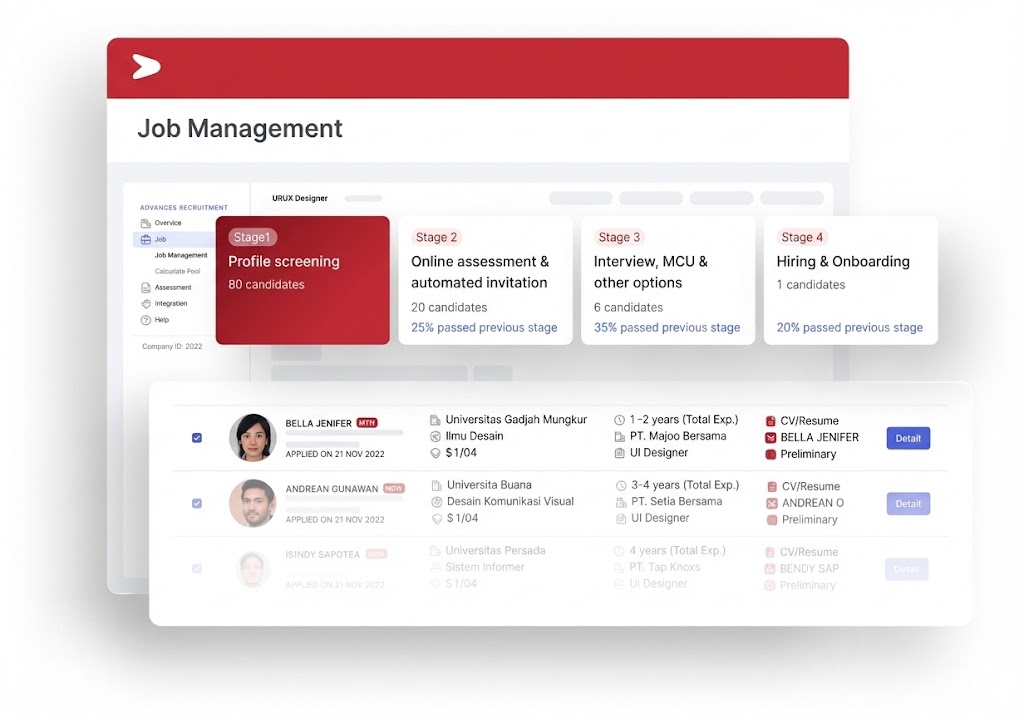
Accelerate Hiring with AI-Powered Talent Acquisition Software by Mekari Talenta
An integrated HCM platform with AI-powered talent acquisition software designed to help organizations streamline large-scale hiring, automate candidate screening, accelerate recruitment workflows, and connect hiring directly with onboarding, workforce management, and employee training within one connected system.
Reference
Frequently Asked Questions (FAQs)
How can HR improve hiring quality across multiple departments?
How can HR improve hiring quality across multiple departments?
Hiring quality usually improves when organizations standardize interview frameworks, competency models, and candidate evaluation criteria across teams. Many HR leaders also implement structured interviewer training to reduce inconsistent assessments between hiring managers. Post-hiring analysis is equally important because retention outcomes, performance progression, and manager feedback often reveal weaknesses in earlier recruitment stages. Organizations with stronger hiring quality typically treat talent acquisition as part of broader workforce planning rather than isolated recruitment activity.
Why do many organizations still struggle with high attrition after hiring?
Why do many organizations still struggle with high attrition after hiring?
High attrition often originates from mismatched hiring expectations, weak manager alignment, unrealistic workload assumptions, or limited career visibility after onboarding. In many cases, compensation remains competitive, yet employees still leave because of poor leadership experience, burnout, or unclear growth pathways. HR teams increasingly analyze early turnover patterns to identify recurring hiring issues connected to specific departments or management structures. Stronger collaboration between talent acquisition, leadership, and workforce development teams usually helps reduce these risks over time.
How can HR balance hiring speed with candidate quality?
How can HR balance hiring speed with candidate quality?
Faster hiring processes do not automatically reduce hiring quality when workforce planning and talent pipelines are managed proactively. Many organizations improve hiring speed by maintaining pre-qualified candidate pools, simplifying approval workflows, and strengthening alignment between recruiters and hiring managers before recruitment begins. Structured assessments also help accelerate decision-making because evaluation criteria become clearer and more consistent. Delayed hiring often creates greater workforce risk than carefully managed recruitment acceleration.
What role does workforce analytics play in talent acquisition?
What role does workforce analytics play in talent acquisition?
Workforce analytics helps HR teams identify hiring bottlenecks, turnover risks, workforce gaps, sourcing effectiveness, and long-term hiring outcomes more accurately. Many organizations now rely on recruitment analytics to forecast future hiring demand and evaluate whether hiring strategies support business priorities effectively. Talent acquisition decisions increasingly depend on data visibility rather than intuition alone, especially when managing large-scale workforce planning across multiple functions. Analytics also supports better succession readiness and workforce capability planning.