

A Guide to Performance Appraisal: Frameworks for Strategic Excellence


- Performance appraisal is a structured process used to evaluate employee contributions, behaviors, and results over a defined period.
- For example, a sales manager may be assessed based on revenue targets, pipeline conversion, and how they develop their team.
Performance rarely fails due to lack of effort. It breaks down when expectations are unclear, feedback is inconsistent, and decisions rely too heavily on perception rather than evidence.
As teams scale across functions and geographies, maintaining fairness and alignment in evaluating performance becomes significantly more complex.
Small inconsistencies at the manager level can quickly compound into disengagement, misaligned incentives, and leadership gaps.
This is where a well-structured appraisal system becomes a critical operating mechanism, not just an administrative process.
This article will break down how performance appraisals actually work in practice and how to execute them effectively.
What Is a Performance Appraisal?
A performance appraisal is a structured evaluation process used to assess an employee’s contributions, behaviors, and outcomes over a defined period.
In practice, it functions as a decision-making framework that connects day-to-day performance with broader business priorities, ensuring that individual efforts translate into measurable organizational impact.
In mature environments, performance appraisals extend beyond annual reviews. They are embedded into a continuous performance cycle that includes goal setting, periodic check-ins, real-time feedback, and formal evaluation. The objective is to create clarity around expectations while maintaining alignment with evolving business needs.
A well-designed appraisal process typically combines quantitative metrics and qualitative insights. Quantitative data may include target achievement, productivity indicators, or project delivery timelines.
On other hand, qualitative evaluation focuses on leadership behaviors, collaboration, problem-solving, and adaptability.
Increasingly, organizations rely on people analytics to reduce subjectivity, using performance data trends to inform more consistent and evidence-based evaluations.
Benefits of Performance Appraisals
When implemented with discipline and consistency, performance appraisals become a central mechanism for aligning execution, strengthening accountability, and sustaining workforce quality over time.
They influence far more than individual performance, shaping retention, capability building, and leadership effectiveness.
Below are the key benefits observed in well-run appraisal environments:
1. Strengthens Employee Engagement and Retention
A structured appraisal process creates clarity, recognition, and direction, which are the three drivers most closely tied to employee engagement.
This also has direct implications for employee retention.
In practice, the impact is visible during calibration cycles. Teams with consistent feedback rhythms tend to have fewer regrettable exits and more internal mobility.
This is where performance appraisal connects directly with employee turnover reduction and long-term workforce stability.
2. Improves Performance Through Clear Accountability
Performance appraisals establish a transparent link between expectations and outcomes. Employees understand what success looks like and how it is measured.
This is where performance appraisal frameworks become effective. When embedded into the appraisal cycle, they shift conversations from subjective opinions to measurable outcomes, reducing ambiguity and performance drift across teams.
3. Enables Targeted Talent Development
One of the most underutilized benefits of performance appraisals is the ability to systematically identify capability gaps and growth potential.
Organizations that operationalize this well typically connect appraisal outcomes directly into talent development initiatives, including structured training paths and succession pipelines.
At an operational level, this is where tools such as a learning management system and a clearly defined individual development plan become critical. Without this linkage, appraisal insights remain diagnostic rather than actionable.
Read also: How to Improve Employee Satisfaction: Strategies and Benefits
4. Supports Better Workforce Planning Decisions
Performance data accumulated over time provides a reliable foundation for workforce decisions, from promotions to restructuring.
Appraisal outcomes help identify high performers, underperformers, and critical skill gaps. This insight feeds directly into strategic activities such as employee recruitment, succession planning, and leadership pipeline development.
A recurring pattern in large-scale organizations is that weak appraisal systems lead to reactive hiring and inconsistent leadership quality.
Strong systems, on the other hand, enable proactive workforce shaping based on real performance evidence rather than perception.
5. Enhances Organizational Credibility and Employer Value
Consistency and fairness in performance evaluations have a measurable impact on how employees perceive the organization.
Over time, this contributes to stronger employer branding, particularly in competitive talent markets.
Candidates increasingly evaluate how performance is managed before accepting offers, and internal employees often reference appraisal quality during an exit interview.
Organizations that maintain rigorous, data-backed appraisal practices tend to build a reputation for fairness and growth, which becomes a long-term differentiator in attracting and retaining high-quality talent.
How Performance Appraisal Works
In practice, a performance appraisal is not a single event. It is an operating cycle that runs continuously throughout the year, with formal checkpoints layered on top.
When executed well, it creates a rhythm where expectations, feedback, and decisions are tightly connected. Below is how the process works in real-world execution:
1. Goal Setting and Alignment at the Start of the Cycle
The cycle begins with defining clear, measurable goals that are directly tied to business priorities. This is where many organizations fail, because the goals are too generic or disconnected from actual outcomes.
Effective teams translate company priorities into team-level deliverables, then cascade them into individual targets. Frameworks like objective key results are often used here to ensure clarity and measurability.
To ensure goal setting is structured and consistently executed, many companies now leverage performance management software like Mekari Talenta to define measurable targets, align them across teams, and track progress in real time.
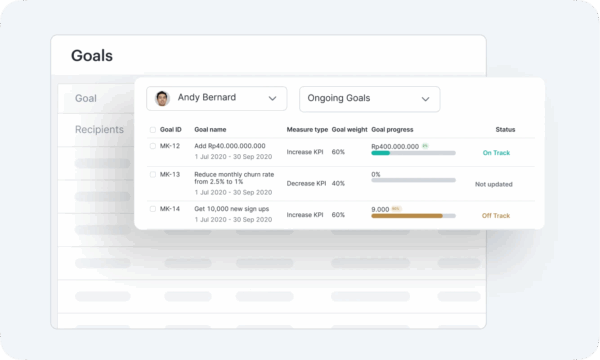
At this stage, experienced managers focus on two things that are often overlooked:
- First, they define what success looks like in concrete terms, including timelines and trade-offs.
- Second, they align expectations early to avoid misinterpretation later. Misalignment at this stage is one of the biggest root causes of dispute during performance reviews.
Read also: OKR vs KPI: Key Differences, Examples & When to Use
2. Continuous Check-ins and Real-Time Feedback
Once the cycle is in motion, performance management shifts into an ongoing dialogue rather than a passive observation period.
High-performing teams typically run monthly or quarterly check-ins. These sessions are not status updates. They are focused conversations around progress, blockers, and behavioral observations.
Managers who do this well document key moments, both positive and negative, instead of relying on memory at the end of the cycle.
In more advanced setups, performance management system is used to capture feedback, track progress, and maintain visibility across teams. This reduces dependency on manual tracking and minimizes bias caused by recency effects.
A consistent pattern seen in the field is that teams with structured check-ins experience fewer surprises during formal reviews. Employees already know where they stand.
3. Mid-Cycle Calibration and Course Correction
Mid-cycle reviews act as a control mechanism. This is where managers assess whether goals remain relevant and whether performance is tracking as expected.
In dynamic business environments, priorities shift. Strong appraisal processes allow for recalibration without penalizing employees for changes outside their control.
This stage often includes cross-team calibration discussions, especially for roles that operate across functions. Leaders compare performance standards, challenge rating assumptions, and ensure consistency. Without this step, rating inflation and inconsistency across teams become almost inevitable.
Read also: What Is Performance Review Calibration?
4. Formal Evaluation and Rating Process
At the end of the cycle, all documented inputs are consolidated into a formal evaluation. This includes goal achievement, behavioral assessment, and peer or stakeholder feedback where applicable.
Most organizations follow a structured flow:
- Employee self-assessment to reflect on achievements and challenges
- Manager evaluation based on documented evidence
- Calibration sessions to validate fairness across teams
- Final rating and justification
What differentiates mature organizations is the level of evidence used. Decisions are rarely based on isolated outcomes.
Instead, they rely on patterns of performance over time, supported by documented feedback and measurable results.
5. Performance Discussion and Development Planning
The final step is the performance conversation, which carries more weight than the rating itself. This is where managers translate evaluation outcomes into actionable direction.
Strong managers approach this discussion with clarity and specificity. They highlight what drove success, where improvement is required, and what needs to change moving forward.
This is also where performance appraisal connects directly to growth. Outcomes are translated into a concrete individual development plan, outlining skills to build, experiences to gain, and support required.
In parallel, appraisal results feed into broader processes such as promotions, compensation adjustments, and succession planning.
Over time, this creates a system where performance data consistently informs workforce decisions rather than isolated judgment calls.
Types of Performance Appraisals
Different types of performance appraisals provide alternative lenses for evaluating contribution, behavior, and impact.
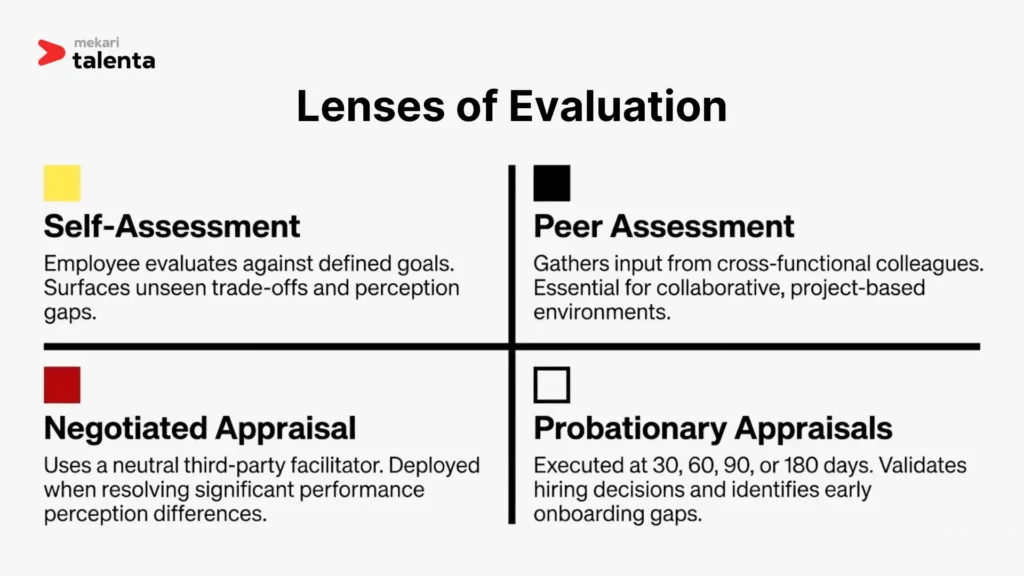
Here are some commonly used types:
1. Self-Assessment
A self-assessment requires employees to evaluate their own performance against defined goals and expectations.
This method is often used to encourage structured reflection before formal reviews. It helps surface context that may not be visible in performance data, such as trade-offs, constraints, or behind-the-scenes contributions. It also highlights perception gaps, which become useful discussion points during evaluation.
2. Peer Assessment
Peer assessment gathers input from colleagues who work closely with the individual on a day-to-day basis.
This is particularly effective in collaborative environments where performance is shaped by cross-functional interaction.
For example, project-based teams often rely on peer input to assess contribution quality, communication, and reliability, areas that are not always visible to direct managers.
3. Negotiated Appraisal
A negotiated appraisal introduces a neutral third party to facilitate the performance discussion between manager and employee.
It is typically used in situations where there is a significant difference in how performance is perceived, or when previous reviews have led to disagreement. The facilitator helps both sides align on evidence, clarify expectations, and reach a shared conclusion.
4. Probationary Appraisals
Probationary appraisals evaluate performance during the early stages of employment, commonly within the first 30, 60, 90, or 180 days.
They are used to assess initial fit, validate hiring decisions, and identify early development needs. In many cases, this stage is closely tied to employee onboarding, where structured feedback ensures new hires adapt effectively to role expectations and team dynamics.
Method of Performance Appraisals Commonly Used
Different roles, functions, and maturity levels require different appraisal approaches. In practice, most organizations do not rely on a single method. They combine several models to balance objectivity, behavioral insight, and business outcomes.
Below are seven of the most commonly used performance appraisal methods:
1. Management by Objectives (MBO)
Management by objectives evaluates performance based on the achievement of predefined goals over a specific period. It is most effective in roles where outputs can be clearly measured and directly tied to business impact.
In practice, MBO works particularly well for sales, marketing, and product functions. For example, a regional sales lead may be evaluated based on revenue targets, pipeline conversion rates, and expansion into new accounts. In these cases, performance conversations are grounded in tangible outcomes rather than subjective judgment.
However, there are trade-offs. MBO tends to underrepresent behavioral factors such as collaboration, leadership, or long-term capability building. Employees may focus heavily on hitting targets while overlooking how those results are achieved.
Because of these limitations, many organizations combine MBO with behavioral or feedback-based methods to create a more balanced evaluation.
2. Behaviorally Anchored Rating Scales (BARS)
BARSevaluates performance using a scoring system that is tied to specific, observable behaviors. Each rating level is supported by clear examples, so managers assess what employees actually do rather than relying on general impressions.
BARS works best in roles where behavior quality directly impacts outcomes. For example, a customer support lead may be evaluated based on how they handle escalations, communicate under pressure, or resolve complex issues.
In these cases, defining what “strong” or “weak” performance looks like in behavioral terms significantly improves clarity.
However, BARS requires significant upfront effort. Defining accurate behavioral indicators for each role takes time and input from experienced leaders. If not maintained, the behaviors can become outdated as roles evolve.
3. 360-Degree Feedbacksz
360-degree feedback gathers performance input from multiple perspectives, typically including managers, peers, direct reports, and occasionally cross-functional stakeholders.
It is designed to surface patterns that are not always visible in a single reporting line, especially in roles that rely heavily on influence rather than authority.
This approach is most valuable for leadership and matrix-based roles. For instance, a country manager working across functions may deliver strong business results, but peer feedback might reveal gaps in alignment or decision transparency.
In day-to-day execution, effective 360 processes are tightly structured. Questions are focused on specific competencies, responses are anonymized, and feedback is aggregated into themes rather than isolated comments. Without this structure, feedback tends to become either overly cautious or disproportionately critical.
The main risk lies in interpretation. Not all feedback carries equal weight, and without proper context, it can lead to confusion or defensive reactions. Another common issue is feedback fatigue when surveys are too frequent or too broad.
4. Self-Assessment
Self-assessment invites employees to evaluate their own performance against defined goals and expectations before the formal review. It is commonly used as an input layer rather than a standalone evaluation method.
This approach works well to surface how employees perceive their contributions. For example, a marketing manager may highlight campaign impact, trade-offs made during execution, and constraints that were not fully visible to leadership. This context often fills gaps that raw performance data cannot capture.
The limitation is consistency. Without clear guidance, responses can become overly subjective or generic. Strong organizations address this by providing structured prompts and requiring evidence-based input, ensuring self-assessments remain grounded and useful.
5. Rating Scales
Rating scales are built for comparability. They translate performance into a standardized score, making it easier to review large groups of employees within a consistent framework.
You will typically see this method used during company-wide review cycles where leadership needs a clear distribution of performance.
For example, a finance function may use a 1 to 5 scale across dimensions like accuracy, timeliness, and stakeholder management.
When aggregated, these scores allow leaders to quickly spot patterns such as teams that consistently overperform or areas where performance is uneven.
That said, the quality of output depends heavily on how the scale is defined and enforced. If a rating of “3” means something different across teams, the entire system loses credibility.
6. Critical Incident Method
This method focuses on documenting specific employee behaviors that have a meaningful impact on outcomes, both positive and negative, throughout the review period.
Managers record key moments as they happen. For example, how a team lead handled a high-stakes client escalation, or how an individual contributor resolved a major operational issue under pressure. These incidents become concrete evidence during evaluation, reducing reliance on memory.
This method works best in roles where situational judgment and decision-making are critical. It brings depth into performance discussions by anchoring feedback in real events rather than general impressions.
7. Continuous Performance Management
This model shifts away from annual reviews toward ongoing feedback, regular check-ins, and dynamic goal adjustments.
It reflects how modern teams operate, especially in fast-moving environments. Continuous performance management improves responsiveness and reduces the risk of misalignment.
Organizations that adopt this model often integrate it with real-time tracking tools and feedback systems, creating a more adaptive and transparent performance culture.
Performance Appraisal Examples
Looking at how leading companies actually run performance appraisals gives a clearer picture of what works in practice.
These examples show how different approaches are applied, including what they optimize for and the trade-offs involved.
Example 1: Netflix – Continuous Feedback and “Keeper Test”
Netflix moved away from traditional annual reviews and replaced them with continuous, candid feedback supported by periodic 360 input.
Managers regularly assess performance through what is internally known as the “keeper test”, asking whether they would actively try to retain an employee. If the answer is no, action is taken quickly, often with generous severance.
This creates a very high-performance environment. Employees receive frequent, direct feedback and always understand where they stand. It also reduces long-term underperformance because decisions are not delayed until year-end cycles.
The trade-off is intensity. This model requires strong managerial maturity and a culture that can handle direct feedback without disengagement. Without that foundation, it can create anxiety rather than clarity.
Example 2: Google – Data-Driven and Feedback-Rich Reviews
Google combines goal-based evaluation with structured feedback and strong emphasis on psychological safety. Regular feedback loops and data-backed evaluation help create a more objective review process.
In execution, managers evaluate employees based on goal achievement, peer input, and behavioral indicators. Calibration sessions play a major role to ensure consistency across teams.
What stands out is the use of data to support decisions. Performance is rarely discussed without evidence, which reduces bias and strengthens trust in the system.
The limitation is complexity. This approach requires strong infrastructure, disciplined documentation, and managers who are trained to interpret both qualitative and quantitative inputs.
Read also: Data-Driven HR: Definition, Benefits, and Practical Implementation
Example 3: Cargill – Everyday Performance Management
Cargill replaced traditional annual reviews with a model focused on continuous conversations between managers and employees.
Instead of relying on one formal review, performance discussions happen regularly throughout the year. This shift led to around 70% of employees feeling more valued after implementation.
In practice, this approach works well in environments where operational performance needs to be monitored consistently. It reduces surprises and allows faster course correction.
The main challenge is consistency. Without strong discipline, frequent conversations can become informal and lose evaluative depth.
Performance Appraisal Keywords and Phrases
The quality of a performance appraisal is often reflected in how clearly feedback is articulated. Vague language leads to misinterpretation, while precise wording improves alignment, accountability, and follow-through.
| Purpose | Example Phrase |
|---|---|
| Performance Outcome | “Consistently exceeded quarterly targets” |
| Behavior | “Demonstrates strong cross-functional collaboration” |
| Improvement | “Needs to strengthen prioritization and execution consistency” |
| Strength | “Builds trust quickly with stakeholders” |
| Development | “Should focus on expanding leadership scope” |
Below are commonly used keywords and phrases that strengthen performance discussions:
Describing Performance Outcomes
These phrases help anchor evaluations in measurable results and observable impact:
- “Consistently exceeded quarterly targets with sustained performance across periods”
- “Delivered results aligned with agreed priorities and timelines”
- “Met expectations in core responsibilities with stable output quality”
- “Performance fell short of defined targets in key areas”
- “Demonstrated strong ownership in driving business outcomes”
Evaluating Behaviors and Work Approach
Behavioral feedback provides context on how results are achieved:
- “Demonstrates strong collaboration across cross-functional teams”
- “Shows initiative in identifying and solving problems proactively”
- “Communicates effectively with stakeholders at different levels”
- “Requires improvement in prioritization and time management”
- “Adapts well to changing priorities and business needs”
Giving Constructive Feedback
Constructive feedback should be direct, specific, and focused on improvement:
- “Would benefit from more structured planning to improve execution consistency”
- “Needs to strengthen stakeholder alignment during project initiation”
- “Should improve follow-through on agreed action items”
- “Opportunity to develop stronger decision-making in ambiguous situations”
Highlighting Strengths
Recognizing strengths reinforces behaviors that should be sustained:
- “Demonstrates strong analytical thinking and attention to detail”
- “Builds trust quickly with both internal and external stakeholders”
- “Consistently takes ownership beyond defined responsibilities”
- “Acts as a reliable contributor in high-pressure situations”
Framing Development and Next Steps
Performance conversations should always translate into forward-looking direction:
- “Next phase of development should focus on expanding leadership scope”
- “Recommended to take on more complex projects to build strategic capability”
- “Development focus includes improving cross-functional communication”
- “Progress will be tracked through defined milestones in the next cycle”
Best Practices for a Strong Performance Appraisal Process
A strong performance appraisal process is built through discipline in execution rather than policy design. Many organizations already have the right framework in place, yet the outcomes remain inconsistent due to gaps in alignment, documentation, and managerial capability.
Below are practices that consistently differentiate high-quality appraisal systems from those that struggle to deliver impact:
1. Anchor Evaluations in Evidence, Not Memory
The most common failure point in performance reviews comes from overreliance on end-of-cycle recall. Managers tend to remember recent events or highly visible outcomes, which distorts the overall assessment.
Strong systems enforce continuous documentation. Managers capture key achievements, missed expectations, and behavioral observations throughout the cycle. This creates a performance narrative based on patterns rather than isolated moments.
In practice, teams that maintain structured documentation produce more defensible evaluations and experience fewer disputes during review discussions.
2. Separate Performance Discussion from Compensation Decisions
When performance ratings and compensation outcomes are discussed in the same conversation, the focus often shifts toward justification rather than development.
Experienced organizations split these conversations. The performance discussion is used to evaluate contribution, provide feedback, and align on future expectations. Compensation discussions are handled separately with clear rationale tied to broader policies.
This separation leads to more constructive dialogue and reduces defensiveness, allowing managers to address performance gaps with greater clarity.
3. Standardize Calibration Across Teams
Consistency across managers is one of the hardest challenges to solve. Without calibration, similar levels of performance can receive very different ratings depending on the evaluator.
Effective calibration requires structured forums where leaders review and challenge each other’s assessments. The discussion focuses on evidence, impact, and relative contribution rather than individual opinion.
A practical approach often includes:
- Reviewing top and bottom performers first to establish benchmarks
- Comparing similar roles across different teams
- Requiring justification for outlier ratings
Over time, this builds a shared standard of what strong performance looks like.
4. Build Manager Capability as a Core Priority
The quality of any appraisal system ultimately depends on how managers execute it. Even well-designed processes fail when managers lack the ability to assess performance objectively or communicate feedback effectively.
High-performing organizations invest heavily in manager training. This includes how to set clear expectations, document performance, handle difficult conversations, and translate feedback into actionable direction.
One pattern seen in the field is that teams led by well-trained managers consistently show higher alignment, stronger performance outcomes, and fewer escalations during review cycles.
5. Connect Appraisal Outcomes to Development Actions
Performance evaluations lose impact when they stop at ratings. The real value comes from translating insights into concrete next steps.
Strong processes link appraisal outcomes directly to development actions such as role expansion, targeted training, or stretch assignments.
For example, an employee identified with strong potential but gaps in stakeholder management may be assigned to cross-functional projects or leadership exposure programs. This ensures that feedback leads to measurable growth rather than static documentation.
6. Integrate Data and Systems for Consistency
Manual processes introduce fragmentation, especially when multiple teams operate across different locations or functions.
Organizations that scale performance management effectively rely on integrated systems to track goals, feedback, and evaluation outcomes in one place. This improves visibility, supports calibration, and ensures consistency in how data is used during reviews.
Over time, this data becomes a valuable asset for broader decisions, including succession planning and workforce strategy, enabling more informed and consistent talent decisions across the organization.
Turning Performance Appraisal into Actionable Talent Decisions with Mekari Talenta
Managing performance appraisals is not only about completing evaluation cycles, but also ensuring that results are translated into clear, structured actions such as promotion, development planning, or retention strategies.
Without a structured system, many organizations struggle to move beyond appraisal results. Performance data often sits unused, calibration is inconsistent across teams, and there is limited visibility into how decisions are made.
These challenges lead to misaligned ratings, unclear follow-up actions, and missed opportunities to optimize talent potential.
To address this, companies can leverage Mekari Talenta as an AI-powered, cloud-based HCM software that manages the employee lifecycle end to end, from HR administration, attendance tracking, payroll, to performance management and talent development.
Through its Performance Management feature, Mekari Talenta enables organizations to run structured evaluations and turn appraisal data into actionable talent decisions.
With Mekari Talenta companies can:
- Define customized performance metrics and evaluation indicators based on roles, competencies, or business goals, and set who participates in the evaluation process, including managers, peers, or 360-degree reviewers
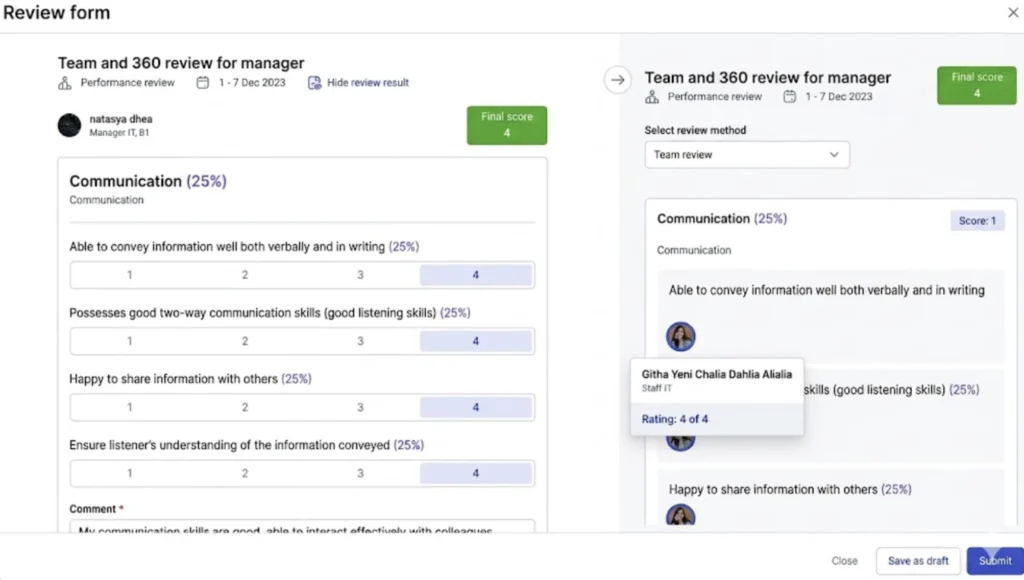
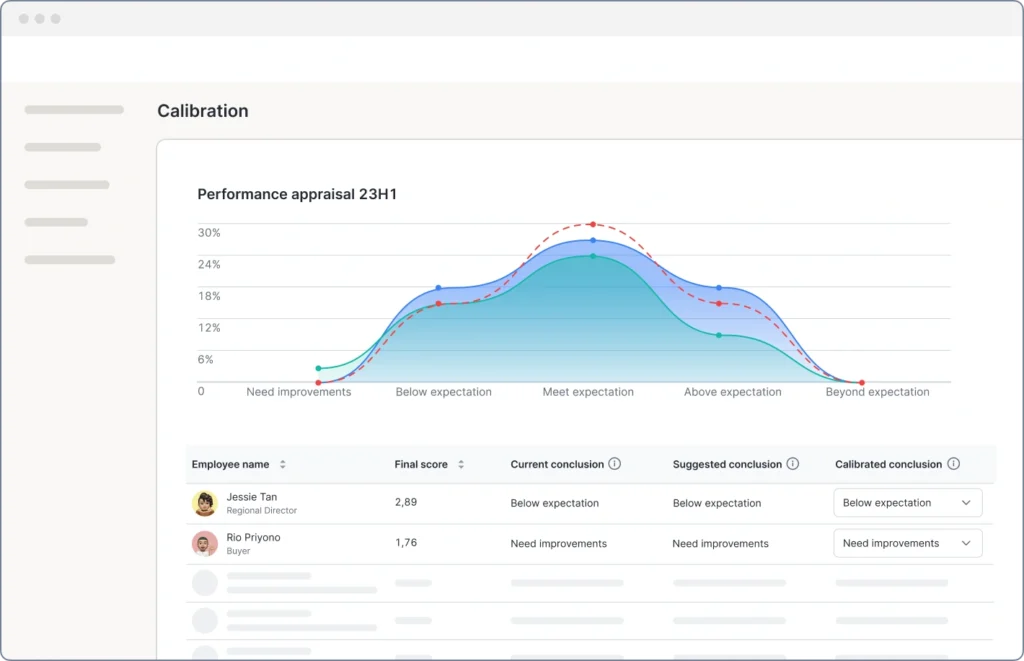
- Conduct structured calibration processes to ensure fair and consistent performance ratings across teams
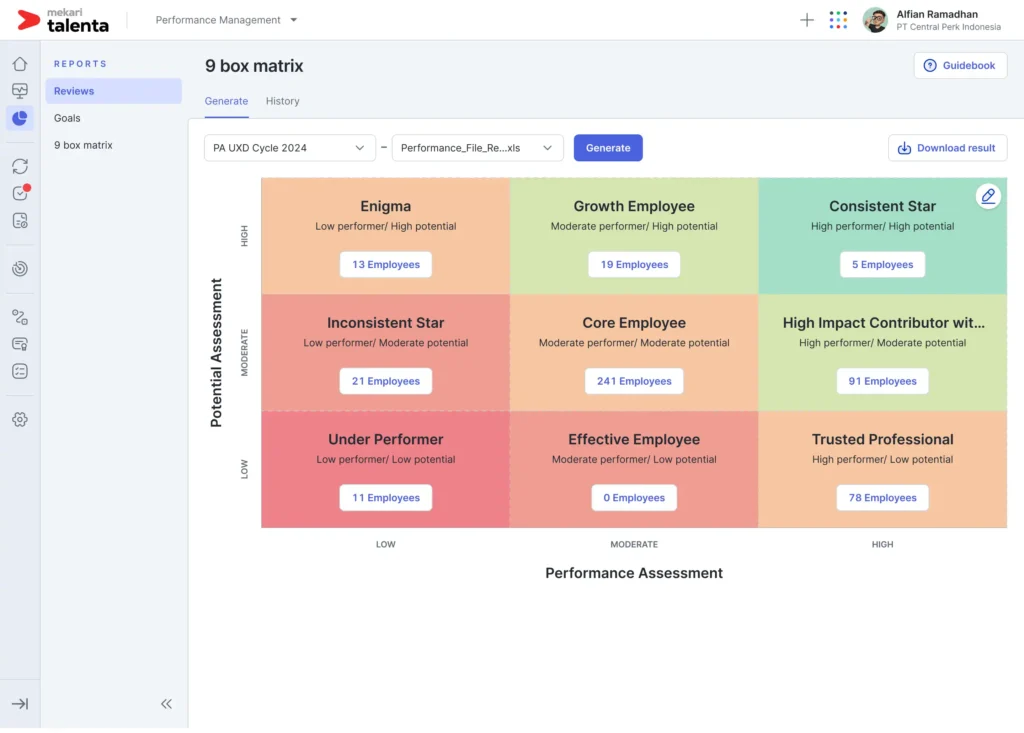
- Visualize employee performance and potential using the 9-Box Matrix for clearer talent mapping
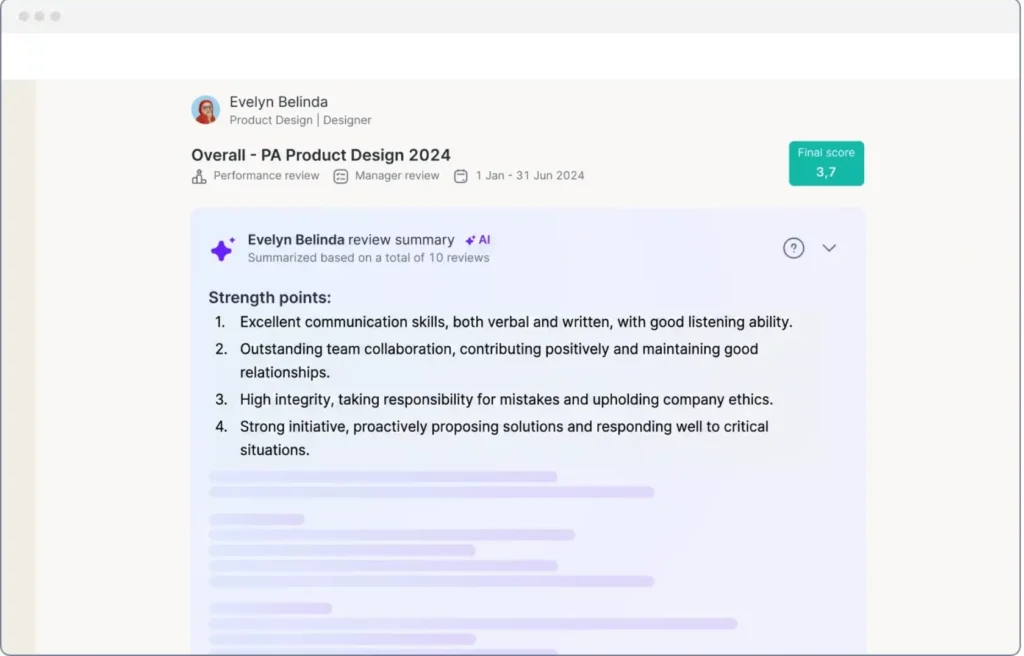
- Generate AI-powered review summaries to improve consistency and reduce manual effort
This performance management module can also be implemented as a standalone solution, allowing companies to adopt structured appraisal, calibration, and talent mapping without replacing their existing HR systems.
With a centralized performance appraisal system, organizations gain better visibility into talent performance, can identify high-potential employees more accurately, and ensure that appraisal outcomes lead to measurable business impact.
Interested in exploring how Mekari Talenta can support your performance appraisal strategy?
Schedule a free demo with our team and discover how a structured, AI-powered approach can make your performance reviews more objective, actionable, and scalable.
Reference
Netflix CTO says the company has no ‘formal performance reviews’ – Business Insider
18 Performance Review Ideas from Google, Netflix, and Other Top Companies – Uptick
Frequently Asked Questions (FAQs)
How often should performance appraisals be conducted?
How often should performance appraisals be conducted?
Most organizations maintain an annual cycle for formal evaluation, supported by quarterly or monthly check-ins. The frequency depends on how fast priorities shift within the business. Teams operating in dynamic environments benefit from shorter feedback cycles to maintain alignment. The key is consistency rather than frequency alone.
What is the difference between performance appraisal and performance review?
What is the difference between performance appraisal and performance review?
A performance review typically refers to the discussion itself, where feedback and evaluation are communicated. Performance appraisal is the broader system that includes goal setting, tracking, evaluation, and decision-making. The review is one component within the overall appraisal cycle. Confusing the two often leads to incomplete implementation.
How do you ensure fairness in performance appraisals?
How do you ensure fairness in performance appraisals?
Fairness is achieved through three core elements: clear criteria, documented evidence, and calibration across managers. Without these, ratings become highly subjective and inconsistent. Regular calibration sessions help align standards across teams. Strong systems also rely on data trends rather than isolated outcomes.
What are common mistakes in performance appraisals?
What are common mistakes in performance appraisals?
The most common issues include unclear goal setting, lack of documentation, and overreliance on recent performance. Another frequent problem is inconsistent standards across managers, which leads to rating inflation or compression. Many organizations also fail to translate feedback into actionable development plans. These gaps reduce both credibility and impact.
How can technology improve performance appraisal processes?
How can technology improve performance appraisal processes?
Apa keuntungan dari menerapkan performance appraisal di perusahaan?
Apa keuntungan dari menerapkan performance appraisal di perusahaan?
Keuntungan dari performance appraisal antara lain mendorong karyawan untuk berprestasi lebih baik, memberikan penghargaan bagi karyawan yang berkinerja tinggi, serta membantu perusahaan dalam memetakan potensi sumber daya manusia yang ada.
Apa saja risiko yang mungkin muncul dari performance appraisal yang tidak objektif?
Apa saja risiko yang mungkin muncul dari performance appraisal yang tidak objektif?
Performance appraisal yang tidak objektif dapat menimbulkan beban moral bagi karyawan, memicu protes jika prosedur penilaian dianggap tidak adil, dan menciptakan iklim kerja yang tidak kondusif akibat adanya ketidakpuasan di antara karyawan.