
Employee Onboarding: Process, Best Practices & Guide


-
Employee onboarding is a process that helps new hires adapt to the work environment, understand company culture, and perform their responsibilities effectively.
-
Examples of onboarding programs include company orientation, job training, buddy or mentoring programs, as well as onboarding evaluations to ensure employees can adapt successfully.
In many organizations, hiring the right talent is only half the equation, while the real challenge lies in how quickly that talent becomes effective.
New hires often enter environments where priorities are shifting, stakeholders are complex, and expectations are not always explicitly defined.
Without a structured onboarding approach, even highly capable employees can spend months navigating uncertainty instead of delivering impact. This creates hidden costs in the form of delayed productivity, misalignment, and avoidable attrition.
This article will explore how to design onboarding that drives clarity, accelerates contribution, and sustains long-term performance.
What Is Employee Onboarding?
Employee onboarding is a structured process that ensures a new hire transitions into the organization with clarity, confidence, and the ability to contribute meaningfully in the shortest reasonable time.
It goes far beyond administrative orientation. Effective onboarding connects business priorities with role expectations, team dynamics, and cultural alignment, creating a strong foundation for long-term performance.
In practice, onboarding begins before the first day and continues through the first several months. Pre-boarding activities often include access to essential systems, an overview of organizational context, and early communication with managers.
Once the employee starts, onboarding focuses on clarifying success metrics such as KPI (Key Performance Indicators), aligning expectations with stakeholders, and embedding the individual into formal and informal networks.
High-performing organizations design onboarding as an integrated journey, allowing consistent experiences across functions and geographies.
This includes structured check-ins, role-specific training pathways, and early feedback loops that surface risks before they impact performance or engagement.
A well-executed onboarding process directly influences retention, productivity, and internal mobility. It reduces early-stage employee turnover by addressing uncertainty and misalignment early, while also reinforcing the organization’s employer branding through a cohesive and professional first impression.
The Purpose of Employee Onboarding
The purpose of onboarding is to compress the gap between hiring decision and sustained performance.
It ensures that a new hire does not spend their first months navigating ambiguity, informal power structures, or unclear expectations, which are the most common causes of early disengagement in large, matrixed environments.
1. Translating Business Priorities into Executable Work
Onboarding operationalizes strategy at the individual level. Many new hires struggle not because of capability gaps, but because success criteria are implied rather than explicitly defined.
Strong onboarding breaks down priorities into concrete deliverables, timelines, and decision boundaries, ensuring alignment between managers and new hires from the start. This clarity prevents over-engineering, duplicated efforts, and misaligned expectations across stakeholders.
2. Reducing Time Lost to Informal Navigation
A reality often underestimated is how much time new hires spend figuring out how things actually work. Org charts rarely reflect real influence, and formal processes often differ from day-to-day execution.
Effective onboarding reduces this friction by mapping key stakeholders, clarifying decision flows, and exposing informal norms early. This allows new hires to operate with confidence instead of hesitation.
3. Building Credibility in the First 90 Days
Early perception tends to stick. Onboarding should be designed to create meaningful early wins that are visible and relevant to the business.
This requires deliberate sequencing of work, where initial contributions demonstrate value without being overly dependent on complex coordination. When this is missed, even strong hires can be perceived as slow or misaligned, which is difficult to reverse later.
4. Creating a Structured Feedback Environment
New hires rarely receive direct, actionable feedback unless it is intentionally built into the process. Effective onboarding introduces regular, low-friction check-ins that surface gaps in understanding, working style mismatches, and expectation misalignment.
Over time, these patterns can be aggregated through people analytics to identify systemic onboarding issues across teams and geographies, rather than treating each case as isolated.
5. Protecting Long-Term Engagement and Stability
A significant portion of early disengagement is driven by mismatched expectations that were never clarified. Onboarding provides the space to align role reality with initial perceptions while giving employees enough context to make informed decisions about their fit.
When executed well, it stabilizes engagement early and prevents avoidable attrition patterns that often emerge within the first year.
Why is employee onboarding important?
Employee onboarding plays a direct role in determining whether a new hire becomes productive, engaged, and retained, or remains misaligned and eventually exits.
Data consistently shows that onboarding influences performance, retention, and even revenue outcomes within the first year. Below are the key reasons why it matters.
1. Directly Impacts Retention and Early Attrition
The first months of employment are the highest-risk period for attrition, and onboarding is the primary variable within control.
This highlights that early attrition is rarely about compensation or capability. It is driven by confusion, poor integration, and weak early experiences that onboarding is meant to address.
2. Accelerates Productivity at a Measurable Scale
Onboarding determines how quickly a new hire reaches expected performance levels.
In operational terms, this means shorter ramp-up time, fewer performance gaps, and less dependency on managers to continuously course-correct.
3. Protects the ROI of Employee Recruitment
Significant investment goes into employee recruitment, yet without effective onboarding, that investment is exposed to immediate risk.
Poor onboarding has been linked to substantial productivity losses, including cases where ineffective onboarding programs resulted in millions in lost output.
Read also: Employee Recruitment Strategy: A Guide for Modern HR Teams
4. Shapes Engagement and Long-Term Commitment
Onboarding influences how employees perceive the organization and their role within it. Employees who go through effective onboarding are more likely to feel committed to their organization, which directly impacts discretionary effort and long-term contribution.
This gap is where most organizations lose momentum. Onboarding is often designed as a checklist, while its actual impact comes from how well it aligns expectations, builds confidence, and integrates individuals into real workflows.
Employee Onboarding Process
An effective onboarding process is designed as a phased journey that aligns business priorities, role expectations, and capability building over time.
It is not a single event, but a structured sequence that reduces ambiguity, accelerates contribution, and ensures consistency across teams.
Below is how a well-executed onboarding process is typically structured in practice, along with what should actually be done at each stage.
Pre-boarding: Securing Early Alignment Before Day One
The process begins once the offer is accepted. At this stage, the focus is on removing first-day friction and setting early expectations.
In practice, what works is not simply sending documents, but providing directional clarity:
- Share a concise 30–60–90 day expectation outline, even if it is still flexible
- Introduce key stakeholders with context on why they matter, not just who they are
- Provide access to essential tools and a high-level walkthrough of how they are used in real workflows
A common mistake is overloading new hires with static materials. What is more effective is giving just enough context to reduce uncertainty while leaving room for guided discovery once they start.
First 30 Days: Building Clarity and Direction
The first month is where most misalignment either gets prevented or silently formed. The goal is to ensure the new hire understands how work actually gets done, not just how it is supposed to work.
What should be prioritized:
- Translate role expectations into specific deliverables and short-term priorities
- Schedule structured weekly check-ins focused on alignment, not just progress
- Encourage shadowing of key meetings to observe decision-making dynamics
At this stage, strong managers avoid assuming understanding. They actively test it by asking new hires to reframe priorities in their own words. This is where hidden gaps usually surface.
30–60 Days: Driving Initial Contribution
This phase is about shifting from observation to ownership. New hires should begin contributing in ways that are visible and relevant.
Execution at this stage should focus on:
- Assigning projects with clear scope but real business impact
- Reducing dependency bottlenecks by clarifying who can unblock decisions quickly
- Creating space for the new hire to propose improvements based on fresh perspective
A frequent oversight is delaying meaningful work until “full readiness.” In reality, early contribution builds confidence and accelerates integration faster than extended learning periods.
60–90 Days: Establishing Independence and Momentum
By the third month, onboarding should transition into performance momentum. The new hire is expected to operate with greater autonomy while still having access to guidance when needed.
What differentiates strong execution:
- Shift check-ins from directive to strategic, focusing on priorities and trade-offs
- Expand scope of ownership to include cross-functional collaboration
- Begin outlining a forward-looking individual development plan based on observed strengths and gaps
Mekari Talenta also supports this phase by enabling managers to structure and monitor individual development plans, making it easier to track progress, align development goals, and ensure continuity between onboarding and long-term growth.
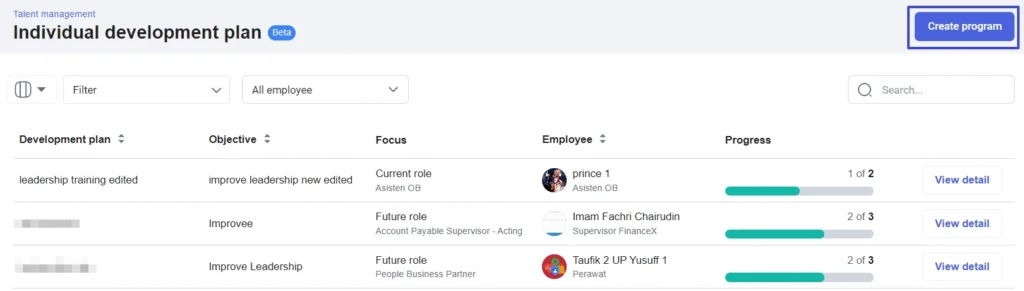
At this point, onboarding is more about setting the trajectory for sustained performance. The quality of this transition often determines whether a new hire remains a steady contributor or evolves into a high-impact talent within the organization.
How to Create an Employee Onboarding Program
Building an onboarding program that consistently delivers results requires more than assembling activities across the first 90 days.
The real challenge lies in designing a system that aligns business priorities, manager capability, and employee experience into a repeatable structure that works across teams and locations.
Below is how an effective onboarding program is built in practice.
1. Start with Role-Based Outcomes, Not Generic Journeys
Most onboarding programs fail because they are designed as one-size-fits-all experiences. In reality, onboarding should be anchored in role-specific outcomes.
Define what success looks like in the first 30, 60, and 90 days for each critical role. This includes expected deliverables, decision scope, and key dependencies.
The more specific this is, the easier it becomes for managers to execute onboarding consistently without reinventing expectations for every new hire.
2. Standardize the Structure, Not the Experience
Consistency does not mean rigidity. Strong onboarding programs standardize the framework, such as timelines, check-in cadence, and core milestones, while allowing flexibility in how managers deliver the experience.
For example, every new hire should go through structured alignment sessions and progress reviews, but the actual work assigned should reflect real team priorities. This balance prevents onboarding from becoming either too generic or too fragmented.
3. Equip Managers to Execute, Not Just HR to Design
One of the most common gaps is assuming onboarding is driven by HR, while in practice, managers determine 80% of the experience. A well-designed program includes clear guidance for managers on what to do, when to do it, and how to assess progress.
This is where many organizations engage KPI consultancy support to refine how success metrics are defined and cascaded into onboarding expectations, ensuring alignment between hiring goals and actual performance outcomes.
4. Build Feedback Loops Into the Program Design
Onboarding should not rely on annual reviews to improve. Effective programs include built-in feedback mechanisms within the first 90 days.
This typically includes structured check-ins, pulse feedback from new hires, and pattern tracking across teams. The goal is to identify recurring friction points, such as unclear expectations or slow decision-making, and address them systematically rather than case by case.
5. Integrate Onboarding With Long-Term Development
Onboarding should not end at 90 days without a clear continuation path. The transition from onboarding to ongoing performance management and growth planning must be intentional.
To bridge the gap between initial orientation and sustained mastery, high-performing organizations leverage a Learning Management System (LMS).
This includes defining the next set of expectations, identifying capability gaps, and linking early performance to longer-term talent development opportunities.
Without this connection, onboarding becomes a disconnected phase rather than the foundation of sustained performance.
6. Use Systems to Ensure Consistency at Scale
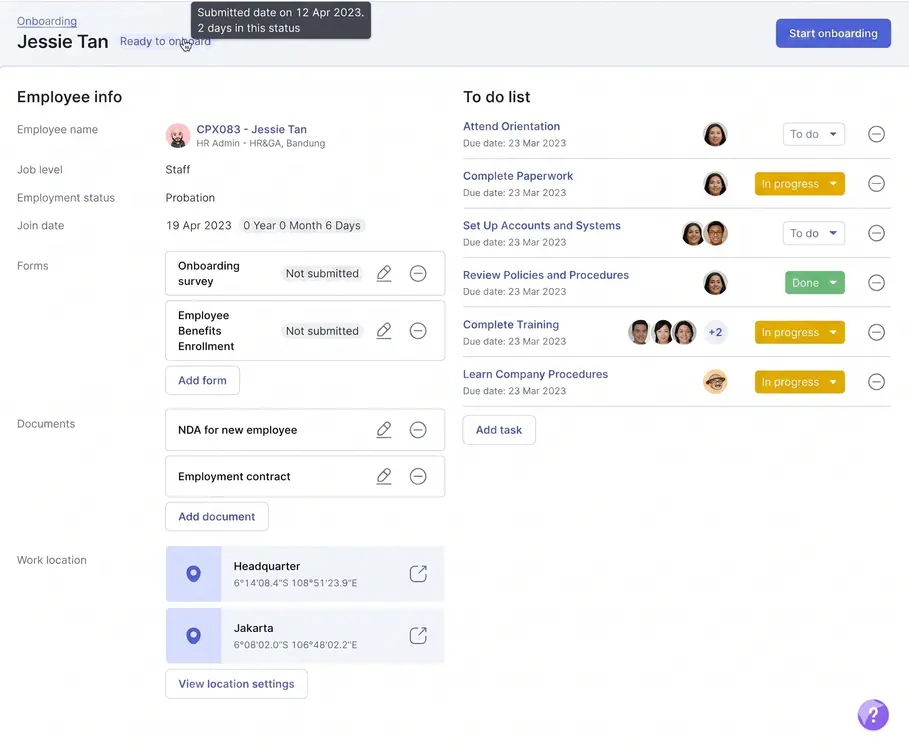
As organizations grow, manual onboarding becomes difficult to sustain. A structured program is typically supported by integrated systems that track progress, standardize workflows, and provide visibility across teams.
These systems ensure that onboarding is not dependent on individual manager styles, but instead follows a consistent baseline while still allowing room for contextual adaptation.
Mekari Talenta supports this through its onboarding capabilities, enabling teams to track onboarding progress in real time, manage task completion across stakeholders, and centralize employee data and documentation within a single system.
Employee Onboarding Checklists
A well-structured onboarding checklist ensures that critical steps are executed consistently while still allowing flexibility for role-specific needs.
The goal is not to create administrative tasks, but to ensure that no essential element of alignment, access, or integration is missed during the onboarding journey.
| Checklist Item | Description | Status |
|---|---|---|
| Offer acceptance confirmation | Ensure all documentation is completed and expectations are reconfirmed post-offer | ☐ |
| Pre-boarding welcome communication | Send structured email including first-day agenda, team intro, and key contacts | ☐ |
| System access provisioning | Grant access to email, HRIS, communication tools, and role-specific platforms | ☐ |
| Equipment readiness | Ensure laptop, software, and required tools are ready before day one | ☐ |
| 30–60–90 day plan drafted | Outline expectations, milestones, and priorities for initial onboarding period | ☐ |
| First-day orientation session | Introduce company structure, priorities, and operating model | ☐ |
| Manager alignment session | Clarify role expectations, deliverables, and immediate priorities | ☐ |
| Team introduction | Introduce team members with context on roles and collaboration points | ☐ |
| Tools and workflow walkthrough | Explain how systems are used in actual day-to-day work | ☐ |
| Stakeholder mapping | Identify key stakeholders, decision-makers, and escalation paths | ☐ |
| Initial training completion | Complete mandatory and role-specific training modules | ☐ |
| Shadow key meetings | Observe decision-making and communication dynamics in real scenarios | ☐ |
| Assign first meaningful task | Provide scoped work that delivers visible value | ☐ |
| Weekly manager check-ins | Discuss alignment, blockers, and clarify expectations regularly | ☐ |
| Ownership of initial projects | Transition from observation to execution with clear accountability | ☐ |
| Cross-functional collaboration | Engage with other teams to understand dependencies and workflows | ☐ |
| Feedback collection (manager to employee) | Provide structured feedback on performance and working style | ☐ |
| Feedback collection (employee to manager) | Capture onboarding experience and identify friction points | ☐ |
| Adjust expectations if needed | Refine priorities based on business needs and observed capability | ☐ |
| Expanded scope of responsibility | Increase ownership to include more complex or cross-functional work | ☐ |
| Independence assessment | Evaluate ability to operate with minimal supervision | ☐ |
| Formal onboarding review | Assess progress against initial expectations and readiness for next phase | ☐ |
| Transition to long-term goals | Define next priorities and performance expectations beyond onboarding | ☐ |
| Onboarding feedback analysis | Aggregate insights across hires to identify systemic issues | ☐ |
| Program iteration | Refine onboarding structure based on feedback and business changes | ☐ |
Common challenges in onboarding
In practice, most onboarding issues are not caused by new hires failing to adapt, but by structural and execution gaps on the HR and management side.
These challenges tend to repeat across teams because they are embedded in how onboarding is designed, communicated, and governed.
1. Lack of Alignment Between HR and Hiring Managers
One of the most persistent challenges is misalignment between HR and hiring managers on what onboarding should deliver.
HR may design a structured program, but managers interpret it differently or prioritize immediate operational needs over onboarding quality.
This results in inconsistent experiences across teams. Some new hires receive strong guidance, while others are left to navigate independently.
Organizations that manage this well treat onboarding expectations as a shared accountability, not an HR-owned initiative. Clear ownership, aligned success criteria, and visibility into execution help close this gap.
2. Overstandardization That Ignores Role Complexity
HR often pushes for consistency, which is necessary at scale, but excessive standardization can dilute relevance.
A generic onboarding flow may work for administrative roles but fall short for roles that require deep stakeholder management or technical ramp-up.
The issue becomes visible when new hires complete onboarding “on paper” but still lack the context needed to perform.
Strong onboarding programs differentiate between what must be standardized and what must remain flexible, especially in how role-specific expectations and workflows are introduced.
3. Limited Visibility Into Actual Onboarding Execution
HR typically tracks onboarding through completion metrics such as training attendance or checklist completion. However, these metrics do not reflect whether onboarding is effective.
The real issue is the lack of visibility into what actually happens during onboarding. Without structured data and insights, it becomes difficult to identify which teams are executing well and which are not.
This is where leveraging HR analytics becomes critical, allowing HR to move beyond compliance tracking and identify patterns such as delayed ramp-up, inconsistent manager involvement, or recurring friction points.
4. Weak Manager Enablement
Many onboarding programs assume that managers know how to onboard effectively, but in reality, this capability varies widely. Some managers provide clear direction and structured support, while others rely on informal guidance.
Without proper enablement, onboarding quality becomes dependent on individual manager experience.
HR teams that address this do not just provide guidelines, but equip managers with practical tools such as structured conversation frameworks, expectation-setting templates, and examples of what good onboarding looks like in real scenarios.
5. Onboarding Designed as an HR Event, Not a Business Process
A common structural issue is positioning onboarding as a one-time HR-driven activity rather than an integrated business process.
This leads to heavy focus on first-day orientation and compliance, while the critical 30–90 day period is loosely managed.
In reality, onboarding should be tightly connected to how work is executed, how performance is assessed, and how teams collaborate.
Organizations that shift this mindset embed onboarding into team workflows, making it part of how managers lead rather than an additional task to complete.
6. Feedback Collection Exists, but Is Not Actionable
Many organizations collect onboarding feedback through surveys, but the insights often remain high-level and are not translated into actionable changes.
Comments such as “lack of clarity” or “too much information” are common, yet without deeper analysis, they do not lead to meaningful improvements.
Effective HR teams go beyond surface feedback by identifying root causes and patterns across cohorts. They translate feedback into specific changes in onboarding design, communication, or manager behavior, ensuring that insights lead to measurable improvements rather than recurring issues.
7. Difficulty Scaling Consistency Across Teams
As organizations grow, maintaining a consistent onboarding experience becomes increasingly difficult. Different teams develop their own practices, tools, and expectations, which creates fragmentation.
This is where structured systems such as talent management software play a key role in standardizing workflows, tracking progress, and ensuring baseline consistency while still allowing flexibility at the team level. Without this, onboarding quality becomes uneven and difficult to control at scale.
How to Build Employee Onboarding Effectively: Best Practices
Strong onboarding is rarely defined by what is visible on the surface. The real differentiator lies in how deeply it is embedded into day-to-day execution, how consistently managers apply it, and how well it anticipates friction before it happens.
Below are practices that tend to exist in high-performing environments but are often overlooked or underutilized.
1. Treat the First 2 Weeks as a Risk Window, Not a Learning Phase
Most onboarding programs position the first weeks as a time for learning and observation. In reality, this is the highest-risk period for misalignment.
New hires form their understanding of priorities, decision-making norms, and expectations very quickly, often based on limited signals.
Experienced teams do not wait for formal check-ins to correct this. They actively test understanding early by asking new hires to articulate priorities, explain stakeholder dynamics, and outline how they would approach their first deliverables. This surfaces gaps immediately, before incorrect assumptions become embedded.
2. Design for Manager Behavior, Not Just Employee Experience
Onboarding success is heavily influenced by how managers behave, yet many programs are designed primarily around what the new hire should experience.
Effective onboarding programs are built around manager actions. This includes defining what conversations must happen in week one, what alignment looks like in practice, and how feedback should be delivered.
The goal is to reduce variability in execution. When onboarding depends on individual manager style, consistency breaks down quickly.
3. Sequence Exposure to Complexity, Not Just Information
A common assumption is that onboarding should gradually provide more information. In practice, what needs to be managed is exposure to complexity.
High-performing teams intentionally control when new hires are exposed to cross-functional dependencies, decision-making ambiguity, and high-stakes discussions. Too early, and it creates confusion. Too late, and it delays readiness.
The sequencing is based on when the new hire has enough context to interpret what they are seeing, not just when the information becomes available.
4. Use Early Deliverables to Build Internal Credibility
Early work should not be designed for convenience, but for visibility and relevance. Even small deliverables can shape long-term perception if they demonstrate understanding of business context and stakeholder needs.
Experienced managers avoid assigning isolated or low-impact tasks. Instead, they design early contributions that intersect with ongoing workstreams, allowing new hires to be seen as contributors rather than observers. This significantly accelerates integration into the team.
5. Make Informal Structures Explicit
One of the biggest hidden challenges in onboarding is navigating informal structures such as influence networks, decision shortcuts, and communication norms. These are rarely documented, yet they determine how work actually gets done.
Strong onboarding surfaces these explicitly. Managers and peers share who actually influences decisions, how approvals tend to happen in practice, and which stakeholders require early alignment. This reduces trial-and-error and prevents avoidable friction.
6. Align Onboarding With the Full Employee Lifecycle
Onboarding should not operate as a standalone phase. It needs to connect directly to how employees grow, perform, and eventually transition out of the organization.
Mature organizations treat onboarding and offboarding as two ends of the same system. Insights gathered at exit interview, especially around early misalignment, unmet expectations, or integration challenges, are fed back into onboarding design.
This creates a feedback loop where onboarding is continuously refined based on real employee experience across the lifecycle.
Read also: Employee Lifecycle Management: Definition, Stages, and Tips
7. Build Institutional Memory, Not Just Individual Experience
Most onboarding improvements rely on anecdotal feedback, which limits scalability. Experienced HR teams treat onboarding as a system that can be continuously refined.
They document recurring friction points, track patterns across cohorts, and translate insights into structural changes.
Over time, this creates institutional knowledge on what works and what does not, reducing reliance on individual intuition and making onboarding more predictable and effective at scale.
Strengthen Employee Experience through Seamless Onboarding Process with Mekari Talenta
One of the most critical aspects of employee onboarding is ensuring that all administrative requirements and work essentials are fully prepared before the new hire starts.
This includes completing employee data, setting up system accounts, and providing necessary tools such as laptops, corporate email, and ID cards.
When these processes are handled manually, HR teams often spend excessive time managing documents and coordinating administrative tasks, which can slow down onboarding execution.
One solution that supports this need is Mekari Talenta’s onboarding solution. As part of an integrated HCM platform within Mekari’s software ecosystem, Mekari Talenta enables organizations to manage onboarding processes more efficiently within a centralized system.
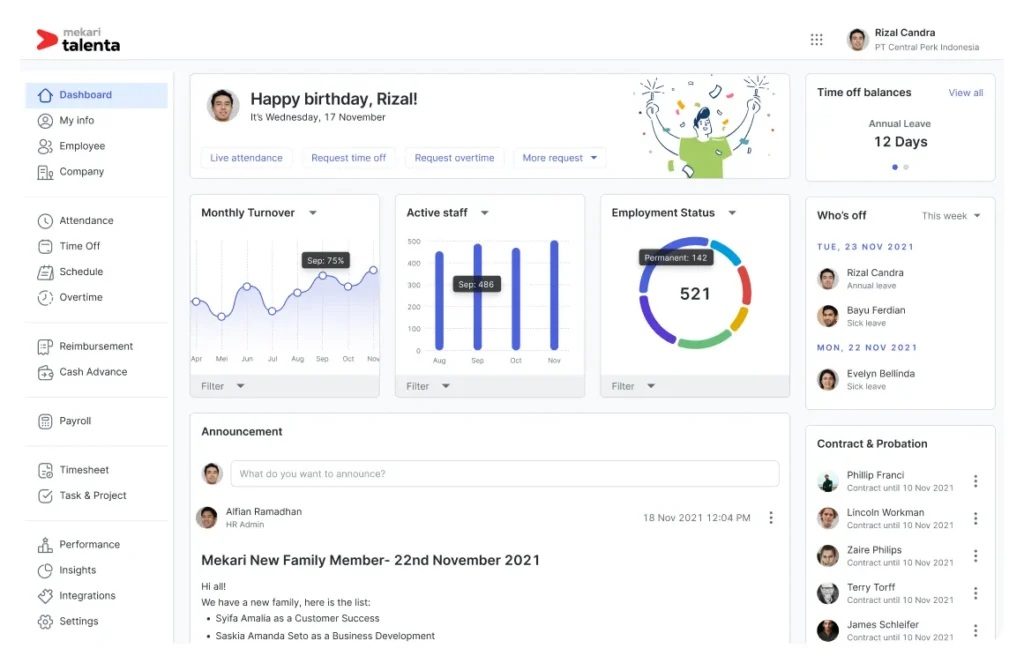
Through Mekari Talenta, HR teams can handle key onboarding needs such as:
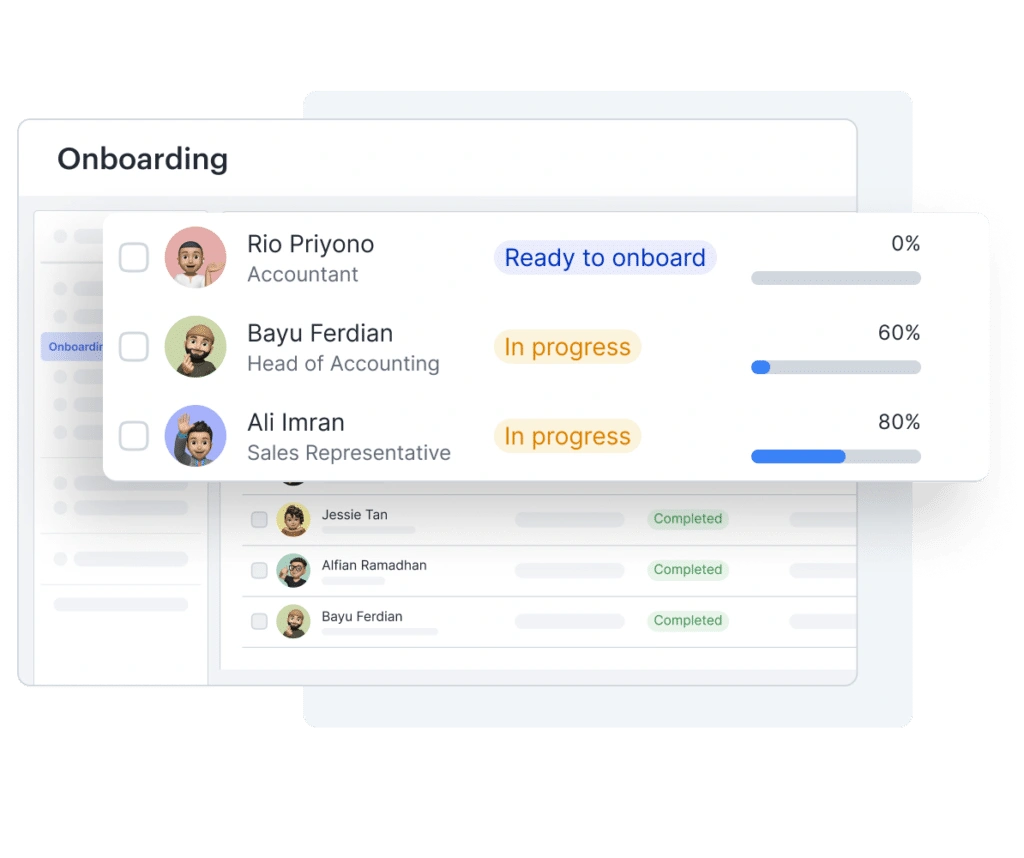
- Managing employee data in a centralized system to simplify HR administration
- Organizing employee documents digitally for better accessibility and control
- Managing leave and attendance through an integrated system
- Preparing administrative requirements such as insurance accounts, ID cards, and system access
- Monitoring onboarding progress to ensure each stage runs according to plan
With an integrated system in place, HR teams can significantly reduce administrative workload while ensuring that new hires experience a seamless and well-organized onboarding journey.
Interested in exploring how it can fit your organization? Connect with the team to discuss your needs and identify the most effective approach to managing your workforce.
Reference:
Frequently Asked Questions (FAQs)
How long should an employee onboarding program last?
How long should an employee onboarding program last?
Onboarding should extend beyond initial orientation and typically spans 60 to 90 days, depending on role complexity. In practice, some organizations extend structured onboarding up to six months for roles with high cross-functional dependencies. The duration should align with the time required for an employee to operate independently and deliver consistent results.
Who is responsible for onboarding success?
Who is responsible for onboarding success?
Onboarding success is a shared responsibility between HR and hiring managers. HR designs the structure and ensures consistency, while managers drive execution through daily interactions, expectation setting, and feedback. Without strong manager involvement, onboarding quality tends to vary significantly.
What metrics should be used to evaluate onboarding effectiveness?
What metrics should be used to evaluate onboarding effectiveness?
Effective onboarding is measured through time-to-productivity, early retention rates, and quality of initial performance. Additional indicators include feedback from new hires, manager satisfaction, and alignment between expected and actual role execution. These metrics provide a more accurate picture than checklist completion alone.
What is the difference between onboarding and orientation?
What is the difference between onboarding and orientation?
Orientation is typically a short-term activity focused on administrative setup and company introduction. Onboarding is a longer, structured process that includes performance alignment, capability building, and integration into the organization. Orientation is one component within a broader onboarding journey.
How can onboarding be improved continuously?
How can onboarding be improved continuously?
Continuous improvement comes from systematically collecting and analyzing feedback across multiple onboarding cohorts. Organizations should identify recurring friction points, validate them with data, and translate them into process or structural changes. This ensures onboarding evolves alongside business needs rather than remaining static.