

Performance Improvement Plan (PIP): Frameworks for Talent Recovery


- A performance improvement plan (PIP) is a structured framework used to help employees improve measurable performance gaps within a defined timeline.
- A PIP is not inherently good or bad. Its effectiveness depends on how fairly, clearly, and consistently managers implement the process.
Performance improvement plans are commonly used when recurring performance issues begin affecting productivity, operational stability, and team accountability across the organization.
In many companies, underperformance develops gradually through missed priorities, inconsistent execution, communication breakdowns, and declining ownership of responsibilities.
When these issues remain unresolved, they eventually impact project delivery, managerial workload, workforce stability, and overall business performance.
A structured performance improvement plan helps managers address these concerns through measurable expectations, recurring progress reviews, and clearer accountability standards while still supporting employee development.
This article will explain what a performance improvement plan (PIP) is, when companies should use it, how to create one effectively, and how to measure improvement outcomes consistently.
What are Performance Improvement Plans (PIPs)?
A performance improvement plan (PIP) is a structured framework used to address gaps between expected and actual employee performance through measurable objectives, defined timelines, managerial support, and documented progress reviews.
A well-designed PIP creates clarity for both managers and employees by translating broad concerns into specific expectations tied to business outcomes, role accountability, and operational standards.
Strong organizations use PIPs to correct performance issues before they affect team productivity, service quality, leadership credibility, or long-term workforce stability.
The process usually applies when recurring issues appear in areas such as missed deadlines, inconsistent execution, communication breakdowns, low collaboration, declining output quality, or failure to meet agreed targets within a broader performance appraisal cycle.
An effective PIP should function as a development mechanism rather than an administrative formality. Managers who succeed with PIPs typically combine structured coaching, regular feedback sessions, and realistic milestones with access to resources such as mentoring, technical training, or a learning management system.
Clear documentation also helps leaders identify patterns that may later influence succession planning, employee engagement initiatives, or broader people analytics strategies across departments.
When implemented properly, PIPs help preserve institutional knowledge, strengthen accountability, and reduce avoidable employee turnover caused by unresolved performance issues.
Difference Between Quality Improvement vs. Performance Improvement
Quality improvement and performance improvement are often discussed together because both aim to strengthen organizational outcomes, operational consistency, and workforce effectiveness.
However, the focus, measurement, and execution of each approach are fundamentally different.
| Aspect | Quality Improvement | Performance Improvement |
|---|---|---|
| Primary Focus | Improving systems, workflows, and operational consistency | Improving employee or team execution and accountability |
| Main Objective | Reducing errors, inefficiencies, and process variation | Closing gaps between expected and actual performance |
| Scope | Organization-wide processes or functional operations | Individual employees, managers, or specific teams |
| Measurement | Defect rates, process accuracy, compliance, turnaround time | KPIs, productivity, behavioral expectations, delivery outcomes |
| Root Cause Orientation | System inefficiencies or workflow breakdowns | Capability gaps, behavioral issues, or execution problems |
| Common Methods | Process redesign, SOP optimization, automation, audits | Coaching, feedback sessions, training, performance improvement plans |
| Leadership Involvement | Operations leaders, process owners, quality management teams | Direct managers, HR leaders, department heads |
| Impact on Workforce Strategy | Supports operational scalability and service consistency | Supports capability development and employee retention |
The core difference lies in where the problem originates.
Quality improvement addresses how work is designed and executed across processes, while performance improvement addresses how people perform within those processes.
Strong leadership teams evaluate both dimensions simultaneously because operational excellence depends on reliable systems supported by capable employees.
The Purpose of a Performance Improvement Plan
A performance improvement plan exists to create structured intervention before performance issues escalate into operational disruption, leadership strain, or long-term workforce instability.
Strong organizations use PIPs to restore alignment between employee capability, role expectations, and business priorities while maintaining fairness and accountability throughout the process.
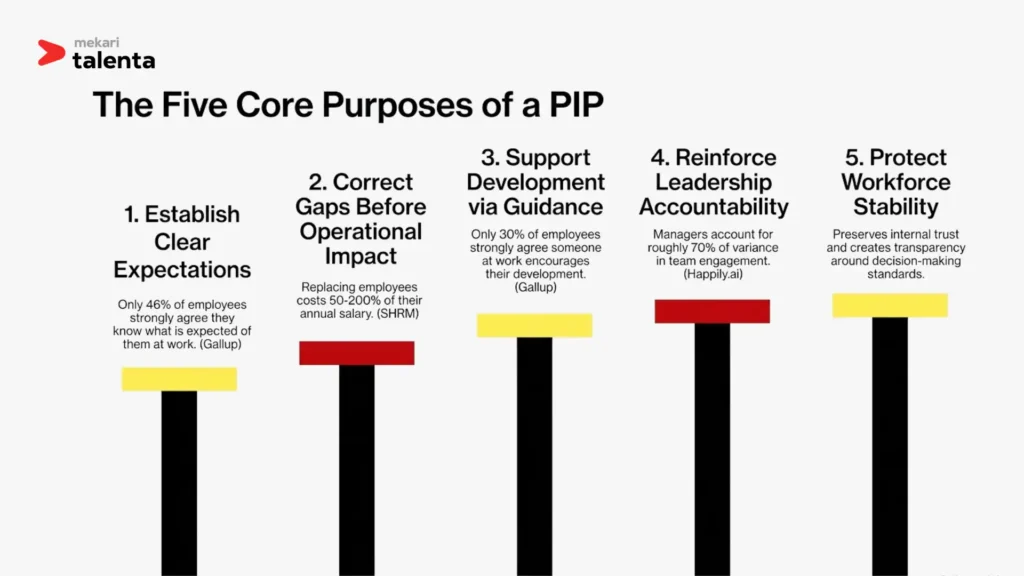
Here are the main purposes behind implementing a performance improvement plan effectively.
1. Establish Clear Performance Expectations
Many performance issues persist because employees operate without clearly defined success metrics. Managers often assume expectations are already understood, while employees interpret priorities differently across projects, reporting lines, or operational demands.
A properly structured PIP removes ambiguity by translating concerns into measurable standards tied to timelines, deliverables, communication expectations, and role accountability.
This clarity becomes especially important in fast-moving environments where shifting priorities can easily create confusion around ownership and execution quality.
2. Correct Performance Gaps Before They Affect Business Operations
Underperformance rarely remains isolated to a single employee. Missed deadlines, inconsistent execution, and communication breakdowns eventually affect surrounding teams, project dependencies, customer delivery, and managerial workload.
These costs extend beyond recruitment expenses into employee onboarding delays, productivity loss, operational disruption, and knowledge transfer gaps.
An effective PIP allows organizations to intervene early before unresolved issues contribute to broader employee turnover or operational instability.
Strong managers understand that early correction is significantly less disruptive than reactive replacement after performance deterioration has already affected surrounding teams.
3. Support Employee Development Through Structured Guidance
One of the most overlooked purposes of a PIP is developmental alignment. Performance problems are not always caused by lack of effort.
In many cases, employees struggle because expectations changed faster than their capability development, role transitions were poorly managed, or employee onboarding failed to provide sufficient operational context.
Strong PIPs therefore include developmental support mechanisms such as targeted coaching, manager check-ins, role-specific training, peer mentoring, and alignment with an individual development plan.
Organizations that treat PIPs purely as administrative documentation often fail to achieve meaningful behavioral improvement because employees receive correction without capability reinforcement.
4. Reinforce Leadership Accountability
A performance improvement process also evaluates managerial effectiveness. Poorly managed teams often reveal patterns such as inconsistent feedback, delayed escalation, unclear priorities, or lack of performance documentation long before formal intervention occurs.
This is why mature organizations require managers to maintain recurring performance conversations, document progress consistently, and provide actionable feedback throughout the PIP period.
The process creates stronger leadership discipline while improving fairness and consistency across departments.
Read also: What Is Employee Engagement and How It Drives Business Performance
5. Protect Workforce Stability and Long-Term Retention
Employees closely observe how organizations handle underperformance cases. Inconsistent treatment, vague expectations, or abrupt termination decisions can negatively affect employee engagement, internal trust, and employer branding across the workforce.
Well-managed PIPs help create transparency around expectations, improvement opportunities, and decision-making standards.
They also provide valuable insights into broader workforce trends that may later surface in people analytics reviews, succession planning discussions, or employee retention strategies.
Types of Performance Issues Require a PIP
Not every workplace issue requires a performance improvement plan. Strong managers distinguish between isolated mistakes, temporary performance fluctuations, behavioral concerns, and recurring underperformance patterns that require formal intervention.
A PIP becomes necessary when performance gaps consistently affect productivity, collaboration, operational delivery, or business outcomes despite prior coaching and informal feedback.
Here are the most common types of performance issues that typically require a structured performance improvement plan.
1. Consistently Missing Performance Targets
One of the clearest indicators for a PIP is repeated failure to achieve agreed objectives, especially when expectations, timelines, and resources have already been clarified.
This issue often appears through missed sales quotas, delayed project delivery, declining productivity metrics, inaccurate reporting, or inability to achieve department KPIs over multiple review periods.
In organizations using management by objective frameworks, persistent gaps between assigned goals and actual execution usually trigger formal performance discussions.
Managers should evaluate whether the issue stems from capability limitations, workload imbalance, role mismatch, or weak prioritization before initiating a PIP.
Employees who receive structured direction early are more likely to recover performance stability than those managed reactively after prolonged decline.
2. Declining Quality of Work
Performance problems are not always tied to output volume. In many cases, employees continue delivering work on time while quality standards deteriorate steadily.
Common examples include:
- recurring compliance errors
- inaccurate reporting or documentation
- increased customer complaints
- poor decision-making quality
- lack of attention to operational detail
- repeated rework caused by preventable mistakes
Quality-related issues are especially critical in functions where accuracy directly affects financial reporting, customer trust, regulatory compliance, or operational continuity.
Strong PIPs for quality-related problems should define measurable quality benchmarks rather than focusing only on productivity metrics.
2. Behavioral and Collaboration Issues
High technical capability does not automatically translate into sustainable workplace performance. Employees who disrupt collaboration, communication flow, or team dynamics can negatively affect broader operational effectiveness even when individual output remains acceptable.
Behavioral-related PIPs commonly involve issues such as repeated communication breakdowns, resistance to managerial direction, poor stakeholder management, unprofessional conduct, or inability to collaborate across functions.
Managers should avoid vague behavioral feedback such as “improve attitude” or “be more professional.” Effective PIPs define observable behaviors, expected communication standards, escalation protocols, and measurable interaction improvements.
3. Attendance and Reliability Problems
Frequent lateness, unexplained absences, unreliable responsiveness, or failure to meet scheduling commitments can eventually disrupt operational continuity and increase workload pressure across teams.
Attendance-related performance concerns become particularly serious when employees handle customer-facing operations, time-sensitive deliverables, shift coordination, or leadership responsibilities where reliability directly affects broader workforce performance.
Before implementing a PIP, managers should assess whether attendance issues are connected to burnout, workload distribution, unclear scheduling expectations, insufficient employee engagement, or external circumstances requiring organizational support.
4. Failure to Adapt to Role or Organizational Changes
Performance deterioration often occurs during periods of organizational transition. Employees may struggle after promotions, restructuring initiatives, technology implementation, leadership changes, or evolving operational requirements.
This issue commonly appears when employees fail to adapt to new systems, changing workflows, revised reporting structures, or increased decision-making expectations. In many cases, the root problem is not resistance, but insufficient capability transition support.
Organizations introducing new technologies or workflow systems without proper enablement frequently experience short-term performance declines during adaptation phases.
Companies with strong transition planning usually minimize this risk through structured training, coaching support, and ongoing performance monitoring.
In these situations, a PIP helps create a controlled framework for capability adjustment while allowing managers to track improvement progress objectively through recurring checkpoints and measurable outcomes.
When Should Companies Use a Performance Improvement Plan?
A performance improvement plan should be used when performance concerns have become consistent, measurable, and significant enough to require formal intervention.
The timing of a PIP is critical. Organizations that implement it too early often create unnecessary tension, while delayed intervention usually allows problems to spread across productivity, morale, and operational delivery.
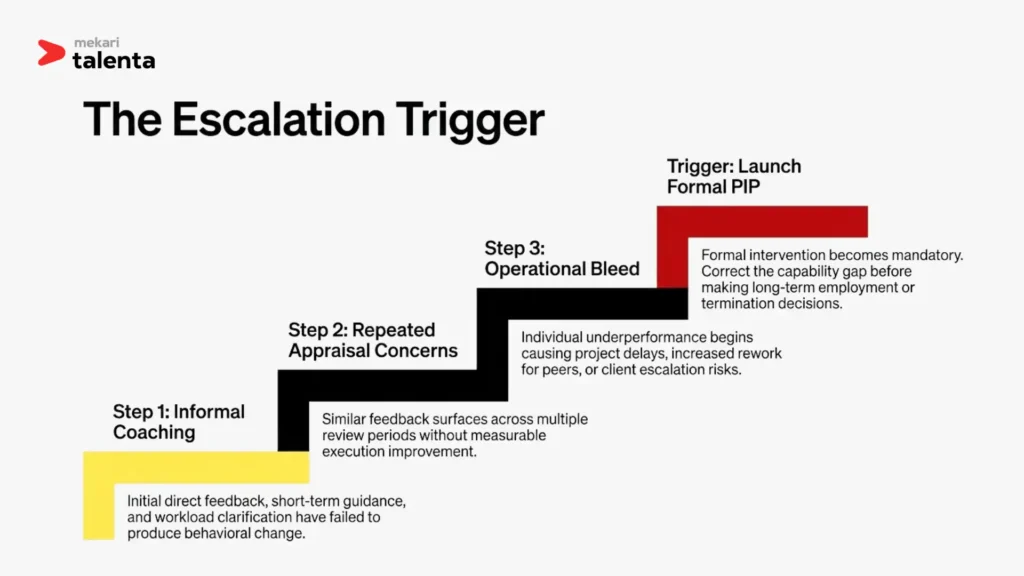
The decision to initiate a PIP should therefore be based on performance patterns, previous management actions, and the broader business impact of unresolved issues.
1. After Informal Coaching Has Failed to Produce Improvement
A PIP should rarely be the first response to underperformance. Strong managers typically begin with direct feedback, coaching discussions, workload clarification, or short-term corrective guidance before escalating into a formal process.
The purpose of informal intervention is to determine whether the issue can be corrected through clearer communication or managerial support.
If performance remains unchanged after multiple documented conversations, a structured improvement plan becomes necessary.
Organizations that skip this stage often create employee resistance because the PIP appears sudden rather than progressive.
2. When Performance Problems Begin Affecting Team Operations
A PIP becomes necessary when performance issues start creating operational consequences beyond the individual employee.
This often happens when underperformance causes:
- project delays
- increased rework for surrounding teams
- client escalation risks
- leadership bottlenecks
- uneven workload distribution
- declining team accountability
At this stage, unresolved issues begin affecting overall workforce efficiency rather than isolated individual output.
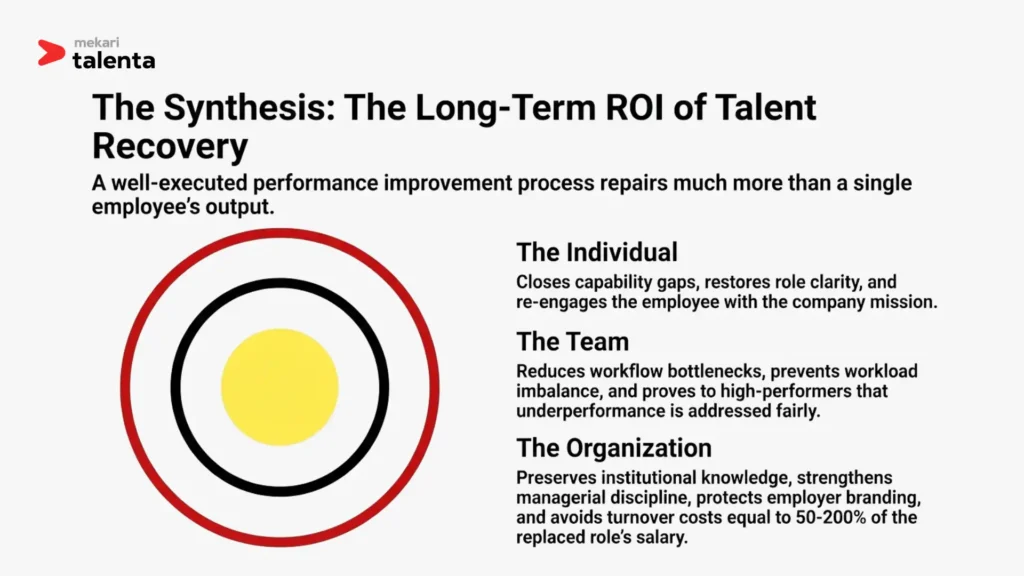
Managers should avoid waiting until performance deterioration becomes severe enough to require immediate termination decisions. Early structured intervention typically creates better recovery outcomes and reduces disruption across teams.
3. During Repeated Performance Appraisal Cycles With Similar Concerns
Recurring performance concerns across multiple review periods are one of the clearest indicators that a formal intervention framework is required.
If employees repeatedly receive similar feedback during performance appraisal discussions without measurable improvement, the issue usually reflects deeper execution gaps rather than temporary inconsistency.
Common warning signs include recurring comments related to:
- missed deadlines
- communication quality
- low ownership
- inconsistent follow-through
- inability to meet strategic priorities
A PIP helps convert recurring feedback into actionable objectives with timelines, accountability checkpoints, and measurable expectations. This creates clearer visibility into whether improvement is realistically achievable within the role.
Without formal intervention, repeated low-performance ratings often become administrative records without meaningful behavioral change.
4. When Organizational Changes Create Higher Performance Expectations
Business transformation frequently changes role expectations faster than employees can naturally adapt. During restructuring, technology adoption, expansion initiatives, or leadership transitions, organizations often raise productivity standards, reporting requirements, or operational complexity.
Employees who previously performed adequately may begin struggling under revised expectations. In these situations, a PIP helps determine whether the gap can be resolved through structured development and clearer alignment.
A well-managed PIP during organizational change should focus on adaptation capability, training support, and measurable progression milestones.
5. Before Making Long-Term Employment Decisions
One of the most important functions of a PIP is establishing a fair and transparent process before organizations make significant workforce decisions.
A structured improvement period demonstrates that employees were given:
- clear expectations
- documented feedback
- reasonable timelines
- managerial support
- measurable opportunities to improve
This process strengthens consistency across departments while reducing legal and reputational risk tied to subjective performance management practices.
PIPs also provide valuable organizational insight. Patterns identified during the process may reveal broader operational problems involving leadership capability, onboarding quality, workload imbalance, or weak employee engagement structures that extend beyond the individual employee case itself.
What Should Be Included in a Performance Improvement Plan?
A performance improvement plan should provide enough structure for employees to clearly understand what needs to improve, how improvement will be measured, what support will be provided, and what outcomes are expected within a defined timeframe.
Weak PIPs often fail because they rely on vague language, inconsistent metrics, or unrealistic expectations that create confusion instead of accountability.
To make the process easier to implement, you can use the downloadable PIP form template below to document performance concerns, define measurable expectations, and track employee progress more consistently.
Each section in the template should be completed with clear, measurable, and role-specific information to ensure the performance improvement process remains structured, fair, and actionable.
Here are the key components that should be included in a performance improvement plan.
1. Clear Description of Performance Concerns
The plan should begin with a detailed explanation of the performance issues being addressed. This section must focus on observable behaviors, measurable outcomes, and documented examples rather than subjective opinions.
Instead of writing statements such as “lacks ownership” or “needs better attitude,” strong PIPs describe the actual impact of the issue on operations, team collaboration, or delivery expectations.
Examples may include:
- missed reporting deadlines over multiple review periods
- recurring client escalation cases
- declining productivity metrics
- repeated compliance inaccuracies
- failure to complete assigned deliverables within agreed timelines
Specific documentation creates clarity while reducing the risk of misunderstanding or inconsistent interpretation between managers and employees.
2. Measurable Performance Expectations
One of the biggest reasons PIPs fail is the absence of measurable success criteria. Employees cannot improve consistently if expectations remain broad or undefined.
This section should outline the exact standards employees are expected to achieve during the improvement period. Expectations should align with operational priorities, role responsibilities, and team objectives already established within the organization.
Effective performance metrics may include productivity targets, delivery turnaround times, quality accuracy benchmarks, communication standards, customer satisfaction indicators, or project completion rates tied to objective key results.
3. Defined Timeline and Review Schedule
Every PIP should establish a formal improvement timeline with recurring review checkpoints. Most organizations use a 30-day, 60-day, or 90-day structure depending on the severity and complexity of the issue.
The timeline should include:
- scheduled progress discussions
- interim evaluation dates
- documentation checkpoints
- final review expectations
Regular review sessions are critical because they prevent managers from treating the PIP as passive documentation. Ongoing conversations allow both parties to identify obstacles early, adjust development support if needed, and maintain alignment throughout the improvement period.
Strong managers also document each review meeting carefully to maintain consistency and transparency across the process.
4. Support and Development Resources
A PIP should clearly explain what support the organization will provide to help the employee improve. Many organizations fail at this stage by focusing entirely on accountability while offering minimal developmental assistance.
Depending on the root cause of the issue, support mechanisms may include additional coaching, mentoring sessions, technical training, workflow guidance, peer shadowing, or structured learning modules delivered through a learning management system.
This section becomes especially important when performance gaps are connected to role transitions, system adoption, operational changes, or insufficient capability development rather than intentional misconduct.
Managers should also identify whether external factors such as unclear onboarding, shifting priorities, or communication breakdowns contributed to the decline in performance.
5. Consequences and Expected Outcomes
The final section should explain what happens if performance improves and what happens if improvement does not occur within the defined period.
This creates transparency around accountability while preventing confusion later in the process. Employees should clearly understand whether successful completion will return them to standard performance monitoring or whether additional corrective action may follow if expectations are not achieved.
Well-structured PIPs avoid threatening language while remaining direct about organizational expectations. The purpose is to create fairness, consistency, and measurable opportunity for improvement rather than emotional pressure or punitive management practices.
Organizations that maintain this balance typically see stronger employee engagement during corrective processes and more sustainable long-term performance outcomes.
Performance Improvement Plan Process
A performance improvement plan process should follow a structured sequence that allows managers to identify issues early, communicate expectations clearly, monitor progress consistently, and make objective decisions based on measurable outcomes.
Organizations that manage the process inconsistently often create confusion, documentation gaps, and unnecessary tension between managers and employees.
An effective process also ensures that performance intervention remains development-focused while maintaining accountability throughout each stage.
Here are the main stages involved in a performance improvement plan process.
1. Identify and Validate Performance Issues
The process begins with identifying recurring performance concerns supported by measurable evidence rather than assumptions or isolated incidents.
Managers should review performance trends, operational impact, feedback history, productivity data, and previous coaching discussions before initiating formal action.
In many cases, early warning signs already appear through missed deadlines, declining work quality, recurring communication issues, or repeated concerns raised during performance reviews.
This stage is critical because poorly validated PIPs often create employee distrust and inconsistent managerial decisions.
Managers should also assess whether external factors such as workload imbalance, unclear role expectations, insufficient onboarding, or operational restructuring contributed to the performance decline.
2. Conduct an Initial Performance Discussion
Before presenting the formal PIP document, managers should conduct a direct conversation with the employee regarding the identified concerns.
The objective of this discussion is to explain:
- the specific performance gaps observed
- the business impact of those issues
- previous feedback already provided
- why formal intervention is now required
Strong managers approach this conversation with clarity and professionalism rather than emotional escalation. Employees should leave the discussion understanding both the seriousness of the issue and the organization’s intention to support improvement.
3. Develop the Performance Improvement Plan
Once the issue has been formally discussed, managers create the PIP document based on measurable expectations and realistic improvement objectives.
A strong PIP should include:
- clearly documented performance concerns
- measurable success criteria
- timeline and review checkpoints
- available support resources
- expected outcomes and consequences
The improvement goals should remain achievable within the employee’s actual role scope and operational context. Unrealistic targets often reduce engagement and increase resistance throughout the process.
Organizations with mature performance cultures frequently align PIP goals with broader operational priorities, departmental KPIs, or OKR to maintain consistency between individual performance expectations and business objectives.
4. Monitor Progress Through Recurring Reviews
A PIP should function as an active management process rather than static documentation.
Managers should schedule recurring review sessions throughout the improvement period to evaluate progress, provide feedback, identify obstacles, and document measurable developments.
Most organizations conduct weekly or biweekly reviews depending on the severity of the issue and the duration of the PIP timeline.
During these sessions, managers should focus on observable progress, remaining gaps, and additional support required to sustain improvement.
Consistent documentation becomes especially important because it creates transparency and reduces ambiguity later in the process.
This stage also allows organizations to identify whether the issue is improving, stabilizing, or continuing to deteriorate despite intervention efforts.
5. Conduct the Final Evaluation and Determine Next Steps
At the end of the PIP period, managers conduct a final evaluation based on the predefined expectations established at the beginning of the process.
Possible outcomes may include successful completion of the PIP, extension of the improvement period, reassignment considerations, or further corrective action if expectations remain unmet.
The final decision should rely on measurable outcomes rather than subjective managerial preference. Organizations that maintain objective evaluation standards typically achieve stronger consistency across departments while reducing performance management disputes.
The final review stage also provides valuable organizational insight into broader workforce patterns. Repeated PIP cases within the same teams may indicate deeper leadership, training, or employee engagement challenges that require attention beyond individual employee performance alone.
Best Practice to Create an Effective Performance Improvement Plan
A performance improvement plan becomes effective when it creates realistic improvement pathways, maintains managerial consistency, and gives employees clear direction for success.
Many organizations already have formal PIP templates and workflows in place, yet the outcomes remain inconsistent because the execution lacks clarity, structure, or follow-through.
An effective PIP should help employees understand exactly what must improve, why it matters, and how progress will be evaluated throughout the process.
Here are the most important steps to create a performance improvement plan that delivers meaningful results.
1. Define the Real Performance Problem Before Writing the PIP
One of the biggest mistakes managers make is treating symptoms as root causes. Missed deadlines, declining productivity, or communication issues are often visible outcomes of deeper operational or capability problems.
Before drafting a PIP, managers should evaluate whether the issue is caused by:
- unclear expectations
- insufficient training
- workload imbalance
- role mismatch
- leadership gaps
- poor cross-functional coordination
This stage is critical because the wrong diagnosis usually leads to ineffective corrective action. Employees placed on vague or inaccurate PIPs often become disengaged instead of improving performance.
Strong organizations frequently use operational metrics, manager observations, and workforce data to validate performance patterns before initiating formal intervention. This creates more objective decision-making and reduces inconsistency across teams.
2. Set Measurable and Realistic Improvement Goals
Employees should leave a PIP discussion knowing exactly what success looks like. Broad instructions such as “improve communication” or “show more ownership” rarely produce measurable behavioral change because expectations remain open to interpretation.
Effective PIPs define specific outcomes tied to role responsibilities, delivery expectations, and operational priorities. Clear metrics also make progress discussions significantly more productive because both managers and employees evaluate the same standards consistently.
Strong goals typically include defined timelines, measurable targets, quality standards, and observable behavioral expectations connected to actual business outcomes.
3. Align Managers Before Launching the PIP
Many failed PIPs are caused by inconsistent management rather than employee resistance. Employees receive mixed messages when managers interpret expectations differently, delay feedback, or apply inconsistent evaluation standards throughout the process.
Before launching a PIP, managers and HR leaders should align on:
- performance expectations
- documentation standards
- review frequency
- escalation thresholds
- success criteria
This alignment is especially important in organizations where employees collaborate across multiple stakeholders or reporting structures.
Consistent leadership communication improves employee trust throughout corrective processes and reduces confusion during recurring progress discussions.
4. Combine Accountability With Development Support
A PIP should create accountability without removing development opportunities. Employees are far more likely to improve when organizations provide practical support alongside performance expectations.
Support mechanisms may include targeted coaching, mentoring, process guidance, technical upskilling, or access to structured training resources.
In many cases, performance recovery accelerates when managers provide ongoing feedback in shorter review cycles rather than waiting for formal monthly evaluations.
Managers should also evaluate whether operational barriers are limiting performance improvement despite employee effort.
5. Document Progress Consistently Throughout the Process
Documentation quality often determines whether a PIP remains structured or becomes subjective over time. Many organizations lose process credibility because progress discussions are poorly recorded or inconsistently tracked across review periods.
Managers should document measurable progress, ongoing concerns, employee responses, coaching actions, and agreed next steps after every review meeting. Consistent records help maintain transparency while reducing future disputes related to evaluation outcomes.
Detailed documentation also helps organizations identify broader workforce trends. Repeated performance concerns across the same departments may later reveal deeper organizational issues involving leadership capability, role clarity, or employee attrition patterns that extend beyond individual employee performance cases.
6. Maintain Professionalism Throughout the Entire Process
Employees usually remember how the PIP process was handled more than the document itself. Managers who approach the process emotionally, inconsistently, or defensively often damage trust even when the performance concerns are valid.
An effective PIP should remain direct, respectful, and solution-oriented from beginning to end. Strong managers focus discussions on measurable performance outcomes rather than personal criticism or emotional escalation.
Organizations that maintain professionalism during corrective processes typically protect employee engagement more effectively while preserving stronger long-term workplace credibility and internal trust.
How to Measure Performance Improvement Effectively
Performance improvement should be measured through consistent behavioral change, operational impact, and measurable progress against defined expectations.
Many organizations focus too heavily on short-term results during the PIP period while overlooking whether the improvement can actually be sustained over time.
Below are the most important ways to measure performance improvement effectively.
1. Measure Progress Against Defined Performance Metrics
Performance improvement becomes difficult to evaluate when success criteria are unclear from the beginning. Employees and managers need measurable standards that define what successful improvement actually looks like within the role.
Organizations should compare employee progress against the targets established during the PIP process, including productivity levels, quality benchmarks, project delivery expectations, communication standards, or operational KPIs.
Examples of measurable indicators may include:
- improved task completion rates
- fewer reporting or compliance errors
- stronger attendance consistency
- faster response times
- reduced customer escalation cases
Clear metrics help managers evaluate improvement more objectively while reducing inconsistency across departments and review cycles.
2. Evaluate Consistency Instead of Short-Term Improvement
One of the most common mistakes in performance management is treating temporary improvement as long-term recovery.
Employees may increase performance briefly during close monitoring periods but gradually return to previous behaviors once formal oversight decreases.
This is why organizations should evaluate whether improvement remains consistent across multiple review periods rather than isolated short-term progress.
Managers should observe whether employees continue demonstrating stronger accountability, communication quality, responsiveness, and execution discipline after the formal PIP process ends.
Sustainable improvement usually appears through repeated behavioral consistency rather than dramatic short-term performance spikes.
Organizations with mature performance cultures often continue monitoring employees through recurring check-ins even after the formal improvement period has been completed.
3. Assess the Impact on Team Operations
Performance improvement should eventually create positive effects beyond the individual employee. Strong recovery outcomes usually improve team coordination, reduce workflow disruptions, and strengthen overall operational stability.
Managers should assess whether improvement contributes to smoother collaboration, stronger delivery consistency, and reduced dependency on managerial intervention.
In collaborative work environments, unresolved performance issues often create secondary operational problems such as delayed approvals, increased rework, uneven workload distribution, or communication bottlenecks across departments.
This broader operational view helps organizations determine whether the employee’s improvement is creating measurable business impact instead of only improving isolated performance metrics.
4. Use Continuous Feedback and Review Discussions
Performance measurement should remain ongoing rather than limited to the formal PIP timeline. Continuous feedback helps organizations identify whether employees are maintaining progress while also creating opportunities to address new challenges early.
Recurring review discussions also help managers evaluate areas that may not appear immediately through quantitative metrics alone, including communication quality, collaboration effectiveness, adaptability, and decision-making consistency.
Strong managers use these discussions to reinforce expectations, provide developmental guidance, and maintain alignment around future performance priorities.
5. Monitor Long-Term Workforce Outcomes
Organizations should also evaluate whether their overall performance management practices are contributing to healthier workforce outcomes over time.
Long-term indicators may include:
- lower employee turnover
- stronger employee retention
- improved internal mobility
- fewer recurring PIP cases
- stronger manager effectiveness across teams
Broader workforce analysis becomes especially important when organizations review long-term employee engagement trends or conduct an exit interview to understand whether unresolved performance issues contributed to separation decisions.
When performance management systems are poorly executed, recurring underperformance often increases employee attrition, leadership strain, and operational instability across teams.
Building a More Structured and Scalable Performance Improvement Process with Mekari Talenta
In managing performance improvement plans, it’s important to ensure that managers can monitor progress consistently, provide structured feedback, and track measurable improvement outcomes across the organization.
Without a centralized system, many companies struggle to manage PIPs consistently. Documentation is often scattered across spreadsheets or emails, review timelines are missed, managerial evaluations become subjective, and progress tracking lacks visibility across teams.
These challenges can lead to inconsistent expectations, weak follow-up processes, delayed intervention, and difficulty identifying whether performance issues are actually improving over time.
To address this, companies can leverage Mekari Talenta as an AI-powered, cloud-based HCM software that helps organizations manage employee performance, workforce administration, and talent development within a centralized platform.
Through its Performance Management feature, Mekari Talenta enables organizations to manage performance improvement processes more systematically through measurable goals, structured evaluations, and continuous progress monitoring.
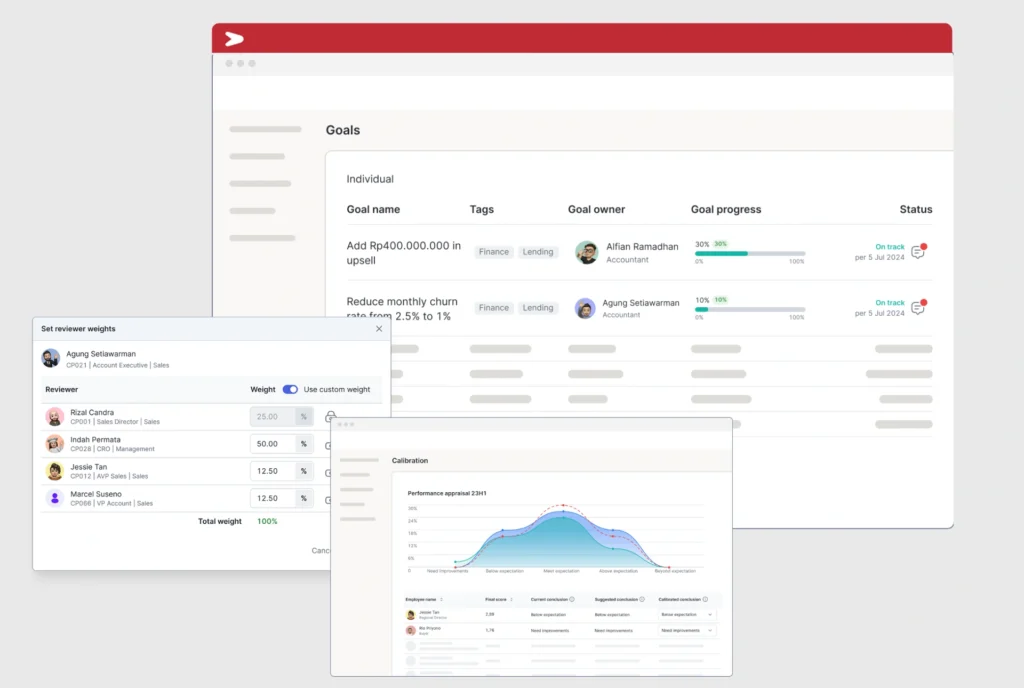
With Mekari Talenta, companies can:
- Define customized performance indicators, measurable targets, and evaluation criteria aligned with employee roles and business objectives
- Conduct structured performance reviews and recurring manager check-ins within a centralized system
- Monitor employee progress and performance trends more consistently across departments
- Maintain clearer documentation for feedback sessions, improvement timelines, and evaluation outcomes
- Generate AI-powered review summaries to help managers create more consistent and actionable evaluations
- Improve visibility into workforce performance through centralized reporting and analytics dashboards
This performance management module can also be implemented as a standalone solution, allowing companies to strengthen their performance improvement process without replacing existing HR systems.
With a centralized and structured performance management system, organizations can improve managerial consistency, reduce administrative inefficiencies, strengthen employee accountability, and create more sustainable performance improvement outcomes across teams.
Interested in exploring how Mekari Talenta can support your performance improvement process?
Schedule a free demo with our team and discover how a more structured, AI-powered approach can help your organization manage performance improvement plans more effectively and consistently.
Reference
Frequently Asked Questions (FAQs)
Is a performance improvement plan the same as a warning letter?
Is a performance improvement plan the same as a warning letter?
No. A warning letter is typically disciplinary and focuses on policy violations or misconduct, while a PIP focuses on improving measurable performance gaps through structured guidance and evaluation. A PIP usually includes coaching support, measurable goals, progress reviews, and a defined improvement period. In many organizations, employees successfully complete a PIP and continue performing effectively afterward.
How long should a performance improvement plan last?
How long should a performance improvement plan last?
Most PIPs run between 30 to 90 days depending on the severity of the issue, the complexity of the role, and the type of improvement required. Operational or behavioral issues that require longer adjustment periods may need extended timelines with recurring reviews. The duration should remain realistic enough for employees to demonstrate measurable improvement without allowing unresolved issues to continue indefinitely.
Should HR always be involved in a PIP process?
Should HR always be involved in a PIP process?
HR involvement is highly recommended, especially for documentation consistency, compliance alignment, and managerial guidance. HR teams also help ensure that performance expectations, review timelines, and evaluation standards are applied fairly across departments. In larger organizations, HR often acts as a neutral partner that supports both managers and employees throughout the process.
Can employees reject or refuse to sign a PIP?
Can employees reject or refuse to sign a PIP?
Employees may refuse to sign a PIP document in some situations, but the organization can still proceed with the process as long as expectations and discussions have been properly documented. A signature typically acknowledges receipt and discussion of the document rather than agreement with every point inside it. Managers should remain professional and continue documenting all communication carefully throughout the process.
What happens if an employee successfully completes a PIP?
What happens if an employee successfully completes a PIP?
Employees who successfully complete a PIP usually return to standard performance monitoring and regular review cycles. Managers should continue conducting periodic check-ins to ensure performance improvements remain stable over time. In many cases, employees who complete a well-managed PIP develop stronger accountability, communication habits, and role clarity after the process ends.