

A Guide to Employee Attrition: Risk Mitigation for Talent Continuity


- Employee attrition refers to workforce reduction that happens when employees leave and their positions are not immediately replaced.
- Employee attrition reduces headcount over time, while employee turnover focuses on employee replacement and workforce movement.
Workforce stability has become increasingly difficult to maintain as organizations manage restructuring cycles, changing employee expectations, leadership transitions, and evolving operating models simultaneously.
In large organizations, even small increases in attrition can create operational ripple effects across productivity, succession planning, delivery timelines, and leadership continuity.
What makes attrition especially challenging is that workforce risks often remain hidden until resignation patterns begin affecting critical functions or high-performing teams.
This article will explain employee attrition, how it differs from turnover, what causes it, how organizations analyze it, and what strategies can help reduce it sustainably.
What Is Employee Attrition?
Employee attrition refers to the gradual reduction of a company’s workforce when employees leave and their roles are not immediately backfilled.
Unlike routine staffing changes, attrition reflects a deliberate or structural shift in workforce composition over time. It can occur through resignations, retirements, or internal transitions that lead to role consolidation.
Attrition often signals deeper workforce dynamics. It may indicate evolving business priorities, cost optimization efforts, or gaps in workforce planning.
In global environments with layered team structures, attrition rarely happens in isolation. A single departure can reshape reporting lines, redistribute responsibilities, and influence team performance in subtle but measurable ways.
Attrition also plays a critical role in shaping long-term workforce quality. When managed intentionally, it allows organizations to phase out redundant roles, refresh capabilities, and align talent with strategic direction.
However, unmanaged attrition can erode institutional knowledge, disrupt continuity, and increase pressure on remaining employees.
This is why many organizations integrate attrition tracking into broader people analytics frameworks, treating it as a leading indicator of workforce health rather than a lagging outcome.
Employee Attrition vs. Employee Turnover
Employee attrition and employee turnover are closely related, but they represent different workforce patterns and require different management responses.
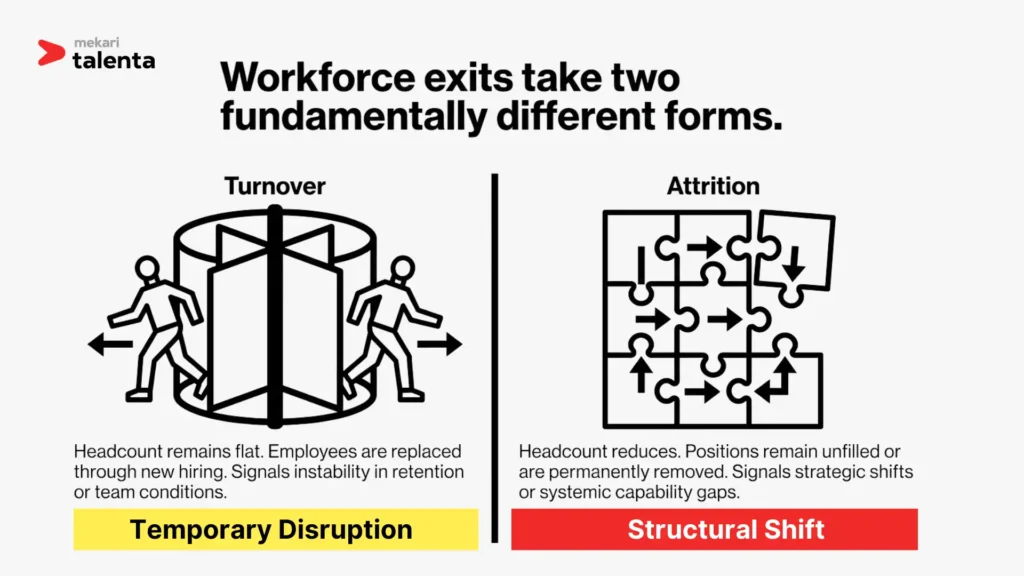
Many companies misread these metrics because both involve employees leaving the organization. In practice, the operational impact, financial consequences, and long-term workforce implications are significantly different.
Understanding the distinction helps leaders interpret workforce data more accurately, especially when evaluating hiring effectiveness, productivity capacity, and long-term talent planning.
| Aspect | Employee Attrition | Employee Turnover |
|---|---|---|
| Definition | Employees leave and their positions remain unfilled for an extended period or are permanently removed. | Employees leave and are replaced through new hiring. |
| Impact on Workforce Size | Reduces overall headcount. | Maintains or increases headcount. |
| Primary Driver | Workforce restructuring, automation, budget optimization, or changing business priorities. | Resignations, dismissals, career moves, or normal workforce movement. |
| Operational Impact | Teams often absorb additional responsibilities and workflows are redistributed. | Temporary disruption until replacement employees become productive. |
| Organizational Signal | Indicates structural or strategic workforce shifts. | Indicates instability in retention, hiring quality, leadership, or team conditions. |
| Hiring Response | Replacement hiring may be delayed or intentionally avoided. | Immediate or planned backfilling is common. |
| Cost Implication | Can lower labor costs in the short term but may create capability gaps over time. | Increases recurring recruitment, training, and ramp-up costs. |
| Common Areas of Analysis | Workforce planning, role redundancy, productivity allocation, and succession readiness. | Recruitment effectiveness, retention trends, and hiring efficiency. |
| Typical Management Focus | Long-term capability alignment and operational redesign. | Improving retention, recruitment quality, and employee onboarding processes. |
Although both metrics involve workforce exits, they should never be interpreted in the same way.
A company with low turnover can still experience damaging attrition in critical functions, while high turnover may remain manageable if replacement quality and transition speed are strong.
The key lies in analyzing workforce movement alongside business context, operational dependency, and future capability needs.
The Hidden Costs of Employee Attrition
The financial impact of employee attrition is often underestimated because most organizations only calculate visible replacement costs such as recruitment spending or onboarding expenses. In reality, the long-term operational impact extends far beyond hiring budgets.
When experienced employees leave, organizations also absorb productivity disruption, leadership strain, delayed execution, knowledge loss, and declining team stability.
These effects usually spread gradually across departments, making them difficult to quantify immediately but highly expensive over time.
Below are some of the most significant hidden costs organizations experience when employee attrition is left unmanaged.
1. Productivity Loss Across Teams
Attrition rarely affects only the employee who resigns. In most cases, responsibilities are redistributed temporarily across existing teams while organizations search for replacements or restructure workloads internally.
This creates operational slowdowns that are often underestimated during workforce planning.
The impact becomes even more severe in functions tied directly to revenue generation, client management, operational delivery, or strategic execution.
Losing experienced employees in these roles can delay projects, weaken customer continuity, and reduce overall output quality for extended periods.
The challenge is that workforce recovery takes significantly longer than many organizations expect. Even after a replacement is hired, productivity usually does not return immediately because onboarding, knowledge transfer, and operational adaptation require time before employees reach full effectiveness.
2. Employee Burnout and Secondary Attrition
One of the most damaging consequences of attrition is the pressure placed on remaining employees.
When teams become understaffed, high-performing employees often absorb additional responsibilities to maintain operational continuity.
While this may stabilize operations temporarily, prolonged workload imbalance frequently leads to burnout, disengagement, and eventually additional resignations.
This creates a compounding effect where attrition triggers operational pressure, which then increases the likelihood of future attrition.
Burnout-related attrition is especially difficult to detect early because employees often continue performing at high levels while disengagement gradually builds underneath the surface.
In many organizations, employees only express concerns after workload strain has already become unsustainable.
Organizations with healthier workforce stability usually monitor workload distribution closely and reassess team capacity regularly instead of relying continuously on employee adaptability during staffing gaps.
3. Loss of Institutional and Operational Knowledge
Experienced employees often carry operational knowledge that extends far beyond documented procedures.
This includes:
- Historical decision context
- Informal workflows
- Stakeholder relationships
- Cross-functional dependencies
- Operational shortcuts developed through experience
Much of this knowledge is rarely documented fully inside formal systems.
As a result, attrition can create hidden capability gaps even when replacement hiring happens quickly. New employees may understand technical responsibilities but still require months or years to rebuild organizational familiarity and operational judgment.
The risk becomes particularly significant in leadership, technical, compliance, and relationship-driven roles where continuity depends heavily on accumulated experience rather than standardized documentation alone.
4. Rising Recruitment and Replacement Costs
Most organizations recognize that attrition increases recruitment expenses, but the true cost is often much larger than anticipated.
Beyond job advertisements and recruiter fees, replacement hiring also consumes:
- Managerial interview time
- Internal coordination resources
- Training capacity
- Team productivity during vacancy periods
- Ramp-up time for new employees
In many cases, replacement costs multiply further when organizations rush hiring decisions to restore operational stability quickly.
Poor hiring alignment increases the likelihood of short-tenure employees, repeated vacancies, and additional recruitment cycles.
This is why organizations with stronger retention outcomes usually focus as heavily on workforce stability as they do on recruitment efficiency.
Read also: 10 Recruitment Process Optimization Steps to Improve Hiring Efficiency
5. Delayed Workforce Readiness and Performance Recovery
Hiring a replacement employee does not immediately restore organizational capacity.
New employees require time to understand systems, internal processes, decision-making structures, stakeholder dynamics, and team expectations.
Even highly capable hires often need extended adjustment periods before operating independently at full productivity.
The recovery timeline becomes longer in highly specialized or cross-functional roles where operational complexity is difficult to transfer quickly.
During this transition period, organizations frequently experience slower execution, heavier managerial oversight requirements, and inconsistent delivery quality.
Existing employees may also spend substantial time supporting onboarding and knowledge transfer instead of focusing fully on their primary responsibilities.
This is why reducing attrition often delivers significantly greater long-term operational value than organizations initially expect.
Workforce stability improves continuity, preserves institutional knowledge, strengthens execution consistency, and reduces the hidden operational strain that repeated employee turnover creates over time.
Types of Employee Attrition
Attrition patterns usually fall into several categories, each carrying different operational risks and long-term implications.
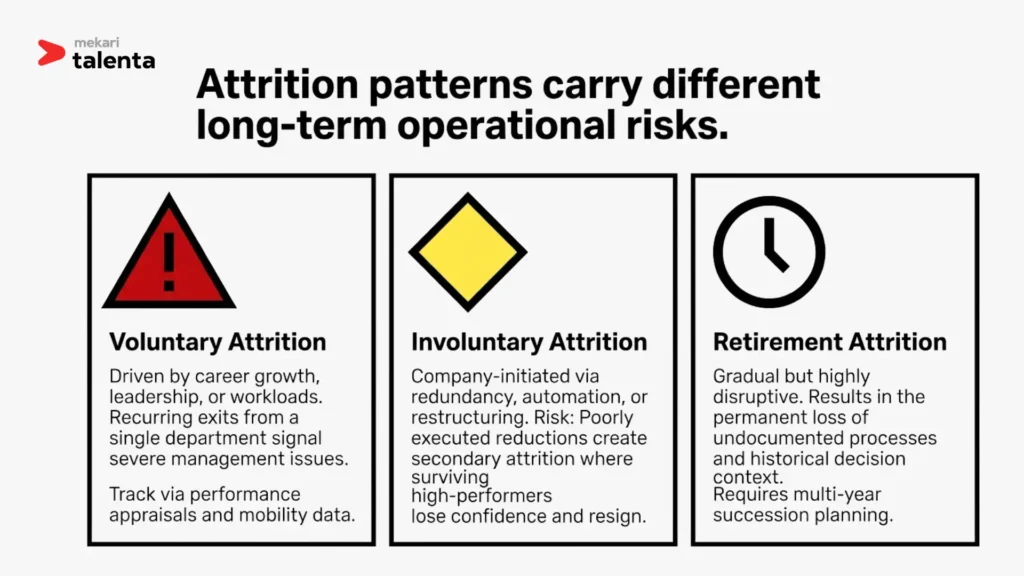
Understanding these distinctions helps organizations respond more precisely instead of applying broad retention strategies across every workforce segment.
Voluntary Attrition
Voluntary attrition occurs when employees choose to leave on their own, usually for career growth, compensation, leadership changes, workload concerns, or better long-term opportunities.
This is often the most closely monitored type because it reveals how employees perceive their future within the company.
Patterns within voluntary exits matter more than overall numbers. Losing one senior specialist with deep institutional knowledge may create greater disruption than multiple junior resignations.
In many cases, recurring exits from the same department indicate management issues, stalled career mobility, or weak team dynamics that are not visible through surface-level metrics.
Organizations with mature retention practices typically connect voluntary attrition trends with performance appraisal outcomes, internal mobility data, and leadership effectiveness reviews to identify risks before resignations escalate.
Involuntary Attrition
Involuntary attrition happens when the company initiates the separation. This may result from restructuring, redundancy, performance issues, compliance violations, or operational realignment.
While often associated with cost reduction, involuntary attrition can also reflect strategic workforce transformation. Roles may become obsolete due to automation, regional consolidation, or changing business models. The challenge is managing the transition without damaging morale among remaining employees.
Poorly executed workforce reductions frequently create secondary attrition, where high-performing employees leave because they lose confidence in organizational stability or leadership transparency.
This is why communication timing, manager preparedness, and transition planning are critical during organizational changes.
Retirement Attrition
Retirement attrition is commonly underestimated because it tends to happen gradually. However, its long-term impact can be significant, especially in roles that rely heavily on institutional knowledge, stakeholder relationships, or specialized operational expertise.
Many companies focus heavily on external hiring while overlooking succession gaps created by upcoming retirements.
As experienced employees exit, undocumented processes, historical decision context, and informal operational knowledge often disappear with them.
Organizations with stronger workforce continuity usually begin transition planning years in advance through mentoring structures, knowledge transfer programs, and targeted capability development supported by an individual development plan for future successors.
Read also: Talent Development Strategy: A Complete Guide for Scalable Growth
Common Factors Behind Employee Attrition
Employee attrition rarely happens because of a single issue. In most cases, employees leave after a combination of operational, managerial, and career-related frustrations accumulates over time.
Many organizations focus too heavily on compensation while overlooking deeper structural problems that gradually weaken commitment and long-term motivation.
Below are some of the most common drivers behind employee attrition and why they continue to affect workforce stability across industries.
1. Limited Career Growth and Internal Mobility
One of the strongest predictors of attrition is the absence of visible career progression. Employees are far more likely to disengage when they cannot see a realistic path toward growth, expanded responsibilities, or leadership opportunities.
This issue becomes more serious in organizations where promotions are inconsistent or heavily dependent on managerial discretion rather than transparent capability frameworks. High-performing employees often leave long before performance declines become visible internally.
Organizations with lower attrition rates usually create clearer development pathways through structured capability mapping, mentoring programs, and measurable growth expectations tied to objective key results.
2. Poor Leadership Quality
Employees may tolerate demanding workloads for extended periods, but poor leadership accelerates attrition much faster than operational pressure alone. In many cases, employees do not leave companies immediately. They first disconnect from their direct managers.
Leadership issues commonly appear through inconsistent communication, lack of recognition, unclear priorities, delayed decision-making, or uneven workload distribution across teams.
Over time, trust erodes and employees begin exploring external opportunities even when compensation remains competitive.
This explains why organizations investing heavily in leadership capability development often see stronger long-term employee retention outcomes than companies focusing only on compensation adjustments.
3. Weak Employee Development Infrastructure
Many companies underestimate how strongly learning access influences retention. Employees are more likely to stay when they feel their skills remain relevant and future-ready.
Development problems usually appear in subtle ways:
- Training programs exist but are disconnected from actual career progression
- Managers rarely discuss long-term capability development
- Learning access is inconsistent across departments or regions
- Employees struggle to apply newly learned skills into meaningful work
When employees believe their growth has stalled, attrition risk rises significantly, especially among high performers with strong external marketability.
Organizations with stronger retention performance often integrate development initiatives into daily operations through a centralized learning management system, making learning progress visible, measurable, and connected to workforce planning.
4. Low Trust in Organizational Direction
Attrition tends to increase when employees lose confidence in leadership decisions or future business direction. This commonly happens during repeated restructuring cycles, unclear communication from senior leadership, or rapidly shifting priorities without operational clarity.
Employees pay close attention to organizational consistency. Frequent changes in targets, reporting structures, or strategic priorities create uncertainty that spreads faster than leadership teams often realize.
Once trust weakens, even top performers may begin preparing exit plans long before resignations become visible.
In practice, declining engagement often becomes an early warning sign of future attrition, particularly during periods of operational change or leadership instability.
5. Ineffective Hiring and Workforce Alignment
Attrition problems frequently begin long before employees resign. In many cases, the root issue starts during recruitment and early-stage integration.
Misaligned hiring decisions create long-term instability when employees enter roles that differ significantly from actual expectations.
Common problems include unrealistic job previews, unclear success metrics, or hiring based primarily on urgency rather than long-term fit.
Organizations with healthier workforce stability usually invest more heavily in hiring calibration, role clarity, and structured onboarding processes supported by stronger talent management software that improves alignment between hiring decisions, workforce planning, and long-term capability needs.
Read also: 10 Recruitment Strategies for Multi-Generational Workforce in Today’s Workplace
How to Calculate the Attrition Rate
Attrition rate measures the percentage of employees who leave the organization during a specific period without being replaced immediately.
It is one of the most important workforce indicators because it helps organizations evaluate workforce stability, operational continuity, and long-term staffing sustainability.
The standard formula is:
For example, if 45 employees leave during the year and the company’s average workforce size during that period is 900 employees, the calculation would be:
Generally, these are the ranges many organizations use as benchmarks for annual employee attrition rates:
| Attrition Rate | Interpretation |
|---|---|
| Below 10% | Typically considered healthy and stable for most corporate environments |
| 10%–15% | Still manageable, but should be monitored by department and role type |
| 15%–20% | Indicates elevated workforce instability and usually requires deeper analysis |
| Above 20% | Often signals structural retention problems, leadership issues, or hiring misalignment |
However, the “healthy” number depends heavily on the function and workforce type.
For example:
- Customer service, retail, or operational support functions often tolerate higher attrition rates.
- Specialized technical, leadership, finance, legal, or strategic roles usually target much lower attrition because replacement costs and knowledge loss are significantly higher.
- High-growth companies may temporarily experience higher attrition during restructuring or rapid scaling periods.
In practice, organizations rarely evaluate attrition only at the company-wide level. More meaningful insights usually come from segmenting attrition data across business units, leadership levels, critical roles, geographic regions, and tenure groups.
This is because overall attrition percentages can hide serious workforce risks. A company may appear stable at the macro level while experiencing severe attrition within high-performing teams or business-critical functions.
Many organizations also track voluntary and involuntary attrition separately to distinguish between controllable retention issues and strategic workforce restructuring.
Combining attrition analysis with workforce planning data, hiring trends, and succession readiness creates a much clearer picture of long-term organizational health.
More mature organizations typically integrate attrition reporting into broader workforce dashboards alongside metrics such as hiring velocity, productivity trends, and management by objective performance alignment.
Is Employee Attrition Always Bad?
Employee attrition is often viewed as a warning sign, particularly when workforce reductions begin affecting productivity, delivery timelines, or leadership stability.
However, attrition does not always create negative outcomes. In many cases, controlled attrition can improve operational efficiency, strengthen workforce quality, and support long-term business transformation.
The real issue is not whether employees leave, but who leaves, why they leave, and how prepared the organization is to absorb the impact.
Some level of attrition is healthy for workforce sustainability. It creates room for internal mobility, leadership renewal, and capability upgrades.
Teams that remain unchanged for too long often become resistant to new processes, slower in decision-making, and overly dependent on legacy practices. Strategic attrition allows organizations to reshape workforce composition without large-scale restructuring initiatives.
Attrition also helps organizations identify underlying issues that may otherwise go unnoticed. When employees consistently leave the same department or manager, the pattern usually points to deeper problems such as ineffective leadership, limited career growth, or unsustainable workloads.
The concern becomes more serious when attrition affects high-performing employees or business-critical functions.
Once experienced talent leaves in large numbers, teams often face productivity slowdowns, heavier workloads, and longer ramp-up periods for replacements. Over time, this can weaken collaboration, reduce morale, and negatively affect overall employee engagement.
Well-managed organizations therefore focus less on eliminating attrition entirely and more on understanding which types of attrition are manageable, preventable, or strategically beneficial.
How to Conduct Employee Attrition Analysis Effectively
Calculating attrition rate is only the starting point. On its own, a single percentage rarely explains whether workforce movement is healthy, manageable, or becoming operationally risky.
The real value comes from analyzing where attrition happens, who is leaving, and what patterns consistently appear over time.
In larger organizations, company-wide attrition figures can easily hide localized problems. One business unit may maintain strong workforce stability while another experiences persistent exits that continuously disrupt operations.
When both are combined into a single metric, the overall number may appear normal despite serious issues inside specific teams or regions.
This is why effective attrition analysis focuses heavily on segmentation rather than aggregate reporting alone.
1. Identify Workforce Patterns Over Time
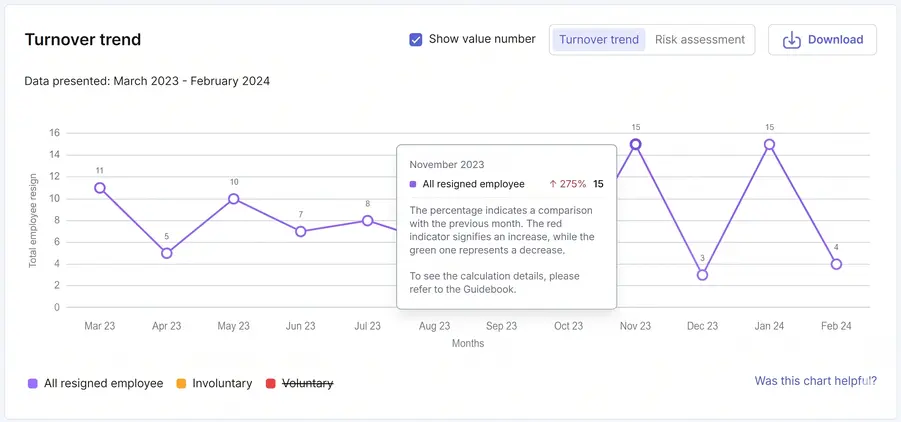
One of the first things organizations should evaluate is whether attrition follows a stable pattern or shows unusual fluctuations.
A gradual increase over multiple quarters often signals structural issues such as declining morale, leadership instability, workload imbalance, or weak career progression.
Sudden spikes, on the other hand, are usually tied to organizational changes, compensation gaps, restructuring initiatives, or external market competition.
Seasonal patterns also matter. Some industries consistently experience higher attrition after bonus periods, annual performance cycles, or major organizational reviews. Without historical comparison, these trends are often misinterpreted as isolated incidents.
Organizations with stronger workforce planning capabilities usually monitor attrition trends continuously through centralized HR dashboards, allowing leadership teams to detect risks before workforce disruption becomes widespread.
2. Analyze Attrition by Workforce Segment
Company-wide metrics rarely provide enough operational insight. More meaningful analysis typically comes from examining attrition across:
- Departments
- Leadership levels
- Geographic locations
- Tenure groups
- Critical business functions
For example, high attrition among employees with less than one year of tenure often points to hiring quality or onboarding issues.
Attrition concentrated among experienced employees may indicate leadership fatigue, compensation misalignment, or limited advancement opportunities.
Patterns inside protected or underrepresented workforce groups should also be reviewed carefully. Uneven attrition across demographic segments can signal deeper concerns related to inclusion, career accessibility, or workplace culture.
3. Understand Why Employees Leave
Many organizations collect resignation data but fail to analyze it beyond surface-level categories. Generic explanations such as “better opportunity” or “personal reasons” rarely provide enough insight to guide retention decisions.
More effective organizations combine qualitative and quantitative analysis by reviewing:
- Exit trends by manager
- Promotion history
- Compensation progression
- Internal mobility patterns
- Workload distribution
- Team engagement scores
Structured exit interview processes become especially valuable when responses are analyzed collectively rather than individually. Over time, recurring themes often reveal operational issues that employees hesitate to raise while still employed.
4. Use Predictive Analysis to Reduce Future Attrition
More advanced organizations increasingly use predictive workforce modeling to identify attrition risks before resignations occur.
Instead of reacting after employees leave, they analyze indicators associated with future exits, such as declining engagement, stalled promotions, sudden drops in performance consistency, or reduced participation in development initiatives.
By analyzing employee data patterns, the company was able to detect workforce risks earlier and better understand which benefits employees valued most, helping strengthen long-term retention strategies.
Effective attrition analysis therefore goes far beyond reporting monthly exit numbers. Its real purpose is to uncover operational patterns early enough for leadership teams to improve workforce stability before attrition begins affecting performance, continuity, and long-term capability growth.
How to Reduce Employee Attrition
Reducing employee attrition requires a deeper approach than simply increasing compensation or accelerating recruitment.
In many organizations, employees leave because operational issues gradually accumulate over time, including inconsistent leadership, unclear career direction, excessive workload pressure, and weak workforce planning.
Organizations with stronger workforce stability usually treat retention as an ongoing operational priority rather than a reactive initiative after resignation rates begin rising.
Below are several strategies commonly used to reduce employee attrition more effectively and sustainably.
1. Improve Leadership Consistency Across Teams
Leadership quality remains one of the strongest factors influencing long-term retention. Employees are far more likely to stay when managers provide clarity, fair workload distribution, constructive feedback, and consistent communication during periods of uncertainty.
The challenge is that leadership inconsistency often develops quietly. One department may maintain strong team stability while another experiences continuous resignations under the same organizational policies. In many cases, employees leave managers rather than companies.
Organizations with lower attrition rates usually invest heavily in frontline leadership capability because day-to-day employee experience is shaped more by direct management than by executive messaging alone.
Strong organizations also evaluate managers using broader indicators such as team retention trends, mobility rates, engagement movement, and long-term productivity sustainability instead of relying only on short-term output metrics.
2. Create Clearer Career Progression Pathways
Employees are less likely to leave when they can clearly understand how their careers can grow internally.
One of the most common drivers of attrition is uncertainty around advancement opportunities, particularly among mid-level employees and high performers.
Career stagnation often occurs even in organizations with strong compensation structures. Employees may still leave if promotions feel inconsistent, development expectations remain unclear, or internal mobility opportunities are difficult to access.
Organizations that reduce attrition more successfully typically establish structured growth frameworks that define:
- Capability expectations for each level
- Internal mobility opportunities
- Leadership readiness criteria
- Development priorities for future roles
3. Reduce Operational Burnout Before It Becomes Chronic
One of the most underestimated causes of attrition is prolonged operational fatigue. Employees can sustain high workloads temporarily, but ongoing pressure without recovery periods eventually weakens engagement, collaboration quality, and long-term commitment.
Burnout usually develops through cumulative operational conditions such as:
- Persistent understaffing
- Unclear priorities
- Excessive meetings
- Constant organizational changes
- Unrealistic deadlines across multiple functions
The problem becomes more severe when high performers consistently absorb additional responsibilities because they are viewed as dependable. Over time, this creates retention risk among the very employees organizations rely on most heavily.
Organizations with healthier retention patterns often redesign workloads, improve resource allocation, and reassess operational dependencies before burnout begins affecting workforce stability.
4. Strengthen Workforce Trust Through Better Communication
Employees pay close attention to how organizations communicate during periods of change. Poor communication during restructuring, leadership transitions, or operational shifts often increases uncertainty and accelerates attrition even among previously stable teams.
Trust weakens when employees receive inconsistent messaging, delayed updates, or sudden changes without sufficient explanation.
In large organizations, information gaps tend to spread quickly across departments and create speculation that leadership teams may underestimate.
Organizations that maintain stronger retention during periods of change usually prioritize communication transparency, leadership visibility, and clearer decision-making rationale.
Employees do not necessarily expect perfect stability, but they expect clarity regarding direction, expectations, and future priorities.
5. Use Retention Data More Proactively
Many organizations analyze attrition only after employees resign. More advanced retention strategies focus on identifying workforce risks earlier before disengagement becomes permanent.
Common early indicators often include declining participation in development programs, reduced collaboration levels, inconsistent performance patterns, increased absenteeism, or stalled career movement.
Organizations with stronger long-term retention outcomes typically combine workforce analytics, engagement trends, and operational data into a more proactive retention strategy.
This allows leadership teams to identify vulnerable workforce segments earlier and take corrective action before attrition begins affecting broader operational continuity.
Retention therefore becomes less about reacting to exits and more about continuously improving the overall employee experience through better leadership, workforce planning, development visibility, and operational sustainability.
Read also: Data-Driven HR: Definition, Benefits, and Practical Implementation
Manage Employee Attrition More Effectively with Integrated HR Software from Mekari Talenta
Workforce stability depends on far more than hiring speed or compensation competitiveness. Sustaining retention over time requires organizations to manage performance, career growth, engagement, workload distribution, and workforce planning in a connected and measurable way.
To reduce employee attrition effectively, organizations need visibility into why employees leave, which workforce segments are most vulnerable, and what operational patterns consistently contribute to disengagement.
Without integrated workforce data, attrition risks often remain hidden until resignations begin affecting productivity, continuity, and leadership stability.
To address these challenges, companies can leverage Mekari Talenta as an AI-powered, cloud-based HCM platform designed to manage the employee lifecycle end to end, from recruitment and attendance management to performance evaluation, payroll, talent development, and workforce analytics.
With an integrated workforce management approach, organizations can improve retention visibility, strengthen workforce planning, and maintain more consistent employee experiences across teams and operational functions.
Through its platform, Mekari Talenta enables organizations to:
- Analyze workforce trends through AI-powered HR analytics dashboards, including attrition and turnover patterns across departments, tenure groups, and business functions
- Build clearer career progression structures through career pathing, succession planning, and structured individual development plan management
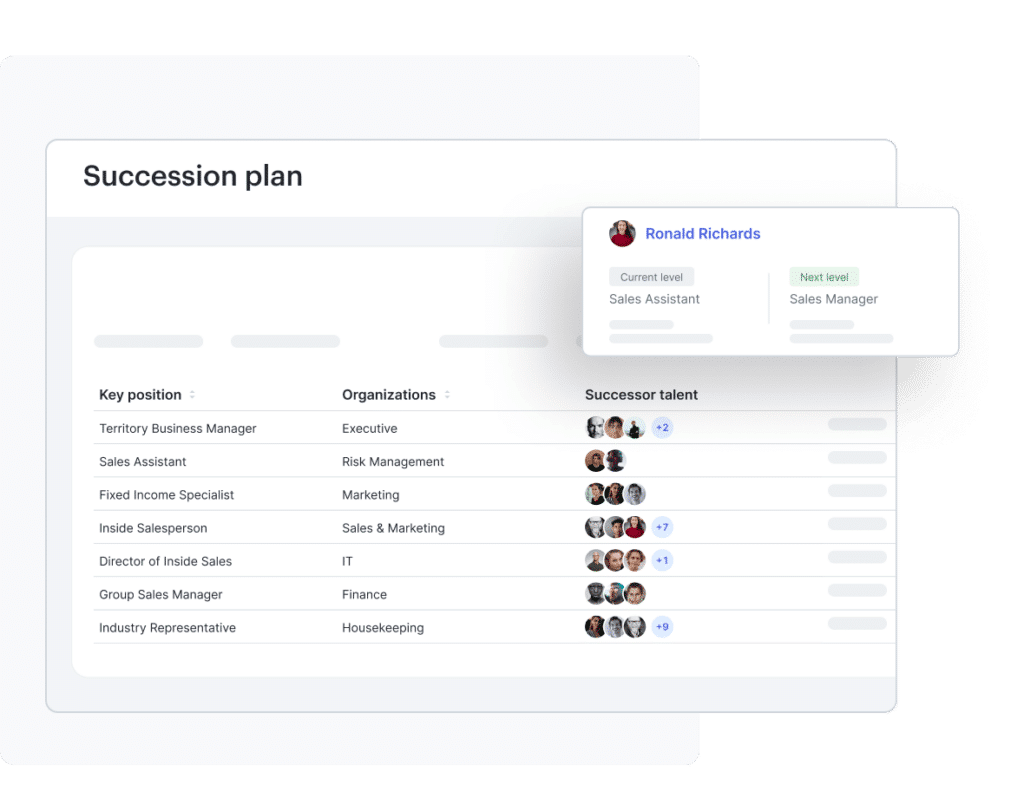
- Conduct more organized offboarding processes with digital offboarding checklists, resignation workflows, and integrated exit interview tracking
- Monitor employee performance continuously through goal management, feedback cycles, performance reviews, and development tracking
- Improve workforce visibility through centralized employee data, attendance tracking, payroll integration, and organizational reporting
- Identify workload imbalances and potential burnout risks earlier through workforce monitoring and productivity insights
- Support learning and capability development through integrated employee training and development management
- Create more consistent employee experiences through self-service HR processes and centralized workforce administration
By managing workforce processes within a single integrated system, organizations gain stronger visibility into employee lifecycle trends and can take earlier action before attrition begins affecting operational stability.
Workforce decisions become more data-driven, leadership alignment becomes more consistent, and retention strategies become easier to execute across teams and regions.
Interested in strengthening your employee retention strategy with a more integrated approach?
Schedule a demo with our team and explore how Mekari Talenta can help reduce attrition risk and improve workforce stability.
Reference
Frequently Asked Questions (FAQs)
What is considered a healthy employee attrition rate?
What is considered a healthy employee attrition rate?
A healthy attrition rate varies depending on industry, workforce structure, and business model. Roles with high specialization or long onboarding periods usually require lower attrition tolerance because replacement takes longer and operational disruption becomes more costly.
In practice, a stable 12% attrition rate can be healthier than a volatile 7% rate if the lower number hides concentrated exits among high performers or critical teams.
Some organizations may sustain moderate attrition in transactional roles while maintaining stricter retention targets for leadership or critical operational functions. The most important factor is whether attrition remains stable and manageable without affecting productivity or continuity.
Which departments are usually most vulnerable to employee attrition?
Which departments are usually most vulnerable to employee attrition?
Departments with consistently high workloads, repetitive operational pressure, or limited career mobility tend to experience higher attrition. Customer support, sales, operational delivery, and middle management functions are often more vulnerable because employees face both performance pressure and emotional fatigue over long periods. Teams undergoing repeated organizational changes or leadership instability also face higher attrition risk. The impact becomes more severe when attrition concentrates within highly specialized or revenue-driving functions.
How often should organizations review attrition data?
How often should organizations review attrition data?
Most organizations review attrition monthly or quarterly, but high-growth or rapidly changing environments may require more frequent monitoring. Annual reviews are usually too slow to detect emerging workforce risks early enough. Attrition analysis becomes more effective when combined with hiring trends, engagement movement, internal mobility, and productivity indicators. Continuous monitoring helps leadership teams identify operational issues before resignation patterns spread across larger workforce segments.
Can high employee engagement fully prevent attrition?
Can high employee engagement fully prevent attrition?
High engagement can reduce attrition risk significantly, but it cannot eliminate workforce exits entirely. Employees may still leave because of relocation, career shifts, compensation opportunities, or personal priorities outside organizational control. However, strong engagement often improves retention among high performers and increases workforce stability during periods of change. Organizations with stronger engagement levels also tend to recover faster from workforce disruption because trust and collaboration remain stronger internally.
Why is voluntary attrition often more concerning than involuntary attrition?
Why is voluntary attrition often more concerning than involuntary attrition?
Voluntary attrition usually reflects employee choice, which makes it a stronger indicator of workforce sentiment and organizational health. When high-performing employees resign voluntarily, organizations risk losing institutional knowledge, leadership potential, and operational continuity simultaneously. Voluntary exits can also influence remaining employees, especially when resignations occur repeatedly within the same team or under the same manager. Involuntary attrition, by comparison, is often more controlled because it aligns with organizational decisions or restructuring priorities.
Mengapa penting menganalisis employee attrition bagi perusahaan?
Mengapa penting menganalisis employee attrition bagi perusahaan?
Menganalisis employee attrition penting untuk memahami tren karyawan dan dampaknya terhadap organisasi. Hal ini membantu perusahaan dalam perencanaan sumber daya manusia, meningkatkan budaya organisasi, dan mengidentifikasi masalah operasional yang mungkin ada.
Bagaimana cara mengurangi dampak negatif dari employee attrition?
Bagaimana cara mengurangi dampak negatif dari employee attrition?
Untuk mengurangi dampak negatif employee attrition, perusahaan dapat menciptakan lingkungan kerja yang inklusif dan sehat, memenuhi kebutuhan karyawan, serta melakukan exit interview untuk memahami alasan di balik pengunduran diri. Penggunaan alat analisis HR juga dapat membantu mengelola kebutuhan tenaga kerja secara lebih efektif.