

16 Types of Empoloyee Training Program to Drive Performance Growth


-
Employee training is a structured development process designed to improve workforce capability, operational readiness, decision-making quality, and long-term business performance.
-
The most common training types include technical training, compliance training, leadership training, onboarding, mentoring, coaching, cybersecurity training, upskilling, and more.
As workforce structures become more distributed, operationally interconnected, and technology-driven, training decisions now influence far more than individual employee capability.
Delays in system adoption, inconsistent execution standards, weak managerial readiness, and poor cross-functional coordination often trace back to ineffective learning strategies rather than purely operational issues.
Companies that scale successfully usually treat employee training as part of workforce infrastructure because capability gaps directly affect productivity, compliance stability, customer experience, and long-term organizational resilience.
This is why modern training programs increasingly combine technical learning, behavioral development, leadership preparation, and continuous capability building across different levels of the organization.
This article will discuss what employee training is, its benefits, 16 commonly used employee training types, and practical ways to choose the right training strategy based on business needs.
What Is Employee Training?
Employee training is a structured process designed to build the knowledge, technical capability, decision-making ability, and operational readiness employees need to perform effectively within their roles and adapt to evolving business demands.
In modern organizations, training is closely tied to workforce productivity, compliance consistency, leadership continuity, and long-term business scalability.
Effective employee training goes far beyond onboarding sessions or mandatory learning modules. It shapes how teams execute processes, respond to operational risks, collaborate across functions, and maintain service quality under changing business conditions.
Strong training frameworks also support succession readiness, workforce mobility, and sustainable retention by giving them a clearer growth path inside the company.
Today, training programs increasingly integrate digital learning systems, role-based competency mapping, and continuous upskilling and reskilling initiatives to ensure workforce capability remains aligned with market shifts, automation, and organizational transformation.
In many organizations, structured learning programs are also positioned as part of the overall employee benefit strategy to strengthen workforce engagement and long-term retention.
Read also: 30 Types of Employee Benefits for Competitive Talent Advantage
Benefits of Employee Training
Well-structured employee training creates a direct impact on operational consistency, workforce capability, leadership readiness, and long-term business stability.
As organizations scale, training becomes closely connected to productivity, collaboration quality, compliance execution, and employee engagement across departments.
1. Improves Productivity and Operational Accuracy
Employees who clearly understand workflows, systems, and performance expectations tend to execute tasks faster with fewer operational errors.
This becomes especially important in environments where teams handle multiple processes, approvals, and cross-functional coordination daily.
This explains why many organizations now treat training budgets as operational investments tied directly to efficiency and business output rather than administrative expenses.
2. Strengthens Employee Retention and Internal Mobility
Career stagnation remains one of the most common drivers of employee retention, especially among high-performing employees seeking long-term growth opportunities.
Training programs help employees see a clearer future within the organization while preparing them for broader responsibilities.
In many cases, strong development programs also create healthier internal promotion pipelines, reducing dependency on external hiring for mid-level and leadership roles.
3. Supports Workforce Adaptability During Business Change
Operational priorities, digital systems, compliance requirements, and customer expectations continue evolving rapidly. Without continuous learning, teams often struggle to maintain consistency during periods of organizational change.
This is increasingly relevant as companies accelerate digital transformation and automation initiatives.
For this reason, many companies now prioritize continuous upskilling and reskilling initiatives to ensure workforce readiness keeps pace with business transformation.
4. Improves Employee Engagement and Workplace Experience
Training also influences how employees feel about their daily work environment. Employees who receive proper guidance and development opportunities often demonstrate stronger confidence, collaboration quality, and ownership over their responsibilities.
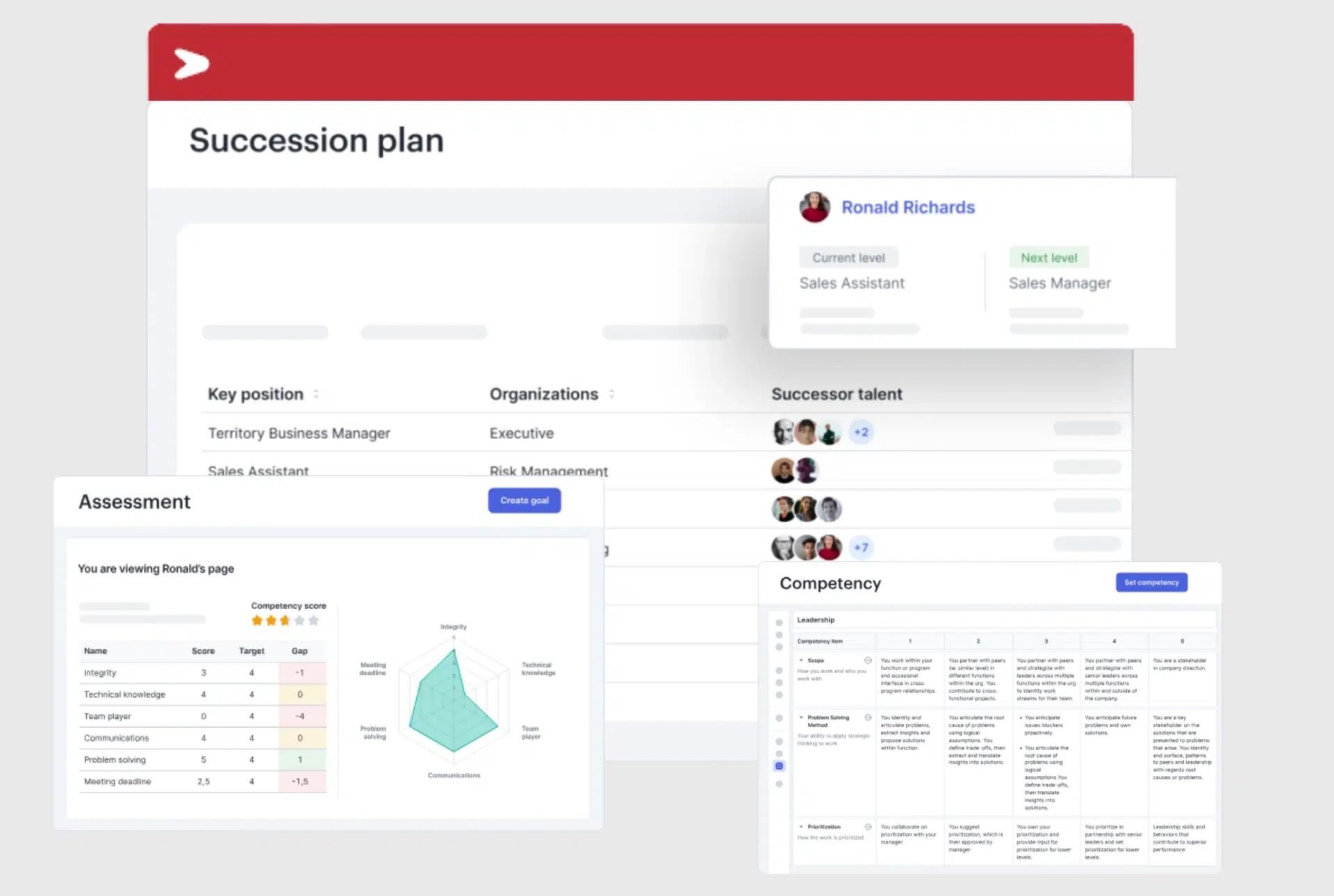
This is why many organizations integrate learning programs with coaching, leadership development, mentoring, and even BARS-based performance evaluation frameworks to create a more sustainable and measurable development culture.
16 Types of Employee Training Commonly Used
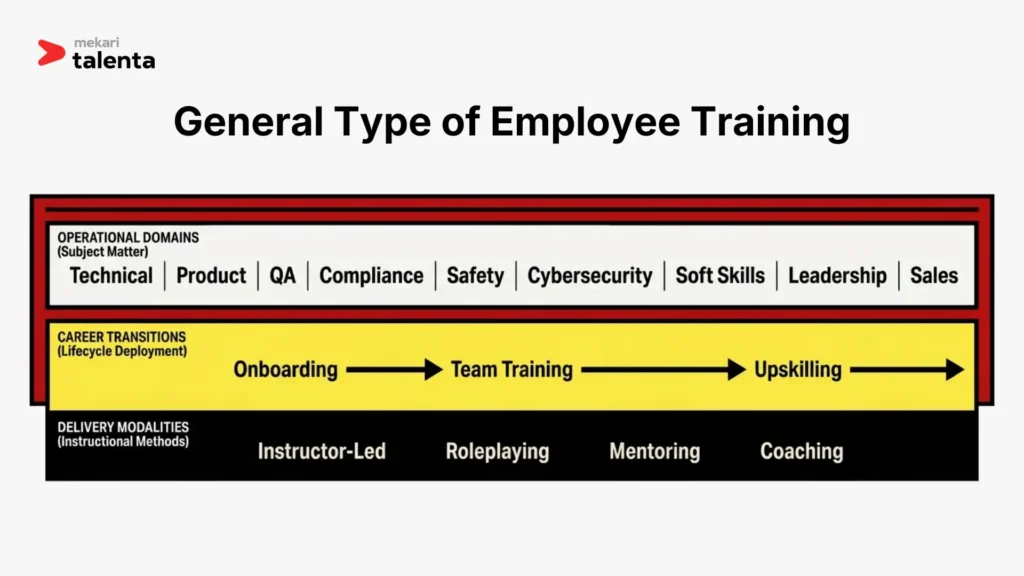
Different training methods serve different operational goals. Some focus on technical execution, while others strengthen leadership capability, communication quality, compliance consistency, or workforce adaptability.
In practice, most organizations combine multiple training types to support both short-term operational needs and long-term workforce development.
1. Technical Training
Technical training focuses on helping employees master specific tools, systems, platforms, or operational procedures required for their roles.
This type of training is commonly used for software adoption, machinery operations, payroll systems, data management, analytics tools, and workflow automation platforms.
Strong technical capability reduces execution errors and improves process consistency across teams. Many organizations also use technical training to accelerate digital transformation initiatives and system migration projects.
2. Soft Skills Training
Soft skills training develops interpersonal capabilities such as communication, collaboration, negotiation, adaptability, emotional intelligence, and problem-solving.
These skills heavily influence how employees interact with clients, managers, and cross-functional teams in daily operations. Poor soft skills often create operational friction even when technical capability is strong.
As organizations become more collaborative and matrix-based, soft skills training becomes increasingly important for maintaining productivity and workplace cohesion.
3. Compliance Training
Compliance training ensures employees understand legal requirements, company policies, industry regulations, and operational standards that must be followed consistently.
Topics commonly include labor regulations, workplace conduct, anti-harassment policies, payroll compliance, privacy protection, and internal governance procedures.
This training helps reduce legal exposure, audit risks, and operational inconsistencies. In highly regulated industries, compliance training is usually conducted periodically to keep employees aligned with evolving regulations.
4. Product Training
Product training helps employees understand company products, services, features, operational value, and customer use cases in greater depth.
It is commonly provided to sales, support, marketing, and customer success teams to ensure consistent communication with clients and stakeholders.
Strong product understanding improves customer confidence and reduces misinformation during client interactions.
Organizations also use product training to accelerate go-to-market readiness whenever new products or features are launched.
5. Leadership Training
Leadership training prepares employees to handle managerial responsibilities, decision-making, delegation, conflict resolution, and team development more effectively. This type of training is commonly used for succession planning and internal leadership pipeline development.
Many organizations begin leadership development long before employees formally enter management positions.
Effective leadership training also strengthens organizational stability during periods of rapid growth or structural change.
6. Safety Training
Safety training is designed to reduce workplace accidents, operational hazards, and health-related risks. It is particularly important in industries involving manufacturing, logistics, construction, healthcare, field operations, or heavy equipment usage.
Employees are trained on emergency procedures, hazard prevention, equipment handling, and workplace safety protocols.
Strong safety training programs also help organizations maintain regulatory compliance and reduce operational downtime caused by incidents.
7. Sales Training
Sales training helps employees improve prospecting, negotiation, objection handling, relationship management, and closing techniques.
Modern sales training often combines consultative selling, customer psychology, and data-driven sales approaches. This training also helps align sales teams with changing buyer behavior and market expectations.
In many organizations, sales training is conducted continuously to maintain competitiveness and revenue performance.

8. Onboarding Training
Onboarding training is designed to help new employees become operationally ready as quickly as possible after joining the company.
Effective onboarding goes beyond company introductions or orientation sessions. It typically includes system access setup, workflow familiarization, reporting structures, approval processes, compliance requirements, communication protocols, and role-specific operational training.
In many organizations, onboarding failure becomes visible within the first three months through delayed productivity, repeated operational mistakes, dependency on supervisors, and early employee attrition.
This is why mature onboarding programs usually involve structured 30-60-90 day milestones, manager check-ins, training documentation, and measurable readiness indicators instead of relying solely on informal guidance from team members.
Strong onboarding programs also play an important role in shaping early-stage employee experience, particularly during the first few months when employees are adapting to new workflows, reporting structures, and performance expectations.
Read also: Employee Onboarding: Process, Best Practices & Guide
9. Roleplaying Training
Roleplaying training uses simulated business scenarios to train employees on how to respond in high-pressure, high-risk, or communication-sensitive situations before they encounter them in actual operations.
Rather than focusing on theory, this training emphasizes behavioral execution, decision-making quality, and response consistency under realistic conditions.
For example, sales teams may practice objection handling during procurement negotiations, while managers simulate difficult employee performance review conversations or conflict resolution scenarios.
Customer service teams often use roleplaying to handle escalation cases, frustrated clients, or service recovery situations.
The main value of this method lies in exposing employees to operational pressure safely while allowing managers to observe communication gaps, judgment quality, and behavioral patterns that are often difficult to identify through standard classroom training alone.
10. Quality Assurance Training
Quality assurance training focuses on maintaining operational consistency, reducing process deviations, and ensuring outputs meet predefined standards across teams and departments.
This training is especially critical in environments where even small execution errors can create financial loss, compliance exposure, customer dissatisfaction, or operational disruption.
Employees are usually trained on process checkpoints, documentation standards, escalation procedures, audit preparation, and error identification methods relevant to their functions.
In customer-facing operations, QA training may include service consistency scoring and call evaluation standards. In manufacturing or payroll environments, it often involves accuracy controls, reconciliation procedures, and approval validation processes.
Strong QA training also helps organizations create measurable accountability frameworks instead of relying solely on managerial supervision to maintain quality.
11. Team Training
Team training is intended to improve how employees coordinate, communicate, and execute responsibilities collectively within shared operational workflows.
Many operational problems are not caused by lack of individual competence, but by poor coordination between teams handling interconnected responsibilities.
This type of training often focuses on cross-functional collaboration, communication alignment, workflow dependencies, escalation handling, and decision-making clarity between departments.
For example, finance, payroll, and HR teams may require joint training to reduce payroll reconciliation issues caused by incomplete employee data updates or delayed approval flows.
12. Instructor-Led Training
Instructor-led training involves structured learning sessions conducted directly by trainers, consultants, managers, or subject matter experts who guide employees through materials in real time.
This format is commonly used when organizations need deeper explanation, immediate discussion, or direct supervision during the learning process.
It is particularly effective for operationally sensitive topics such as system implementation, compliance updates, leadership development, cybersecurity awareness, and policy changes that require detailed interpretation rather than passive learning.
Experienced instructors also provide practical context that employees often cannot obtain through self-paced learning modules alone, including operational examples, implementation challenges, and real-world case handling.
13. Mentoring
Mentoring is a long-term development approach where experienced employees guide less experienced employees through practical knowledge sharing, career development support, and operational decision-making.
Unlike formal training programs that focus on standardized materials, mentoring transfers institutional knowledge that is often undocumented but highly valuable in day-to-day operations.
This type of training is commonly used for leadership preparation, succession planning, and accelerating readiness for strategic roles.
Senior employees typically help mentees navigate stakeholder management, business communication, operational prioritization, and organizational dynamics that are difficult to learn through technical training alone.
14. Cybersecurity Training
Cybersecurity training educates employees on how to identify, prevent, and respond to digital security threats that may compromise company systems, financial data, or sensitive employee information.
As organizations rely more heavily on cloud-based platforms, remote access systems, and integrated business applications, employee behavior becomes one of the most critical components of security protection.
Training topics usually include phishing detection, password management, access control procedures, suspicious link identification, device security, and data handling protocols.
Many cybersecurity incidents originate from relatively simple human errors such as credential sharing, weak passwords, or accidental exposure of confidential files.
Because of this, cybersecurity training is no longer limited to IT teams and is increasingly conducted company-wide, particularly for employees handling payroll data, financial approvals, or customer information.
15. Coaching
Coaching focuses on improving individual employee performance through continuous guidance, structured feedback, and targeted capability development.
Compared to traditional classroom training, coaching is usually more personalized because it addresses specific performance gaps, behavioral patterns, or leadership challenges experienced by an employee.
Managers commonly use coaching to improve communication quality, strengthen decision-making, increase accountability, or support employees undergoing role transitions.
Coaching is also frequently applied during performance improvement plan implementation when organizations need measurable behavioral and operational improvement within a defined period.
Effective coaching relies heavily on observation quality, feedback consistency, and follow-up discussions rather than one-time training sessions.
Read also: What Is Coaching for Employees? – A guide to Build High-Impact Teams
16. Upskilling
Upskilling helps employees develop new competencies that allow them to remain effective as business needs, technologies, and operational processes evolve.
Rather than replacing existing employees with external hires whenever capability gaps emerge, many organizations now prioritize developing internal talent through structured learning initiatives.
Upskilling programs commonly focus on digital systems, data literacy, automation tools, analytics capability, project management, and leadership readiness.
This approach helps organizations maintain workforce agility while supporting long-term employee retention through clearer career growth opportunities.
In practice, successful upskilling initiatives usually require close alignment between workforce planning, business transformation priorities, and future capability requirements rather than generic training catalogs.
Read also: Upskilling and Reskilling: Building a Future-Ready Workforce
Best Practices for Choosing Employee Training Based on Company Needs
Selecting the right training program requires more than identifying trending learning topics or purchasing generic courses from external vendors.
Effective training decisions are usually tied closely to operational priorities, workforce capability gaps, business expansion plans, and long-term organizational objectives.
Below are several practical approaches commonly used when determining which employee training programs deliver the strongest impact.
1. Start With Operational Problems, Not Training Requests
One of the most common mistakes in corporate learning initiatives is approving training solely because managers request it.
In many cases, the actual issue is unclear workflows, unrealistic KPIs, weak supervision, poor system adoption, or process bottlenecks rather than lack of employee capability.
Before selecting any training program, identify the operational symptoms first:
- repeated execution errors
- slow approval cycles
- declining productivity
- inconsistent customer handling
- leadership bottlenecks
- poor cross-functional coordination
- rising compliance issues
This approach helps HR distinguish whether employees truly need training, process redesign, managerial intervention, or system improvements.
Strong HR teams usually conduct discussions with department heads and operational managers before finalizing training priorities to avoid wasting budget on programs that do not solve the root problem.
2. Separate Immediate Skill Gaps From Long-Term Capability Building
Not all training serves the same business purpose. Some training programs address urgent operational weaknesses, while others prepare the workforce for future organizational needs.
For example, cybersecurity training may become urgent after a phishing incident or data governance audit finding. Meanwhile, leadership development or upskilling initiatives are often designed to support succession planning and future workforce readiness over several years.
Organizations that manage training effectively usually divide learning priorities into two categories:
- operational continuity needs
- strategic capability development
This distinction helps prevent training calendars from becoming overloaded with short-term reactive programs while neglecting long-term workforce sustainability.
Organizations that consistently invest in long-term workforce capability development also tend to strengthen employer credibility in the market, reducing excessive dependence on external talent aquisition efforts for strategic and leadership roles.
3. Match Training Methods With Operational Reality
Training effectiveness depends heavily on whether the delivery method fits actual working conditions. Many programs fail because companies choose convenient training formats rather than formats suitable for operational realities.
For example, field employees and shift-based workers often struggle with long instructor-led sessions scheduled during operational hours.
In these situations, shorter mobile learning modules, microlearning sessions, or blended learning approaches are often more effective.
Meanwhile, leadership and managerial development usually benefit more from mentoring, coaching, roleplaying, and case-based discussion rather than passive eLearning modules.
Experienced HR leaders rarely standardize one training method for all departments because workforce conditions, learning behavior, and operational pressure vary significantly across functions.
4. Prioritize Roles With High Operational Impact
Training budgets are rarely unlimited, which means prioritization becomes critical. Instead of distributing training evenly across all employees, many organizations focus first on positions that directly influence operational continuity, revenue generation, compliance exposure, or workforce stability.
These roles often include:
- frontline managers
- payroll and finance teams
- customer-facing employees
- technical specialists
- compliance-sensitive positions
- supervisors managing large teams
This approach creates faster operational impact because improvements in high-leverage roles tend to influence broader organizational performance more quickly.
5. Use Performance Data Before Selecting Training Topics
Strong training decisions are usually supported by operational and workforce data rather than assumptions. HR teams that rely solely on manager opinions often overlook deeper capability patterns across departments.
Useful indicators may include employee performance review outcomes, productivity trends, audit findings, customer complaints, onboarding failure rates, or internal mobility data.
For example, if multiple departments consistently struggle with delegation quality and escalation handling, leadership training may create greater impact than technical training.
Using measurable performance indicators also helps HR justify training investments more effectively to leadership teams because learning priorities are tied directly to operational evidence.
6. Evaluate Whether Managers Can Reinforce the Training
Training rarely creates sustainable improvement if managers do not reinforce new behaviors after employees return to daily operations.
Many employees complete training programs successfully but eventually return to old habits because operational expectations remain unchanged.
Before launching major training initiatives, organizations should assess whether managers are prepared to:
- monitor behavioral changes
- provide follow-up coaching
- adjust workflows if needed
- reinforce accountability consistently
This is especially important for soft skills, leadership, coaching, and communication-related programs where long-term behavioral reinforcement matters more than training attendance itself.
7. Build Training Around Business Changes, Not Annual Calendars
Many companies still design training programs once per year based on fixed annual schedules. In practice, workforce capability requirements can shift much faster due to system implementation, organizational restructuring, regional expansion, compliance changes, or automation initiatives.
More mature organizations continuously reassess training priorities based on evolving operational conditions. For example, after implementing new HRIS systems, training priorities may shift toward digital adoption, data accuracy, and workflow governance.
During rapid expansion periods, onboarding standardization and managerial capability training often become more urgent.
Aligning training strategy with business transformation efforts allows organizations to maintain workforce readiness without waiting for yearly training cycles to catch up with operational realities.

Reference
Forbes — Employee Training As A Strategic Investment For Long-Term Growth
Frequently Asked Questions (FAQs)
How often should companies conduct employee training?
How often should companies conduct employee training?
Training frequency depends heavily on operational complexity, industry regulations, workforce turnover, and business transformation pace. Compliance and cybersecurity training are often conducted annually or semi-annually, while technical and operational training may occur whenever systems, workflows, or policies change. Leadership development and coaching programs are usually continuous because managerial capability evolves over time. Many organizations also reassess training priorities quarterly instead of relying solely on yearly learning calendars.
What is the difference between training and employee development?
What is the difference between training and employee development?
Training usually focuses on improving specific skills or operational capabilities required for current responsibilities. Employee development has a broader objective because it prepares employees for future roles, leadership responsibilities, and long-term career progression. For example, payroll system training helps employees execute current tasks more effectively, while leadership mentoring prepares them for managerial positions in the future. Both are interconnected but serve different organizational purposes.
What are common signs that employees need additional training?
What are common signs that employees need additional training?
Recurring operational errors, delayed project execution, inconsistent customer handling, weak system adoption, repeated compliance issues, and heavy dependency on supervisors are some of the most common indicators. Companies may also identify capability gaps through audit findings, onboarding failure rates, or declining team productivity trends. In some situations, increased employee frustration or communication breakdown between departments also signals the need for training intervention. Strong organizations typically combine operational data and manager observations to identify these issues early.
Should companies prioritize internal or external trainers?
Should companies prioritize internal or external trainers?
The decision depends on the type of capability being developed. Internal trainers usually work better for operational procedures, company systems, workflow alignment, and organization-specific processes because they understand internal realities more deeply. External trainers are often more effective for leadership development, industry certifications, specialized technical topics, or strategic transformation initiatives that require broader external expertise. Many organizations combine both approaches to balance operational relevance with outside perspective.
How can companies measure whether training is effective?
How can companies measure whether training is effective?
Training effectiveness should be evaluated using measurable operational outcomes rather than attendance rates alone. Common indicators include productivity improvement, reduction in operational errors, faster onboarding readiness, stronger audit results, improved customer satisfaction, and higher managerial effectiveness. Some organizations also compare pre-training and post-training performance metrics to assess behavioral or capability changes more accurately. Long-term measurement is particularly important for leadership, coaching, and soft skills development programs where impact often appears gradually over time.