

Employee Retention: Driving Growth Through Talent Sustainability

- Employee retention is an organization’s ability to keep employees engaged, productive, and aligned over time.
- Companies strategy to improve retention is by creating clear career paths, strengthening manager capability, and using data to identify early attrition risks.
Employee retention has become one of the primary challenges in modern organizations, as retaining talent is now just as critical as recruiting new talent.
High turnover is no longer just an HR concern, as its impact is directly felt in business costs, team workload, and operational stability.
When employees leave, organizations lose more than headcount. They also lose accumulated knowledge, contextual understanding of the business, internal relationships, and established productivity.
This article explores the definition of employee retention, its objectives, why it matters, the key causes of low retention, and how to measure and improve retention more strategically.
What is Employee Retention?
Employee retention refers to an organization’s ability to retain its employees over a sustained period while maintaining their productivity, engagement, and alignment with business goals.
It reflects how effectively a company creates conditions where employees choose to stay and continue contributing at a high level.
In practice, retention is closely tied to the entire employee lifecycle. It begins from employee onboarding, where early experiences shape expectations and commitment, and continues through performance management, career progression, and long-term development.
Each stage plays a role in influencing whether employees remain engaged and see a future within the organization.
Retention is often misunderstood as simply keeping employees from leaving. In reality, it is about maintaining a workforce that is both stable and performing.
An employee who stays but is disengaged or underperforming introduces hidden costs such as reduced productivity, lower team morale, and increased management effort.
This is why retention must always be evaluated alongside employee engagement and performance outcomes, including insights gathered through structured processes like performance appraisal.
It is also important to distinguish retention from turnover. Employee retention focuses on the ability to keep valuable talent, while employee turnover measures the rate at which employees leave the organization.
A certain level of turnover is expected and can even be healthy when it involves low performers or misaligned roles. The objective is to retain high-impact employees while managing overall workforce quality.
Read also: Employee Lifecycle Management: Definition, Stages, and Tips
Why is Employee Retention Important?
Employee retention has a direct impact on operational stability, cost efficiency, and long-term business performance.
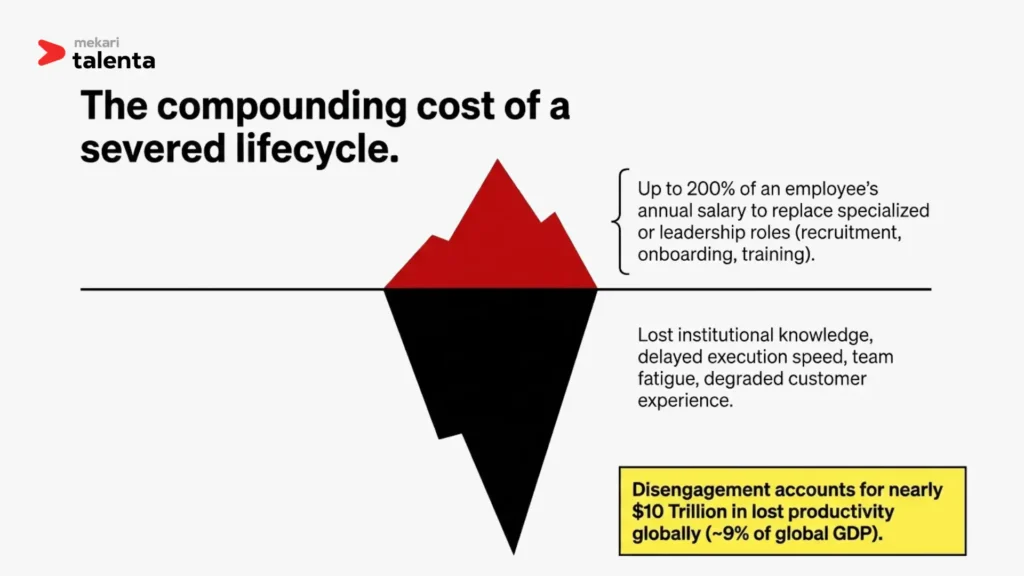
When retention is well managed, teams maintain continuity, institutional knowledge is preserved, and execution becomes more consistent across functions. When it is neglected, the impact quickly compounds across cost, productivity, and customer outcomes.
Below are the key reasons why retention requires continuous attention:
1. High Cost of Turnover
Employee turnover creates both direct and indirect costs that are often underestimated.
Direct costs include employee recruitment, onboarding, and training investments required to bring new hires up to speed.
Indirect costs are more difficult to quantify but equally significant, including lost productivity, delayed projects, and the time managers spend supporting new employees.
The financial impact becomes more pronounced at senior levels. Replacing experienced employees often involves longer hiring cycles, higher compensation benchmarks, and extended ramp-up periods.
2. Impact on Team Workload and Morale
When employees leave, their responsibilities do not disappear. Work is typically redistributed across remaining team members, increasing workload and pressure.
Over time, this creates a cycle where high performers absorb additional responsibilities, leading to fatigue and reduced engagement.
Teams operating under sustained pressure often experience declining morale, lower collaboration quality, and increased risk of burnout.
Managers who have experienced repeated attrition within a team often see a noticeable drop in energy and ownership, even among previously strong performers.
3. Risk of Losing High-Quality Talent
Losing employees means losing accumulated knowledge, skills, and contextual understanding of the business. This includes both technical expertise and informal knowledge such as stakeholder relationships and internal processes.
High-performing employees are particularly at risk because they tend to have more external opportunities. When these individuals leave, the gap is not easily filled, and the impact is felt immediately in execution quality and leadership continuity.
Retention efforts that fail to differentiate between performance levels often result in the loss of the very individuals who drive the most value.
4. Impact on Customer Experience
Employee retention has a direct relationship with customer experience, especially in roles that interact closely with clients or users.
Frequent turnover disrupts consistency in service delivery. New employees require time to build product knowledge, understand customer expectations, and develop communication effectiveness. During this transition, service quality often fluctuates.
This means that stable teams are better positioned to build long-term relationships, maintain service standards, and respond effectively to customer needs.
5. Relevance to Business Growth
Retention is closely linked to productivity, execution speed, and overall business performance. Organizations that maintain stable, high-performing teams are able to scale more effectively because they spend less time replacing talent and more time advancing strategic priorities.
Low retention creates continuous disruption. Teams operate in a constant state of rebuilding, which slows down decision-making and reduces overall output.
On a broader scale, low engagement and poor retention contribute to significant economic loss.
In this context, employee retention becomes more than a workforce metric. It serves as a leading indicator of whether the organization can sustain performance and growth over time.
Benefits of Employee Retention
While the importance of retention highlights the risks of losing employees, the benefits focus on the measurable advantages gained when employees stay, perform, and grow within the organization.
Strong retention creates a compounding effect where stability, capability, and culture reinforce each other over time.
Below are the key benefits observed in organizations with strong retention practices:
1. Higher Workforce Productivity and Efficiency
Employees who stay longer develop deeper role mastery, stronger internal networks, and better understanding of business processes. This reduces the time needed for coordination, decision-making, and execution.
In practice, experienced teams move faster with fewer errors. They require less supervision and are able to anticipate challenges before they escalate. This creates a level of operational efficiency that cannot be replicated through constant hiring.
2. Stronger Talent Development and Internal Mobility
Retention enables organizations to invest in long-term talent development with confidence. Employees who remain in the organization can be systematically developed through structured programs, stretch assignments, and leadership exposure.
Over time, this builds a reliable internal pipeline for critical roles. Instead of relying heavily on external hiring, organizations can promote from within, reducing risk and improving continuity.
A common pattern in high-retention environments is the presence of clearly defined growth paths supported by framework such as an individual development plan or tool like a learning management system, ensuring development efforts are structured and trackable.
3. More Effective Workforce Planning
Stable retention provides predictable workforce data, which improves planning accuracy. Leaders can make more informed decisions around capacity, succession, and future hiring needs.
When retention is low, workforce planning becomes reactive. Teams are forced to fill urgent gaps rather than strategically building capabilities.
Strong retention shifts this dynamic toward proactive planning, where talent decisions are based on long-term priorities rather than immediate shortages.
Read also: Strategic Workforce Planning: Benefits and Implementation
4. Improved Organizational Knowledge and Capability
Employees accumulate both formal knowledge and informal context over time. This includes understanding of systems, processes, stakeholder dynamics, and historical decisions.
Retention preserves this knowledge within the organization. Teams with low attrition tend to have stronger problem-solving capabilities because they can draw from past experiences and established practices.
Loss of knowledge, on the other hand, often leads to repeated mistakes, slower onboarding, and inconsistent execution.
5. Stronger Employer Positioning in the Talent Market
Organizations known for retaining employees tend to build stronger employer branding over time. Candidates pay attention to tenure patterns, internal mobility opportunities, and how employees grow within the company.
High retention signals stability, career growth, and a positive work environment. This makes it easier to attract high-quality candidates and reduces dependency on aggressive hiring strategies.
In competitive talent markets, reputation becomes a decisive factor. Retention plays a key role in shaping that perception.
6. Better Alignment Between Performance and Business Outcomes
When employees stay and grow within the organization, performance management becomes more meaningful. Managers are able to evaluate performance over time, identify patterns, and make more accurate decisions.
This is where structured processes such as management by objective and consistent goal alignment contribute to stronger outcomes. Employees understand expectations more clearly, and their contributions become more directly linked to business results.
Over time, this alignment strengthens accountability and ensures that performance translates into measurable impact.
What Does Employee Leave? Key Causes of Employee Attrition that Lower Retention
Understanding why employees leave requires looking beyond assumptions and examining actual workforce data.
Insights from the 2024 Gallup Employee Retention and Attraction survey show that attrition is driven by a combination of structural, personal, and managerial factors.
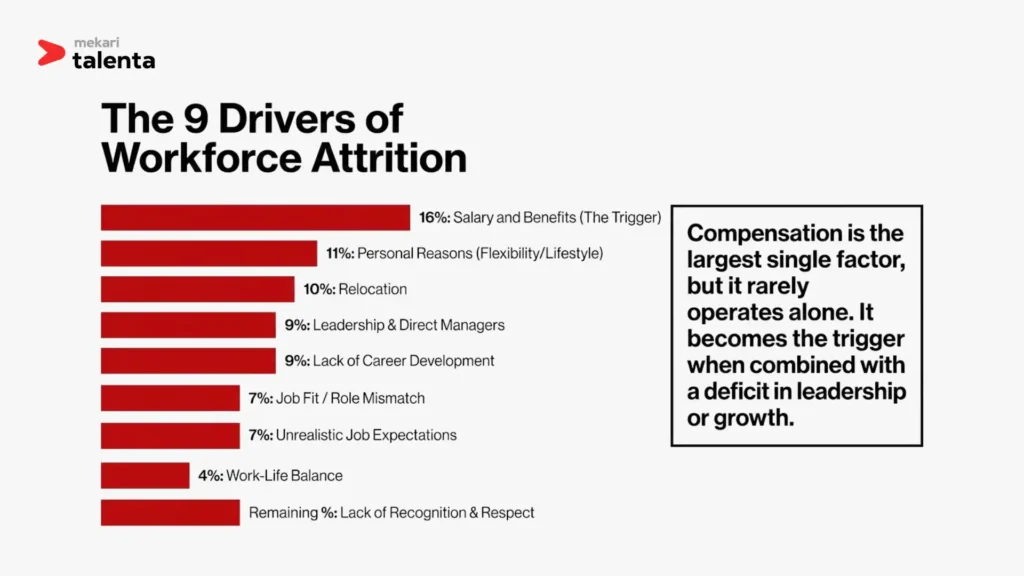
These causes rarely exist in isolation and often compound over time, creating a tipping point that leads to resignation.
Below are the most common drivers of employee attrition:
1. Salary and Benefits
Compensation remains the most cited reason for leaving, with around 16% of respondents identifying it as their primary driver.
While this makes it the single largest factor, it rarely operates alone. Employees often tolerate compensation gaps when other elements such as growth, leadership, or work environment are strong. Compensation becomes a trigger when combined with dissatisfaction in other areas.
In practice, organizations that rely solely on salary adjustments to retain employees often see short-term improvements without long-term impact.
2. Personal Reasons
Personal factors have become more prominent, rising to 11% in 2024 from 9% in 2023.
This shift reflects changing priorities around flexibility, family needs, health, and lifestyle preferences. Employees are increasingly making decisions based on how work fits into their broader life context.
Retention strategies that ignore these evolving expectations tend to fall behind, especially in roles where flexibility can be offered but is not.
3. Relocation
Location-related factors remain stable at around 10% since 2023.
Mobility, commuting challenges, and geographic preferences continue to influence employee decisions. Even with the rise of remote work, location still matters, particularly for roles that require physical presence or hybrid arrangements.
Organizations that provide flexibility in work location often reduce this risk significantly.
4. Leadership and Direct Managers
Leadership-related issues account for 9% of attrition, down from 12% in 2023, yet still highly influential.
Direct managers shape day-to-day experience through communication, feedback, and decision-making. Employees often evaluate their immediate manager more than the organization itself when deciding whether to stay.
Even a small decline in leadership quality within a team can lead to disproportionate attrition.
5. Career Development
Lack of growth opportunities continues to be a key driver, with 9% of employees citing it as a reason for leaving.
A slight decline in percentage does not reduce its importance. Employees who do not see a clear path forward tend to disengage before eventually exiting.
Organizations that embed structured growth paths, supported by talent development strategy, are more likely to retain high-potential employees over time.
6. Job Fit and Role Mismatch
Around 7% of employees leave due to misalignment between their role and expectations.
This often stems from gaps between job descriptions and actual responsibilities. When employees feel that their skills are underutilized or mismatched, dissatisfaction builds quickly.
Improving clarity during recruitment and early stages of employment reduces this risk significantly.
7. Unrealistic Job Expectations
Another 7% of respondents cite unclear or unrealistic job scope as a reason for leaving.
This issue is closely tied to role clarity. Employees who enter a role with one expectation and experience something different in practice tend to lose trust in the organization.
Clear communication of responsibilities, performance expectations, and success metrics is critical in preventing this mismatch.
8. Work-Life Balance
Concerns around work-life balance have increased from 3% in 2023 to 4% in 2024.
Although the percentage appears smaller, the trend signals growing awareness of workload sustainability and burnout. Teams operating under prolonged pressure often experience gradual disengagement that eventually leads to attrition.
Organizations that actively manage workload and provide flexibility are better positioned to address this risk.
9. Lack of Recognition and Respect
Feeling undervalued or disrespected continues to rise as a contributing factor.
This includes recognition from managers, treatment by colleagues, and the overall workplace culture. Employees who do not feel acknowledged for their contributions tend to disengage, regardless of compensation or role.
Consistent recognition and a respectful work environment are foundational elements in sustaining retention over time.
Employee Retention Models
Employee retention is not driven by a single factor. It is shaped by a combination of psychological, behavioral, and organizational dynamics that influence how employees perceive their work and their relationship with the company.
Retention models help translate these dynamics into structured frameworks that can be applied in day-to-day management.
Below are four widely used models that provide practical guidance for designing retention strategies:
1. Maslow’s Hierarchy of Needs
Maslow’s model explains that employees are motivated by a progression of needs, starting from basic security to higher-level fulfillment such as purpose and self-actualization.
In practice, retention improves when organizations address these needs in sequence. Competitive compensation and job security create a stable foundation, and a sense of belonging is built through team culture and collaboration. Higher retention is achieved when employees experience recognition, growth, and meaningful contribution.
A common gap seen in execution is focusing heavily on higher-level engagement initiatives while basic needs such as role clarity or workload stability remain unresolved. This often leads to inconsistent retention outcomes.
Read also: Deep Understanding About Employee Sense of Belonging
2. Herzberg’s Two-Factor Theory
Herzberg distinguishes between hygiene factors and motivators. Hygiene factors include salary, policies, and working conditions, while motivators relate to the nature of the work itself, such as achievement, recognition, and growth.
Retention is strongest when both elements are managed together. Adequate compensation and policies prevent dissatisfaction, while meaningful work and career progression create long-term commitment.
In real-world application, organizations that rely only on improving hygiene factors often stabilize retention temporarily.
Sustainable retention requires strengthening motivators through structured career paths, ownership of work, and visible impact.
3. Social Exchange Theory
This model views the relationship between employee and organization as a continuous exchange of value. Employees assess whether the rewards they receive are proportional to their contributions.
When employees perceive fairness in recognition, compensation, and opportunities, they are more likely to stay. When the balance shifts, disengagement increases and eventually leads to exit.
This is where consistent feedback mechanisms, recognition practices, and transparent decision-making play a critical role. Insights gathered from processes such as an exit interview often reflect breakdowns in this perceived exchange.
4. Human Capital Theory
Human Capital Theory positions employees as long-term assets whose value increases through investment in skills, knowledge, and experience.
Organizations that actively invest in employee capability building tend to see stronger retention. Employees are more likely to stay when they experience continuous growth and see clear progression opportunities.
Read also: Human Capital Management Strategy: Definition, Benefits & Examples
The Relationship Between Employee Retention and Employee Experience
Employee retention is a direct outcome of how employees experience the organization over time. Every interaction, from the first day of onboarding to ongoing performance conversations, shapes whether employees choose to stay and continue contributing.
Employee experience is not defined by isolated programs. It is built through consistent moments such as how goals are communicated, how feedback is delivered, how decisions are made, and how employees are supported in their roles. These moments accumulate and form a perception of fairness, growth, and belonging.
To understand this relationship more concretely, the connection between experience and retention can be mapped across key touchpoints:
| Employee Experience Touchpoint | What Employees Experience | Impact on Retention |
|---|---|---|
| Onboarding | Clarity of role, early support, integration into team | Strong start reduces early attrition risk |
| Goal Setting | Clear expectations and measurable targets | Increases alignment and ownership |
| Feedback & Appraisal | Regular, fair, and structured evaluation | Builds trust and long-term commitment |
| Career Development | Visibility of growth opportunities | Encourages employees to stay and grow internally |
| Leadership Interaction | Communication quality and decision transparency | Directly influences engagement and loyalty |
| Work Environment | Workload balance, collaboration, and culture | Affects daily satisfaction and sustainability |
One of the most critical links between experience and retention lies in clarity and alignment. Employees who understand what is expected of them and how their work contributes to broader goals are more likely to remain engaged.
Frameworks such as objective key results (OKR) help reinforce this clarity by connecting individual performance to business priorities in a structured way.
Another key driver is how performance is evaluated and communicated. A well-executed performance appraisal process provides transparency, recognition, and direction.
Employees who receive consistent, evidence-based feedback tend to have a stronger sense of progress and purpose, which directly influences their decision to stay.
Experience is also shaped by growth opportunities. Employees who see clear development pathways and receive support in building new capabilities are more likely to commit long term. When development is unclear or inconsistent, disengagement often follows.
In practice, retention challenges rarely appear suddenly. They build gradually through repeated gaps in experience. Organizations that actively manage employee experience across the lifecycle are better positioned to sustain retention and reduce unwanted attrition.
The Business Case for Employee Retention
Employee retention directly influences financial performance, execution stability, and long-term competitiveness. It is often treated as an HR metric, yet its impact extends into cost structure, productivity, customer outcomes, and leadership continuity.
Organizations that manage retention effectively are able to operate with greater consistency and make more reliable strategic decisions.
Retention as a Cost Control Lever
One of the most immediate impacts of retention is on cost. High attrition creates recurring expenses related to hiring, onboarding, and training. These costs are visible, but they represent only a portion of the total impact.
The larger cost comes from lost productivity during transition periods. New hires require time to reach full effectiveness, and during that period, output is often lower while errors and rework increase. For critical roles, this gap can affect entire teams and delay key initiatives.
Retention reduces these hidden costs by maintaining workforce stability and minimizing disruption.
Impact on Productivity and Execution Speed
Teams with stable membership operate differently from those with frequent turnover. They develop stronger coordination, clearer communication patterns, and a deeper understanding of internal processes.
This results in faster decision-making and more consistent execution. Projects move forward with fewer delays because less time is spent on alignment and knowledge transfer. Over time, this creates a cumulative advantage that is difficult to replicate in high-turnover environments.
Strengthening Talent Investment Returns
Organizations invest significantly in hiring, onboarding, and developing employees. Retention determines whether these investments generate long-term value.
When employees stay, the return on these investments increases as their contribution grows over time. When employees leave early, the organization absorbs the cost without realizing the full benefit.
This is particularly relevant for roles that require specialized knowledge or long ramp-up periods. Retention ensures that capability building translates into sustained performance rather than short-term output.
Supporting Leadership Pipeline and Continuity
Retention plays a critical role in building a reliable leadership pipeline. Future leaders are developed internally over time through accumulated experience and exposure.
Frequent attrition disrupts this process. Organizations are forced to rely more on external hiring, which carries higher risk and longer adjustment periods. Internal continuity is harder to maintain when key talent leaves before reaching leadership readiness.
Strong retention allows organizations to develop leaders who understand the business deeply and can operate effectively from day one in expanded roles.
Enhancing Employer Position in the Talent Market
Retention contributes to how the organization is perceived externally. Candidates often assess tenure patterns, internal mobility, and employee progression before making career decisions.
Organizations with strong retention signal stability, growth opportunities, and a supportive work environment. This strengthens employer branding and reduces dependency on aggressive hiring strategies.
A positive reputation also improves the quality of incoming candidates, creating a reinforcing cycle where strong talent attracts more strong talent.
Enabling Data-Driven Workforce Decisions
Retention data provides valuable insight into workforce dynamics. Patterns in attrition, tenure, and performance help leaders understand where risks exist and where interventions are needed.
When combined with broader workforce data, retention becomes a key input for strategic planning. Decisions related to hiring, development, and restructuring can be made with greater confidence.
Organizations that treat retention as a strategic metric rather than an operational outcome are better positioned to maintain performance, control costs, and sustain long-term growth.
How to Calculate Employee Retention: Measuring and Monitoring Retention Metrics
Measuring employee retention provides a clear view of workforce stability over a given period. Without consistent measurement, retention becomes difficult to manage, and decisions are often based on assumptions rather than data.
The most commonly used metric is the employee retention rate:
Where:
- S = number of employees at the start of the period
- E = number of employees at the end of the period
- N = number of new employees hired during the period
Example calculation:
Assume an organization starts the year with 100 employees. By the end of the year, it has 110 employees, including 30 new hires.
Retention Rate = ((110 – 30) / 100) × 100% = 80%
This means 80% of the original workforce remained over the period.
A high retention rate is generally positive, but it does not automatically indicate a healthy workforce.
Retention must be analyzed alongside performance and engagement. Retaining low-performing or disengaged employees can reduce overall productivity.
Key Retention Metrics to Monitor
Retention cannot be understood through a single metric. A more accurate view comes from analyzing multiple indicators that reveal patterns across time, roles, and performance levels.
1. Retention Rate (Overall)
This represents the percentage of employees who remain within a given period. It provides a high-level view of workforce stability and is often used for trend analysis across quarters or years.
2. Turnover Rate
Turnover rate measures the percentage of employees who leave the organization. It is typically segmented into voluntary turnover, where employees choose to leave, and involuntary turnover, such as terminations.
Tracking turnover alongside retention provides a clearer picture of workforce movement and underlying causes.
3. Retention by Tenure
This metric breaks down retention based on length of service, such as less than one year, one to three years, and beyond.
Early attrition, particularly within the first year, is a critical signal. It often indicates issues with hiring quality, role clarity, or onboarding effectiveness. Addressing early-stage retention has a disproportionate impact on overall stability.
4. Retention by Department or Manager
Retention patterns often vary across teams. Measuring retention at the department or manager level helps identify areas where issues may be concentrated.
Consistently high turnover within specific teams can point to leadership challenges, workload imbalance, or misalignment in expectations.
5. High Performer Retention
Overall retention can mask underlying risks if high-performing employees are leaving while lower performers remain.
Tracking retention specifically for top performers provides a more accurate indicator of organizational health. Retaining high-impact talent is far more critical than maintaining overall headcount stability.
Strategies and Best Practices to Improve Employee Retention
Improving employee retention requires more than isolated initiatives. It depends on how consistently expectations, development, leadership, and daily work experience are managed over time. Retention improves when multiple levers are aligned and executed with discipline.
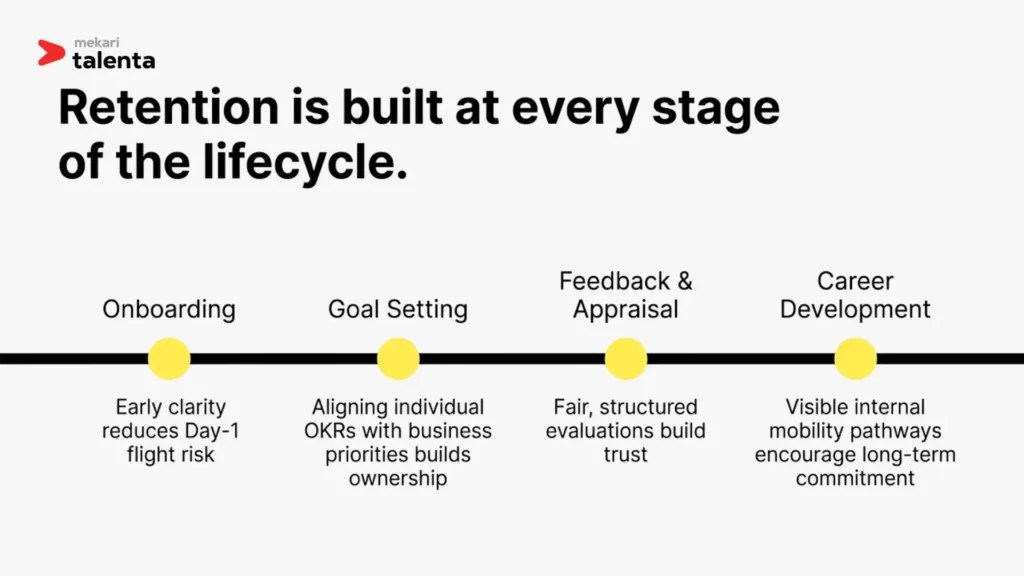
Below are ten strategies that have proven effective in real-world implementation:
1. Establish Clear Role Expectations from Day One
A significant portion of early attrition originates from unclear expectations. Employees who are unsure about priorities, success metrics, or decision boundaries tend to disengage gradually.
High-performing teams eliminate ambiguity by defining measurable outcomes from the beginning. Expectations are translated into concrete deliverables, timelines, and trade-offs.
This clarity reduces friction during performance evaluation and prevents misalignment that often leads to frustration.
2. Align Goals with Business Priorities
Retention strengthens when employees can clearly connect their work to broader business objectives. Misalignment creates a disconnect between effort and impact, which reduces motivation over time.
Organizations that embed structured goal-setting frameworks ensure that individual contributions remain relevant and visible. This alignment creates a stronger sense of ownership and reinforces accountability across teams.
3. Establish Continuous Performance Conversations
Annual reviews alone are insufficient to sustain engagement and alignment. Employees need ongoing direction, feedback, and recognition to understand their progress.
Teams that maintain regular performance conversations create a feedback loop that reduces uncertainty. A well-structured performance management system reinforces this by anchoring discussions in evidence and ensuring that evaluations are consistent and transparent.
4. Create Visible Career Growth Pathways
Uncertainty around career growth is one of the fastest triggers of disengagement. Employees who do not see a clear path forward begin to explore external opportunities, often long before resignation becomes visible.
Retention improves when career progression is defined, communicated, and revisited regularly. Growth pathways should include multiple options such as vertical progression, lateral movement, and skill-based advancement. This creates flexibility while maintaining long-term commitment.
5. Translate Development into Structured Action
Development conversations often remain conceptual without structured follow-through. Employees receive feedback but lack clear direction on how to improve.
Organizations that operationalize development convert feedback into actionable plans, typically through an individual development plan.
These plans include specific competencies to build, learning activities, and measurable milestones. Progress is monitored regularly to ensure development is actively pursued rather than deferred.
6. Strengthen Leadership Quality at the Manager Level
The quality of direct leadership has a disproportionate impact on retention. Employees evaluate their immediate manager daily through communication, decision-making, and support.
Strong organizations treat manager capability as a core priority. This includes training on expectation setting, feedback delivery, and managing performance objectively.
Teams led by capable managers consistently show higher stability, stronger engagement, and better performance outcomes.
7. Ensure Fairness Through Structured Evaluation and Calibration
Perceived fairness is a key determinant of whether employees stay or leave. Inconsistent evaluation standards quickly erode trust, even when overall policies are well designed.
Structured evaluation processes supported by calibration across teams ensure that performance is assessed consistently. This reduces bias, aligns expectations across managers, and strengthens credibility in decision-making.
8. Leverage Data to Anticipate Retention Risks
Retention challenges develop gradually and often show early signals before employees disengage fully. These signals include declining performance, reduced participation, or changes in work patterns.
Organizations that use people analytics can identify these trends early and intervene proactively. This shifts retention from a reactive process into a predictive one, allowing targeted action before attrition occurs.
9. Integrate Learning and Capability Building into Daily Work
Retention improves when employees experience continuous growth that is directly relevant to their roles. Learning that is disconnected from daily responsibilities rarely translates into meaningful capability improvement.
Organizations that embed learning into actual work assignments tend to see stronger retention outcomes. This includes stretch projects, cross-functional exposure, and increased ownership in decision-making. Employees develop faster when learning is tied to real challenges rather than isolated training sessions.
Capability building becomes more effective when it is aligned with performance expectations and future roles. When employees can clearly see how their skills are evolving and how that connects to career progression, commitment to the organization increases significantly.
10. Act on Insights from Employee Exits
Employee exits provide valuable information about underlying issues within the organization. Patterns in exit reasons often reveal gaps that are not visible through internal surveys or performance data.
A well-managed exit interview process focuses on identifying recurring themes rather than isolated feedback. The critical step lies in translating these insights into systemic improvements, ensuring that similar issues are addressed before they affect a broader group of employees.
Employee Retention Examples
Real-world retention strategies show that there is no single approach that works universally. Organizations design retention based on what they value most, whether that is performance, flexibility, or long-term development.
Below are two examples that illustrate how retention is executed in different ways:
Example 1: Netflix – High Performance Culture and Talent Density
Netflix approaches retention by focusing on maintaining a high-performing workforce rather than maximizing overall headcount stability.
The company applies a “keeper test,” where managers continuously evaluate whether an employee is someone they would actively fight to retain.
To support this, Netflix offers market-leading compensation and gives employees a high degree of autonomy in how they work. This combination creates an environment where top performers are motivated to stay and deliver strong results
The outcome is a workforce with high talent density and strong accountability. Employees understand expectations clearly and receive continuous feedback, which reinforces performance and alignment.
The trade-off is selectivity. This model accepts higher attrition among employees who do not meet performance standards, prioritizing overall team quality over retention rate alone.
Example 2: Google – Innovation Through Autonomy and Internal Opportunities
Google focuses on retention by creating an environment that supports innovation, flexibility, and internal growth.
One well-known initiative is the “80/20 rule,” where employees are allowed to spend a portion of their time working on projects outside their core responsibilities. This encourages creativity, skill development, and a sense of ownership over their work.
In addition, Google invests heavily in internal mobility and development opportunities, allowing employees to explore different roles without leaving the organization. This reduces stagnation and keeps employees engaged over the long term.
The result is a retention strategy built around growth and innovation. Employees remain because they continue to find new challenges and opportunities within the organization.
Improve Employee Retention Strategically with an Integrated HR System
Strong retention reflects how well an organization manages performance, development, and employee experience across the entire lifecycle.
To manage retention effectively, organizations need a clear understanding of turnover patterns and underlying risk factors. Without this visibility, retention efforts tend to be reactive rather than proactive.
Without an integrated system, several challenges commonly emerge. Data is fragmented across different functions, making it difficult to get a complete view of the workforce.
Early signals of resignation risk often go unnoticed. Key processes such as payroll, performance management, and engagement tracking operate separately, limiting the ability to take timely and coordinated action.
To address this, companies can leverage Mekari Talenta as an AI-powered, cloud-based HCM software that manages the employee lifecycle end to end, from employee recruitment, attendance, to performance management, compensation, and talent development.
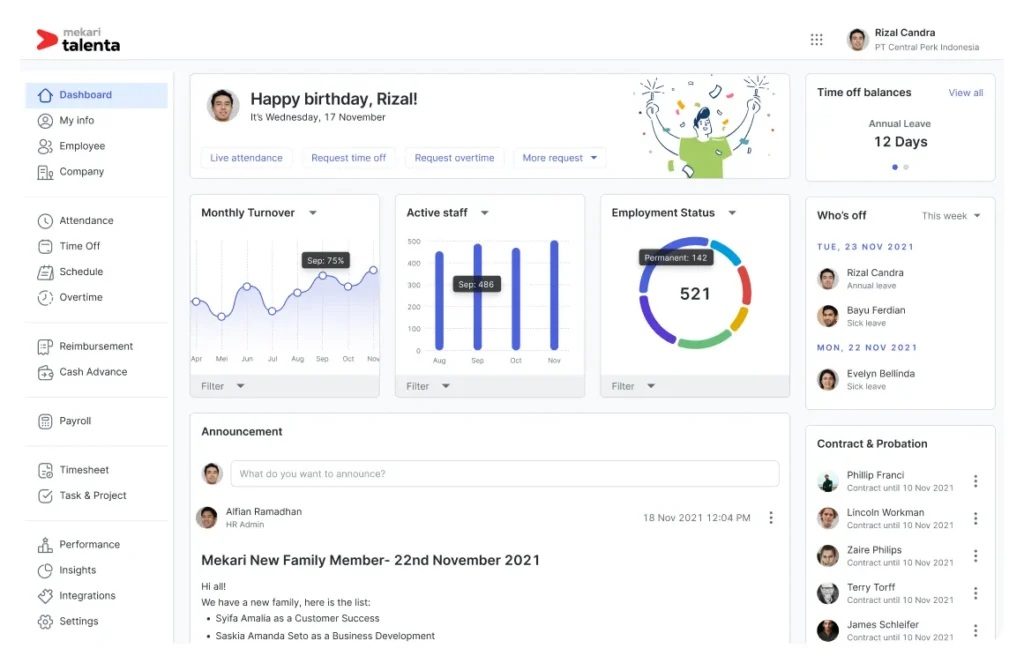
With an integrated approach, organizations can identify retention risks earlier, align workforce decisions more effectively, and maintain consistency across all HR processes.
Through its platform, Mekari Talenta enables organizations to:
- Build structured career pathways through job grading, career pathing, and succession planning, reducing stagnation and providing clear direction for growth
- Ensure fair and transparent compensation through salary structure and payroll management aligned with internal roles and market benchmarks
- Monitor performance and collect continuous feedback through performance reviews, 1-on-1 sessions, and engagement surveys, allowing timely intervention before disengagement escalates
- Strengthen employee capability through structured learning and development programs that support both technical and leadership growth
- Track workforce patterns, attendance, and workload distribution to identify potential burnout risks and improve productivity balance
- Access real-time insights through HR analytics dashboards while improving employee experience with self-service access to HR processes
By managing the employee lifecycle within a single platform, organizations gain the visibility and control needed to sustain retention over time.
Data becomes actionable, decisions become more consistent, and employee experience becomes more aligned with business objectives.
Interested in exploring how Mekari Talenta can support your employee retention strategy?
Schedule a demo with our team and discover how an integrated, AI-powered approach can help you manage retention more effectively, reduce attrition risk, and build a more stable and high-performing workforce.
Reference
Retention Strategies to Steal From Google, Walmart and More – Entrepeneur
Frequently Asked Questions (FAQs)
What is considered a good employee retention rate?
What is considered a good employee retention rate?
A good retention rate varies by industry, but generally ranges between 85% to 90% annually. High-growth industries or competitive talent markets may experience lower benchmarks. The key is not just the percentage, but who is being retained. Retaining high performers is more important than maintaining overall headcount stability.
How long should employees stay to be considered “retained”?
How long should employees stay to be considered “retained”?
Retention is typically measured over a defined period such as quarterly or annually. However, tenure benchmarks differ by role. For example, early attrition within the first year is often seen as a red flag, while longer tenure indicates stronger alignment and integration.
What is the difference between voluntary and involuntary turnover?
What is the difference between voluntary and involuntary turnover?
Voluntary turnover occurs when employees choose to leave, often due to better opportunities or dissatisfaction. Involuntary turnover includes terminations initiated by the company. Understanding the balance between the two helps identify whether retention issues are driven by internal factors or performance management decisions.
How can managers directly influence employee retention?
How can managers directly influence employee retention?
Managers influence retention through daily interactions such as setting expectations, providing feedback, and supporting development. Employees often decide to stay or leave based on their relationship with their direct manager. Consistent communication and fair decision-making significantly improve retention outcomes.
What are early warning signs of potential employee attrition?
What are early warning signs of potential employee attrition?
Common indicators include declining performance, reduced engagement, lower participation in discussions, and changes in behavior. Employees may also become less responsive or show decreased ownership of responsibilities. Identifying these signals early allows organizations to intervene before disengagement leads to resignation.