

Employee Benefit: A Strategy for Competitive Talent Advantage

- Employee benefits are non-cash forms of compensation provided to employees in addition to salary to support wellbeing, financial security, and long-term employment stability.
- Common examples of employee benefits include health insurance, paid leave, retirement contributions, flexible work arrangements, wellness programs, and learning support.
As workforce structures become more distributed and operational demands continue increasing, employee benefits have evolved into a major factor influencing workforce stability and long-term retention.
Many companies now face growing pressure to balance rising workforce expectations with cost control, compliance obligations, and operational consistency across teams and locations.
At the same time, employees increasingly evaluate workplace support systems alongside compensation when deciding whether to join or remain with an organization.
This shift has pushed many organizations to redesign benefits around flexibility, wellbeing, workforce sustainability, and long-term employee experience.
This article will explain employee benefits, their costs, common types, workplace trends, and practical strategies for building effective benefit programs.
What Is Employee Benefit?
Employee benefits are non-cash forms of compensation provided by employers in addition to salary or wages. These benefits are designed to support employees financially, physically, and professionally throughout their employment period.
In most companies, employee benefits include health insurance, paid leave, retirement contributions, meal allowances, transportation support, flexible working arrangements, and wellness programs.
Benefits are different from direct salary because they are usually structured as long-term workforce support rather than monthly income. A transportation allowance, for example, is considered a benefit, while overtime pay is classified as compensation.
During employee onboarding, clear benefit policies help employees understand company support systems and workplace expectations earlier.
Many companies review benefit programs regularly to improve employee engagement and reduce employee attrition caused by dissatisfaction with workplace support.
The Difference Between Benefits and Compensation
Compensation and benefits are both part of total employee rewards, but they serve different purposes in workforce management. The differences include:
| Aspect | Compensation | Benefits |
|---|---|---|
| Definition | Direct financial payment provided in exchange for work performed | Additional non-cash support provided alongside salary |
| Main Purpose | Reward employee contribution and productivity | Support employee wellbeing and long-term stability |
| Examples | Salary, bonuses, commissions, overtime pay | Health insurance, paid leave, retirement plans |
| Payment Structure | Processed through payroll based on pay cycles | Provided through company programs or policies |
| Performance Connection | Commonly tied to targets or objective key results | Usually standardized based on employee eligibility |
| Business Impact | Affects short-term motivation and output | Influences employee engagement and retention |
In short, the main difference is that compensation rewards employees for the work they deliver, while benefits support employees throughout their employment lifecycle.
Both are equally important because employees evaluate total value, not salary alone.
In many organizations, compensation is used to attract candidates during talent acquisition, while benefits play a larger role in maintaining employee retention over time.
Companies that balance both effectively often create a stronger employee experience because employees evaluate not only how much they earn, but also how well they are supported beyond payroll.
Why Are Employee Benefits Essential?
Employee benefits have become a critical component of workforce strategy because employees increasingly evaluate overall workplace support, not compensation alone.
Below are several reasons why employee benefits are essential for maintaining workforce stability and long-term organizational performance.
1. Help Improve Employee Retention
Employee benefits play a major role in retaining experienced employees, especially in competitive labor markets where employees evaluate long-term workplace support before deciding to stay.
Health coverage, retirement programs, paid leave, and flexible work arrangements often influence retention more than incremental salary increases.
Many companies also use benefit structures to support employee retention during periods of organizational change, workforce restructuring, or expansion into multiple locations. Strong support systems help reduce disruption caused by employee attrition and repeated rehiring cycles.
Read also: Employee Retention: Driving Growth Through Talent Sustainability
2. Strengthen Employee Engagement and Productivity
Employees tend to perform more consistently when they feel supported physically, mentally, and financially.
Benefits such as wellness programs, flexible work arrangements, and mental health support contribute directly to employee engagement because they reduce stress that affects daily productivity.
Many organizations now integrate benefit programs with employee experience initiatives, workload management, and performance improvement plan strategies to maintain sustainable productivity without increasing burnout risk.
Benefit reviews are also often conducted alongside performance appraisal cycles because workforce satisfaction, promotion readiness, and compensation adjustments are commonly evaluated during the same review period.
3. Influence Talent Acquisition Decisions
Employee benefits have become a critical factor during talent acquisition process because candidates increasingly compare workplace support systems before accepting offers.
Candidates now evaluate healthcare access, flexibility, parental support, and career development opportunities as part of total employment value.
Some companies also align benefit eligibility or incentive-based benefits with management by objective frameworks to create clearer connections between workforce contribution and organizational priorities.
Companies with competitive benefits packages tend to build stronger employer branding because candidates associate workforce support with operational stability and long-term career growth.
How Much Do Employee Benefits Cost?
Employee benefit costs in Southeast Asia vary significantly depending on local labor regulations, workforce composition, and the type of benefits provided by the employer.
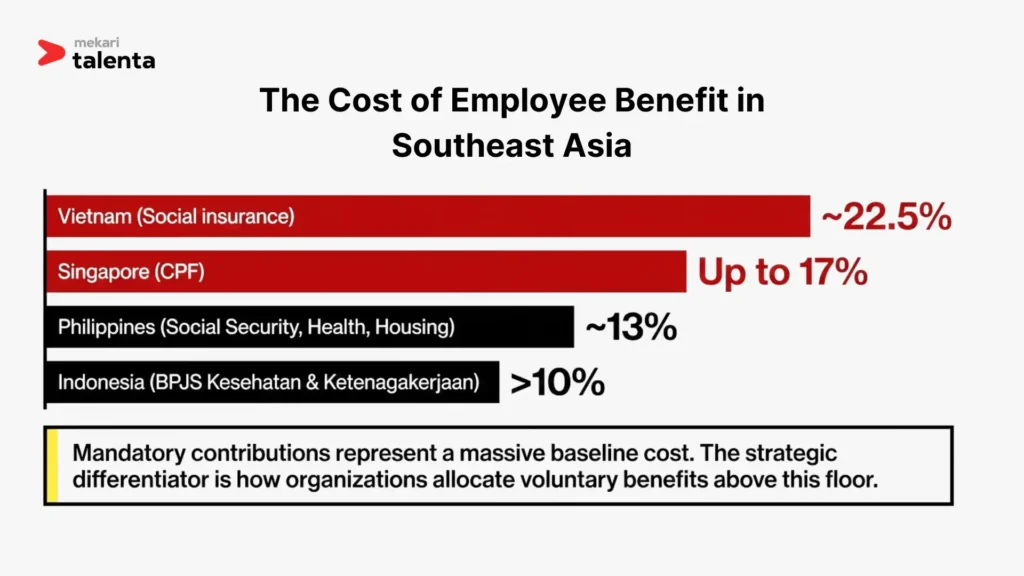
In many countries across the region, mandatory contributions alone already represent a substantial portion of total workforce costs:
- Singapore has one of the highest statutory employer contribution structures in Southeast Asia through the Central Provident Fund (CPF). Employers contribute up to 17% of monthly wages for eligible local employees, excluding additional healthcare, insurance, and wellness benefits commonly offered by larger companies.
- Vietnam also has relatively high mandatory employment costs, where employer social insurance contributions can reach around 22.5% of gross wages.
- In Indonesia, employee benefit costs are largely driven by mandatory BPJS contributions, where employers contribute around 4% for BPJS Kesehatan plus additional BPJS Ketenagakerjaan contributions for pension, old-age security, work accident, and death protection programs. Depending on industry risk classification, total employer contributions can exceed 10% of monthly salary before additional benefits such as private insurance, allowances, or wellness programs are included.
- Meanwhile, the Philippines requires combined contributions for social security, healthcare, and housing programs that can total approximately 13% of employee wages.
Beyond statutory obligations, many companies in Southeast Asia allocate additional budgets for medical insurance, transportation allowances, hybrid work support, mental health programs, and employee training initiatives.
According to the CIPD Asia Employee Benefits Report 2025, 61% of organizations in Asia planned to maintain their current employee benefits spending levels despite ongoing cost pressures, showing that benefits remain a long-term workforce investment priority.
As organizations expand across multiple countries, benefit administration costs often increase further due to differences in tax rules, social security systems, healthcare structures, and compliance requirements between markets.
Common Types of Employee Benefits & Examples
Employee benefits can vary across industries and countries, but several categories are consistently used because they address the most common workforce needs such as healthcare, financial security, flexibility, and career development.
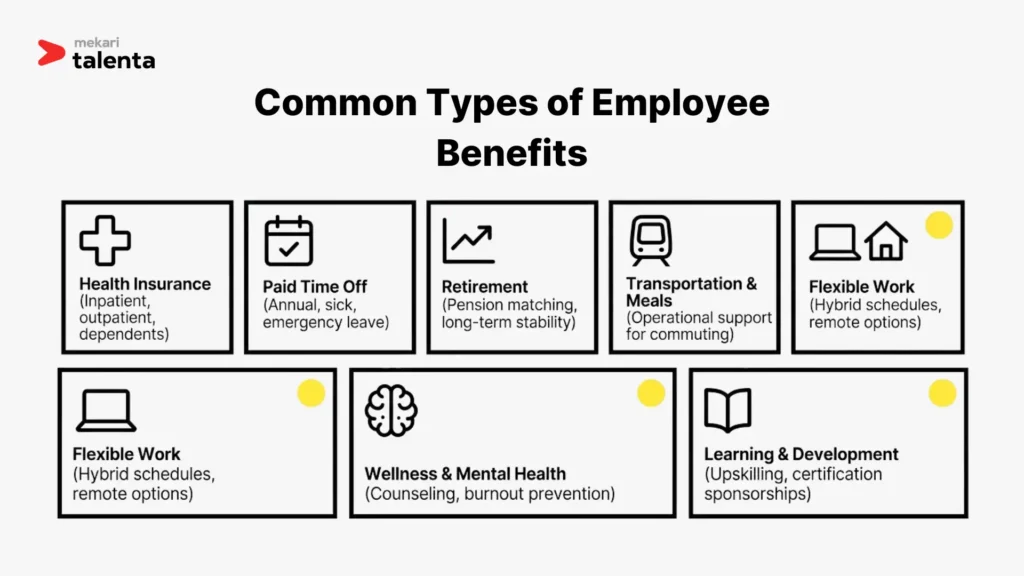
Below are some of the most common types of employee benefits used across modern workplaces.
1. Health Insurance Benefits
Health insurance helps employees manage medical expenses while reducing financial stress related to healthcare access.
Many companies provide statutory healthcare coverage first, then add private insurance plans to improve coverage limits, hospital access, or dependent protection.
In practice, companies with distributed or regional workforces often standardize healthcare coverage tiers to reduce disparities between offices or business entities.
- Example: Inpatient and outpatient medical coverage for employees and dependents.
2. Paid Time Off (PTO)
Paid leave gives employees time away from work without losing income. Common PTO categories include annual leave, sick leave, maternity leave, paternity leave, bereavement leave, and public holidays.
Companies with high operational workloads usually create clearer leave approval policies to avoid staffing shortages during peak business periods.
- Example: Annual leave allocations with separate emergency leave policies.
3. Retirement and Pension Benefits
Retirement programs support employees’ long-term financial stability after their working years. These benefits can include pension contributions, retirement savings programs, or employer matching schemes.
Organizations with mature workforce planning often position retirement benefits as part of long-term employee retention strategies rather than compliance obligations alone.
- Example: Employer-funded retirement contributions or pension matching programs.
4. Flexible Work Arrangements
Flexible work policies help employees manage productivity alongside personal responsibilities. These arrangements may include hybrid work schedules, flexible working hours, compressed workweeks, or remote work options.
Many companies now structure flexibility based on job function instead of applying identical policies across all departments.
- Example: Hybrid work schedules allowing employees to work remotely several days per week.
5. Transportation and Meal Allowances
Transportation and meal support help employees manage daily operational expenses, especially in cities with high commuting costs or long travel times.
These benefits are commonly adjusted based on work location, shift schedules, or field assignment requirements.
- Example: Transportation reimbursement for onsite employees working night shifts.
6. Wellness and Mental Health Support
Wellness programs are increasingly used to reduce burnout risk and maintain workforce productivity. Modern benefit structures often include mental health support because stress-related productivity issues have become more visible across many industries.
Some organizations now integrate wellness programs into broader employee engagement initiatives.
- Example: Mental health counseling access and wellness reimbursement programs.
7. Learning and Development Benefits
Learning benefits help employees improve technical capability, leadership skills, and long-term career readiness. Many organizations include employee training programs as part of workforce development strategies to strengthen internal mobility and reduce dependency on external hiring.
Companies with structured workforce development plans often connect learning benefits with promotion pathways and performance growth targets.
- Example: Professional certification sponsorship and leadership development programs.
Read also: 30 Types of Employee Benefits for Competitive Talent Advantage
Employee Benefits Trends in Modern Workplaces
Employee benefits in recent years are increasingly shaped by workforce flexibility, personalization, mental wellbeing, and data-driven decision-making.
Many organizations are redesigning benefits not only to improve retention, but also to support changing work models, workforce expectations, and long-term operational sustainability.
1. Mental Health Benefits Are Becoming a Core Workforce Priority
Mental health support is no longer treated as an optional wellness initiative. Companies increasingly provide counseling access, burnout prevention programs, stress management support, and mental wellbeing reimbursements because psychological health now directly affects productivity and workforce stability.
Many organizations now integrate mental health support into broader employee experience and retention strategies instead of treating it as a standalone HR initiative.
2. Flexible and Hybrid Work Benefits Continue Expanding
Hybrid work has permanently changed how companies structure employee benefits. Traditional office-focused benefits such as onsite meals and commuting support are increasingly complemented with internet reimbursement, home office allowances, and flexible scheduling policies.
In many companies, flexibility policies are now differentiated based on operational roles, workforce distribution, and collaboration requirements rather than using one standardized arrangement for all employees.
3. Personalized Benefits Are Replacing One-Size-Fits-All Programs
Many organizations are moving toward personalized benefit structures because workforce priorities differ significantly between employee groups, career stages, and working models.
Employees increasingly expect benefits that align with their individual situations such as childcare support, wellness reimbursement, learning subsidies, or flexible allowance systems.
This shift also helps companies reduce spending on low-utilization benefits that employees rarely use.
4. Learning and Upskilling Benefits Are Becoming More Strategic
Companies increasingly invest in employee training, certification sponsorships, leadership development, and AI-related upskilling because workforce transformation is accelerating across industries.
Many organizations now position learning benefits as part of long-term workforce resilience and internal mobility planning rather than only career development support.
5. Data and AI Are Influencing Benefits Management
Organizations are increasingly using AI and workforce analytics to improve benefits planning, monitor utilization rates, predict healthcare costs, and personalize employee support.
This shift helps organizations make benefit decisions based on workforce behavior and operational data rather than assumptions alone.
Best Practices for Building an Effective Employee Benefits Strategy
Creating employee benefits is no longer simply about adding more perks or following market trends. Effective benefit strategies are built around workforce behavior, operational realities, retention risks, and long-term business sustainability.
Many benefit programs fail because they are designed based on assumptions rather than actual employee needs.
Below are several practical strategies commonly used by companies to build employee benefits that remain relevant, sustainable, and operationally effective over time.
1. Separate Core Benefits from Competitive Benefits
One of the biggest mistakes companies make is treating all benefits equally. In practice, employees divide benefits into two categories: expected benefits and differentiating benefits.
Expected benefits are the minimum support employees assume will already exist, such as healthcare coverage, paid leave, and statutory contributions. These benefits rarely improve retention on their own because employees consider them standard.
Differentiating benefits are the programs employees actively compare between employers, such as flexible work policies, mental health support, family assistance, learning sponsorships, or wellness reimbursements. These benefits often influence acceptance decisions more directly during recruitment.
Companies that understand this distinction usually allocate budgets more effectively instead of overspending on low-impact programs employees barely notice.
2. Build Benefits Around Workforce Segments, Not Company-Wide Assumptions
A benefit program becomes ineffective when every employee receives identical support regardless of role, work pattern, or workforce demographics.
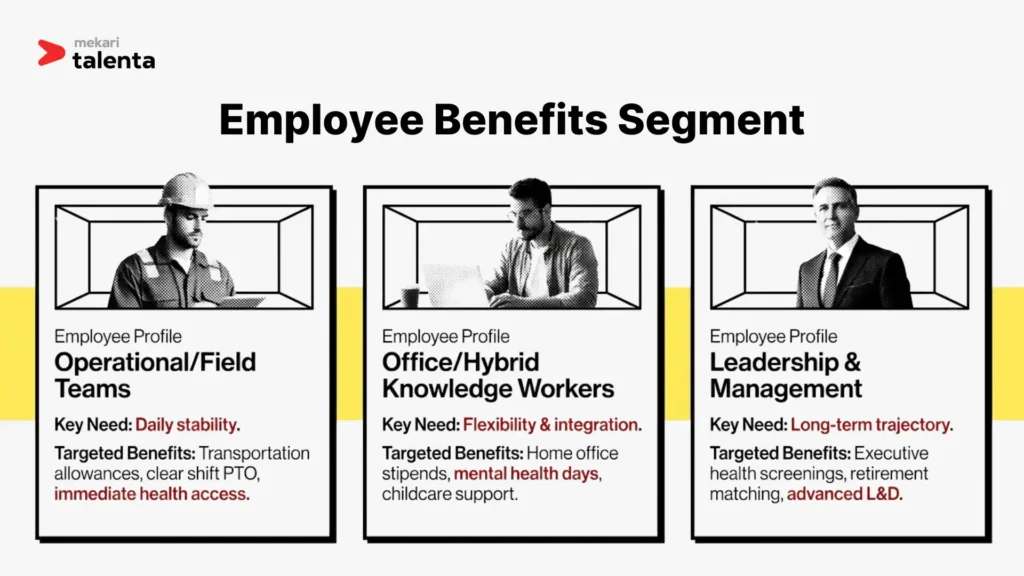
Field employees, operational teams, office-based staff, managers, and regional employees often face completely different daily challenges.
Transportation support may matter more for shift workers, while flexibility and childcare support may be more valuable for managerial or hybrid employees.
Many organizations now use workforce segmentation to improve benefit relevance without increasing total spending dramatically.
This approach also reduces low utilization rates that commonly happen when benefits are designed based on leadership assumptions rather than workforce behavior.
3. Review Benefit Utilization Data Regularly
Some benefits look attractive during rollout but are barely used in reality. This creates hidden inefficiencies that continue for years because companies rarely audit actual utilization patterns.
Effective organizations track:
- benefit participation rates
- claim frequency
- reimbursement usage
- leave trends
- healthcare utilization
- employee feedback patterns
Low utilization does not always mean employees dislike the benefit. Sometimes the claim process is too complicated, policies are unclear, or employees do not fully understand eligibility rules.
Companies that review utilization data regularly usually improve employee experience faster because adjustments are based on operational evidence rather than assumptions.
4. Align Benefits with Operational Realities
Benefit structures should reflect how employees actually work, not how policies are written on paper.
For example, hybrid work allowances become ineffective when employees still need to visit offices frequently for approvals or meetings. Wellness programs also fail when workloads remain consistently excessive across departments.
The most effective benefit programs are closely connected to workforce operations, scheduling realities, overtime patterns, and workload distribution. This is why operational alignment matters more than simply adding more benefit categories every year.
5. Design Benefits That Support Long-Term Retention
Many organizations focus heavily on hiring incentives while underinvesting in benefits that influence long-term retention.
Retention-driven benefits usually include:
- career development support
- internal mobility programs
- retirement planning
- long-service rewards
- dependent healthcare support
- structured learning opportunities
Employees often evaluate whether workplace support will still feel valuable several years into employment, especially after career progression, marriage, parenthood, or managerial responsibilities begin affecting personal priorities.
6. Keep Benefit Administration Simple and Transparent
Even strong benefits lose value when employees struggle to understand policies, claim processes, or eligibility requirements.
Complicated reimbursement procedures, inconsistent approvals, and unclear documentation requirements often create frustration that weakens trust in the program itself.
Companies with mature workforce operations usually centralize benefit information through HR systems or employee self-service platforms to improve transparency and reduce administrative dependency.
Simple administration also reduces payroll disputes, manual errors, and compliance issues that commonly appear when benefit tracking is still handled through spreadsheets or fragmented workflows.
How to Measure the Effectiveness of Employee Benefits
Employee benefits should be evaluated regularly to determine whether they genuinely improve workforce stability, employee satisfaction, and long-term retention.
Many companies continue increasing benefit spending every year without fully understanding which programs actually create operational impact and which benefits are rarely used by employees.
Below are several practical ways organizations commonly measure the effectiveness of employee benefits in real workforce environments.
1. Monitor Employee Retention and Turnover Patterns
One of the clearest indicators of benefit effectiveness is employee retention. If turnover remains consistently high despite strong compensation and benefits spending, the issue may be related to benefit relevance, accessibility, or workforce alignment.
Many organizations compare resignation trends before and after introducing new benefit programs to identify whether workforce stability improves over time.
This becomes even more important for departments with historically high employee attrition or difficult replacement processes.
Companies with mature workforce planning also analyze turnover by employee group, location, tenure, and managerial level because benefit expectations often differ significantly across workforce segments.
Read also: Employee Turnover: Definition, Types, Formula & How to Prevent It
2. Review Benefit Utilization Rates
A benefit program may look attractive on paper but provide little actual value if employees rarely use it. This is why utilization tracking is one of the most important operational measurements.
Commonly monitored areas include:
- healthcare claim frequency
- wellness program participation
- reimbursement usage
- learning subsidy adoption
- leave utilization patterns
Low utilization does not always mean employees dislike the benefit. In many cases, the approval process is too complicated, communication is unclear, or employees simply do not understand eligibility requirements.
This is why many organizations now simplify access through employee self-service systems and centralized HR platforms.
3. Measure Employee Satisfaction and Workplace Sentiment
Employee feedback often reveals operational issues that utilization reports cannot fully explain. Many companies conduct periodic workforce surveys to understand how employees perceive healthcare quality, flexibility support, wellbeing programs, and overall workplace support systems.
Benefit satisfaction also tends to influence employee engagement because employees often associate workplace support quality with organizational commitment toward workforce wellbeing.
In many organizations, benefit-related questions are integrated into broader employee experience surveys rather than evaluated separately.
4. Evaluate Hiring Acceptance Rates
Employee benefits increasingly influence recruitment outcomes because candidates now compare workplace support structures before accepting offers.
Companies with outdated or inflexible benefit programs often experience lower offer acceptance rates, especially for mid-level and senior positions.
Many recruitment teams now monitor:
- offer rejection reasons
- candidate feedback
- hiring cycle duration
- compensation competitiveness against market benchmarks
This helps organizations identify whether benefit structures remain aligned with current workforce expectations and hiring competition.
5. Analyze Operational Efficiency and Administrative Burden
Benefits should also be evaluated from an operational perspective because inefficient administration often creates hidden workforce costs.
Manual claim processing, inconsistent approvals, fragmented systems, and payroll coordination issues commonly increase administrative workload while reducing employee trust in the program itself.
Organizations managing multiple entities or locations usually benefit from centralized administration systems because they improve reporting accuracy, policy consistency, and workforce visibility across different business units.
Many companies also review benefit administration alongside performance appraisal and annual workforce planning cycles to align operational costs with long-term business priorities.
Read also: Multi Location Workforce Management: A Guide for Multi-Branch Teams Published

Reference
Employee Wellbeing Is Key for Workplace Productivity – Gallup
Frequently Asked Questions (FAQs)
Are employee benefits legally required in every country?
Are employee benefits legally required in every country?
No. Employee benefit requirements vary significantly depending on local labor laws and social security systems. Some countries require mandatory healthcare, pension, or leave benefits, while others allow companies greater flexibility in designing workforce support programs. Organizations operating across multiple countries usually need localized benefit structures to maintain compliance.
How often should companies review employee benefits?
How often should companies review employee benefits?
Most organizations review employee benefits annually alongside budgeting, compensation planning, and workforce strategy discussions. However, companies experiencing rapid growth, restructuring, or high turnover often conduct more frequent evaluations to ensure benefits remain competitive and operationally relevant. Workforce feedback and utilization data are commonly used during these reviews.
What is the difference between mandatory and voluntary employee benefits?
What is the difference between mandatory and voluntary employee benefits?
Mandatory benefits are legally required by government regulations, such as social security contributions, healthcare programs, or statutory leave entitlements. Voluntary benefits are additional programs provided by employers to improve workforce support and competitiveness. Examples include private insurance, wellness reimbursements, flexible work support, or education sponsorships.
Why do some employee benefits fail to improve retention?
Why do some employee benefits fail to improve retention?
Benefits often become ineffective when they do not match actual workforce needs or are difficult to access operationally. Complicated claim processes, inconsistent policies, and low relevance across employee groups commonly reduce benefit value perception. Retention issues may also continue if workload management, leadership quality, or career growth problems remain unresolved.