

30 Types of Employee Benefits for Competitive Talent Advantage


- Employee benefits are non-salary compensation and support programs designed to improve workforce wellbeing, retention, and long-term organizational stability.
- Employee benefits include healthcare, paid leave, retirement support, bonuses, flexible work arrangements, wellness initiatives, and career development programs.
Employee benefits have become one of the most influential factors shaping workforce stability, retention, and long-term employee engagement across modern organizations.
As operational demands become more dynamic and workforce expectations continue evolving, companies are increasingly expected to provide benefits that support not only financial security, but also wellbeing, flexibility, career growth, and work-life sustainability.
Benefit structures that fail to adapt often contribute to higher turnover, recruitment difficulties, disengagement, and lower workforce satisfaction over time.
At the same time, organizations with well-designed employee benefit programs are generally better positioned to maintain productivity continuity, strengthen talent retention, and support long-term business growth.
This article will discuss the most common types of employee benefits, their functions, practical workplace applications, and the latest trends shaping employee benefits strategies today.
What Is Employee Benefits?
Employee benefits are the non-wage compensation and support programs provided to employees alongside their salaries.
They typically include health insurance, retirement plans, paid leave, wellness support, allowances, flexible work arrangements, and long-term development initiatives.
In many companies, benefits have evolved from administrative support into a strategic workforce tool that directly influences talent acquisition process.
Well-structured benefits programs also help organizations maintain operational continuity during periods of rapid growth, restructuring, or labor market competition.
For example, companies with strong healthcare coverage, mental health support, and career development pathways often experience lower turnover and stronger internal mobility outcomes.
Increasingly, organizations are also aligning benefits with broader workforce strategies such as upskilling and reskilling to ensure employees remain adaptable as business demands evolve.
Benefits of Employee Benefits
Employee benefits directly influence how sustainably a company can attract, retain, develop, and stabilize its workforce over time.
As labor markets become more competitive and employee expectations continue to evolve, benefits are increasingly viewed as part of operational strategy rather than administrative support.
1. Stronger Employee Retention and Lower Turnover Costs
Competitive employee benefit programs play a major role in reducing employee attrition, particularly in industries facing persistent talent shortages and high replacement costs.
Employees increasingly evaluate total rewards packages alongside salary when deciding whether to stay with an organization long term.
In practice, organizations with mature benefits structures often experience greater workforce stability during periods of restructuring, expansion, or market uncertainty.
Benefits tied to family support, healthcare access, flexible work arrangements, and career development also strengthen employee retention because they create a stronger sense of long-term security and organizational commitment.
Read also: Employee Retention: Driving Growth Through Talent Sustainability
2. Improved Talent Attraction in Competitive Labor Markets
Benefits packages have become a decisive factor during recruitment, especially for candidates evaluating multiple offers with similar compensation ranges.
Modern candidates assess healthcare coverage, flexibility policies, learning opportunities, wellness support, and financial security programs as indicators of how sustainably a company manages its workforce.
This is why many companies now integrate employee training, leadership development, and upskilling and reskilling initiatives directly into their broader employee benefit strategy to strengthen long-term hiring outcomes.
3. Higher Engagement, Productivity, and Employee Experience
Benefits also influence day-to-day workforce performance. Employees who feel supported physically, financially, and emotionally are generally more engaged, collaborative, and productive.
Comprehensive support systems reduce stressors that often disrupt concentration, attendance, and overall work quality.
Organizations that align benefits with broader workforce programs such as performance appraisal systems, career mobility frameworks, and performance review processes also tend to create a more consistent employee experience across the full employment lifecycle.
4. Better Workforce Development and Internal Mobility
Well-designed benefits programs support long-term workforce capability building, particularly in environments where business priorities, technology adoption, and operational models evolve rapidly.
Learning support, certification reimbursement, coaching access, and structured development pathways help organizations prepare employees for future responsibilities while reducing dependency on external hiring.
This becomes increasingly important when companies implement succession planning frameworks, competency-based assessments such as BARS, or structured interventions like a performance improvement plan.
When development-related benefits are integrated into workforce planning, organizations gain stronger internal mobility pipelines, faster readiness for leadership transitions, and more sustainable capability growth across departments.
30 Types of Employee Benefits
Employee benefits cover a wide range of financial, healthcare, wellbeing, development, and work support programs designed to improve workforce stability and employee satisfaction beyond base salary.
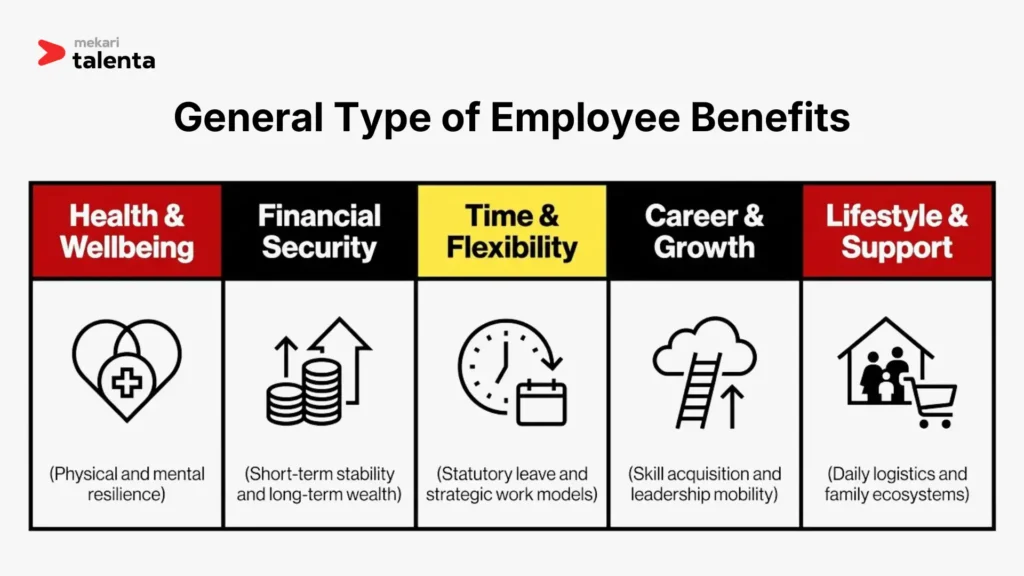
Different benefits serve different organizational objectives. Some are intended to strengthen retention, while others support productivity, mobility, family responsibilities, leadership development, or long-term workforce planning.
Below are some of the most common types of employee benefits used by companies.
1. Health Insurance
Health insurance helps cover employees’ medical expenses, including hospitalization, outpatient care, specialist consultations, and preventive treatment.
Companies typically provide it to reduce financial stress related to healthcare while improving attendance consistency and workforce wellbeing.
In many countries, healthcare-related employee benefits are also closely tied to statutory employment obligations.
For example, employers in Indonesia are required to register employees under the national healthcare program, BPJS Kesehatan.
In Singapore, employers commonly support workforce medical coverage through corporate health insurance alongside national healthcare schemes such as MediShield Life and CPF-linked medical contributions.
Malaysia similarly operates mandatory employee social protection frameworks through SOCSO and other employment-related healthcare protections.
Across global markets, healthcare support is generally considered one of the most fundamental components of an employee benefit strategy because medical costs directly affect workforce stability, absenteeism, and long-term employee retention.
Comprehensive medical coverage becomes increasingly important for organizations with aging workforces, operationally intensive roles, shift-based operations, or geographically distributed teams.
2. Dental Insurance
Dental insurance covers preventive, routine, and corrective oral healthcare expenses such as dental check-ups, cleanings, fillings, root canal treatment, tooth extractions, braces, crowns, and periodontal care.
Some organizations also extend coverage to dependents as part of broader family-oriented healthcare programs.
Although often treated as a secondary healthcare benefit, dental health can significantly affect employee productivity, attendance consistency, and overall wellbeing.
In some countries, basic dental care may be partially supported through national healthcare systems or social security frameworks, while many employers provide supplementary corporate dental insurance to expand treatment access, improve coverage limits, and shorten waiting times for employees.
3. Vision Insurance
Vision insurance helps reimburse eye examinations, prescription glasses, contact lenses, and certain corrective treatments related to visual health.
This benefit is commonly provided in industries where employees rely heavily on screen-based work, detailed visual accuracy, or precision-focused operational tasks such as technology, manufacturing, engineering, healthcare, logistics, and design.
Regular eye care support can help reduce eye strain, fatigue, headaches, and concentration issues that may affect daily productivity and work quality.
Many organizations include vision coverage as part of broader preventive healthcare initiatives to support long-term employee wellbeing and maintain consistent workforce performance.
4. Retirement Plans
Retirement plans help employees build long-term financial security through employer-sponsored pension schemes, provident funds, or contribution-based savings programs.
These benefits are widely used to strengthen employee retention, particularly among experienced and senior-level employees who prioritize long-term financial stability when evaluating employers.
In many countries, retirement-related contributions are also mandatory under employment regulations. For example, Singapore requires employer and employee contributions through the Central Provident Fund (CPF), while Indonesia requires social security participation through BPJS Ketenagakerjaan programs that include old-age and pension benefits.
In other countries, such as Australia, mandates employer retirement contributions through the Superannuation Guarantee system, while employers in the United States commonly support retirement savings through 401(k) programs alongside Social Security contributions.
5. Life Insurance
Life insurance provides financial protection for employees’ families or dependents in the event of death through lump-sum compensation or coverage-based payouts.
Organizations commonly provide this benefit to strengthen workforce security, support long-term employee wellbeing, and reduce financial uncertainty for employees with family responsibilities.
This benefit is particularly important in industries with higher operational risks such as construction, manufacturing, mining, logistics, transportation, and field operations.
Many companies also provide higher coverage tiers for leadership positions, expatriate assignments, or employees handling critical operational responsibilities.
In some countries, basic death and work-related insurance protections may already be included under national employment or social security programs.
However, many organizations still provide additional corporate life insurance coverage to offer broader protection and more competitive total rewards packages.
6. Paid Annual Leave
Paid annual leave allows employees to take time off without salary deductions for rest, personal matters, travel, or family needs.
Beyond supporting employee wellbeing, structured leave policies help reduce burnout, improve morale, and maintain long-term productivity sustainability, particularly in high-pressure or operationally intensive work environments.
Paid leave is also a mandatory employment entitlement in most countries, although the duration, accrual system, and eligibility rules vary depending on local labor regulations.
For example, employees in Singapore are entitled to statutory annual leave under the Employment Act based on years of service, while Indonesia regulates annual leave entitlements through labor law after employees complete a minimum service period.
Many European countries also enforce significantly longer minimum paid leave requirements as part of broader workforce protection frameworks.
7. Sick Leave
Sick leave allows employees to take time off for illness or medical recovery without losing income during their absence period.
This benefit plays an important role in maintaining workforce health, reducing operational disruption caused by illness outbreaks, and supporting long-term productivity sustainability.
In many countries, paid sick leave is regulated under labor laws or national employment systems, although the entitlement structure varies significantly.
For example, Germany requires employers to continue paying employee wages during certified illness periods for a specified duration, while the United Kingdom provides Statutory Sick Pay (SSP) under government-regulated conditions.
Australia and Canada also mandate paid sick leave entitlements under employment standards, with different accrual systems depending on the jurisdiction.
8. Maternity Leave
Maternity leave supports employees during pregnancy, childbirth, and postnatal recovery periods through protected leave arrangements and income support.
In most countries, maternity protection is regulated under labor laws or national social security systems, although entitlement periods and payment structures vary considerably.
For example, the United Kingdom provides statutory maternity leave and maternity pay protections, while Japan offers maternity and childcare leave support through employment insurance programs.
India also mandates paid maternity leave under the Maternity Benefit Act, with extended protections for eligible employees in certain sectors and company sizes.
Strong maternity programs contribute significantly to employee retention among experienced female professionals, particularly in leadership, technical, and specialized roles where workforce replacement costs are high.
Many organizations also expand maternity support beyond legal requirements through flexible return-to-work arrangements, childcare assistance, nursing support facilities, or phased reintegration programs to improve long-term employee experience and workforce stability.
9. Paternity Leave
Paternity leave allows fathers or partners to take time off after childbirth or adoption to support caregiving responsibilities and family adjustment during the early stages of parenthood.
Many countries now regulate paternity leave under labor or parental leave frameworks, although entitlement durations vary widely.
For example, Sweden and Norway provide extensive parental leave systems that can be shared between parents, while Spain offers fully paid paternity leave through national social security programs.
Companies increasingly expand paternity benefits beyond minimum legal requirements to strengthen work-life balance initiatives, support gender equity objectives, and improve employee perceptions around family support.
10. Flexible Working Arrangements
Flexible working arrangements allow employees to adjust working hours, work locations, or scheduling patterns based on operational requirements and personal needs.
Common arrangements include hybrid work, remote work, compressed workweeks, flexible start and end times, and staggered shift scheduling.
These policies became significantly more common after the COVID-19 pandemic accelerated large-scale remote and hybrid workforce adoption across global industries.
Many organizations that initially implemented flexibility as a temporary business continuity measure later incorporated it into long-term workforce strategies due to its impact on productivity, workforce accessibility, and employee satisfaction.
Flexible arrangements are now widely used to reduce commuting fatigue, support cross-regional collaboration, improve workforce continuity across time zones, and accommodate changing employee expectations around work-life balance.
They are particularly common in technology, consulting, financial services, creative industries, and regional operations with distributed teams.
11. Employee Assistance Program (EAP)
Employee Assistance Programs (EAP) provide confidential support services that help employees manage personal, emotional, financial, legal, or work-related challenges that may affect their wellbeing and job performance.
These programs commonly include counseling services, mental health support, stress management assistance, financial consultation, family support resources, and crisis intervention services.
EAP adoption has increased significantly in recent years as organizations place greater focus on employee wellbeing, burnout prevention, and workforce resilience following the COVID-19 pandemic.
Many companies now recognize that unresolved personal or psychological challenges can directly affect productivity, absenteeism, engagement, and long-term employee retention.
12. Wellness Programs
Wellness programs are designed to support employees’ physical, mental, and emotional wellbeing through preventive and lifestyle-focused initiatives.
These programs commonly include fitness memberships, health screenings, nutrition support, stress management initiatives, wellness challenges, mindfulness programs, and workplace wellbeing campaigns.
Many organizations increasingly invest in wellness initiatives as workforce expectations shift toward healthier and more sustainable working environments.
Rising concerns around burnout, stress-related absenteeism, and long-term health risks have also pushed companies to treat employee wellbeing as part of broader workforce sustainability and retention strategies.
13. Mental Health Support
Mental health benefits help employees manage emotional, psychological, and stress-related challenges that may affect their wellbeing and work performance.
These benefits may include counseling services, therapy access, employee assistance programs, mental health hotlines, stress management support, burnout prevention initiatives, or access to licensed mental health professionals.
Mental health support has become especially important in fast-paced, high-pressure, and continuously connected work environments where prolonged stress can gradually impact workforce stability and performance consistency.
14. Transportation Allowance
Transportation benefits help employees manage commuting expenses through travel reimbursements, shuttle services, fuel allowances, parking support, ride-sharing subsidies, or monthly transportation stipends.
These benefits are commonly provided to reduce employees’ daily commuting burden and improve attendance consistency.
Transportation support is especially important in metropolitan areas with high commuting costs, traffic congestion, limited public transportation access, or operational sites located far from urban centers.
Industries such as manufacturing, logistics, construction, mining, retail, and field operations frequently provide transportation assistance because workforce mobility directly affects punctuality, shift continuity, and operational stability.
In some countries, transportation-related support may also be partially regulated under employment agreements or industry-specific labor practices, particularly for shift-based or remote operational environments.
15. Meal Allowance
Meal benefits help employees cover daily food expenses during working hours through meal allowances, food vouchers, subsidized cafeterias, pantry support, or meal delivery programs.
These benefits are commonly provided to improve employee convenience, support workforce wellbeing, and reduce out-of-pocket daily expenses.
Meal support is especially common in shift-based operations, manufacturing environments, healthcare facilities, hospitality businesses, customer service centers, and workplaces with extended operational hours where employees may spend long periods on-site.
In some industries, meal provisions are also important for maintaining workforce energy levels and operational continuity during demanding schedules.
16. Housing Allowance
Housing allowance is commonly provided when employees are assigned to different cities, remote project sites, or countries with significantly higher living costs than their original location.
The support may cover rental subsidies, company-provided accommodation, temporary housing, relocation housing assistance, or expatriate living arrangements.
This type of benefit is widely used for leadership transfers, expatriate assignments, regional mobility programs, and project-based deployments that require employees to relocate for operational needs.
Industries such as construction, mining, oil and gas, consulting, manufacturing, and regional corporate operations frequently rely on housing support to ensure smoother workforce mobility and faster deployment readiness.
17. Childcare Assistance
Employees managing childcare responsibilities often face scheduling challenges, unexpected disruptions, and increased financial pressure, all of which can affect attendance consistency, productivity, and career continuity if not properly supported.
Childcare assistance helps employees balance professional responsibilities with parenting and caregiving obligations.
The support may include childcare subsidies, onsite daycare facilities, partnerships with childcare providers, emergency childcare assistance, parenting support programs, or childcare reimbursement schemes.
18. Education Assistance
Education assistance supports employees pursuing formal learning opportunities that improve professional knowledge, technical expertise, or leadership capabilities.
Companies may provide tuition reimbursement, sponsorship for degree programs, financial support for certifications, or funding for external courses and executive education programs.
Organizations often use education benefits to strengthen internal capability development while preparing employees for evolving business requirements, digital transformation initiatives, and future leadership responsibilities.
These programs are especially valuable in industries where workforce skills must continuously adapt to regulatory changes, technological advancement, or specialized operational demands.
For employees, education support can also create clearer long-term career pathways and stronger motivation for internal growth
As a result, many companies position education assistance as part of broader talent development strategies rather than standalone learning initiatives.
Read also: Talent Development Strategy: A Complete Guide for Scalable Growth
19. Professional Certification Support
Professional certification support helps employees obtain industry-recognized credentials that strengthen technical expertise, regulatory knowledge, or specialized operational capabilities.
The support may include exam fee reimbursement, certification sponsorship, training preparation programs, renewal assistance, or paid study leave.
This benefit is especially common in industries where certifications directly influence operational quality, compliance standards, client trust, or business credibility.
Finance, technology, engineering, healthcare, cybersecurity, legal services, and compliance-heavy sectors frequently rely on certified professionals to maintain industry standards and regulatory requirements.
20. Leadership Development Programs
Leadership development programs are designed to prepare high-potential employees for future managerial, strategic, and decision-making responsibilities within the organization.
Rather than focusing only on technical capability, these programs typically develop communication skills, stakeholder management, business judgment, people management, and organizational leadership readiness.
The structure can vary significantly depending on organizational needs. Some companies emphasize executive mentoring and cross-functional exposure, while others focus on structured succession pipelines, leadership coaching, strategic project assignments, or rotational management programs.
Senior leadership involvement is also common because future leaders often need direct exposure to organizational decision-making dynamics and operational complexity.
21. Employee Recognition Programs
Employee recognition programs are used to acknowledge individual or team contributions that positively impact business performance, operational improvement, innovation, collaboration, or workplace culture.
Recognition may take the form of monetary rewards, public appreciation, awards, peer recognition systems, milestone celebrations, or performance-based incentives.
The effectiveness of recognition initiatives often depends on fairness, consistency, and alignment with measurable contribution outcomes.
Programs that feel overly subjective or infrequent may lose credibility over time, while well-structured recognition systems can strengthen morale, improve employee experience, and support stronger organizational commitment.
22. Performance Bonuses
Performance bonuses provide additional financial rewards when employees achieve specific individual, team, departmental, or company-wide performance targets.
In some companies, bonuses are distributed annually based on overall business performance, while others implement quarterly, project-based, or KPI-driven incentive systems depending on operational models and industry practices.
To maintain fairness and credibility, performance bonuses are often integrated with structured performance appraisal systems or goal-setting frameworks.
23. Profit-Sharing Programs
Profit-sharing programs allow employees to receive a portion of company profits based on overall organizational performance during a specific financial period.
The distribution structure may vary depending on company policy, profitability levels, tenure, role level, or predefined compensation formulas.
Unlike individual performance bonuses that focus on personal achievement, profit-sharing emphasizes collective contribution and organizational success.
24. Stock Options or Equity Benefits
Stock options and equity benefits give employees partial ownership opportunities in the company through shares, restricted stock units (RSUs), or option-based compensation schemes.
These programs are especially common in startups, technology companies, multinational corporations, and high-growth businesses seeking to align employee interests with long-term company performance.
Because employees directly benefit from company growth and valuation increases, equity programs can create stronger long-term engagement and retention among leadership teams, technical specialists, and high-potential employees.
Equity benefits are also frequently used in highly competitive talent markets where organizations need to attract specialized expertise while balancing long-term compensation strategy with sustainable cash flow management.
25. Employee Discounts
Employee discount programs give employees access to reduced pricing for company products, services, or partner merchant offerings.
These benefits may include discounts on retail products, food and beverages, transportation services, travel bookings, fitness memberships, entertainment platforms, or lifestyle-related services.
This type of benefit is especially common in B2C-focused companies where employees can directly access the company’s own products or services as part of internal engagement initiatives.
Many organizations also collaborate with third-party merchants, financial institutions, healthcare providers, or lifestyle brands to expand employee discount offerings without significantly increasing internal benefit costs.
26. Travel Benefits
Travel benefits support employees whose roles require mobility, regional coordination, or frequent business travel as part of their operational responsibilities.
The support may include business travel reimbursement, accommodation coverage, transportation allowances, relocation packages, travel insurance, or leisure travel incentives tied to employee rewards programs.
These benefits are particularly relevant for organizations with regional operations, distributed branch networks, client-facing functions, project-based deployments, or cross-border collaboration requirements.
Industries such as consulting, logistics, construction, technology, sales, hospitality, and multinational corporate operations commonly rely on travel-related support to maintain operational flexibility and workforce mobility.
27. Relocation Assistance
Relocation assistance helps employees transition more smoothly when they are assigned to different cities, regions, or countries for operational, strategic, or leadership purposes.
The support may include moving allowances, temporary accommodation, visa and immigration assistance, family relocation support, transportation costs, or administrative coordination during the transfer process.
Organizations commonly provide relocation benefits during regional expansion, internal leadership mobility, project deployment, or workforce restructuring initiatives where operational continuity depends on rapid talent movement across locations.
28. Early Wage Access
Early wage access programs allow employees to access a portion of their earned salary before the official payroll date.
Unlike traditional salary advances or loans, these programs are typically based on wages that employees have already accrued through completed working hours.
Many organizations implement early wage access to help employees manage short-term financial needs, unexpected expenses, or cash flow gaps without relying on high-interest borrowing options.
Early wage access has become increasingly popular in industries with large frontline workforces such as retail, logistics, manufacturing, hospitality, and customer service operations.
29. Learning and Development Support
Learning and development support helps employees continuously improve their skills, knowledge, and professional capabilities through company-sponsored training opportunities.
The support may include course reimbursement, access to online learning platforms, certification sponsorship, conference participation, workshop funding, or internally organized development programs.
Some organizations allow employees to independently choose external courses or learning providers based on their career goals and role requirements, while others provide structured learning pathways aligned with business priorities, leadership development plans, or technical capability needs.
Many companies also combine both approaches to balance employee autonomy with organizational workforce planning objectives.
30. Career Development and Internal Mobility Programs
Career development and internal mobility programs help employees grow into new responsibilities, functions, or leadership pathways within the organization rather than seeking opportunities externally.
These programs may include structured career pathways, promotion planning, cross-functional rotations, mentorship initiatives, succession pipelines, or internal job posting systems.
Organizations increasingly prioritize internal mobility because replacing experienced employees externally is often more expensive, slower, and operationally riskier than developing existing talent internally.
Employees are also more likely to remain engaged when they can clearly see long-term growth opportunities inside the company.
Employee Benefits Trends and Best Practices
Employee benefit strategies are evolving rapidly as workforce expectations become more personalized, flexible, and wellbeing-focused.
Many organizations are no longer designing benefits solely around standard compensation structures or statutory compliance requirements.
Instead, benefits are increasingly used to improve workforce sustainability, strengthen employee retention, support business continuity, and create a more competitive employee experience.
1. Flexible Benefits Are Becoming More Common
Flexible benefits allow employees to choose benefit allocations based on their personal needs, lifestyle, family situation, or career stage rather than receiving identical benefit packages across the workforce.
Employees may be given benefit points, spending allowances, or customizable benefit menus covering healthcare, wellness, childcare, learning support, additional leave, or lifestyle-related benefits.
This approach has become increasingly popular because workforce needs are becoming more diverse across generations, regions, and job functions.
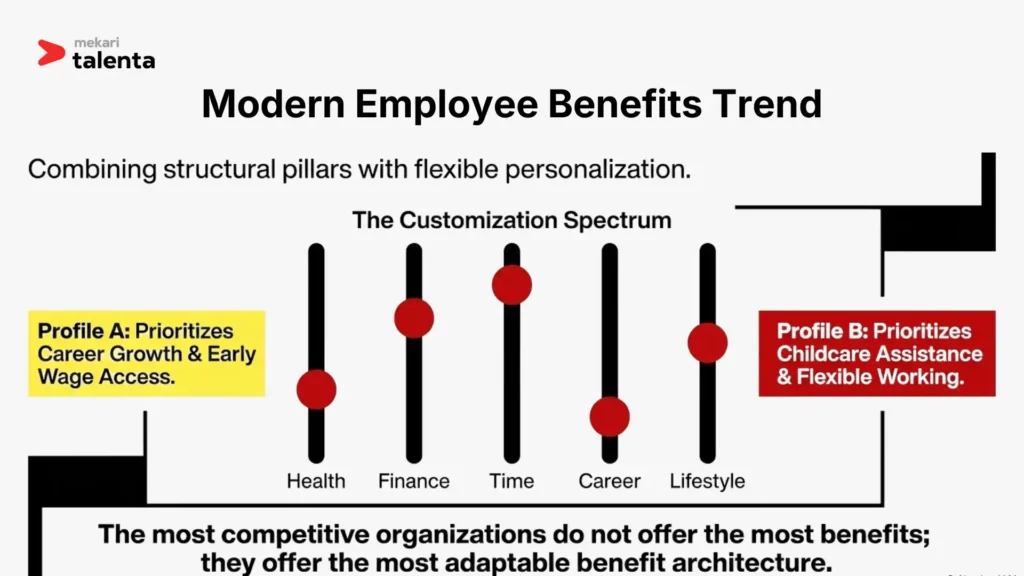
For organizations, flexible benefit structures can improve perceived benefit value without necessarily increasing total benefit spending significantly.
Employees also tend to feel more supported when they can prioritize benefits most relevant to their own circumstances.
2. Wellbeing Benefits Are Expanding Beyond Healthcare
This makes employee wellbeing initiatives are increasingly extending beyond traditional medical insurance and annual health checkups.
Many companies now incorporate mental health support, preventive healthcare, stress management, fitness programs, resilience training, and financial wellbeing initiatives into broader workforce strategies.
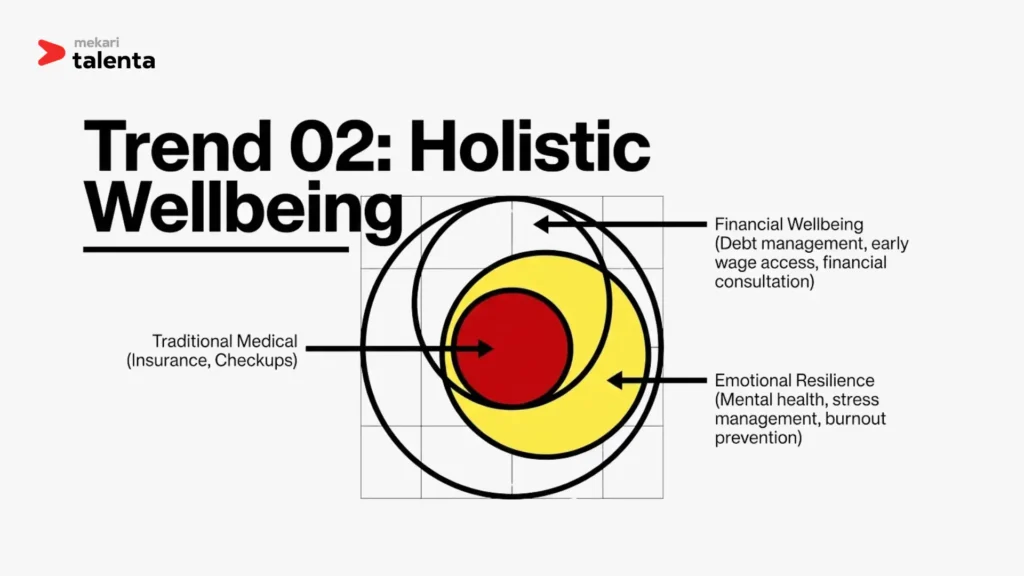
The growing focus on holistic wellbeing is largely driven by rising burnout concerns, workforce fatigue, and increasing awareness around mental health’s impact on productivity and employee attrition
3. Career Development Is Becoming Part of Benefits Strategy
Learning opportunities are increasingly being treated as part of the employee benefits experience rather than standalone HR initiatives.
Employees now expect organizations to support continuous skill development, certifications, leadership preparation, and career progression opportunities as part of long-term employment value.
Many companies are expanding learning reimbursement programs, internal development academies, digital learning access, and leadership acceleration initiatives to strengthen workforce adaptability and internal mobility readiness.
Organizations that integrate career development into their employee benefit strategy often create stronger long-term retention outcomes because employees can see clearer future growth opportunities inside the company.

Reference
Frequently Asked Questions (FAQs)
Which employee benefits are considered the most important by employees today?
Which employee benefits are considered the most important by employees today?
Healthcare coverage, paid leave, flexible work arrangements, retirement support, and career development opportunities are consistently viewed as some of the most valuable employee benefits across many industries. However, priorities can differ depending on workforce demographics, career stages, and local economic conditions. Younger employees may prioritize flexibility and learning opportunities, while employees with families often place higher importance on healthcare and financial stability benefits. This is why many companies are shifting toward more personalized or flexible benefit structures.
Do all companies need to provide the same employee benefits?
Do all companies need to provide the same employee benefits?
No. While certain benefits may be legally mandatory depending on local labor laws, many benefit programs are designed based on workforce needs, industry practices, operational structure, and business strategy. For example, manufacturing companies may prioritize transportation and shift-related support, while technology companies may focus more heavily on flexibility and learning benefits. Effective benefit programs are usually tailored to actual workforce realities rather than standardized across all industries.
How do employee benefits affect employee retention?
How do employee benefits affect employee retention?
Employee benefits can significantly influence whether employees choose to remain with an organization long term. Benefits related to healthcare, flexibility, financial security, wellbeing, and career growth often contribute to stronger employee satisfaction and organizational commitment. Poor or outdated benefit structures may increase employee attrition, particularly when competitors offer more supportive work environments. In many cases, employees evaluate total rewards packages rather than salary alone.
What are flexible benefits in employee compensation?
What are flexible benefits in employee compensation?
Flexible benefits allow employees to customize parts of their benefits package based on their personal needs and preferences. Instead of receiving identical benefits across the workforce, employees may choose between different healthcare options, additional leave, childcare support, wellness programs, or learning allowances. Flexible benefit models are increasingly popular because workforce expectations are becoming more diverse across different generations and lifestyles.
How can companies improve their employee benefits strategy?
How can companies improve their employee benefits strategy?
Organizations can improve their benefits strategy by regularly reviewing workforce feedback, benefit utilization data, labor market trends, and operational priorities. Strong benefit strategies are usually aligned with workforce demographics, business sustainability goals, and employee experience initiatives rather than focusing only on compliance obligations. Companies also increasingly integrate wellbeing, flexibility, and career development into broader employee retention and workforce planning strategies.