

What Is Coaching for Employees? – A guide to Build High-Impact Teams


- Coaching is a structured process that helps individuals or teams improve performance and achieve specific goals through guided reflection and feedback.
- The main purpose of coaching is to unlock potential, build capability, and drive measurable performance improvement.
In many organizations, performance gaps are not caused by a lack of knowledge, but by a lack of clarity, ownership, and consistent development.
Traditional approaches like training often fail to address real-time challenges employees face in their roles. This is where coaching becomes a more adaptive and context-driven approach to development.
By embedding coaching into daily workflows, companies can unlock better decision-making, stronger accountability, and more sustainable performance improvements.
This article will explore what coaching is, why it matters, and how organizations can implement it effectively.
What Is Coaching?
Coaching is a structured guidance process designed to help individuals or teams develop their potential, improve performance, and achieve specific goals.
It involves a collaborative relationship between a coach and a coachee, where the coach provides support, direction, and constructive feedback, often through questions and reflection rather than direct instruction.
In a workplace context, coaching is commonly used as a strategic approach to talent development, enabling organizations to build skills, enhance performance, and prepare talent for long-term growth.
Coaching can be conducted in various contexts, including professional, personal, or organizational settings, and can help individuals or teams achieve their best potential in reaching goals and facing challenges.
Objectives and Benefits of Coaching
The objectives of coaching vary widely and can cover various aspects of a person’s life and career. The following are some of its objectives.
1. Skill Development
Coaching aims to help individuals develop new skills or improve existing ones. This can include developing leadership skills, communication, time management, or specific technical skills related to the job.
This benefit is statistically proven.
2. Improving Performance
Another objective is to improve individual or team performance. The coach works with the coachee to identify areas where performance can be improved, set measurable goals, and develop strategies to achieve those goals.
Read also: Calculating Return on Training Investment (ROTI) and Strategies
3. Improving Interpersonal Relationships
Coaching can also be used to improve interpersonal relationships and overall employee engagement in the workplace or in personal life. This may involve conflict resolution, improving communication, building collaboration, or increasing trust and mutual understanding.
4. Achieving Career Goals
Many people use coaching to help them achieve bigger career goals while strengthening overall employer branding.
This may include getting a promotion, changing career paths, finding work-life balance, or planning steps to achieve long-term career aspirations.
5. Improving Balance and Well-Being
Another benefit is helping individuals achieve work-life balance and improve overall well-being. A coach can help the coachee identify life priorities, manage stress, improve health and fitness, and achieve better balance in their overall life.
Types of Coaching
In practice, coaching is not a one-size-fits-all approach. Different business challenges, employee maturity levels, and organizational goals require different coaching styles.
Understanding these variations allows companies to apply the right approach in the right context, maximizing both individual growth and business impact.
Before diving deeper, the table below summarizes the key differences between common coaching types based on their focus and the role of the coach:
| Coaching Type | Main Focus | Main Role of Coach | Suitable Situations |
|---|---|---|---|
| Executive | Strategy & Leadership | Strategic partner & challenger | Senior leaders / C-Level |
| Team | Collaboration & Synergy | Group dynamics facilitator | Team conflict or new projects |
| Directive | Instructions & Quick Solutions | Subject matter expert | New employees or crisis situations |
| Non-Directive | Awareness & Independence | Active listener & facilitator | Long-term talent development |
| Laissez-Faire | Full autonomy | Passive supporter | Highly autonomous employees |
| Situational | Context adaptation | Flexible (adaptive) | Dynamic work environments |
Following the overview above, here is a detailed breakdown of each coaching type commonly applied in organizations:
1. Executive Coaching
Executive coaching is designed for senior leaders such as CEOs and top-level executives. It focuses on enhancing leadership effectiveness at a strategic level, including decision-making, stakeholder management, and navigating organizational complexity.
Rather than solving day-to-day operational issues, executive coaching helps leaders sharpen strategic thinking, navigate complex stakeholder dynamics, and align their leadership approach with long-term business goals.
It often acts as a sounding board—challenging assumptions, refining decision-making, and strengthening leadership presence in high-stakes environments.
Read also: Developing Leadership Competencies: Skills for Managing High-Performing Teams
2. Team Coaching
Team coaching focuses on improving collaboration, communication, and collective performance. Unlike individual coaching, it treats the team as a single unit.
The goal is to improve how the team functions as a whole: enhancing communication, building trust, and aligning members toward shared objectives.
This approach is particularly valuable when teams face internal conflict, cross-functional misalignment, or are entering new phases such as project launches or organizational change.
3. Directive Coaching
Directive coaching is a more structured and instruction-driven approach, where the coach takes on the role of an expert.
This method is highly effective in situations that require speed, precision, and clarity, such as onboarding new employees, handling urgent issues, or operating in high-risk environments where compliance and accuracy are critical.
However, its strength can also be its limitation. Over-reliance on directive coaching may reduce independent thinking and create dependency, making it less suitable for long-term capability building.
4. Non-Directive Coaching
In contrast, non-directive coaching is built on the belief that individuals already possess the answers—they simply need the right guidance to uncover them.
Here, the coach acts as a facilitator rather than an instructor, using reflective questions to encourage deeper thinking, self-awareness, and ownership. This approach is especially powerful for developing senior talent, fostering innovation, and building future leaders.
While it typically requires more time and maturity from the coachee, the long-term impact is significantly stronger, as solutions are internally driven rather than externally imposed.
5. Laissez-Faire Coaching
Laissez-faire coaching represents a hands-off approach, giving full control to the coachee in determining direction, pace, and priorities.
The coach’s role is minimal—stepping in only when needed. This style works best for highly experienced professionals who already possess strong competence and intrinsic motivation.
In such cases, too much intervention can be counterproductive, while autonomy can drive creativity, ownership, and performance at a higher level.
6. Situational Coaching
Situational coaching is arguably the most flexible and practical approach in modern organizations.
Rather than adhering to a single style, coaches adjust their methods based on the context, challenges, and readiness of the coachee.
For example, a coach may adopt a directive approach during a crisis to establish clarity and control, then shift to a non-directive style to encourage reflection and long-term learning.
This adaptability makes situational coaching particularly valuable in dynamic work environments, where change is constant and no single approach fits all scenarios.
When Should Companies Run Coaching Programs?
Coaching is most effective when it is applied intentionally, not as a reactive fix, but as a strategic lever aligned with business needs, employee recruitment, and workforce development priorities.
Rather than treating coaching as a one-time initiative, organizations should identify key moments where coaching can create the greatest impact.
The following scenarios highlight when coaching programs become particularly valuable:
1. Business Growth Stagnation
When business growth begins to plateau, the challenge often lies not only in strategy, but in execution and leadership alignment.
In these situations, coaching can help leaders and management teams uncover hidden barriers, making gaps, misaligned priorities, or capability limitations.
More importantly, coaching creates space for critical reflection and strategic recalibration, enabling organizations to reignite growth with clearer direction and stronger leadership ownership.
2. Resolving Persistent Organizational Issues
Unresolved internal challenges such as team conflicts, rising employee turnover, ineffective communication, or declining performance—often reflected in insights gathered from an exit interview—rarely fix themselves over time.
Coaching provides a structured and objective approach to address these issues at their root. By facilitating open dialogue, encouraging accountability, and guiding problem-solving, coaching helps individuals and teams move beyond surface-level fixes toward more sustainable behavioral and performance improvements.
3. Closing Skills and Capability Gaps
As businesses evolve, driven by technological advancements, market shifts, or new strategic priorities, skill gaps inevitably emerge within the workforce.
Coaching plays a critical role in bridging these gaps, particularly when development needs go beyond what a traditional learning management system can provide.
It supports employees in applying new skills in real-world contexts, accelerating learning, and building confidence in navigating change. This makes coaching especially relevant in upskilling and reskilling initiatives.
4. Strengthening Leadership Effectiveness
Leadership challenges are one of the most common and most impactful triggers for coaching.
Whether it’s managing team dynamics, making high-stakes decisions, or leading organizational transformation, coaching helps leaders develop greater self-awareness, refine their leadership approach, and respond more effectively to complex situations.
Over time, this not only improves individual leadership performance but also strengthens overall organizational capability.
5. Navigating Organizational Change and Transformation
Periods of change such as restructuring, mergers, or rapid expansion, often create uncertainty and disrupt established ways of working.
Coaching supports employees and leaders in adapting to these changes by building resilience, maintaining focus, and reinforcing alignment with new organizational directions. It also helps ensure that change initiatives are not only implemented, but truly adopted at the behavioral level.
Differences Between Coaching, Mentoring, Consulting, and Training
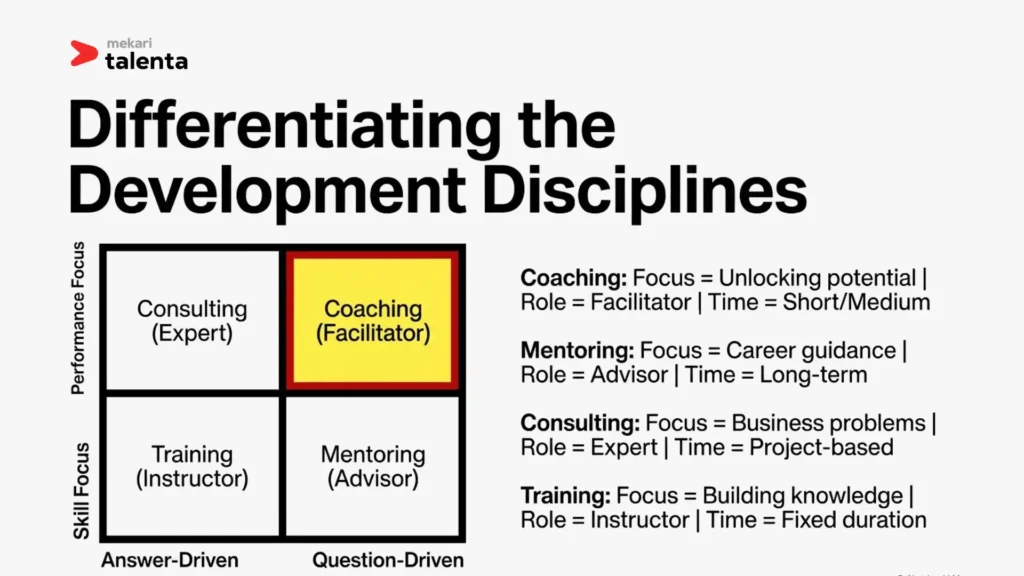
While these four approaches are often used interchangeably, they serve fundamentally different purposes in employee development and business performance.
Understanding their distinctions helps organizations apply the right method in the right context.
| Aspect | Coaching | Mentoring | Consulting | Training |
|---|---|---|---|---|
| Primary Focus | Unlocking potential and improving performance | Sharing experience and career guidance | Solving specific business problems | Building knowledge and skills |
| Role of Expert | Facilitator (asks questions, guides thinking) | Advisor (shares insights and experience) | Expert (provides solutions and recommendations) | Instructor (delivers structured learning) |
| Approach | Question-based, reflective, process-driven | Experience-based, advisory | Analysis-driven, solution-oriented | Curriculum-based, structured |
| Goal Ownership | Coachee defines and owns the goals | Shared direction guided by mentor | Defined by client problem | Defined by program or curriculum |
| Time Horizon | Short to medium term (goal-oriented) | Long-term development | Typically short-term (project-based) | Fixed duration (session/program-based) |
| Key Outcome | Behavior change and performance improvement | Career growth and personal development | Concrete solutions and business results | Knowledge acquisition and skill mastery |
| Best Used When | Developing talent and improving performance | Guiding career growth and leadership journey | Addressing complex or technical challenges | Standardizing skills and knowledge across teams |
In practice, these approaches are not mutually exclusive. High-performing organizations often combine coaching, mentoring, consulting, and training as part of talent development program, aligning individual growth with broader business objectives.
How to Implement Effective Coaching in Companies
For coaching to deliver real business impact, it cannot exist as a standalone HR initiative. It must be embedded into daily workflows, aligned with performance goals, and supported by clear structures and accountability.
In many organizations, this level of integration is supported by talent management software that connects development initiatives with broader HR processes.
Below are practical steps companies can implement to ensure coaching is effective, scalable, and sustainable.
1. Define Clear and Measurable Coaching Objectives
Effective coaching always begins with clarity. Many organizations apply principles such as management by objective (MBO) to ensure coaching goals are directly aligned with measurable business outcomes.
Without well-defined goals, coaching conversations tend to become abstract, making it difficult to measure progress or demonstrate impact.
In practice, companies should translate broad development goals into specific, measurable outcomes that are directly tied to business performance and KPI (key performance management) frameworks.
For example, instead of setting a goal like “improve leadership skills,” a more actionable objective would be “improve delegation effectiveness to reduce team bottlenecks within three months.”
By anchoring coaching objectives to real business challenges, such as productivity gaps, missed deadlines, or communication issues, organizations ensure that coaching is not just developmental, but also performance-driven.
This alignment also makes it easier for both managers and employees to stay focused and accountable throughout the coaching process.
2. Use a Structured Coaching Framework
Consistency is one of the biggest challenges in implementing coaching at scale. Without a clear structure, coaching sessions often turn into casual conversations or informal advice-sharing, which limits their effectiveness.
Using a framework such as the GROW model (Goal, Reality, Options, Will) helps bring discipline into every session. It ensures that conversations start with a clear objective, explore the current situation in depth, identify possible solutions, and end with concrete actions.
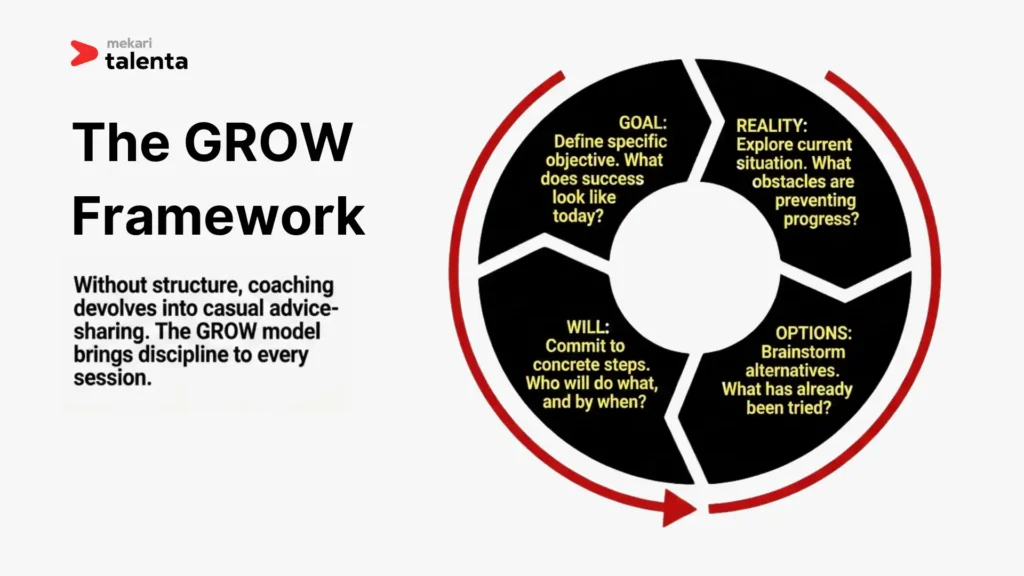
This structure also allows managers to guide discussions without dominating them. For instance, when addressing performance issues, the conversation can move systematically from identifying the goal, understanding current obstacles, exploring alternatives, and committing to next steps.
Over time, this structured approach builds a habit of solution-oriented thinking across the organization.
3. Focus on Questions Rather Than Instructions
A common pitfall in workplace coaching is the tendency for managers to jump straight into giving advice. While this may seem efficient, it often limits employee growth and reduces ownership.
Effective coaching shifts the focus from providing answers to asking the right questions. By encouraging employees to reflect on their own challenges and explore possible solutions, coaching helps develop critical thinking, self-awareness, and accountability.
For example, instead of directing an employee on how to solve a problem, a manager might ask what approaches have already been tried, what obstacles are preventing progress, and what success would look like.
This approach not only leads to better solutions, but also ensures that employees feel more responsible for executing them.
4. Integrate Coaching into Daily Workflows
Coaching is most effective when it is embedded into everyday work, rather than treated as a separate or occasional activity. Organizations that rely solely on formal coaching sessions often struggle to sustain momentum.
In practice, coaching should be integrated into existing touchpoints such as one-on-one meetings, performance reviews, and even real-time problem-solving situations. This allows coaching to happen continuously, in context, and with immediate relevance to actual work challenges.
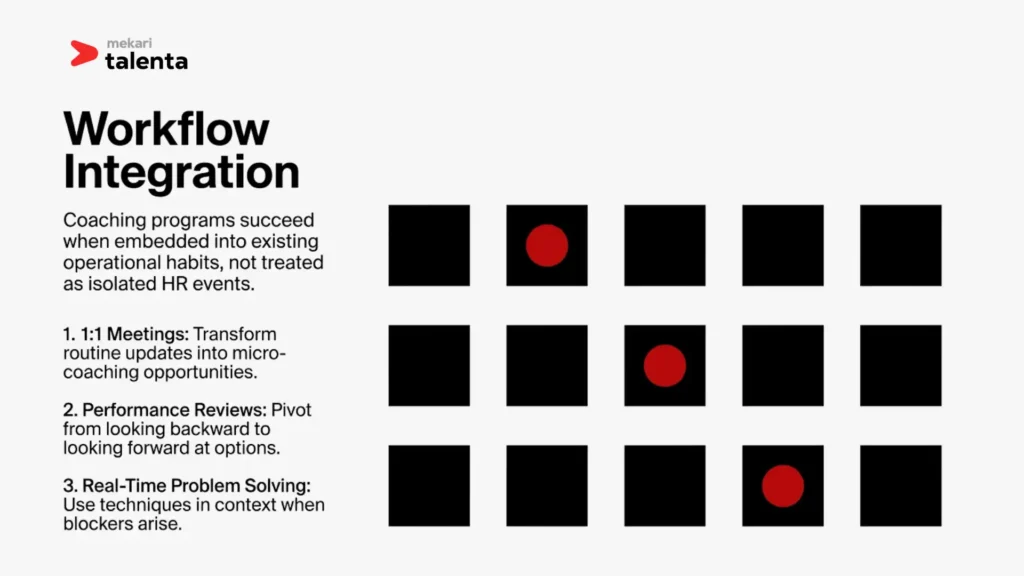
For example, during a routine check-in, a manager can use coaching techniques to explore an employee’s progress, clarify priorities, or address blockers.
Over time, this creates a culture where coaching becomes a natural part of leadership behavior rather than an additional task.
5. Track Progress and Evaluate Impact
For coaching to be taken seriously at the organizational level, its impact needs to be visible and measurable.
This approach is aligned with practices commonly used in KPI consultancy, where performance is continuously tracked and optimized based on data. Without proper tracking, coaching risks being perceived as a “soft” initiative with unclear value.
Companies should establish clear indicators to monitor progress, leveraging people analytics to gain deeper insights into performance trends and behavioral changes.
This can include improvements in key metrics such as productivity or project delivery, as well as shifts in how employees communicate, collaborate, or make decisions.
Regular evaluation also allows organizations to refine their coaching approach over time. By combining data with qualitative feedback, companies can identify what works, what needs adjustment, and how coaching contributes to broader business goals.
Building a Structured Coaching and Development Culture with Mekari Talenta
Managing employee development, including running coaching programs, is not just about identifying skill gaps, but also ensuring that development plans are executed consistently, monitored regularly, and aligned with organizational priorities.
Without an integrated system, companies often face challenges in managing development and coaching initiatives at scale.
These challenges range from inconsistent documentation, lack of visibility into employee progress, to difficulties in tracking whether coaching and development sessions are actually completed and delivering effective impact.
To address this, companies can leverage Mekari Talenta as an AI-centric, cloud-based HCM solution that provides end-to-end employee lifecycle management, covering HR administration, attendance tracking, payroll processing, performance management, and talent development.
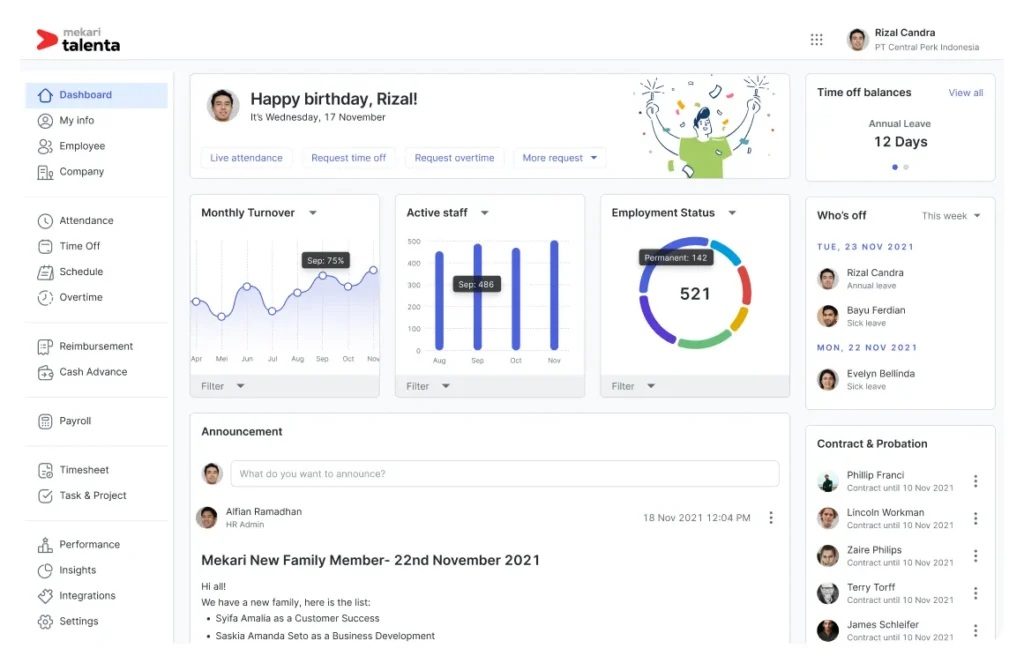
Mekari Talenta supports end-to-end talent development processes by enabling HR teams to design, execute, and monitor Individual Development Plans (IDP) in a far more systematic way.
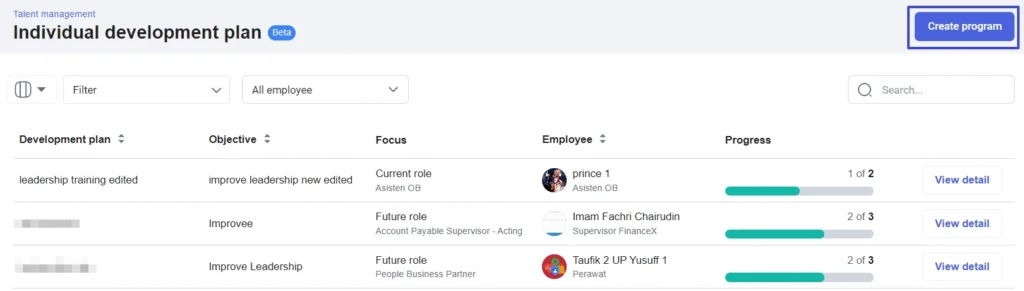
Through this platform, companies can:
- Define and track various action plans flexibly. Within Mekari Talenta’s IDP, HR can assign concrete actions such as coaching, training, self-learning, and project exposure.
- Monitor the progress of coaching and development execution through transparent status tracking (to do, in progress, completed).
- Align coaching plans with competency frameworks and employee role qualification standards.
- Integrate IDP execution with succession planning and performance management.
With a centralized HCM system, companies gain more comprehensive visibility into talent readiness, can identify stalled coaching programs early, and ensure that employee capability development aligns with long-term workforce planning.
Interested in exploring how Mekari Talenta can support your coaching and employee development strategy?
Schedule a free demo with our team and discover how a structured and integrated approach can make employee development execution in your company more effective, measurable, and scalable.
Reference
What Is Employee Coaching? (Plus Benefits and How To Use It) – Indeed
Frequently Asked Questions (FAQs)
What is the difference between coaching and performance management?
What is the difference between coaching and performance management?
Coaching focuses on development through guided thinking and self-discovery, while performance management is a structured process to evaluate and measure results against predefined targets. Coaching is more ongoing and developmental, whereas performance management is often periodic and evaluative. In practice, coaching complements performance management by helping employees improve how they achieve their targets. When combined, both create a more balanced approach to performance and growth.
Who should be responsible for coaching in a company?
Who should be responsible for coaching in a company?
Coaching is not limited to HR—it is primarily the responsibility of direct managers and team leaders. They are closest to day-to-day performance and can provide the most relevant guidance. However, HR plays a key role in enabling coaching by providing frameworks, tools, and training. In mature organizations, coaching becomes a shared capability across all leadership levels.
How often should coaching sessions be conducted?
How often should coaching sessions be conducted?
There is no fixed frequency, but effective coaching is typically ongoing rather than occasional. Many organizations integrate coaching into weekly or bi-weekly one-on-one meetings. The key is consistency and relevance, not formality. Coaching should happen whenever there are opportunities for reflection, feedback, or problem-solving.
Can coaching be applied to all employees?
Can coaching be applied to all employees?
Yes, but the approach should be adjusted based on experience and role. Junior employees may benefit more from structured or directive coaching, while senior employees respond better to non-directive approaches. The effectiveness of coaching depends on aligning the method with the individual’s readiness and context. A one-size-fits-all approach is rarely effective.
How do companies measure the success of coaching programs?
How do companies measure the success of coaching programs?
Success is measured through both performance outcomes and behavioral changes. This can include improvements in KPIs, productivity, leadership effectiveness, or collaboration quality. Companies may also track engagement scores and feedback from employees. The most effective measurement combines data insights with qualitative observations over time.