

What Is Exit Interview? – Purpose & Questions Example


- A structured conversation with departing employees to understand their experience and decision to leave.
- The purpose of exit interview is to uncover patterns behind attrition and generate insights that improve retention and employee experience.
Employee exits are often treated as the end of the employee lifecycle, rather than as a critical component of a broader human capital management strategy.
In reality, the moment someone leaves can reveal patterns that are difficult to detect through engagement surveys or performance reviews alone.
Many organizations conduct exit interviews, but few extract meaningful, actionable insights from them. The difference lies in how the process is designed, executed, and analyzed.
This article will explore what exit interviews are, why they matter, and how to conduct them in a way that generates real organizational insight.
What Is Exit Interview?
An exit interview is a structured conversation between an organization and an employee who is leaving, typically conducted during the final stage of employment.
Its primary objective is to understand the employee’s experience from their perspective—what worked well, what did not, and what ultimately influenced their decision to leave.
These discussions usually cover areas such as leadership, team dynamics, workload, compensation, career development, and organizational culture.
When approached properly, exit interviews provide a clearer view of how the organization operates beyond surface-level metrics.
Across multiple interviews, recurring themes begin to emerge—whether related to management gaps, unclear career progression, or misalignment in expectations.
When captured systematically and reviewed over time, these insights can inform improvements in retention, employee experience, and broader talent management strategies.
In more structured environments, exit interview data is often captured through HRIS or HCM software to ensure consistency and enable longitudinal analysis.
Purpose of Conducting Exit Interviews for Departing Employees
Exit interviews play a critical role in helping organizations understand why employees leave and what can be improved internally.
In companies with layered structures, diverse teams, and multiple business units, these insights become even more valuable as they reveal patterns that are not always visible through day-to-day operations.
When conducted consistently and analyzed properly, exit interviews can turn individual departures into meaningful input for strengthening retention, improving management practices, and refining overall employee experience.
1. Identify Systemic Drivers of Turnover at Scale
In complex organizations with multiple teams, functions, or entities, individual resignation cases rarely stand alone. Exit interviews help consolidate patterns across different business units to reveal underlying issues—whether related to leadership quality, role clarity, or culture.
Exit interviews help close this gap by grounding decisions in real employee sentiment rather than assumptions.
2. Strengthen Retention Strategy Through Data-Driven Insights
Exit interviews provide structured qualitative data that can be aggregated and analyzed across locations, functions, or subsidiaries.
Over time, this creates a reliable dataset to identify recurring themes, such as lack of career growth, ineffective management, or compensation misalignment—and prioritize high-impact interventions.
This makes exit interviews a key input for strategic workforce planning and broader people analytics initiatives.
3. Protect Employer Brand and Long-Term Talent Pipeline
How an organization manages the exit experience directly influences its reputation in the talent market, especially in interconnected or high-visibility environments.
Exit interviews create a structured way to close the employee lifecycle with professionalism, while also capturing feedback that can improve future employee experience.
In large, networked organizations, this impacts not only employer branding but also referrals, rehires (“boomerang employees”), and overall talent attraction.
Read also: Data-Driven HR: Definition, Benefits, and Practical Implementation
Key Aspects of an Effective Exit Interview
A well-designed exit interview process is built on several core elements that ensure the insights collected are reliable, comparable, and actionable.
1. Timing of the Interview (Pre-Exit vs. Post-Exit)
When the interview is conducted has a direct impact on the quality of feedback.
- Too early (e.g., right after resignation): responses tend to be guarded, especially if the employee is still transitioning work or concerned about references.
- Too late (e.g., long after departure): context fades, and feedback becomes less specific.
Best practice in more mature setups is a two-step approach:
- A primary interview during the notice period (once emotions stabilize)
- A follow-up post-exit (2–4 weeks after leaving) to capture more candid reflections
This combination balances immediacy with honesty.
2. Clearly Defined Exit Drivers (Standardized Taxonomy)
At scale, you can’t rely on open-text answers alone. There needs to be a structured classification of exit reasons, such as career growth, compensation, leadership, workload, or job fit.
The key here is consistency. Different HRBPs or interviewers should categorize feedback in the same way, otherwise the data becomes impossible to aggregate.
Mature organizations typically maintain a controlled “exit driver taxonomy” that evolves over time but remains standardized across entities.
2. Calibrated Question Framework
The questions asked should be consistent enough to allow comparison, but flexible enough to reflect different employee contexts.
For example, leadership-related questions may carry more weight for senior roles, while onboarding or role clarity may be more relevant for early-tenure employees.
The aspect here is calibration. Not every exit interview should feel identical, but the core dimensions must remain aligned.
3. Independent and Unbiased Data Collection Mechanism
Who conducts the interview significantly impacts the quality of feedback. When interviews are handled by direct managers, responses tend to be filtered or overly diplomatic.
A well-designed process separates the conversation from direct reporting lines, typically through HR or a neutral party, and ensures the tone is exploratory rather than evaluative. This reduces response bias and increases data credibility.
4. Structured Data Capture
One of the biggest gaps in many organizations is how feedback is recorded. Free-text notes alone don’t scale.
Key aspects here include:
- Pre-defined fields for core themes
- Quantifiable inputs where possible (e.g., rating manager effectiveness)
- Consistent documentation format across interviews
This enables aggregation, trend analysis, and reporting without excessive manual interpretation.
In more advanced setups, these insights are visualized through HR dashboards and analytics tools to support faster and more informed decision-making.
5. Centralized Aggregation and Pattern Recognition
Exit interview data only becomes valuable when it is centralized and analyzed collectively. Instead of reviewing feedback case by case, strong HR teams look for patterns across:
- Functions or departments
- Specific managers or leadership layers
- Tenure bands or performance groups
This allows organizations to move from anecdotal insights to systemic understanding.
6. Linkage to Action and Decision-Making Forums
The final aspect is governance. Exit interview insights need a clear path into decision-making, whether through quarterly talent reviews, leadership meetings, or workforce planning discussions.
Without this linkage, even high-quality data remains underutilized. With it, exit interviews become an input for real organizational change, not just documentation.
Read also: Employee Master Data: Definition, Benefits, and Best Practices for HR
How to Conduct Exit Interviews That Generate Real Insight
In many organizations, exit interviews fall short not because of lack of intent, but because of shallow design and limited follow-through. Their real value emerges when treated as a diagnostic tool rather than a checklist exercise.
To make exit interviews truly valuable, organizations should focus on the following:
1. Distinguishing “Stated Reasons” vs. “Actual Drivers”
Exit feedback often reflects the most convenient explanation, not the underlying cause. Compensation is a common example, frequently cited as the reason for leaving, yet often acting as a trigger rather than the root issue.
In many cases, deeper analysis reveals that factors such as inconsistent management quality, limited career visibility, or role misalignment play a more significant role. Employees may accept similar compensation elsewhere if these underlying conditions are improved.
Effective exit interviews therefore rely on layered questioning, moving beyond “why are you leaving” toward “when did you first consider leaving” and “what would have changed that decision.” This is where more reliable signals tend to emerge.
2. Segmenting Insights Across Functions, Managers, and Tenure
Aggregated data can be misleading if not segmented properly. In large or multi-entity structures, issues are rarely uniform.
What may initially appear as a company-wide issue—such as lack of career growth—often becomes more nuanced when segmented.
Patterns frequently concentrate within specific functions, leadership layers, or tenure groups. For instance, unclear internal mobility processes may affect certain teams, while others with structured pathways experience significantly lower attrition.
Robust exit interview analysis consistently answers three questions:
- Where is this occurring? (function, entity, or geography)
- Under whom? (manager or leadership layer)
- At what stage? (early tenure vs. mid-career exits)
Without this level of segmentation, organizations risk addressing symptoms rather than root causes.
3. Treat Timing and Interview Ownership as Design Variables
The quality of feedback is highly sensitive to when and how the interview is conducted.
Interviews conducted too close to the resignation trigger—such as immediately after conflict or burnout—tend to reflect emotional responses.
On the other hand, interviews conducted too late in the offboarding process often result in disengaged or rushed input.
More structured approaches typically include two touchpoints:
- A primary conversation during the notice period, once the situation has stabilized
- A short post-exit follow-up (2–4 weeks after departure) to capture more reflective feedback
Equally important is interview ownership. Separating the process from direct reporting lines—by assigning it to a neutral HR or centralized people function—generally leads to more candid and reliable input.
4. Converting Qualitative Feedback into Decision-Grade Data
The hardest part is making data from exit interview usable. Free-text answers without structure quickly become noise.
Experienced teams typically apply coding frameworks (e.g., tagging feedback into themes like “manager capability,” “role clarity,” “workload,” etc.), then quantify frequency and severity. Over time, this allows leadership to see trends such as:
- Which issues are persistent vs. emerging
- Which ones correlate most with regrettable attrition
- Which managers or units are statistical outliers
Over time, this structured approach allows organizations to integrate exit data into broader talent management systems.
5. Closing the Loop with Visible Action
The long-term effectiveness of exit interviews depends on whether insights lead to change. When feedback is collected but not acted upon, the process quickly loses credibility, both internally and in the broader talent market.
Effective organizations prioritize targeted action based on recurring and high-impact themes, then communicate clearly what is being addressed.
This does not require responding to every piece of feedback, but it does require demonstrating that patterns are taken seriously and translated into improvement initiatives.
Over time, this visibility reinforces trust and strengthens the overall employee experience, even among those who are not leaving.
Exit Interview Questions Examples
To generate meaningful insight, exit interview questions need to go beyond surface-level prompts and focus on decision points, trade-offs, and lived experience. The goal is not just to understand why someone left, but how that decision was formed over time.
Below is a set of questions commonly used in more mature exit interview frameworks:
- When did you first start considering leaving the organization? What triggered that moment?
- Before deciding to leave, what options did you explore internally (e.g., role change, discussion with manager)? What was the outcome?
- What ultimately made you decide to move forward with leaving, rather than staying?
- Looking back, what aspects of your role worked well for you?
- Which parts of your role felt misaligned with your expectations or career goals?
- How clearly defined were your responsibilities and success metrics?
- How would you describe the quality of support and direction from your direct manager?
- Were there specific moments where management either positively or negatively impacted your experience?
- What could your manager have done differently to improve your likelihood of staying?
- How would you assess your opportunities for growth and development here?
- Did you have a clear understanding of potential career paths within the organization?
- At what point, if any, did growth feel limited or unclear?
- How would you describe the team dynamics and collaboration within your function?
- Were there any cultural or behavioral patterns that affected your day-to-day experience?
- Did the work environment enable you to perform at your best? Why or why not?
- How would you evaluate your compensation and benefits relative to your responsibilities and market expectations?
- If compensation played a role in your decision, was it the primary factor or part of a broader consideration?
- How manageable was your workload over time?
- Were there periods of sustained pressure or burnout? If so, how were they addressed?
- What could have been done differently to make your workload more sustainable?
- If you had the opportunity to redesign your role or experience here, what would you change?
- What is one thing the organization could have done that might have influenced you to stay longer?
- How does your new opportunity differ from your experience here? What stood out the most in your decision?
- What does your new role or company offer that you felt was missing here?
- Did you feel that performance evaluations, including any 360-degree feedback processes, were fair and useful?
- Would you consider returning to the organization in the future? Under what conditions?
- Would you recommend this organization to others? Why or why not?
- Is there anything we have not asked that you believe is important for us to understand?
Common Mistakes in Exit Interviews
Below are several recurring mistakes consistently reduce the quality and usability of exit data.
1. Treating Exit Interviews as an Administrative Step
In some organizations, exit interviews are positioned as part of offboarding formalities—completed quickly alongside clearance processes.
In one case, interviews were conducted on the employee’s last day with a fixed checklist and limited time. Most responses were short, polite, and non-specific.
When aggregated, the data showed no clear pattern, leading leadership to conclude that attrition was “market-driven,” when in reality, deeper issues were simply not captured.
When exit interviews are treated as a formality, the output reflects it.
2. Taking “Better Opportunity” at Face Value
A common mistake is accepting initial answers without probing further.
In multiple instances, “better opportunity” or “higher salary” appeared as the dominant reason for leaving. However, when deeper questioning and cross-analysis were applied, the pattern pointed to inconsistent manager capability across specific teams.
Employees were not only leaving for better offers. They were leaving environments where growth, feedback, and support felt limited. Without deeper probing, this distinction would have been missed entirely.
3. Running Exit Interviews Without Segmentation
Looking at exit data in aggregate often leads to misleading conclusions.
In one organization, “lack of career growth” emerged as the top reason for attrition. Initial responses triggered a company-wide initiative to redesign career frameworks.
However, a later segmented analysis revealed that the issue was concentrated within a few functions where internal mobility processes were unclear. Other areas with structured pathways showed stable retention.
The absence of segmentation led to overcorrecting at the wrong level.
4. Assigning Interviews to Direct Managers
Allowing direct managers to conduct exit interviews often results in filtered or overly diplomatic feedback.
In practice, employees tend to avoid sharing critical feedback directly with their reporting line—especially if the issue is related to leadership style or team dynamics.
In one case, exit interviews conducted by managers showed consistently positive feedback, while anonymous post-exit surveys revealed significant dissatisfaction with the same leadership group.
This gap highlighted how interviewer ownership can directly impact data reliability.
5. Over-Relying on Qualitative Notes Without Structuring Data
Another frequent issue is collecting detailed feedback but failing to structure it for analysis.
In one scenario, HR accumulated months of exit interview notes across multiple business units. While the feedback was rich, it was stored as free text without categorization. When leadership requested insights, the team struggled to produce clear patterns or quantify trends.
Without coding, tagging, or standardization, even high-quality input becomes difficult to use at scale.
6. Failing to Close the Loop
Collecting feedback without visible follow-through reduces long-term effectiveness.
In one organization, repeated exit interviews highlighted workload imbalance and burnout within a specific division. However, no clear action was taken or communicated.
Over time, employees became increasingly disengaged during exit interviews, providing minimal or generic responses.
When feedback does not lead to change—or is not seen to—trust in the process declines quickly.
7. Ignoring Early Signals Because “It’s Just One Case”
A subtle but critical mistake is dismissing early feedback because it appears isolated.
In several cases, initial exit interviews flagged concerns about a specific manager or team environment. These signals were initially treated as one-off issues.
Over time, similar feedback accumulated, eventually revealing a clear pattern of regrettable attrition linked to that leadership area.
The delay in recognizing the pattern resulted in avoidable talent loss that could have been addressed earlier.
Limitations of Exit Interviews
While exit interviews can provide valuable insight, they also come with inherent limitations, especially when over-relied upon as a primary source of employee feedback.
Understanding these constraints is critical to avoid drawing incomplete or misleading conclusions.
1. Feedback Comes Too Late to Retain Talent
By the time an exit interview takes place, the employee has already made the decision to leave.
Even when root causes are identified, such as poor management, lack of growth, or workload issues, the opportunity to intervene for that individual is gone.
This makes exit interviews a lagging indicator, rather than a preventive tool. Organizations that rely solely on exit data often miss earlier signals that could have improved retention.
2. Response Bias and Filtered Feedback
Not all feedback shared during exit interviews is fully candid.
Employees may withhold negative comments due to concerns about references, relationships, or professional reputation, especially in environments where industries or networks are closely connected. On the other hand, some feedback may be overly emotional if tied to recent conflict or dissatisfaction.
As a result, exit data can reflect a mix of diplomacy and bias, requiring careful interpretation rather than literal acceptance.
3. Overemphasis on Stated Reasons
Exit interviews often capture what employees say rather than what actually drove their decision.
Common responses such as “better opportunity” or “higher compensation” can mask deeper issues like leadership gaps, unclear career paths, or misalignment in expectations.
Without deeper probing and cross-analysis, organizations risk addressing surface-level symptoms instead of root causes.
4. Limited Representativeness of the Workforce
Exit interviews only reflect the perspectives of employees who leave—not those who stay.
This creates an inherent imbalance. High-performing or highly engaged employees who remain in the organization may have very different experiences that are not captured through exit data. Relying too heavily on exit interviews can therefore skew the overall understanding of employee sentiment.
This also limits its usefulness in informing long-term talent development strategies or succession planning decisions if used in isolation.
5. Weak Follow-Through Reduces Credibility
If exit interview insights are not translated into visible action, the process quickly loses impact.
Employees—both current and former—tend to notice when feedback is collected but not acted upon. Over time, this can reduce trust in HR processes and lead to more guarded or disengaged responses in future interviews.
Read also: HRIS Implementation: A Practical Guide from Data Cleansing to Hyper-Care
Streamline Offboarding and Exit Interview Processes with Mekari Talenta
Managing employee exits effectively involves coordinating multiple processes, from knowledge transfer, asset return, access revocation, and data capture across teams, systems, and timelines.
Without a structured HRIS, offboarding often becomes fragmented, making it difficult to maintain consistency, safeguard data, and capture insights that could improve future workforce decisions.
A centralized system helps standardize how employee transitions are managed, ensuring that both administrative tasks and experience-related elements—such as exit interviews—are handled in a more organized and reliable way.
This becomes increasingly important in organizations with multiple teams or entities, where visibility and coordination across the employee lifecycle are critical to maintaining operational efficiency.
Mekari Talenta provides an AI-centric cloud-based HRIS platform that supports seamless onboarding and offboarding processes, helping organizations manage employee transitions with greater structure and control.
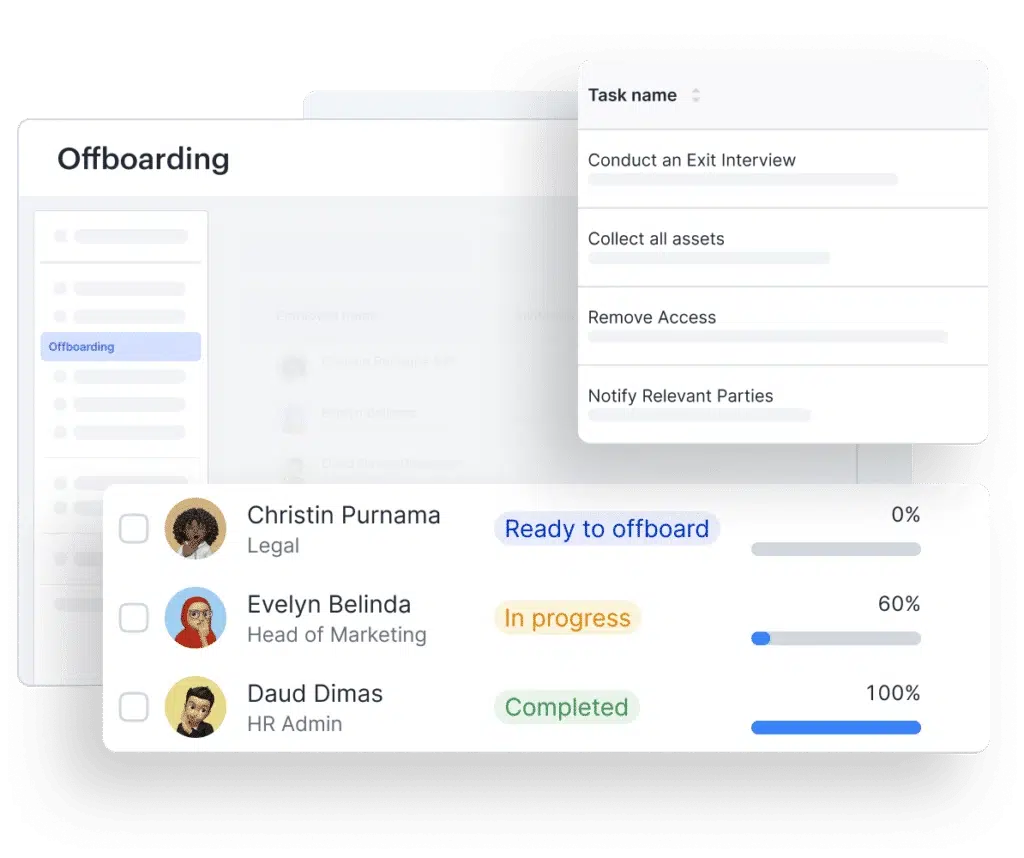
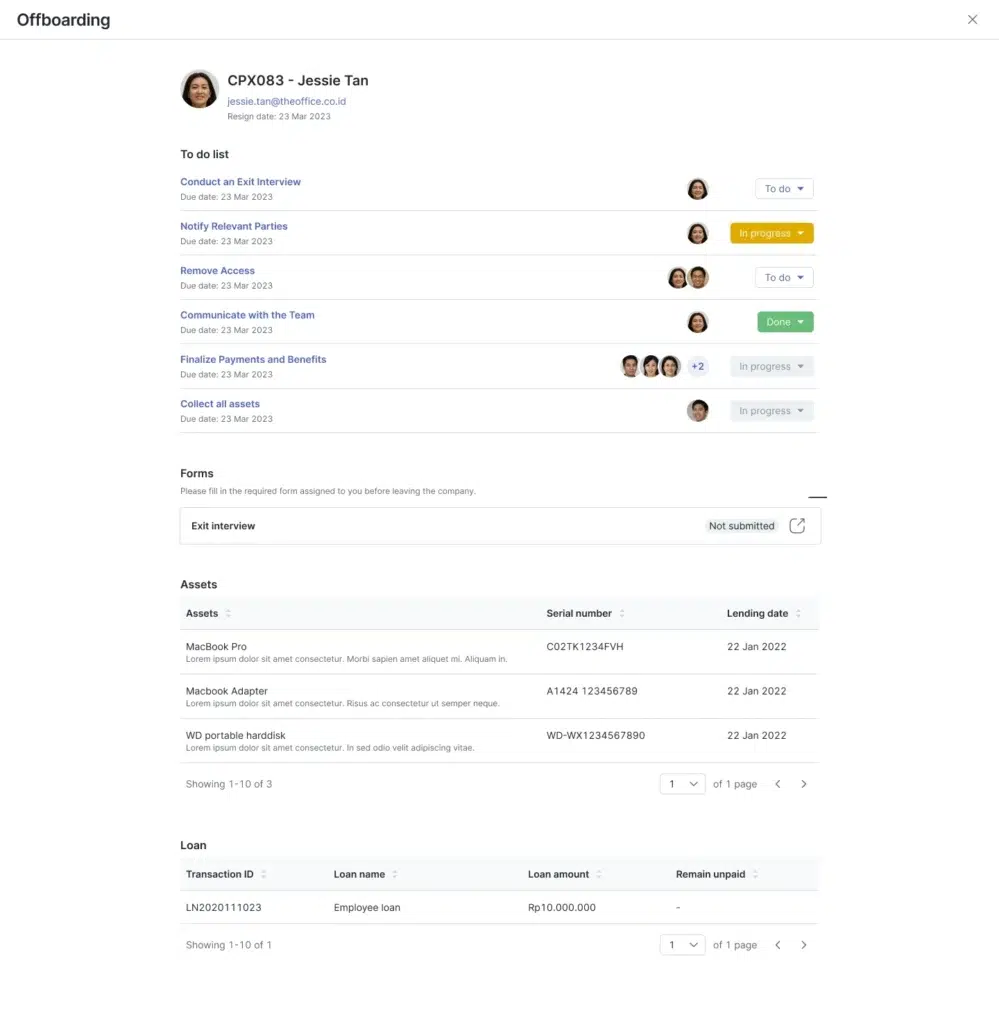
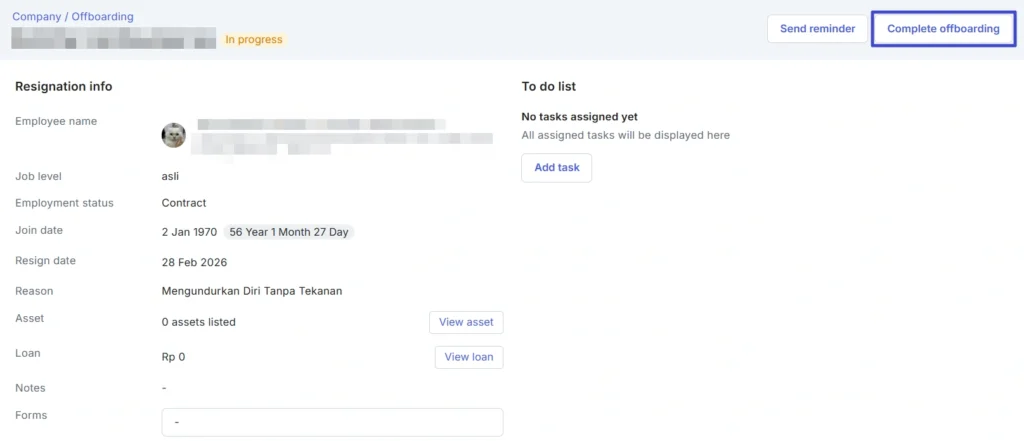
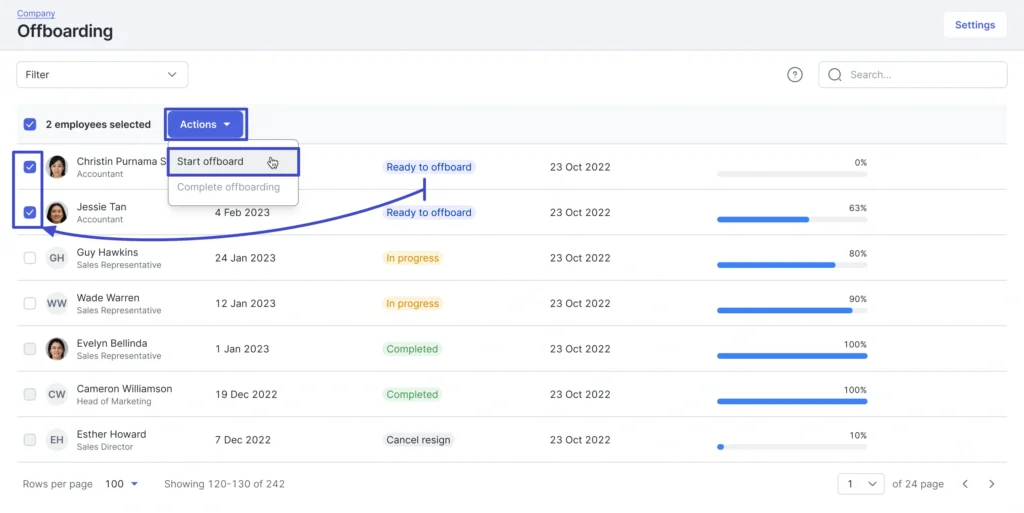
With Mekari Talenta’s onboarding and offboarding solution, organizations can simplify administrative workflows while also capturing valuable insights from employee exits. Key features include:
- Structured Offboarding Workflow. Manage resignation processes with approval flows, task assignments, and clear ownership across teams.
- Integrated Exit Interview Forms. Capture employee feedback directly within the system as part of the offboarding process, ensuring insights are not lost or fragmented.
- Task-Based Offboarding Management. Assign and track offboarding tasks (e.g., asset return, handover, documentation) with designated PICs for each step.
- Centralized Monitoring and Visibility. Track offboarding progress across employees through a single dashboard, improving coordination and accountability.
- AI-powered Data-Driven Insight Capture. Consolidate exit interview responses and offboarding data to identify patterns and support better organizational decisions.
By integrating offboarding processes within a single HRIS, organizations can move beyond manual coordination and build a more consistent, insight-driven approach to managing employee transitions.
Looking to improve how your organization handles onboarding and offboarding? Connect with our team to see how it can support your HR operations at scale.
Pertanyaan Umum seputar Exit Interview
Who should conduct an exit interview?
Who should conduct an exit interview?
Ideally, exit interviews should be conducted by HR or a neutral third party rather than the employee’s direct manager. This helps create a safer environment for honest feedback, especially when issues relate to leadership or team dynamics. In more structured organizations, centralized people teams often handle this process to ensure consistency and reduce bias.
Should exit interviews be mandatory?
Should exit interviews be mandatory?
Exit interviews are typically optional, but strongly encouraged. Making them mandatory can lead to disengaged or low-quality responses, while voluntary participation often results in more thoughtful input. The focus should be on creating a process that employees see as safe and worthwhile.
What is the difference between exit interviews and stay interviews?
What is the difference between exit interviews and stay interviews?
Exit interviews are conducted when employees are leaving, while stay interviews are conducted with current employees to understand what keeps them engaged. Stay interviews are proactive and help address issues before attrition occurs, whereas exit interviews are retrospective and help diagnose patterns after the fact. Both should be used together for a more complete view.
How long should an exit interview take?
How long should an exit interview take?
A typical exit interview lasts between 30 to 60 minutes, depending on the depth of discussion. The goal is to allow enough time for meaningful conversation without making it feel like a formal interrogation. Follow-up surveys or post-exit check-ins can complement the initial discussion.
How should exit interview data be stored and managed?
How should exit interview data be stored and managed?
Exit interview data should be documented in a structured and centralized system to allow aggregation and analysis. This often includes categorizing feedback into predefined themes and linking it with employee data such as tenure or department. Proper data handling also requires maintaining confidentiality and limiting access to relevant stakeholders.