
Employee Turnover: Definition, Types, Formula & How to Prevent It

-
Employee turnover is the movement of employees leaving and being replaced within an organization over a specific period.
-
Employee turnover rate is calculated by dividing the number of employees who leave by the average workforce, with a healthy range typically between 10% to 15% depending on context.
You must have often heard the term employee turnover rate, but not every organization fully understands its implications in a comprehensive workforce management context.
In simple terms, employee turnover is the process of employees entering and leaving an organization within a certain period of time.
In human resource management practice, turnover is actually a natural phenomenon and difficult to avoid due to the dynamics of workforce needs and employee career development.
At a healthy level, employee movement can even help organizations refresh competencies and align talent needs with business strategy.
However, if it occurs too frequently, high turnover can disrupt team stability, increase employee recruitment costs, and affect overall operational continuity.
This article will provide a comprehensive overview of employee turnover, including its definition, types, underlying causes, calculation methods, impacts on organizational performance, and strategic approaches to manage and reduce turnover effectively within a structured workforce environment.
What is Employee Turnover?
Employee turnover refers to the structured and continuous movement of employees entering and leaving an organization within a defined period, driven by a combination of individual, organizational, and external factors that influence workforce dynamics.
This process represents not only workforce replacement, but also a measurable indicator of how effectively an organization manages employee lifecycle, workforce stability, and internal capability alignment over time.
Such movement can occur either voluntarily, when employees decide to leave based on personal or professional considerations, or involuntarily, as a result of organizational decisions such as termination of employment, restructuring initiatives, role realignment, or performance-based actions.
In a broader workforce management context, employee turnover also reflects how well organizational systems, leadership practices, and work environments are able to retain critical talent while continuously adapting to evolving business requirements.
What is Turnover Rate?
Employee turnover rate or labor turnover rate is a metric used to measure the intensity of employee movement within a certain period.
This measurement is typically conducted on a regular basis, such as monthly or annually, to observe workforce movement trends within the organization.
This data helps HR teams understand whether the organization is experiencing workforce stability or facing a high level of employee movement.
High turnover is often a signal of underlying organizational issues, ranging from job dissatisfaction to limited career development opportunities.
On the other hand, a healthy turnover rate can indicate that the organization is able to retain talent while still allowing room for workforce regeneration.
However, if the turnover rate is too high, the organization may face significant losses. In addition to losing experienced employees, the organization must also bear additional costs for recruitment processes, training, and onboarding adaptation for new hires.
Employee Turnover vs. Attrition
Employee turnover and attrition are often used interchangeably, but they refer to different workforce dynamics. Understanding the distinction is important for organizations to manage headcount, strategic workforce planning, and retention strategies more effectively.
While both involve employees leaving, the key difference lies in whether the role is replaced and how the exit is managed. Here are the key differences between these two:
| Aspect | Employee Turnover | Attrition |
|---|---|---|
| Definition | The rate at which employees leave and are replaced within an organization | The natural reduction of workforce without immediate replacement |
| Replacement | Positions are typically refilled | Positions are usually not replaced |
| Nature | Can be voluntary or involuntary | Mostly voluntary or natural (resignation, retirement) |
| Intent | Managed as part of workforce operations | Often used as a strategic workforce reduction approach |
| Impact on Workforce Size | Workforce size remains relatively stable | Workforce size gradually decreases |
| Examples | Resignation followed by hiring a replacement | Employee retires and role is eliminated |
Conclusion:
The main difference between employee turnover and attrition lies in workforce continuity.
Turnover focuses on maintaining workforce levels by replacing employees who leave, making it an operational concern tied to hiring and retention.
In contrast, attrition reflects a deliberate or natural reduction in workforce size, often used as part of cost control or organizational restructuring.
Types of Employee Turnover
There are several types of employee turnover that can be classified based on different approaches, such as the level of voluntariness, the degree of organizational control, and the impact on organizational performance outcomes.
Types of Turnover Based on Functional Impact
This classification helps organizations understand whether employee movement provides positive contributions or creates disadvantages.
Based on this functional perspective, employee turnover is generally divided into two main types, namely functional turnover and dysfunctional turnover.
1. Functional Turnover
Functional turnover occurs when employee replacement does not create a negative impact on organizational performance.
In certain conditions, this type of turnover can even provide tangible benefits to the organization. This situation typically occurs when employees who leave demonstrate relatively lower or suboptimal performance.
Workforce replacement enables the organization to acquire new talent with competencies that are more aligned with current organizational needs.
As a result, the organization gains an opportunity to improve overall team quality while also enhancing collective productivity.
2. Dysfunctional Turnover
In contrast, dysfunctional turnover is a type of turnover that tends to create disadvantages for the organization. Employee replacement under this condition can generate a significant impact on organizational stability.
This usually occurs when employees who leave are high performers who contribute substantially to organizational outcomes.
In addition, the loss of key individuals or influential employees can disrupt team coordination as well as internal decision-making processes.
Employees who possess extensive experience, strong competencies, and a deep understanding of business processes often hold strategic roles within the organization.
When such employees leave, the organization risks losing critical institutional knowledge that cannot be easily replaced within a short period of time.
Types of Turnover Based on Voluntariness
Meanwhile, based on who initiates the departure, turnover can be divided into the following categories:
1. Voluntary Turnover
Voluntary turnover occurs when employees independently decide to leave the organization.
This decision is usually influenced by various factors such as better career opportunities, higher compensation, the desire to gain new experiences, or dissatisfaction with the work environment.
In organizations with complex team structures, voluntary turnover needs to be closely monitored because it often involves employees with high competencies or critical experience.
If a large number of high-performing employees leave voluntarily, this may indicate deeper issues within management systems, workplace culture, or talent development strategies.
2. Involuntary Turnover
In contrast, involuntary turnover occurs when the organization makes the decision to terminate the employment relationship.
This is typically caused by several factors such as underperformance, violations of company policies, organizational restructuring, or workforce efficiency measures.
In certain situations, this type of turnover is part of a strategic effort to maintain team performance quality. However, if it occurs too frequently, involuntary turnover can also create negative impacts on team morale and employee perceptions of organizational stability.
The Process of Employee Turnover
In this discussion, the turnover process is explained from the employee’s perspective. This approach helps organizations understand how work experiences influence an individual’s decision to remain or leave.
1. Evaluation
The first stage in the turnover process is the evaluation phase, where employees assess their work environment. At this stage, employees begin evaluating various aspects of their job over time.
This assessment usually develops gradually as tenure increases. In many cases, employees begin to clearly perceive workplace culture and job pressure after approximately six months.
During this period, they start to understand how internal systems operate. Employees typically evaluate factors such as team collaboration quality, relationships with supervisors, organizational systems, and whether the organization supports employee well-being.
Additionally, they assess their daily work routines. If the job feels too monotonous or lacks meaningful challenges, this can affect job satisfaction.
Employee evaluation is also often linked to perceptions of career development opportunities. If employees feel supported in learning and growth, they tend to have higher motivation to stay.
Conversely, if the system does not support professional development, it may trigger the desire to seek opportunities elsewhere.
2. Decision
After the evaluation phase, employees enter the decision-making stage. At this point, they consider two main options: staying or seeking new opportunities.
This phase is often marked by behavioral changes. In some cases, performance may decline as attention shifts toward job searching.
Employees also begin actively seeking external opportunities. This may involve professional networks, job platforms, or peer recommendations.
In complex organizational structures, this phase is often not immediately visible to management. However, if not properly managed, resignations may occur suddenly without clear warning signs.
Therefore, organizations need systems to monitor employee satisfaction to detect early turnover risks.
3. Resignation Submission
The final stage in the turnover process is the resignation phase or formal exit submission by employees. At this stage, employees officially communicate their decision to leave the organization to their direct supervisors or the HR team.
Typically, this process begins with informal communication with team leaders before proceeding to formal administrative procedures within the HR department.
In this situation, organizations need to take appropriate steps to manage the transition process in a professional manner.
One important step that needs to be implemented is conducting exit interviews with employees who are leaving the organization.
This communication aims to gather feedback and understand workplace dynamics that may have contributed to the resignation decision.
Feedback from departing team members can become a valuable source of insight for improving systems and building a healthier work environment.
Read also: The Great Resignation: Causes, Trends, and Solutions
Factors Causing High Turnover Rate
In general, turnover causes can be grouped into three main categories: individual factors, organizational factors, and geographical factors.
These factors interact and influence employee decisions.
1. Individual Factors
Individual factors relate to personal conditions that influence how employees perceive their work. Each employee has different backgrounds, motivations, and expectations.
This variation leads to different work experiences even within the same organization. In many cases, individual factors become the primary trigger behind an employee’s decision to leave.
a) Job Satisfaction
Job satisfaction is one of the most influential individual factors affecting employee turnover.
Employees who feel satisfied with their work tend to demonstrate higher levels of loyalty toward the organization. Conversely, when employees feel dissatisfied, the likelihood of them seeking alternative opportunities increases significantly.
Job dissatisfaction can arise from various factors such as lack of meaningful challenges, poor relationships with supervisors or colleagues, and insufficient recognition of employee contributions.
One of the most critical components of job satisfaction is work-life balance, referring to the balance between personal life and professional responsibilities.
If employees feel that work consumes excessive personal time, it can lead to dissatisfaction and emotional strain.
As a result, employees become more inclined to seek environments that offer better balance and overall well-being, ultimately influencing their decision to stay or leave.
b) Lack of Career Development Opportunities
Career development is a critical priority for most employees. When employees feel they lack opportunities to grow or advance, they often experience stagnation.
This stagnation can drive them to seek roles elsewhere that offer clearer progression pathways.
Organizations that fail to provide structured career paths or continuous learning opportunities risk losing valuable talent.
Employees want to feel that they have a future within the organization, and when that expectation is not met, they are more likely to transition to environments that better support their professional growth.
c) Excessive Workload
Excessive workload is one of the leading causes of workplace stress. Employees who consistently feel overwhelmed by high workloads or tight deadlines are at risk of experiencing burnout.
Burnout not only reduces productivity but also increases the likelihood of employees seeking roles with more manageable demands. Unbalanced workload distribution often occurs when workforce capacity does not align with operational demands.
To address this, organizations need to actively monitor workload distribution and ensure that responsibilities remain aligned with employee capacity and capabilities.
d) Long Tenure
Long tenure within a single organization can also become a contributing factor to turnover.
Employees who have spent extended periods in the same role or environment may feel they have reached a plateau where there is limited room for further growth or learning. This often triggers a desire to explore new opportunities, gain different experiences, and expand their skill sets.
Organizations can mitigate this by offering job rotation, cross-functional exposure, or new strategic projects to keep experienced employees engaged and continuously developing.
e) Lack of Work-Life Balance
Work-life balance has become an increasingly critical factor in the modern workplace.
Employees who feel unable to maintain a balance between professional demands and personal life—due to long working hours or increasing expectations—often choose to leave.
A lack of work-life balance can lead to both emotional and physical exhaustion, ultimately affecting productivity and overall well-being.
Organizations that fail to prioritize this aspect are at a significantly higher risk of experiencing elevated turnover rates.
To address this, flexible working arrangements such as remote work or adjusted schedules can play a critical role in improving retention.
2. Organizational Factors
Organizational factors refer to internal conditions that shape employee experiences at work. Policies, culture, and operational systems often have a direct impact on whether employees choose to stay or leave.
a) Restrictive Work Systems
Work systems that are overly rigid and lack flexibility are often a major contributor to turnover. Organizations that impose strict policies without allowing space for innovation or autonomy tend to lose high-performing talent.
Employees who feel overly controlled may become disengaged and eventually seek more flexible environments.
Additionally, systems that do not support employee well-being—such as lack of benefits or inadequate leave policies—can significantly increase dissatisfaction.
b) Non-Transparent Compensation Systems
Compensation plays a central role in employee retention. Employees who perceive that their pay does not reflect their contributions or that compensation systems lack transparency are more likely to leave.
A lack of clarity or fairness in compensation can erode trust between employees and management. Organizations therefore need to ensure that compensation structures are fair, competitive, and clearly communicated.
c) Poor Work Environment
An unhealthy work environment—whether physical or social—can significantly impact employee retention. Workplaces characterized by excessive pressure, lack of support, or interpersonal conflict create conditions that are not conducive to productivity or well-being.
Employees who feel uncomfortable or undervalued are far more likely to seek alternative environments that offer better support and culture.
d) Poor Leadership
Ineffective leadership is one of the strongest drivers of turnover. Employees expect leaders who provide clear direction, fairness, and support. When leadership fails, employee morale declines significantly.
Organizations that want to reduce turnover must invest in leadership development and ensure that managers are equipped with both technical and interpersonal capabilities.
3. Geographical Factors
Geographical factors often influence employee decisions, particularly when commuting distance becomes excessive.
Time and cost associated with daily travel can become a significant burden, especially for employees located far from operational centers. Long commutes contribute to fatigue, stress, and reduced productivity.
Additionally, when employees find opportunities closer to home, they may choose to transition in order to reduce commuting strain.
To address this, organizations can implement remote or hybrid work policies or flexible scheduling arrangements. Such flexibility not only improves employee well-being but also plays a crucial role in reducing turnover driven by geographical constraints.
However, one of the common concerns when adopting remote or hybrid work models is the perceived difficulty in monitoring employee performance and maintaining productivity visibility across distributed teams.
To overcome this challenge, many organizations are increasingly adopting HRIS (Human Resource Information System) platforms that enable real-time performance tracking, attendance monitoring, and data-driven workforce insights.
With the right system in place, organizations can maintain operational control while still offering the flexibility that employees expect, creating a balance between productivity and employee experience.
Cost of Turnover
Employee turnover is not only a workforce issue. It is a financial one that directly impacts operational efficiency and long-term growth.
The cost of turnover goes far beyond recruitment expenses. It includes productivity loss, onboarding time, training investment, and the hidden cost of knowledge gaps.
On average, replacing an employee can cost between 30% to 200% of their annual salary, depending on the role complexity.
For example:
- Entry-level roles: ~$5,000 – $15,000 per employee
- Mid-level roles: ~$20,000 – $50,000 per employee
- Specialized or leadership roles: can exceed $100,000+ per employee
Additionally, organizations also face indirect costs such as:
- Productivity loss during vacancy and onboarding (typically 1–3 months)
- Decreased team output due to workload redistribution
- Loss of institutional knowledge and business continuity disruption
In large-scale operations, even a 10% annual turnover rate can translate into millions of dollars in total workforce-related losses. This is why turnover is increasingly treated as a strategic cost center rather than just an HR me
How to Calculate Employee Turnover Rate
Calculating employee turnover rate or labor turnover rate can be analyzed using two methods, namely annual calculation and calculation for periods under one year.
Which method is more effective? Both are effective depending on analytical needs. The following is the explanation.
1. Annual Turnover Calculation
Annual calculation is used to measure employee turnover within one working year. This method is commonly used in strategic HR analysis because it provides a more comprehensive view of workforce stability.
The formula used is as follows:
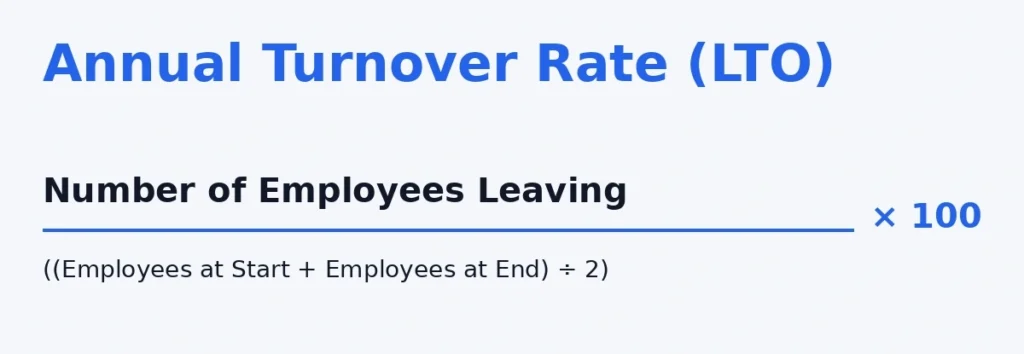
For example, you want to calculate the employee turnover rate for the year 2025. During that year, there were 10 employees who left the organization.
The number of employees at the beginning of 2025 was 100, while at the end of the year it was 90.
Thus, the calculation becomes:
(100 + 90) ÷ 2 = 95
Next, the turnover rate is calculated using the formula:
Turnover rate = (Number of employees leaving ÷ average number of employees) × 100%
Therefore, the result is:
(10 ÷ 95) × 100% = 10.53%
This means that the employee turnover rate for the year 2025 is approximately 10.5%.
2. Monthly Turnover Calculation
Unlike the annual calculation, monthly turnover calculation is used to monitor employee movement within a shorter time period.
This approach is typically used to identify workforce trends more quickly so that organizations can take earlier corrective actions.
The formula used in monthly calculation is essentially the same:
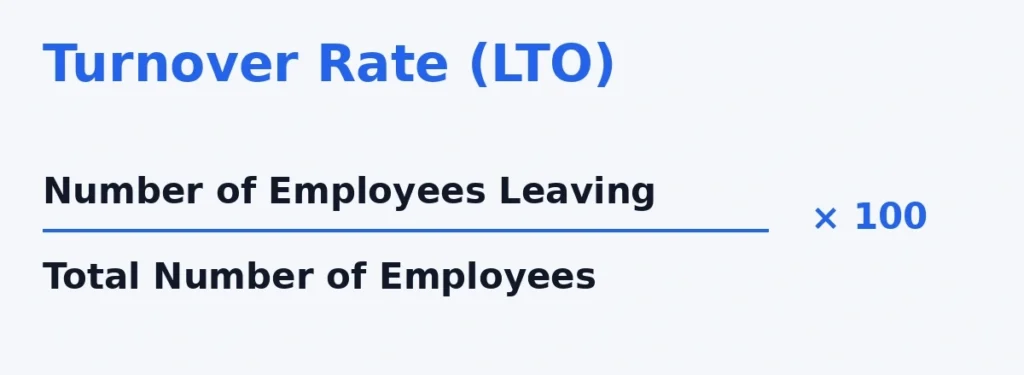
For example, in one month there are 5 employees who leave the organization, while the total number of employees during that period is 100.
Thus, the calculation is as follows:
(5 ÷ 100) × 100% = 5%
This means that the employee turnover rate for that period is 5%.
What Is a Healthy Employee Turnover Rate?
A “healthy” turnover rate is not defined by a single universal number, but rather by context: industry, workforce composition, and business model all play a role.
However, general benchmarks can provide a useful reference:
- 5% – 10% → Low turnover (high stability, but may limit talent refresh)
- 10% – 15% → Healthy and balanced turnover
- 15% – 25% → Moderate turnover (requires monitoring)
- Above 25% → High turnover (potential structural issues)
In many industries, the average annual turnover rate typically falls between 10% to 20%.
A healthy turnover rate is not necessarily the lowest possible rate. Instead, it reflects a balance between:
- Retaining high-performing employees
- Allowing underperforming or misaligned roles to transition out
- Continuously refreshing skills and capabilities
This balance is often reflected through clearly defined KPI (Key Performance Indicators), ensuring that performance expectations remain aligned with organizational goals.
Impact of High Employee Turnover Rate
A high turnover rate can have significant impacts on organizational stability, team productivity, as well as overall operational effectiveness.
When employees who hold important roles leave the organization, work processes that were previously stable can become disrupted. This situation often occurs particularly in organizations where team structures are highly interdependent.
Below are the key impacts, with supporting data to strengthen each point:
1. Decrease in Team Productivity
When employees leave, teams are required to redistribute workloads and adapt to new working dynamics. This transition period often leads to inefficiencies and short-term productivity loss.
Additionally, turnover volatility—frequent and unpredictable employee exits—has been shown to negatively affect labor productivity, making it harder for organizations to maintain consistent performance levels.
2. Loss of Knowledge and Work Experience
Employees who leave take with them not only their roles, but also accumulated knowledge, experience, and understanding of internal processes.
This loss of institutional knowledge is one of the most critical hidden risks of turnover.
Unlike operational tasks, this type of knowledge is often undocumented and cannot be easily transferred, making replacement significantly more complex and time-consuming.
3. Increase in Recruitment and Training Costs
High turnover forces organizations to continuously invest in hiring and onboarding new employees. These costs include job advertising, recruitment processes, onboarding programs, and training efforts.
Beyond direct costs, there are also indirect financial impacts such as reduced productivity during ramp-up periods.
On average, replacing an employee can cost up to 150% of their annual salary, particularly for mid-to-senior roles. This makes turnover not just an operational issue, but a significant financial burden when occurring at scale.
4. Disruption of Team Stability
Frequent turnover forces teams to keep reworking how they operate.
When someone leaves, their responsibilities don’t transfer perfectly. Even if documented, there are always gaps in context, such as why something is done a certain way, who to coordinate with, or what to prioritize. That gap creates friction.
The team then needs time to redistribute work and re-align. During this period, output slows because people are adjusting, double-checking, or fixing mistakes caused by incomplete handovers.
When a replacement joins, the process repeats. They need time to understand the role, the team, and the workflow. Until that happens, others have to compensate, which affects overall efficiency.
If this happens occasionally, teams recover. If it happens frequently, teams stay in a constant adjustment phase—less time executing, more time stabilizing.
5. Decline in Employee Morale
Turnover does not only affect those who leave. It also impacts those who stay. Employees in high-turnover environments often experience increased workloads, uncertainty, and reduced confidence in organizational stability.
This can lead to disengagement and further turnover, creating a compounding effect.
When turnover becomes persistent, it can create a cycle where declining morale leads to further attrition.
In some cases, organizations adopt approaches such as 360 degree feedback to better understand team dynamics and identify underlying issues that may contribute to disengagement.
6. Overall Organizational Impact
When these effects accumulate, turnover begins to influence not just HR outcomes, but overall business performance.
High turnover has been linked to reduced productivity, weaker competitiveness, and declining organizational sustainability.
This is why leading organizations no longer treat turnover as a standalone metric, but as a key indicator of organizational health and operational resilience.
How to Prevent Increasing Employee Turnover Rate
Preventing high employee turnover is one of the key challenges in workforce management. Organizations need to not only focus on acquiring new talent but also ensure that existing employees can grow and feel valued within the organization.
A structured talent development strategy plays a critical role in ensuring that employee growth is aligned with long-term organizational needs, reducing the likelihood of disengagement and turnover.
The following are several approaches that can be implemented to reduce employee turnover rates:
1. Develop Employee Engagement Strategies
One of the most important steps in reducing turnover is building strong employee engagement strategies. Organizations can design various programs that focus on employee well-being and motivation.
For example, by providing competitive compensation programs, recognition initiatives for high-performing employees, and performance-based incentives.
In addition, organizations can offer structured talent development programs, enabling employees to build relevant skills while progressing toward defined career goals.
Organizations also need to implement structured performance management systems so that management can evaluate employee progress and provide more consistent, objective feedback.
Employee satisfaction surveys can also be conducted periodically to understand employee perceptions of the work environment and identify potential issues early.
2. Leverage Data-Driven Insights to Predict and Prevent Turnover
reducing turnover increasingly depends on how well organizations can leverage people analytics to identify risks before they materialize.
Rather than reacting after employees resign, organizations need the ability to continuously monitor workforce signals and detect early indicators of potential attrition.
This includes visibility into:
- Turnover trends over time (whether attrition is increasing or stabilizing)
- Breakdown of turnover by department, location, or role
- Voluntary vs involuntary exit patterns
- Underlying resignation reasons across different employee segments
By analyzing these patterns, organizations can move from reactive decision-making to a more predictive approach.
For example, a sudden increase in voluntary turnover within a specific function may indicate deeper issues related to workload, leadership, or career progression.
Similarly, consistent attrition within certain locations or tenure groups may signal structural misalignment that requires targeted intervention.
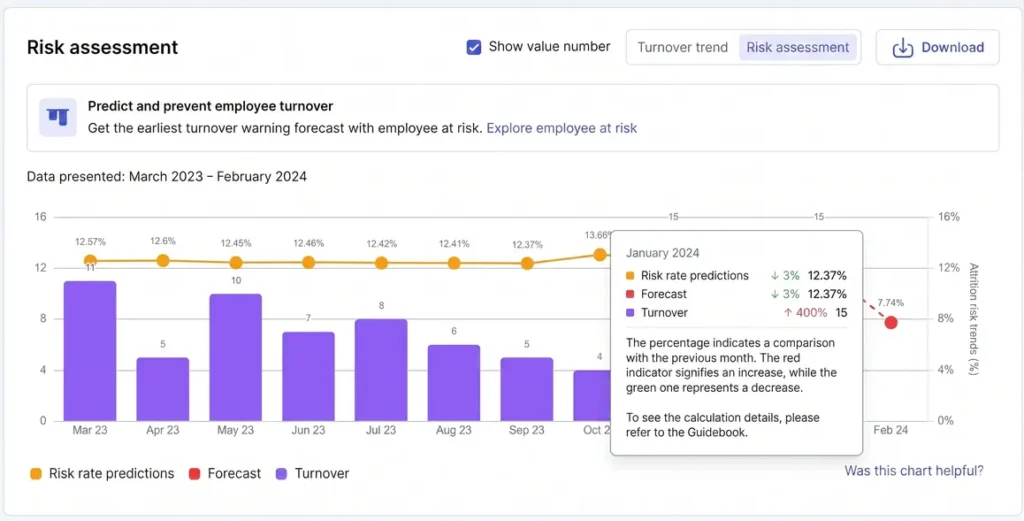
Advanced HR platforms like Mekari Talenta further extend this capability through risk assessment and forecasting models, allowing organizations to estimate potential turnover levels in upcoming periods.
Through Talenta Insights, HR teams can monitor turnover trends on a monthly basis through a visual dashboard. This allows organizations to track whether turnover is increasing, stabilizing, or declining over time.
The data can also be segmented by resignation type—such as voluntary and involuntary—so teams can distinguish whether turnover is driven by employee decisions or organizational actions, making the analysis more actionable.
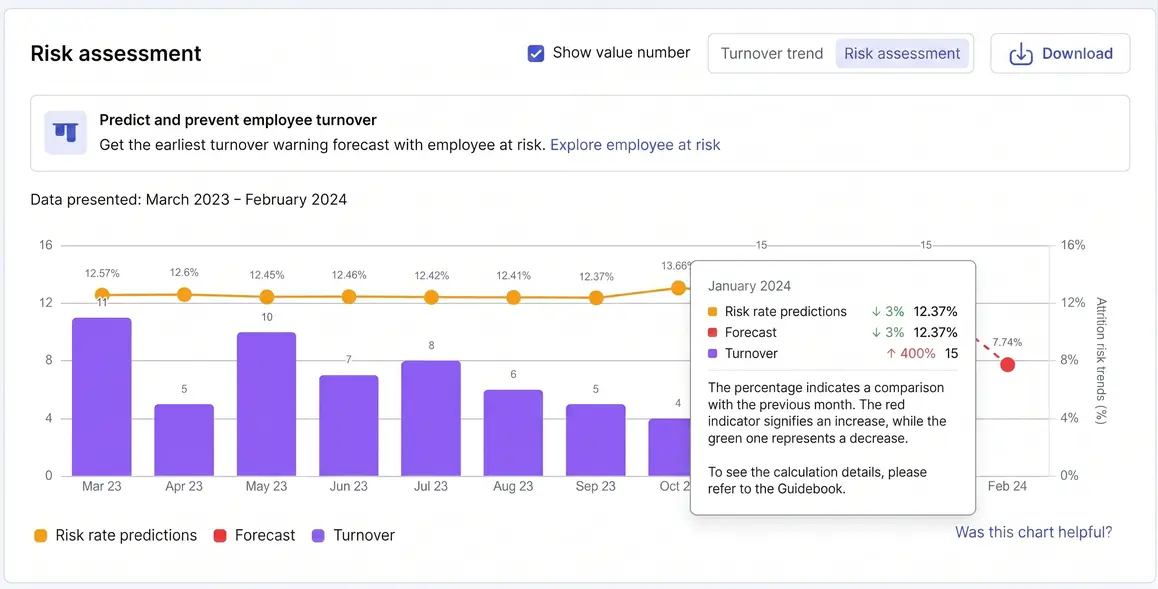
Building on these trends, Talenta Insights also provides a risk assessment layer that translates historical turnover data into forward-looking indicators.
Instead of only showing past patterns, the system highlights projected turnover risk, forecasted percentages for upcoming periods, and current turnover benchmarks that enables teams to anticipate potential spikes and take preventive action earlier.
Read also: Data-Driven HR: Definition, Benefits, and Practical Implementation
3. Build Clear Individual Career Planning
Organizations also need to provide clear career planning for each employee.
Career planning helps employees understand the growth opportunities they can achieve within the organization. With this clarity, employees can identify their strengths, weaknesses, and the skills they need to develop.
Organizations can also support employees in setting both short-term and long-term career goals. This approach enables employees to feel that they have a future within the organization.
Conversely, if organizations fail to provide clear development pathways, employees are more likely to seek opportunities elsewhere.
4. Implement Succession Planning
Another strategy to reduce turnover is implementing succession planning.
Succession planning is the process of developing employees to prepare them to fill key roles within the organization in the future. This program helps ensure that critical positions can be filled by internal talent when leadership transitions occur.
In addition, succession planning provides motivation for employees, as they can see clear opportunities for advancement.
Employees who feel involved in career development processes tend to demonstrate higher levels of loyalty toward the organization.
With the right retention strategies in place, organizations can maintain workforce stability while ensuring long-term sustainability.
5. Foster a Technology-Enabled Work Environment
In the digital era, the use of technology can help organizations improve efficiency in workforce management.
Organizations that leverage technology effectively are generally able to create a more seamless and supportive work experience.
For example, using HR software to manage administrative processes such as attendance tracking, leave requests, and employee data management. With an integrated digital system, administrative processes can run faster and more transparently.
In addition, organizations can implement employee self-service systems that allow employees to independently access HR-related services.
Through this system, employees can submit leave requests, manage attendance, or access work-related information without going through lengthy administrative procedures.
Strengthening Workforce Retention Through Integrated HCM from Mekari Talenta
Managing employee turnover is not only about tracking exit rates, but also about understanding the underlying drivers behind employee departures while maintaining long-term workforce stability.
Without a centralized HCM platform, organizations often face challenges in consolidating employee data, identifying turnover risks early, and managing recruitment as well as employee development processes in a consistent and scalable manner.
To enable a more structured and data-driven approach, organizations can leverage Mekari Talenta as an AI-centric, cloud-based HCM solution that supports end-to-end workforce management.
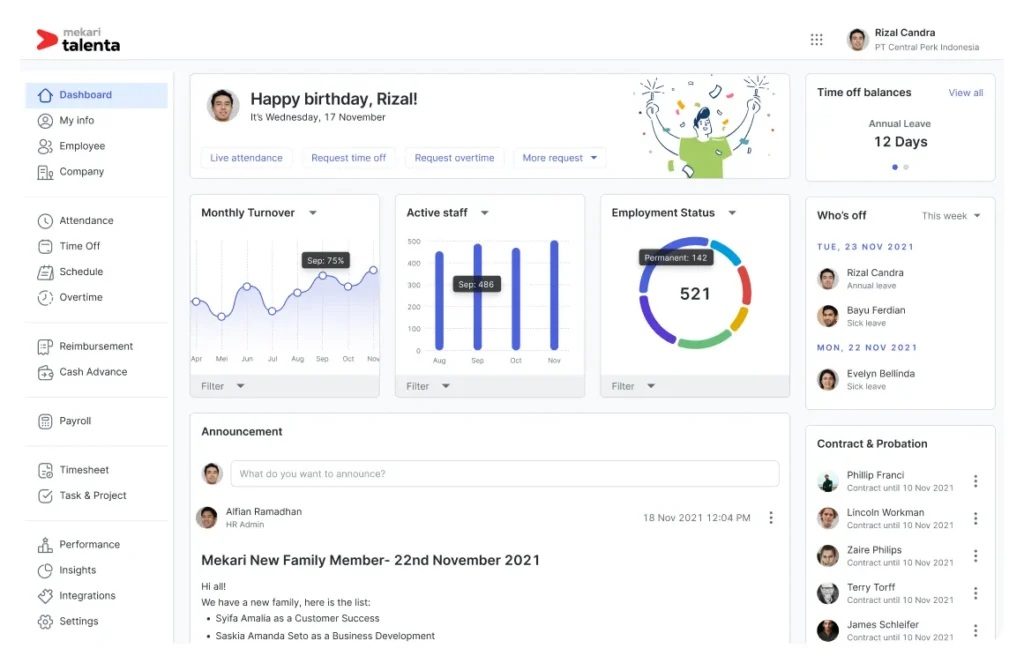
Mekari Talenta provides a comprehensive set of features that support HR teams in monitoring workforce conditions while building more effective retention strategies, including:
- HR Dashboard & Analytics to track employee data, turnover trends, and key HR metrics in real time
- Performance Management System to evaluate employee performance systematically and identify potential performance issues early
- Employee Self Service (ESS) to streamline employee access to HR services such as leave requests, attendance, and work-related information
- Attendance and time management system to monitor workforce presence and identify work patterns that may impact productivity
- Payroll, compensation & benfit management to ensure accurate and transparent processing of salaries, benefits, and deductions
- Talent development and career planning tools to support structured career pathways across the organization
- Succession planning and talent management to prepare internal candidates for critical roles and ensure continuity during workforce transitions
With an integrated HR system in place, organizations can manage the entire employee lifecycle more effectively—from performance monitoring to career development—while reducing turnover risk in a more controlled and sustainable way.
Interested in exploring Mekari Talenta? Schedule a demo with our team and see how it can support more structured and scalable workforce management.
Reference
Frequently Asked Questions (FAQs)
What is considered a high employee turnover rate?
What is considered a high employee turnover rate?
A turnover rate above 10–15% annually is generally considered high, though this varies by industry. High turnover becomes a concern when it involves critical roles or high-performing employees. It often indicates deeper issues such as poor management practices or lack of career growth. Organizations should evaluate both the rate and the type of turnover.
How does employee turnover differ from employee attrition?
How does employee turnover differ from employee attrition?
Employee turnover includes both voluntary and involuntary exits, while attrition usually refers to natural reductions such as resignations or retirements that are not immediately replaced. Attrition is often part of workforce planning, while turnover is more actively managed. Both impact workforce stability but require different strategies. Understanding the distinction helps in planning headcount and retention efforts.
Which industries typically have the highest turnover rates?
Which industries typically have the highest turnover rates?
Industries such as retail, hospitality, and customer service tend to have higher turnover due to operational intensity and lower entry barriers. In contrast, industries requiring specialized skills often have lower turnover but higher replacement costs. The context of the workforce model plays a major role. Benchmarking against industry standards is essential for accurate evaluation.
How long does it take for a new employee to reach full productivity?
How long does it take for a new employee to reach full productivity?
On average, it can take between 3 to 6 months for a new employee to reach optimal productivity, depending on role complexity. During this period, organizations often experience reduced output and increased supervision requirements. Effective onboarding programs can shorten this ramp-up time. This is one of the hidden costs of turnover that is often underestimated.
Can turnover ever be beneficial for an organization?
Can turnover ever be beneficial for an organization?
Yes, turnover can be beneficial when it involves underperforming or misaligned employees. This type of movement allows organizations to bring in new skills and perspectives. It can also support organizational transformation and capability upgrades. The key is ensuring that turnover remains controlled and aligned with strategic goals.