
Individual Development Plan: A Framework for Employee Growth


-
An Individual Development Plan (IDP) is a structured plan that defines how employees develop the skills and capabilities required for current and future roles.
- For example, an employee preparing for a leadership role may be assigned to lead projects, manage stakeholders, and be evaluated through defined performance milestones over time.
In many organizations, employee development is often discussed during performance cycles but lacks consistent execution across teams and functions.
As a result, development efforts become fragmented, difficult to track, and rarely aligned with actual role requirements.
This often indicates the absence of a clearly defined talent development strategy, where development priorities are not systematically aligned with evolving business needs.
Without a structured approach, organizations tend to rely on ad hoc decisions rather than a clear development framework.
This article will provide a comprehensive guide to understanding, structuring, and implementing Individual Development Plans effectively.
What Is an Individual Development Plan?
An Individual Development Plan (IDP) is a structured plan that outlines how an employee will develop the specific skills, capabilities, and experiences required to meet role expectations and prepare for future responsibilities within a defined period.
In practice, an IDP is used to translate outcomes from the performance management process into concrete development actions.
It identifies what gaps exist between an employee’s current capability and the required standard, then defines how those gaps will be addressed through targeted activities such as project assignments, mentoring, training, or cross-functional exposure.
A well-defined IDP is always tied to clear objectives. It does not focus on general improvement, but on capabilities that are relevant to the employee’s role or next role.
This includes defining what needs to be developed, how it will be developed, and how progress will be measured over time.
From a management perspective, IDPs are used to ensure that employee development is aligned with organizational needs.
They provide visibility into readiness levels, help track progress consistently, and support decisions related to promotion, succession, and internal mobility.
For instance, an employee identified as a potential team lead may need to strengthen stakeholder management and decision-making capabilities.
Instead of assigning generic training, the IDP would define specific actions such as leading a cross-functional project, receiving structured feedback from peers and supervisors, and being evaluated against defined performance milestones over a set period.
Without an IDP, development tends to be informal and difficult to measure. With a structured plan in place, organizations can ensure that capability building is intentional, trackable, and directly connected to workforce requirements.
The Importance of an Individual Development Plan
An Individual Development Plan (IDP) becomes critical when organizations need to ensure that employee development is not random, but structured, trackable, and aligned with actual workforce needs.
1. Without Structure, Development Rarely Happens Consistently
In most organizations, development is often discussed but not systematically executed. Employees may receive feedback, but there is no clear follow-up on what needs to be improved or how.
This creates inconsistency that some employees progress, others stagnate, even within the same role.
An IDP becomes important because it standardizes development into something repeatable and measurable, rather than dependent on individual managers or informal discussions.
Without structure, talent development becomes inconsistent across teams and heavily dependent on individual manager initiative.
2. Performance Evaluation Becomes Ineffective Without Action
Performance reviews are designed to identify strengths and gaps, often measured against defined KPI (Key performance Indicator) benchmarks. However, without a mechanism to act on those findings, the process stops at assessment.
An IDP ensures that every identified gap is followed by a defined action plan: what needs to be developed, how it will be done, and within what timeline.
In practice, IDP is what turns performance management from a reporting activity into a continuous improvement process.
3. Workforce Planning Cannot Be Executed Without Development Mechanism
Organizations often define future talent needs like leadership pipelines, critical roles, or capability requirements. However, without a system to prepare employees, these plans remain theoretical.
An IDP translates strategic workforce planning into individual-level execution by defining how employees will be developed over time to meet those future needs.
This is important because IDPs explicitly link individual career goals with organizational goals, ensuring alignment between talent development and business direction.
Without internal readiness, organizations tend to rely more heavily on external employee recruitment, which increases cost, risk, and transition time.
Benefits of Implementing Individual Development Plan
Implementing an Individual Development Plan (IDP) allows organizations to standardize how capability is built across roles and functions.
Instead of relying on fragmented training initiatives, development becomes structured, trackable, and directly tied to performance and workforce outcomes.
1. Improves Retention Through Clear Growth Direction
One of the main drivers of employee turnover is uncertainty around career progression. When employees do not see how they can grow, they are more likely to look externally.
An IDP addresses this by making progression visible and actionable. Employees know what is expected, what gaps they need to close, and what opportunities are available if they meet those expectations. This reduces ambiguity, which is often a key trigger for resignation.
In some cases, insights gathered from exit interview findings further reinforce the importance of providing clear development direction to reduce recurring attrition patterns.
2. Increases Workforce Productivity Through Targeted Capability Building
Without a structured plan, development efforts are often generic and not aligned with actual job requirements. As a result, employees may complete training but still struggle to perform effectively.
An IDP ensures that development is targeted at specific capability gaps. This shortens the time needed for employees to perform at the expected level, because learning is directly applied to their role.
3. Strengthens Employee Engagement Through Role Clarity
Engagement is closely tied to clarity. When employees understand what they are working toward and how they are progressing, they are more likely to stay focused and committed.
An IDP provides this clarity by defining expectations, milestones, and measurable outcomes. Instead of working without direction, employees have a clear reference point for progress.
This is why organizations with structured development programs report significantly higher engagement levels. The increase in engagement is not driven by the program itself, but by the clarity and direction it provides.
4. Builds Internal Talent Pipeline and Reduces External Hiring Dependency
Filling roles externally often introduces risk, such as longer onboarding time, cultural misalignment, and higher cost.
An IDP mitigates this by preparing employees in advance for future roles. Because development is planned early, employees are closer to “ready” when opportunities arise.
This reduces the need to search externally, as organizations already have candidates who understand the systems, processes, and expectations. The benefit is not only cost efficiency, but also faster role transition and lower disruption.
5. Enables More Accurate Talent Decisions
In many organizations, talent decisions rely heavily on subjective judgment. Without structured data, it is difficult to determine whether someone is actually ready for a larger role.
An IDP creates measurable indicators such as:
- capability gap closure
- progress over time
- readiness against defined expectations
This allows HR and management to make decisions based on observed development, not assumptions. Over time, this improves the consistency and quality of promotion and succession decisions.
Key Components of an Individual Development Plan
An Individual Development Plan (IDP) only becomes effective when each component is clearly defined and directly tied to execution.
In practice, many IDPs fail not because the concept is wrong, but because the components are too vague, making them difficult to implement and evaluate.
To make these components easier to understand and implement, the structure of an Individual Development Plan can be summarized as follows:
| Component | What It Defines | Example |
|---|---|---|
| Development Objective | Target role or capability to be achieved | Prepare for Team Lead role within 6 months |
| Current Capability | Existing strengths and limitations | Strong execution, limited stakeholder exposure |
| Gap Identification | Difference between current vs required capability | Needs improvement in decision-making and communication |
| Development Actions | Activities to close the gap | Lead projects, attend meetings, mentoring |
| Timeline & Milestones | When development should happen | 3-month exposure, 6-month evaluation |
| Success Indicators | How progress is measured | Able to lead meetings independently |
| Review & Monitoring | How progress is tracked | Monthly check-ins with manager |
Each of these components plays a distinct role in ensuring that the IDP is actionable and measurable. Below is a more detailed explanation of how each component should be defined and applied in practice:
1. Development Objective
The development objective defines what the employee is being prepared for and sets the overall direction of the plan. This should always be specific and tied to role expectations, not general improvement.
For instance, instead of stating “improve leadership skills,” the objective should clearly indicate the target outcome, such as preparing the employee to take on a Team Lead role within a defined timeframe. This makes the development effort focused and easier to align with business needs.
Read also: Developing Leadership Competencies: Skills for Managing High-Performing Teams
2. Current Capability Assessment
Before defining any development actions, it is necessary to understand the employee’s current condition. This includes identifying strengths and limitations based on actual performance, not assumptions.
In practice, this might involve recognizing that an employee is strong in execution and task ownership but has limited exposure to stakeholder management or decision-making. This level of clarity is important because it prevents development from targeting areas that are not relevant.
3. Gap Identification
Once the current state is clear, the next step is to define the gap between what the employee can do now and what is expected in the target role or capability.
This gap needs to be described in operational terms. For example, instead of saying “needs better communication,” it should specify that the employee struggles to lead meetings, manage cross-functional stakeholders, or make independent decisions. The more specific the gap, the easier it is to design relevant development actions.
In many cases, this assessment is strengthened through structured inputs such as 360 degree feedback to capture broader performance perspectives.
4. Development Actions
This component translates identified gaps into concrete actions. The focus should be on activities that are directly connected to real work, not just theoretical learning.
For example, if the gap is in stakeholder management, the plan might include leading team meetings regularly, handling coordination with other departments, or taking ownership of a cross-functional project. Training can be included, but it should support practical application rather than stand alone.
5. Timeline and Milestones
An IDP must define when development is expected to happen. Without a timeline, development tends to be delayed or deprioritized.
In practice, this means breaking the plan into phases, such as assigning initial responsibilities in the first few months, followed by more complex tasks, and then evaluating readiness after a certain period. Milestones help ensure that progress is visible and trackable over time.
6. Success Indicators
Success indicators define how development outcomes will be measured. Without this, it becomes difficult to determine whether the employee is actually progressing.
These indicators should be observable and tied to performance. For example, being able to lead meetings independently, receiving positive feedback from stakeholders, or successfully delivering a project without escalation. Clear indicators remove ambiguity in evaluating readiness.
7. Review and Monitoring
An IDP requires continuous monitoring to remain effective. Development is not linear, and adjustments are often needed based on progress and challenges.
This usually involves regular check-ins between the employee and manager to review what has been achieved, what is still lacking, and whether the development approach needs to be adjusted. Without this process, the IDP often becomes a static document that is not actively used.
Types of Individual Development Plan & Examples
Individual Development Plans (IDPs) are not one-size-fits-all. The structure and focus of an IDP should depend on what the organization is trying to achieve, whether it’s improving performance, preparing future leaders, or building specific capabilities.
Below are the most common types of IDPs used in practice, along with when to use them and how they typically look.
1. Performance Improvement Plan (PIP)
This type of IDP is used when an employee is not meeting expected performance standards and requires immediate, structured intervention.
The focus is on correcting specific gaps that directly affect day-to-day output, making the plan more short-term and closely monitored.
For example, if an employee consistently misses deadlines and struggles with task prioritization, the IDP would not include broad development goals.
Instead, it would define practical actions such as implementing weekly task planning with manager review, setting clear performance targets within a defined period, and providing targeted support such as time management training. Progress is typically reviewed frequently to ensure improvement is measurable.
In some organizations, this process is supported by internal or external KPI consultancy to ensure performance standards are clearly defined and measurable.
2. Career Development IDP
A career development IDP is designed for employees who are performing well but need structured guidance to progress to the next role within the same function. The plan focuses on expanding responsibilities and building competencies required at the next level.
For instance, a marketing executive preparing to become a marketing manager would need exposure beyond execution.
The IDP may include leading a campaign end-to-end, participating in budget planning discussions, and analyzing performance metrics to support decision-making. This type of plan is more medium-term and emphasizes readiness rather than immediate correction.
3. Leadership Development IDP
This type of IDP is typically used for employees identified as having potential to take on leadership roles. The development focus shifts from individual contribution to managing people, making decisions, and handling broader responsibilities.
For example, a senior individual contributor being prepared for a managerial role may be assigned to lead cross-functional projects, coordinate with multiple stakeholders, and gradually take responsibility for team outcomes.
In addition, structured feedback—both from supervisors and peers—becomes important to evaluate leadership readiness. The plan is usually tied to succession planning and requires longer-term tracking.
4. Skill-Based (Upskilling/Reskilling) IDP
A skill-based IDP is used when employees need to build specific capabilities due to changes in role requirements or business direction. The focus is on targeted skill acquisition rather than overall career movement.
For example, an HR professional transitioning into a more data-driven role would need to develop analytical skills. The IDP may include training in HR analytics tools, working on real datasets, and presenting insights to management.
The effectiveness of this type of IDP depends on how closely the learning activities are connected to actual work application.
5. Role Transition IDP
This type of IDP supports employees who are moving into a new role, whether through promotion, lateral movement, or internal transfer. The objective is to reduce the time needed for the employee to become effective in the new position.
For instance, an employee moving from an operational role into a strategic function will need to adapt to different expectations.
The IDP may include exposure to planning processes, involvement in strategic discussions, and gradual ownership of new responsibilities.
Compared to other types, this plan is more time-bound and focused on accelerating adaptation rather than long-term development.
5. Onboarding / Induction Plan
This type of IDP is used for new employees to accelerate their integration into the organization. It focuses on helping them understand their role, internal processes, and company culture.
For example, a new hire may go through a structured plan that includes role-specific training, system onboarding, shadowing experienced team members, and regular check-ins to ensure adaptation is on track.
This process is often structured within a talent management system to ensure consistency and visibility across onboarding stages.
6. Cross-Training / Job Rotation Plan
A cross-training or job rotation plan is designed to build flexibility by exposing employees to different roles or functions. This helps organizations create a more adaptable workforce.
For example, an employee in operations may be rotated into a planning or strategy function for a few months. This not only broadens their understanding but also allows the organization to build multi-skilled employees who can handle different responsibilities.
7. Succession Planning Plan
Succession planning is used to prepare employees to fill critical roles in the future. It is usually applied to roles that are difficult to replace or have significant impact on the organization.
For instance, an employee identified as a successor for a key leadership position may undergo a structured plan involving strategic exposure, decision-making responsibilities, and mentoring from senior leaders. The goal is to ensure readiness before the transition occurs.
Execution is typically supported by talent management software to track readiness levels and successor pipelines more systematically.
8. Mentoring & Coaching Plan
Mentoring and coaching plan focuses on development through direct guidance, either from internal leaders or external coaches. It is often used for employees who need deeper support in specific areas such as leadership, communication, or decision-making.
For example, an employee preparing for a leadership role may be paired with a senior mentor who provides regular feedback, shares experience, and helps navigate complex situations. This type of development is more personalized and experience-driven.
How to Create an Individual Development Plan in a Company
Creating an Individual Development Plan (IDP) that actually works requires more than filling out a template. In practice, the effectiveness of an IDP depends on how closely it is tied to real work, how clearly it defines expectations, and how consistently it is executed by managers.
What differentiates a useful IDP from a formal one is simple: whether it is used to drive day-to-day development decisions or just documented once and ignored.
1. Start from Role Requirements, Not Employee Preference
A common mistake is starting the IDP from what the employee wants to learn, instead of what the role actually requires. This often leads to development that feels useful but does not improve performance or readiness.
The correct approach is to anchor the plan on role expectations. Define what capabilities are required for the current role or the next role, then assess where the employee stands against those expectations.
For example, if a role requires stakeholder management and decision-making, but the employee only focuses on execution, the IDP should prioritize exposure to coordination and decision ownership—not additional technical training.
This ensures development is aligned with business needs, not just individual interest.
2. Use Performance Evidence to Define Development Focus
A common issue in IDP creation is relying on general impressions instead of actual performance evidence. This leads to development plans that are too broad and difficult to act on.
To avoid this, organizations need to ground development decisions in observable data. In more structured environments, this is often supported by people analytics, where performance patterns and behavioral trends are analyzed to validate development priorities more objectively.
Effective IDPs are built from these observable patterns. For instance, an employee may consistently deliver high-quality work but avoid taking ownership in discussions or decisions. That pattern becomes the basis for development focus.
Using real performance evidence ensures that the plan is grounded, relevant, and easier to justify both to the employee and management.
Baca juga: Data-Driven HR: Definition, Benefits, and Practical Implementation
3. Translate Gaps into Real Work
One of the biggest gaps in IDP execution is over-reliance on training programs. Training alone rarely changes behavior unless it is reinforced through actual work. Effective IDPs translate capability gaps into responsibilities.
So, instead of “Attend leadership training”, use:
- leading a project
- handling stakeholder communication
- making decisions within defined scope
Training can support the process, but real capability is built through application. Organizations that rely only on classroom learning often see minimal impact.
In practice, translating development gaps into real work requires structure. Without a clear system, these actions are often inconsistently assigned, difficult to track, and rarely evaluated over time.
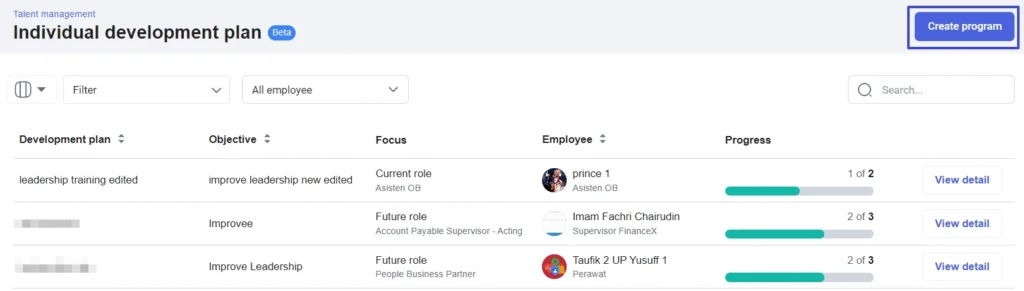
To make this more effective, organizations typically rely on HCM platforms such as Mekari Talenta. Through its Talent Management feature, HR teams can formalize development plans by defining clear objectives, assigning actionable development activities, and monitoring progress within a single system.
4. Define a Clear Timeframe and Progress Checkpoints
Without a defined timeline, development tends to lose priority as operational work takes over. An IDP needs a clear timeframe so both the employee and manager know what progress should look like within a certain period.
In practice, this means breaking development into phases. Early stages may involve exposure and guidance, followed by independent execution, and eventually evaluation of readiness.
Regular checkpoints are critical. They allow managers to assess whether progress is happening or if adjustments are needed before it is too late.
5. Ensure Manager Involvement Is Active
IDPs often fail because they are treated as the employee’s responsibility alone. In reality, managers play a central role in making development happen.
They are the ones who assign relevant work, provide feedback, and decide whether the employee is ready for more responsibility. Without their active involvement, the plan will not move beyond documentation.
In organizations where IDPs work well, development progress is regularly discussed between manager and employee, not just reviewed at the end of a cycle.
When these check-ins happen over calls, capturing the agreed goals and follow-up actions gives both sides a shared record for the next checkpoint. Teams evaluating tools for this workflow can use the Fireflies AI review to assess how its transcription, summaries, and post-call workflows support recurring check-ins.
6. Connect the IDP to Real Decisions
An IDP becomes meaningful when it is tied to actual outcomes, such as promotion, role expansion, or succession planning. If development progress is not used in decision-making, the plan loses relevance.
In practice, this means employees are evaluated not only on past performance, but also on how well they have progressed against their development plan. This creates a clear link between effort and opportunity.
When this connection exists, both employees and managers take the IDP more seriously.
7. Keep the Plan Flexible and Updated
Development is not static. As employees progress or business needs change, the IDP should be adjusted accordingly.
For example, if an employee develops faster than expected, the plan should move to the next level of capability. If progress is slower, the approach may need to be revised, either by changing the development method or providing additional support.
Treating the IDP as a working document (not a fixed one) ensures that it remains relevant and continues to drive meaningful development.
Building a Structured Employee Development Framework with Mekari Talenta
Managing employee development is not only about identifying skill gaps, but also about ensuring that development plans are executed consistently, monitored over time, and aligned with organizational priorities.
Without an integrated system, organizations often face challenges in managing Individual Development Plans at scale, ranging from inconsistent documentation, lack of visibility into progress, to difficulty in tracking whether development actions are actually completed and effective.
To address this, organizations can leverage Mekari Talenta as an AI-centric, cloud-based HCM solution that enables more structured and data-driven employee development.
Mekari Talenta supports end-to-end talent development processes by allowing HR teams to design, execute, and monitor Individual Development Plans in a more systematic way.
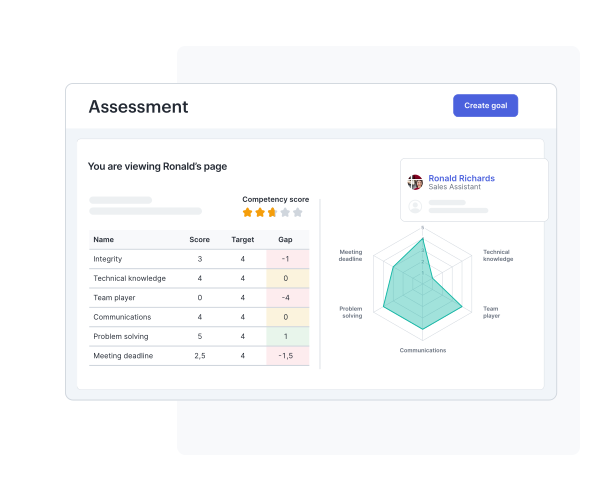
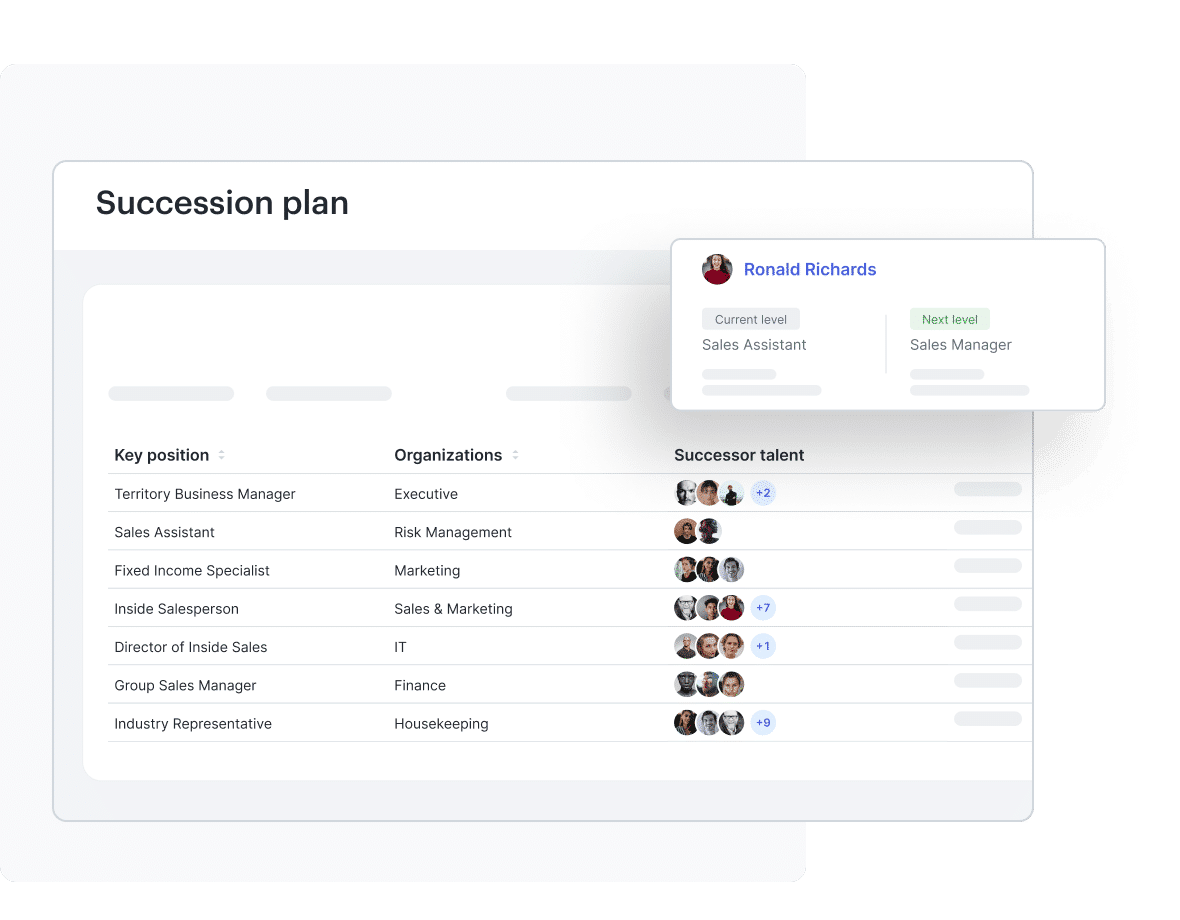
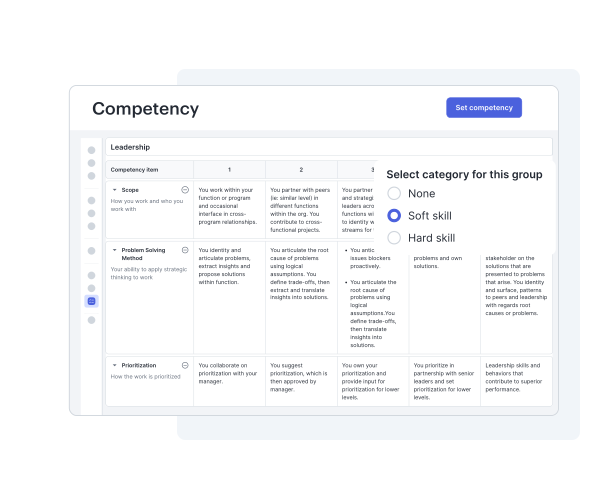
Through the platform, organizations can:
- Create structured IDP programs with clearly defined objectives, whether for current roles or future positions
- Assign and track action plans such as training, coaching, project exposure, and self-learning activities
- Monitor development progress through status tracking (to do, in progress, completed)
- Align development plans with competency frameworks and role requirements
- Integrate IDP execution with succession planning and performance management processes
This level of integration ensures that development is not only planned, but also executed and measured consistently across the organization.
With a centralized HCM system, organizations gain better visibility into employee readiness, can identify stalled development early, and ensure that capability building is aligned with long-term workforce planning.
Interested in exploring how Mekari Talenta can support your employee development strategy? Schedule a demo with our team and discover how a structured, integrated approach can make Individual Development Plans more effective and scalable.
Reference:
The College of New Jersey. (2021). Individual development plan guide.
Frequently Asked Questions (FAQs)
How often should an IDP be updated?
How often should an IDP be updated?
An IDP should be reviewed regularly, typically every 3 to 6 months, depending on the role and development timeline. Updates are necessary to reflect progress, shifting priorities, or changes in role expectations. A static IDP quickly becomes irrelevant. Regular updates ensure the plan remains aligned with both employee growth and business needs.
What is the difference between IDP and training programs?
What is the difference between IDP and training programs?
Training is only one component of an IDP, while the IDP itself is a broader development framework. An IDP defines what needs to be developed and how, which may include training, but also real work exposure, mentoring, and project assignments. Training alone does not guarantee capability development. The IDP ensures that learning is applied and measurable.
When is the right time to create an IDP?
When is the right time to create an IDP?
The most effective time to create an IDP is immediately after performance evaluations or talent reviews. At this stage, capability gaps and development needs are already identified. Creating the IDP during this window ensures continuity between evaluation and action. It also increases the likelihood that development will be prioritized.
How do you measure if an IDP is successful?
How do you measure if an IDP is successful?
An IDP is considered effective when it leads to observable changes in performance and readiness. This includes the ability to take on more responsibility, close identified capability gaps, and meet defined success indicators. Progress should be measurable over time, not based on perception. If development does not translate into improved outcomes, the plan needs to be revisited.
Who should be responsible for creating an IDP?
Who should be responsible for creating an IDP?
An IDP should be created collaboratively between the employee and their direct manager. HR provides the framework and ensures consistency, but managers are responsible for aligning development with role expectations. Employees contribute by sharing career direction and development needs. This shared responsibility ensures the plan is both relevant and executable.