
Complete OKR Framework Guide: Implementation & Examples


- OKR is a strategic framework that connects qualitative leadership vision with quantitative, outcome-based metrics to drive organizational alignment.
- For example, an objective to dominate a new market could be measured by a key result of capturing a thirty percent market share within twelve months.
Navigating a global workforce demands a precise mechanism that translates high-level strategy into synchronized daily execution across multiple time zones.
The sheer scale of modern operations often creates a disconnect where isolated departments work intensely on initiatives that contradict the broader mission.
Without a unifying framework, leadership teams struggle to pivot rapidly when market dynamics shift unexpectedly.
The gap between setting ambitious targets and actually measuring the concrete outcomes is where massive growth potential is frequently lost.
This article will provide a comprehensive breakdown of the Objectives and Key Results (OKR) methodology, detailing how to architect, implement, and measure goals that drive genuine market disruption.
What Is an OKR?
Objectives and Key Results (OKRs) represent a dynamic framework designed to bridge the gap between high-level strategic ambition and daily execution.
At its core, an ‘Objective’ defines a qualitative, aspirational destination. It answers the question of where the leadership intends to take the ship over the next quarter or year.
These objectives must be aggressive enough to spark innovation, yet grounded enough to remain within the realm of possibility.
The ‘Key Results’ serve as the quantitative yardsticks that validate progress. Unlike traditional task lists, Key Results focus exclusively on outcomes.
If a team completes every planned activity but the metric remains stagnant, the Key Result has not been achieved.
This shift from “output” to “outcome” is the fundamental DNA of the methodology. It creates a transparent environment where every contributor understands how their specific output moves the needle on a global scale.
Effective performance management relies on this clarity. When the framework is deployed correctly, it eliminates the ambiguity that often plagues large-scale operations.
It moves the conversation away from subjective opinions about “hard work” and toward objective data regarding impact.
By aligning individual efforts with the broader mission, the framework ensures that even the most granular tasks contribute directly to the collective success of the mission.
What Is The Difference between KPI and OKRs?
Understanding the distinction between OKR and KPI (Key Performance Indicator) two metrics is essential for maintaining operational stability while pursuing aggressive growth.
While they often coexist within the same ecosystem, they serve fundamentally different purposes in the lifecycle of a high-performing team.
The following comparison highlights the structural and philosophical differences between these two measurement pillars:
| Feature | Key Performance Indicators (KPI) | Objectives and Key Results (OKR) |
|---|---|---|
| What | Numbers that track the operation of your business. | Action-orientated goals and measures. |
| Foundation | Based on past results or future goals. | Mission-based, aspirational and directional. |
| Direction | Monitors the “steady-state” and benchmarks. | Audacious and bold, tied to mission. |
| Triggers | Actions are prompted when numbers are off track. | Actions are taken as issues arise. |
| Duration | Measured on an ongoing basis. | Time-bound, often quarterly. |
| Lifespan | May be the same from quarter to quarter, year to year. | Change from quarter to quarter, year to year. |
Conclusion:
The fundamental difference lies in the perspective of the observer. A KPI is retrospective and protective; it signals when a vital sign of the business is healthy or failing.
If a leader asks KPI for their specific function, they are looking for the baseline metrics that must be maintained to avoid operational collapse. It is the “steady-state” that keeps the lights on.
In contrast, an OKR is prospective and disruptive. It is not interested in maintaining the status quo but in challenging it.
While a KPI tells you how fast you are driving, an OKR tells you where you are going and why you need to get there faster.
Read also: What Are the Key Differences Between OKRs vs KPIs?
Why is OKR methodology important?
The following pillars outline why this methodology has become a non-negotiable standard for market leaders:
1. Strategic Alignment and Horizontal Synergy
In large ecosystems, the most pervasive threat is “the drift,” where individual departments slowly diverge from the central mission due to a lack of shared visibility.
OKR enforces a vertical and horizontal alignment that ensures every resource is deployed toward the same horizon.
By making all goals public, it breaks down the walls between functions, allowing teams to see how their work supports or depends on others.
This level of transparency is often the missing link in traditional performance management systems that focus too heavily on isolated vertical reporting lines.
2. Acceleration of Innovation through Psychological Safety
Traditional metrics often punish failure, which inadvertently stifles the risk-taking necessary for breakthrough growth. This framework is important because it institutionalizes the “moonshot” mentality.
By decoupling aspirational targets from direct compensation, the methodology provides a playground for innovation.
This environment allows for high-velocity experimentation, where the goal is not perfection but the rapid acquisition of market insights.
3. Enhanced Data Integrity and People Analytics
Effective leadership requires a move away from gut-feeling management toward evidence-based strategies.
The framework provides a structured stream of objective data that feeds directly into people analytics platforms.
This allows HR leaders to move beyond basic reporting and start predicting where talent gaps will occur or which teams are at risk of burnout.
This data-driven approach transforms the HR function into a strategic partner that can quantify the impact of human capital on the bottom line.
4. Resilience Against Market Volatility
Static planning cycles are increasingly becoming a liability. The importance of OKR lies in its quarterly cadence, which allows for rapid pivots without dismantling the entire corporate strategy.
When global market conditions shift, the framework provides a structured way to re-evaluate priorities. It ensures that the organization remains lean and focused, shedding initiatives that no longer serve the mission.
This agility is the primary defense against employee turnover, as contributors remain connected to a mission that feels relevant and responsive to the real world, rather than following an outdated annual plan.
The benefits of OKRs
The previous section outlined the strategic necessity behind this methodology, detailing why leadership teams must adopt it to survive in volatile markets.
In contrast, the benefits represent the tangible, day-to-day advantages that teams experience once the system is actively running.
Below are the primary benefits that transform daily operations:
1. Hyper-Focused Prioritization
Massive operations often suffer from initiative overload. When everything is deemed a priority, nothing actually receives the attention required for exceptional execution.
The methodology forces a structural scarcity, usually limiting objectives to three to five per quarter. This constraint acts as a filter, allowing teams to confidently decline tasks that do not directly feed into their key results.
It moves the conversation away from mere busyness and toward concrete impact, ensuring that critical resources are deployed only where they generate the highest return.
2. Vertical and Horizontal Alignment
Departmental silos remain one of the most stubborn barriers to efficiency. A major benefit of this system is its ability to map dependencies across different groups seamlessly.
When the product development team can transparently see the key results of the marketing department, they can synchronize their launch schedules accordingly.
This frictionless collaboration reduces duplicated effort and prevents different wings of the building from working at cross-purposes.
3. Enhanced Retention and Autonomy
Top-tier professionals crave autonomy and a clear line of sight regarding how their daily output matters.
By dictating the desired outcome but leaving the execution strategy up to the individual contributors, this framework empowers employees to take ownership of their processes.
The resulting spike in employee engagement directly counteracts career stagnation. When leaders conduct an exit interview, a recurring theme among departing high-performers is often a lack of clear direction or feeling disconnected from the broader mission.
Implementing transparent, outcome-based goals directly neutralizes this friction point, fostering a culture where top talent feels integral to the ongoing success of the business.
4. Continuous Objective Tracking
Unlike annual reviews that rely heavily on subjective memory, this framework provides a continuous stream of actionable data.
The weekly or bi-weekly check-ins ensure that potential roadblocks are identified before they derail the entire quarter.
If a key result is severely lagging by week four, leadership has the agility to reallocate budget or adjust the strategy immediately.
This real-time course correction minimizes wasted effort and keeps the entire workforce calibrated to the most current market realities.
Types of OKRs
A standardized framework rarely works across massive, multi-layered operations. Different business cycles and departmental maturities require different approaches to goal setting.
Understanding the distinct variations within this methodology allows leadership to apply the right type of pressure at the right time, ensuring that both innovation and stability are maintained.
1. Committed vs. Aspirational OKRs
The distinction between these two categories determines how a team approaches risk.
Committed goals represent the non-negotiable deliverables. Leadership expects complete achievement on these metrics by the end of the cycle.
They typically involve regulatory compliance mandates, core revenue retention targets, or critical system upgrades.
Falling short on a committed goal indicates a severe operational breakdown requiring immediate root-cause analysis.
Aspirational goals act as the disruptive growth engine. They are specifically designed to be uncomfortable and highly ambitious.
Reaching a 60% to 70% achievement rate on an aspirational target is considered a massive success. If a department consistently hits perfect scores on their aspirational targets, they are sandbagging their capabilities and leaving market potential on the table.
Balancing both types ensures the foundation remains solid while the perimeter expands.
2. Learning OKRs
When a business unit enters entirely uncharted territory, setting hard performance metrics is counterproductive. Learning goals prioritize discovery and validation.
The primary objective is to acquire high-value data to inform future strategies rather than immediately driving revenue.
A key result in this category might involve executing a set number of beta tests or conducting deep-dive interviews with fifty prospective clients to validate a new product hypothesis.
This specific format prevents teams from chasing arbitrary sales numbers in unproven markets. It gives them the mandate to secure necessary market intelligence before leadership commits millions of dollars to a full-scale commercial launch.
3. Top-Down vs. Bottom-Up OKRs
Alignment requires a delicate balance of executive direction and front-line autonomy.
Top-down objectives originate directly from the C-suite or regional leadership. They establish the macro priorities, setting the overarching theme for the year.
Bottom-up objectives are formulated by the execution teams themselves, defining precisely how they will move the needle on those macro priorities.
The most efficient ecosystems maintain a ratio where roughly 60% of the goals are generated bottom-up.
This strategic balance empowers individual contributors to design their own tactical workflows. It builds a culture of deep accountability because employees are executing project plans they actively helped create, completely removing the friction of micromanagement.
4. Personal OKRs
Career progression requires the same rigorous tracking as daily business operations. Personal goals focus entirely on individual capability enhancement rather than standard job duties.
An individual might set an objective to master advanced data modeling or to become a recognized subject matter expert within their division.
The accompanying key results would track highly specific milestones, such as completing an industry certification or successfully leading two cross-functional task forces by the end of the quarter.
This approach provides a highly structured and measurable path for upward mobility. It guarantees that internal promotions are based on documented, continuous growth rather than subjective managerial preferences or simple tenure.
Examples of OKR
Moving from theoretical goal setting to actual execution is where many leadership teams lose momentum.
To bridge that gap, we need to examine how these distinct categories function organically on the ground.
Here are examples of OKRs based on the different categories:
1. Committed OKR Example
These must be achieved to keep the core business stable. Imagine a scenario where a newly implemented data privacy regulation requires immediate compliance.
- Objective: Ensure 100% data compliance across all European operations ahead of the Q3 regulatory deadline.
- Key Result 1: Audit and migrate 500,000 legacy user records to the new encrypted database.
- Key Result 2: Train 100% of regional staff on the updated data handling protocols.
2. Aspirational OKR Example
This category requires a leap of faith and aggressive tactics. Suppose the leadership team wants to dominate a completely new product category.
- Objective: Establish our brand as the undisputed leader in the predictive analytics market.
- Key Result 1: Capture 35% market share from our primary competitor within twelve months.
- Key Result 2: Secure media placements in three top-tier financial publications regarding our new algorithmic models.
3. Learning OKR Example
When stepping into the unknown, gathering intelligence is more valuable than immediate revenue. Consider a product team exploring the integration of a new technology.
- Objective: Determine the commercial viability of a mobile-first application for our legacy client base.
- Key Result 1: Conduct 40 deep-dive user interviews with legacy clients to identify workflow bottlenecks.
- Key Result 2: Build and test three distinct rapid prototypes with a beta group of 100 users.
The outcome here is not a launched product, but rather a definitive “go” or “no-go” decision backed by rigorous data rather than executive guesswork.
4. Top-Down vs. Bottom-Up OKR Example
This illustrates the synergy between executive vision and frontline execution.
- Top-Down Objective (Set by the CEO): Fortify our operating margins to weather the upcoming economic downturn.
- Top-Down Key Result: Reduce overall operational expenditure by 15% across all global regions.
Once that is communicated, a specific department like Engineering creates a bottom-up goal to support that vision.
- Bottom-Up Objective (Set by the Engineering Team): Optimize our cloud infrastructure architecture to eliminate wasted resources.
- Bottom-Up Key Result: Consolidate 50 legacy server instances into the new automated hosting environment by November.
The leadership sets the financial destination, and the engineers determine the exact technical route to get there.
5. Personal OKR Example
These goals are critical for grooming the next generation of leadership internally. Think of a high-performing engineer looking to move into management.
- Objective: Transition from an independent technical expert to a capable cross-functional leader.
- Key Result 1: Successfully facilitate four weekly cross-departmental sprint planning sessions.
- Key Result 2: Mentor two junior developers to achieve their mid-year technical milestones.
How to write OKRs
Drafting effective goals requires strict linguistic discipline and a clear departure from standard task lists.
When leadership teams gather to define their quarter, the conversation often devolves into listing projects. The fundamental shift is moving from what the team will do to what the team will achieve.
Here are the practical steps to architect these goals correctly:
1. Anchor the Objective in Qualitative Ambition
The Objective must be a short, memorable, and highly inspiring statement. It defines the destination. Avoid numbers here.
If the goal is related to expanding the workforce, an objective like “Hire 50 people” is fundamentally flawed because it reads like a quota.
A much stronger objective would be to “Build a world-class engineering team to dominate the European market.” This provides direction, context, and purpose.
2. Establish Quantitative Key Results
This is where the rigorous measurement occurs. A highly reliable formula is to use an action verb followed by a specific metric moving from a starting baseline (X) to a target number (Y).
Following the previous example regarding employee recruitment, the key results should focus entirely on outcomes rather than activities.
A strong key result would be “Decrease average time-to-hire from 45 days to 25 days” or “Achieve a 90% offer acceptance rate among senior engineering candidates.”
If a proposed result cannot be measured objectively with a number, it belongs in a project management tool.
3. Run the Alignment Stress Test
Once the initial drafts are complete, teams must look horizontally across the organization. A classic failure point occurs when one department’s goal unintentionally sabotages another.
If the sales team has a key result to close fifty new deals by the end of the month, but the legal team has an objective to strictly audit all new contracts which triples the approval time, operational friction is inevitable.
Leadership must facilitate a synchronization session where inter-departmental dependencies are explicitly discussed, and conflicting targets are resolved before the quarter begins.
4. Apply the Confidence Check
Before finalizing the draft, the team should evaluate their key results and gauge their confidence in achieving complete success. If the confidence level is absolute, the targets are too safe and need to be calibrated higher.
The ideal confidence level sits around 50% to 70% during the drafting phase. This ensures the team is pushing their operational limits and thinking creatively, rather than relying on business-as-usual tactics.
During this phase, it is vital to understand the dynamic of talent management vs performance management.
The goals written in this framework should focus heavily on immediate execution and pressing business outcomes.
While nurturing long-term potential is critical, mixing multi-year career development paths with urgent quarterly business targets often muddles the focus.
By keeping the structure clean and fiercely outcome-oriented, the entire workforce gains a unified, actionable playbook for the months ahead.
How to Implement OKRs Effectively
Rolling out this methodology is fundamentally an exercise in cultural adaptation. The most common point of failure is launching the framework simultaneously across thousands of employees without a testing ground.
Here are the practical steps on how to implement OKRs effectively:
Step 1: Launch a Controlled Pilot Phase
Do not deploy the system globally on day one. Start by selecting the executive team and one or two highly adaptable departments to run the first quarter cycle.
This initial cohort acts as a stress test. It will expose the cultural friction points, reveal misunderstandings in goal drafting, and help refine the scoring cadence before a full-scale deployment.
Debugging the process in a controlled environment builds a group of internal champions who can advocate for the system later.
Step 2: Embed the Framework into Early Immersion
Integration into daily operations must begin at the very beginning of the employee lifecycle. The methodology should be introduced deeply during employee onboarding, setting the expectation that outcome-based thinking is the operational standard from day one.
When new hires understand how to align their personal contributions with departmental goals right out of the gate, the methodology becomes an organic part of the cultural fabric rather than an annoying administrative chore.
Step 3: Centralize Visibility with Dedicated Technology
To maintain absolute transparency across dispersed locations and multiple time zones, deploying a robust talent management system is non-negotiable.
This platform serves as the centralized nervous system for the company. It ensures that cross-functional goals remain visible and progress is updated continuously.
Relying on disconnected documents or presentation slides guarantees that these critical targets will disappear into the background noise of daily operations within the first month.
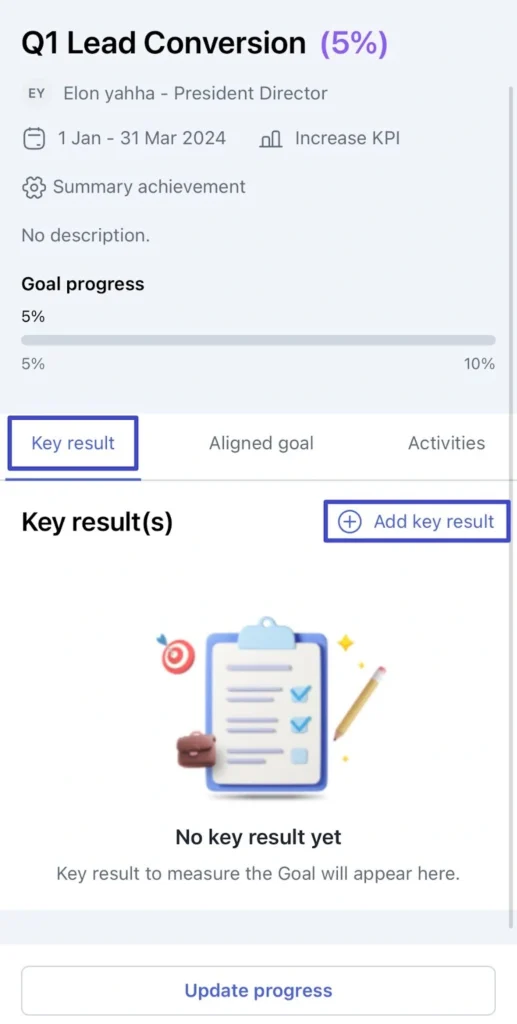
For example, with Mekari Talenta, management teams can visualize real-time progress on specific quarterly objectives and instantly map out the supporting metrics.
The interface below demonstrates how seamlessly a primary objective can be tracked alongside its corresponding key results in a unified, accessible dashboard:
Step 4: Enforce a Strict Check-in Rhythm
Implementation dies in the silence between the beginning and the end of the quarter. Establish a mandatory weekly or bi-weekly check-in rhythm.
These meetings should be brief and focused entirely on identifying roadblocks. If a metric is lagging by week three, leadership has the agility to reallocate budget or pivot the strategy immediately.
This cadence transforms the framework from a static performance reporting tool into an active steering wheel for the business, ensuring resources are always allocated to the highest-impact initiatives.
How to Measure OKR in Organization
The measurement phase requires a distinct departure from traditional evaluation methods. Legacy systems typically evaluate success in binary terms of complete or incomplete.
This specific framework demands a more nuanced approach to scoring that actively encourages aggressive risk-taking and accepts partial success as a massive operational leap forward.
Here are the foundational principles for accurately tracking and evaluating these objectives:
1. The Standardized Decimal Scale
The most effective way to grade progress is by utilizing a scale from 0.0 to 1.0 at the close of the quarter.
Within this system, scoring a 0.7 on an aspirational target signifies exceptional progress. It indicates that the target was appropriately ambitious and the team pushed their operational limits.
Consistently scoring a 1.0 means the targets are far too safe and the team is operating entirely within their comfort zone, effectively sandbagging their true capabilities.
Conversely, a score below 0.4 serves as an early warning signal, triggering an immediate root-cause analysis to fix systemic blockers.
2. Decoupling Progress from Compensation
This remains one of the most critical insider insights for a successful deployment. The scores achieved on these goals must remain completely separated from direct financial bonuses.
If leadership ties a guaranteed payout directly to achieving a perfect score, employees will systematically lower their targets to protect their compensation.
This dynamic entirely neutralizes the innovation engine. Progress should inform developmental conversations and provide context during annual reviews, but using it as a rigid formula for calculating bonuses will destroy the psychological safety required for setting ambitious goals.
3. Weekly Confidence Tracking
Measurement must occur continuously instead of waiting for a post-mortem at the end of the cycle. Teams should report a qualitative “confidence score” alongside their actual numerical updates during weekly check-ins.
A team might be only 20% of the way to their numerical target by week four, but if they just finalized a massive contract that will close in week five, their confidence score remains high.
Tracking this subjective confidence level alongside the objective data provides leadership with a highly accurate forecasting tool to predict end-of-quarter landing zones.
4. The Qualitative Retrospective
A raw number provides very little strategic value without context. The final step of the measurement phase is the quarterly retrospective, where teams explain the reasoning behind their final scores.
If a department scored a 0.9, they must document the specific tactical shifts that drove that massive success so other business units can replicate them.
If they scored a 0.2, they must articulate the specific market realities or internal bottlenecks that blocked their path.
This qualitative layer transforms raw performance data into actionable institutional knowledge for the next planning cycle.
Common Mistakes to Avoid with OKRs
Even when the initial rollout is flawless, specific operational traps can erode the integrity of the framework over time.
Scaling this methodology across thousands of employees requires constant vigilance to ensure the core philosophy remains intact.
Here are the critical errors to watch for and how to correct them in real-time:
1. The “Set It and Forget It” Syndrome
Many leadership teams treat goal setting as a singular event at the start of the quarter. They write brilliant, aggressive targets in January, bury them in a digital folder, and do not review them again until the end of March.
This transforms a dynamic steering mechanism into a stagnant reporting requirement. Without a strict weekly or bi-weekly check-in rhythm, daily urgencies will inevitably cannibalize strategic priorities.
The framework only survives if it becomes the central agenda of weekly team meetings, forcing a continuous conversation about resource allocation and lagging metrics.
2. Cascading Instead of Aligning
A frequent error in massive operations involves creating a rigid, top-down waterfall effect. The C-suite sets a goal, which strictly dictates the Vice President’s goal, which then dictates the Director’s goal, continuing step-by-step down the hierarchy.
In a multi-regional workforce, this cascading process can take six weeks to finalize. By the time the front-line workers receive their targets, the market conditions have already shifted.
The correct approach relies on simultaneous alignment. The executive team broadcasts the top-level destination, and departments immediately draft their own localized targets to support that overarching vision, drastically reducing planning time.
3. Overloading the System with Business-as-Usual
Teams often confuse their daily operational checklist with strategic milestones. If an accounting department creates an objective to “Close the financial books accurately every month,” they are simply documenting their baseline job description.
This framework exists specifically to drive transformation and strategic breakthroughs. Daily operational maintenance belongs in standard operating procedures or baseline tracking systems.
Filling the framework with routine tasks dilutes the executive focus required to achieve genuine market disruption.
4. Dictating the “How” Alongside the “What”
When managers write both the objective and the precise key results for their teams, they completely neutralize the autonomy that makes this methodology powerful.
Dictating the exact metrics strips away emotional investment. Real-world implementation shows that leaders must define the ultimate destination and then step back, allowing the individual contributors to architect the metrics that will prove success.
This bottom-up contribution builds profound accountability because the employees are executing a tactical plan they actively helped create.
Monitor and Manage Employee OKRs Automatically with Mekari Talenta
Managing OKRs manually often becomes a challenge for companies, especially when the number of employees and strategic objectives increase.
Without an integrated system, the process of tracking key results, evaluating progress, and aligning cross-functional teams can become deeply inefficient.
Mekari Talenta is an integrated cloud-based HCM platform that enables companies to manage end-to-end HR processes, from employee administration and payroll to performance management within a single system.
Within the platform, Mekari Talenta provides a robust performance management feature that helps companies manage OKR-based execution more effectively and consistently.
Through these features, organizations can monitor outcome achievement more objectively and transparently, supported by centralized and structured data.
HR teams and managers can also provide strategic feedback and conduct quarterly retrospectives more systematically, ensuring total alignment with the overarching business mission.
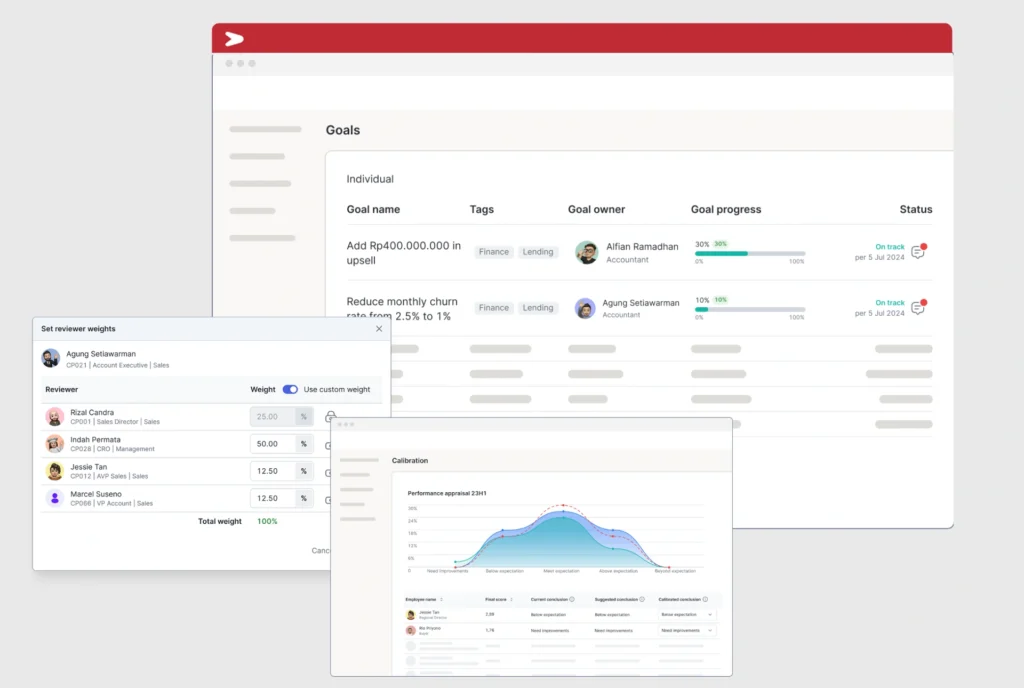
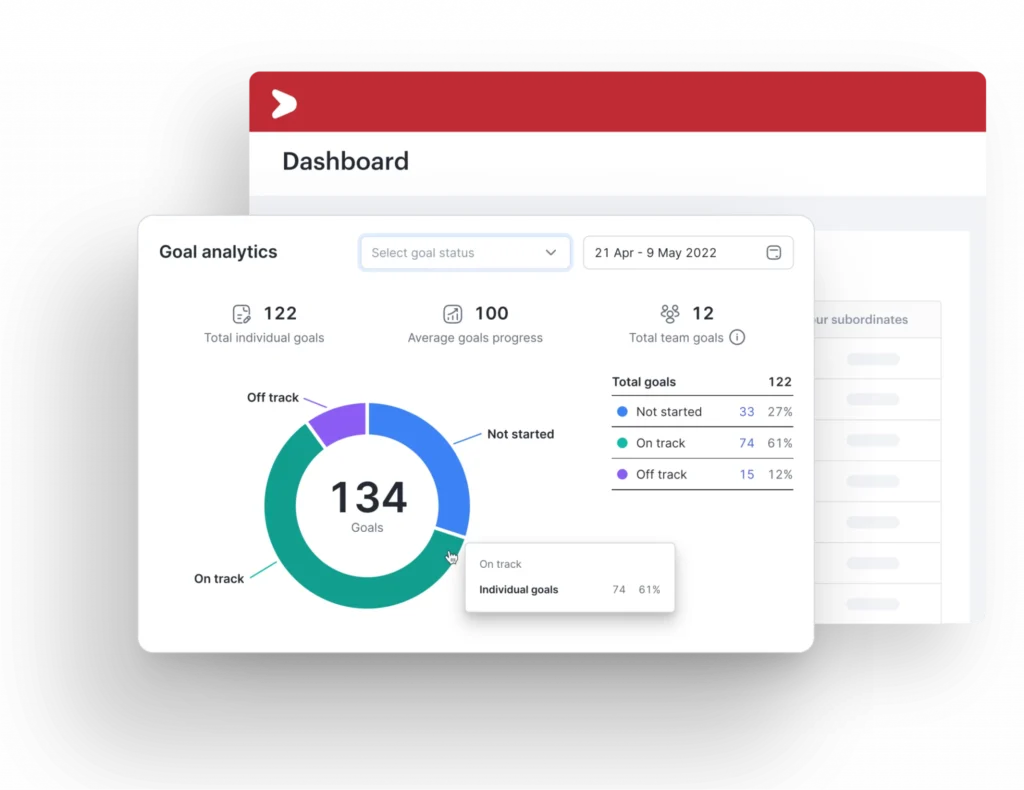
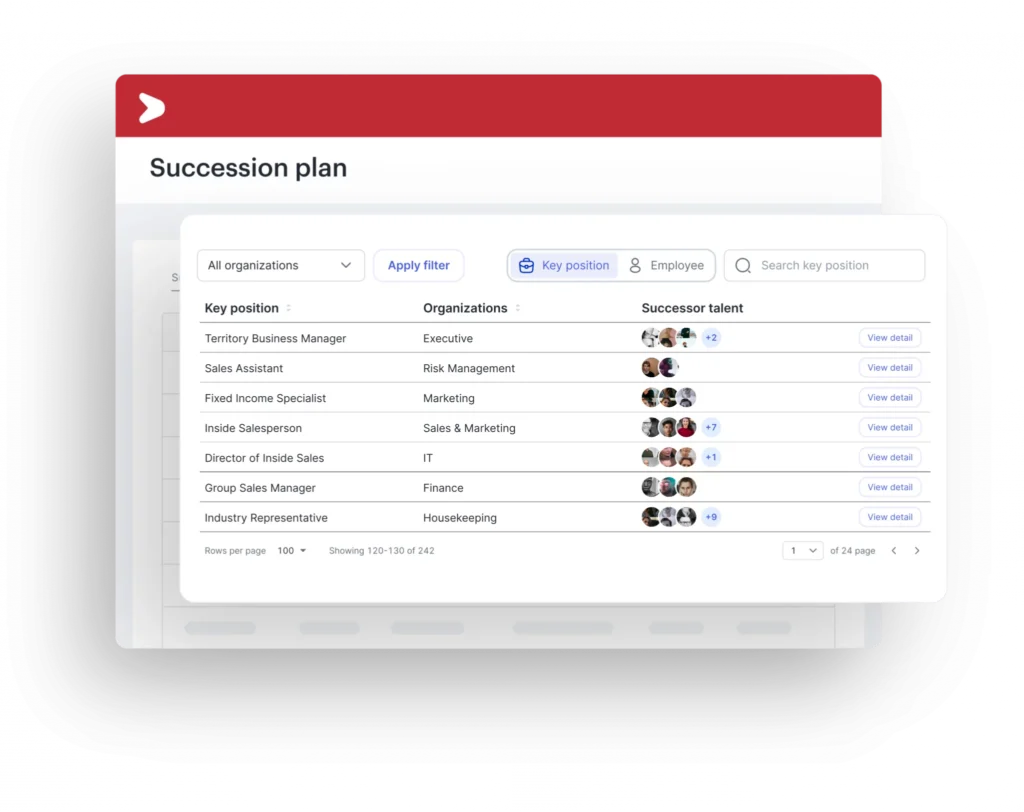
Several main features that support OKR and performance management in Mekari Talenta include:
- Organizational and team objective setting: Document high-level business aspirations so that each team and contributor has a clear strategic direction.
- Creation and alignment of key results: Create quantitative key results aligned with the overarching objectives and synchronize them across relevant departments.
- Progress monitoring in a unified dashboard: HR leaders and managers can track metric achievement progress continuously through a centralized, transparent dashboard.
- Integration with talent development: Objective achievement data can be seamlessly connected to the broader ecosystem to inform developmental conversations and career progression.
- More structured quarterly check-ins: The evaluation process can be conducted systematically using clearly documented OKR data and weekly confidence scores.
- Mobile-based employee self-service: Employees can update their key results, log progress, and receive continuous feedback directly through mobile applications.
With this integrated system, companies can ensure that the goal-setting process runs more efficiently, transparently, and remains entirely data-driven.
In addition, the use of applications such as Mekari Talenta also helps HR reduce the administrative burden so they can focus more on talent development and organizational strategy.
Contact the Mekari Talenta sales team to find out how an automated OKR management system can help your company align strategy and accelerate business outcomes more effectively.
Reference:
Frequently Asked Questions (FAQs)
How should we handle goals for cross-functional projects?
How should we handle goals for cross-functional projects?
Cross-functional initiatives require shared ownership rather than assigning the objective to a single department. Multiple teams will adopt the exact same Objective, but they will write distinct Key Results that reflect their specific departmental contribution. This structure forces immediate collaboration and ensures no group becomes a bottleneck for the overall project. Regular joint check-ins are mandatory to keep all involved parties fully synchronized.
What happens if a goal becomes completely irrelevant mid-quarter?
What happens if a goal becomes completely irrelevant mid-quarter?
Agility is a core tenet of this methodology, meaning teams are never locked into obsolete targets. If a major market shift or internal pivot renders an objective useless, leadership should officially archive it and draft a replacement immediately. Continuing to track a dead metric wastes valuable resources and frustrates contributors. The rationale for archiving the goal must be documented clearly for future strategic reference.
How does this system differ from traditional Management by Objectives (MBO)?
How does this system differ from traditional Management by Objectives (MBO)?
MBOs are typically private, top-down agreements between a manager and an employee that are reviewed annually and directly tied to compensation. OKRs are entirely public, updated weekly or monthly, and decoupled from salary or bonuses to encourage aggressive risk-taking. This modern framework prioritizes radical transparency and team alignment over isolated individual performance contracts. The focus shifts entirely from completing assigned tasks to driving measurable business outcomes.
Should this framework be integrated into Performance Improvement Plans (PIPs)?
Should this framework be integrated into Performance Improvement Plans (PIPs)?
Using aspirational targets within a disciplinary or remedial context is highly discouraged. A PIP requires highly predictable, localized task completion to demonstrate baseline competency, whereas this methodology is designed for stretching operational limits. Forcing an underperforming employee to hit aggressive growth metrics will only accelerate their failure rate. Remedial plans should rely on standard operational metrics rather than disruptive strategic goals.
Who should ultimately own the administration of this process?
Who should ultimately own the administration of this process?
While the executive team must dictate the overarching strategic direction, the administrative orchestration usually falls to a dedicated Chief of Staff or a specialized operational strategy team. Human resources professionals often facilitate the training and integration into broader development cycles, but treating it purely as an administrative initiative limits its business impact. The most successful implementations treat the framework as the primary operating system of the entire company. Shared ownership between strategy leaders and functional heads guarantees sustained momentum.