

KPI (Key Performance Indicator): Examples & How to Calculate


-
KPI is a measurable indicator used to track how well individuals, teams, or organizations achieve defined objectives.
-
For example, a sales KPI can be monthly revenue generated, while an HR KPI can be employee retention rate or time-to-hire.
KPI is a strategic tool to measure organizational performance objectively and ensure every business initiative provides real contribution to company objectives.
For the HRD division, KPI also functions as a framework to align talent management, strategic workforce planning, and measure employee performance evaluation consistently.
Implementation of KPI that is effective requires metrics that are appropriate, data that is reliable, and governance that is clear so that the results can be followed up.
Read this article for a complete guide, metric examples, and steps for implementing KPI that are suitable for companies.
What Is KPI (Key Performance Indicators)?
KPI or Key Performance Indicator is an indicator used to measure to what extent an individual, team, or work unit achieves targets that have been set by the organization.
KPI helps companies monitor the achievement of business strategy in a measurable and data-based way. It is used to ensure every organizational function contributes to company objectives.
Therefore, KPI can differ in each division because each has responsibilities and success indicators that are different.
As an example, a company sets an annual revenue growth target. To support that target, the sales team has KPI in the form of the number of deals successfully closed each month or the value of revenue generated per sales representative.
On the other hand, the HRD division can use KPI such as employee retention rate, average employee recruitment time, or level of performance review achievement to assess the effectiveness of human resource management.
In many organizations, KPI is managed through a talent management software to ensure consistency, visibility, and alignment across teams.
Differences Between KPI vs. OKR
Besides KPI, organizations also often use OKR (Objectives and Key Results) to manage performance and achievement of targets.
OKR is a performance management framework consisting of objectives (main goals to be achieved) and key results (measurable results that show whether those goals are achieved).
If KPI functions as an indicator to measure performance that is already running, OKR is usually used to drive achievement of more ambitious strategic targets within a certain period. Therefore, both are often used side by side in a performance management system.
Below are the differences between KPI and OKR:
| Aspect | KPI | OKR |
|---|---|---|
| Definition | Indicator used to measure work performance based on specific metrics | Framework used to set strategic goals and measurable results |
| Focus | Monitoring ongoing operational performance | Driving achievement of strategic goals or specific changes |
| Structure | Usually in the form of metrics or numerical targets | Consists of Objectives and multiple Key Results |
| Example Implementation | Sales team KPI: revenue Rp10 billion per quarter, conversion rate 15% |
Objective: Increase company revenue growth Key Results: Add 50 new clients, increase conversion rate to 15% |
Conclusion:
KPI and OKR are both used to measure performance, but have different functions.
KPI plays a role as an indicator to monitor performance consistently, while OKR helps organizations set strategic goals and measure progress of their achievement within a certain period.
Read also: What Are the Key Differences Between OKRs vs KPIs?
When Is KPI Used?
Usually, KPI is set at the beginning of a work period, such as monthly, quarterly, or annually, as a reference in employee performance evaluation and team performance assessment.
However, basically, KPI can be used anytime when an organization needs to measure and monitor achievement of targets in a measurable way, for example when evaluating sales team performance, assessing effectiveness of recruitment processes, or monitoring employee productivity.
HRD divisions and work unit leaders use KPI to see whether individual, team, or departmental targets have been achieved as well as to support a more objective performance evaluation process.
Objectives and Functions of KPI
Basically, the function and objective of KPI is to help organizations translate business targets into indicators that can be monitored systematically. Below is the explanation.
1. Become a Reference in Performance Evaluation
The main function of KPI is to become the basis in the process of employee and team performance evaluation. With indicators that have been set since the beginning of the work period, companies can evaluate performance more consistently and objectively.
As an example, the sales team can have KPI such as number of transactions successfully closed each month or value of revenue generated per sales representative. These indicators become the reference in the performance evaluation process.
2. Connect Individual Targets with Organizational Targets
KPI also functions to connect individual work targets with company business objectives. With this system, each division has indicators aligned with overall organizational objectives.
For example, if a company targets increasing customer growth, the marketing team can have KPI in the form of number of leads generated, while the sales team has KPI in the form of sales conversion rate.
Later, KPI can be used to monitor performance progress periodically, for example through monthly or quarterly reports. With such monitoring, organizations can see whether target achievement runs according to plan.
3. Become the Basis for Managerial Decision-Making
KPI also functions as a basis for management to make decisions related to strategy and operations, especially when supported by a structured KPI management system that centralizes data and ensures consistency in performance tracking.
By monitoring KPI achievement, companies can determine whether strategies being implemented are already effective or need to be adjusted.
For example, if KPI shows a decrease in sales conversion rate, management can evaluate marketing strategy or ongoing sales processes.
Benefits of KPI for Companies
Many companies use KPI to help ensure strategies that are designed can be translated into measurable work targets.
Below are several benefits of KPI in its implementation in organizations.
1. Increase Clarity of Targets and Work Direction
KPI helps organizations translate business strategies into targets that are clear and measurable for each team or individual.
With specific indicators, employees can understand work priorities and know how their contributions affect company objectives as a whole.
This makes KPI an important tool to ensure all divisions move in the same direction.
2. Increase Employee Productivity and Performance
KPI also plays a role in encouraging improvement of employee performance because each individual has performance indicators that can be monitored objectively.
With clear metrics, employees can see progress of target achievement and adjust work strategies to improve results.
KPI also helps organizations provide more constructive feedback, often integrated with 360 degree feedback performance evaluation approaches to gain a more comprehensive view of employee performance.
3. Support Data-Driven Decision Making
Another benefit of KPI is helping management make decisions based on measurable performance data, not just assumptions or intuition.
By monitoring key indicators periodically, organizations can more quickly identify operational issues and improvement opportunities.
This makes KPI an important foundation in data-driven management practices, often supported by people analytics to generate deeper insights into workforce performance and trends.
These insights can also be enriched by qualitative inputs such as exit interview insight, helping organizations better understand workforce challenges beyond quantitative KPI data.
Read also: Data-Driven HR: Definition, Benefits, and Practical Implementation

Types of KPI
KPI does not only consist of one type of indicator. Some KPI are used to measure long-term strategic achievement, while others are used to monitor operational activities or predict future outcomes.
Below are types of KPI that you need to understand to ensure that the indicators used are appropriate with the level of performance measurement needed.
| Type of KPI | What Is Measured | Example Implementation |
|---|---|---|
| Strategic KPI | Measures achievement of long-term business objectives and overall organizational performance | ARR increases 20% YoY |
| Operational KPI | Monitors performance of daily operational processes or short-term activities | Complete 95% of IT tickets within ≤24 hours (per month) |
| Functional KPI | Measures performance targets at the department or specific function level | Marketing CPL ≤ Rp2,000,000 per lead (per quarter) |
| Leading KPI | Early indicators that can predict future outcomes | Add 30 qualified prospects to pipeline per week |
| Lagging KPI | Measures results that have already occurred based on data from previous periods | Customer churn rate 5% in Q1 |
Organizations usually use a combination of several types of KPI at once.
Strategic and functional KPI help ensure achievement of business objectives, while operational and leading KPI help teams monitor work progress more quickly. Lagging KPI is then used to see final results of strategies that have been implemented.
Characteristics of Effective KPI
To ensure KPIs are used effectively in performance management, the indicators must have several key characteristics.
A good KPI is usually objective, can be verified through data, and focuses on information that is truly important for decision-making.
- Example of a bad KPI: improving customer experience (classified as less effective because too general and does not have a clear measure)
- Example of a good KPI: increasing customer renewal rate by 8% until end of Q2 (has indicators that are specific, measurable, and have a clear time limit.
One way to ensure KPI is good and effective is by using the SMART framework. Below are characteristics of effective KPI based on SMART principles.
Specific
KPI must be formulated clearly and not ambiguous so that it is easily understood by all parties involved.
Indicators that are too general can cause different interpretations and make performance evaluation processes difficult.
As an example, indicators such as “improving customer experience” are too broad. A more specific KPI is increasing customer renewal rate.
Measurable
KPI must have a clear measure so that its achievement can be assessed objectively. Usually this indicator is associated with numbers or certain quantitative targets.
An example is “increasing customer satisfaction score to 4.5 out of a scale of 5”.
With clear numbers, companies can monitor performance progress more accurately.
Achievable
KPI targets must be realistic and based on data or previous performance. KPI that are too high can reduce team motivation, while targets that are too low do not encourage performance improvement.
For example, companies can target increasing sales by 10–15% if in the previous two years sales growth was in the range of 8–12% per year.
Relevant
KPI must have direct relevance to business objectives and functions of departments that execute them. Indicators that are not relevant can make teams focus on metrics that are actually not within their control.
As an example, if a company is running a strategy to increase customer retention, then KPI such as customer renewal rate or customer retention rate become relevant for the customer success team.
On the other hand, those KPI are less relevant if applied to the marketing team, because their main function focuses more on generating leads or new prospects.
In this context, KPI that are more relevant for the marketing team are for example number of leads generated, cost per lead (CPL), or marketing qualified leads (MQL) entering the sales pipeline.
Time-bound
Each KPI must have a clear time limit so that progress of its achievement can be monitored periodically. Without a deadline, performance evaluation will be difficult to conduct.
For example, a target of increasing number of new customers by 20% within one year provides a clear time framework for the team to achieve it.
KPI Elements
A KPI usually consists of several important elements so that the indicator can be used clearly and measurably.
Below are several main elements in KPI formulation.
1. Indicator Being Measured
The first element is the performance indicator to be measured. This indicator is usually in the form of metrics that reflect performance of an activity or business process.
For example, the marketing team can use indicators such as number of leads generated, while the sales team can use value of revenue generated per quarter.
2. Target to Be Achieved
Each KPI must have a clear target so that its achievement can be assessed objectively. This target is usually expressed in the form of numbers or certain percentages.
For example, KPI number of leads generated can have a target of 500 leads per month.
3. Measurement Period
KPI must also have a clear time period to monitor its achievement. This period can be weekly, monthly, quarterly, or annual, depending on organizational needs.
For example, KPI revenue increase of 15% within one year shows a clear time limit to evaluate its achievement.
4. Data Source
The next element is the data source used to measure KPI. The data must be accessible and verifiable so that performance measurement results remain objective.
For example, KPI related to website traffic can be measured using data from analytics tools such as Google Analytics.
5. Person in Charge (KPI Owner)
Each KPI should have a clearly assigned owner responsible for its achievement. This ownership can be defined at both the team and individual level, depending on the scope of the KPI.
Assigning KPI ownership ensures that each indicator is actively monitored, managed, and followed through with accountability.
For example, employee retention rate may be owned at the HR level, but specific supporting KPIs—such as onboarding completion or engagement scores—can be assigned to individual HR team members.
Similarly, while customer satisfaction score may be owned by the customer success team, response time or ticket resolution rate can be assigned to specific individuals to ensure more direct accountability.
Objects That Can Be Measured in KPI Setting
In KPI formulation, it is important to choose relevant objects as measurement targets. These objects can come from various aspects in organizational structure, whether human resources, projects, or operational processes.
Below are several categories of objects commonly used as the basis for KPI measurement:
1. Risk
Risk management becomes an important element in company sustainability. KPI that focus on risk are generally used in project management, legal compliance, and internal audit.
For example, “number of audit findings per quarter” or “level of compliance with operational SOP” can become important indicators that reflect success in mitigating risk.
2. Personnel
This object includes aspects of behavior, skills, productivity, and employee loyalty.
KPI that can be applied include: “monthly attendance rate”, “number of trainings attended per year”, or “employee retention within the last 12 months”. Focusing on personnel helps companies maintain quality of human resources which are the most crucial asset.
Focusing on personnel also supports broader talent development initiatives by ensuring that employee growth, capability building, and performance improvement are consistently measured.
3. Project
In project management, KPI is used to monitor progress, budget, and effectiveness of implementation.
Examples of project KPI include: “percentage of projects completed on time”, “actual cost compared to project budget”, and “client satisfaction level with project results”. These indicators ensure that projects run according to plan and quality standards.
4. Operational
Operational KPI includes metrics directly related to daily business processes. Indicators such as “number of units produced per day”, “product defect ratio”, or “customer service waiting time” are common examples.
These KPI help improve efficiency and data-driven decision-making.
5. Strategic
Strategic objects reflect long-term achievement of the organization. For example, “annual profit growth”, “market share”, “brand value”, or “number of new customers per year”.
Strategic KPI are usually set by top management to evaluate policy direction and company competitiveness in the market.
Examples of KPI Commonly Used by Organizations
Below are several examples of KPI commonly used in organizations to measure company and employee performance across various functions.
KPI Examples for Companies
Companies usually set several main KPI to monitor overall business performance. Examples include:
- Revenue growth rate: Measures company revenue growth in a certain period as an indicator of overall business performance.
E.g.: Increase annual revenue by 15% compared to previous year. - Customer retention rate: Measures the company’s ability to retain customers in a certain period.
E.g.: Retain 90% of active customers each year. - Net profit margin: Shows percentage of net profit generated from total company revenue.
E.g.: Achieve net profit margin of 18% at the end of fiscal year.
KPI Examples for Employees
Besides KPI at the organizational level, companies also set KPI for various functions or job positions, examples include:
KPI Examples for Digital Marketing Team
- Organic traffic growth: Measures the increase in website visitors from organic channels.
E.g.: Increase organic traffic by 25% within 6 months. - Cost per lead (CPL): Measures the efficiency of marketing spend in generating leads.
E.g.: Maintain CPL below Rp2,000,000 per lead per quarter. - Conversion rate: Measures the percentage of visitors who complete a desired action.
E.g.: Achieve a 3% conversion rate from landing pages each month.
KPI Examples for Customer Service Team
- Customer satisfaction score (CSAT): Measures level of customer satisfaction with services provided.
E.g.: Achieve minimum CSAT score of 4.5 out of 5 each month. - Average response time: Measures average time needed to respond to customer questions or complaints.
E.g.: Maintain average response time below 10 minutes. - First contact resolution rate: Measures percentage of customer issues resolved in one interaction.
E.g.: Resolve 85% of customer tickets at first contact.
KPI Examples for Administrative Team
- Document processing time: Measures speed in processing administrative documents.
E.g.: Process 95% of administrative documents within a maximum of 1 working day. - Data accuracy rate: Measures level of accuracy of data entered or managed in company systems.
E.g.: Maintain data accuracy at least 99% each month.
KPI Examples for IT Team
- System uptime: Measures the availability and reliability of systems or infrastructure.
E.g.: Maintain system uptime at 99.9% each month. - Average incident resolution time: Measures the speed in resolving technical issues.
E.g.: Resolve critical incidents within 2 hours on average. - Ticket resolution rate: Measures the percentage of IT tickets resolved within SLA.
E.g.: Close 95% of tickets within defined SLA each month.
KPI Examples for Finance Team
- Budget variance: Measures the difference between planned and actual financial performance.
E.g.: Maintain budget variance within ±5% per quarter. - Accounts receivable turnover: Measures how efficiently the company collects outstanding payments.
E.g.: Achieve receivable turnover of 8 times per year. - Financial reporting accuracy: Measures the accuracy of financial reports produced.
E.g.: Maintain 100% accuracy in monthly financial reporting.
How to Create and Structure KPI to Measure Employee Performance
In organizations that have many teams and work functions, KPI must be designed systematically so that they truly reflect employee contributions to company objectives.
Therefore, the KPI formulation process usually starts from company strategic goals, then is translated into relevant performance indicators at division, team, and individual levels.
Below are practical steps in structuring KPI to measure employee performance.
1. Align KPI with Company Business Objectives
The first step is ensuring that employee KPI originate from company business objectives. Without this linkage, KPI only become numbers that do not have real impact on organizational strategy.
For example, if a company has a target to increase revenue by 20% within one year, then KPI in various divisions can be derived as follows:
- Sales team: number of deals closed per quarter
- Marketing team: number of marketing qualified leads (MQL) generated
- Customer success team: customer retention rate
With this approach, each team has clear indicators regarding their contribution to company targets.
2. Determine Relevant Performance Indicators
After business objectives are defined, the next step is selecting performance indicators that truly reflect job performance. These indicators must be within the control of the team or individual concerned.
For example:
Digital marketing team
- Organic traffic growth
- Cost per lead (CPL)
- Conversion rate
Customer service team
- Customer satisfaction score (CSAT)
- Average response time
- First contact resolution rate
Appropriate indicators help companies avoid situations where employees are assessed based on metrics that they do not control.
3. Determine Targets and Measurement Period
Each KPI must have clear targets and defined measurement periods. Without these two elements, the performance evaluation process becomes inconsistent.
Some common practices used by companies include:
- Monthly: daily operational metrics such as service response time
- Quarterly: sales targets or customer growth
- Annual: revenue growth or market share
For example:
- KPI: number of leads generated
- Target: 500 leads per month
- Evaluation period: monthly
With this format, companies can conduct performance evaluation periodically and consistently.
4. Assign KPI Ownership (PIC)
Once KPIs, targets, and measurement periods are defined, the next step is assigning each KPI to a specific individual.
At this stage, ownership should no longer sit at the team level. Each KPI must have a clearly assigned person responsible for its execution and outcome.
This is important because accountability does not operate effectively at the team level. While targets may be defined per function, execution always happens at the individual level.
The example below shows how KPI ownership is assigned within Mekari Talenta, where each goal is directly linked to a specific individual.
In this case, goals such as “add Rp40,000,000,000 in upsell” are assigned to Andy Bernard, making it clearly visible who is responsible for tracking progress and driving results.
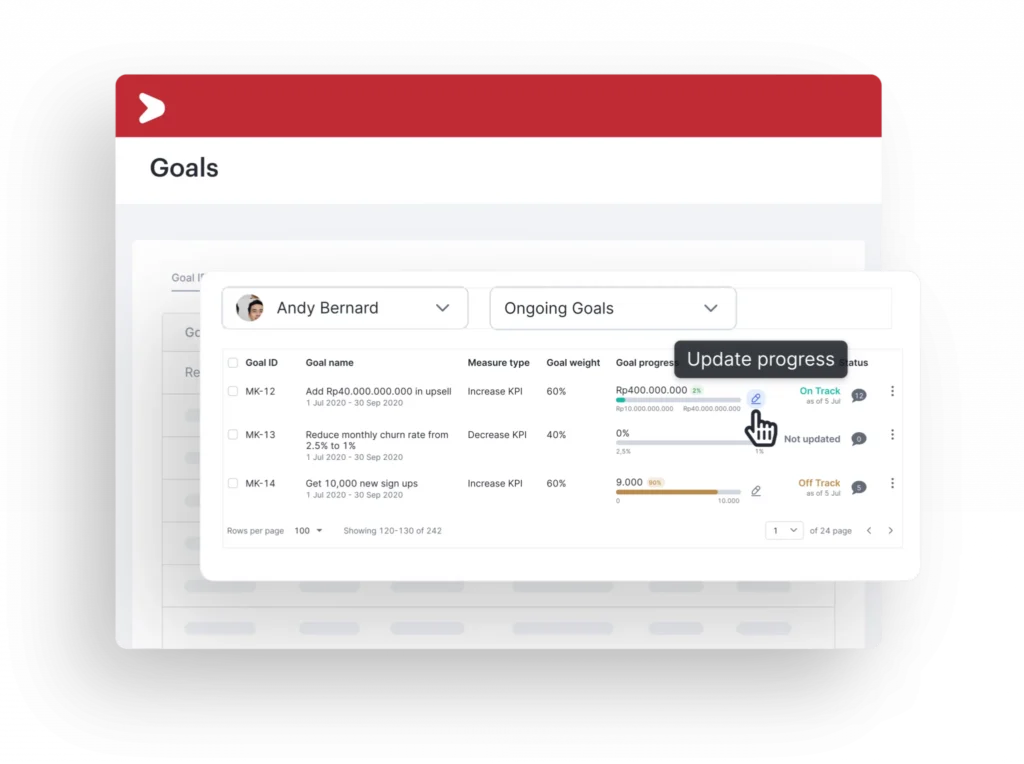
Without individual ownership, KPIs often become shared responsibilities with unclear accountability, which leads to slower execution and inconsistent results.
By assigning each KPI to a specific person, organizations create clear ownership, faster follow-through, and more accurate performance evaluation.
5. Assign Weight to Each KPI
One job position usually has several KPI at once. Therefore, each indicator needs to be assigned a weight according to its level of importance.
The higher the weight assigned, the greater the influence of the KPI on overall employee performance evaluation.
This weighting helps organizations determine priorities and avoid situations where all indicators are considered to have equal importance.
For example KPI for SEO Specialist:
| KPI | Target | Weight |
|---|---|---|
| Organic traffic growth | +30% per year | 40% |
| Keyword ranking (Top 10) | 50 keywords | 30% |
| Conversion rate from organic | 3% | 30% |
6. Calculate KPI
After KPI and weights are determined, the next step is calculating employee performance achievement.
How to calculate KPI?
Calculation is usually done by comparing actual results with targets that have been set. The basic formula commonly used is:
KPI Achievement (%) = (Actual / Target) × 100
Example:
- Monthly leads target: 500 leads
- Actual: 450 leads
KPI achievement:
- (450 ÷ 500) × 100 = 90%
If KPI has weight, calculation can be done as follows:
KPI Score = KPI Achievement × Weight
Example:
- KPI achievement: 90%
- KPI weight: 30%
- KPI score = 27 points
The values of all KPI are then summed to produce final employee performance score in the evaluation period.
7. Conduct KPI Review Periodically
KPI are not static indicators. Changes in business strategy, market conditions, or organizational priorities can affect relevance of KPI used.
Therefore, companies usually conduct KPI reviews periodically, for example every quarter or annually, to ensure that indicators used remain aligned with business objectives.
Common Mistakes in Determining KPI
In practice, determining KPI does not always run properly.
Mistakes in designing KPI can make performance evaluation processes less effective and make it difficult for companies to achieve targets that have been set.
Some common mistakes in determining KPI include:
- Company objectives and strategies are not formulated clearly. As a result, KPI set only focus on financial performance without considering other performance indicators that are also important for business sustainability.
- Not considering needs and roles of each division. The same KPI are applied across different departments without adjusting to each function, making indicators less relevant.
- Conflict of interest between teams or work programs. This can occur when performance indicators between divisions are not aligned or contradict each other.
- Not supported by adequate performance management systems. Without proper system support, KPI measurement and reporting processes can become inconsistent and difficult to monitor.
Therefore, companies need to ensure that KPI are designed clearly, measurable, and supported by systems that are able to monitor performance effectively.
One way that can be done is by using KPI software such as Mekari Talenta, which helps companies manage and monitor employee KPI in a more structured way.
In more complex organizations, companies may also engage external support such as kpi consultancy services to design more accurate and aligned performance measurement frameworks.
Read also: Talent Management vs Performance Management: 6 Key Differences
Monitor and Manage Employee KPI Automatically with Mekari Talenta
Managing KPI manually often becomes a challenge for companies, especially when number of employees and performance indicators increase.
Without an integrated system, the process of monitoring targets, performance evaluation, and incentive calculation can become inefficient.
Mekari Talenta is an integrated cloud-based HCM platform that enables companies to manage end-to-end HR processes, from employee administration and payroll to performance management within a single system.
Within the platform, Mekari Talenta provides a performance management feature that helps companies manage KPI-based performance more effectively and consistently.
Through these features, organizations can monitor employee target achievement more objectively and transparently, supported by centralized and structured data.
HR teams and managers can also provide feedback and conduct performance evaluations more systematically, ensuring alignment with overall business objectives.
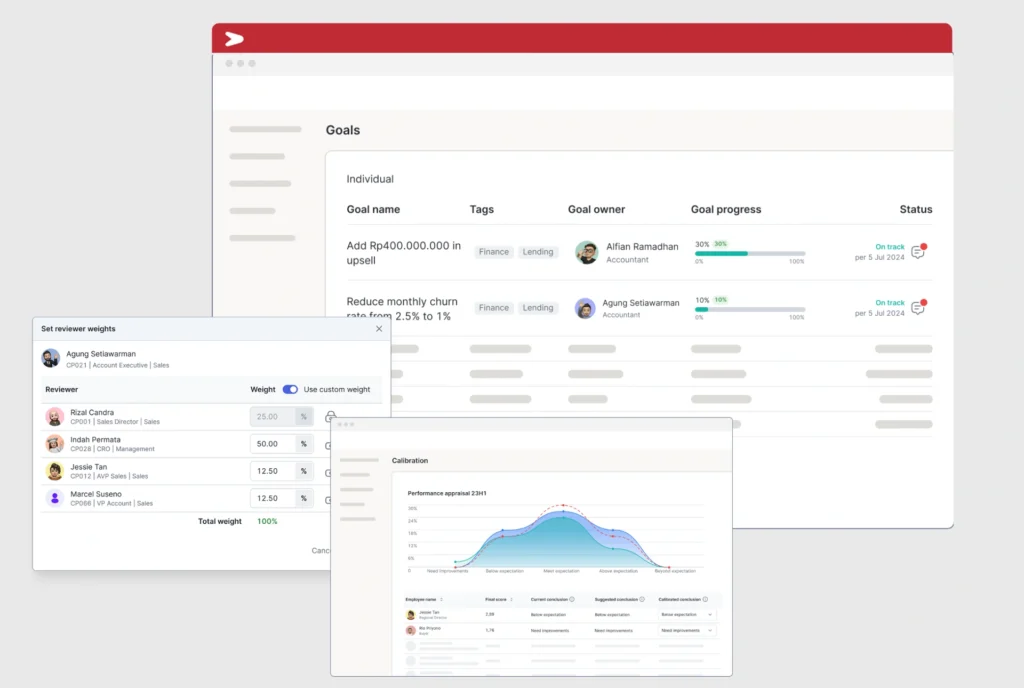
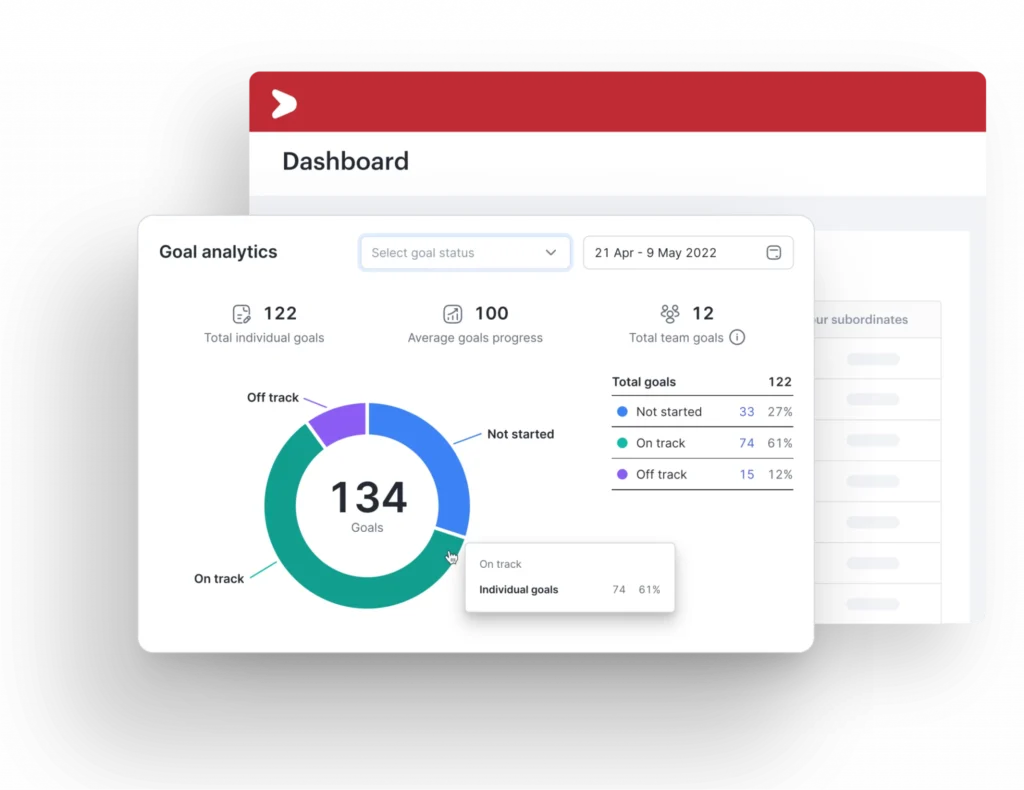
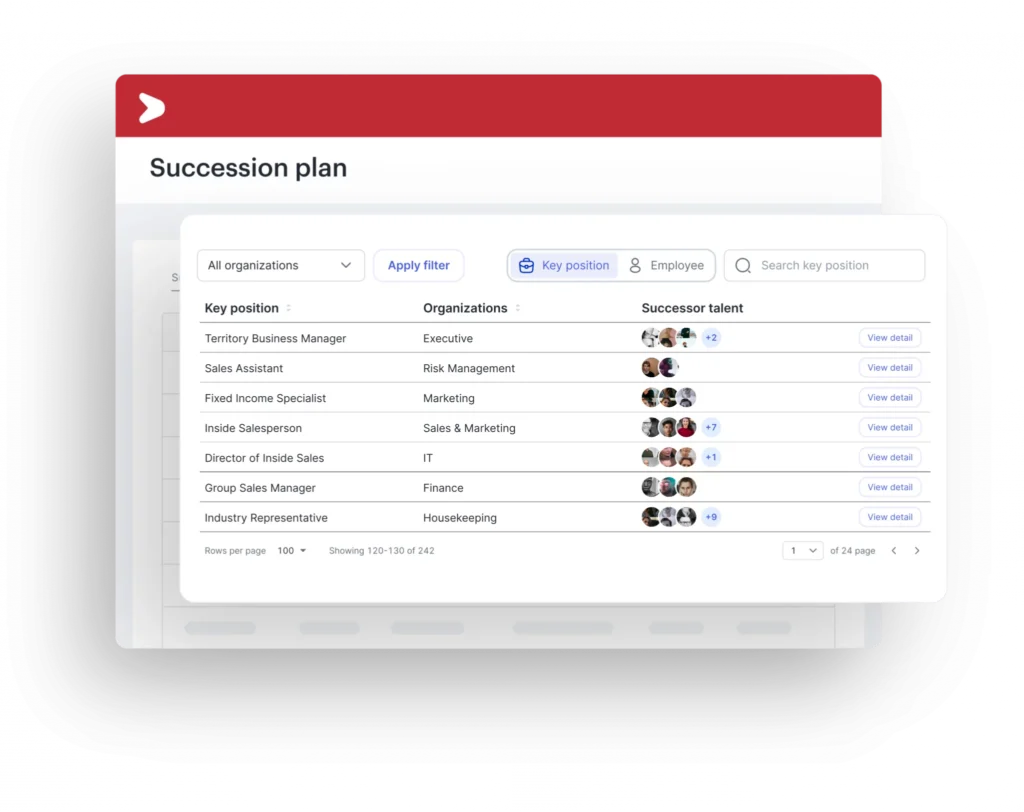
Several main features that support KPI and performance management in Mekari Talenta include:
- Organizational and team goal setting: Document company business objectives so that each team and employee has clear work direction.
- Creation and distribution of work targets: Create KPI or tasks aligned with organizational objectives and distribute them to employees or relevant teams.
- Performance progress monitoring in one dashboard: HR and managers can monitor target achievement progress in real-time through a centralized dashboard.
- Integration of KPI with payroll and incentives: Employee performance achievement can be directly connected to payroll system to calculate bonuses or incentives automatically.
- More structured performance review: Performance evaluation process can be conducted systematically with clearly documented KPI data.
- Mobile-based employee self-service: Employees can access targets, work progress, and feedback directly through mobile applications.
With this integrated system, companies can ensure that performance management processes run more efficiently, transparently, and data-driven.
In addition, the use of applications such as Mekari Talenta also helps HR reduce administrative burden so they can focus more on employee development and organizational strategy.
Contact Mekari Talenta sales team to find out how KPI management systems can help your company monitor and improve employee performance more effectively.
Reference:
Frequently Asked Questions (FAQs)
How many KPIs should one role ideally have?
How many KPIs should one role ideally have?
Most roles work best with 3–5 KPIs to maintain focus and avoid dilution of priorities. Too many KPIs make it harder to track performance meaningfully and reduce clarity in execution. The key is selecting indicators that directly impact outcomes, not just activities. Quality of KPI matters more than quantity.
What is the difference between KPI and metrics?
What is the difference between KPI and metrics?
Metrics are raw measurements, while KPIs are selected metrics tied to specific business objectives. Not every metric qualifies as a KPI because it must reflect performance against a goal. For example, website traffic is a metric, but conversion rate tied to revenue target is a KPI. KPIs always have context and purpose.
How often should KPIs be reviewed or updated?
How often should KPIs be reviewed or updated?
KPI performance is typically monitored regularly (monthly or quarterly), but KPI structure itself should be reviewed every 6–12 months. Changes in strategy, market conditions, or priorities often require adjustment. Keeping KPIs static for too long can make them irrelevant. Regular review ensures alignment with current business direction.
Can KPIs be qualitative, or must they always be quantitative?
Can KPIs be qualitative, or must they always be quantitative?
KPIs are generally quantitative to ensure objectivity, but qualitative aspects can be translated into measurable indicators. For example, “improving customer experience” can be measured using CSAT or NPS scores. The goal is to convert subjective outcomes into trackable metrics. This ensures consistency in evaluation.
What happens if KPIs are not aligned across departments?
What happens if KPIs are not aligned across departments?
Misaligned KPIs can create conflicting priorities between teams, slowing down execution and reducing overall performance. For example, one team may optimize for cost while another focuses on growth, leading to friction. Alignment ensures that all functions contribute toward the same business outcome. This is why KPI design must start from company-level objectives.