Retaining talented employees has become one of the biggest challenges for many companies today. High turnover rates not only increase recruitment costs, but can also disrupt organizational stability and team productivity.
This shows that structured talent management can help companies retain top employees while improving organizational stability.
One solution widely used by companies today is talent management system, which helps HR manage employee development and retention strategies more effectively.
Therefore, many companies are starting to use talent management software to support more structured talent development strategies.
This article will discuss 12 of the best talent management software that can help companies manage talent more strategically.
What Is Talent Management Software?
Talent management software is an application that helps companies manage various employee development processes in an integrated digital platform.
Through this system, HR and management can monitor employee performance, identify potential talent, and design career development strategies more systematically.
Typically, talent management applications are part of a Human Resource Information System (HRIS) or Human Capital Management (HCM) system that is integrated with other HR processes such as performance management, learning management, and succession planning.
To execute this strategy effectively, companies usually use a talent management framework as a guide to align talent management with business goals.
By using talent management software, companies can perform various important activities, such as:
- Monitoring employee performance through a performance management system
- Identifying high-potential employees
- Developing employee career development programs
- Managing succession planning for strategic roles
- Analyzing talent data for HR decision-making
The main objective of using this software is to help organizations manage talent more strategically and data-driven.
With a structured system, companies can identify employee potential faster, provide regular feedback, and ensure that each employee has a clear development path.
In addition, talent management software also plays an important role in improving employee retention. When employees feel they have clear career development opportunities, they tend to be more loyal and motivated to grow with the company.
Read also: Talent Management vs Performance Management: 6 Key Differences
Key Features of Talent Management Software

Every company has different needs in managing talent. Some organizations focus more on leadership development, while others prioritize performance evaluation and competency improvement.
However, in general, most talent management software includes the following key features:
- Performance Management → Helps companies monitor employee performance and provide regular feedback to improve team performance.
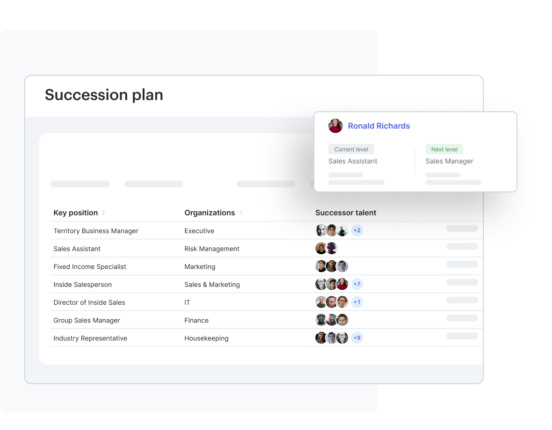
- Succession Planning → Helps companies identify high-potential employees and prepare future leaders for strategic roles.
- Individual Development Plan (IDP) → Enables companies to create personalized employee development plans based on performance and potential.
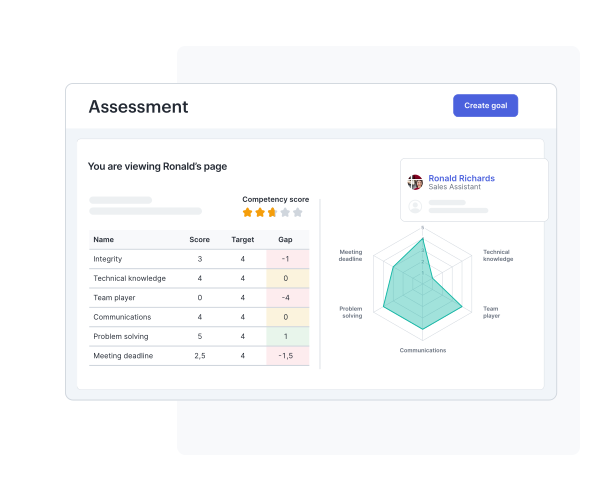
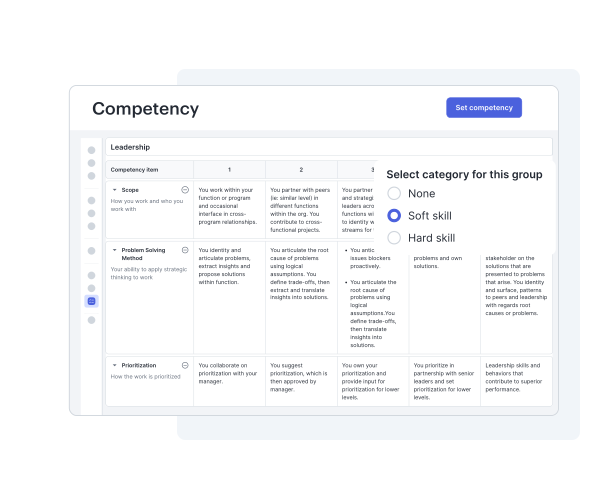
- Competency Management → Helps map employee competencies and identify skill gaps that need to be developed.
- Analytics and Reporting → Provides data-driven insights into talent development, enabling HR to make more strategic decisions.
With these features, talent management applications help companies manage the employee development cycle more systematically, from performance evaluation to career planning.
Comparison Table of the Best Talent Management Software
Each talent management software has its own advantages. Some platforms are designed for large enterprises with complex HR needs, while others are better suited for small to mid-sized organizations.
Therefore, it is important for companies to choose software that best fits their organizational needs.
| Software | Features | Advantages | Platform | Pricing |
|---|---|---|---|---|
| Mekari Talenta | Performance management, talent development, succession planning, LMS | Integrated HCM system for end-to-end talent management | Web, Mobile App | Essential, Plus, Talenta 360 (custom pricing) |
| SAP SuccessFactors | Talent management, learning management, HR analytics | Enterprise HR system with comprehensive features | Web (limited mobile support) | Starting from ~$18/user/month |
| Oracle HCM Cloud | Workforce planning, performance management | Suitable for global companies | Web (limited mobile support) | ~$2–8/user/month (varies by modules) |
| Workday Talent Management | Talent analytics, succession planning | Enterprise platform with strong analytics | Web (mobile app available) | ~$35–100+/user/month (custom) |
| BambooHR | Performance review, employee data | Simple and user-friendly interface | Web, Mobile App | ~$10–25/user/month |
| Lattice | Performance management, engagement survey | Focus on feedback and employee engagement | Web (limited mobile support) | Starting from ~$11/user/month |
| 15Five | Continuous feedback, performance tracking | Supports a continuous feedback culture | Web, Mobile App | ~$4–16/user/month |
| Culture Amp | Employee engagement, performance review | Strong employee engagement analytics | Web (limited mobile support) | ~$9–14/user/month (enterprise > $20) |
| Zoho People | HR management, performance tracking | Suitable for small to mid-sized businesses | Web, Mobile App | ~$1–6/user/month (varies by plan) |
| Cornerstone OnDemand | Talent development, learning management | Enterprise talent management platform | Web (limited mobile support) | Starting from ~$6/user/month |
| Leapsome | Performance management, learning tools | Integrates feedback and learning programs | Web (limited mobile support) | ~$6–15/user/month (min ~$6,000/year) |
| Engagedly | Performance management, goal tracking | Supports employee development through OKRs | Web, Mobile App | ~$2–10/user/month (min ~$7,500/year) |
12 Best Talent Management Software
Currently, many HR software vendors offer talent management features to help companies manage employee development more strategically.
Below are some of the most widely used talent management software by organizations.
1. Mekari Talenta


Mekari Talenta is a cloud-based Human Capital Management (HCM) platform that helps companies manage performance, talent development, and employee career planning in one integrated system.
As part of the Mekari integrated software ecosystem, the Talent Management and talent development features in Mekari Talenta are designed to support organizations with complex structures and evolving HR needs.
Key Features
- Goal & KPI Management → Set employee targets and monitor progress in real-time
- Performance Management → Conduct objective employee performance evaluations through 360 degree feedback or continuous reviews.
- AI-powered Performance Summary → Automatically generate performance review summaries for easier analysis
- Succession Planning → Identify high-potential employees and prepare future leaders
- Competency Management → Map employee competencies for career development
- Individual Development Plan (IDP) → Create personalized development plans
- Learning Management System (LMS) → Manage employee training programs in one platform
- HR Analytics → Provide data-driven insights on employee performance, potential, and development
- HR System Integration → Sync KPI, feedback, payroll, and other HR data in one system
Pricing
Mekari Talenta pricing is divided into several packages: Essential, Plus, and Talenta 360, tailored to business needs and scale.
Advantages
- An integrated HCM system that enables companies to manage end-to-end talent management processes within a single platform.
- Supports comprehensive talent development strategies through features such as performance management, succession planning, and learning management.
- Provides data-driven insights through HR analytics to support more strategic decision-making.
- Seamlessly integrated with other HR modules such as payroll, attendance, and employee database to reduce data duplication.
- Suitable for companies with complex organizational structures that require a scalable HR system.
Disadvantages
- The implementation process requires onboarding and adaptation from the HR team to ensure optimal usage.
- Initial configuration may require adjustments to align with each company’s policies and organizational structure.
Why choose Mekari Talenta?
2. SAP SuccessFactors


SAP SuccessFactors is an enterprise-level talent management application widely used by global companies to manage employee development in an integrated way.
This platform is part of the SAP Human Experience Management (HXM) ecosystem, designed to support various strategic HR processes, from recruitment to leadership development.
As a talent management software, SAP SuccessFactors enables companies to monitor employee performance, design competency development programs, and prepare future leaders through structured succession planning.
This platform is commonly used by multinational organizations that require HR systems capable of managing thousands of employees across different countries.
Features
- Talent management
- Learning management
- HR analytics
- Succession planning
- Performance management
Pricing
Starting from around USD 18 per user per month, with additional costs depending on add-ons and company needs.
Advantages
- Enterprise-grade HR platform with comprehensive features.
- Suitable for multinational companies.
- Strong integration with SAP ecosystem.
Disadvantages
- Implementation is relatively complex.
- High implementation costs.
Why choose SAP SuccessFactors?
3. Oracle HCM Cloud


Oracle HCM Cloud is a cloud-based HR platform that offers various human resource management modules, including talent management.
This system is designed to help large organizations manage employees globally through one integrated platform.
As a talent management application, Oracle HCM Cloud helps companies monitor performance, identify high-potential talent, and design more structured career development strategies.
It also provides workforce planning features to help organizations forecast future workforce needs.
Oracle HCM Cloud is typically used by companies with complex organizational structures and global operations that require strong analytics capabilities.
Features
- Workforce planning
- Talent analytics
- Performance management
- Career development tools
- Succession planning
Pricing
Varies from around USD 2–8 per employee per month to higher ranges depending on modules and scale.
Advantages
- Suitable for global organizations with complex structures.
- Strong HR analytics capabilities.
- Integrated with Oracle ecosystem.
Disadvantages
- High implementation cost.
- Complex configuration process.
Why choose Oracle HCM Cloud?
4. Workday Talent Management


Workday Talent Management is a global talent management solution commonly used by large enterprises to manage employee development strategically.
This platform is part of Workday Human Capital Management (HCM), offering various cloud-based HR features.
Workday allows companies to identify potential talent, monitor employee progress, and design leadership development programs through powerful talent analytics.
It also supports succession planning by mapping future leaders based on employee performance and potential.
Due to its strong analytics capabilities, Workday is widely used by large organizations that rely on data-driven HR decision-making.
Features
- Talent analytics
- Succession planning
- Performance management
- Workforce planning
- Career development tools
Pricing
Custom and subscription-based. According to third-party sources, it typically ranges from USD 35–100+ per employee per month.
Advantages
- Strong talent analytics capabilities.
- Suitable for large enterprises.
- Integrated enterprise HR system.
Disadvantages
- Not ideal for small companies.
- High implementation cost and time.
Why choose Workday?
Read also: What Is a KPI Management System? Definition, Benefits, and Elements
5. BambooHR


BambooHR is a popular HR software among small to mid-sized companies. It is known for its simple and user-friendly interface, making it a common choice for organizations starting their HR digitalization journey.
As a talent management tool, BambooHR provides performance management features to help HR monitor employee performance and deliver regular feedback. It also includes a structured employee database, making HR data management more efficient.
Features
- Performance management
- Employee database
- HR reporting
- Employee self-service
- Basic analytics
Pricing
Starting from around USD 10–25 per employee per month, depends on the chosen package: Core, Pro, or Elite.
Advantages
- Simple and user-friendly interface.
- Suitable for small to mid-sized businesses.
- Fast implementation.
Disadvantages
- Limited enterprise features.
- Not as comprehensive as large platforms.
Why choose BambooHR?
6. Lattice


Lattice is a performance management platform focused on improving employee engagement and development. It is widely used by tech companies and startups that aim to build a strong feedback culture.
Lattice helps organizations monitor performance through structured goal tracking and performance reviews. It also supports continuous feedback between employees and managers, making development processes more transparent.
Features
- Goal tracking
- Feedback management
- Performance review
- Employee engagement tools
- Career development tools
Pricing
Starting from around USD 11 per user per month, depending on modules and add-ons.
Advantages
- Strong continuous feedback and performance management system.
- Modern interface that is easy for employees and HR to use.
- Helps improve employee engagement and transparency.
Disadvantages
- Limited HRIS and operational HR features.
- Requires integration with other HR tools for full functionality.
Why choose Lattice?
7. 15Five


15Five is a talent management application focused on continuous feedback and employee engagement. It is designed to help managers and employees communicate more effectively through regular check-ins and feedback cycles.
Through 15Five, companies can monitor employee progress, set goals, and quickly identify team challenges.
Features
- Weekly check-in
- Performance tracking
- Goal management
- Engagement survey
- Coaching tools
Pricing
Starting from around USD 4–16 per user per month, depends on the package: Engage, Perform, or Total Platform
Advantages
- Encourages continuous feedback through weekly check-ins.
- Improves manager-employee communication and alignment.
- Supports performance tracking and goal management.
Disadvantages
- Limited HRIS and administrative HR capabilities.
- Less suitable for large enterprise needs.
Why choose 15Five?
8. Culture Amp


Culture Amp is known as a software focused on employee engagement and performance management. It is widely used by companies that want to better understand workplace culture and improve employee experience.
As a talent management platform, Culture Amp offers tools for engagement surveys, performance reviews, and in-depth employee analytics.
Features
- Engagement survey
- Performance review
- Talent analytics
- Feedback tools
- Culture insights
Pricing
Not publicly disclosed. Third-party sources estimate around USD 9–14 per employee per month, with enterprise plans exceeding USD 20 per user per month.
Advantages
- Provides deep employee engagement insights through advanced analytics.
- Strong survey and feedback tools.
- Helps improve employee experience and retention.
Disadvantages
- Primarily focused on engagement and feedback.
- Limited core HR and operational features.
Why choose Culture Amp?
9. Zoho People


Zoho People is a cloud-based HR platform that provides various HR features, including talent management for small to mid-sized businesses.
It helps organizations manage employee data, monitor performance, and automate HR processes such as attendance and leave requests.
Features
- Performance management
- HR automation
- Attendance management
- Employee database
- Workflow automation
Pricing
Starting from around $1.50–$4.50 per user per month.
Advantages
- Affordable pricing for small and mid-sized businesses.
- Integrates well with Zoho ecosystem.
- Automates core HR processes efficiently.
Disadvantages
- Limited advanced features for enterprise needs.
- HR analytics is less advanced compared to larger platforms.
Why choose Zoho People?
10. Cornerstone OnDemand


Cornerstone OnDemand is an enterprise talent management software widely used by large organizations to manage employee development in a comprehensive and structured way.
The platform is known for combining talent management and learning management into a single system, enabling companies to align employee development programs with long-term business goals.
With its integrated approach, organizations can manage performance, learning, and succession planning more efficiently within one platform.
Features
- Talent development
- Learning management
- Succession planning
- Performance management
- Workforce analytics
Pricing
Starting from around USD 6 per user per month, depending on the module like performance or learning management.
Advantages
- Comprehensive talent and learning management platform.
- Suitable for large organizations and enterprises.
- Strong focus on employee development and training.
Disadvantages
- Complex implementation process.
- Higher cost compared to simpler tools.
Why choose Cornerstone OnDemand?
11. Leapsome


Leapsome is a talent management platform that combines performance management with a built-in learning system to support continuous employee development.
The platform helps organizations manage employee growth through a combination of structured feedback, training programs, and performance tracking.
With this approach, companies can create a more holistic development experience while ensuring that employees continuously improve their skills and performance.
Features
- Performance review
- Learning management
- Employee feedback
- Goal tracking
- Development planning
Pricing
Pricing is not officially disclosed, but according to third-party sources, it typically starts from around USD 6–15 per user per month, with a minimum annual contract of approximately USD 6,000, depending on the number of users and selected modules.
Advantages
- Combines performance management with learning in one platform.
- Supports continuous employee development.
- Flexible and modular feature structure.
Disadvantages
- May not fully meet complex enterprise requirements.
Why choose Leapsome?
12. Engagedly


Engagedly is a talent management software that focuses on improving employee engagement and performance through a combination of OKR-based performance management and learning tools.
The platform is designed to help organizations increase employee motivation, align individual goals with company objectives, and build a more engaged workforce.
Features
- OKR management
- Performance review
- Learning platform
- Employee engagement tools
- Recognition system
Pricing
Ranges from approximately USD 2–10 per user per month, depending on the selected modules, with a minimum annual cost of around USD 7,500.
Advantages
- Supports OKR-based performance management.
- Focuses on employee engagement and recognition.
- Includes learning and development features.
Disadvantages
- Limited HRIS capabilities for complex needs.
- Requires additional tools for full HR management.
Why choose Engagedly?
Read also: Top 10 Employee Training Software to Boost Revenue per Worker Up to 218%
Build a More Structured Talent Management System with Mekari Talenta
After exploring various talent management software, companies need a solution that not only tracks employee performance but also supports continuous talent development.
One of the best is Mekari Talenta, a cloud-based HCM platform that enables organizations to manage performance management and talent development within a fully integrated system.
Beyond talent management and talent development features, Mekari Talenta also offers a wide range of HR capabilities, including:
- Payroll Management (Compensation & Benefits) → automate payroll processing, including tax calculations, allowances, and digital payslips
- Attendance & Live Tracking → monitor employee attendance through mobile and GPS-based systems
- Leave & Reimbursement Management → streamline leave requests and expense claims with integrated approval workflows
- Employee Self Service (ESS) → allow employees to access personal data, payslips, and HR requests independently
- HR Analytics Dashboard → gain actionable insights on employee data, attendance, and team performance in one dashboard
- Recruitment & Onboarding → manage hiring and onboarding processes seamlessly within a unified HRIS
As a proven case, Istana Group leveraged Mekari Talenta to improve how they manage employee performance and workforce data across multiple business units.
With operations spanning dozens of entities and projects in different locations, having a centralized system allowed HR to monitor employee performance, track KPIs, and manage workforce data more efficiently in one platform.
As a result, HR processes became up to 80% more efficient, while data accuracy improved significantly, enabling faster and more reliable performance evaluations and decision-making.
If your company is looking to build a more structured and data-driven talent management system, you can explore Mekari Talenta further or schedule a demo with our sales team.