
Employee Offboarding: HR Process and Compliance Checklist

- Offboarding is a risk-control process, not just admin. It helps prevent security, compliance, and operational issues during employee exits.
- Good offboarding needs cross-team coordination. HR, IT, finance, and managers must align on handover, access, payroll, and documentation.
- A structured process improves consistency and visibility. Standard workflows and tracking help reduce missed steps and offboarding errors.
As part of the employee life-cycle, employee exits are often treated as a routine administrative event, but in reality they carry significant operational, security, and compliance risk. When offboarding is handled poorly, organizations can face data exposure, missed legal obligations, and disruption to ongoing work.
These problems are often made worse by manual processes, limited visibility, and inconsistent execution across teams. Offboarding is also more complex than it first appears because it involves coordination across HR, IT, finance, and direct managers, all of whom own different parts of the exit process.
This article explains how to build a structured and scalable employee offboarding process and checklist so organizations can manage exits with more control and consistency.
What is employee offboarding?
In human capital management, employee offboarding is the structured process of managing an employee’s exit from the organization, including administrative, operational, and compliance-related activities.
It applies across different departure types such as resignation, termination, and retirement, and is designed to make sure the employee’s departure is handled accurately, securely, and consistently. In practice, offboarding is not just about removing someone from payroll.
It is a coordinated process that protects the business, supports the departing employee, and ensures critical tasks are completed in the right order.
The scope of offboarding usually includes knowledge transfer, company asset return, system and access revocation, final payroll and benefits processing, documentation, and any required compliance steps.
A complete offboarding process may also involve exit interviews, team transition planning, contract and confidentiality reminders, and post-departure recordkeeping.
Because these tasks span several functions, offboarding should be treated as a formal business process rather than an informal HR checklist.
Read more: How to Improve Employee Satisfaction
Why is employee offboarding important?

1. Prevents security and data risks
One of the strongest reasons offboarding matters is that employee exits create a major internal security risk, especially when access is not removed quickly enough.
Nearly 59% of companies have experienced a data breach linked to poorly managed employee offboarding, and it notes that failure to revoke access promptly is a common cause.
When former employees retain active access to systems, files, or communication tools, organizations face the risk of unauthorized data access, accidental misuse, or deliberate misuse after departure.
This risk is especially dangerous because delayed access revocation is often overlooked until after the employee has already left.
A structured offboarding process reduces that exposure by making immediate access removal a required control step rather than an afterthought.
Read more: What Is Pre-Employment Background Checks?
2. Ensures compliance and legal protection
Offboarding is also closely tied to legal, financial, and administrative compliance. Final payroll, contract obligations, tax documentation, benefit handling, and confidentiality requirements all need to be completed accurately and on time.
Final pay, documentation, benefits processing, and records management are core parts of a compliant exit process. The real risk here is that compliance failures often do not happen because of intentional misconduct, but because one or two steps are missed during a busy or fragmented process.
When that happens, organizations can face payroll disputes, documentation gaps, benefit errors, and avoidable legal exposure. A structured offboarding process helps reduce those risks by making sure required legal and administrative actions are completed in a consistent sequence.
3. Protects business continuity
Employee exits can also disrupt operations more than organizations expect. Enboarder reports that 47% of organizations identify knowledge loss as the biggest offboarding challenge, and 76.6% say they are concerned about losing institutional knowledge during offboarding.
That matters because critical know-how is often embedded in daily routines, undocumented processes, customer relationships, or project context that only becomes visible once someone is already gone.
Without structured handover, businesses can lose momentum on active work, create confusion in the team, and reduce productivity for the people who stay behind.
A stronger offboarding process protects continuity by making knowledge transfer, project handoff, and transition planning part of the exit workflow rather than leaving them to chance.
4. Improves employer branding
Offboarding is the final stage of the employee experience, and it often leaves a lasting impression. Only 45% of employees are satisfied with how their organization handled the exit process, and just 24% are extremely satisfied. It also found that employees with a positive exit experience are 2.9 times more likely to recommend the organization to others.
These numbers matter because former employees influence employer brand long after they leave, whether through referrals, online reviews, or direct conversations with future candidates.
A negative exit experience can damage trust and reputation, while a well-managed departure can strengthen long-term brand perception. In that sense, offboarding is not just about risk reduction. It is also part of how the company is remembered.
5. Strengthens internal control and accountability
Offboarding also matters because it is a multi-stakeholder process that breaks down easily without clear ownership and visibility.
HONO, citing Aberdeen, reports that only 29% of companies have a structured offboarding strategy in place. That means many organizations still rely on inconsistent handoffs between HR, IT, finance, and managers, which increases the chance that key steps are missed.
The complexity grows even further when the business operates across multiple teams, entities, or locations, because responsibility becomes more fragmented and harder to track.
A structured offboarding process improves accountability by making task ownership visible, standardizing execution, and giving the organization a clearer view of whether the exit process is actually complete.
Read more: The Great Resignation: Cause, Trends, and Solutions
Key steps in employee offboarding process

Employee offboarding is not just a final-day checklist. It is a time-sensitive, cross-functional workflow that needs coordination across HR, IT, finance, and business teams.
When one step is delayed, other issues often follow, such as late access removal, payroll mistakes, missed handovers, or incomplete records. That is why effective offboarding depends on timing, ownership, and visibility across the entire process.
1. Initiate offboarding process
The offboarding process should begin as soon as the exit is confirmed, whether the trigger is a resignation, termination, or contract end. Experienced teams do not wait until the employee’s final week to start.
They log the exit in the HRIS immediately, define the last working day and notice period, and notify the relevant stakeholders early, including HR, IT, finance, and the direct manager.
This early trigger matters because delays at the start often create cascading issues later in the process. A late start can lead to incomplete handover, delayed final payroll preparation, or access remaining active longer than it should.
2. Knowledge transfer and handover
Knowledge transfer is one of the most underestimated parts of offboarding. In many cases, teams focus only on formal job responsibilities and forget that employees also hold undocumented operational knowledge, project context, client history, or system-specific know-how.
A strong offboarding process should document ongoing tasks, transfer ownership of projects, clients, and systems, and identify any single point of failure knowledge that currently sits with one person.
In practice, this works best when the organization uses a structured handover document, schedules real handover sessions, and assigns clear new owners for each responsibility. If this step is handled casually, the knowledge gap often becomes visible only after the employee has already left.
3. Asset return and clearance
Asset return should also be treated as a structured process rather than a last-day assumption. Offboarding should cover laptops, phones, ID cards, access cards, company credit cards, and any other assigned equipment. Strong teams do not wait until the final day to discover what has or has not been returned.
They generate an asset list from the relevant system, verify item condition and completeness, and require clearance from the departments that own those assets, such as IT, administration, or finance.
This matters because missing assets are often discovered too late, sometimes even after payroll has already been processed.
4. Revoke system access
System access revocation is one of the highest-risk steps in offboarding, and timing is critical. The main issue is usually not that access is forgotten completely, but that it is revoked too late. Offboarding should cover email, internal systems, and cloud tools such as shared drives, communication platforms, and CRMs.
Organizations need to define exactly when access will be removed, ideally down to the last working hour rather than the following day.
Access should be revoked centrally wherever possible, and file ownership should be transferred before accounts are disabled. This helps reduce the risk of unauthorized access while also ensuring important work materials are not lost in the process.
5. Final payroll and benefits processing
Final payroll is another sensitive part of offboarding because errors at this stage often lead directly to disputes. The process may include final salary, prorated pay, unused leave payout, bonuses, incentives, and benefit adjustments such as insurance or statutory contributions.
HR should align with finance early instead of waiting for the normal payroll run, and all components should be validated carefully before the final calculation is made. Compliance also matters here, especially when local labor rules affect payment timing, leave encashment, or mandatory benefits treatment.
Because departing employees pay closer attention to final compensation, mistakes at this stage are often felt more strongly than regular payroll issues.
6. Conduct exit interview
Exit interviews should not be treated as a formality. When done well, they provide useful insight into resignation patterns, management issues, cultural concerns, and broader retention risks. The most effective approach is to focus less on isolated complaints and more on recurring themes across exits.
In practice, this means conducting the interview in a neutral setting, asking open-ended questions, and documenting insights in a consistent format.
Exit interviews are one of the most valuable sources of people data in HR, but they are often underused because organizations collect the information without analyzing it systematically.
7. Documentation and record update
The final step is making sure all offboarding records are updated properly. This includes changing employee status in the HRIS, archiving relevant documents, storing compliance records, and maintaining an audit trail of what was completed, by whom, and when.
A common mistake is closing the employee record before all offboarding actions are fully completed. Good documentation makes future audits easier, supports legal and compliance requirements, and helps the organization prove that all required steps were followed.
Incomplete records are often not noticed during the exit itself, but they become a serious issue later when an audit, dispute, or investigation takes place.
Read more: Recruitment Strategies for Multi-Generational Workforces
Employee offboarding best practices
As organizations grow across teams, systems, locations, and entities, offboarding can no longer rely on informal coordination. It needs to become structured, trackable, and scalable.
The challenge is not only making sure each exit is completed, but making sure the process works consistently even when many stakeholders are involved. Strong offboarding practices help organizations reduce risk while improving control and execution quality.
1. Standardize offboarding across teams
One common issue is that each department develops its own version of offboarding. This creates inconsistency, missing steps, and unclear expectations.
A better approach is to build one core offboarding workflow for the entire organization, then add role-based variations where needed, such as for leadership, engineering, finance, or sales roles.
Full standardization without flexibility often fails in practice, so the stronger model is a common base process with controlled variations for higher-risk or function-specific exits.
2. Start offboarding early and define day 0
Many teams say offboarding should start early, but they never define exactly when that means. A stronger practice is to define day 0 clearly, usually as the day a resignation is accepted or a termination is confirmed. From that point, all workflows should begin immediately.
Access removal, payroll preparation, handover planning, and stakeholder notifications should be scheduled against the full exit timeline rather than pushed toward the final day. This reduces last-minute pressure and gives each team time to complete its part properly.
3. Centralize ownership, but distribute accountability
Another best practice is to centralize process ownership while distributing execution responsibility. If everything is centralized in HR, HR becomes overloaded.
If everything is decentralized, visibility and control disappear. The better model is for HR to own the process design and overall tracking, while each function owns execution for its own tasks. IT manages access, finance handles payroll and financial clearance, and managers handle transition and handover.
Problems usually appear when everyone is involved but no one is clearly accountable, so clear ownership per step is essential.
4. Prioritize high-risk roles
Not all exits carry the same level of risk. Employees with broad system access, finance responsibilities, leadership authority, or critical client relationships need stricter controls than lower-risk roles. A best practice is to create risk tiers for offboarding and apply more intensive controls where the risk is highest.
That may include earlier access cut-off planning, more formal handover requirements, or additional approval steps. Prioritization helps organizations scale offboarding more effectively because control is applied where it matters most.
5. Automate task tracking, not just tasks
Automation in offboarding is often misunderstood. The real value is not only in automating actions, but in creating visibility. The most useful automation usually covers task assignment, reminders, approvals, and progress tracking.
That makes it easier to see which tasks are complete, which are delayed, and which stakeholders still need to act. In growing organizations, this level of tracking is more valuable than trying to automate everything end to end.
6. Align timing across HR, IT, and finance
One of the biggest offboarding problems is timing misalignment between teams. IT may revoke access too late, payroll may be processed before asset clearance is complete, or benefits may not be aligned with the actual exit date.
A better approach is to define one shared offboarding timeline with key milestones such as last working day, access cut-off, payroll cut-off, and documentation deadline. When everyone works from the same timeline, the process becomes far more predictable and easier to control.
7. Track completion, but also track exceptions
Most organizations only track whether offboarding tasks were completed. What often gets missed is the pattern of exceptions and delays. A stronger approach is to monitor incomplete tasks, late approvals, repeated bottlenecks, and recurring failure points across offboarding cycles.
Even a simple dashboard showing percentage completed on time, delayed tasks, and common exceptions can help the organization identify where the process is breaking down. This turns offboarding from a task list into a process that can actually be improved over time.
Read more: Employee Recruitment Strategy: A Guide for Modern HR Teams
Employee offboarding checklist template
After understanding the steps above, use the following checklist to make sure offboarding activities are completed consistently, accurately, and on time. In practice, this checklist works best when HR owns the workflow centrally while each function, such as IT, finance, and the direct manager, is responsible for completing its assigned tasks.
It is also useful to treat this checklist as a live tracking tool rather than a static document, so delayed items and exceptions can be seen before they create bigger risks.
The structure below follows the offboarding flow you outlined and can be adapted by role, entity, or location as needed.
| Step | Area | What to check | Key question | Status | Notes |
| 1 | Initiation | Offboarding process initiated | Has resignation or termination been recorded? | ||
| 2 | Knowledge transfer | Handover completed | Are responsibilities transferred? | ||
| 3 | Asset return | Company assets returned | Are all assets accounted for? | ||
| 4 | Access control | System access revoked | Are all accounts disabled? | ||
| 5 | Payroll | Final pay processed | Is final compensation accurate? | ||
| 6 | Benefits | Benefits handled | Are benefits closed or transferred? | ||
| 7 | Exit interview | Conducted | Has feedback been collected? | ||
| 8 | Documentation | Records updated | Is employee data updated in the system? | ||
| 9 | Compliance | Legal requirements met | Are all compliance obligations fulfilled? |
Build an employee offboarding process that works with Mekari Talenta
Employee offboarding becomes much harder as organizations scale across teams, systems, and locations. Even when a company already has a defined process, execution often breaks down because coordination is manual, visibility is limited, and HR, IT, finance, and managers work across disconnected systems.
That is why organizations need a solution that not only standardizes offboarding steps, but also helps ensure execution stays consistent, trackable, and controlled across the full exit workflow.
Mekari Talenta is a cloud-based HCM platform that supports the broader employee lifecycle, and its onboarding and offboarding solution is described as helping organizations manage transitions for new and exiting employees more efficiently.
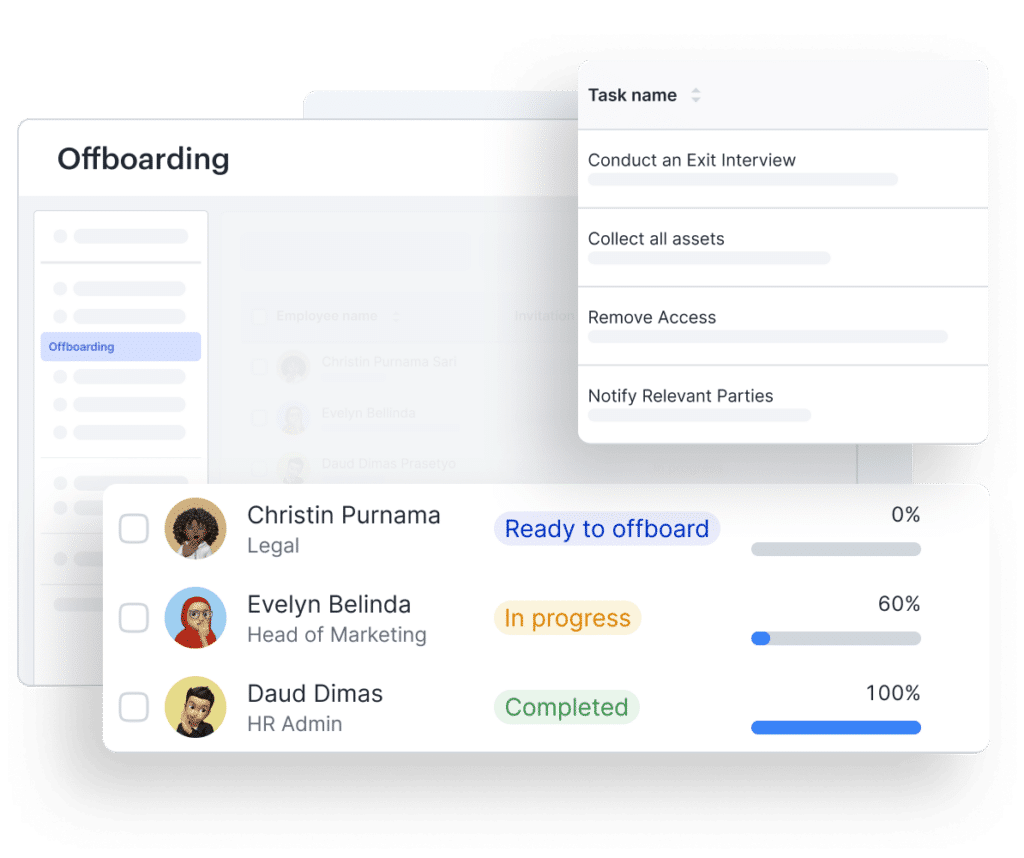
Mekari Talenta helps remove manual handovers, improve transition efficiency, and support business continuity. The same page also highlights offboarding capabilities related to asset returns, access revocation, knowledge transfer, and insights for organizational improvement.
From a practical offboarding perspective, Mekari Talenta’s value starts with workflow standardization and centralized employee data.
Mekari Talenta’s HCM positioning emphasizes an integrated approach to managing the employee lifecycle, while its onboarding and offboarding solution states that it automates administrative tasks and provides access to the information needed for better decision-making.
That kind of setup is especially useful in offboarding because it reduces dependence on scattered files, manual follow-ups, and separate department trackers.
Mekari Talenta also supports smoother execution through features that help organizations manage key offboarding control points more systematically. It supports asset return handling, access revocation, and knowledge transfer, all of which are among the most critical offboarding risks.
Mekari Talenta also promotes AI and HR analytics capabilities, including automated reports and workforce insights, which can help teams monitor HR data more efficiently and improve visibility into exit-related patterns over time.
As a result, Mekari Talenta can be viewed not only as an HR administration platform, but as an execution layer for offboarding. It helps organizations reduce manual handovers, improve coordination across stakeholders, and manage employee exits in a more structured and scalable way.
Organizations that want to standardize employee exits can explore Mekari Talenta, review its cloud-based HCM and onboarding/offboarding solution, or contact the sales team to discuss how the platform can fit their offboarding needs.
FAQ
1. What is the difference between employee offboarding and employee exit management?
1. What is the difference between employee offboarding and employee exit management?
Employee offboarding and employee exit management are closely related, but they differ in scope and structure.
Employee exit management typically refers to the administrative side of handling an employee’s departure, such as resignation processing, final payroll, and documentation. It is often reactive and focused on completing required tasks.
Employee offboarding, on the other hand, is a broader and more structured process that includes not only administrative tasks but also knowledge transfer, access control, asset management, and cross-functional coordination. It is designed to ensure a smooth transition while minimizing operational, security, and compliance risks.
In practice, exit management is a subset of offboarding, while offboarding represents a more strategic and controlled approach to employee transitions.
2. How long should an employee offboarding process take?
2. How long should an employee offboarding process take?
The duration of an offboarding process depends on the employee’s role, responsibilities, and organizational complexity.
For most roles, offboarding activities typically span the employee’s notice period, which can range from a few days to several weeks. However, critical roles—such as leadership positions or employees handling key systems or clients—may require extended transition planning and more structured handovers.
In practice, offboarding should begin as soon as the exit is confirmed and continue until all tasks are completed, including post-exit activities such as documentation and system updates. The focus should not be on speed alone, but on ensuring that all risks are addressed and transitions are properly managed.
3. What are the biggest risks if employee offboarding is poorly managed?
3. What are the biggest risks if employee offboarding is poorly managed?
Poorly managed offboarding can expose organizations to several risks across security, operations, and compliance.
One of the most critical risks is unauthorized system access, where former employees retain access to internal systems, increasing the likelihood of data breaches or misuse. Operational risks also arise when knowledge is not properly transferred, leading to disruptions, delays, or duplicated work.
Additionally, compliance risks can occur if final payroll, benefits, or documentation are not handled correctly, potentially resulting in legal disputes or penalties. Over time, these issues can accumulate and impact both financial performance and organizational reputation.
4. How can organizations ensure consistency in offboarding across multiple teams or locations?
4. How can organizations ensure consistency in offboarding across multiple teams or locations?
Consistency in offboarding becomes more challenging as organizations operate across different teams, locations, or entities. Without a structured approach, each team may follow its own process, leading to gaps and inconsistencies.
To address this, organizations should establish a standardized offboarding framework that defines core steps, responsibilities, and timelines. This framework should be supported by centralized tracking and clear ownership, while still allowing controlled flexibility for role-specific requirements.
Using a centralized system also helps ensure visibility across all stakeholders, making it easier to track progress, enforce compliance, and maintain consistency regardless of location or team structure.
5. Can employee offboarding improve retention and workforce strategy?
5. Can employee offboarding improve retention and workforce strategy?
While offboarding focuses on employee exits, it can provide valuable insights that support retention and workforce planning.
Exit interviews, when conducted properly, can reveal patterns related to employee dissatisfaction, management issues, or structural challenges within the organization. When this data is collected and analyzed consistently, it can inform improvements in areas such as employee experience, compensation, and career development.
In this way, offboarding is not just an operational process—it also serves as a feedback loop that helps organizations refine their talent strategy, reduce future attrition, and improve overall workforce effectiveness.