

What Is Learning & Development (L&D)? Example Programs & Strategy

- Modern L&D transforms corporate training from a reactive, one-off task into a strategic, forward-looking capability engine that directly drives employee engagement and long-term talent retention.
- Overcoming barriers like heavy operational workloads and unmeasurable ROI requires automated personalization, microlearning, and a centralized platform like Mekari Talenta to align employee growth with macro business goals.
Companies today are expected to adapt quickly to changing business needs, technology, and evolving workforce expectations. Consequently, modern employees are no longer looking only for financial compensation, but also for career growth and continuous skill development opportunities.
Despite this shift, many organizations still struggle to build structured learning programs that align employee capabilities with macro business goals.
To bridge this gap, learning and development (L&D) has emerged as one of the key strategic HR functions used to improve employee performance, retention, and organizational readiness.
Effective learning and development programs help companies build a more agile, skilled, and future-ready workforce while supporting long-term business growth.
What Is Learning and Development?
Learning and Development (L&D) is a strategic HR function focused on systematically improving employee skills, knowledge, competencies, and overall workplace performance.
Rather than being a reactive fix for immediate operational issues, L&D operates as a forward-looking engine that covers both short-term employee learning initiatives and long-term organizational capability development.
Modern L&D is not limited to traditional classroom training sessions. Instead, it encompasses a wide ecosystem of talent cultivation practices, including executive coaching, peer mentoring, leadership development tracks, targeted reskilling and upskilling, structured career development planning, and continuous knowledge-sharing networks.
The ultimate goal of a modern L&D department is to directly support macro business objectives, improve workforce adaptability in volatile markets, maximize employee engagement, and proactively prepare high-performing workers for future leadership roles.
To achieve this at scale, companies deliver L&D through diverse channels, such as interactive online learning, hands-on workshops, blended learning models, on-the-job training (OJT), and centralized learning management systems (LMS).
The Difference Between L&D vs. HR
Human Resources (HR) and Learning & Development (L&D) are closely related corporate functions, but they maintain fundamentally different primary focuses within employee management and organizational growth. While they share the same ultimate goal of maximizing human capital, their daily operations, scope, and metrics of success diverge.
The table below outlines the core structural differences between general HR operations and L&D specializations:
| Aspect | HR (Human Resources) | L&D (Learning & Development) |
| Main Focus | Managing the overall employee lifecycle and workplace structure. | Developing employee skills, mindsets, and behavioral capabilities. |
| Core Responsibilities | Recruitment, payroll processing, legal compliance, employee relations, and workforce administration. | Training delivery, upskilling initiatives, leadership development, and career growth tracking. |
| Primary Objective | Ensure workforce operations run effectively, safely, and compliantly. | Improve employee competency and build long-term workforce readiness. |
| Scope of Work | Broad organizational HR management and corporate governance. | Targeted employee learning and capability development. |
| Key Activities | Hiring, attendance tracking, payroll calculation, policy management, and performance administration. | Organizing workshops, coaching, mentoring, launching LMS programs, and executing skill assessments. |
| Success Metrics | Employee retention rates, regulatory compliance, and administrative operational efficiency. | Measurable skill improvement, training effectiveness, and leadership pipeline readiness. |
The core difference is that HR focuses on managing employees throughout their entire employment lifecycle from a functional standpoint, while L&D focuses on helping those employees continuously grow, improve, and prepare for future responsibilities.
In high-performing organizations, L&D does not operate in a silo; instead, it works closely with HR Business Partners (HRBPs), department managers, and senior leadership teams to align learning initiatives directly with strategic workforce planning.
For example, HR recruits and boards employees who possess the required baseline competencies for a role, while L&D takes over to help those employees strengthen and scale those competencies through structured training and development programs over time.
Why Is Learning and Development So Important?
Investing in a robust L&D strategy is no longer a corporate luxury; it has become a fundamental business necessity for organizations aiming to sustain their market position and maintain an engaged workforce.
1. Improves Employee Retention and Engagement
Employees are far more likely to stay with companies that actively invest in their professional growth and provide transparent career development opportunities.
According to the global LinkedIn Workplace Learning Report, 94% of employees state they would stay longer at a company that actively invests in their learning and development.
By building clear paths for growth, L&D directly helps increase employee motivation, improve daily job satisfaction, strengthen long-term career visibility, and cultivate a corporate culture of continuous growth.
Workers who feel supported in their professional development are generally more engaged, more productive, and deeply committed to building a long-term career within the organization.
2. Helps Companies Adapt to Changing Skills and Technology
The accelerating pace of technological innovation requires organizations to continuously reskill and upskill their workforces to remain competitive.
The World Economic Forum estimates that 44% of workers’ core skills will be disrupted due to rapid technological change and AI adoption within the next few years.
As companies undergo massive digital transformations, automation integrations, and AI adoptions, workforce expectations shift accordingly.
L&D acts as the primary tool that helps companies adapt to these evolving business needs by ensuring that employees continuously develop relevant technical capabilities and critical soft skills.
Organizations that fail to invest in proactive workforce development will inevitably struggle to keep pace with industry innovation and operational change.
3. Supports Leadership Development and Business Growth
Building a strong, sustainable internal leadership pipeline is critical for organizational longevity, robust succession planning, and long-term business scalability.
Deloitte research shows that organizations with strong, ingrained learning cultures are 92% more likely to innovate by developing entirely new products and internal processes.
L&D directly supports this corporate agility by enhancing managerial capabilities and accelerating leadership readiness across middle management.
By running targeted leadership development programs, growing companies can prepare future managers internally, drastically reducing the external recruitment costs and operational risks associated with sudden leadership gaps.
Ultimately, learning and development is not just about employee training; it is about building long-term organizational resilience, innovation capability, and a sustainable competitive advantage.
Read more: Understanding Competency Management: Guide to Workforce Development
L&D Common Challenges
Despite its recognized importance, implementing a highly effective and scalable L&D program comes with several structural and cultural challenges that HR leaders must navigate.
1. Low Employee Participation
One of the most persistent hurdles is a low rate of employee participation. Workers often struggle to allocate dedicated time for training, workshops, or online courses due to heavy daily workloads, immediate operational priorities, and pressing departmental deadlines that leave little room for professional development.
2. Difficulty Measuring Training Effectiveness
Many organizations struggle to connect their learning programs directly with quantifiable productivity improvements, employee performance upgrades, or bottom-line business outcomes. Without clear tracking metrics, calculating the exact return on investment (ROI) of L&D initiatives remains highly elusive for HR teams.
3. Limited Personalization
Generic, one-size-fits-all training programs frequently fail to engage employees because workforces are naturally composed of individuals with different baseline skill levels, unique learning styles, and entirely different career paths. When training feels irrelevant to an employee’s daily role, engagement plummets.
4. Budget and Resource Constraints
Building a world-class L&D framework requires substantial financial backing. Organizations frequently face tight limitations regarding internal trainer availability, rising learning platform subscription costs, high content development fees, and broader operational resource limitations.
5. Rapid Skill Changes
The lightning-fast evolution of modern technology and corporate business models means that highly technical training content can quickly become outdated.
HR teams often find themselves in a continuous loop of revising curriculum just to keep pace with changing industry standards. Effectively managing L&D requires moving beyond mere training delivery into continuous program evaluation, deep personalization, and tight alignment with changing business priorities.
Who Is Responsible for L&D?
A successful learning culture cannot be forced by a single department; it requires a shared responsibility and active collaboration across all layers of the organization.
HR and L&D Teams
The centralized HR and L&D specialists hold the primary operational responsibility for designing the overarching corporate learning strategy, managing corporate training budgets, selecting and monitoring digital learning platforms, evaluating high-level learning outcomes, and developing standardized competency frameworks across the enterprise.
Managers and Team Leaders
Line managers and department heads act as the crucial link on the ground. They are directly responsible for identifying real-time skill gaps within their specific teams, providing continuous coaching, supporting the execution of individual development plans, and actively encouraging employee participation by creating space in daily schedules for learning.
Employees
Ultimately, employees bear the responsibility for their own career trajectories. They must actively participate in the provided learning programs, work diligently to improve their core competencies, and proactively apply their newly acquired knowledge to elevate their daily operational output at work.
Examples of L&D Programs

To build a well-rounded workforce, modern corporations typically combine multiple types of L&D programs to target different stages of the employee lifecycle and diverse skill requirements.
1. Onboarding and Orientation Programs
A critical first step designed to seamlessly integrate new hires into the company. These structured programs help new employees quickly understand the unique company culture, daily operational workflows, internal software systems, and overarching performance expectations. Discover how to build a seamless transition through a comprehensive onboarding strategy.
2. Technical Skills Training
Focused on keeping employees sharp within their specific hard-skill domains. Examples include advanced software training, data analysis methodologies, engineering tool certifications, cybersecurity compliance protocols, and modern digital marketing strategies. Companies can explore structured execution frameworks through our guide on employee training.
3. Leadership Development Programs
Programs specifically engineered to prepare future managers, supervisors, and identified high-potential employees for advanced corporate responsibilities. These specialized tracks usually blend personal coaching, executive mentoring pairs, and strategic leadership workshops.
4. Compliance and Safety Training
Mandatory programs designed to mitigate legal risks, ensure workplace safety, and maintain regulatory standards. These are highly critical and strictly monitored in heavily regulated sectors like manufacturing, healthcare, logistics, and corporate finance.
5. Soft Skills Development
Aimed at strengthening interpersonal dynamics across the organization. Key focus areas include communication skills, cross-functional teamwork, creative problem solving, conflict management, and impactful presentation skills. Merging these distinct programs ensures that companies successfully support both immediate technical capabilities and long-term employee career growth.
The Future of L&D
The landscape of corporate learning is undergoing a major evolution, shifting toward technology-driven and hyper-personalized models that mirror modern digital behaviors.
- AI-Powered Learning: Artificial Intelligence is revolutionizing L&D by automatically creating hyper-personalized learning paths for individual users, recommending targeted training content based on role performance, and automating corporate skill gap analysis in real-time.
- Microlearning and Flexible Learning: Gone are the days of mandatory week-long seminars. The future belongs to shorter, highly accessible microlearning formats including mobile-first learning modules, brief video-based tutorials, and self-paced digital courses that employees can consume flexibly during natural breaks in their workday.
- Skills-Based Workforce Development: Progressive companies are shifting their focus away from rigid job titles and degrees, moving toward precise skill mapping, competency-based development, and fluid internal talent mobility networks that match skills directly to emerging project needs.
- Data-Driven Learning Analytics: Organizations are increasingly leveraging advanced big data analytics to move beyond basic vanity metrics. Modern dashboards track deep indicators like training completion speed, real-time competency improvements, and the direct business impact of training on team productivity. Future L&D strategies will inevitably become more personalized, technology-driven, and tightly integrated with proactive workforce planning.
Read more: Leadership & Management Development
How to Build an Effective L&D Program
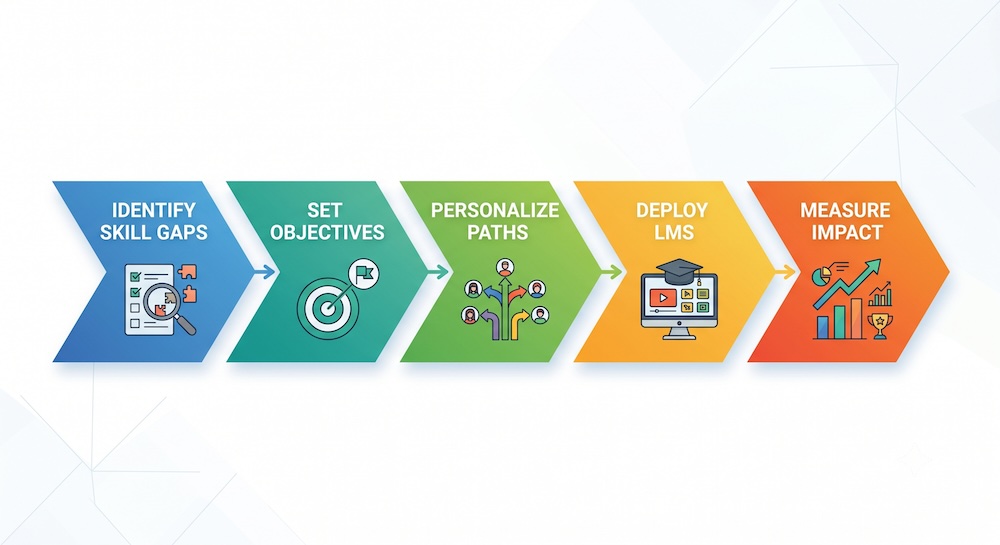
Constructing an impactful L&D program requires an intentional, step-by-step operational strategy that ensures training directly translates into enhanced business performance.
1. Identify Skills Gaps and Business Needs
The process must always begin with a thorough assessment of current employee capabilities compared against future workforce demands and macro business objectives. HR should gather this foundational data by analyzing performance reviews, running formal competency assessments, collecting direct employee feedback, and reviewing manager evaluations.
2. Create Clear Learning Objectives
Every learning program introduced must be anchored by highly measurable, specific goals. Examples of solid objectives include improving departmental leadership capabilities, increasing technical software certification rates by a specific percentage, or measurably strengthening customer service satisfaction scores. These goals must directly align with broader organizational priorities.
3. Personalize Learning Paths
To maximize engagement, HR must move away from generic curriculums and customize learning paths based on specific job roles, seniority levels, individual department needs, and the personal career aspirations of the employees. Personalization drastically improves knowledge retention and program effectiveness.
4. Use Technology and Learning Platforms
Trying to manage enterprise learning via manual sheets is highly inefficient. Companies should leverage centralized LMS platforms, digital learning tools, mobile-first applications, and blended learning systems.
A centralized technology stack allows HR to track employee progress in real-time, seamlessly manage global training schedules, monitor participation, and evaluate learning outcomes instantly.
5. Measure and Continuously Improve Programs
Finally, HR leaders must relentlessly track key performance metrics to gauge success, including training completion rates, post-training employee engagement scores, actual workplace skill improvements, direct productivity impacts, and internal promotion rates. Collecting feedback regularly ensures that the corporate L&D strategy remains relevant, agile, and impactful.
Managing Learning and Development More Efficiently with Mekari Talenta
As organizations grow, managing learning and development programs can become increasingly complex because companies must coordinate training schedules, competency frameworks, employee progress, performance evaluations, and development planning across multiple teams and locations.
However, in practice, many HR teams still face challenges such as fragmented employee data, inconsistent training records, limited visibility into skill development, and manual administrative processes that make workforce development difficult to manage efficiently.
As an integrated HCM software, Mekari Talenta helps companies manage employee learning, performance, and talent development more systematically through one centralized platform.
With Mekari Talenta, companies can:
- Conduct structured performance reviews using flexible methods such as 360° review, self-review, and supervisor evaluation.
- Track employee competencies and identify skill gaps through competency assessment features.
- Manage training programs, onboarding, certification, and learning materials through an integrated Learning Management System (LMS).
- Monitor employee development and workforce readiness through centralized HR analytics and real-time progress tracking.
- Reduce administrative complexity by integrating HR operations, attendance, payroll, performance, and employee development workflows within the broader Mekari ecosystem.
This integrated approach helps companies build learning and development processes that are more structured, measurable, and scalable while supporting long-term workforce readiness and organizational growth.
Schedule a consultation with the Mekari Talenta team to learn how integrated HR and performance management systems can help your company manage employee learning and development more effectively.
Reference:
LinkedIn Workplace Learning Report – 2025 Workplace Learning Report
Learnerbly.com – Does Your Organization Have a Learning Culture? It’s Time to Find Out
FAQ
1. What is the operational difference between upskilling and reskilling in an L&D strategy?
1. What is the operational difference between upskilling and reskilling in an L&D strategy?
While both concepts focus on capability growth, they serve different career trajectories:
-
Upskilling involves teaching an employee advanced skills to optimize their performance within their current career path. An example is training a digital marketer on advanced data analytics tools to improve campaign tracking.
-
Reskilling involves training an employee in entirely new skills to transition them into a completely different role or department. An example is retraining a manual data-entry clerk to become a junior software QA engineer because their original function has been automated.
2. How can organizations practically measure the true ROI of an L&D program beyond simple training completion rates?
2. How can organizations practically measure the true ROI of an L&D program beyond simple training completion rates?
To measure impact objectively, organizations use the Kirkpatrick Model of Training Evaluation, which scales across four levels:
-
Level 1 (Reaction): Measures how employees felt about the training via post-course surveys.
-
Level 2 (Learning): Assesses the actual knowledge acquired using pre- and post-training tests.
-
Level 3 (Behavior): Evaluates behavioral changes on the job through manager observations 30 to 90 days after training.
-
Level 4 (Results): Tracks macro business outcomes. HR calculates ROI by comparing the financial value of these Level 4 improvements (e.g., a 15% reduction in compliance penalties or a 10% increase in sales conversions) against the total cost of designing and deploying the training program.
3. What specific tactical solutions can HR implement to overcome low employee participation caused by heavy daily workloads?
3. What specific tactical solutions can HR implement to overcome low employee participation caused by heavy daily workloads?
To resolve time constraints, companies should transition from rigid, hours-long training blocks to asynchronous microlearning—delivering content in 5- to 10-minute mobile-friendly modules that fit naturally into daily gaps.
Organizations can also introduce Protected Learning Hours, such as locking two hours on Wednesday afternoons where internal meetings are banned corporate-wide. Finally, tying development completion directly to performance evaluation KPIs ensures that employees view learning as an essential requirement for career advancement rather than an optional administrative task.
4. How does a modern Learning Experience Platform (LXP) differ from a traditional Learning Management System (LMS)?
4. How does a modern Learning Experience Platform (LXP) differ from a traditional Learning Management System (LMS)?
The distinction lies in control and user experience:
-
Learning Management System (LMS): A top-down, administrative platform where HR assigns, manages, and tracks mandatory training, such as compliance, safety protocols, and company onboarding.
-
Learning Experience Platform (LXP): A bottom-up, user-centric platform that functions much like a digital streaming service. It leverages AI to analyze an employee’s role, skill gaps, and interests to recommend personalized, crowd-sourced, and external content, encouraging self-directed learning.
5. What is the standard corporate benchmark for calculating an annualized L&D budget per employee?
5. What is the standard corporate benchmark for calculating an annualized L&D budget per employee?
Corporate training budgets vary heavily by industry maturity, headcount, and growth stage. However, global enterprise benchmarks typically range from $1,000 to $1,500 per employee annually, or roughly 1% to 3% of the organization’s total payroll budget. Companies undergoing rapid digital transformations or experiencing aggressive scaling phases often lean toward the higher end of this spectrum, heavily biasing the spend toward technical upskilling and leadership pipeline acceleration.