

Understanding Competency Management: Guide to Workforce Development

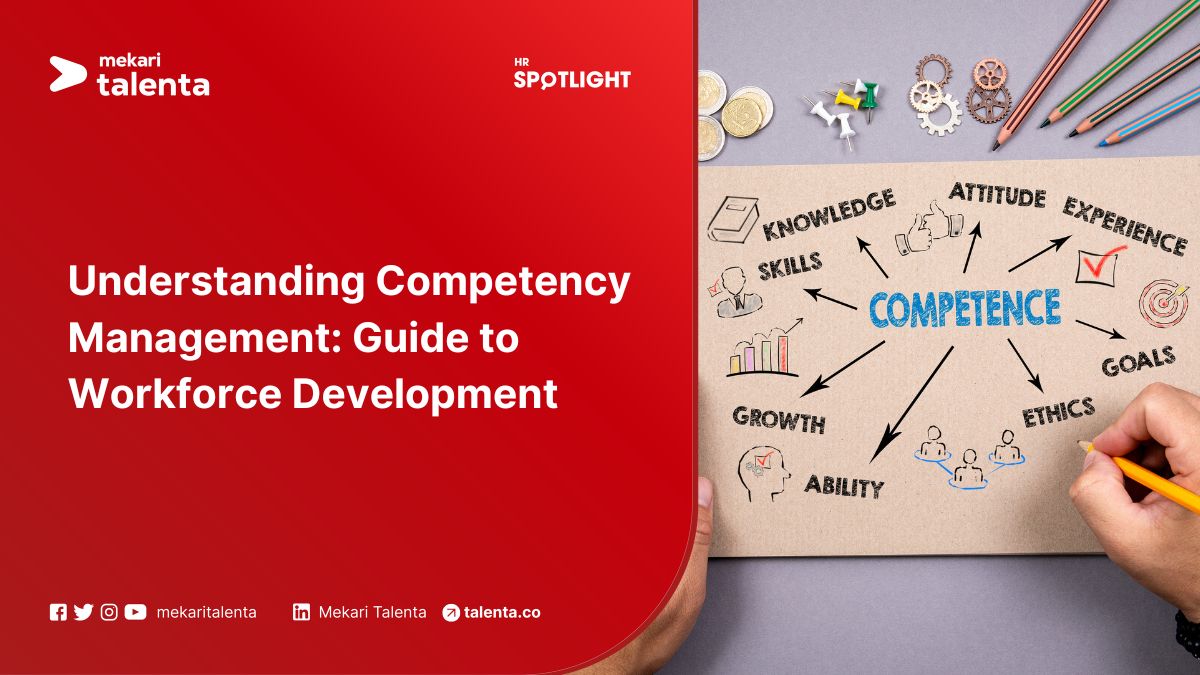
- Competency management shifts workforce development from subjective assumptions to a data-driven framework, establishing clear behavioral benchmarks that align long-term employee capabilities with strategic business goals.
- By pairing competency data with short-term KPIs on a centralized HCM platform like Mekari Talenta, organizations gain the visibility needed to systematically eliminate skill gaps and build scalable succession pipelines.
Many companies today face increasing pressure to ensure employees have the right skills and competencies to support business growth, digital transformation, and operational complexity.
As organizations grow larger and more complex, companies often struggle to maintain consistent competency standards across departments, managers, and locations.
Without a structured competency management system, companies may face expanding skill gaps, inconsistent performance expectations, ineffective development programs, and severe difficulties in workforce planning.
Competency management addresses these challenges as a strategic approach used by organizations to identify, assess, develop, and manage employee competencies in direct alignment with business objectives.
Ultimately, competency management helps companies build a more structured, data-driven, and scalable workforce development strategy while improving organizational readiness and long-term business performance.
What Is Competency Management?
Competency management is a structured approach companies use to define the capabilities employees need in order to perform effectively in their roles and support business objectives.
This methodology helps organizations answer critical operational questions such as what specific skills and behaviors are required for each role, how employee competencies should be measured, which capability gaps currently exist, and what exact development actions are needed to improve workforce readiness.
In practice, competency management is used to create standardized competency frameworks that become the foundational reference point for recruitment criteria, employee evaluation, development planning, promotion readiness, succession planning, and workforce capability mapping.
By establishing these frameworks, competency management allows companies to evaluate employees using measurable competency standards instead of subjective assumptions alone.
For example, an organization utilizing this system will explicitly state that a manager role requires leadership, strategic thinking, and decision-making competencies, while a frontline customer service role may prioritize communication, empathy, and problem resolution capability.
Read more: Leadership & Management Development
Why Is Competency Management Important?
Implementing a formalized competency system is crucial for transitioning human resource operations from a reactive support function into a proactive driver of business growth.
1. Helps Organizations Identify Skill Gaps
Companies need real-time visibility into current workforce capabilities to identify competency gaps that may affect productivity, operational performance, and long-term business growth.
Competency management directly addresses this issue by helping organizations evaluate employee capabilities, compare competency levels against immediate business requirements, identify workforce readiness issues, and prioritize development initiatives based on measurable competency data.
Without structured competency visibility, companies often struggle to determine which specific skills are missing, which teams require targeted development support, and which critical roles may become operational bottlenecks as business complexity grows.
2. Supports Workforce Planning and Business Scalability
Workforce complexity increases significantly as organizations expand across departments, branches, business units, and multiple legal entities.
Competency management helps organizations standardize capability expectations, support rapid organizational growth, improve workforce readiness, strengthen succession planning, and build stronger internal leadership pipelines.
This systematic approach guarantees tight alignment with multi-entity workforce management, operational scalability, leadership development, and long-term workforce governance.
Competency management becomes increasingly important for growing organizations because companies need consistent competency standards across teams, managers, and locations to maintain operational quality and safeguard business continuity through strategic workforce planning.
3. Improves Employee Development and Performance
Competency management helps companies create more targeted and measurable employee development plans based on structured competency assessments rather than generalized training programs.
LinkedIn’s Workplace Learning Report found that 91% of L&D professionals believe continuous learning is more important than ever for career success.
By utilizing competency baselines, organizations can focus directly on personalized development planning, short-term performance improvement, clear career progression, leadership readiness, and continuous capability development.
Competency-based development helps organizations provide more relevant learning initiatives because employees may require entirely different competencies depending on their specific role, seniority level, and business function.
This strategy helps organizations move from reactive training initiatives into more structured, scalable, and data-driven workforce capability management aligned with long-term business strategy.
Benefits of Competency Management
A well-executed competency management framework yields widespread advantages across the entire employee lifecycle, optimizing both talent retention and business output.
1. More Structured Employee Development
By mapping individual profiles against role-specific requirements, companies can design training and development programs based on actual, quantified competency gaps rather than generic educational modules.
2. Better Performance Evaluation
Competency frameworks provide an objective set of descriptors that help companies standardize performance expectations, significantly reducing subjectivity, personal bias, and inconsistency during manager evaluations.
3. Improved Succession Planning
Organizations can map out leadership pipelines systematically, making it easier to identify high-potential employees early and prepare future leaders for critical roles through proactive succession planning.
4. Stronger Workforce Agility
With clear visibility into cross-functional skills, competency management helps employees adapt more quickly to digital transformations, sudden operational changes, and evolving business market demands.
5. More Data-Driven HR Decision Making
Having centralized competency assessment data provides senior leadership with the solid evidence needed to support promotion decisions, horizontal talent mapping, future workforce planning, and organizational restructuring through a data-driven HR guide.
Competency Management Process
Establishing a functional competency system requires an ongoing, multi-stage operational lifecycle to ensure that employee capabilities continuously adapt to corporate milestones.
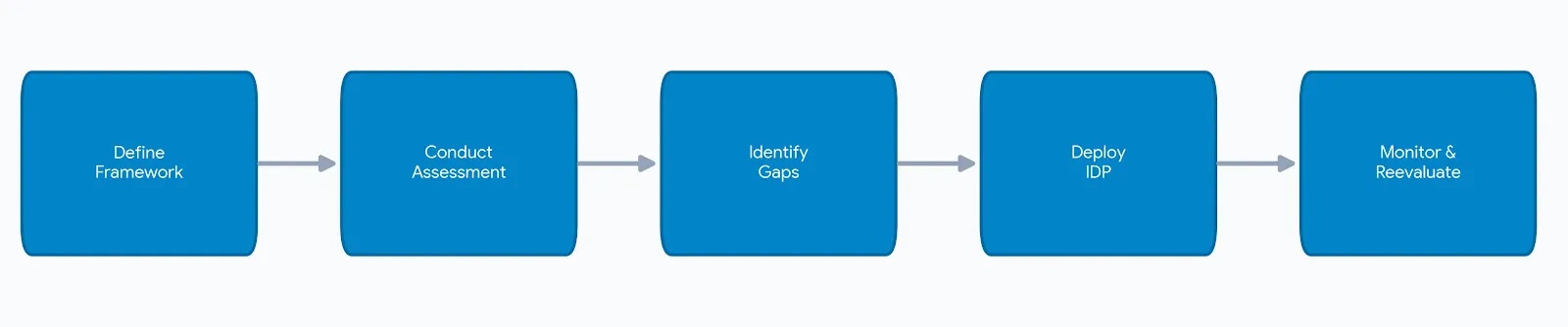
1. Define Core Competencies and Role Requirements
The process begins by identifying the unique competencies needed for each role based on day-to-day job responsibilities, overall business goals, organizational values, and operational requirements.
This involves separating foundational competencies, such as leadership capability for managers, communication skills for customer-facing roles, or specific technical capabilities for engineering and IT teams.
2. Conduct Competency Assessment
Next, HR must evaluate current employee competency levels using measurable and observable indicators. This step is typically executed through a combination of standard performance reviews, manager evaluations, self-assessments, formal competency tests, and a comprehensive 360 degree feedback mechanism to gather multi-angle performance data.
3. Identify Skill Gaps
Once the assessment phase is complete, the system automatically compares current employee competencies with expected organizational competency standards.
This cross-referencing allows HR to flag urgent development priorities, track leadership readiness gaps, and mitigate operational capability risks before they impact business revenue.
4. Develop Individual Development Plans (IDP)
Using the identified gaps, managers and HR collaborate to design a personalized individual development plan that balances employee career aspirations with corporate needs.
These plans outline specific intervention strategies, including specialized coaching, peer mentoring, targeted training programs, professional certifications, or strategic job rotations.
5. Monitor Progress and Reevaluate Competencies
The final stage demands regular tracking of competency improvements, training completion rates, behavioral performance changes, and evolving leadership readiness.
Continuous competency monitoring ensures that the workforce capability map remains accurate and adaptive as the organization grows.
Read more: What Is Learning & Development (L&D)? Example Programs & Strategy
Key Elements of Competency Management

To remain functional and scalable, an enterprise-level competency strategy must be built upon five core interconnected pillars:
- Competency Framework: The centralized matrix that defines structured competency standards, behavioral indicators, and proficiency levels for every role and organizational tier.
- Competency Assessment: The utilization of objective, measurable tools and clear rubrics to evaluate employee capability levels consistently across the organization.
- Development Planning: The creation of structured, role-specific learning journeys and training initiatives derived directly from assessment results.
- Performance Alignment: The intentional synchronization of competency expectations with operational goal-setting frameworks, such as individual KPIs and corporate OKRs.
- Workforce Analytics and Reporting: The use of centralized HR dashboards to monitor macro-level competency trends, organizational readiness, talent pipeline strength, and development progress.
Read more: Candidate Evaluation Framework
Competency Management Example
Consider a large-scale manufacturing company implementing competency management to evaluate its production floor employees. Instead of judging workers based on output volume alone, the management establishes a framework covering operational safety compliance, technical machine handling, teamwork, and problem-solving capability.
Managers conduct competency assessments using structured, observable indicators, such as machine operation accuracy, strict adherence to safety procedures during shifts, active collaboration during shift handovers, and independent troubleshooting ability when a mechanical breakdown occurs.
The outcomes of this system are clear and data-driven:
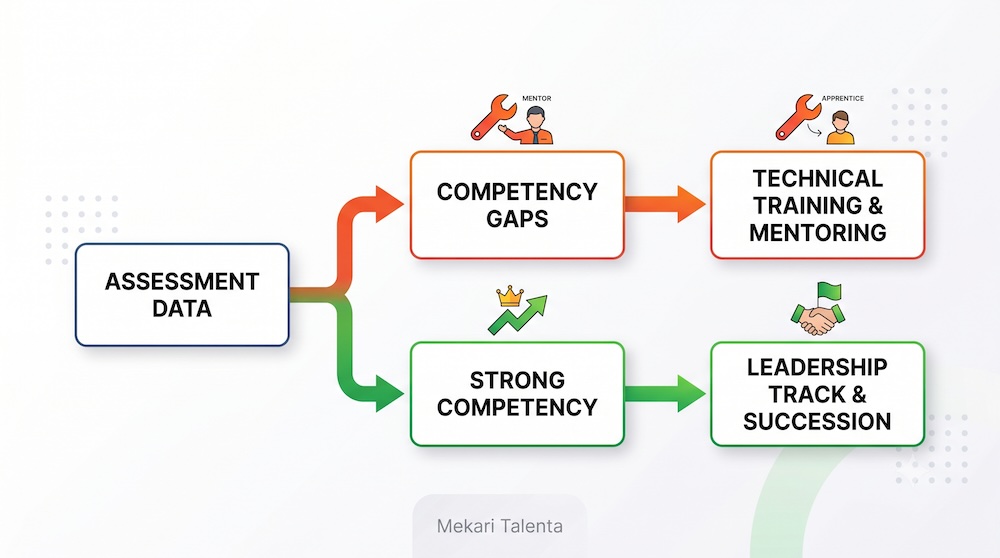
Employees who demonstrate clear competency gaps in machine handling are automatically routed to receive additional technical training, close mentoring, or safety certification programs.
Meanwhile, employees who score exceptionally high across teamwork and troubleshooting indicators are flagged by HR as high-potential talent, ensuring they are fast-tracked into leadership development programs, mapped into succession planning, and prioritized for upcoming promotion considerations.
This approach allows the company to make workforce development decisions based on measurable capability data instead of subjective assumptions.
Competency Management vs Performance Management
While competency management and performance management are closely related and share a digital ecosystem, they focus on entirely different dimensions of workforce evaluation.
Companies achieve the best results by using both systems together. Organizations must evaluate not only what employees achieve in the short term, but also whether the workforce possesses the underlying capabilities required to support long-term business growth and operational readiness.
The table below outlines the core functional differences between the two methodologies:
| Evaluation Aspect | Competency Management | Performance Management |
| Main Focus | Employee capability and long-term role readiness. | Employee execution and immediate business results. |
| What Is Evaluated | Skills, behavioral indicators, knowledge, and attributes. | KPI achievements, productivity metrics, and target completion. |
| Primary Objective | Develop long-term workforce capability and agility. | Measure and optimize short-term work performance. |
| Practical Examples | Leadership behaviors, negotiation skills, technical competency. | Sales target achievement, project delivery, operational output. |
| Main Use Cases | Development planning, succession planning, talent mapping. | Annual performance appraisal, salary review, bonus calibration. |
| Key Outcome | Workforce readiness and sustainable capability growth. | Immediate business performance and operational improvement. |
The core difference is that competency management focuses on whether employees have the capabilities required to perform effectively and grow within the organization, while performance management focuses on measuring how well employees achieve specific business targets and operational objectives.
Combining competency management with a robust KPI system creates a more balanced, holistic, and data-driven workforce management approach.
For instance, while a KPI system measures whether a sales employee achieves their quarterly revenue targets, competency management evaluates the underlying communication skills, negotiation ability, and customer relationship management capabilities that make that achievement repeatable.
Tips for Successful Competency Management
Building a scalable competency framework requires careful planning and a strong focus on objectivity to ensure long-term adoption across departments.
1. Define Competencies Clearly and Specifically
HR must ensure that every single competency indicator is measurable, observable, role-specific, and aligned with business objectives. Avoid overly generic or vague descriptors such as “has a good attitude” or “possesses a strong personality,” as these cannot be evaluated objectively.
Instead, utilize concrete behavioral descriptions like “consistently provides detailed daily project updates” or “independently resolves client complaints according to corporate protocols.”
2. Align Competency Frameworks with Business Needs
A competency framework cannot be designed in a vacuum; it must directly support your organization’s operational complexity, workforce scalability, and geographic expansion plans.
Ensure that the capability expectations built into the system directly feed into your future leadership readiness tracks and macro workforce planning strategies to support corporate governance.
3. Use Consistent Assessment Standards
To eliminate bias, standardise the competency evaluation process across all managers, teams, branches, and separate business entities. This consistency is achieved by publishing clear evaluation guidelines, implementing structured scoring systems, and conducting regular calibration reviews among leadership teams before finalizing scores.
4. Combine Competency Data with Performance Data
Integrate your competency assessment data directly with your short-term performance metrics, including OKR achievements and historical appraisals.
Merging these datasets provides a comprehensive workforce insight that helps companies make accurate promotion decisions, optimize talent mapping, and prioritize development budgets effectively.
5. Use Technology to Centralize Competency Management
Relying on manual tracking sheet systems or disconnected tools slows down operations and fragments data. Implementing an integrated HR system allows companies to centralize competency records, monitor real-time development progress, automate analytical reporting, and achieve total workforce visibility from a single location.
Managing Competency Management More Efficiently with Mekari Talenta
As organizations grow, competency management can become increasingly complex because companies must manage competency frameworks, employee assessments, development planning, performance reviews, and workforce visibility across multiple teams, managers, and locations.
In practice, many HR teams still struggle with inconsistent competency assessments, fragmented workforce data, manual evaluation processes, and limited visibility into employee capability development.
These challenges often make workforce planning and talent development difficult to manage consistently at scale.
As an integrated HCM software, Mekari Talenta helps companies manage competency management more systematically through integrated Performance Management, Talent Management, and Learning Management System (LMS) capabilities within one centralized platform.
To make competency management more effective, organizations typically rely on HCM platforms such as Mekari Talenta.
Through its Talent Management feature, HR teams can formalize competency development plans by defining clear objectives, assigning actionable development initiatives, and monitoring employee progress within a centralized system.
With Mekari Talenta, companies can:
- Centralize employee competency data and workforce development processes within one integrated platform.
- Conduct structured competency assessments to identify capability gaps more consistently.
- Create and monitor employee development plans based on competency evaluation results.
- Support talent mapping and succession planning through competency-based workforce insights.
- Improve workforce visibility and decision-making using centralized talent analytics and performance data.
This integrated approach helps organizations build competency management processes that are more structured, measurable, scalable, and aligned with long-term workforce readiness and business growth.
Schedule a consultation with the Mekari Talenta team to learn how integrated talent development and competency management systems can help your company improve workforce capability development more effectively and consistently.
Reference:
Tech Class – Smart Succession Planning
LearnExperts – Workplace Learning Report 2025
FAQ
1. How should HR handle a situation where an employee consistently meets all short-term performance targets (KPIs) but scores poorly on core role competencies?
1. How should HR handle a situation where an employee consistently meets all short-term performance targets (KPIs) but scores poorly on core role competencies?
This scenario represents a misalignment between “what” is achieved and “how” it is achieved. HR should decouple short-term financial rewards from long-term career progression. While the employee may qualify for performance-based bonuses based on their KPIs, they should be restricted from promotions or leadership tracks until their competency gaps are resolved. HR and the line manager must place this employee on a targeted Individual Development Plan (IDP) focusing on behavioral coaching, making it clear that sustained career growth within the organization requires meeting both performance and competency standards.
2. What practical steps can HR take to minimize manager and employee resistance when launching a new competency framework?
2. What practical steps can HR take to minimize manager and employee resistance when launching a new competency framework?
Resistance usually occurs because stakeholders view competency management as an added administrative burden or a subjective disciplinary tool. To counter this, HR should employ a bottom-up change management strategy. First, involve line managers directly in workshops to co-create and validate the behavioral indicators for their respective teams, ensuring immediate buy-in. Second, run a pilot program within a single, highly collaborative department to demonstrate success and refine the workflow. Finally, position the rollout strictly as a career development and growth transparency initiative rather than a punitive evaluation tool.
3. How are proficiency levels (e.g., Basic, Intermediate, Advanced) structurally defined within a competency framework to avoid overlap?
3. How are proficiency levels (e.g., Basic, Intermediate, Advanced) structurally defined within a competency framework to avoid overlap?
Proficiency levels must be structured using a matrix of increasing behavioral complexity, autonomy, and scope of impact. For example, a Basic level should describe an employee who performs a skill under direct supervision or in routine situations. An Intermediate level implies independent execution and the ability to handle standard variations in workflow. An Advanced level requires the employee to solve highly complex, non-routine problems and actively mentor or train others. HR must ensure that each tier uses distinct, progressive action verbs (e.g., assists vs. executes vs. authorizes) to eliminate ambiguity during assessments.
4. Who holds the final authority during a competency calibration review if a line manager and HR disagree on an employee's capability score?
4. Who holds the final authority during a competency calibration review if a line manager and HR disagree on an employee's capability score?
The primary ownership of the score remains with the line manager, as they observe the employee’s behavior on a daily basis. However, HR (specifically the HR Business Partner) serves as the governance facilitator during calibration. HR’s role is to challenge scores that deviate from historical performance data or show signs of manager bias (such as halo or leniency effects). If an impasse is reached, the decision is escalated to the department head or senior leadership of that specific business unit, who will provide the final sign-off based on the consensus guidelines established by HR.
5. What is the ideal governance cycle for auditing and updating a corporate competency dictionary to ensure it remains relevant?
5. What is the ideal governance cycle for auditing and updating a corporate competency dictionary to ensure it remains relevant?
An enterprise competency dictionary should not be static, but updating it too frequently creates administrative chaos. The ideal governance model is a rolling review conducted every 2 to 3 years to align with changing macro business strategies. However, immediate, out-of-cycle micro-updates should be triggered when a specific department undergoes major digital transformation, when generative AI or automation fundamentally alters a job function’s daily execution, or when the company enters a completely new regional market with unique operational compliance requirements.