

Candidate Evaluation Framework: Build Fair and Scalable Hiring


- Structured evaluation reduces bias. A candidate evaluation framework helps teams assess candidates more fairly using clear criteria and scoring.
- Consistency improves hiring quality. Standardized interviews, assessments, and decision rules make candidate comparison more objective.
- Technology helps scale the process. Integrated systems like Mekari Talenta support faster, more consistent, and data-driven hiring.
Candidate evaluation is becoming more complex as organizations hire across multiple entities, functions, and workforce generations, making consistency harder to maintain from one interview process to the next. When evaluation lacks structure, hiring decisions often drift toward interviewer instinct instead of job-related evidence.
That risk is not theoretical: 68% of hiring managers say their decisions are influenced by factors unrelated to job performance, according to the 2023 Workplace Equality Index.
The result is familiar across many companies: hiring bias, inconsistent scoring between interviewers, and difficulty comparing candidates fairly, especially at scale. A structured, scalable, and data-driven candidate evaluation framework is therefore no longer optional, but essential for improving hiring quality and decision consistency.
What is a candidate evaluation framework?
A candidate evaluation framework is a structured system used to assess job applicants against predefined criteria, evaluation methods, scoring standards, and decision rules.
In practice, it helps hiring teams judge candidates based on the competencies, behaviors, and qualifications that are actually relevant to performance in the role, rather than on vague impressions or personal preference.
Structured approaches matter because they standardize how candidates are assessed, making the process more equitable and more defensible.
Its core function is not only to support objective evaluation, but also to make fair comparison possible across different candidates, interviewers, and hiring stages. A strong framework improves hiring quality by ensuring that the same standards are applied consistently, even when recruitment volume is high or organizational structures are complex.
For that reason, a candidate evaluation framework should not be treated as a simple checklist. It is a complete decision-making structure that combines job-relevant criteria, assessment methods, scoring logic, and hiring rules so organizations can evaluate talent more fairly and more reliably at scale.
Read more: A Comprehensive Guide to Manpower Planning
Core components of an effective candidate evaluation framework

1. Evaluation criteria
Every effective candidate evaluation framework starts with clearly defined evaluation criteria before the hiring process begins. If the criteria are unclear, interviewers tend to rely on instinct, first impressions, or personal preference, which makes the process less reliable.
A structured framework solves this by defining in advance what matters most for success in the role and then using those standards consistently throughout the process.
Structured interviewing works best when employers define the key competencies first and build interview questions around them.
These criteria should usually cover technical skills, behavioral competencies, and cultural or team-fit considerations. For example, a sales role may prioritize communication, negotiation, resilience, and coachability because those traits directly affect pipeline building and deal conversion.
A technical role may place greater emphasis on coding ability, problem-solving, debugging, and systems thinking. Leadership roles may require stronger focus on judgment, collaboration, stakeholder management, and adaptability.
The core principle is that criteria should be role-specific and job-related, not improvised midway through the process. Selection procedures should be job-related and appropriate for the employer’s purpose.
Without clearly defined criteria, evaluation quickly becomes subjective and inconsistent. One interviewer may prioritize technical expertise, another may focus on communication style, and another may be influenced by personality even when it is not the strongest predictor of job performance.
That makes it harder to compare candidates fairly and increases the risk of poor hiring decisions. A framework creates alignment by ensuring that the hiring team is evaluating the same capabilities for the same reason.
2. Evaluation methods
A strong framework should never rely on only one evaluation method. No single interview or assessment can capture everything an organization needs to know about a candidate.
Different methods reveal different dimensions of potential, which is why a stronger process combines multiple forms of evidence instead of treating one conversation as the final source of truth.
There is a range of job-related selection procedures, including cognitive tests, work samples, simulations, and other assessments, as long as they are used appropriately.
Technical tests or work samples are especially useful for engineering, design, data, content, and other specialist roles where the output can be observed directly.
Behavioral or cognitive assessments are often more suitable for analytical, planning, and problem-solving roles where reasoning and decision quality matter.
Cultural fit or culture-add assessments are often relevant for leadership and collaborative roles, where communication style, values alignment, and working approach influence long-term success.
In practice, a software engineer might complete a coding exercise and a structured behavioral interview, while a sales candidate may go through a role-play, objection-handling scenario, and communication assessment.
Combining methods improves accuracy because it reduces over-reliance on one performance moment and allows hiring teams to evaluate candidates from multiple angles.
3. Standardized scoring system
A standardized scoring system is what turns interviews into a consistent decision-making process. Once the organization has defined the evaluation criteria and selected the right methods, candidates should be assessed using structured scoring templates and evidence-based feedback.
Interview questions should be linked to specific candidate attributes so hiring teams can make evidence-based decisions rather than rely on general impressions.
A strong scorecard usually includes the role or interview stage, the competencies being assessed, a rating scale, interviewer comments, and a final recommendation.
This structure helps interviewers explain not only what score they gave, but also why they gave it. Without standardized scoring, it becomes difficult to compare candidates objectively because each interviewer may apply a different logic or threshold.
That problem becomes even more serious in organizations with multiple interviewers across different departments or entities.
Greenhouse’s analysis of around 10.3 million scorecards found that using focused attributes was associated with interview-scorecard comparability that was 31 percent to 38 percent higher, showing how standardization can materially improve consistency.
4. Decision guidelines
Even the best criteria and scorecards are not enough if the organization has no clear rules for making the final decision. A strong framework should define who has final decision authority, how feedback from multiple interviewers is combined, and how conflicting evaluations are resolved.
Without these guidelines, hiring decisions can become inconsistent, overly influenced by the loudest voice in the room, or shaped by hierarchy instead of evidence.
It is important to clearly define scorecards and interview plans so the hiring team is aligned on how feedback will be collected and used.
This becomes especially important in large, cross-functional teams where recruiters, hiring managers, panel interviewers, and business stakeholders may all assess the same candidate from different angles.
Different perspectives can improve hiring quality, but only if there is a clear decision process that brings those perspectives together in a disciplined way.
Otherwise, disagreement creates confusion rather than better judgment. Decision guidelines help turn multiple viewpoints into a more balanced and defensible hiring outcome.
5. Structured interviews
Structured interviews are one of the most important components of a strong candidate evaluation framework. In a structured interview process, all candidates are asked the same core questions for the same competencies, and their responses are evaluated using the same criteria and scoring logic.
Structured interviews standardize questions around job-related competencies, making it easier to assess candidates more consistently and equitably.
The benefits are significant. Structured interviews make fair comparison easier, reduce interviewer bias, and keep the discussion focused on evidence that is relevant to job performance.
They also improve evaluation quality because interviewers are collecting similar information from every candidate at the same stage of the process.
In other words, structured interviews do not just create more order. They create a better foundation for making stronger hiring decisions at scale.
Read more: Employer Branding Stragegy Guide for Scaling Talent Acquisition
Common challenges in implementing a candidate evaluation framework

1. Inconsistency across interviewers
One of the most common implementation challenges is inconsistency across interviewers. Large organizations often involve multiple interviewers with different habits, standards, and interpretations of what a strong candidate looks like.
Without clear alignment, the same candidate may receive very different evaluations depending on who conducted the interview.
This weakens both hiring quality and decision accuracy. Scorecard comparability tends to decline as the number of interviewers and scorecards increases, which shows why consistency becomes harder at scale.
2. Lack of standardization across entities
Multi-entity organizations often face another challenge: different business units or subsidiaries may use different hiring practices, interview formats, and decision rules.
That makes it difficult to implement one unified framework across the organization. The result is often a fragmented evaluation process where fairness and quality standards vary by team, geography, or legal entity.
Over time, that fragmentation makes it harder to compare outcomes and harder to improve the hiring system as a whole.
3. High volume of candidates
High candidate volume also puts pressure on evaluation quality. When recruiters and hiring teams are reviewing large pipelines, manual processes quickly become difficult to sustain.
Interview feedback may become rushed, scorecards may be incomplete, and decisions may be made too quickly simply to keep the process moving.
This creates more room for inconsistency and bias, especially when interviewers are under time pressure. Structured hiring systems are valuable partly because they reduce the burden of making repeated decisions without a clear framework.
4. Bias and subjectivity
Bias remains a major challenge even when organizations have a partial framework in place. Several common forms of hiring bias include affinity bias, confirmation bias, attribution bias, and bias related to gender, ethnicity, age, and cultural background.
Affinity bias is especially common when interviewers favor candidates who feel familiar or similar to themselves, while age bias can influence assumptions about adaptability, ambition, or long-term fit.
These biases can reduce both diversity and quality of hire by shifting attention away from actual role-related capability.
5. Lack of data and visibility
Many organizations still do not have structured evaluation data that can be reviewed, compared, and improved over time. When feedback is scattered across notes, spreadsheets, emails, or informal conversations, leaders cannot easily see whether interviewers are using the same standards or whether the framework is actually improving hiring outcomes.
That lack of visibility makes continuous improvement difficult. Structured scorecards, centralized records, and evidence-based feedback are therefore essential, not only for immediate hiring decisions, but also for long-term evaluation of hiring quality and process effectiveness.
Read more: Recruitment Strategies for Multi-Generational Workforces
What makes an effective candidate evaluation framework
1. Standardized but flexible
An effective candidate evaluation framework needs to be standardized enough to create consistency, but flexible enough to reflect the realities of different roles. The purpose of standardization is to ensure that candidates are evaluated against the same core logic rather than each interviewer’s personal preference.
At the same time, a framework that is too rigid can become less useful because it ignores differences in job context, seniority, and function.
Therefore, strong frameworks use the same structure across the organization while allowing role-specific criteria, interview questions, and assessments where needed.
2. Role-based and competency-driven
A strong framework should always be built around the actual requirements of the role. That means evaluation should be based on clearly mapped competencies, not generic impressions of whether someone seems capable or likable.
Competency mapping helps organizations define what success looks like in practical terms, whether that involves technical expertise, problem-solving, stakeholder management, communication, or leadership potential.
When the framework is role-based and competency-driven, the hiring process becomes more job-relevant, more defensible, and more likely to identify candidates who can perform well after hire.
3. Scalable for large organizations
Scalability is another core requirement, especially for organizations operating across multiple entities, business units, or locations. A framework may work well for one hiring team, but if it cannot be applied consistently across a larger organization, it loses much of its value.
Large businesses need evaluation systems that can support multiple interviewers, high candidate volume, and more complex approval structures without sacrificing fairness or visibility.
In that sense, scalability is not just about handling more candidates. It is about preserving evaluation quality as hiring complexity increases.
4. Data-driven and measurable
An effective framework also has to be data-driven and measurable. Hiring decisions should be supported by evidence collected during interviews, assessments, and scorecards rather than by intuition alone.
That includes structured scoring, written justification, and clear visibility into how each candidate performed against the defined criteria.
A measurable framework makes it easier to compare candidates objectively, review interviewer consistency, and improve hiring practices over time.
Without data, organizations may still believe they are hiring fairly, but they have little proof and even less ability to refine the process.
5. Integrated with recruitment process
Finally, a candidate evaluation framework is only effective when it is embedded directly into the recruitment process. A framework that exists as a separate document or disconnected policy is difficult to enforce in day-to-day hiring.
It becomes much more effective when the criteria, scoring, interview stages, and decision rules are integrated into the actual system recruiters and hiring managers use.
That is what allows evaluation to remain consistent from sourcing to screening, interview, and final decision, rather than breaking down at each stage.
Read more: Employee Master Data: Definition, Benefits, and Best Practices for HR
Optimize candidate evaluation with the right recruitment system
Candidate evaluation becomes significantly more difficult as organizations grow. High-volume hiring, multiple interviewers, and multi-entity structures all increase the risk that evaluation will become uneven from one team or stage to another.
Even when a company already has a framework on paper, the process often becomes inconsistent in practice because candidate information is spread across fragmented tools, scoring is handled manually, and visibility across the pipeline is limited.
In those conditions, it becomes harder to compare candidates fairly and harder to maintain the same hiring standard across the organization.
That is why a candidate evaluation framework only reaches its full value when it is supported by a recruitment strategy that can standardize, track, and scale the evaluation process.
Mekari Talenta Advanced Recruitment is positioned as an end-to-end recruitment platform that centralizes job postings, candidate pipelines, interview workflows, and recruitment reporting in one system.
Its official recruitment page says the platform helps HR teams manage job postings, AI candidate screening, and hiring pipelines in one centralized dashboard, while also supporting organizations with complex hiring needs, including multiple departments, locations, or high recruitment volumes.
From an evaluation perspective, several capabilities are particularly relevant. Mekari Talenta Advanced Recruitment includes AI Candidate Scoring based on candidate profile and skills, and its public documentation says the system analyzes experience, skills, and job requirements to help recruiters identify suitable applicants faster and rank candidates by their level of match with the job criteria.
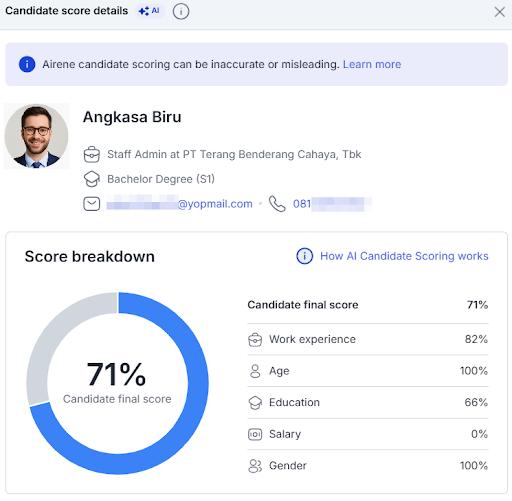
The same platform also provides a centralized candidate dashboard, stage-based pipeline tracking, interview invitations sent directly from the dashboard, MBTI assessment delivery with instant results, automatic rejection emails based on minimum score, and filtering by education, experience, and skills.
The practical value of this kind of system is clear. It helps organizations maintain more consistent and evidence-based evaluation across interviewers and entities, reduces manual effort in screening and pipeline management, and makes it easier to handle large candidate volumes without sacrificing quality.
When candidate evaluation is supported by centralized workflows, structured scoring logic, and recruitment reporting, hiring teams can move faster while still making more reliable decisions.
Organizations that want to standardize and optimize their candidate evaluation process can explore Mekari Talenta, learn more about Mekari Talenta Advanced Recruitment, or contact the sales team to discuss their hiring needs and request a consultation.