





- Mass hiring is the process of recruiting and onboarding large numbers of employees within a short timeframe, typically to support business expansion, seasonal demand, or operational scaling.
- To build scalable mass hiring processes, companies should combine workforce planning, recruitment automation, structured screening, and centralized analytics to maintain hiring speed and candidate quality at scale.
When a business expands rapidly, like opening new locations, launching a new product line, scaling operations into a new market, the pressure to hire hundreds or thousands of people within a compressed window becomes one of the most operationally demanding challenges HR leaders face.
Mass hiring at the enterprise level is not simply “regular recruitment done faster.” It is a fundamentally different discipline with different failure modes, different metrics, and a different infrastructure requirement.
And yet, most organizations still approach it using systems and processes that were built for individual, role-by-role hiring.
The result is predictable, from delayed onboarding, inconsistent candidate quality, burned-out HR teams, and spiraling per-hire costs that quietly drain workforce budget, all while the business waits for the headcount it urgently needs.
This guide is built for HR leaders, CHROs, and talent acquisition teams who are either actively running high-volume hiring programs or preparing for one.
It covers what mass hiring truly requires, where conventional approaches break down, the structural pillars of a scalable system, and how to build a recruitment operation capable of delivering quality at speed.
What Is Mass Hiring?
Mass hiring (also referred to as high-volume recruitment or bulk hiring) is the process of recruiting and onboarding a large number of employees within a defined, often compressed, timeframe.
While the threshold varies by organizational context, mass hiring generally begins when a company needs to fill 50 or more positions simultaneously, though enterprise campaigns routinely involve hundreds or thousands of hires across multiple business units.
The Difference Between Mass Hiring and Standard Recruitment
Standard employee recruitment is optimized for depth: a small number of open roles, extensive interviewing, careful deliberation.
Mass hiring flips this logic. The challenge shifts from evaluating a handful of candidates in detail to efficiently processing thousands of applicants while still maintaining quality thresholds and a positive candidate experience.
| Aspect | Standard Recruitment | Mass Hiring |
|---|---|---|
| Hiring Volume | Small number of open roles | Hundreds or thousands of positions |
| Recruitment Focus | Deep candidate evaluation | Speed and scalability |
| Screening Process | Manual and detailed | Structured and automated |
| Interview Approach | Extensive interviews and deliberation | Standardized, high-volume evaluation |
| Main Challenge | Finding the best-fit candidate | Managing large applicant volumes efficiently |
| Recruitment Workflow | Suitable for low hiring demand | Requires scalable systems and automation |
| Data Complexity | Limited candidate data | High-volume recruitment data and reporting |
| Coordination Needs | Minimal cross-team coordination | Complex coordination across recruiters, hiring managers, and business units |
| Candidate Experience Risk | Easier to personalize | Difficult to maintain consistently at scale |
This distinction has meaningful consequences for process design. A recruitment workflow that works for 10 hires per month may collapse entirely when asked to handle 500.
The bottlenecks are different, the data volumes are different, and the coordination overhead across hiring managers, HR teams, and interviewers becomes exponentially more complex.
When Do Companies Typically Need Mass Hiring?
Mass hiring typically arises in response to predictable business triggers: seasonal demand surges, new facility openings, geographic expansion, product launches, mergers and acquisitions, or large contract wins that require immediate workforce scale-up.
Some industries like logistics, retail, manufacturing, hospitality, financial services, and technology, experience these pressures cyclically or as a consequence of aggressive growth.
For enterprises with operations across multiple regions or entities, the complexity multiplies further. Different locations may have varying compliance requirements, different hiring manager workflows, and different candidate sourcing needs, all of which must feed into a centralized reporting and control structure.
Read also: Cross-Border Hiring: A Strategic Guide for Global Talent Acquisition
The ROI Case for Getting Mass Hiring Right
Mass hiring is a significant financial event. Companies that run high-volume recruitment programs without the right infrastructure carry substantial hidden costs that rarely show up in a single budget line but compound quietly across the talent lifecycle.
1. The True Cost of a Poor Hire in High-Volume Context
This means that in high-volume hiring environments, even small increases in poor-hire rates can create substantial financial exposure at scale.
The financial impact becomes even more significant when poor hiring decisions lead to high turnover.
In high-volume environments, where turnover often happens at scale rather than in isolated cases, repeated rplacement cycles can quickly inflate operational costs, disrupt workforce stability, and place additional pressure on recruitment teams to continuously refill the same positions.
2. Speed-to-Productivity as a Revenue Driver
Every unfilled position in a revenue-generating or operations-critical role represents a direct drag on output.
In logistics and manufacturing contexts, staffing gaps translate directly to missed shipment targets, slower production lines, or reduced service capacity. In customer-facing roles, understaffing degrades service quality and retention.
In high-volume hiring, the ability to identify and onboard stronger candidates faster — even if only by two to three weks — produces compounding output gains at scale.
3. Brand and Candidate Experience as a Competitive Lever
In mass hiring contexts, where thousands of applicants pass through a process simultaneously, the candidate experience is both highly visible and highly replicable, positively or negatively.
Organizations that deliver structured, responsive, and respectful high-volume hiring experiences build employer brand equity that reduces future sourcing costs and increases offer acceptance rates.
The inverse also holds: a chaotic, poorly communicated bulk hiring process generates social media complaints, Glassdoor reviews, and long-term brand damage that is difficult and expensive to repair.
The Breaking Point: Why Traditional Recruitment Fails at Scale
Most mass recruitment processes were not designed for volume. They were designed for deliberation. When organizations try to apply standard recruitment workflows to mass hiring without modification, they encounter predictable, structural failure points.
1. Manual Processes Cannot Handle Application Volumes
A standard ATS configured for individual role hiring may process dozens of applications per opening. A mass hiring campaign may generate thousands.
Without automated screening, scoring, and routing, the manual overhead falls entirely on recruiters.
It creates bottlenecks, slowing response times, and ultimately causing qualified candidates to drop out of the process out of frustration.
Organizations that cannot move fast in high-volume contexts systematically lose their strongest applicants to competitors who can.
2. Inconsistent Evaluation Creates Quality Problems
When hiring at scale without structured screening criteria, evaluation quality degrades rapidly. Different interviewers apply different standards.
Screening conversations focus on different attributes. Hiring managers make decisions based on gut feel rather than validated competency signals.
The result is high variance in hire quality — which, at enterprise scale, translates into significant downstream costs across training, performance management, and turnover.
3. Siloed Data Prevents Real-Time Decision Making
In traditional recruitment setups, data lives in disconnected spreadsheets, email threads, and multiple recruitment portals.
HR teams struggle to answer basic questions in real time: How many applications have been received? What is the current conversion rate at each pipeline stage? Which sourcing channels are producing the strongest candidates? How many positions remain unfilled versus target?
This data fragmentation forces reactive management rather than proactive optimization. Problems are identified weeks after they emerge, when the cost of correction is highest.
4. Poor Candidate Communication Accelerates Drop-Off
In mass hiring campaigns, candidates frequently move through a process with minimal communication.
They submit an application and hear nothing. They complete an assessment and receive no acknowledgment. They attend an interview and wait days for feedback. At each of these silence points, a portion of the candidate pool disengages and accepts alternative offers.
In mass hiring, where application volumes are high and HR capacity is stretched, communication quality is often the first thing to deteriorate.
5. Disconnected Onboarding Breaks the Hiring Investment
Even when mass recruitment succeeds in filling positions, the value often erodes at onboarding.
New hires who complete paperwork manually, wait days for system access, or receive inconsistent orientation experiences are more likely to disengage in their first 90 days.
For companies that have invested significantly in recruiting 500 or 1,000 new employees, losing 20% in the first year due to broken onboarding processes represents a direct and measurable loss on the hiring investment.
Read also: Pre-Employment Background Checks: Everything You Need to Know
The 3 Pillars of High-Volume Recruitment Infrastructure
Organizations that execute mass hiring effectively do not simply work harder. They build different infrastructure. Across industries and geographies, scalable high-volume recruitment programs share three foundational pillars that distinguish them from organizations that struggle at scale.
Pillar 1: Centralized, Automated Candidate Pipeline Management
The first pillar is a centralized applicant tracking system (ATS) capable of handling high application volumes with automated intake, scoring, and routing.
This means a single platform that aggregates applications from all sourcing channels — job boards, social platforms, the company’s own career site, employee referrals — into one structured pipeline.
Automation within this pillar handles the most time-consuming low-value tasks: sending acknowledgment communications, routing applications to the correct pipeline stage, flagging candidates who meet minimum qualifications, and generating recruiter task lists.
This frees HR capacity for the work that requires human judgment: interviewing, assessing cultural fit, negotiating offers, and building relationships with high-priority candidates.
The business impact of centralized automation at this level is substantial.
Pillar 2: AI-Assisted Screening and Candidate Scoring
The second pillar is AI-powered screening that replaces manual CV review with automated, criteria-based candidate scoring.
In a mass hiring campaign receiving 5,000 applications for 200 positions, no recruiting team has the capacity to manually review each CV.
AI screening closes this gap by evaluating candidates against configurable criteria — education, experience level, relevant skills, location — and surfacing a ranked shortlist for human review.
This is not about removing human judgment from hiring; it is about applying human judgment where it creates the most value.
Recruiters who are freed from reviewing 4,500 clearly unqualified applications can spend their time engaging with the top 500 in depth, resulting in both a better candidate experience and higher conversion rates.
AI screening also enables consistent application of evaluation criteria across large candidate pools, reducing the variance that leads to poor hire quality in unstructured high-volume processes.
The key is configuring scoring criteria carefully and auditing outcomes regularly to ensure the system is surfacing quality rather than filtering it out.
Pillar 3: Integrated Reporting and Real-Time Analytics
The third pillar is a live reporting and analytics layer that gives HR leaders and talent acquisition managers real-time visibility into pipeline health, conversion rates, time-to-hire, and sourcing channel performance.
Without this visibility, mass hiring programs operate in the dark — problems go undetected until they become crises.
Real-time dashboards enable proactive intervention: if a specific sourcing channel is generating a high volume of applications but a low percentage of qualified candidates, the channel strategy can be adjusted mid-campaign.
If one business unit’s pipeline is moving more slowly than others, additional recruiter capacity can be reallocated. If offer acceptance rates are declining, compensation benchmarks or offer timing can be reviewed before the trend worsens.
A Practical Guide to Building Scalable Mass Hiring for Your Company
Understanding what mass hiring requires structurally is different from knowing how to build it. The following framework provides a step-by-step approach that enterprise HR leaders can adapt to their organizational context.
1. Align Mass Hiring to Manpower Planning (MPP)
The foundation of any scalable mass hiring program is workforce planning. Before launching a campaign, HR must have clarity on how many positions are needed, in which functions or locations, by what dates, and at what grade levels.
This requires an active Manpower Planning (MPP) process that connects headcount requests to business objectives and provides the structural mandate for the recruitment campaign.
Without MPP integration, mass hiring programs frequently overshoot or undershoot their targets, create organizational structure inconsistencies, or produce headcount that the business is not actually prepared to absorb. MPP ensures the hiring campaign is calibrated to actual organizational need.
Read also: A Comprehensive Guide to Manpower Planning: Process and Best Practices
2. Design Role Profiles and Minimum Criteria Before Sourcing Begins
A common failure mode in rushed mass hiring campaigns is launching sourcing before role profiles and minimum qualifications are fully defined.
This results in misaligned applications, inconsistent screening, and extensive rework as the criteria are adjusted mid-campaign.
Before posting positions, define the non-negotiable minimum qualifications (education, experience, certifications where required), the preferred qualifications that distinguish stronger candidates, and the assessment criteria that will guide the screening and interview stages.
These should be documented as standardized templates that apply consistently across all sourcing channels and all interviewers.
3. Build a Multi-Channel Sourcing Strategy
High-volume hiring that relies on a single sourcing channel is fragile. A campaign targeting 500 hires that depends entirely on one job board faces significant risk if that channel underperforms.
Enterprise mass hiring programs should operate across a diversified sourcing mix: major job boards, professional platforms like LinkedIn, the company’s own career website, employee referral programs, community partnerships, and where relevant, campus or vocational school pipelines.
Each channel should be tracked for performance metrics including application volume, qualified application rate, conversion-to-hire rate, and cost per hire.
This data enables ongoing channel optimization and provides clear insight into which sources produce the highest return on sourcing investment.
4. Implement Structured Assessment at Scale
Structured assessment is what separates high-volume hiring that produces consistent quality from bulk hiring that fills headcount but creates downstream problems.
At scale, structured assessments like brief competency tests, psychometric instruments like MBTI or cognitive assessments, or standardized interview question sets, can be deployed digitally, completed asynchronously by candidates, and scored automatically.
This approach maintains evaluation rigor at volume while reducing the per-candidate time investment for recruiters. Candidates who pass automated assessment thresholds advance to human interview stages; those who do not receive a timely, respectful communication.
The candidate experience is preserved, and recruiter capacity is concentrated on the strongest portion of the pipeline.
5. Streamline Offer and Onboarding to Protect Conversion
Even well-executed mass hiring campaigns lose candidates between offer and first day if the offer and onboarding process is slow, manual, or confusing.
At enterprise scale, offer letters, background check authorizations, and employment contracts should be digitally generated from approved templates and distributed electronically, with digital signature capability to accelerate turnaround.
Onboarding should begin before the first day. A pre-boarding digital flow that captures new hire data, distributes policy documents, and assigns initial training automatically reduces HR administrative burden and gives new employees a structured first impression of the organization.
The data captured in recruitment should flow directly into the HRIS without manual re-entry, eliminating errors and reducing time-to-productivity.
6. Train and Align Hiring Managers
Hiring managers are a critical variable in mass hiring quality — and frequently an undertrained one. In high-volume campaigns, hiring managers may interview dozens of candidates across a compressed timeframe.
Without structured interview guides, calibration sessions, and clear evaluation criteria, their assessments will vary widely, undermining the consistency that scalable mass hiring requires.
Before a mass hiring campaign launches, invest time in briefing all participating hiring managers on the role profiles, evaluation criteria, assessment tools, and structured interview questions they will use.
Calibration sessions, where managers review sample candidate profiles together and align on quality standards, significantly reduce evaluation variance and improve downstream hire quality.
Read also: What Is Learning & Development (L&D)? Example Programs & Strategy
Make Mass Hiring More Effective with Mekari Talenta Advanced Recruitment
Mekari Talenta’s Advanced Recruitment is an AI-powered talent acquisition platform built for enterprises that need to move from job posting to onboarding at speed, without sacrificing candidate quality or data integrity.
The following steps show how enterprise HR teams can run a complete mass hiring campaign through the platform.
Step 1 — Connect Recruitment to Manpower Planning
The workflow begins with Manpower Planning (MPP), Mekari Talenta’s workforce planning module. Before opening any requisition, HR leaders define approved headcount by department, business unit, and location — creating a structured mandate that ensures each job posting is connected to validated organizational need.
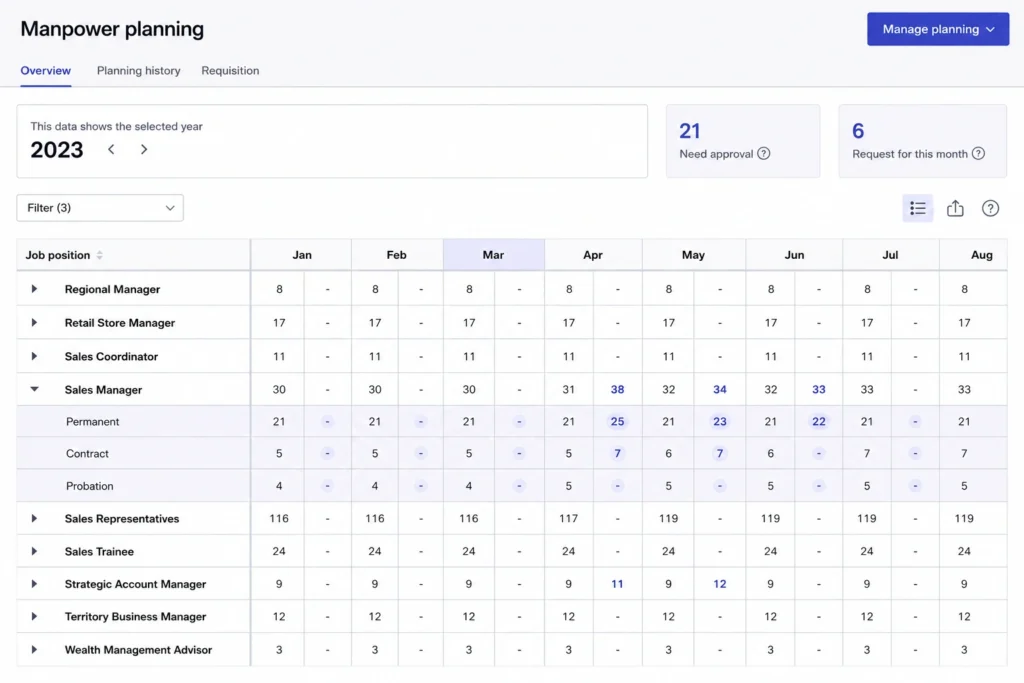
Once an MPP is approved, recruiters can open job requisitions directly from the planning module, ensuring the hiring campaign is calibrated to actual business requirements and tracked against the approved plan throughout the campaign.
Step 2 — Create and Publish Job Postings Across Multiple Channels
From the centralized Recruitment Dashboard, HR teams create standardized job posting templates that can be reused across multiple positions.
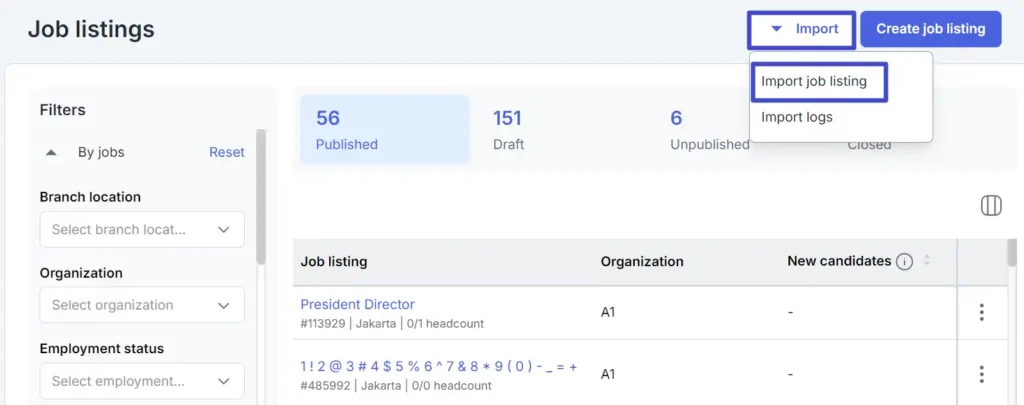
If your company already has dozens of open positions before implementing Mekari Talenta, recruiters can also publish job listings in bulk through CSV import templates, eliminating the need to create and upload vacancies one by one.
A single posting in Mekari Talenta Recruitment dashboard can be published simultaneously to LinkedIn, JobStreet, and the company’s career website, reducing the administrative overhead of managing multiple job board logins and keeping all incoming applications synchronized in one system.
For mass hiring campaigns involving dozens of similar roles, templated job postings dramatically reduce posting preparation time while maintaining consistency in how the role is communicated to the market.
Step 3 — Automate Screening with AI Candidate Scoring
As applications arrive, Mekari Talenta’s AI Candidate Scoring engine evaluates each candidate’s profile against the configured criteria like education, years of experience, skill keywords, location, and assigns a score that allows the recruiting team to prioritize their review queue.
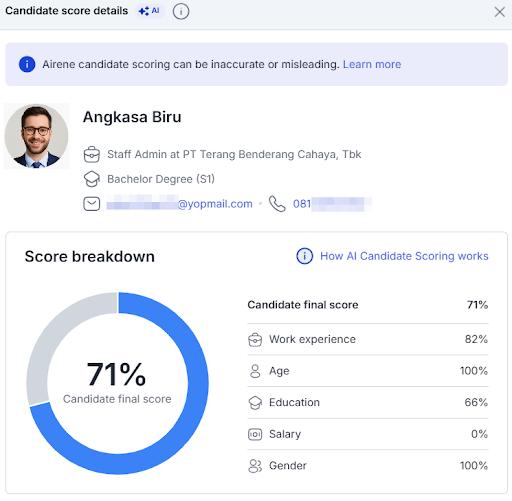
Candidates who fall below a configurable minimum score threshold can receive automatic rejection communications, ensuring every applicant receives a timely response without adding to recruiter workload.
Blacklist detection automatically flags candidates with previous disqualifications, preventing repeat processing of ineligible applicants. Recruiters focus their attention on the scored shortlist, where human judgment adds the most value.
Step 4 — Configure Custom Hiring Stages per Role Type
Mass hiring campaigns frequently involve multiple distinct role types, such as field operations, office roles, and technical positions, each with its own appropriate assessment sequence.
Mekari Talenta allows HR teams to configure distinct hiring stage workflows per position, ensuring each role type has a structured, appropriate pipeline without requiring a separate system setup.
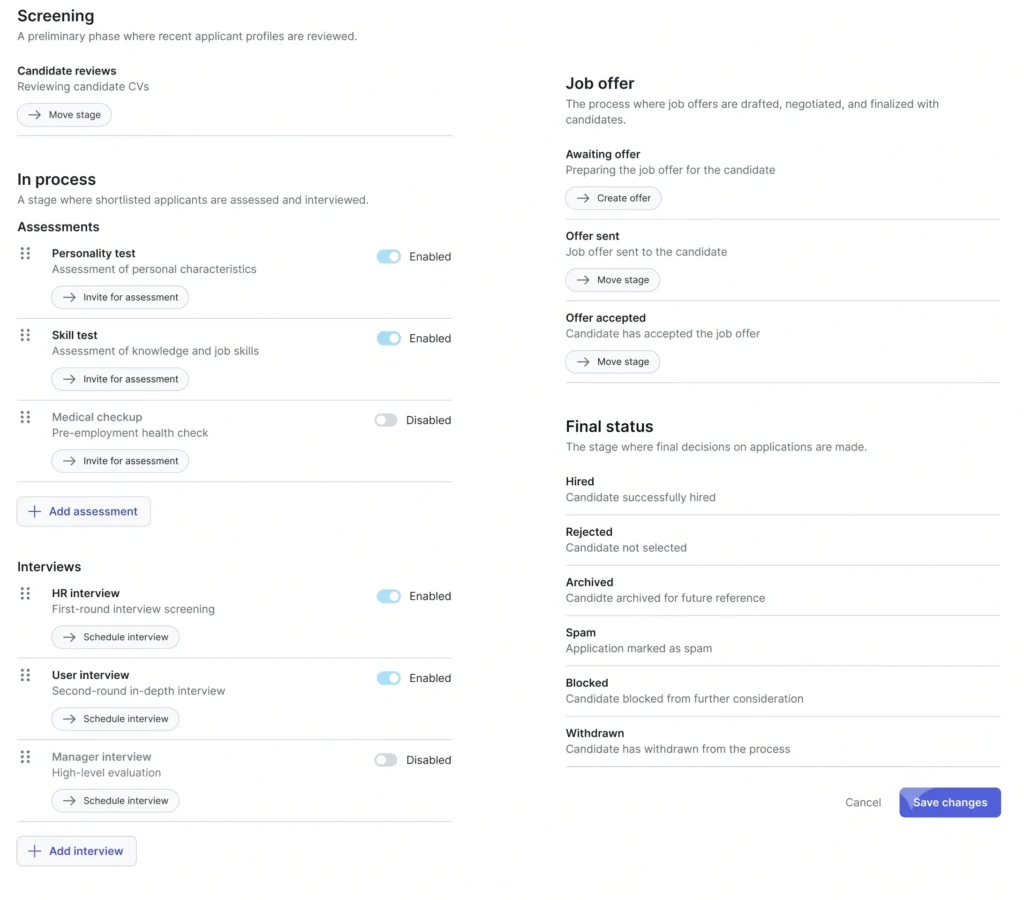
For blue-collar or field roles, a three-stage pipeline (screening, interview, offer) may be appropriate. For technical or specialist roles, the pipeline can include assessment stages, panel interviews, and offer negotiation steps. Each stage’s progress is visible in real time on the centralized dashboard.
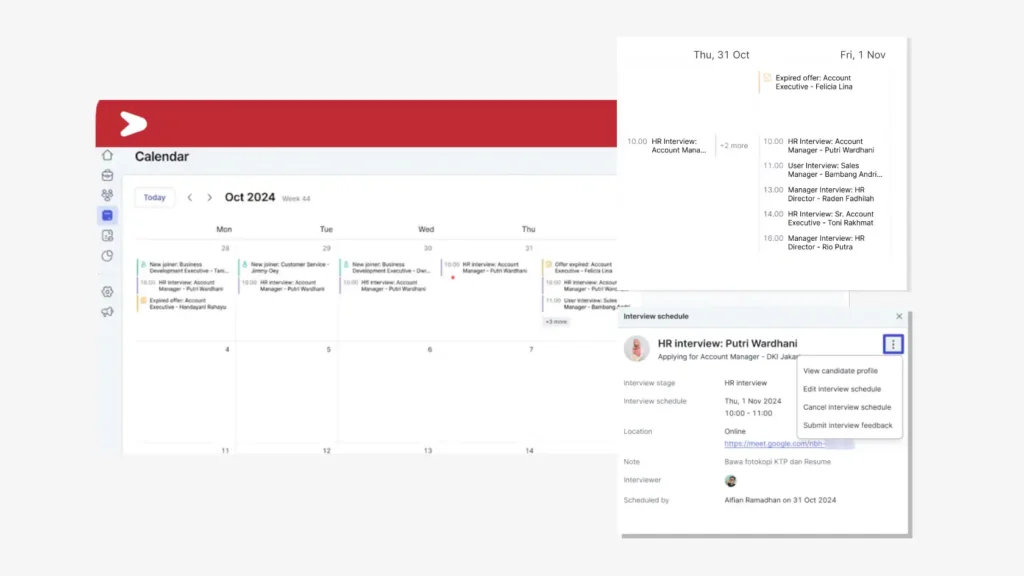
Step 5 — Manage Interviews and Assessments Centrally
Interview invitations can be sent directly from the Mekari Talenta dashboard, with calendar scheduling integrated into the flow.
Beyond interview management, recruiters can also assign and manage multiple types of assessments directly within the platform, including MBTI assessments, custom technical assessments, psychometric tests by LPTUI, and specialized assessments through Mercer | Mettl.
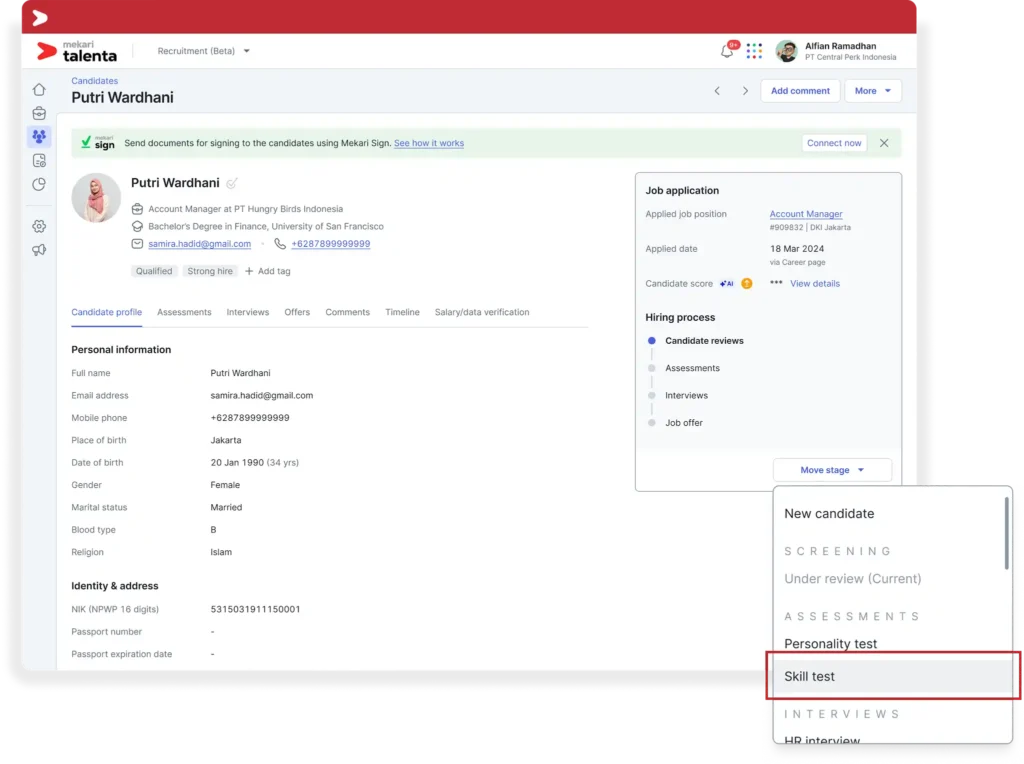
Assessment results are automatically stored within the candidate profile, allowing recruiters and hiring managers to review personality insights, cognitive evaluations, technical capabilities, and hiring recommendations in one centralized recruitment workflow.
The CV preview feature, one of the most operationally impactful capabilities in high-volume contexts, allows recruiters to review candidate documents, current compensation, and expected salary directly in the platform without downloading individual files.
For campaigns processing hundreds of candidate profiles, this single feature can save dozens of hours of recruiter time per week.
Step 6 — Generate Digital Offers with Integrated Signatures
Once a hiring decision is made, offer letters are generated from standardized templates and distributed electronically.
Integration with Mekari Sign (PSrE-certified digital signature) enables candidates to execute offer letters digitally, eliminating printing, scanning, and courier delays that commonly slow down final conversion in mass hiring campaigns.
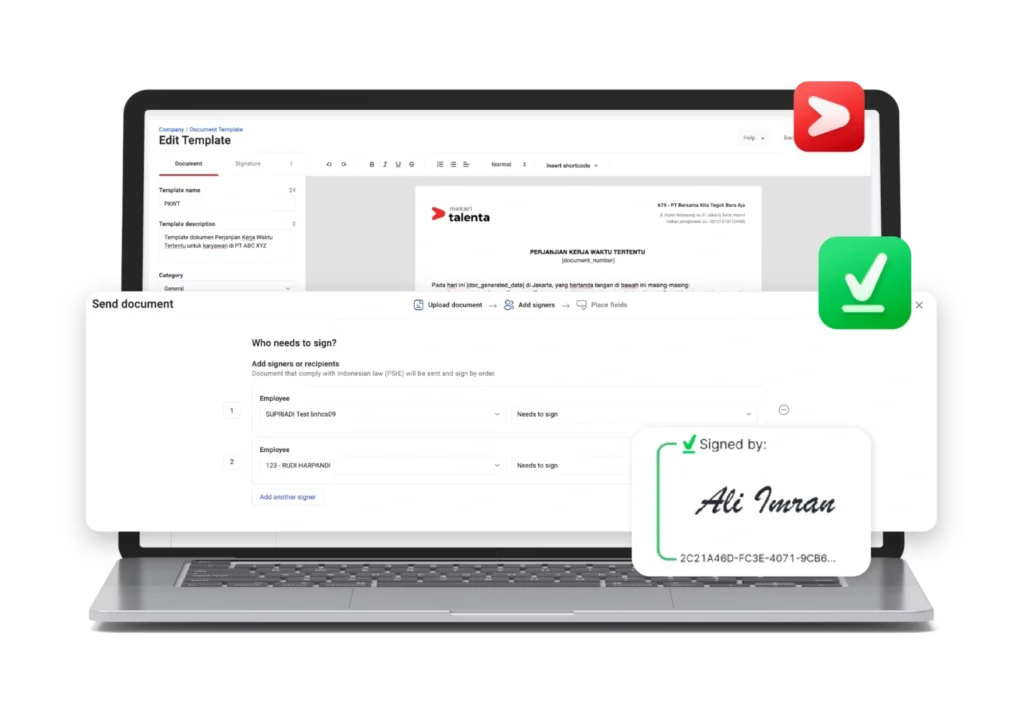
Offer acceptance rates and offer-to-join conversion are tracked in the recruitment analytics dashboard, giving HR teams real-time visibility into where the pipeline is losing candidates at the final stages.
Step 7 — Sync New Hire Data Directly to HRIS for Onboarding
When a candidate’s status changes to “Hired,” their recruitment data like personal details, employment history, agreed compensation, position, and division, is automatically synchronized into Mekari Talenta’s HRIS module.
New hires are not required to re-enter their information during onboarding, eliminating a common source of administrative friction and data error.
This seamless data flow from recruitment to HR administration to payroll is particularly valuable in mass hiring contexts, where manually transferring data for hundreds of new employees creates significant risk of error and delay.
Step 8 — Monitor Campaign Health Through Recruitment Analytics
Throughout the campaign, Mekari Talenta’s centralized analytics dashboard provides real-time tracking of Time-to-Hire, Time-to-Fill, stage-by-stage conversion rates, candidate acceptance rates, and sourcing channel performance.
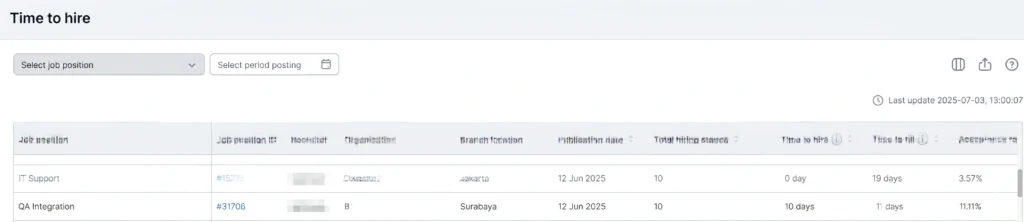
Customizable reports can be generated for management review, giving senior leadership visibility into campaign progress without requiring manual data compilation from HR teams.
For enterprises managing mass hiring across multiple business units or geographic locations, the ability to filter and compare performance by division or region enables proactive management of capacity and quality across the entire campaign.
How to Measure the Financial Impact and ROI of Mass Hiring
Measuring mass hiring performance requires a distinct set of metrics that capture both the efficiency and the quality of the hiring investment. The following framework provides the core measures enterprise HR leaders should track.
1. Cost Per Hire (CPH)
Cost per hire is the total investment in the recruitment process divided by the number of successful hires. This includes direct costs (job board fees, assessment tools, agency fees where applicable, recruiter time) and indirect costs (hiring manager interview time, HR system costs allocated to the campaign).
Benchmarking CPH against SHRM’s average cost per hire of $4,700 USD provides a baseline for evaluating the efficiency of the enterprise’s mass hiring infrastructure. Organizations with mature automated recruitment systems consistently report CPH 20–40% below this benchmark.
2. Time-to-Fill and Time-to-Hire
Time-to-fill measures the number of calendar days from a job requisition opening to a candidate’s first day. Time-to-hire measures the days from when a candidate first applies to when they accept an offer.
Both metrics are essential in mass hiring contexts, where business units have operational timelines that depend on headcount being in place.
Glassdoor research indicates an average time-to-fill of approximately 23 days across industries. Enterprises running automated, structured mass hiring programs can achieve time-to-fill of 14–21 days for high-volume roles. This is a competitive advantage in markets where speed of deployment drives business performance.
3. Offer Acceptance Rate
Offer acceptance rate measures the percentage of candidates who accept employment offers after receiving them.
A declining acceptance rate in a mass hiring campaign is an early warning signal. It may indicate that compensation is uncompetitive, the offer process is too slow (allowing competing offers to land first), or the candidate experience through the process has been poor enough to erode enthusiasm.
Tracking acceptance rate at the campaign level, and by role type and sourcing channel, provides the data needed to make targeted adjustments before the issue becomes a large-scale problem.
4. 90-Day Retention Rate
The 90-day retention rate measures the percentage of mass-hired employees who remain with the organization 90 days after their first day.
Early attrition in the 0–90 day window is a direct indicator of hire quality problems or onboarding failures that the mass hiring process is producing.
A 90-day attrition rate above 15% in a high-volume cohort warrants immediate review of both screening criteria and onboarding quality.
5. Quality of Hire Score
Quality of hire is a composite metric that combines early performance indicators, typically 90-day performance review scores, productivity ramp time, manager satisfaction ratings, to produce a measure of whether the mass hiring campaign delivered candidates who are actually performing well in the role.
This metric closes the feedback loop between the talent acquisition function and the business, ensuring that speed and volume targets do not come at the expense of workforce quality.
Proven Success: Enterprise Mass Hiring Case Studies
The operational benefits of a structured, technology-enabled mass hiring approach are well-illustrated by real enterprise experiences.
The following two client stories demonstrate how organizations have transformed their high-volume recruitment outcomes with Mekari Talenta.
ATT Group — Scaling Recruitment Efficiency in a Large Logistics Enterprise
ATT Group is a large, integrated logistics services provider offering 360° services including shipping, warehousing, and customs brokerage, with both domestic and international operations.
With over 2,000 employees — the majority blue-collar workers — ATT Group faces the sustained recruitment volume challenge common to enterprises in the logistics sector.
Before implementing Mekari Talenta, the recruitment process at ATT Group was entirely manual. Candidate data from multiple portals including JobStreet, Glints, and their career website was recorded separately, creating significant duplicate data problems.
The HR team lacked visibility into the notifications candidates received, which led to transparency issues and occasional candidate complaints surfacing on social media.
Reporting to management depended on manual data compilation in Excel, which was time-consuming and prone to error.
After adopting Mekari Talenta’s Advanced Recruitment, the transformation was significant. The integrated dashboard now allows the HR team to present real-time data to management on vacancy performance, from application volumes through to filtered candidates, interviews, and assessments, eliminating the weekly manual reporting burden.
CV screening, including viewing current and expected salaries, happens directly in the platform without downloading individual files, dramatically accelerating the initial screening phase.
Candidate data from all portals is automatically centralized, and when a hire is confirmed, recruitment data flows directly into the HRIS, removing the need for candidates to re-enter their information at onboarding.
As Bernadette Michelle Geovannie, Recruitment Specialist at ATT Group, described the impact:
The platform provides clear percentage-based data for each posted position, showing how many applicants have progressed through screening, assessment, and interview stages — giving both the HR team and management the visibility they previously lacked.
Topremit — Accelerating Hiring Speed in a Growing Financial Services Company
Topremit is a financial services company specializing in international and domestic remittance, operating under the supervision of Bank Indonesia with over 100 employees and ongoing expansion from its existing locations into new regional offices.
As a growing company managing hiring across multiple locations and role types, Topremit’s pre-Talenta recruitment process was manual and administratively burdensome.
CVs had to be downloaded and reviewed one at a time, candidate data was recorded in separate documents, and reports were compiled manually, making accurate, timely data presentation to management difficult.
The company began using Mekari Talenta in 2022 and progressively expanded usage from core HRIS features to the full recruitment module. The operational improvements were immediate.
CV preview capability eliminated the need to download individual files, enabling the team to screen candidates significantly faster across multiple simultaneous roles.
Screening questions built into the application flow allowed the team to validate candidate placement preferences — for example, confirming readiness to be based in Medan — without requiring individual follow-up calls. Candidate data flows automatically into structured reports, replacing manual compilation.
As Sefania R.K., Senior People and Culture Specialist at Topremit, described the change:
The hiring process that previously took around one month could be shortened to approximately two weeks. The ability to customize hiring stages per position type is a particular operational strength — as is the CV preview feature, which saves significant time in the multi-role, multi-candidate environments that characterize the company’s growth-phase hiring demands.
Building a More Scalable Mass Hiring Strategy with Mekari Talenta
Mass hiring is not a problem that resolves itself as organizations grow.
Without a deliberate infrastructure investment, the challenges compound with scale: more positions, more applications, more coordination complexity, more data to manage, and more downstream costs from inconsistent hire quality.
The organizations that execute mass hiring well —those that fill hundreds or thousands of positions at speed without sacrificing quality or destroying the candidate experience— share a common characteristic: they build their recruitment operation around connected, automated infrastructure rather than manual processes and disparate tools.
Mekari Talenta provides an end-to-end talent acquisition platform that integrates job posting, AI screening, structured assessment, digital offer management, and seamless HRIS onboarding in a single system, reducing the operational fragmentation that drives up cost and time-to-hire in conventional high-volume recruitment.
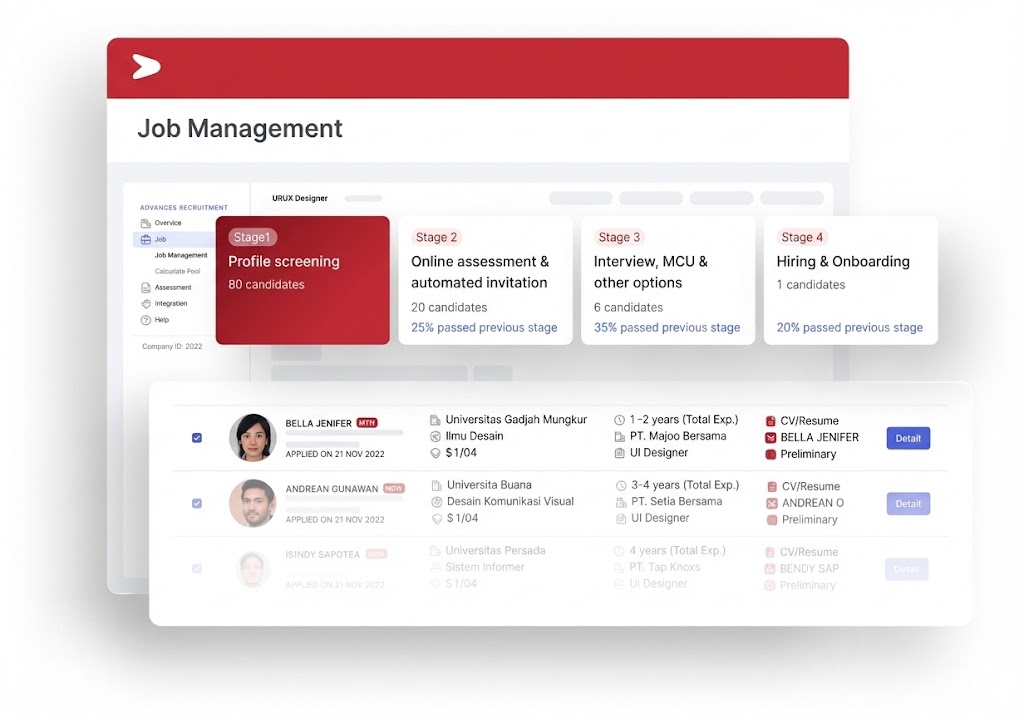
The Advanced Recruitment module is built to handle the application volumes, pipeline complexity, and real-time reporting demands that enterprise mass hiring requires.
It is deployable as a standalone recruitment solution or as part of a broader integrated HCM platform — allowing organizations to adopt it at the pace their operational readiness supports.
Whether you are preparing for an upcoming high-volume hiring campaign, restructuring a recruitment function that has outgrown its current tools, or building the talent acquisition capability to support aggressive organizational growth, the infrastructure choices made now will determine the cost, quality, and speed of every hire that follows.
Schedule a consultation with the Mekari Talenta team to explore how Advanced Recruitment can help your organization build a more scalable, data-driven, and operationally resilient mass hiring program.
References:
- Work Institute — Retention Report
- Deloitte — Global Human Capital Trends
- BambooHR — Onboarding Research