
Payroll Processing: A Strategic Guide to Building Scalable and Compliant Global Payroll Operations

- Payroll processing is the end-to-end process of calculating, validating, and distributing employee compensation while ensuring tax, statutory, and compliance obligations are met.
- Payroll processing typically follows three stages: pre-payroll preparation, payroll execution, and post-payroll governance to ensure every payroll cycle remains accurate and compliant.
Payroll processing is often expected to run flawlessly, yet it becomes significantly more difficult as organizations expand across legal entities, countries, and increasingly complex regulatory environments.
What begins as a routine administrative process quickly evolves into a business-critical operation that influences compliance, financial reporting, workforce trust, and operational resilience.
Organizations that continue to rely on disconnected systems often find payroll becoming harder to govern as complexity grows.
This article explores what payroll processing is, how the end-to-end process works, why complexity increases at scale, and the operating model organizations can adopt to build a more accurate, compliant, and scalable payroll function.
What Is Payroll Processing?
Payroll processing is the end-to-end operational discipline of calculating, validating, and disbursing employee compensation while meeting every statutory, tax, and reporting obligation attached to it.
It is not simply “running numbers.” It is the mechanism through which workforce data, time inputs, compliance rules, and financial systems converge into a single, trustworthy outcome each pay cycle.
For a single-entity organization, this process can feel mechanical. For a multi-entity enterprise operating across several countries, payroll processing becomes a coordination challenge involving dozens of stakeholders, systems, and regulatory frameworks operating in parallel.
Understanding payroll processing at this level of depth is the first step toward treating it as a strategic capability, not just an administrative function.
Core Components of a Payroll Processing Framework
Rather than listing generic “key elements,” it is more useful for enterprise leaders to understand payroll as a framework made up of interconnected components.
Each component depends on the ones before it, and a weakness in any single layer tends to surface downstream, often at the worst possible moment: right before disbursement.
The six components below form the backbone of any payroll processing framework, regardless of company size or industry.
1. Workforce Data Management
Every payroll cycle begins long before payroll calculations take place. It starts with the quality and consistency of workforce data.
Employee onboarding, promotions, transfers, salary adjustments, leave records, and resignations continuously change workforce information throughout the month.
If these changes are recorded across multiple systems or maintained by different teams without a consistent governance process, payroll teams must spend each pay cycle validating data before they can process payroll.
A reliable payroll framework therefore depends on workforce data that is accurate, standardized, and continuously updated. This foundation typically includes:
- Employee master data, such as employment terms, compensation structure, tax information, statutory benefits, and bank account details.
- Organizational structure, including legal entities, business units, departments, reporting lines, and cost centers that determine payroll ownership and financial allocation.
- Employment changes, including hiring, promotions, transfers, leave, contract amendments, and offboarding that directly affect payroll calculations.
When workforce data is managed consistently from the beginning, payroll teams spend less time reconciling discrepancies, approvals move faster, and payroll can be completed with greater confidence and fewer last-minute adjustments.
Read More: Understanding On-Cycle vs Off-Cycle Payroll: Key Differences and When to Use Each
2. Time, Attendance, and Variable Pay Inputs
Payroll calculations depend on more than fixed salaries. Every pay cycle requires organizations to capture and validate variable workforce data, including attendance records, overtime, shift premiums, leave balances, bonuses, commissions, allowances, and reimbursements.
Unlike employee master data, these inputs change continuously throughout the payroll period and often require multiple levels of approval before they can be included in payroll.
The larger the organization, the greater the volume of transactions that must be verified within a limited payroll timeline.
Without integration between time tracking, leave management, expense claims, and payroll systems, payroll teams are forced to consolidate data manually from multiple sources.
This not only extends payroll processing time but also increases the likelihood of calculation errors, duplicate payments, and delayed payroll approvals.
3. Payroll Calculation
Payroll calculation is the point where workforce data is translated into financial outcomes.
Every salary payment must reflect the correct combination of earnings, deductions, statutory contributions, tax obligations, and organization-specific compensation policies.
As organizations expand across multiple entities, payroll calculations become increasingly difficult to standardize.
Different pay structures, tax treatments, statutory benefits, and payroll calendars must all be applied accurately while maintaining a consistent payroll process across the organization.
When these rules are managed through manual adjustments rather than standardized payroll logic, calculation accuracy becomes heavily dependent on individual expertise.
Over time, this creates operational risk, limits scalability, and makes payroll more difficult to govern and audit.
4. Statutory Compliance and Tax Administration
Payroll processing must comply with a wide range of statutory obligations, from income tax withholding and social security contributions to mandatory payroll reporting and filing requirements.
Because payroll regulations continue to evolve, compliance is an ongoing operational responsibility rather than a one-time configuration.
For organizations operating across multiple legal entities or countries, maintaining compliance becomes significantly more demanding.
Each jurisdiction may impose different tax rules, contribution rates, reporting deadlines, and regulatory requirements, requiring payroll teams to keep pace without disrupting payroll schedules.
When statutory rules are tracked manually or updated inconsistently, even small regulatory changes can result in payroll errors, late filings, financial penalties, and additional audit work.
Maintaining compliance therefore depends not only on understanding local regulations but also on ensuring those requirements are consistently applied throughout every payroll cycle.
5. Payroll Distribution and Financial Reconciliation
Payroll processing does not end when employee salaries have been calculated.
Payroll data must also be translated into accurate financial records to ensure salary payments, accounting entries, and labor costs remain aligned.
Once payroll is approved, employee payments need to be disbursed on schedule while payroll journals are reconciled with the general ledger.
This ensures payroll expenses are accurately reflected in financial statements and supports a timely financial close.
When payroll and finance operate on disconnected systems, reconciliation often becomes a manual process.
Payroll teams must verify salary payments, accounting entries, and payroll reports across multiple data sources before results can be finalized.
Beyond extending the payroll cycle, this also reduces confidence in workforce cost reporting and creates additional work for both HR and finance teams.
6. Payroll Reporting and Executive Analytics
Payroll data becomes significantly more valuable when it can be translated into meaningful business insights.
Beyond generating payslips and payroll reports, organizations need timely visibility into workforce costs, payroll accuracy, compliance, and operational performance.
Consolidated payroll reporting enables HR and finance teams to monitor payroll expenses across business units, legal entities, and reporting periods without manually combining data from multiple systems.
This makes it easier to identify cost trends, investigate payroll anomalies, and support workforce planning with reliable data.
When payroll information is fragmented or difficult to access, reporting often becomes a manual exercise performed after each payroll cycle.
As a result, decisions are based on historical reports rather than timely insights that can improve workforce and financial planning.
Understanding the Payroll Processing Lifecycle
Payroll is often viewed as a monthly transaction, but in reality it is a continuous operational cycle.
Every payroll run depends on hundreds or even thousands of workforce changes that occur throughout the month, each creating downstream implications for payroll accuracy, compliance, and financial reporting.
While organizations frequently invest in payroll automation, many delays originate long before payroll calculations begin.
Understanding where work accumulates across the payroll lifecycle helps organizations reduce manual intervention, strengthen governance, and improve payroll reliability over time.
Stage 1. Pre-Payroll Preparation
Pre-payroll preparation is the process of validating every payroll input before calculations begin.
At this stage, organizations consolidate workforce changes, attendance records, overtime, leave balances, variable compensation, expense claims, and other payroll-related transactions to ensure the data is complete, accurate, and approved.
Although payroll software can automate calculations, it cannot compensate for incomplete or inaccurate inputs.
This is why payroll reliability is largely determined before the first calculation is performed.
Errors introduced during pre-payroll often cascade into salary adjustments, delayed payments, compliance issues, and additional reconciliation work later in the payroll cycle.
As organizations scale, pre-payroll becomes less about collecting information and more about governing change.
Employee movements, compensation updates, and payroll exceptions occur continuously throughout the month, often across multiple departments and legal entities.
Without standardized approval workflows, payroll calendars, and cut-off policies, payroll teams spend the final days before payday validating late submissions instead of preparing payroll.
Organizations with mature payroll operations reduce this dependency by treating pre-payroll as a continuous governance process rather than a last-minute administrative checklist.
Stage 2. Payroll Execution
Payroll execution is the stage where validated payroll inputs are converted into employee payments.
Once payroll processing begins, the priority shifts from gathering information to executing calculations accurately, consistently, and within the scheduled payroll timeline.
At this stage, payroll teams apply salary structures, variable compensation, statutory deductions, tax obligations, and company policies to produce the final payroll results.
Because payroll calculations affect employee compensation, compliance, and financial reporting simultaneously, changes introduced after execution has started often trigger recalculations, repeated validations, and additional approval cycles.
A well-controlled payroll execution process minimizes manual intervention by standardizing routine calculations while isolating exceptions that genuinely require review.
This keeps payroll cycles predictable, reduces processing time, and strengthens confidence in payroll accuracy.
Stage 3. Post-Payroll Governance
Completing payroll is not the end of the process. Every payroll cycle also provides an opportunity to verify results, strengthen controls, and improve the next payroll run.
After salaries have been disbursed, payroll teams validate payment outcomes, reconcile payroll records with financial data, complete statutory obligations, and document every transaction required for audit purposes.
This stage ensures that payroll results remain accurate, traceable, and fully supported by the underlying records.
More importantly, post-payroll is where recurring issues become visible. Repeated payroll adjustments, frequent off-cycle payments, recurring approval delays, or reconciliation discrepancies often indicate weaknesses elsewhere in the payroll process.
Reviewing these patterns helps reduce the same exceptions in future payroll cycles rather than treating each payroll run as an isolated monthly activity.
A mature payroll function therefore uses post-payroll governance not only to confirm what happened, but also to continuously improve how payroll is managed.
Read More: Managing End to End Payroll Processing
How Long Does Payroll Processing Typically Take?
For multi-entity organizations, that timeline often extends significantly, since each entity may run on a different calendar, use different compliance rules, and require separate validation steps before consolidation.
The real answer, however, depends heavily on the factors below, which is why benchmark numbers should be treated as a starting point rather than a target.
Factors That Affect Payroll Processing Time
Several variables determine how long a payroll cycle actually takes in practice, and they rarely act in isolation. It includes:
- Workforce size and complexity – More employees, diverse compensation structures, and variable pay components require additional validation.
- Number of legal entities – Each entity may have different payroll policies, tax rules, and statutory requirements.
- Approval workflows – Multiple approval layers and late submissions often delay payroll processing.
- Payroll exceptions – Salary adjustments, off-cycle payments, and retroactive changes increase processing time.
- System integration – Disconnected HR, attendance, and payroll systems require manual data consolidation before payroll can begin.
Enterprise Benchmarks for Payroll Cycle Time
Industry benchmarks suggest that payroll processing typically takes around three business days from payroll cut-off to payroll transmission, although actual cycle times vary depending on organizational complexity.
Many organizations complete payroll within two to three business days, while more complex payroll operations may require four days or longer.
Cycle time should not be evaluated in isolation. A shorter payroll cycle has little value if it relies on repeated recalculations, manual reconciliations, or frequent off-cycle payments.
More meaningful indicators include the number of payroll exceptions, post-payroll corrections, and late changes submitted after payroll cut-off.
When payroll processing consistently exceeds internal targets, the underlying constraint is often not workforce size but fragmented data, disconnected systems, unclear approval workflows, or recurring payroll exceptions.
Addressing these operational bottlenecks typically has a greater impact on payroll efficiency than simply accelerating the calculation process.
Why Payroll Processing Becomes Increasingly Complex as Organizations Scale
Payroll that works smoothly at one hundred employees rarely scales cleanly to ten thousand, and the reasons are structural rather than incidental.
As organizations grow across entities and geographies, complexity does not increase linearly. It compounds, often in ways that are invisible until a payroll run fails or an audit surfaces a gap.
Understanding these five drivers of complexity helps HR anticipate where scaling pressure will show up first.
1. Multi-Entity Operations
Each new legal entity brings its own payroll calendar, approval chain, and reporting requirements, even when the underlying HR policies are meant to be standardized.
Without a centralized architecture, multi-entity payroll tends to fragment into a collection of loosely connected local processes, each managed differently depending on who runs it.
Read More: A Practical Guide to Multi-Country Payroll in Southeast Asia Effectively
2. Country-Specific Regulatory Compliance
Tax rules, statutory contributions, and labor regulations differ significantly from one country to another, and they change frequently without much advance notice.
Staying current with tax regulations, labor laws, and statutory requirements across multiple jurisdictions quickly becomes difficult without dedicated compliance infrastructure.
3. Disconnected HR, Finance, and Payroll Systems
When these three functions run on separate systems that do not communicate automatically, every payroll cycle requires manual data transfer and reconciliation.
This disconnect is one of the most common sources of hidden operational cost, since the effort required to bridge these gaps rarely appears as a formal line item anywhere.
4. Limited Payroll Visibility Across Business Units
As organizations grow, leadership increasingly needs consolidated visibility into labor costs, compliance status, and payroll accuracy across every business unit simultaneously.
Without centralized reporting, that visibility has to be manually assembled each time it is needed, which delays decision-making precisely when speed matters most.
5. Increasing Audit and Governance Requirements
Larger, more complex organizations face heavier scrutiny from auditors, regulators, and internal governance functions, all of which expect clear, defensible documentation.
Payroll processes that rely on informal workarounds struggle to produce this documentation on demand, turning routine audits into resource-intensive exercises.
Building a Modern Payroll Processing Operating Model
Understanding where complexity comes from is only useful if it leads to a different way of operating. This is where payroll shifts from an administrative function into a genuine leadership decision.
Leading organizations are no longer focused solely on processing payroll faster. They are redesigning how payroll is architected, governed, and scaled to support a growing and increasingly complex workforce.
The three pillars below outline what that modern operating model actually looks like in practice.
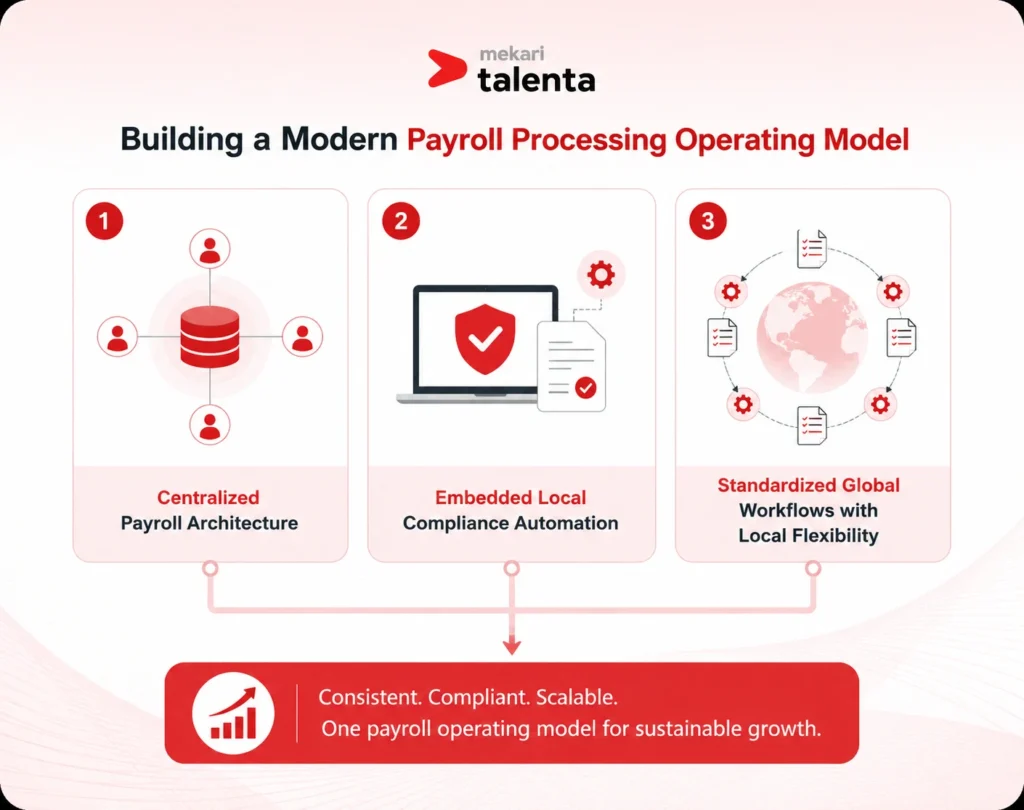
Pillar 1. Centralized Payroll Architecture
A centralized architecture starts with a single source of truth for employee and payroll data, rather than fragmented records across entities.
This is supported by a shared employee master that stays consistent across HR, time management, and payroll systems, eliminating the reconciliation work that fragmented data creates.
Unified reporting sits on top of this foundation, giving leadership one consolidated view of payroll performance across every entity, rather than a patchwork of local reports.
Pillar 2. Embedded Local Compliance Automation
Rather than treating compliance as a manual, country-by-country research exercise, modern payroll operations embed localized tax logic directly into the calculation engine.
This includes automated handling of statutory benefits, which vary significantly by country and are among the most common sources of compliance error when managed manually.
Regulatory updates and country-specific rules are maintained centrally and pushed automatically into local calculations, reducing the lag between a regulation changing and the organization complying with it.
Pillar 3. Standardized Global Workflows with Local Flexibility
The most mature payroll operating models strike a balance between global consistency and local adaptability, rather than forcing one extreme or the other.
Approval governance is standardized globally, giving leadership confidence that every entity follows the same control framework regardless of location.
At the same time, configurable policies and entity-specific payroll rules preserve regional autonomy, allowing local teams to reflect legitimate local practices without breaking the global framework.
Payroll Processing Models: Choosing the Right Approach for Your Organization
There is no single “correct” payroll model for every organization.
The right approach depends on company size, entity complexity, and how much internal capacity HR is realistically able to dedicate to payroll operations.
The four models below represent the spectrum most enterprise organizations choose from, often shifting between them as the business scales.
In-House Payroll Management
In-house payroll means full internal ownership, with HR and payroll teams handling every step of the process directly.
This model offers greater control, since the organization retains complete visibility and decision-making authority over every aspect of the payroll cycle.
The trade-off is a higher operational workload, particularly as headcount and entity complexity increase, since every additional requirement adds directly to internal capacity demands.
In-house payroll tends to be most suitable for smaller organizations with less complex payroll requirements and a limited number of entities.
Payroll Software
Payroll software automates calculations and workflows, significantly reducing the manual effort required to process each cycle accurately.
This automation improves accuracy by removing much of the manual data entry and calculation work that introduces human error in traditional processes.
That said, payroll software still requires internal payroll expertise to configure correctly, interpret outputs, and manage exceptions as they arise.
This model is ideal for organizations looking to digitize payroll while maintaining internal operations and control over the process.
Managed Payroll Services
With managed payroll services, execution is handled by dedicated specialists who manage calculations, disbursement, and compliance on the organization’s behalf.
This includes ongoing compliance monitoring, which is particularly valuable for organizations operating across multiple jurisdictions with frequently changing regulations.
The result is a reduced administrative burden on internal HR teams, freeing capacity that would otherwise go toward operational payroll tasks.
Managed payroll services tend to suit organizations with multiple entities, growing headcount, or complex compliance requirements that exceed internal capacity.
Read More: The Real Cost of Payroll Services: What Indonesian Companies Are Actually Paying
Hybrid Payroll Operations
Hybrid payroll operations represent the model most enterprise organizations are converging toward today, and it is worth examining more closely.
In this model, internal HR retains ownership of payroll strategy and policy decisions, while a payroll partner handles day-to-day execution and compliance management.
Technology plays a connecting role here, providing centralized visibility across both internal strategy and external execution, so leadership never loses sight of what is happening operationally.
This balance of control and capacity is precisely why hybrid payroll has become the dominant model among enterprises managing multiple entities and complex regulatory environments.
When Should Organizations Consider Payroll Services?
At a certain point, the question shifts from “how do we run payroll” to “who should be running it.”
Recognizing that inflection point early prevents payroll from becoming a recurring source of risk and distraction for HR leadership.
The three signals below tend to indicate that it is time to seriously evaluate external payroll services.
1. Payroll Complexity Has Outgrown Internal Capacity
This is often the clearest signal, and it tends to show up gradually before becoming impossible to ignore.
Common indicators include:
- Multi-entity operations that have expanded faster than internal payroll processes have been able to adapt.
- Multiple payroll calendars running in parallel, each requiring separate validation and processing effort.
- Growing headcount that increases transaction volume without a corresponding increase in payroll team capacity.
- Frequent regulatory changes across jurisdictions that internal teams struggle to track and implement consistently.
2. Compliance Risks Continue to Increase
As regulatory exposure grows, so does the cost of getting compliance wrong, both financially and reputationally.
Payroll compliance now extends beyond accurate salary calculations to include timely implementation of tax updates, adherence to local labor regulations, statutory reporting, and maintaining a complete audit trail.
As these requirements continue to evolve independently across jurisdictions, compliance becomes an ongoing operational discipline rather than a periodic administrative task.
3. Internal Teams Need More Time for Strategic HR Initiatives
Perhaps the greatest challenge is not the payroll process itself, but the amount of time it demands from internal HR teams.
As payroll operations become more complex, HR professionals spend more time reviewing exceptions, coordinating approvals, responding to payroll inquiries, and ensuring compliance requirements are met.
While these responsibilities are essential, they also reduce the capacity to focus on workforce planning, talent development, organizational effectiveness, and other strategic priorities.
Over time, the opportunity cost becomes increasingly difficult to ignore.
Build Scalable Payroll Operations with Mekari Talenta Payroll Service
As organizations grow, payroll processing becomes far more than a recurring administrative task.
Expanding across multiple entities, adapting to evolving regulations, and coordinating payroll with HR and finance all require a level of governance that manual processes and disconnected systems often struggle to support.
Without the right operating model, payroll teams can spend more time resolving exceptions and maintaining compliance than contributing to broader business priorities.
This is why many organizations are rethinking not only how payroll is processed, but also how it is managed.
By combining standardized workflows, localized compliance expertise, and integrated technology, businesses can reduce operational complexity while improving payroll accuracy, visibility, and consistency across every payroll cycle.
Payroll Service from Mekari Talenta helps organizations achieve exactly that.
Backed by experienced payroll specialists and an integrated payroll platform, the service supports end-to-end payroll execution, statutory compliance, payroll reporting, and employee salary disbursement.
Whether your organization operates across multiple entities or is preparing for future expansion, Mekari Talenta helps simplify payroll operations while maintaining the control and transparency your business requires.
Contact our team to discuss your payroll challenges and discover how Mekari Talenta Payroll Service can help simplify payroll operations while supporting long-term business growth.
FAQ (Frequently Asked Questions)
What is the difference between payroll processing and payroll management?
What is the difference between payroll processing and payroll management?
Payroll processing refers to the operational activities performed during each payroll cycle, including calculating salaries, applying deductions, and distributing payments. Payroll management has a broader scope, covering payroll governance, compliance, policies, reporting, technology, vendor management, and continuous process improvement. In other words, payroll processing is one component of overall payroll management.
How often should payroll processes be audited?
How often should payroll processes be audited?
Internal payroll reviews should ideally take place after every payroll cycle to identify recurring exceptions and reconciliation issues. More comprehensive payroll audits are commonly conducted annually or whenever there are significant regulatory, organizational, or payroll system changes. Regular audits help strengthen compliance and improve payroll controls over time.
What KPIs should organizations use to measure payroll performance?
What KPIs should organizations use to measure payroll performance?
Beyond processing speed, organizations should monitor payroll accuracy, on-time payroll completion, payroll exceptions, off-cycle payments, compliance filing accuracy, and payroll cycle time. Tracking these metrics together provides a more complete picture of payroll performance than measuring cycle time alone. Many organizations also benchmark these indicators against industry standards to identify operational improvement opportunities.
Can payroll processing be standardized across multiple countries?
Can payroll processing be standardized across multiple countries?
The overall payroll workflow can be standardized, but local payroll rules cannot. Organizations typically establish a consistent global governance framework while allowing country-specific configurations for tax, statutory contributions, labor regulations, and reporting requirements. This approach balances global consistency with local compliance.
When should a company consider outsourcing payroll?
When should a company consider outsourcing payroll?
Organizations often consider managed payroll services when payroll complexity outpaces internal resources. Common indicators include rapid business expansion, multiple legal entities, frequent regulatory changes, increasing payroll exceptions, or limited internal payroll expertise. Outsourcing can reduce administrative workload while improving compliance and payroll continuity.