
OCR Reimbursement: Turning Claims Into a More Controlled Process

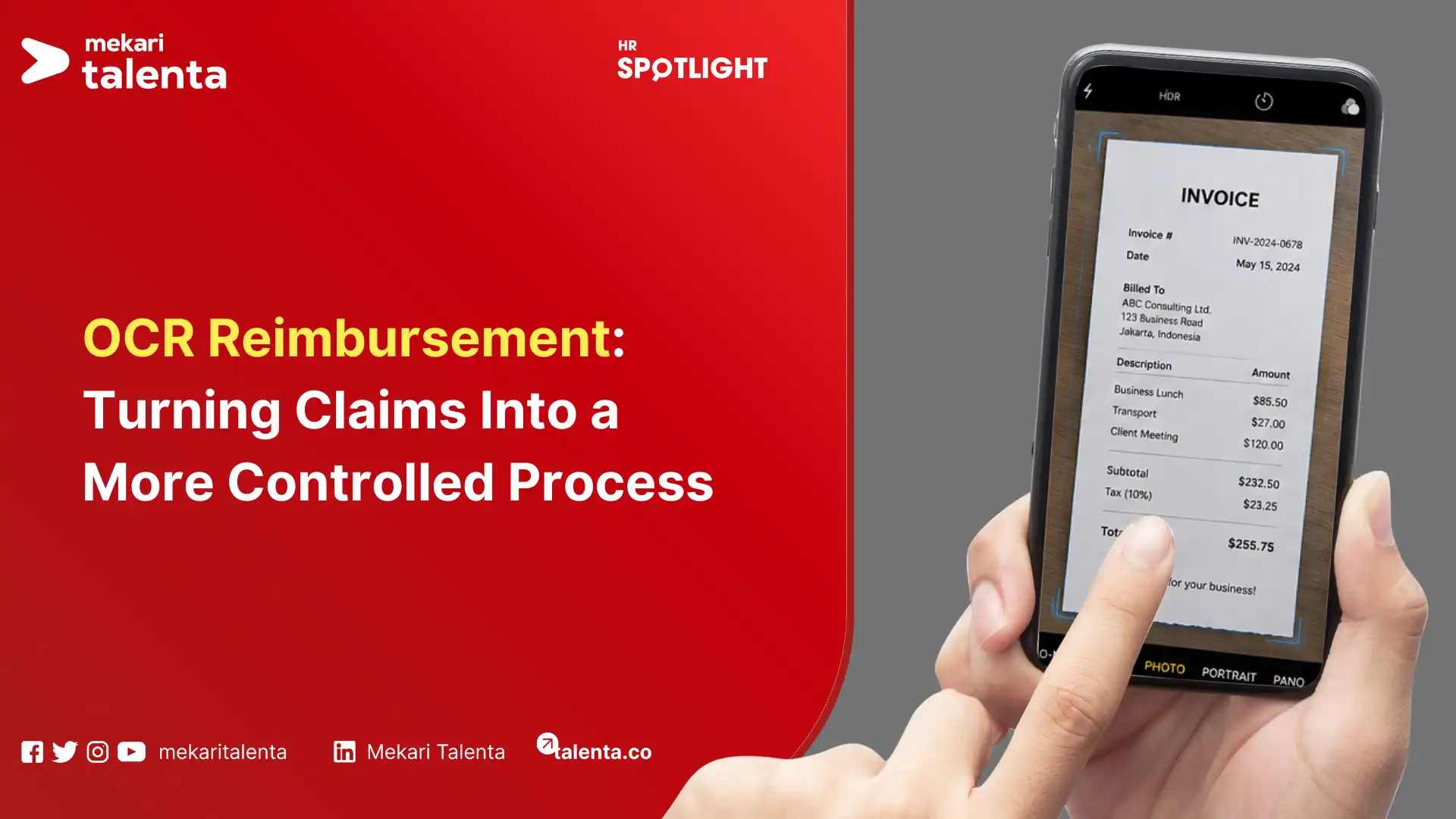
Reimbursement looks simple from the outside: an employee submits a receipt, someone reviews it, and the company reimburses the expense.
At scale, however, every claim creates a chain of manual activities across data entry, policy checks, documentation review, approval, and payment.
As reimbursement volume grows and fraudulent claims become harder to distinguish from legitimate ones, the question is no longer simply how to process more receipts faster, but how to do so without weakening accuracy, policy compliance, or financial controls.
Optical Character Recognition (OCR) addresses one important part of that challenge by converting receipt information into structured data, creating a foundation for more automated and controlled reimbursement workflows.
This article will explore how OCR can transform receipt data into a more structured reimbursement process, while examining where AI, policy validation, and human oversight fit into the broader control framework.
What Is OCR Reimbursement?
OCR reimbursement refers to the use of Optical Character Recognition technology to extract relevant information from receipts, invoices, and other expense documents. That information is then converted into structured data for reimbursement processing.
The technology itself is not new. What has changed is how it fits into a broader reimbursement workflow, moving from a standalone digitization tool into one connected layer of a larger control system.
In practical terms, OCR can identify a range of fields from a single receipt image. This typically includes the merchant name, transaction date, and total amount.
Currency, receipt or invoice number, and expense category can often be captured as well. Tax and other relevant fields round out what a well-built system can extract automatically.
Payment information, where available on the receipt, can also be captured as part of the same process. The result is a receipt that has moved from an image into usable, structured data.
From Receipt Image to Structured Expense Data
The basic workflow follows a consistent sequence. A receipt moves through OCR extraction, becomes structured data, passes through validation, moves to approval, and finally reaches reimbursement.
It is worth emphasizing that the value here is not merely digitizing an image. A scanned copy of a receipt, on its own, does not solve much.
The real operational value comes from making receipt information machine-readable and usable downstream. Once the data exists in structured form, it can be checked, compared, and analyzed in ways a static image never could be.
OCR Is the Data Capture Layer, Not the Entire Reimbursement System
This distinction matters more than it might first appear. OCR is often discussed as though it were the whole solution, when in reality it plays one specific role within a larger system.
| Layer | Role |
|---|---|
| OCR | Extracts information from receipts |
| Policy rules | Defines what can be reimbursed |
| AI validation | Interprets claims against policy and context |
| Approval workflow | Determines who reviews and approves |
| Human review | Handles exceptions and ambiguous cases |
| Reporting and governance | Provides visibility and control |
Each layer depends on the ones around it to function properly. OCR without policy rules simply produces well-organized data with nothing to check it against.
Understanding this layered structure prevents OCR from being treated as a silver bullet. It is a genuinely valuable layer, but only one part of a broader control architecture.
Why Manual Receipt Processing Becomes a Control Risk
Manual reimbursement is often treated as an administrative inconvenience, something that simply takes longer than it should. At scale, it becomes something more serious than an inconvenience.
It becomes a control issue, one that affects the accuracy and reliability of the organization’s financial data. And unlike a slow process, a control gap does not announce itself; it tends to surface only after something has already gone wrong.
These risks rarely show up as a single dramatic failure. They accumulate quietly, one small inconsistency at a time, until they show up in an audit finding or a reconciliation that no longer adds up cleanly.
Understanding these risks in detail is what makes the case for automation concrete rather than abstract.
The three patterns below tend to appear in almost any organization still relying heavily on manual receipt processing.
1. Manual Data Entry Creates Avoidable Errors
Every manual entry step introduces its own risk of error. An incorrect amount can be entered simply through a typo during transcription.
A wrong transaction date, an incorrect merchant name, or an incorrect category can all slip through the same way. Duplicate entries happen when the same receipt gets keyed in more than once, often across different systems.
Missing information and general transcription mistakes round out the common failure points. Every manually entered field becomes another opportunity for inconsistency to enter the record.
2. Volume Multiplies Administrative Work
The issue is not necessarily that any single reimbursement takes too long to process. It is that hundreds or thousands of claims create a genuinely repetitive workload that compounds over time.
The scaling problem is straightforward to describe. More employees lead to more claims, which lead to more receipts, which lead to more manual reviews and, ultimately, more administrative workload.
Without automation, increasing reimbursement volume tends to mean increasing operational resources in direct proportion. There is no natural ceiling on this relationship unless something changes how the work gets done.
3. Manual Review Can Create Inconsistent Decisions
Different reviewers, even working from the same written policy, may interpret identical claims differently. This is one of the quieter risks of manual review.
Consider a simple example involving a meal expense. One reviewer accepts it without question, while another rejects it because it appears to exceed the limit.
A third reviewer, faced with the same claim, might instead request additional documentation before deciding either way. This creates policy inconsistency, even when the underlying policy itself is written clearly.
OCR Alone Cannot Solve Expense Fraud
This point deserves to be stated plainly, since it is often assumed that OCR alone can solve expense fraud. OCR can tell a system what appears on a receipt, but it cannot, by itself, determine whether the claim behind that receipt is legitimate.
This is not a limitation of any particular OCR product. It is a structural boundary of what the technology is designed to do, and understanding that boundary is what keeps expectations realistic.
Fraud Can Exist Even When Receipt Data Is Accurate
A completely accurate receipt can still support an illegitimate claim. A claim might exceed the company’s reimbursement limit even though every field on the receipt is genuine.
A personal expense can be submitted as a business expense using a perfectly real receipt. The same legitimate expense can also be submitted more than once, across different reports or systems.
An expense might belong to a merchant category that the policy explicitly excludes, regardless of how accurate the receipt data is. In some cases, the receipt is entirely valid, but the underlying expense still violates policy in some other way.
An employee might submit a completely legitimate receipt for an expense that was never eligible for reimbursement in the first place. The conceptual takeaway is worth remembering: receipt authenticity does not equal reimbursement eligibility.
Why Fraud Prevention Requires More Than Receipt Recognition
Effective controls require several layers working together rather than any single one operating alone. Data extraction needs to be paired with policy validation, which needs to be paired with anomaly detection.
Approval controls add another layer of accountability on top of that. Human review remains essential for the judgment calls that no automated system can fully replace.
This is part of what makes OCR reimbursement complementary to a broader fraud-prevention strategy, rather than a replacement for one. The two work best when treated as connected pieces of the same system, not competing solutions.
The Role of Expense Reimbursement Policy
Policy remains the foundation underneath all of this. A reimbursement system needs clear rules around eligible expenses and defined spending limits.
Time restrictions and required documentation need to be spelled out explicitly. Expense categories, approval requirements, exceptions, and prohibited expenses all need the same level of clarity.
Technology can automate the enforcement of a policy, but it cannot compensate for an unclear policy. No amount of extraction accuracy fixes a rule that was never well-defined to begin with.
For a deeper look at building effective reimbursement controls, explore our guide to creating an expense reimbursement policy that actually works.
From OCR to Intelligent Reimbursement Validation
Separating what OCR does from what AI validation does helps clarify where each layer’s responsibility actually begins and ends.
This distinction is easy to state but easy to blur in practice, especially once both capabilities live inside the same interface.
In short, OCR extracts. AI interprets. Policy defines the rules being applied. Humans continue to govern the exceptions that fall outside all of it.
OCR Answers “What Is on the Receipt?”
OCR primarily extracts observable information directly from the document itself. It is, at its core, a data capture function rather than a judgment function.
Consider a simple example. OCR might extract a merchant name of “ABC Restaurant,” a date of August 10, an amount of $185, and a category of dining.
That is useful, structured information. But on its own, it says nothing about whether this particular claim should be approved.
AI Answers “Does This Claim Make Sense?”
AI validation takes the extracted information and evaluates it against broader context. This is where the system starts to move from capturing data to interpreting it.
Relevant questions at this stage include whether dining is even reimbursable under the company’s policy in the first place. Whether the amount falls within the permitted limit is another immediate check.
Whether this merchant type is eligible under the applicable category rules matters as well. The system also needs to determine whether the claim requires additional approval given its size or nature.
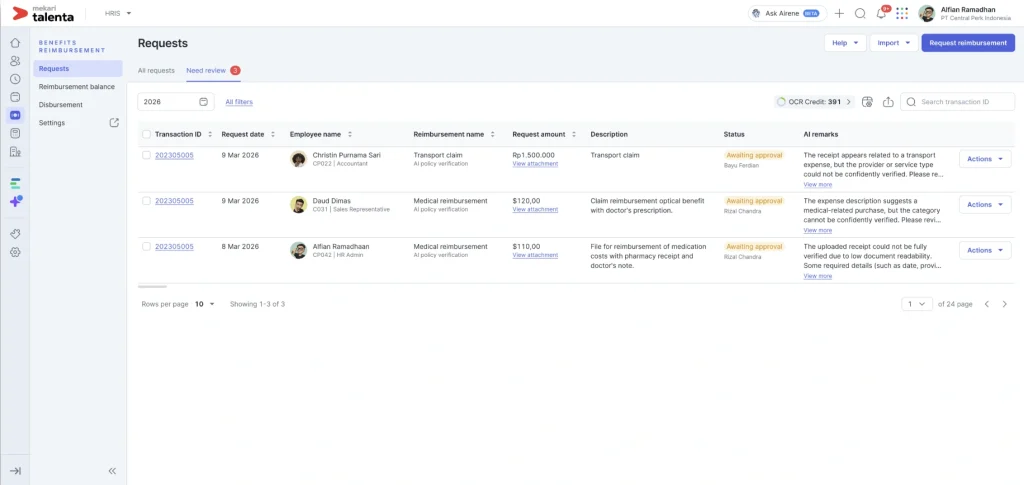
This approach is already reflected in modern reimbursement solutions. For example, Mekari Talenta combines OCR and AI capabilities to help automate receipt data capture and support reimbursement validation, reducing the amount of manual checking required from finance teams.
What an AI-Powered OCR Reimbursement Process Looks Like
It helps to look at what this looks like in practice, from the moment an employee captures a receipt to the point when a reimbursement claim is approved and processed.
The process can be understood as six connected steps. Each serves a different purpose: OCR turns receipt information into structured data, AI applies context and policy to that data, workflow automation moves the claim forward, and human reviewers step in when judgment is required.
Step 1 — Capture the Receipt
The process begins when an employee uploads or captures a receipt digitally, often from a mobile device shortly after a purchase.
Instead of manually entering every detail from the receipt, the employee provides the source document that the reimbursement system needs to process the claim. This creates the starting point for automated data extraction and validation.
Step 2 — Extract the Expense Data With OCR
OCR reads the information contained in the receipt and converts it into structured expense data. Depending on the document, this can include the merchant name, transaction date, amount, currency, category, and other relevant receipt details.
This reduces the amount of information employees need to enter manually. Rather than transcribing data field by field, they can review the information extracted from the receipt and correct it when necessary.
The distinction matters: OCR makes receipt data readable by the system, but it does not determine whether the expense should be reimbursed.
Step 3 — Validate the Claim Against Policy
Once the receipt has been converted into structured data, the claim can be evaluated against the company’s reimbursement policy.
This may include checking spending limits, eligible expense categories, merchant types, receipt requirements, approval thresholds, and other policy-specific rules.
This is where reimbursement automation moves beyond simple receipt scanning. The system is no longer asking only, “What does this receipt say?” It is beginning to answer, “Does this claim meet the conditions for reimbursement?”
Step 4 — Identify Exceptions and Potentially Suspicious Claims
Not every claim needs the same level of scrutiny.
An intelligent reimbursement system can identify claims that require additional attention, such as an unusually high amount, missing information, a policy conflict, a potential duplicate, or an unusual combination of merchant and expense category.
The purpose is not to replace every review with an automated decision. It is to make review more targeted by surfacing the claims where additional judgment may be warranted.
This distinction is particularly important for fraud prevention. A receipt can contain accurate information and still represent an expense that violates company policy or requires further investigation.
Step 5 — Route Claims Through the Appropriate Workflow
Once a claim has been evaluated, it can move through the appropriate reimbursement workflow.
Straightforward claims can proceed through the standard approval process without unnecessary intervention. Claims that meet predefined exception criteria can instead be routed to the appropriate reviewer.
This creates a more differentiated workflow: routine claims move efficiently, while exceptions receive the additional scrutiny they require.
Step 6 — Keep Humans in the Loop
Automation should reduce unnecessary human review, not eliminate human accountability.
Human reviewers remain important when a claim involves a policy exception, ambiguous documentation, unusual circumstances, or a level of risk that warrants additional judgment.
They can also override an automated recommendation when the available data does not capture the full context of a claim.
This human-in-the-loop approach is important because reimbursement decisions do not always have a purely technical answer. The objective is not to remove people from the process entirely. It is to reserve their time for the claims where their judgment adds the most value.
Ultimately, the strongest reimbursement workflows combine the strengths of both approaches: OCR handles structured data capture, AI helps interpret and validate claims, automation moves routine work forward, and people retain control over exceptions and decisions that require context.
The Business Case for OCR-Powered Reimbursement
The value of OCR-powered reimbursement extends beyond faster receipt processing. Its bigger impact comes from changing how administrative work, control, and scale interact.
When repetitive tasks are automated and claims are processed through a more consistent workflow, organizations can increase reimbursement capacity without simply adding more manual effort to the process.
Reduce Administrative Work Without Scaling Headcount
The most immediate benefit of OCR reimbursement is the reduction of repetitive administrative work.
In a manual process, employees may spend time transcribing receipt details into reimbursement forms, while reviewers and finance teams spend additional time checking whether those entries match the original documentation. At higher volumes, the same work gets repeated across thousands of claims.
OCR removes much of the transcription involved by extracting information directly from the receipt. Instead of entering the merchant, date, amount, and other details manually, employees can review the information captured by the system and focus on completing the parts of the claim that actually require their input.
The same principle applies downstream. Reviewers no longer need to spend as much time reconstructing basic information from individual receipts before they can evaluate a claim.
The result is not simply fewer clicks per reimbursement. It is a shift in where internal capacity is spent. Routine data handling can be absorbed by the system, allowing people to focus on exceptions, approvals, and decisions that require actual judgment.
Improve Control and Consistency Across Claims
The value of automation also extends to the quality of reimbursement decisions themselves.
Manual processes can produce inconsistent outcomes even when employees and reviewers are working from the same policy.
One reviewer may interpret a category strictly, while another may allow an exception. One may notice a missing document immediately, while another may overlook it because the claim appears routine.
When policy conditions and validation rules are embedded into the reimbursement workflow, the same baseline checks can be applied consistently across claims.
This does not mean every reimbursement decision should be automated. Rather, it creates a more reliable first layer of control. Claims can be checked against spending limits, eligible categories, documentation requirements, and other defined conditions before they reach a human reviewer.
The combination of OCR and policy-aware validation also improves the quality of the information being reviewed. When receipt data is extracted into a consistent structure, reviewers are working from standardized information rather than manually entered fields that may contain transcription errors.
Over time, this can create a more reliable reimbursement record and make it easier to identify patterns that would be difficult to see across fragmented, manually processed claims.
Scale Reimbursement Without Scaling Complexity
The strongest business case for reimbursement automation appears when volume starts to grow.
A reimbursement process that works well for a relatively small number of employees can become increasingly difficult to manage as the organization expands across teams, locations, currencies, and expense types. More employees create more claims, which create more receipts, more reviews, and more opportunities for inconsistent handling.
Simply adding people to process that volume may keep the system running, but it does not solve the underlying scalability problem. The organization remains dependent on manual capacity to absorb every increase in demand.
OCR and AI-powered validation offer a different model. Routine claims can move through standardized workflows with less intervention, while exceptions are directed toward the people best equipped to handle them.
This allows the process to absorb higher volumes without requiring every additional claim to generate the same amount of administrative work.
What to Look for in an OCR Reimbursement Solution
Evaluating an OCR reimbursement solution requires looking beyond extraction accuracy alone.
Accurate receipt recognition is important, but it only addresses the first stage of the reimbursement process.
The more important question is whether the technology can turn that extracted information into a controlled, policy-aware workflow without creating new administrative burdens.
The following capabilities can help distinguish a receipt-scanning tool from a more complete reimbursement solution.
1. Accurate Receipt Extraction
Look for the ability to reliably capture key fields across different receipt formats, languages, layouts, and image quality levels.
Real-world receipts are rarely standardized. They can vary by merchant, country, currency, language, and document format. A solution that performs well only on clean, predictable receipts will create additional correction work when applied across a broader employee population.
Accuracy therefore matters not only because it improves data quality, but because inaccurate extraction can introduce errors into every subsequent stage of the reimbursement process.
2. Near Real-Time Processing
Receipt data should become available shortly after submission rather than waiting for manual processing.
Near real-time extraction creates a smoother employee experience while allowing validation to begin sooner. It also reduces the administrative lag between submitting a claim and getting it ready for review.
For high-volume reimbursement processes, small delays repeated across thousands of claims can quickly become a significant operational bottleneck.
3. Policy-Aware Validation
OCR should connect to reimbursement rules rather than operate as an isolated receipt-scanning capability.
Extraction answers what is on the receipt. Policy validation helps determine whether the claim meets the organization’s reimbursement requirements.
A more capable solution should be able to evaluate factors such as spending limits, eligible categories, merchant types, documentation requirements, and approval conditions.
Without this layer, organizations may simply move manual data entry earlier in the process without meaningfully improving reimbursement controls.
4. Intelligent Exception Handling
A reimbursement system should distinguish routine claims from those that genuinely require additional attention.
This could include claims with missing information, policy conflicts, unusual amounts, potential duplicates, or other characteristics that warrant further review.
The quality of exception handling matters as much as the ability to identify exceptions. A system that flags too many claims can overwhelm reviewers with unnecessary alerts, while one that flags too few can leave important risks unnoticed.
The goal is therefore not maximum intervention. It is more targeted intervention.
5. Human-in-the-Loop Controls
Organizations should retain the ability to review, override, and escalate AI-driven recommendations when necessary.
Automation is most useful when it handles predictable, repetitive decisions while preserving human judgment for cases involving ambiguity, exceptions, or additional context.
This also creates an important safeguard: when the system cannot confidently interpret a claim, the appropriate response should be to involve a human rather than force an automated decision.
6. Transparency and Governance
As AI becomes more involved in reimbursement decisions, organizations need visibility into how the technology is being used.
Useful governance capabilities can include:
- Clear visibility into AI-generated recommendations and flagged claims
- Explanations or reasoning that help reviewers understand why a claim was flagged
- Usage and activity monitoring
- Audit trails for automated and human decisions
- Company-wide visibility into reimbursement activity
- Controls for overriding or correcting automated recommendations
These capabilities help ensure that automation remains accountable.
The objective is not simply to automate more decisions. It is to create a reimbursement process where organizations can understand, monitor, and control how those decisions are made.
Building a More Controlled Reimbursement Process
Introducing OCR and AI into reimbursement is ultimately an operating-model decision, not simply a technology decision.
The technology may automate receipt processing and claim validation, but the organization still needs to decide how the new process should fit into existing workflows, who owns it, and how success will be measured.
A practical implementation can start with five questions.
1. Map the Current Process Before Replacing It
Before automating reimbursement, document how a claim actually moves through the organization today.
Look beyond the formal workflow. Identify where employees enter information, where reviewers perform duplicate checks, where approvals slow down, and where claims are sent back for correction.
The gap between the documented process and the process people actually follow often reveals the best opportunities for automation.
This also establishes a baseline for measuring improvement later. Without knowing how much time is currently spent on submission, review, correction, and approval, it becomes difficult to determine whether automation has meaningfully changed the process.
2. Prioritize the Highest-Value Workflows
Not every reimbursement scenario needs to be transformed at once.
Organizations can start with the expense types that generate the highest combination of volume, administrative effort, and repeatable decision-making.
These workflows are generally better candidates for automation because the potential efficiency gain is easier to measure and the rules are easier to standardize.
More complex expense types can remain within a controlled manual workflow until the organization has enough data and experience to determine whether further automation makes sense.
This creates a more deliberate rollout rather than attempting to automate every reimbursement scenario simultaneously.
3. Assign Ownership Across the Process
Automation can change who performs the work, but it does not eliminate accountability.
Clear ownership should exist across the reimbursement lifecycle, from maintaining policy rules to reviewing exceptions and monitoring system performance.
Employees need to know what they remain responsible for, while approvers need to understand when they are expected to intervene.
This becomes particularly important when AI recommendations are involved. Someone should ultimately be accountable for deciding how those recommendations are used, when they can be overridden, and how recurring issues are addressed.
Without clear ownership, automation can create an unusual gap where the system is making more decisions but no team clearly owns the outcome.
4. Measure Outcomes, Not Just Automation
A higher automation rate does not automatically mean a better reimbursement process.
Leadership should evaluate whether the transformation is producing meaningful operational outcomes.
Processing time, correction rates, approval turnaround, exception volume, employee effort, and policy compliance can provide a more useful picture than the percentage of claims processed automatically alone.
The right metrics will depend on the organization’s starting point. If the primary problem is administrative workload, processing time and manual effort may matter most. If control is the bigger concern, policy violations, duplicate claims, and exception patterns may be more relevant.
This keeps the technology tied to business outcomes rather than turning automation itself into the objective.
5. Treat the First Implementation as a Starting Point
No reimbursement process remains static.
Policies change, expense patterns shift, new merchants and payment methods emerge, and employees find new edge cases that were not anticipated during implementation. An automated process therefore needs a mechanism for learning from what happens after launch.
The most valuable signals often come from the gaps between what the system expected and what people actually did. A high volume of corrections may indicate a data-capture problem. Frequent manual interventions may reveal a workflow that is too restrictive. Repeated exceptions may point to a policy or process that needs to be reconsidered.
This turns reimbursement automation into an ongoing improvement cycle rather than a one-time implementation project.
The end goal is to build a reimbursement operation where technology absorbs predictable work, people retain meaningful control, and the organization can continuously improve the process as its needs change.
Mekari Talenta’s reimbursement management helps organizations manage employee reimbursements for expenses such as business travel, meals, transportation, and other eligible employee benefits through a more streamlined workflow.
Combining OCR Intelligence and Agentic AI, it can automate receipt extraction and policy validation while keeping human review in the loop for exceptions.
This helps teams reduce manual work, improve claim accuracy, and maintain visibility and control as reimbursement processes evolve.
Contact us to explore how Mekari Talenta can help build a more efficient and controlled reimbursement process.
FAQ (Frequently Asked Questions)
How accurate is OCR for receipt processing?
How accurate is OCR for receipt processing?
OCR accuracy depends on factors such as image quality, document layout, language, and receipt complexity. Clear, well-captured receipts generally produce more reliable results, while damaged, blurry, or unusual documents may require manual correction. Organizations should evaluate OCR performance using the types of receipts they process most frequently.
Can OCR reimbursement process receipts from different countries and currencies?
Can OCR reimbursement process receipts from different countries and currencies?
Yes, OCR systems can be designed to process receipts across different languages, formats, and currencies. However, capabilities vary between solutions, so organizations operating across multiple markets should verify supported languages, currencies, date formats, and receipt layouts before implementation.
Can OCR read handwritten receipts?
Can OCR read handwritten receipts?
Handwritten documents are generally more difficult for OCR systems to interpret accurately than printed receipts. Performance depends on handwriting clarity, image quality, and the OCR technology being used. For claims that cannot be reliably extracted, a manual review process should remain available.
Does OCR reimbursement replace an expense management system?
Does OCR reimbursement replace an expense management system?
Not necessarily. OCR primarily handles document data extraction, while a complete reimbursement system may also manage policies, approvals, employee claims, payments, reporting, and governance. OCR is most valuable when it operates as part of a connected reimbursement workflow.
What happens when OCR extracts the wrong information from a receipt?
What happens when OCR extracts the wrong information from a receipt?
The extracted information should be reviewable and correctable before the claim is finalized. Organizations can also use recurring extraction errors to identify problematic receipt formats and improve the process over time. A human correction path is especially important for claims where inaccurate extraction could affect reimbursement decisions.