
Expense Fraud: Why It Is More Than a Reimbursement Problem

- Expense fraud is the intentional submission of false, inflated, duplicated, or otherwise illegitimate expenses for reimbursement.
- To prevent expense fraud, strengthen your reimbursement policies, approval controls, data visibility, and automated verification while reserving human review for higher-risk exceptions.
When reimbursement volume spans multiple teams, locations, currencies, and approval structures, a suspicious claim can become difficult to distinguish from routine business spending.
The scale of the problem is significant.
The risk is not limited to the value of individual claims. Expense fraud can expose weaknesses in policy enforcement, approval workflows, transaction visibility, and the quality of financial data used for budgeting and decision-making.
As transaction volumes increase, adding more manual review does not necessarily create stronger controls; it can instead introduce approval fatigue, inconsistent enforcement, and more opportunities for errors to pass through.
This article will examine what expense fraud is, why it persists, how weak controls create opportunities for it, and what organizations can do to build a more effective and scalable approach to prevention.
What Is Expense Fraud?
Expense fraud occurs when someone intentionally submits false, inflated, duplicated, or otherwise illegitimate expenses to obtain reimbursement or cause the organization to pay for costs it should not bear.
The key word is intent. Fraud is not simply an inaccurate claim; it is a deliberate attempt to misrepresent what actually happened.
Expense Fraud vs. Expense Errors
Not every inaccurate expense claim is fraud. Many are simply mistakes, and treating every error as suspicious can damage trust unnecessarily.
| Expense Error | Expense Fraud |
| Unintentional mistake | Intentional misrepresentation |
| Wrong amount entered | Deliberately inflated amount |
| Duplicate submission by mistake | Deliberate duplicate claim |
| Missing receipt due to oversight | Fabricated or altered receipt |
| Incorrect category | Deliberately misclassified expense |
The distinction matters because organizations need different responses for each. Errors usually call for better processes and clearer training.
Suspected fraud, on the other hand, calls for stronger controls and, where necessary, formal investigation. Treating both the same way tends to under-respond to real fraud while over-policing honest mistakes.
Expense Fraud Is More Than a Financial Loss
It is tempting to define expense fraud purely by its dollar value. But that view understates what is actually at stake.
Expense fraud touches financial accuracy, budget visibility, and cost allocation across the organization. It also affects audit readiness and the strength of internal controls more broadly.
Beyond the numbers, it shapes something harder to measure: trust. Trust between employees and finance, and trust between managers and the people who report to them.
The Real Cost of Expense Fraud Goes Beyond the Claim Amount
A $50 fraudulent claim is not necessarily a $50 problem. The claim itself is often the smallest part of the total cost.
Reviewing the claim takes time. Investigating whether it is part of a pattern takes more.
Correcting accounting records, recovering funds, and auditing related transactions all add further cost. So does the work of identifying and closing the policy gap that allowed the claim through in the first place.
The more interesting question, then, is not “how much did we lose?” It is “why did the organization allow the transaction to pass through its controls?”
Small Fraud Can Reveal Large Control Weaknesses
A single low-value claim rarely triggers alarm. But a recurring low-value claim is a different story entirely.
Repetition can indicate poor policy enforcement or weak approval mechanisms. It can also point to a lack of transaction visibility across the organization.
Inconsistent manager behavior, where some approvers scrutinize closely and others do not, compounds the problem further. Low-value fraud should not automatically be dismissed as immaterial.
Repeated exceptions, even small ones, can reveal weaknesses in the broader control environment. The value of the individual claim is often less important than what its repetition says about the system around it.
Common Types of Expense Fraud
Expense fraud takes several recognizable forms. Understanding each one makes it easier to spot the early warning signs.
Some of these patterns are opportunistic, arising in the moment a claim is filed. Others are more deliberate, built up gradually over multiple submissions until they form a habit that goes unnoticed.
The list below is not exhaustive, but it covers the categories most finance teams encounter repeatedly. Recognizing the pattern is usually the first step toward closing the gap that allows it.
1. Inflated Expense Claims
This is one of the simplest and most common forms of fraud. It involves claiming a higher amount than what was actually paid.
Examples include increasing mileage or travel costs beyond what was incurred. It can also involve adding unauthorized fees or charges to an otherwise legitimate claim.
Individually, inflated claims can look minor. But small amounts become significant when the same pattern repeats across many transactions or many employees.
2. Fictitious Expenses
Fictitious expenses go a step further than inflation; they involve costs that were never actually incurred. This might mean submitting claims for purchases that never happened.
It can also include non-existent business trips or fake meals and client entertainment. In some cases, employees claim reimbursement for services that were never received at all.
3. Duplicate Expense Claims
Duplicate claims occur when the same expense is submitted more than once. This can happen across different expense reports or through different reimbursement channels entirely.
This type of fraud is especially difficult to detect when multiple systems or spreadsheets are involved. Without a centralized view, the same receipt can pass through more than one approval process undetected.
4. Personal Expenses Submitted as Business Expenses
This category covers costs that have nothing to do with actual business activity. Personal meals and leisure activities during business trips are common examples.
Personal purchases, non-business subscriptions, and expenses involving family or friends also fall into this group. These claims often blend in with legitimate business spending, which is precisely what makes them hard to catch.
5. Altered or Fake Receipts
Receipts themselves can become the instrument of fraud. They may be edited digitally to change the details of the transaction.
Some are altered specifically to increase the claimed amount. Others are reused from previous, already-reimbursed transactions.
In more deliberate cases, receipts are fabricated entirely from scratch. This is one of the areas where receipt verification technology can play a meaningful role in catching what manual review often misses.
6. Misclassified Expenses
Sometimes the fraud is not in the amount or the receipt, but in the category. An employee may intentionally categorize an expense differently than what it actually represents.
This can be done to avoid spending limits tied to a specific category. It can also be used to bypass approval requirements or to claim something that would otherwise be non-reimbursable.
7. False Mileage or Travel Claims
Travel-related claims carry their own specific risks. Inflated distance is one of the most common examples, where the claimed mileage exceeds what was actually driven.
Some claims describe trips that never occurred at all. Others present personal travel as though it were business-related, or repeat the same mileage claim across multiple reports.
8. Collusion and Unauthorized Approvals
Not all expense fraud is committed by a single person acting alone. Some cases involve collusion between an employee and their approver.
This can look like employees approving their own claims, which should not be structurally possible in a well-designed system. It can also involve managers who knowingly ignore policy violations.
In more organized cases, multiple people coordinate the submission of questionable expenses together. This matters because it establishes an important point: approval alone does not automatically equal control.
What Causes Expense Fraud?
Fraud rarely happens in a vacuum. It tends to emerge where structural weaknesses already exist.
1. Unclear Policies Create Ambiguity Around What Can Be Claimed
A clear expense reimbursement policy establishes the boundaries of acceptable business spending. Without one, employees may be unclear about:
- Which expenses are reimbursable
- Which expenses are excluded
- Spending limits
- Required supporting documentation
- Approval requirements
- Submission deadlines
- How exceptions should be handled
This ambiguity creates two problems at once. Employees may submit legitimate expenses incorrectly, while others may exploit unclear rules to justify expenses that would otherwise be rejected.
More importantly, reviewers have no consistent baseline for deciding whether a claim complies with company policy.
What one manager considers reasonable may be rejected by another, creating inconsistent enforcement and potential loopholes.
For a deeper look at how to build an effective policy, read our guide to building an expense reimbursement policy that actually controls spending.
2. Manual Processes Make Errors and Manipulation Harder to Distinguish
Manual expense submission and verification introduces multiple points of failure. This runs from entering claim amounts to reviewing receipts and checking supporting documents.
Consider an employee who enters $180 instead of $108. Whether that happened by accident or was done deliberately to inflate the reimbursement, the system sees the same thing: an incorrect amount.
This is why effective expense controls need to address both sides of the problem at once. Reducing opportunities for deliberate manipulation matters, but so does minimizing the manual errors that make suspicious claims harder to identify.
Manual processes also make several detection tasks more difficult in practice. Spotting duplicate claims, matching receipts against submitted amounts, and identifying inconsistent categories all become harder at scale.
Verifying supporting documentation and reviewing large volumes of transactions consistently add further strain. As transaction volume increases, relying on manual review alone tends to produce reviewer fatigue.
That fatigue, in turn, makes it harder to give unusual claims the scrutiny they actually require.
3. Inconsistent Approval Processes Create Control Gaps
Approval workflows are only effective when managers apply the same rules consistently. If different approvers interpret expense policies differently, the same type of claim may be approved in one team and rejected in another.
Over time, this can create inconsistent policy enforcement, approval loopholes, difficulty identifying exceptions, and opportunities to bypass spending controls.
Adding more approval layers does not necessarily solve the problem. When managers are expected to review large numbers of similar claims, approval can become a routine checkbox rather than a meaningful control.
A stronger approach is to establish clear approval rules and use automated checks to identify claims that genuinely require additional scrutiny.
4. Fragmented Expense Data Limits Visibility
Expense information is often distributed across spreadsheets, email, expense forms, accounting systems, corporate card statements, and different reimbursement platforms.
When data is fragmented, it becomes harder to connect transactions and identify patterns that may indicate errors or fraud.
For example, a duplicate expense may appear legitimate when reviewed individually but become suspicious when compared with another claim submitted through a different channel.
Centralized and structured expense data makes it easier to cross-check the transaction amounts, dates, vendors, supporting documents, and even previous claims.
This visibility becomes increasingly important when organizations process a high volume of transactions across different teams, locations, or business units.
5. Small Claims Can Hide Larger Control Weaknesses
Expense fraud does not necessarily involve large individual transactions. Smaller claims are easy to overlook, since each one can appear insignificant when reviewed in isolation.
However, repeated low-value claims can accumulate into meaningful financial losses over time. More importantly, they can reveal weaknesses in the organization’s controls.
Consider repeated claims that fall just below an approval threshold. That pattern may indicate employees have learned exactly how to operate around the organization’s control boundaries.
The issue, therefore, is not simply the value of an individual claim. It is whether the organization can identify patterns that are difficult to recognize when transactions are reviewed one at a time.
Read More: HRIS Security: Principles and Best Practices to Protect Employee Data
The Business Impact of Expense Fraud
The consequences of expense fraud extend well beyond the observation that “companies lose money.” Its impact can spread across financial reporting, operational workload, compliance, internal controls, and the quality of information leadership relies on to make decisions.
These impacts are worth separating because they require different responses. A financial loss calls for stronger spending controls, while a trust problem may point to weaknesses in accountability and governance.
Both, however, can originate from the same underlying control gap.
1. Direct Financial Losses
The most visible impact is the cost of over-reimbursement, unauthorized spending, and duplicate payments.
The financial impact can extend beyond the original claim. Investigating suspicious transactions, recovering funds, correcting records, and reviewing related claims can create additional costs that sometimes exceed the value of the fraudulent expense itself.
2. Increased Administrative Work
Fraud, along with the weak controls that allow it to occur, creates additional work across the organization.
Finance teams may need to investigate claims, reconcile transactions, and correct records. Managers, operations teams, auditors, and compliance functions can also spend time reviewing or resolving issues that would be less likely to arise in a stronger control environment.
The result is an indirect cost that is often harder to measure: time spent managing exceptions instead of higher-value work.
3. Compliance and Audit Risks
Poor documentation and inconsistent reimbursement practices can make audits more difficult and weaken the organization’s ability to demonstrate that expenses were properly authorized and supported.
Depending on the jurisdiction and nature of the expense, inadequate documentation or inaccurate reporting may also create regulatory or tax-related exposure.
4. Loss of Trust and Internal Control
Expense fraud can quietly undermine trust throughout an organization.
Employees may lose confidence in how spending rules are enforced, while finance teams may face greater scrutiny from management.
When approval failures come to light after the fact, the issue can also affect the relationship between managers and leadership.
Over time, repeated control failures can create a perception that policies are inconsistently applied or that certain employees receive different treatment.
5. Distorted Financial Data
Incorrect expense claims can ripple into the financial data organizations rely on for decision-making.
Department budgets and cost center reporting may become less accurate. Travel and entertainment spending can be overstated, understated, or misallocated.
Over time, these distortions can affect forecasting, financial planning, and decisions about where resources should be allocated.
The more important issue is that leadership may not immediately see the source of the distortion.
A pattern that begins with individual expense claims can eventually appear as a broader budgeting or forecasting problem.
Why Approval Alone Cannot Prevent Expense Fraud
Many organizations still treat manager approval as the primary safeguard against expense fraud. In practice, this is a fragile assumption.
Approval was never designed to be a forensic checkpoint. It was designed as a light-touch confirmation that a claim looks reasonable, made by someone with limited time and limited context.
Expecting that same checkpoint to catch fabricated receipts or carefully split transactions places a burden on it that it was never built to carry.
Human Approval Is Subject to Context and Bias
Managers approve claims for reasons that have little to do with the claim’s actual legitimacy. They may trust the employee submitting it, or feel the amount seems too small to question.
Time pressure plays a role as well, along with a simple lack of supporting information at the moment of review. Some managers assume, consciously or not, that finance will catch any real problems later.
Approval Workflows Can Become a Checkbox Exercise
Approval fatigue is a real and measurable phenomenon. When managers receive dozens or hundreds of claims, reviewing every receipt with equal scrutiny becomes unrealistic.
Over time, approval risks becoming a formality rather than a genuine check. The signature exists, but the scrutiny behind it does not.
Strong Controls Shift Review From Every Transaction to Exceptions
The alternative to blanket review is risk-based review. Instead of “review everything,” the principle becomes “automatically clear routine claims and escalate unusual ones.”
This shift is not about approving less carefully. It is about directing human attention to where it actually adds value, which is an excellent bridge toward technology-assisted controls.
Read More: Payroll Security: Common Risks and How to Secure Payroll Data
What a Modern Expense Control Environment Should Look Like
A strong expense control environment is built in layers, not through a single checkpoint. Each layer addresses a different part of the risk, from defining what is allowed to determining how exceptions are handled.
Layer 1: Policy Controls
Policy controls establish the boundaries for acceptable spending.
They determine what can be claimed, how much can be claimed, what documentation is required, and which expenses require additional justification or approval.
Without clear policy controls, downstream checks have no consistent standard against which to evaluate a claim.
Layer 2: Workflow Controls
Workflow controls determine how a claim moves through the organization.
The system establishes who can submit a claim, who is responsible for approving it, when additional approval is required, and whether self-approval is structurally possible.
Embedding these rules into the workflow reduces reliance on employees and managers to remember or interpret every policy requirement themselves.
Layer 3: Data Controls
Data controls make it possible to identify inconsistencies across transactions.
Organizations can check for duplicate claims, amount mismatches, missing information, unusual transactions, and spending patterns that may warrant further review.
This layer becomes increasingly important as transaction volumes grow, because individual claims may appear legitimate when viewed in isolation while patterns across multiple transactions reveal a potential issue.
Layer 4: Technology-Assisted Verification
Technology becomes most valuable when it strengthens the controls that already exist.
Optical character recognition (OCR), for example, can extract information from receipts and invoices and convert it into structured data.
This reduces manual data entry while making transaction details easier to compare against submitted claims and reimbursement rules.
For example, Mekari Talenta’s Reimbursement Management uses OCR to automatically extract information from receipts, such as the merchant, transaction date, amount, and other expense details.
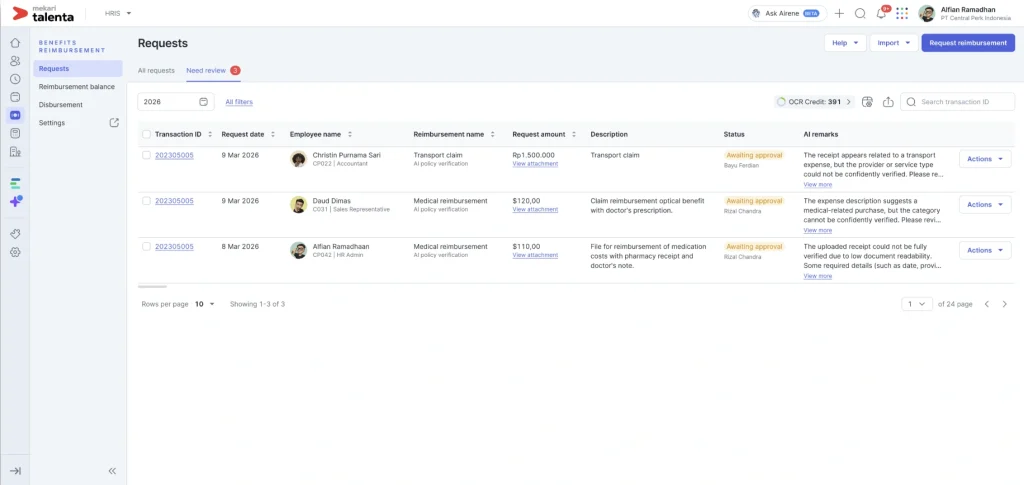
Combined with AI-powered policy validation, the feature can help check whether submitted benefit reimbursement claims align with company-defined rules.
The value of OCR reimbursement, therefore, is not simply that it can “read” a receipt. By turning unstructured documents into usable data, it can support automated validation and make routine verification more consistent at a scale that manual review may struggle to match.
Layer 5: Human Judgment
Even a highly automated expense process still requires human judgment.
People remain responsible for reviewing exceptions, investigating ambiguous claims, interpreting unusual circumstances, and making policy decisions that cannot be resolved through predefined rules alone.
Technology should not replace this layer. It should protect it by reducing the routine verification work that can otherwise consume the attention reviewers need for higher-risk cases.
A well-designed control environment therefore does not aim to remove humans from the process. It aims to ensure that human attention is directed where it adds the most value.
Read More: ISO 27001 Certified HR Software: Why It Matters for Data Security
The Hidden Trade-Off Between Expense Fraud Prevention and Employee Experience
Fraud prevention is rarely free of cost, and that cost is not always financial. It can also show up as friction in the everyday employee experience.
The more controls an organization adds to the reimbursement process, the more opportunities there are for additional approvals, documentation, and manual checks. While these controls may address specific risks, they can also make legitimate expenses harder to submit and process.
1. More Controls Can Create More Friction
Stronger expense controls often introduce additional checkpoints into the reimbursement process.
Employees may need to complete more fields, provide more supporting documentation, obtain additional approvals, or wait for more reviews before receiving reimbursement.
Each control may serve a legitimate purpose, but the cumulative effect can make routine expenses increasingly time-consuming to process.
The challenge becomes particularly visible when the same level of scrutiny is applied to every transaction, regardless of its value or risk.
A routine expense that fully complies with company policy can end up going through the same administrative process as a high-value or unusual claim.
2. Excessive Friction Can Encourage Workarounds
When the reimbursement process becomes too cumbersome, employees may start looking for ways to minimize the burden.
Some may delay submitting legitimate expenses because the process takes too much time. Others may avoid claiming smaller expenses altogether.
Employees may also seek informal approvals outside the official workflow or split expenses to remain below approval thresholds.
These behaviors do not necessarily indicate fraudulent intent. However, they can weaken the organization’s visibility into spending and create inconsistencies in how expenses are reported and approved.
Over time, a process designed to strengthen compliance can inadvertently encourage employees to work around it.
3. Controls Can Gradually Become Part of the Employee Experience
When employees encounter the same administrative barriers repeatedly, those controls become part of how they experience the organization.
A reimbursement process that requires excessive documentation, repeated follow-ups, or unclear approval steps can create the perception that routine business spending is unnecessarily bureaucratic.
This matters because employee behavior is influenced by how easy or difficult it is to follow a process.
When legitimate compliance requires disproportionate effort, employees may become less willing to engage with the formal process consistently.
The issue, therefore, is not simply whether a control exists. It is whether the control is designed in a way that employees can reasonably follow.
4. Inconsistent Enforcement Can Undermine Compliance
Friction becomes even more problematic when expense policies are not applied consistently.
If one manager approves an expense while another rejects the same type of claim, employees may begin to perceive the reimbursement process as dependent on individual judgment rather than clear organizational rules.
This can create a sense of unfairness and make policy boundaries less predictable. Over time, employees may learn which approvers are more lenient, which expenses are likely to receive exceptions, or where policy loopholes exist.
A strong expense control environment therefore needs more than strict rules. Controls must also be clear, consistently applied, and proportionate to the risk they are designed to address.
The Goal Is Control Without Unnecessary Friction
The strongest principle here is simple to state, if harder to execute: automate routine compliance so employees experience less friction, while reviewers gain more visibility into genuine exceptions.
This is where employee experience, fraud prevention, and automation intersect. Getting this balance right is less about choosing between control and convenience, and more about designing a system where the two reinforce each other.
How Leaders Can Evaluate Their Expense Fraud Controls
Evaluating expense fraud controls is less about asking whether fraud has occurred and more about understanding whether the organization is structurally equipped to prevent, detect, and respond to it.
A useful diagnostic starts with a few questions that reveal where control weaknesses may exist across policy, governance, data, and decision-making.
1. Are Expense Policies Clear Enough to Be Enforced Consistently?
A policy cannot function as an effective control if employees and managers interpret it differently.
Leadership should be able to answer whether employees understand what qualifies as a reimbursable expense, which limits apply, what documentation is required, and when additional approval is necessary.
If these boundaries are unclear, the resulting problem is not simply employee awareness. It is a policy design and governance issue.
2. Are Approval Controls Actually Providing Oversight?
The existence of an approval workflow does not necessarily mean that meaningful oversight is taking place.
Examine whether approvers have sufficient information to make informed decisions, whether approval thresholds are appropriate, and whether the same rules are applied consistently across teams.
If approvals have become routine sign-offs, the organization may have an approval process without an effective approval control.
3. How Much Reliance Is Still Placed on Manual Verification?
Manual processes can create both efficiency costs and control risks.
Understand how much of the reimbursement process still depends on employees manually entering transaction data, managers manually reviewing receipts, or finance teams manually reconciling claims.
High levels of manual intervention may indicate that the organization is relying on human attention for controls that could be standardized or automated.
4. Can the Organization Distinguish Routine Spending From Higher-Risk Transactions?
Treating every expense claim the same can create two problems: routine claims receive unnecessary scrutiny, while genuinely unusual transactions may not receive enough attention.
A mature control environment should be able to differentiate between claims that consistently meet policy requirements and those that warrant additional review based on factors such as value, frequency, exceptions, or unusual patterns.
If it cannot, the issue is less about transaction volume and more about risk differentiation.
5. Does Leadership Have Visibility Into Where Exceptions Occur?
Individual policy violations are useful to investigate, but patterns across those violations can be more valuable to leadership.
Leaders should be able to identify where exceptions are concentrated, whether certain expense categories generate disproportionate issues, and whether particular approval workflows or business areas repeatedly require intervention.
Without this visibility, leadership may only see individual incidents rather than the systemic weaknesses behind them.
6. Can the Organization Respond to Exceptions Without Slowing Down Everyone Else?
Effective controls should not require every employee and every transaction to go through the same level of scrutiny.
Leadership should consider whether the organization can isolate higher-risk claims for additional review while allowing routine, compliant expenses to move through the process efficiently.
If every transaction requires the same manual intervention, the control environment may be creating unnecessary friction without proportionately reducing risk.
What These Questions Reveal
The answers to these questions reveal more than whether an organization has experienced expense fraud.
They show whether its control environment is designed to prevent problems proactively or react to them after they occur.
Expense fraud will likely never be eliminated entirely. But organizations can make fraudulent and non-compliant claims harder to pass through while making legitimate expenses easier to process.
The right technology can help strengthen these controls across different types of employee spending. Mekari Talenta supports employee benefit reimbursement management, together with Mekari Expense that is designed for broader business expenses such as travel and other employee spending.
Both solutions help organizations apply clearer policies, streamline approvals, and improve visibility across reimbursement and expense processes.
With OCR and AI-powered capabilities, organizations can also automate receipt data capture and surface potentially non-compliant claims for review. This reduces manual verification while keeping human oversight in place for exceptions that require additional context.
Together, Mekari Talenta and Mekari Expense provide complementary solutions within the Mekari ecosystem, helping organizations strengthen expense controls without adding unnecessary friction to legitimate claims.
If your organization is looking to strengthen its reimbursement and expense controls, explore Mekari Talenta and Mekari Expense to see how each solution can support your needs.
Frequently Asked Questions (FAQs)
What should a company do when it suspects an employee of expense fraud?
What should a company do when it suspects an employee of expense fraud?
Avoid immediately confronting or accusing the employee before the facts are established. Preserve the relevant expense records, receipts, approval history, and transaction data, then follow the organization’s investigation and disciplinary procedures. Depending on the severity and jurisdiction, legal, compliance, internal audit, or external forensic expertise may also be required.
How often should an expense reimbursement policy be reviewed?
How often should an expense reimbursement policy be reviewed?
A policy should be reviewed periodically rather than treated as a one-time document. Organizations should also revisit it when there are significant changes to business operations, travel patterns, approval structures, regulations, or recurring expense exceptions. Patterns in reimbursement data can provide useful evidence for deciding which rules need clarification or adjustment.
Who should own expense fraud prevention?
Who should own expense fraud prevention?
Expense fraud prevention is typically a shared responsibility rather than the sole responsibility of Finance or HR. Finance may own financial controls, while business leaders, managers, internal audit, compliance, and employees each play different roles in maintaining effective controls. Clear ownership and segregation of duties are important so that no single person controls submission, approval, and payment without appropriate oversight.
Can corporate cards eliminate expense fraud?
Can corporate cards eliminate expense fraud?
Corporate cards can improve transaction visibility, but they do not eliminate fraud risk. Personal spending, unauthorized purchases, duplicate claims, and misuse of legitimate business transactions can still occur. Card data becomes more useful for fraud prevention when it can be reconciled with receipts, expense policies, and employee claims.
What expense fraud metrics should leadership monitor?
What expense fraud metrics should leadership monitor?
Leadership can monitor metrics such as policy exception rates, duplicate-claim frequency, average reimbursement processing time, manual intervention rates, and the concentration of exceptions by category or business unit. Trends are generally more informative than isolated incidents because they can reveal recurring control weaknesses. Tracking these metrics can also help leadership assess whether new controls are reducing risk without creating excessive administrative friction.