
Building Expense Reimbursement Policy That Actually Controls Spending

- An expense reimbursement policy defines the rules employees must follow when spending company money and requesting reimbursement.
- To build an expense reimbursement policy, build it around eligible expenses, spending limits, documentation, approval rules, risk levels, exceptions, and continuous review.
Most organizations already have an expense reimbursement policy in some form. Few have stopped to ask whether that policy actually functions as a control, or whether it has simply become a formality attached to the claim form.
That distinction matters more than it might seem. A policy that exists on paper but is not consistently applied offers very little real protection against error, ambiguity, or fraud.
This article looks at what an expense reimbursement policy needs to cover, how it should be designed around risk rather than convenience, and how it connects to the broader process of verifying and reimbursing claims.
What Is an Expense Reimbursement Policy?
An expense reimbursement policy is the rules employees and managers must follow when spending company money and requesting reimbursement. It is, in effect, the rulebook that governs every claim before it reaches an approver.
Its role extends well beyond simply listing what is and is not allowed. A well-built policy defines eligible and ineligible expenses clearly enough to leave little room for guesswork.
It also establishes spending limits and sets documentation requirements that make claims easier to verify.
Approval responsibilities need to be defined just as clearly, so no claim moves forward without accountability attached to it.
Beyond individual claims, the policy creates consistency across teams and locations that would otherwise apply their own informal standards. It also supports financial reporting and audits, since consistent rules produce consistent, auditable records.
Ultimately, its purpose is to reduce ambiguity in reimbursement decisions. When the policy is clear, fewer decisions depend on individual judgment calls that vary from one approver to the next.
Why Expense Policies Become More Important as Organizations Grow
Reimbursement complexity does not scale in a straight line. As more employees begin submitting claims, the variety and volume of transactions expand quickly.
Multiple departments bring different spending patterns with them. A sales team’s travel and entertainment claims look nothing like an engineering team’s software subscriptions.
Frequent business travel adds another layer of complexity, often involving multiple currencies within a single claim. Different tax and regulatory environments across regions complicate this further.
Decentralized approval structures, remote teams, and distributed reporting lines all add friction to what should be a straightforward process. Increasing transaction volume, on top of all this, makes manual oversight progressively less realistic.
The larger the spending environment becomes, the less sustainable it is to rely on individual judgment as the primary control mechanism. At a certain scale, judgment alone simply cannot keep pace with volume.
What Should an Expense Reimbursement Policy Cover?
A useful way to think about policy design is as a framework built to answer five fundamental questions. What can employees claim, and how much can they spend?
What evidence is required to support a claim, and who is responsible for approving it? Finally, what happens when the rules are breached, whether by accident or intent?
Each of the sections below expands on one part of that framework.
1. Eligible and Ineligible Expenses
The policy should define categories that employees can claim with reasonable specificity. These typically include business travel, accommodation, and meals and client entertainment.
Transportation, business supplies, and professional expenses often round out the core list. Communication expenses and other business-related purchases may also warrant their own defined categories.
Just as important, the policy should establish clear examples of expenses that are not reimbursable. Ambiguity here is often where inconsistent claims begin.
Broad categories alone are insufficient to guide real decisions. Vague labels like “travel expenses” leave too much open to individual interpretation.
Ambiguous wording creates room for inconsistent interpretation across different employees and approvers. Two people reading the same sentence can reasonably reach different conclusions about what qualifies.
Strong policies go further by explaining the business purpose required for each category. Requiring a stated purpose turns a generic claim into something that can actually be evaluated.
2. Spending Limits and Allowances
Limits give the policy teeth beyond simply naming eligible categories. These typically cover per-transaction limits alongside daily or monthly limits.
Travel allowances, meal limits, and accommodation caps address the most common areas of variable spending. Mileage or transportation rates, along with department-specific limits where appropriate, round out this section.
Limits work best when they reflect actual business requirements rather than simply being arbitrary numbers. A cap set without reference to real costs tends to generate constant requests for exceptions.
Just as important is defining what happens when a limit is exceeded. Employees and approvers both need clarity on what happens next.
The policy should specify whether exceptions are allowed at all, and if so, under what circumstances. It should also be explicit about who can authorize exceptions and how those exceptions should be documented.
3. Required Documentation and Receipts
Documentation requirements determine how verifiable a claim actually is. At minimum, employees should typically provide a receipt or invoice supporting the transaction.
The date of purchase, the vendor or merchant, and the amount and currency involved should all be captured. The stated business purpose behind the expense matters just as much as the transaction details themselves.
For entertainment or client-related expenses, the policy should require the names of participants involved. Exceptional expenses may call for additional supporting documentation beyond the standard receipt.
Several edge cases deserve specific rules of their own. Missing receipts, digital receipts, and foreign-language receipts all need clear guidance rather than case-by-case decisions.
Foreign-currency transactions and shared expenses split among multiple people also require defined handling. Without clear rules, these edge cases become inconsistent every single time they occur.
Documentation requirements should make legitimate claims easier to verify, not simply make employees produce more paperwork. If a requirement does not improve verification, it is worth questioning why it exists at all.
4. Approval Rules and Authorization Levels
This section defines who can submit expenses and, separately, who can approve them. Approval thresholds should scale with the size and risk of the claim in question.
Exceptional expenses often warrant an additional layer of approval beyond the standard process. The policy should also define clear escalation procedures for claims that fall outside normal parameters.
A foundational principle underlies all of this: segregation of duties. The person incurring an expense should generally not be the only person responsible for validating and approving that expense.
Without this separation, self-approval becomes structurally possible, regardless of how well-intentioned any individual employee might be. The control exists to protect the system, not to imply distrust of any one person.
5. Submission Deadlines and Reimbursement Timelines
Timelines matter as much as the substantive rules themselves. The policy should specify claim submission deadlines and any relevant cut-off periods tied to accounting cycles.
Approval timelines and finance review windows should be clearly stated as well. Reimbursement processing timelines give employees a reasonable expectation of when they will actually be paid back.
Handling of late submissions deserves its own explicit rule rather than ad hoc decisions each time. Clear timelines prevent reimbursement backlogs from building up unpredictably.
They also reduce the pressure for rushed approvals that skip proper verification simply to clear a backlog. A predictable timeline benefits both the employee waiting to be reimbursed and the finance team responsible for processing the claim correctly.
Designing Expense Reimbursement Policies Around Risk
A mature expense policy should be designed based on risk exposure, not simply organized as a long list of permitted expenses. This is a meaningfully different starting point than most policies take.
Instead of asking “what should we allow,” the more useful question is “where is our actual exposure concentrated.” That shift changes how the entire document gets structured.
1. Identify Where Expense Risk Is Highest
Risk is rarely distributed evenly across all types of spending. High-value transactions naturally carry more exposure than routine, low-value ones.
Cash expenses deserve particular attention, since they are inherently harder to trace than card or digital transactions. Travel and entertainment spending tends to concentrate risk as well, given its size and subjectivity.
Vendor-related spending and repeated claims from the same employee or category both warrant closer scrutiny. Manual submissions, by their nature, carry more risk than automated or system-captured ones.
Cross-border expenses introduce currency and documentation complexity that increases risk further. Expenses without sufficient documentation, and unusual spending patterns generally, round out the list of areas worth close attention.
2. Apply Stronger Controls to Higher-Risk Expenses
Once risk areas are identified, the next principle is proportional controls. Not every expense deserves the same level of scrutiny.
| Risk Level | Example | Potential Control |
| Low | Routine office supplies | Standard approval |
| Medium | Business meals | Receipt + business purpose |
| High | Large travel expenses | Additional approval |
| High | Exceptional or policy-exceeding claims | Exception review |
A policy becomes more effective when control intensity corresponds to the financial and fraud risk of the expense.
Applying uniform scrutiny to every claim regardless of risk tends to waste attention on low-risk transactions while under-scrutinizing the ones that actually matter.
3. Build Clear Exception Management
Exceptions should not simply be prohibited outright. In practice, legitimate business needs will always fall outside standard rules from time to time.
A practical policy should define what actually qualifies as an exception in the first place. It should also specify who has the authority to approve one.
Required justification and documentation requirements need to be spelled out clearly. The policy should also address how exceptions are recorded and, critically, how recurring exceptions get reviewed over time.
If exceptions happen frequently, the problem may be the policy itself rather than employee behavior. A high exception rate is often a signal that the underlying rule no longer reflects how the business actually operates.
How Weak Expense Policies Create Fraud Exposure
Policy weaknesses do not just create administrative friction. They also create direct openings for expense fraud, whether opportunistic or deliberate.
1. Ambiguous Rules Create Room for Interpretation
Phrases like “reasonable business expenses” or “moderate entertainment expenses” sound reasonable on their own. In practice, they mean something different to nearly every person who reads them.
The same is true of language like “necessary travel costs,” which offers no concrete threshold at all. Subjective language of this kind makes enforcement inconsistent almost by design.
2. Inconsistent Approvals Weaken Internal Controls
Different managers, even within the same organization, often interpret identical expenses differently. One approver’s routine claim is another’s questionable one.
This inconsistency creates uneven enforcement across teams and locations. It also opens genuine approval gaps that fall through the cracks between different managers’ standards.
Employee confusion tends to follow naturally from this unevenness. Left unaddressed, these gaps become real opportunities for policy abuse.
3. Manual Verification Makes Control Gaps Harder to Detect
Manual processes struggle to reliably catch duplicate receipts submitted more than once. Altered amounts are similarly difficult to spot without a systematic comparison against original documentation.
Claims submitted multiple times across different reports, or expenses that fall outside policy limits, often slip through unnoticed. Suspicious merchant patterns and claims with missing information add further blind spots.
A policy can define the rules clearly and still fail in practice. Organizations still need a reliable mechanism to apply those rules consistently to every single claim, not just the ones that happen to catch someone’s attention.
From Policy to Process: How Expense Claims Should Be Controlled
A policy only creates value when it translates into a consistent process. The reimbursement workflow should therefore be treated as part of the control environment, not simply an administrative sequence.
Step 1 — Employee Incurs a Business Expense
The employee makes a purchase within the boundaries of the expense policy. The expense should fall within an eligible category and comply with any applicable spending limits.
Employees should also retain the required documentation from the point of purchase. Waiting until submission to locate receipts can create documentation gaps that are difficult to resolve later.
Step 2 — Expense Claim Is Submitted
The claim should capture the information needed to evaluate the expense, including the category, amount, transaction date, merchant, business purpose, currency, and supporting receipt.
Capturing complete information upfront reduces unnecessary back-and-forth and gives reviewers a consistent basis for evaluating the claim.
Step 3 — Claim Is Verified
Verification is where the policy becomes an operational control.
The claim should be checked against eligibility rules, spending limits, documentation requirements, duplicate claims, business purpose, and applicable approval requirements.
This stage is also where technology can add significant value. Automated data capture and policy-based validation can help identify incomplete, duplicate, or potentially non-compliant claims before they move further through the workflow.
Step 4 — Claim Is Approved
The appropriate approver reviews the claim based on predefined authorization rules. Approval thresholds should reflect the level of financial risk involved, with higher-value or exceptional claims subject to additional review where necessary.
This also reinforces the principle of segregation of duties: the person incurring an expense should not be the only person responsible for validating and approving it.
Step 5 — Finance Processes the Reimbursement
Once approved, the claim moves into reimbursement and accounting processes. The transaction can then be recorded against the appropriate budget, cost center, or accounting category.
At this point, a well-designed process should allow the organization to maintain a clear audit trail from the original expense through approval and reimbursement.
Step 6 — Expense Data Is Reviewed
The process should not end when the employee receives reimbursement. Aggregated expense data can reveal patterns that individual claims may not make obvious.
Organizations can review spending trends, policy violations, exception frequency, department-level spending, recurring merchants, and other potential risk indicators.
These insights can then feed back into the policy itself. If the same exceptions or violations occur repeatedly, the organization may need to refine its rules, approval thresholds, or controls rather than simply treating each incident as an isolated employee issue.
In this sense, the reimbursement process becomes a continuous control loop: policy defines the rules, the workflow enforces them, and expense data reveals where the controls need to evolve.
Where Technology Fits Into Expense Reimbursement Controls
Technology should support policy enforcement, rather than replace policy design. A strong system cannot compensate for a weak or ambiguous policy underneath it.
Automating Data Capture With OCR Reimbursement
OCR reimbursement is a practical application of automation within this workflow. The technology is becoming increasingly prominent as organizations move away from manual expense reporting toward automated expense management.
Optical character recognition can extract information directly from receipts or invoices without manual transcription.
This typically includes the merchant name, transaction date, and total amount. Tax, currency, and line-item information can often be captured as well, depending on the receipt’s format.
Instead of employees or finance teams manually entering every field by hand, the system captures it directly from the source document.
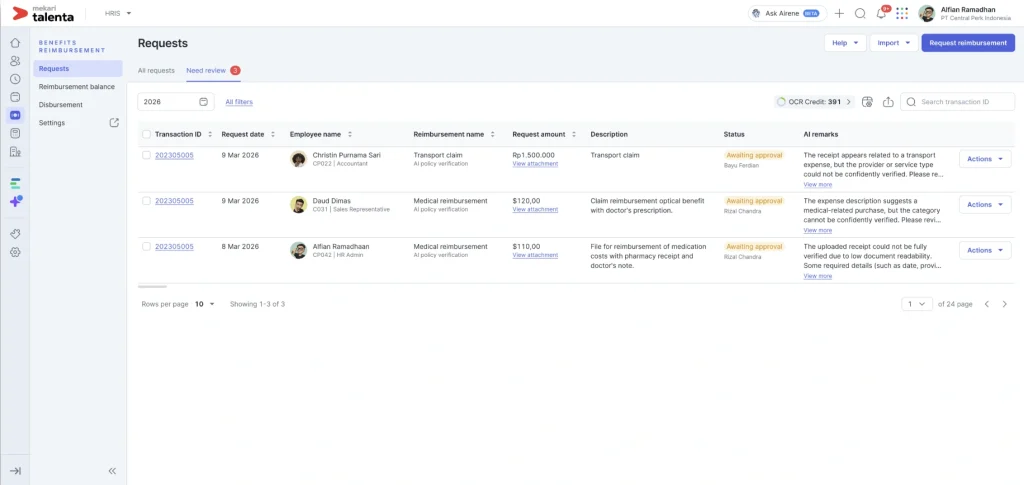
This shifts effort away from repetitive data entry toward actual verification work, while newer reimbursement management solutions, like Mekari Talenta, increasingly combine OCR with policy validation, automated approvals, and AI-powered exception handling.
How OCR Can Reduce Manual Data Entry Errors
The improvements from OCR tend to compound across the process. Less repetitive data entry naturally leads to fewer transcription mistakes downstream.
Claim submission becomes faster for employees, since much of the manual entry disappears. Expense records also become more consistent, since they are drawn directly from the source document rather than retyped by hand.
Verification tends to move faster as a result, since reviewers are working from cleaner, more reliable data. One nuance is worth stating clearly here.
OCR does not determine whether an expense is legitimate. It improves the quality and speed of the data entering the verification process, but the judgment about legitimacy still depends on the policy and the people applying it.
How OCR Can Support Fraud Prevention
OCR can contribute to fraud prevention by making expense data more consistent and easier to validate. When receipt information is extracted directly from the source document, organizations have a more reliable data foundation for identifying anomalies that may otherwise be overlooked during manual processing.
For example, automated data capture can help surface discrepancies between the receipt and the submitted claim, such as differences in transaction amounts, dates, merchants, or expense categories.
It can also make duplicate receipts or repeated transactions easier to identify when claims are compared against existing expense records.
The distinction is important: OCR itself does not determine whether a claim is fraudulent. Its value lies in creating structured, reliable expense data that can be checked against reimbursement policies and other control rules.
Combining OCR With Policy-Based Validation
The real value emerges when data capture and policy validation work together. The relationship can be illustrated as a sequence: expense receipt, OCR data extraction, policy validation, exception detection, approval, and reimbursement.
Consider a few practical examples of this in action. A receipt amount that exceeds the spending limit gets automatically flagged for review.
A submission missing required information gets returned to the employee before it reaches an approver. An expense category that does not match policy gets sent for further review rather than passing through silently.
A duplicate transaction gets detected and investigated before reimbursement occurs. An exception that requires additional approval gets escalated automatically rather than depending on someone noticing it manually.
Automation is most valuable when it operates within a clearly defined policy framework. Without that framework, automation simply processes claims faster without actually improving the quality of the decisions being made.
Best Practice on Building an Expense Reimbursement Policy That Can Scale
Building a policy that works today is one challenge. Building one that continues to work as the organization grows is a different, harder challenge.
1. Standardize the Rules, Not Every Expense
Policies should create consistency without preventing legitimate differences between groups. Departments, job functions, and countries all have genuinely different spending needs.
Travel requirements and the nature of specific business activities also vary widely across teams. The goal is consistent principles applied flexibly, not identical rules applied rigidly everywhere.
2. Make the Policy Easy to Interpret
Clear definitions go further than lengthy explanations. Specific examples help employees translate abstract rules into real decisions they face day to day.
Explicit limits, simple approval rules, and clearly documented exceptions all reduce the need for individual interpretation. Overly legalistic language that employees cannot realistically apply tends to be ignored in practice rather than followed.
3. Design the Policy for Digital Enforcement
This is an increasingly important consideration for policies built today. Rules should be structured so they can eventually be translated into system logic.
An expense category, for instance, can map directly to an allowed or restricted status within a system. An amount can map to a specific approval threshold that triggers automatically.
Location can determine an applicable allowance, while employee role can determine an applicable spending limit. An exception, in turn, can map to a requirement for additional approval before it clears.
The better-defined the policy, the easier it becomes to automate parts of compliance. Vague policies simply cannot be encoded this way, no matter how capable the underlying system is.
Read More: HR Compliance Checklist: A Guide for Scalable HR Operations
4. Review Policies Based on Actual Expense Data
A policy should evolve based on evidence rather than remaining static indefinitely. Organizations can periodically review the most common policy violations that occur.
The most frequent exceptions and highest-spending categories both offer useful signals about where the policy may be misaligned with reality. Repeated reimbursement errors and fraud indicators deserve the same periodic attention.
Approval bottlenecks are worth tracking too, since they often reveal thresholds that no longer match actual spending levels. If the same exception appears repeatedly, it is worth asking whether the policy itself needs to change rather than continuing to treat each instance as a one-off.
How to Evaluate Whether Your Expense Policy Is Working
Reimbursement processing time is a common metric, but it tells only part of the story. A complete evaluation should measure both efficiency and control effectiveness together.
1. Compliance Metrics
Worth tracking here is the overall policy violation rate across all submitted claims. The exception rate offers a related but distinct signal about how often the standard rules do not apply cleanly.
Missing receipt rate and the volume of claims exceeding defined limits both point to documentation gaps. The rejected claims rate rounds out this category, showing how often submissions fail to meet policy from the outset.
2. Process Efficiency Metrics
Average approval time and average reimbursement processing time both indicate how smoothly the workflow is functioning end to end. Manual data-entry volume is worth tracking as a proxy for how much of the process still depends on error-prone manual work.
Claims requiring rework offer a direct signal of friction somewhere earlier in the process, whether at submission, verification, or approval.
3. Risk and Fraud Indicators
Duplicate claims and suspicious transactions are the most direct fraud signals worth monitoring continuously. Repeated policy exceptions, tracked over time, often reveal where the policy itself is being routinely tested or bypassed.
Unusual spending patterns and concentration in high-risk expense categories both deserve regular review, ideally on a recurring cadence rather than only during formal audits.
4. Employee Experience
Employee experience should be considered alongside compliance and control effectiveness. Claim submission friction can influence whether employees follow the process willingly or look for workarounds, while frequent rejections may indicate that the policy is difficult to understand or does not align with actual business needs.
Repeated questions about policy indicate where the document itself may be unclear rather than where employees are simply making mistakes. Time spent resolving reimbursement issues is a final, practical measure of how much friction the process creates for the people actually using it.
A Modern Expense Reimbursement Framework
Bringing the discussion together, a modern expense reimbursement framework should work as a continuous control cycle rather than a linear process that ends once an employee is reimbursed.
Each stage addresses a different part of the risk: defining what is acceptable, capturing reliable information, validating claims, directing exceptions, processing approved expenses, analyzing patterns, and improving the controls based on what the organization learns.
1. Define
The foundation is a clear policy that establishes what employees can claim and under what conditions. This includes eligible and ineligible expenses, spending limits, required documentation, approval thresholds, and rules for exceptions.
The policy should also account for differences in roles, locations, and business requirements where necessary.
More importantly, each rule should be specific enough to be applied consistently by employees, approvers, and finance teams. If a rule cannot be interpreted consistently, it will be difficult to enforce through either manual or automated processes.
2. Capture
Once the rules are defined, the organization needs a consistent way to capture the information required to evaluate each claim.
Employees should provide the expense category, amount, date, merchant, business purpose, currency, and supporting documentation. Digital receipt capture and OCR can reduce manual entry by extracting information directly from receipts or invoices.
The objective is not simply to make submission faster. Structured and complete expense data gives reviewers and automated controls a more reliable basis for determining whether a claim complies with policy.
3. Validate
Validation is where policy becomes an active control.
Each claim should be evaluated against the relevant rules, including expense eligibility, spending limits, documentation requirements, duplicate transactions, business purpose, and approval requirements.
Where technology is available, these checks can be automated to identify straightforward policy violations or anomalies before a claim reaches an approver.
This allows human reviewers to focus on claims that genuinely require judgment rather than spending their time checking every routine field manually.
4. Escalate
Not every exception indicates fraud, and not every claim should follow exactly the same approval path.
Claims that exceed spending limits, contain inconsistencies, lack required documentation, or trigger other risk indicators should be routed for additional review. Higher-value expenses may also require approval from a more senior authority.
A well-designed escalation process ensures that exceptions receive the appropriate level of scrutiny without slowing down routine, compliant claims. It also creates a documented record of why an exception was accepted or rejected.
5. Reimburse
Once a claim has passed validation and received the required approvals, it can move into reimbursement and accounting.
At this stage, efficiency becomes important. Employees should not have to wait unnecessarily for legitimate expenses to be reimbursed simply because the organization has weak or fragmented processes.
At the same time, reimbursement should remain connected to the underlying approval and expense records. This creates traceability from the original transaction through validation, approval, payment, and accounting.
6. Analyze
The reimbursement process generates data that can reveal risks and inefficiencies beyond individual claims.
Organizations can analyze spending by department, category, location, merchant, employee group, or time period. They can also monitor policy violation rates, exception frequency, approval delays, duplicate claims, and other indicators of control effectiveness.
This broader view is particularly important for fraud prevention. A single expense may appear legitimate in isolation, while repeated claims, unusual patterns, or recurring exceptions may become suspicious when viewed across a larger dataset.
7. Improve
The final stage closes the loop by turning those insights into changes.
If certain expenses repeatedly exceed policy limits, the organization may need to revisit its thresholds.
If employees frequently submit incomplete claims, the submission process or documentation requirements may need to be clarified.
If the same type of exception repeatedly requires manual intervention, it may indicate that the policy or workflow needs to be redesigned.
This makes the policy a living control framework rather than a document that is written once and rarely revisited.
The objective is continuous improvement: use actual expense data and control outcomes to make legitimate spending easier to process while making unusual or potentially fraudulent activity easier to identify.
Together, these seven stages create a connected control cycle:
Define → Capture → Validate → Escalate → Reimburse → Analyze → Improve
The strongest expense reimbursement environments are built around this cycle. Policy establishes the boundaries, technology helps enforce them consistently, human judgment handles exceptions, and data provides the feedback needed to strengthen the system over time.
For organizations managing different types of employee spending, the right technology can help operationalize this framework.
Mekari Talenta supports employee benefit reimbursement management, while Mekari Expense is designed for broader business expenses such as travel and other employee spending.
Both are part of the Mekari ecosystem, allowing organizations to address different reimbursement needs with the appropriate workflows and controls.
If you’re looking to strengthen reimbursement and expense controls across your organization, explore Mekari Talenta and Mekari Expense to see how they can support your needs.
FAQ (Frequently Asked Questions)
Who should be responsible for creating an expense reimbursement policy?
Who should be responsible for creating an expense reimbursement policy?
The policy should typically be developed collaboratively by Finance, HR, and relevant business leaders. Finance can define financial controls, while HR can help ensure the policy is practical and clearly communicated to employees. Legal or compliance teams may also review the policy where regulatory or contractual considerations apply.
How often should an expense reimbursement policy be updated?
How often should an expense reimbursement policy be updated?
A formal review at least once a year is a reasonable baseline. However, the policy should also be reviewed after major organizational changes, new regulations, significant changes in spending patterns, or recurring exceptions. Waiting for an annual review alone can leave important control gaps unresolved.
Should expense reimbursement policies be the same for every country?
Should expense reimbursement policies be the same for every country?
Not necessarily. Organizations operating across multiple countries may need a global policy framework with localized rules for tax treatment, currency, statutory requirements, and local business practices. The key is maintaining consistent control principles while allowing necessary local variations.
What should happen when an employee submits an expense that violates the policy?
What should happen when an employee submits an expense that violates the policy?
The appropriate response depends on the type and severity of the violation. Minor errors may be returned for correction, while intentional or repeated violations may require additional review or escalation. Policies should define these consequences clearly so similar cases are handled consistently.
Should employees be required to read and acknowledge the expense policy?
Should employees be required to read and acknowledge the expense policy?
Yes, especially when the policy contains detailed spending limits or approval requirements. Acknowledgment creates a record that employees received and understood the rules, although it should be supported by clear communication and accessible policy guidance. Refresher communication can also be useful when major policy changes are introduced.