
Organizations Are Investing More in Internal Talent Mobility Frameworks — Here’s Why and How

- Transitioning from rigid, siloed job descriptions to a fluid, skills-based internal mobility model allows organizations to dynamically reallocate human capabilities, serving as a vital defense against mounting external talent shortages and widening capability gaps.
- Overcoming major structural roadblocks like manager talent-hoarding and fragmented skills data requires moving past subjective appraisals toward centralized platforms like Mekari Talenta, which uses 9-Box Matrix visualizations and automated succession tracking to surface hidden internal talent.
In the modern corporate ecosystem, talent management has shifted from simply filling open boxes on an organizational chart to dynamically orchestrating human capabilities.
A major global trend highlights this shift: according to empirical data from HR.com’s state of the market, over 80% of organizations now consider talent mobility a significant or critical component of their overarching workforce planning strategy.
This widespread corporate realization proves that locking employees into rigid, lifelong roles is no longer a viable path to long-term business sustainability.
The accelerating trend toward talent mobility is primarily driven by mounting macroeconomic pressures. Organizations worldwide are facing severe external talent shortages, widening internal skill gaps, rapidly changing employee expectations regarding career growth, and an urgent mandate to build highly agile operating structures.
When external recruitment becomes too slow or prohibitively expensive, looking inward to dynamically reallocate existing talent becomes a strategic necessity.
Furthermore, advanced technology implementations are completely reshaping how internal talent moves. The integration of artificial intelligence, predictive workforce analytics, and hybrid or remote work models has removed traditional geographic and departmental barriers.
These tools allow companies to transition away from static, boundary-defined roles toward fluid internal mobility ecosystems, agile cross-functional projects, and skills-based workforce planning.
This strategic evolution is well-supported by global institutional insights. Organizations such as the OECD have continually emphasized the critical importance of career mobility, proactive reskilling, flexible working models, and continuous learning systems.
These pillars are essential not only for boosting corporate output but also for supporting longer, more adaptive working lives in an economy constantly disrupted by technological innovation.
As the corporate landscape continues to evolve, organizations must move away from ad-hoc internal transfers and toward intentional, systematic frameworks.
This comprehensive guide will explore what talent mobility truly means, why it has become an indispensable driver of organizational resilience, the common challenges that cause mobility programs to fail, and the practical strategies leaders can deploy to build a scalable and future-ready internal talent marketplace.
What Is Talent Mobility?
Talent mobility is a structured, systematic process that enables employees to dynamically move across different roles, business functions, projects, geographic locations, departments, leadership tracks, or specialized skill pathways within an organization.
It represents a fundamental break from traditional, linear career models, viewing the workforce instead as a fluid, accessible pool of capabilities that can be deployed rapidly to meet emerging strategic demands.
In practice, a modern talent mobility framework is multi-directional and encompasses several distinct movement pathways:
- Vertical Mobility: Traditional upward promotions within a specific functional department.
- Lateral Mobility: Parallel movements across different roles at the same hierarchical level to broaden employee experience.
- Cross-Functional Mobility: Moving an individual into an entirely different department or business discipline (e.g., transitioning a sales professional into a product marketing strategist role).
- Geographic Mobility: Relocating talent across different regional branches, subsidiaries, or international corporate entities.
- Project-Based Mobility: Temporarily assigning employees to high-priority, cross-functional squads or agile task forces before returning them to their core roles.
- Skills-Based Career Progression: Moving employees through specialized development tracks based on verified competency mastery rather than static tenure.
Ultimately, mature talent mobility is driven by data-backed infrastructure, utilizing deep workforce capability visibility, automated skills mapping, comprehensive competency frameworks, and integrated succession planning.
This approach transforms talent mobility from a series of isolated administrative transfers into an intentional engine designed to optimize workforce capability, minimize leadership dependency risks, maximize organizational resilience, and significantly boost employee retention.
Why Talent Mobility Is Becoming More Important
Building a highly responsive internal talent pipeline has transformed from a progressive HR experiment into a core business imperative for expanding enterprises.
1. Talent Shortages and Skills Gaps Are Increasing
Organizations across all industries are finding it increasingly difficult to fill critical specialist and leadership positions through traditional external hiring. This friction is caused by a shrinking external supply of specialized talent, widening technical skill gaps, fierce market competition, and skyrocketing recruitment overhead costs.
In response, forward-thinking enterprises are shifting away from exclusive reliance on the external market. As highlighted by the HR Research Institute, utilizing internal talent mobility combined with aggressive upskilling and reskilling initiatives has become an organization’s primary defense against severe skills scarcity.
2. Organizations Need More Agile and Adaptable Workforces
The breakneck speed of business transformation, massive AI adoption, and shifting operational requirements demand unprecedented organizational agility. Companies can no longer afford to wait months to source external talent when a new strategic priority arises.
Survival requires an internal workforce capable of moving seamlessly across functions, adapting to unfamiliar roles, learning fresh technical skills at a rapid pace, and aligning instantly with changing business targets. This reality places a premium on an individual’s learning agility, reskilling potential, and transferable core competencies, rather than their static, narrow job specialization.
3. Employee Expectations Around Career Growth Are Changing
The modern workforce, particularly highly skilled professionals, demands a completely different relationship with their employers regarding career development.
According to research from the HR Research Institute, 52% of progressive HR leaders state that formalized talent mobility programs meet employee career aspirations exceptionally effectively.
Modern workers expect clear internal career visibility, continuous skill development, opportunities for lateral experimentation, and transparent progression pathways.
When companies fail to provide this internal visibility, they directly trigger employee disengagement, plunging motivation levels, and a significantly higher turnover risk.
4. Leadership and Succession Gaps Are Becoming More Visible
As organizations scale and diversify across multiple entities, leadership continuity risks multiply. Widespread structural transformations frequently expose weak succession pipelines and sudden leadership vacancies that threaten operational stability.
Talent mobility addresses this vulnerability by acting as a live mechanism to identify high-potential employees (HiPots) early, accelerate their management readiness through real-world stretch assignments, and strengthen long-term internal succession pipelines. Achieving this requires a solid foundation of real-time workforce visibility and integrated competency data.
Read more: What Is Learning & Development (L&D)? Example Programs & Strategy
Common Types of Talent Mobility
To execute an effective internal mobility strategy, human resource leaders must understand the unique mechanics, ideal use cases, and inherent trade-offs associated with each type of movement.
1. Vertical Mobility
Vertical mobility represents the classic advancement of an employee upward through an established departmental hierarchy, typically accompanied by an elevated job title, increased responsibilities, and a higher compensation band.
This type of mobility is ideally suited for highly stable corporate functions with clear, linear skill progressions, such as finance, engineering, or legal departments.
Compared to external executive search, vertical mobility significantly reduces onboarding timelines and maintains institutional knowledge.
However, its primary limitation is the potential creation of a narrow, siloed management layer that lacks cross-functional business perspective. Best practice requires pairing vertical promotions with mandatory multi-departmental project exposure to broaden leadership capabilities.
2. Lateral Mobility
Lateral mobility involves moving an employee to an entirely different role or department at the exact same hierarchical level, keeping their seniority and core salary band intact.
This approach is highly effective for solving structural burnout, addressing localized talent stagnation, and breaking down deep departmental silos.
While it expands an employee’s holistic understanding of the business, its limitation compared to external hiring is that it does not immediately bring fresh, disruptive market perspectives into the team.
Best practice demands that lateral transfers be positioned as a prestigious prerequisite for senior leadership consideration, rather than a remedial adjustment for underperformance.
3. Cross-Functional Mobility
Cross-Functional mobility occurs when an employee transitions across completely different business disciplines, such as an operational manager moving into a client-facing business development role. This movement is perfect for organizations looking to foster intense internal innovation and leverage unique transferable skills.
The main trade-off is the immediate drop in domain-specific technical execution during the initial onboarding phase, which an external specialist wouldn’t experience. Best practice requires supporting cross-functional movers with a structured 90-day technical mentorship program to accelerate their time-to-productivity.
4. Geographic Mobility
Geographic mobility entails the physical relocation of an employee across different regional offices, national branches, or international corporate subsidiaries.
This type of movement is critical for multi-entity enterprises looking to standardize operational quality across new locations, launch regional market expansions, or facilitate global knowledge transfers.
The primary drawback is the significant financial cost of relocation packages and the complex immigration and compliance administration required, which can be far more expensive than hiring a local professional.
Best practice involves reserving geographic mobility for high-potential leaders and utilizing structured pre-assignment cultural briefing programs to ensure landing success.
5. Project-Based Mobility
Project-based mobility relies on the temporary, fluid assignment of workers to specific, high-priority cross-functional task forces, product launch squads, or agile problem-solving teams for a defined timeline. This model is exceptionally well-suited for fast-moving technology, consulting, or creative environments facing volatile project demands.
Its key limitation compared to dedicated hiring is that it can create operational friction and resource deficits within the employee’s original home department.
Best practice requires establishing a transparent internal resource-allocation protocol where a percentage of an employee’s weekly capacity is formally bought back by the project squad.
6. Skills-Based Mobility
Skills-based mobility represents the dynamic, algorithm-matched allocation of talent to specific organizational needs based purely on validated competencies, independent of an employee’s formal job title or current department. This model is ideal for highly complex, non-linear enterprise environments facing rapid digital disruption.
The core challenge is that it requires an exceptionally mature, data-verified skills taxonomy to operate, which can be difficult for developing HR teams to maintain.
Best practice involves deploying an integrated talent marketplace platform that automatically surfaces internal skills profiles and matches them directly to real-time project requirements.
Read more: Cross-Border Hiring: A Strategic Guide for Global Talent Acquisition
The Shift from Job-Based to Skills-Based Talent Mobility
For decades, corporations built their talent management systems around rigid, job-based structures. Career progression was strictly defined by rigid organizational hierarchies and linear vertical promotions within a single siloed department—such as an employee moving predictably from Marketing Associate to Senior Marketer, Marketing Lead, and eventually Head of Marketing.
While this legacy model provided clear administrative simplicity, it has become a major bottleneck in today’s volatile business environment.
Modern organizations must move quickly, redeploy talent dynamically to meet sudden market disruptions, and adjust to rapidly changing skill lifecycles, making traditional, title-bound mobility models highly ineffective.
Rigid Job-Based Model: [Associate] ──> [Senior] ──> [Lead] ──> [Head] (Stuck in one silo)
Modern Skills-Based Model: [Core Skills] ──> Matched to Cross-Functional Projects & Roles Dynamically
To bridge this widening capability gap, progressive enterprises are fundamentally changing their talent philosophy. Organizations are proactively redefining legacy role profiles to focus on underlying capabilities, simplifying complex job descriptions into flexible responsibilities, and prioritizing learning agility and transferable core competencies alongside deep technical expertise.
This enables a dynamic workforce deployment strategy where talent can be reallocated to high-priority business initiatives as needs shift.
Conversely, companies that refuse to evolve and continue to cling to static, inflexible job descriptions often find themselves facing severe operational bottlenecks, unable to fully leverage the diverse human capital already sitting within their walls.
Why Many Talent Mobility Programs Fail
While many human resource leaders claim to have internal mobility initiatives in place, the vast majority of these programs struggle to deliver a measurable business impact or facilitate meaningful talent movement. This failure is typically driven by deep cultural and structural barriers.
1. Managers Still Prioritize External Hiring
A fundamental barrier to internal mobility is deep-seated manager resistance. Data from the HR Research Institute indicates that 33% of organizational leaders routinely prioritize recruiting from the external market rather than intentionally nurturing and advancing their existing employees.
This behavior is fueled by a combination of “the grass is greener” syndrome. assuming external candidates possess superior qualifications, a lack of trust in internal candidate records, and severe talent hoarding, where managers actively conceal their top-performing employees to protect their own localized department outputs.
2. Limited Visibility Into Employee Skills and Internal Opportunities
Many organizations operate in a state of total data fragmentation when it comes to human capital visibility. HR teams frequently struggle with outdated employee skill registries, disconnected performance data silos, and a total lack of internal vacancy transparency.
In fact, limited visibility into internal jobs and employee skills is cited by 30% of HR professionals as the single greatest barrier to successful talent mobility. This information vacuum creates a phenomenon of “hidden talent,” where highly qualified internal employees are completely overlooked for critical openings simply because the organization lacks the data infrastructure to identify them.
3. Rigid Organizational Structures and Silos
Deep-seated organizational silos, historical departmental boundaries, and rigid top-down hierarchies frequently paralyze internal talent movement.
Employees face severe friction when attempting to transfer across different business units, regional branches, or distinct functional teams because the corporate operating model is highly segmented.
Successfully scaling a mobility program requires comprehensive organizational change management and leadership alignment, rather than the simple creation of an internal job board.
4. Skills Frameworks and Workforce Data Are Difficult to Manage
Building and maintaining a scalable corporate skills taxonomy is an exceptionally difficult operational task. Role profiles evolve rapidly, skills taxonomies easily become overly complex and confusing, and self-reported employee competency data goes stale within months.
Without validated skill tracking, standardized competency baselines, and a reliable analytics engine, senior leadership will always lack the confidence to base high-stakes internal mobility and promotion decisions on their existing HR data.
5. Talent Mobility Decisions Are Still Highly Subjective
Remuneration and promotion decisions within developing companies are still heavily corrupted by subjective biases, manager favoritism, and casual internal networks.
According to global research, 44% of companies base internal placement decisions entirely on standard performance reviews, while only 29% incorporate objective, skills-based competency assessments.
Relying solely on localized performance appraisals creates massive visibility bias, introduces severe evaluation inconsistencies, and completely overlooks high-potential employees who may be underutilized in their current roles.
How Talent Mobility Differs Between Mature and Developing Organizations
An organization’s capacity to scale internal mobility depends entirely on its operational maturity. The HR Research Institute categorizes businesses into “mobility leaders” (mature organizations) and “mobility laggards” (developing organizations) based on how deeply their programs are integrated into the core business strategy.
Talent Mobility Is More Embedded Into Workforce Strategy
Mature mobility leaders position internal talent movement as a core component of their macroeconomic talent strategy, succession planning, and broader corporate agility initiatives.
Conversely, developing laggards view talent mobility through a narrow, tactical lens, treating it merely as an ad-hoc internal hiring process or a basic vacancy posting system.
Mature Organizations Have Better Skills Visibility
Mobility leaders build highly effective systems to map employee skill sets, track individual development velocity, and provide managers with absolute visibility into internal talent pools.
Developing organizations, on the other hand, remain trapped in a state of data fragmentation, consistently struggling with incomplete employee profiles and blind spots regarding actual workforce capabilities.
Core Insight: Many organizations do not lack raw talent internally; rather, they completely lack the visibility and data infrastructure required to see the talent they already have.
Mobility Decisions Are More Data-Driven
In mature organizations, internal placements are backed by deep workforce analytics, objective competency tracking, and data-driven matching algorithms.
Developing organizations continue to rely heavily on subjective manager recommendations, gut feel, and isolated annual performance reviews to make internal placement decisions.
Mature Organizations Prioritize Learning Agility and Adaptability
Mobility leaders evaluate talent based on long-term learning potential, reskilling capacity, and transferable core attributes rather than matching a candidate’s background perfectly to a rigid job description.
Developing organizations remain constrained by static historical profiles, heavily prioritizing linear department tenure and narrow specialization.
Technology and AI Play a Bigger Role in Mature Organizations
Mature enterprises successfully scale talent mobility by leveraging advanced AI-driven matching engines, integrated internal talent marketplace software, and fully centralized cloud-based HCM platforms.
Developing organizations are consistently slowed down by manual spreadsheet workflows, disconnected software systems, and inaccurate talent records.
How Companies Build Effective Talent Mobility Frameworks with Mekari Talenta
1. Identify Critical Roles and Skill Gaps with Succession Planning
The first step is knowing where mobility is most needed: which roles are hard to backfill, which functions face leadership gaps, and where your pipeline is thin.
In Mekari Talenta, go to Talenta Performance → Talent Management → Succession Plan, then click “Create Succession Plan.”
From here, you define the key position, set the division scope, and specify employment criteria such as tenure or contract type.
The system then prompts you to add candidates to a succession pool and assign a readiness level to each one, either based on live performance cycle data already in the platform, or through manual input if assessments are done externally.
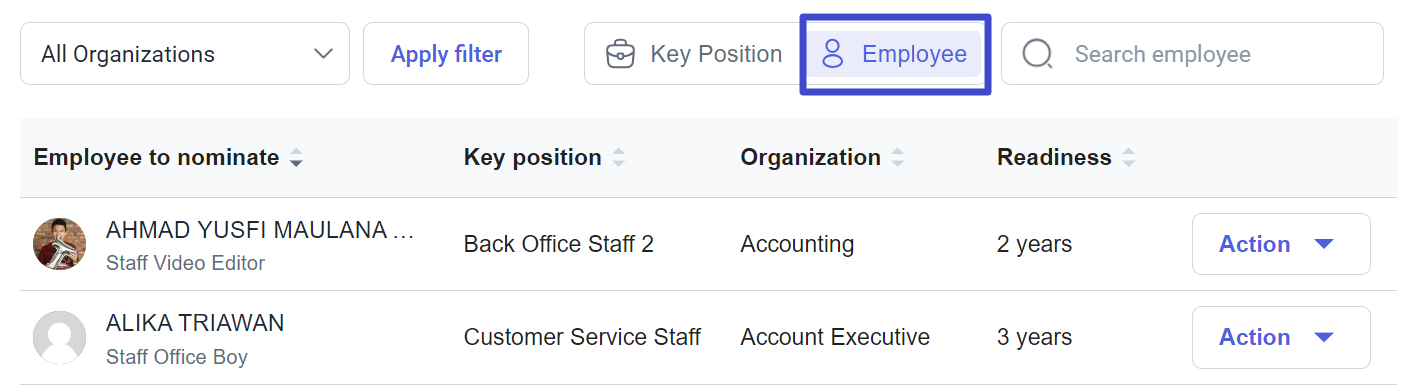
A company scaling its digital operations, for example, can open the Succession Plan dashboard and filter the Data & Analytics function to review internal succession readiness.
Instead of immediately assuming external hiring is necessary, HR teams can identify which employees are categorized as “Ready Now” and which are still considered “Ready in 1–2 Years,” allowing them to plan promotions, development programs, or hiring strategies earlier and more strategically.
Employees categorized as “Ready Now” are considered to already meet the competency standards required for the role, making them strong candidates for immediate promotion or accelerated mobility opportunities.
Meanwhile, employees labeled “Ready in 1–2 Years” typically demonstrate strong potential but still require development in one or two capability areas, which organizations can address through individual development plans (IDPs), mentorship, or stretch assignments.
For long-term successors who are still in the early stages of readiness, companies can continue monitoring their progress through ongoing performance and talent review cycles to gradually prepare them for future leadership opportunities.
2. Define Career Pathways Using Competency Frameworks
Employees don’t pursue internal mobility when they can’t see what’s required to get there. Without visibility into the skills, behaviors, and proficiency levels required for a target role, career progression often becomes subjective and difficult to plan.
To create clearer mobility pathways, companies need a structured competency framework that defines what success looks like at every career stage.
Our Competency Management feature solves this by letting HR define exactly what each role demands — the skills, behaviors, and proficiency levels expected at every career stage.
Go to Talenta Performance menu → Competency → Set Up Competency to build your competency library.
For example:
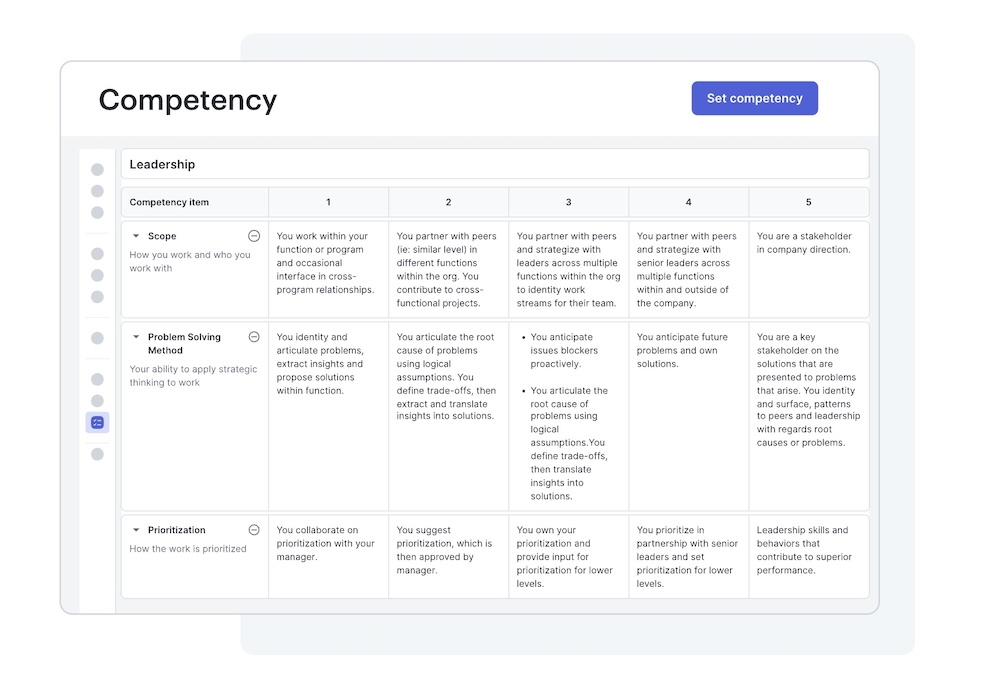
Once competency frameworks are established, companies can map them directly to specific job positions through Competency → Assignment → Create Assignment to map specific competency profiles to job positions across divisions.
This allows each role to have a measurable capability benchmark that employees and managers can use as a reference for career progression and internal mobility planning.
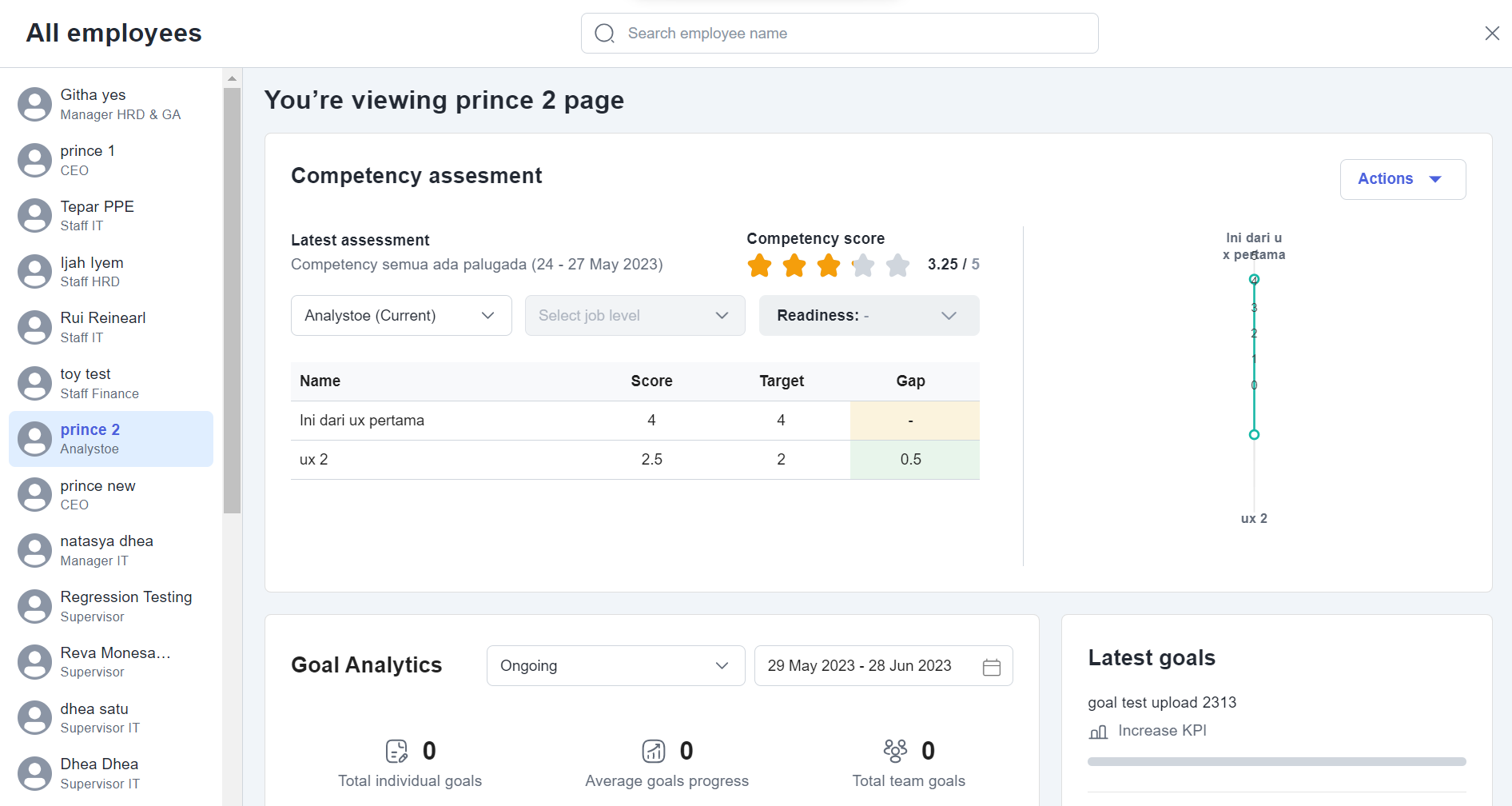
Once frameworks are in place, employees and managers can clearly see what the gap is between a current role and a target role — whether that’s a vertical move (Associate → Senior) or a lateral one (HR Operations → People Analytics, Finance Analyst → Business Strategy). This turns mobility from a vague conversation into a measurable checklist.
3. Surface Hidden Talent with the 9-Box Matrix
Before investing in external hiring, it’s worth checking what’s already inside.
Our 9-Box Matrix visualization, available under Performance Management, automatically plots employees on a grid of performance vs. potential, updated from live appraisal data.
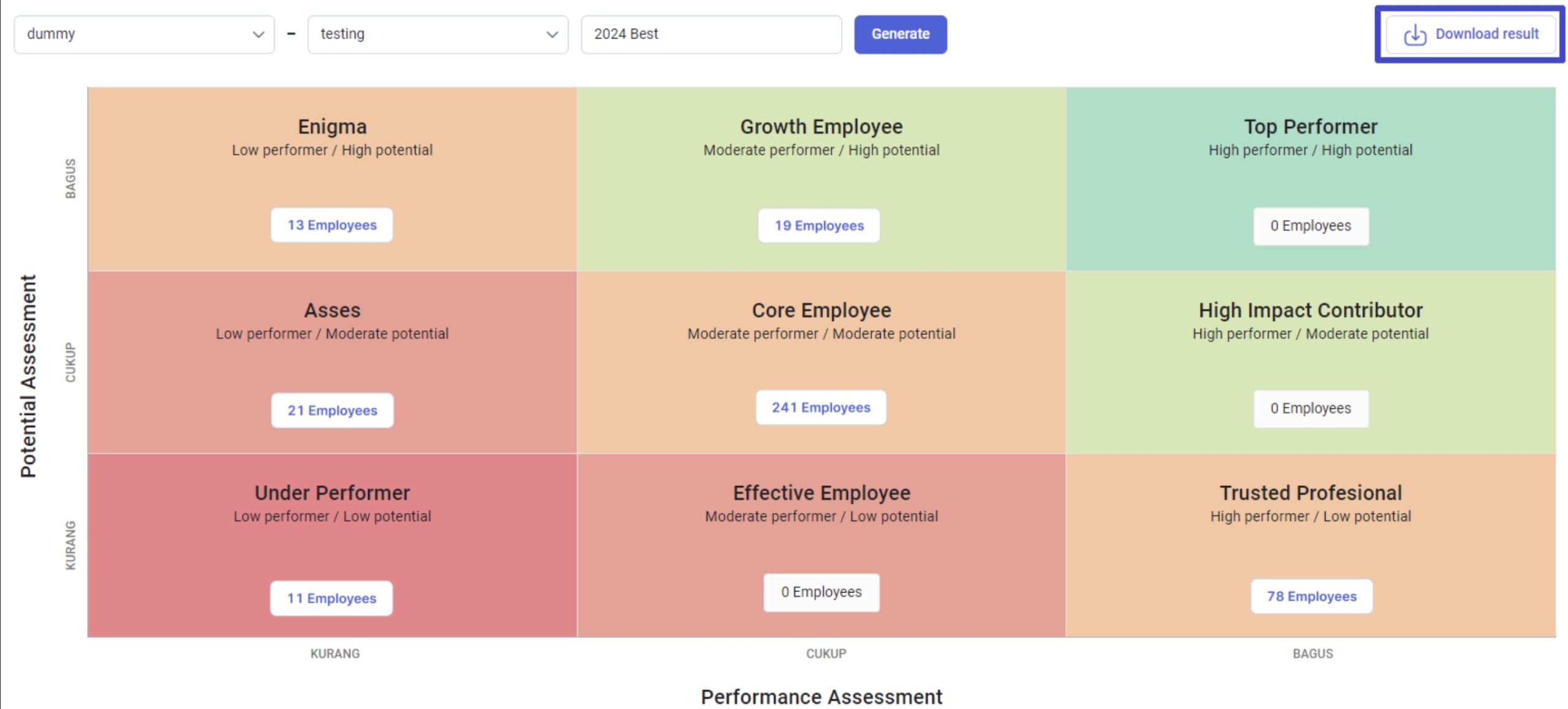
This makes it easy to spot employees who are high-potential but currently in low-visibility roles, exactly the kind of hidden talent that internal mobility programs are designed to unlock.
4. Build Career Pathways into IDPs
Once target roles are clear, development needs a structure.
Go to Talenta Performance → Talent Management → Individual Development Plan → Create Program to build an IDP for any employee.
Inside a program, you define action plans with specific types — training, self-learning, coaching, mentoring, or stretch assignments — along with timelines and measurable outcomes.
With this feature, managers can review progress directly in the platform, and employees can track their own development journey in one place.
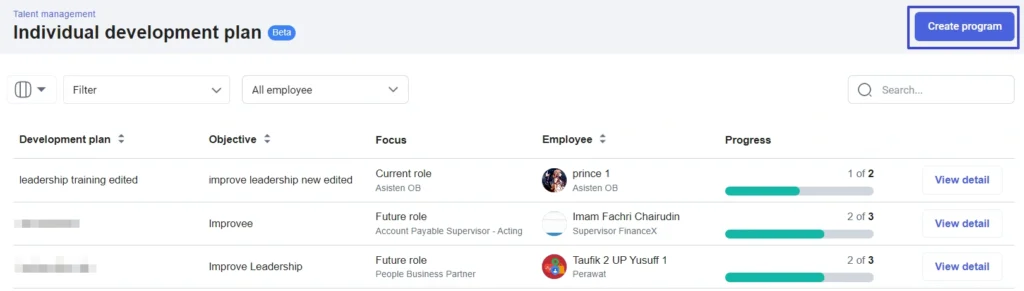
Example of what a complete IDP entry looks like:
| Field | Example |
| Development Plan Name | People Analytics Transition Program |
| Objective | Prepare employee for transition from HR Operations to People Analytics |
| Employee | Amanda Lee |
| Informal Education | Completed internal Excel reporting workshop |
| Focus Plan | Future job position |
| Action Plan | HR Analytics certification course, shadowing workforce reporting team, participation in dashboard project |
| Action Plan Details | Complete certification within 6 months and contribute to two internal workforce dashboards |
Because IDP data sits in the same system as competency assessments and performance reviews, managers don’t need to chase down development updates across spreadsheets and emails.Iit’s all visible in one employee profile.
5. Connect Learning to Mobility with LMS Integration
Not every employee who wants to move into a new role is ready on day one.
Our Learning Management System (LMS) lets HR assign structured learning paths that map directly to the competency requirements of target roles.
When an employee’s IDP identifies a skill gap — say, data visualization for a People Analytics move — HR can assign the relevant course directly through the platform.
Completion status and learning progress are tracked in the same system, so succession readiness scores stay current without manual updates.
6. Measure Whether Mobility Is Actually Working
Mobility programs only improve if you know what’s working.
Our AI & Analytics capabilities consolidate talent data — IDP completion rates, succession pool readiness, performance trends, and retention — into dashboards that HR leaders and business heads can actually act on.
Because Mekari Talenta connects talent management with HRIS and payroll data across the ecosystem, you can go beyond HR metrics and see whether internal movers are performing better, staying longer, and advancing faster than those who stayed in static roles.
How to Measure Talent Mobility Effectiveness
To ensure that internal talent reallocations are actively strengthening the business, organizations must move beyond tracking simple transfer volumes and deploy a balanced set of quantifiable talent metrics.
1. Measure Internal Fill Rate
The internal fill rate calculates the exact percentage of open corporate positions—specifically critical specialist seats and leadership roles—that are successfully filled by existing employees rather than external hires.
A consistently rising internal fill rate proves that an organization possesses healthy internal talent pipelines, clear skills visibility, and an effective internal mobility framework. Achieving a high internal fill rate dramatically reduces corporate recruitment overhead and slashes employee time-to-productivity.
2. Track Retention After Internal Mobility
A primary goal of implementing a mobility program is to extend the career lifecycle of top-performing assets. HR teams should measure and compare the long-term retention rates, engagement scores, and performance appraisals of employees who have transitioned through internal mobility tracks against those who have remained in static roles.
When executed properly, multi-directional internal mobility serves as one of a company’s strongest talent retention drivers.
3. Evaluate Workforce Skills Growth and Readiness
Enterprises must evaluate whether their internal mobility loops are successfully closing core competency gaps and strengthening succession pipelines.
Key indicators to track include the rate of individual competency score improvements, professional certification completion speeds, active learning participation metrics, and overall leadership readiness scores within the succession pool. Tracking these indicators enables organizations to quantify how effectively their reskilling programs are preparing the workforce for future disruptions.
4. Monitor Mobility Participation and Opportunity Visibility
An effective mobility program requires high employee trust and active engagement. HR leaders must continuously monitor internal application rates across departments, participation speeds in rotational programs, and employee awareness levels regarding internal career pathways.
A low internal application rate typically flags underlying issues, such as restrictive manager talent-hoarding behaviors, poor internal job visibility, or unclear career progression frameworks.
5. Use Workforce Analytics to Identify Bottlenecks
Mature organizations leverage advanced workforce analytics to pinpoint hidden friction points across their operating structures. Data analysis should be used to flag departments with unusually low internal talent movement, identify specific managers who exhibit bias toward external hiring, uncover slow mobility approval workflows, and trace business units with chronic succession gaps.
Relying on objective data insights enables companies to continuously optimize their workforce planning and refine their internal talent marketplace.
Building a More Scalable Talent Mobility Strategy with Mekari Talenta
As organizations grow, managing talent mobility manually becomes increasingly complex. HR teams must coordinate competency frameworks, succession readiness, internal hiring, learning development, performance evaluations, and workforce planning across multiple departments and managers.
In practice, many organizations face challenges such as fragmented employee data, unclear career pathways, inconsistent promotion criteria, limited skills visibility, and disconnected talent management processes.
As an integrated HCM platform, Mekari Talenta helps organizations manage talent mobility more strategically through connected talent management features within a centralized system.
With Mekari Talenta, companies can:
- Build customizable competency and career frameworks aligned with organizational structures and business goals.
- Connect performance reviews, development plans, learning progress, and succession readiness within a unified employee lifecycle system.
- Improve workforce visibility through centralized employee data, competency tracking, and talent analytics.
- Support internal mobility and succession planning using measurable workforce insights rather than subjective decision-making.
- Reduce operational fragmentation by integrating workforce processes across HR operations, approvals, performance management, and broader business workflows.
This connected operating model supports organizations in building more scalable, data-driven, and transparent talent mobility programs while improving workforce continuity and long-term talent retention.
Mekari Talenta’s talent management capabilities can also be implemented modularly based on organizational needs, allowing companies to strengthen talent mobility processes without overhauling their entire HR infrastructure immediately.
Schedule a consultation with the Mekari Talenta team to explore how integrated talent management and workforce visibility can help your organization build a more scalable and effective talent mobility strategy.
Reference:
HR.com – Talent Mobility Programs 2025
OECD – Promoting Better Career Mobility for Longer Working Lives in UK
FAQ
1. What is the fundamental difference between traditional job-based career progression and modern skills-based talent mobility?
1. What is the fundamental difference between traditional job-based career progression and modern skills-based talent mobility?
Traditional career progression is strictly linear, rigid, and siloed. Employees move predictably upward within a single department (e.g., Marketing Associate $\rightarrow$ Senior Marketer $\rightarrow$ Marketing Lead), which often locks talent into restrictive boxes.
In contrast, modern skills-based talent mobility treats the workforce as a fluid pool of capabilities. Instead of looking at rigid job titles, organizations deconstruct roles into core competencies and dynamically match employees to cross-functional projects, lateral shifts, or strategic task forces where their verified skills are needed most.
2. Why do many internal talent mobility programs fail even when companies have internal job boards?
2. Why do many internal talent mobility programs fail even when companies have internal job boards?
Simply opening internal vacancies rarely works because of deep-seated structural and cultural barriers:
-
Manager Resistance (Talent Hoarding): Managers often act as gatekeepers, intentionally hiding or retaining their top performers to protect their own localized department outputs.
-
The “Grass is Greener” Bias: Many leaders incorrectly assume external talent is inherently more qualified than internal team members.
-
Data Fragmentation: Without centralized skills intelligence, companies suffer from “hidden talent”—qualified internal employees who are completely overlooked because their cross-functional skills aren’t visible on spreadsheets.
-
Subjectivity: Placement decisions are often based purely on standard annual performance reviews (44%) rather than objective, skills-based competency assessments (29%).
3. How do "mobility leaders" (mature organizations) approach talent movement differently than "mobility laggards"?
3. How do "mobility leaders" (mature organizations) approach talent movement differently than "mobility laggards"?
The distinction lies in how deeply data and strategy are integrated into workforce planning:
| Aspect | Mobility Laggards (Developing) | Mobility Leaders (Mature) |
| Strategic Role | Treated as a standalone HR internal hiring process. | Embedded into macro talent strategy and succession planning. |
| Evaluation Focus | Static job profiles, department tenure, and current role fit. | Learning agility, reskilling potential, and transferable skills. |
| Decision-Making | Subjective manager judgment or performance appraisals alone. | Workforce analytics, skills intelligence, and data-driven matching. |
| Technology Stack | Manual spreadsheets and disconnected, fragmented systems. | AI-driven talent marketplaces and centralized HCM platforms. |
4. What are the most reliable metrics to track to evaluate if a talent mobility program is actually working?
4. What are the most reliable metrics to track to evaluate if a talent mobility program is actually working?
To measure true effectiveness beyond simple transfer volumes, HR leaders must monitor:
-
Internal Fill Rate: The percentage of open specialist and leadership positions successfully filled by existing employees instead of external hires.
-
Retention Velocity: A comparative tracking of retention rates and engagement levels between internal movers and employees who remain in static roles.
-
Skills Growth & Readiness: The speed at which employees close competency gaps and advance their leadership readiness within the corporate succession pool.
-
Mobility Participation Rate: Tracking internal application metrics across different departments to flag hidden management bottlenecks or talent-hoarding behaviors.
5. How can platforms like Mekari Talenta help HR teams systematically surface "hidden talent"?
5. How can platforms like Mekari Talenta help HR teams systematically surface "hidden talent"?
Mekari Talenta eliminates subjectivity by automating the visibility of employee capabilities across the entire lifecycle. Through its Succession Planning module, HR teams can build live talent pools and categorize successors based on clear readiness levels (“Ready Now” vs. “Ready in 1–2 Years”).
Simultaneously, the automated 9-Box Matrix visualization cross-references live performance appraisal data against calculated leadership potential. This instantly plots employees on a dynamic grid, making it effortless for HR and senior heads to spot high-potential, highly agile workers who may currently be siloed in low-visibility or disconnected departments.