

Cost Per Hire: Formula, Benchmarks, and Reduction Guide



-
Cost per hire is a recruitment KPI that measures the total internal and external costs incurred to hire one employee during a specific period.
-
To calculate cost per hire, add all internal and external recruitment costs, then divide the total by the number of successful hires to accurately measure hiring efficiency.
For an enterprise running hundreds or thousands of hires a year across multiple business units, countries, and brands, recruitment spend is no longer a line item HR quietly manages on its own.
It is a number that finance leadership actively questions, especially when headcount budgets tighten and every requisition has to be justified.
At enterprise scale, even a small, unexplained increase in average hiring cost translates into hundreds of thousands of dollars across a single fiscal year.
That is exactly why cost per hire (CPH) has moved from a back-office recruiting statistic to a metric that CFOs, CHROs, and boards now expect to see broken down, defended, and improved.
This guide walks through what cost per hire actually measures, how to calculate it correctly at enterprise scale, what typically gets left out of the number, current benchmarks, and the implementable steps HR teams can take to bring the number down without quietly trading away hiring quality.
What Is Cost Per Hire?
Cost per hire is the total amount an organization spends, internally and externally, to fill one open position, divided by the number of people actually hired in a given period.
The widely used SHRM/ANSI standard defines this as everything spent from the moment a requisition is approved through the candidate’s start date, not including what happens after day one.
The practical nuance is that CPH should never be tracked as a single company-wide blend. A figure averaged across factory operators, sales associates, and senior engineers tells leadership almost nothing useful about where hiring dollars are actually going.
At enterprise scale, hiring is directly tied to revenue capacity, market expansion, and the pace at which new business units can become operational.
A cost per hire that creeps upward without a clear business reason is an early signal of inefficiency that compounds across every open requisition.
This is also why recruiting budgets are increasingly treated as a strategic investment rather than a fixed administrative cost.
A 5 to 10 percent reduction in average cost per hire, applied across an enterprise making thousands of annual hires, returns real, board-visible savings without requiring a single additional headcount cut elsewhere.
Why Cost Per Hire Is an Important Recruitment KPI
Cost per hire only earns its place on an executive dashboard when it is used to drive decisions, not just reported as a number.
1. Improves recruitment budget planning
Tracking cost per hire by role family and region lets enterprises forecast recruiting spend accurately when planning for growth, expansion into new markets, or seasonal hiring surges.
Without this baseline, hiring budgets tend to be built on rough guesses rather than historical, defensible data.
2. Measures hiring efficiency
A consistent cost-per-hire trend line, tracked over time and segmented by business unit, makes it possible to see whether the recruiting function is genuinely getting more efficient or simply hiring fewer people in slower periods.
This distinction matters enormously when leadership asks whether a recruiting team or budget increase is actually justified.
3. Supports workforce planning
Cost per hire data feeds directly into manpower planning and annual headcount budgeting, since knowing the realistic cost of filling a role type helps finance and HR build accurate hiring forecasts rather than rough estimates.
This is particularly valuable when an enterprise is modeling the cost of opening a new regional office or scaling a function quickly.
4. Helps optimize recruitment channels
Segmenting cost per hire by source, such as referrals, organic applications, job boards, or agencies, reveals which channels deliver the best return for each role type.
An enterprise that discovers its referral program produces hires at a third of the agency cost has a clear, data-backed case to shift budget accordingly.
5. Demonstrates recruitment ROI
A well-tracked cost-per-hire metric gives the talent acquisition function a credible, finance-friendly way to justify investment in headcount, technology, or process redesign.
Rather than asking leadership to take recruiting efficiency on faith, HR can show exactly what a given investment returned in reduced spend.
What Costs Should Be Included in Cost Per Hire?
The SHRM/ANSI standard is explicit that cost per hire should capture every sourcing, recruiting, and staffing expense incurred up to a candidate’s start date.
The categories below give HR teams a practical checklist to audit against their own numbers.
1. Recruiter salaries and labor costs
This includes the fully loaded compensation of recruiters and talent acquisition coordinators, prorated for the share of their time spent on active hiring versus other responsibilities like employer branding or workforce planning.
Hiring manager and interviewer time should be included as well; at a loaded rate of roughly 100 USD per hour, just 15 hours of interview and debrief time across a hiring panel already adds 1,500 USD to a single hire.
2. Job advertising expenses
Job advertising covers organic and paid job postings, promoted listings on platforms such as LinkedIn, and any programmatic advertising used to extend reach for hard-to-fill roles.
Enterprises hiring across multiple countries often pay for several overlapping job board subscriptions and promoted listings per region, which is one of the easiest categories to consolidate and reduce without affecting candidate reach.
3. Recruitment agency fees
Agency and executive search fees are typically calculated as a percentage of the placed candidate’s first-year base salary, commonly 15 to 25 percent for contingency search and rising to 25 to 35 percent for retained executive search, per industry fee benchmarks compiled by Eddy’s HR encyclopedia.
For a director-level hire on a 150,000 USD base salary, a 25 percent fee alone equals 37,500 USD, often more than the entire internal cost of the hire combined.
4. Recruitment software and ATS costs
This category includes the prorated subscription cost of the applicant tracking system, sourcing platforms, interview scheduling tools, and any assessment software used during the hiring process.
Many enterprises accumulate overlapping point solutions over time as different business units adopt their own tools, which is worth auditing periodically since consolidating onto a single integrated platform usually lowers the per-hire technology cost.
5. Candidate assessment and background checks
Skills tests, personality assessments, background checks, reference checks, and credential verification all carry a direct per-candidate cost, and these costs scale up quickly in high-volume or regulated hiring, such as finance, healthcare, or logistics roles requiring license verification.
You should track this category separately by role family, since assessment depth that is appropriate for a finance controller is usually unnecessary overhead for a warehouse associate.
6. Interview and travel expenses
This includes travel, accommodation, and meal costs for candidates flown in for onsite interviews, which is especially relevant for senior, cross-border, or relocation-based hires.
It also includes the cumulative cost of interviewer time across multiple rounds, which tends to be underestimated the more interview stages a process has.
7. Onboarding costs
While the SHRM/ANSI standard technically treats cost per hire as ending at the candidate’s start date, many enterprises choose to track the transitional administrative work that happens during the hiring process itself, such as offer letter generation, digital signature, and initial IT or system access provisioning.
Tracking this separately, rather than folding it silently into “internal costs,” gives a clearer picture of where pre-start administrative time is actually going.
How to Calculate Cost Per Hire
Once the concept is clear, the next step is applying a consistent formula that finance, HR, and business unit leaders can all trust.
1. Cost per hire formula
The standard formula is straightforward:
Cost Per Hire = (Total Internal Recruiting Costs + Total External Recruiting Costs) ÷ Total Number of Hires in the period.
The number of hires should reflect people who actually started, not offers extended, since a declined or withdrawn offer still consumes the full recruiting spend with zero return.
For enterprises running concurrent hiring campaigns across regions, a quarterly calculation cadence works better than an annual one.
It surfaces cost trends and process breakdowns early enough to correct course before they show up in a year-end budget review.
2. Internal recruitment costs
Internal costs cover everything an organization spends through its own people and systems to run the hiring process.
For most enterprises, this typically includes:
- Fully loaded salaries and benefits for the talent acquisition team, prorated to the time spent on active hiring
- Hiring manager and interviewer time, calculated by multiplying hours spent screening, interviewing, and debriefing by each participant’s loaded hourly cost
- HR administrative and coordination time across scheduling, offer preparation, and compliance checks
- Prorated subscription costs for the applicant tracking system (ATS), sourcing tools, and scheduling software
- A share of recruiting department overhead, such as office space and equipment allocated to the hiring function
The hardest part for most enterprises is honestly estimating hiring manager and interviewer time, since this labor is rarely tracked anywhere. A simple hours-based estimate, even an imperfect one, is far more useful than leaving this cost out entirely.
3. External recruitment costs
External costs are the expenses paid to outside vendors and are usually easier to total because they appear as direct, invoiced line items. The most common categories include:
- Job board postings, promoted listings, and programmatic advertising spend
- Recruitment agency, executive search, or RPO fees, which commonly range from 15 to 25 percent of first-year salary for contingency search and 25 to 35 percent for retained executive search, according to Eddy’s overview of recruitment fee structures
- Background checks, credential verification, and pre-employment assessments
- Candidate travel, accommodation, and relocation costs for onsite or cross-border interviews
- Employee referral bonuses paid out for successful hires
For enterprises hiring specialist or leadership roles across multiple countries, agency and search fees are very often the single largest external cost line, which makes this category the first place to look when cost per hire trends upward.
Cost per hire calculation example
Consider a multinational manufacturing company, Atlas Industrial Group, which hired 220 employees across Indonesia, Singapore, Vietnam, and Malaysia during one quarter. The company calculated its recruitment costs by separating internal and external expenses.
Internal Recruitment Costs
| Cost Component | Amount (USD) |
|---|---|
| Talent acquisition team salaries & benefits | 145,000 |
| Hiring manager & interviewer time | 82,000 |
| HR administration & recruitment coordination | 28,000 |
| ATS, sourcing & interview scheduling software | 36,000 |
| Recruitment department overhead | 19,000 |
| Total Internal Costs | 310,000 |
External Recruitment Costs
| Cost Component | Amount (USD) |
|---|---|
| Job board advertising & sponsored postings | 48,000 |
| Recruitment agency fees | 142,000 |
| Background checks & employment verification | 22,000 |
| Pre-employment assessments | 18,000 |
| Candidate travel & relocation | 16,000 |
| Employee referral bonuses | 14,000 |
| Total External Costs | 260,000 |
Cost per Hire Calculation
| Item | Amount |
|---|---|
| Total Internal Costs | USD 310,000 |
| Total External Costs | USD 260,000 |
| Total Recruitment Costs | USD 570,000 |
| Total Hires | 220 |
| Cost per Hire | USD 2,591 |
Formula:
Cost per Hire = (USD 310,000 + USD 260,000) ÷ 220 = USD 2,591
A more detailed analysis also revealed that the average recruitment cost varied significantly by role.
| Position Type | Average Cost per Hire (USD) | Primary Cost Driver |
|---|---|---|
| Production Operator | 1,350 | High application volume, employee referrals |
| Corporate Support | 2,900 | Multiple interview rounds & assessments |
| Specialist Engineer | 8,700 | Recruitment agency fees, technical assessments, relocation |
| Executive Leadership | 18,000+ | Executive search firm, extensive interviews, international travel |
Rather than relying solely on an overall cost per hire, organizations should also analyze the metric by job family, seniority level, business unit, or hiring channel.
This provides more actionable insights into where recruitment budgets are being spent and helps identify opportunities to improve efficiency without compromising hiring quality.
Cost Per Hire Benchmarks
Benchmarks are useful as a starting point for a conversation, not as a fixed target every enterprise should aim to hit, since role mix and process maturity explain most of the spread between organizations.
Average cost per hire by company size
Larger organizations consistently report lower average cost per hire than smaller companies, mainly because fixed costs like recruiting software and dedicated TA headcount are spread across a much higher volume of annual hires.
Enterprises with established, specialized talent acquisition functions and high hiring volume typically land toward the lower end of the spectrum, while smaller organizations making only a handful of hires a year often see costs several times higher per hire simply because there is no scale to absorb fixed expenses.
Average cost per hire by industry
SHRM’s 2025 data places the national non-executive average at 5,475 USD and the executive average at 35,879 USD, a figure that has climbed 21 percent since 2022.
A higher cost per hire is not automatically a red flag, either: Bersin by Deloitte research found that the most mature recruiting organizations spend 6,465 USD per employee on talent acquisition, nearly double the 3,258 USD spent by low-maturity organizations, yet achieve 40 percent lower new-hire turnover and fill roles 20 percent faster.
Why benchmarks vary across organizations
Role mix, geography, hiring volume, and process maturity all shape where an individual organization lands relative to the national average, which is why a single external benchmark should never be applied uniformly across an entire enterprise.
The Atlas Industrial Group example earlier in this guide illustrates the point directly: a single blended number of 2,591 USD looked reasonable on its own, but it concealed a more than six-fold difference between factory floor and specialist engineering hires.
Factors That Affect Cost Per Hire
Cost per hire is never a single fixed number, and understanding what drives the variation is what separates a useful benchmark conversation from an unproductive one.
1. Hiring volume
Organizations that hire at higher volume spread fixed costs, such as ATS subscriptions and recruiter salaries, across many more hires, which structurally lowers the average.
This is one of the clearest reasons enterprise organizations typically report a lower blended cost per hire than smaller companies, even when their absolute recruiting budgets are far larger.
2. Role seniority and specialization
Seniority is consistently the single biggest driver of cost-per-hire variation.
3. Industry and labor market conditions
Industries competing for scarce technical or regulated talent, such as technology, healthcare, and financial services, consistently report higher cost per hire than industries with deeper, more available talent pools.
Tight labor markets compound this further by extending sourcing timelines and pushing up the salaries needed to win competitive offers.
4. Recruitment channels
The mix of channels an enterprise relies on has a direct and often underestimated effect on cost per hire.
Deloitte’s research on talent acquisition has found that reskilling and redeploying an existing employee into a new role can cost as little as one-sixth of bringing in an external hire, making internal talent mobility one of the most underused levers for controlling enterprise hiring spend.
5. Employer branding strength
A strong, well-recognized employer brand reduces dependency on paid sourcing because candidates apply directly and organically rather than requiring expensive outbound outreach or agency engagement.
Enterprises that invest in employer brand consistently report lower paid advertising and agency spend over time, even as overall hiring volume grows.
6. Recruitment process efficiency
Manual, fragmented hiring processes inflate cost per hire through wasted recruiter and hiring manager hours.
Read also: 10 Recruitment Process Optimization Steps to Improve Hiring Efficiency
How to Reduce Cost Per Hire Without Sacrificing Hiring Quality with Mekari Talenta
Reducing cost per hire at enterprise scale rarely comes down to one big change.
It comes from removing the small, repetitive sources of recruiter time and vendor spend that quietly accumulate across hundreds of requisitions, which is exactly where an integrated recruitment platform like Mekari Talenta is designed to help.
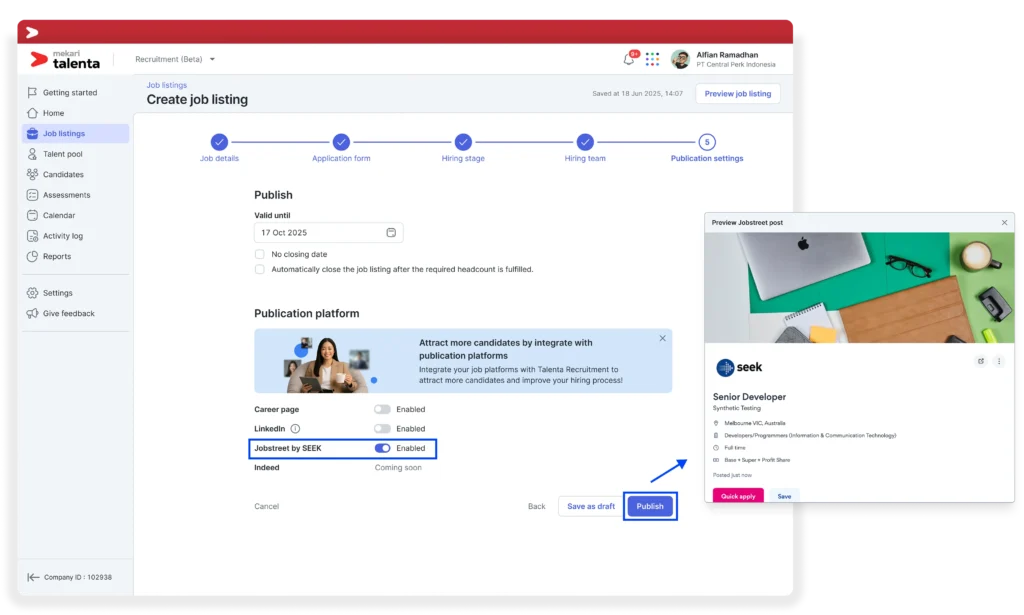
1. Centralize job posting and sourcing to cut advertising spend
Enterprises juggling multiple job boards per country often end up paying for promoted listings separately on each platform, with recruiters manually re-posting the same role across systems.
Mekari Talenta’s job posting and sourcing feature lets HR post once and publish automatically to LinkedIn, JobStreet, and the company career page, with all applications synchronized into a single dashboard.
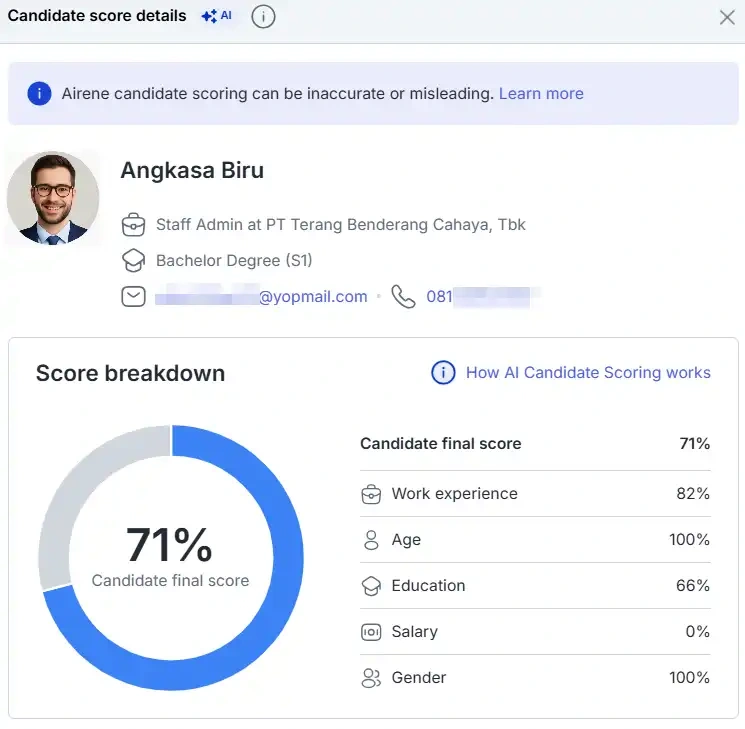
2. Cut screening hours with AI Candidate Scoring
At enterprise hiring volume, manually screening hundreds of resumes per requisition is one of the largest hidden internal labor costs in the entire process.
Mekari Talenta’s AI-powered screening ranks candidates automatically based on profile and skills fit, filters by education and experience, and can trigger rejection emails based on a minimum score, freeing recruiters to focus their time on the shortlist that actually matters.
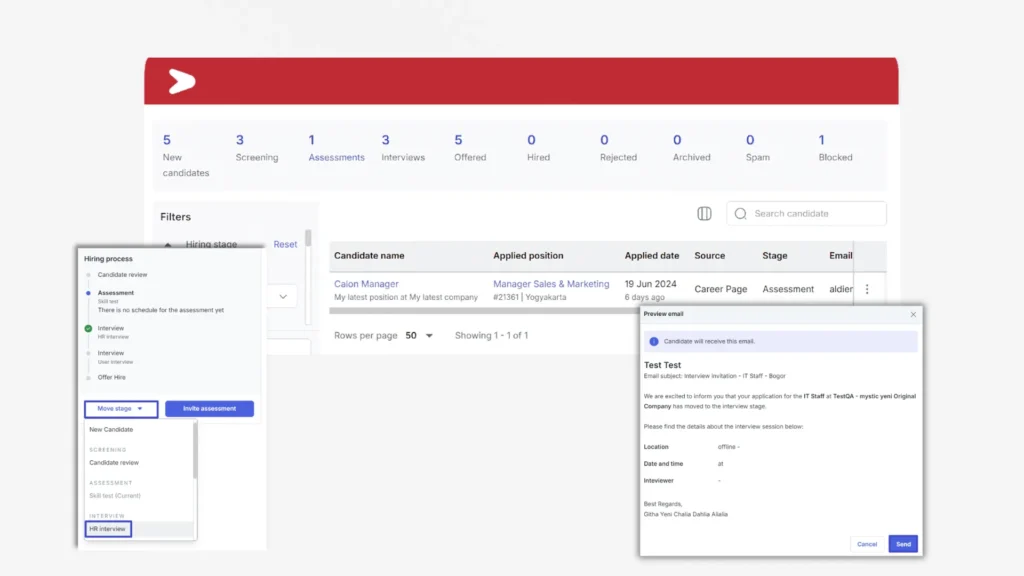
3. Reduce coordination overhead with bulk interview scheduling
High-volume hiring means hundreds of interview invitations and stage changes that, when handled manually, consume hours of recruiter and HR admin time every week.
Within the interview, assessment, and onboarding workflow, recruiters can send interview invitations directly from the dashboard and move candidates through hiring stages in bulk, instead of updating each candidate’s record one by one.
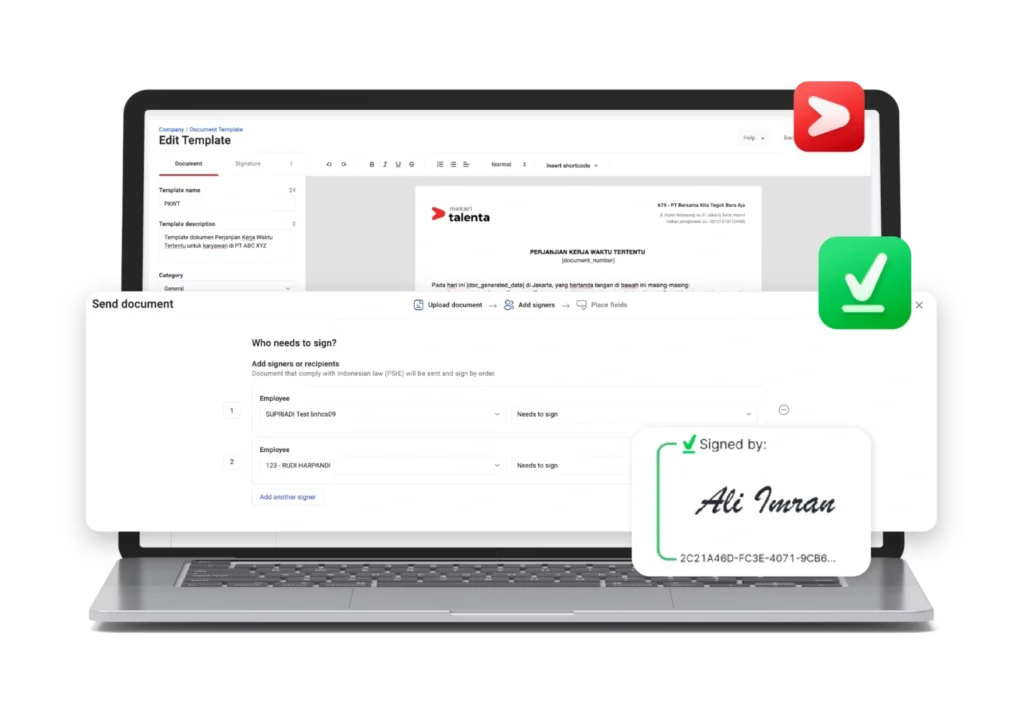
4. Lower assessment and offer-to-signature costs
Many enterprises pay separate vendors for personality and skills assessments, then rely on slow, paper-based or third-party e-signature tools to finalize offers, both of which add vendor cost and delay.
Mekari Talenta lets recruiters send assessments and generate offer letters directly within the platform, integrated with Mekari Sign’s PSrE-certified digital signature, which shortens the time between offer and signed acceptance and reduces the risk of losing a candidate to a slower competing process.
5. Reuse past candidates instead of paying to source again
Enterprises frequently rehire for the same role types, such as regional retail staff or recurring technical positions, yet often pay for a fresh sourcing cycle each time, even when a strong runner-up from an earlier search is still a good fit.
Mekari Talenta Recruitment supports this approach by maintaining a centralized candidate database where recruiters can store applicant profiles, resumes, interview history, assessment results, and hiring status.
Candidates can also be tagged or categorized based on skills, job families, locations, seniority levels, or hiring outcomes, making it easier to rediscover qualified talent when similar vacancies arise.
Rather than paying to source new candidates for every opening, recruiters can quickly search, filter, and re-engage previously evaluated candidates, significantly reducing sourcing costs and shortening time to hire.
6. Make recruitment spend visible with built-in reporting
Many enterprises genuinely cannot calculate a clean cost-per-hire number because cost data and hiring data sit in separate, disconnected systems that have to be manually reconciled every quarter.
Mekari Talenta’s recruitment insight and reports dashboard tracks time-to-hire, time-to-fill, and acceptance rate in one place, and because recruitment connects directly with manpower planning and onboarding within the same platform, HR can see cost and outcome data together instead of exporting it across spreadsheets.
Common Mistakes When Measuring Cost Per Hire
Even enterprises with mature recruiting functions frequently miscalculate cost per hire in ways that quietly distort budget decisions.
1. Excluding hidden recruitment costs
The most common mistake is counting only the obvious, invoiced expenses, such as job ads and agency fees, while leaving out hiring manager time, interviewer hours, and vacancy losses.
These omitted costs alone can inflate the true cost of a hire by 30 to 40 percent beyond what most organizations report internally.
2. Measuring only external expenses
Some talent acquisition teams track cost per hire using only vendor invoices, effectively ignoring the recruiter and hiring manager labor that the SHRM/ANSI standard explicitly requires as part of the formula.
This produces a number that looks efficient on a slide but does not reflect the actual cost of running the hiring process.
3. Ignoring hiring quality
Chasing a lower cost per hire by rushing the process or skipping assessment steps frequently produces costly mis-hires further down the line.
SHRM’s 2025 benchmarking report found that only 20 percent of organizations currently track quality of hire at all, which means most enterprises have no visibility into whether a “cheap” hiring process is quietly costing them far more in turnover and lost productivity.
4. Comparing different job levels unfairly
Blending entry-level, mid-level, and executive hires into a single average cost-per-hire figure makes cross-team or cross-region comparisons close to meaningless.
A factory or call center function will always show a structurally lower blended cost than a function hiring mostly senior specialists, regardless of how efficiently either team actually operates.
5. Tracking cost per hire without other hiring KPIs
The SHRM/ANSI standard itself is explicit that cost per hire does not, on its own, capture time-to-fill, quality of hire, or candidate and hiring manager satisfaction. Treating it as the only recruiting metric that matters almost always leads to optimizing the wrong thing.
Cost Per Hire vs. Other Recruitment Metrics
Cost per hire becomes genuinely useful only when it is read alongside the metrics that explain what that spend actually bought the organization.
1. Cost per hire vs. time-to-hire
Time-to-hire measures the speed of the recruiting process, typically from application to offer acceptance, while cost per hire measures what that process cost.
The two interact directly: rushing to compress time-to-hire through overtime, expedited agency fees, or rejected candidate corner-cutting often raises cost per hire even as the calendar days go down.
2. Cost per hire vs. quality of hire
Quality of hire evaluates whether the people brought on actually perform well and stay, commonly measured through a combination of performance, retention, and internal mobility, a framework LinkedIn uses in its own Future of Recruiting research.
A low cost per hire paired with poor quality of hire is not an efficiency win; it usually signals an under-resourced process that will cost more later in replacement hiring and lost productivity.
3. Cost per hire vs. cost of vacancy
As covered earlier, cost per hire and cost of vacancy pull in opposite directions when read in isolation: minimizing one too aggressively tends to inflate the other.
An enterprise that slows its process to drive down agency spend may be quietly absorbing thousands of dollars a day in lost output from the still-empty seat.
4. Why these metrics should be measured together
The most defensible approach for an enterprise talent acquisition function is a balanced scorecard that reports cost per hire alongside time-to-fill, quality of hire, and cost of vacancy in the same dashboard.
This is what allows HR to walk into a budget conversation with finance or the board and demonstrate that recruiting spend is being managed as an investment with a measurable return, not simply minimized for its own sake.
Building a More Cost-Efficient Hiring Strategy with Mekari Talenta
As enterprises scale, controlling cost per hire stops being a matter of cutting individual line items and becomes a question of how well sourcing, screening, interviewing, offers, and reporting are connected end to end.
Fragmented tools and disconnected data are often the real reason hiring costs more than it should, not the underlying salaries or vendor rates themselves.
In practice, many enterprises face overlapping job board subscriptions, manual screening at scale, slow offer-to-signature cycles, and recruiting cost data that lives in spreadsheets disconnected from finance reporting.
As an integrated recruitment solution within the broader Mekari Talenta HCM platform, hiring teams can manage sourcing, AI-assisted screening, interview coordination, digital offer signing, and reporting within a single connected system.
With Mekari Talenta, enterprises can:
- Consolidate job posting and sourcing across multiple channels and regions into one dashboard, reducing redundant advertising spend.
- Cut recruiter screening hours with AI Candidate Scoring that ranks applicants by skills and job fit before a human ever opens a resume.
- Shorten offer-to-signature time with integrated digital signing, reducing the risk of losing candidates to slower processes.
- Reuse qualified past candidates through a centralized talent pool instead of resourcing recurring roles from scratch.
- See cost-relevant metrics like time-to-hire and acceptance rate in one connected dashboard, rather than reconciling data across disconnected systems.
This connected approach helps enterprise HR teams control recruitment spend without compromising candidate experience or hiring quality, and it can be implemented modularly alongside existing HR systems rather than requiring a full platform overhaul.
Schedule a consultation with the Mekari Talenta team to see how an integrated recruitment platform can help your organization lower cost per hire while building a faster, more defensible hiring process.
Reference:
- SHRM – SHRM Releases 2025 Benchmarking Reports
- LinkedIn Talent Solutions – The Future of Recruiting 2025
- Bersin by Deloitte – U.S. Spending on Recruitment Rises
- Deloitte Insights – Talent Acquisition Opportunities in Today’s World
- Built In – Cost of Vacancy: Calculate the Cost of Open Roles
- Eddy – Recruitment Fees: The Cost of Using an Agency
Frequently Asked Questions (FAQs)
What is a good cost per hire for an organization?
What is a good cost per hire for an organization?
There is no universal benchmark because cost per hire varies depending on hiring volume, industry, job complexity, and location. Executive and highly specialized roles naturally have higher recruitment costs than entry-level positions. Organizations should compare their cost per hire across similar roles and monitor trends over time rather than relying solely on industry averages.
How often should organizations calculate cost per hire?
How often should organizations calculate cost per hire?
Most organizations review cost per hire quarterly to identify spending trends and optimize recruitment budgets throughout the year. Quarterly reporting also allows HR and finance teams to detect inefficiencies before they significantly affect annual hiring costs. Organizations with high-volume hiring may even monitor the metric monthly.
Should onboarding costs be included in cost per hire?
Should onboarding costs be included in cost per hire?
It depends on the measurement framework used. Under the SHRM/ANSI standard, cost per hire generally includes recruitment expenses incurred up to the candidate’s start date. However, many organizations separately track onboarding costs to gain greater visibility into the full investment required to bring new employees into the business.
What recruitment metrics should be tracked alongside cost per hire?
What recruitment metrics should be tracked alongside cost per hire?
Cost per hire should be evaluated together with time to hire, time to fill, quality of hire, offer acceptance rate, source of hire, candidate experience, and employee retention. Monitoring these metrics together provides a more complete view of recruitment effectiveness. Focusing only on reducing hiring costs may unintentionally impact hiring quality or business productivity.
How can recruitment technology help reduce cost per hire?
How can recruitment technology help reduce cost per hire?
An integrated recruitment platform helps reduce cost per hire by automating resume screening, centralizing candidate sourcing, simplifying interview scheduling, maintaining reusable talent pools, and providing recruitment analytics in one system. These capabilities reduce manual work, improve recruiter productivity, shorten hiring cycles, and lower dependence on expensive external recruitment channels.