

Competency Mapping: Building a Skills-Driven Talent Strategy


-
Competency mapping is the process of identifying, assessing, and aligning employees’ skills, knowledge, and behaviors with the competencies required for each role.
-
To build competency mapping framework, define competency standards, map them to job roles, assess employee proficiency, identify skill gaps, and connect development plans to business needs.
For decades, enterprise talent management was built around the job description. A role had a fixed title, a fixed set of duties, and a fixed career ladder. That model is breaking down fast, and most HR leaders already feel it.
Roles change shape every few quarters. Reorganizations happen more often than annual planning cycles can keep up with.
And business leaders keep asking the same uncomfortable question: “Do we actually know what our people can do?” For most enterprises, the honest answer is no, not with the precision the business now demands.
Competency mapping is how organizations close that gap. It replaces guesswork about workforce capability with a structured, evidence-based view of what employees can do today and what the business will need from them tomorrow.
This guide walks through what competency mapping really means for enterprise HR teams, why the job-based model is losing relevance, and how to build a framework that’s practical enough to survive contact with a real, multi-entity organization.
What Is Competency Mapping?
Competency mapping is the process of identifying, defining, and assessing the specific skills, knowledge, and behaviors required for a role, function, or career path, then measuring how individual employees stack up against that standard.
Unlike a simple skills inventory, competency mapping links capability directly to performance and business outcomes.
A competency map typically includes a proficiency scale (for example, novice to expert), a clear behavioral definition for each level, and a way to tie that competency back to specific roles or career tracks.
In practice, this means an HR team doesn’t just know that “Sarah has project management experience.” They know Sarah is rated Level 3 out of 5 in stakeholder management, Level 4 in budget planning, and Level 2 in vendor negotiation, against a benchmark that’s been validated across the organization.
That level of precision is what makes competency mapping usable for real workforce decisions, not just a documentation exercise.
Why Traditional Job-Based Talent Management No Longer Works
Job descriptions assume stability: a role stays roughly the same for years, and employees are hired, evaluated, and promoted against that static definition.
Four forces are breaking that assumption for most enterprises today.
1. Rapidly changing skill requirements
Technical and digital skill requirements are shifting inside roles faster than job descriptions can be rewritten.
A job description written two years ago may no longer reflect what the role actually requires today.
Read also: Upskilling and Reskilling: Building a Future-Ready Workforce
2. Organizational restructuring and workforce transformation
Mergers, divestitures, and operating model changes happen more frequently in large enterprises than most HR systems are designed to handle.
When the business restructures, job titles and reporting lines change, but the underlying skills employees bring don’t disappear.
Without a competency layer, that capability becomes invisible during reorganization, and HR ends up rebuilding talent visibility from scratch every time.
3. Increasing demand for internal mobility
Employees increasingly expect to move across functions, not just up a single ladder.
A job-title-based system simply has no language for this kind of fluid movement.
Read also: Organizations Are Investing More in Internal Talent Mobility Frameworks — Here’s Why and How
4. The growing importance of skills-based organizations
Enterprises that have shifted toward a skills-first operating model are seeing measurable gains.
Competency mapping is the foundational layer that makes a skills-based operating model possible. Without it, “skills-first” remains a slogan rather than a system.
Why Competency Mapping Matters for Enterprise Organizations
For a 50-person company, informal skill tracking might still work.
At enterprise scale with multiple business units, regional entities, and thousands of employees, informal tracking collapses under its own weight. Here’s what competency mapping unlocks specifically at that scale.
1. Aligning workforce capabilities with business strategy
When leadership sets a new strategic priority, like entering a new market, launching a new product line, and adopting new technology, competency mapping tells HR exactly which capabilities already exist in-house and which need to be built or hired.
This turns workforce planning from reactive to proactive.
2. Identifying enterprise-wide competency gaps
A single business unit might have a strong data analytics bench while another is critically short.
Without enterprise-wide competency data, HR can’t see that imbalance, let alone redistribute talent or design targeted upskilling to fix it. Mapping makes those gaps visible at the portfolio level, not just team by team.
3. Building leadership pipelines
Leadership competencies —strategic thinking, people development, cross-functional influence— are far harder to assess than technical skills, but they’re exactly what determines succession readiness.
A structured competency framework gives succession planning an objective foundation instead of relying on a manager’s personal impression of “who’s ready.”
4. Supporting workforce planning and organizational redesign
When the business restructures, competency data lets HR map existing talent against the new structure’s requirements before deciding what to hire externally. This consistently reduces unnecessary external recruitment and shortens the time needed to staff a new structure.
5. Improving talent investment decisions
Learning and development budgets are finite, and enterprises waste a meaningful share of them on generic training that doesn’t target actual gaps.
Competency data lets L&D teams direct spend at the specific capabilities the business is short on, rather than running one-size-fits-all programs across the whole organization.
6. Driving business agility through skills visibility
Deloitte’s broader research on talent agility found that 95% of executives say talent agility and access to cross-border skills are essential today, and that this importance will keep growing over the next five years.
Competency mapping is what makes that agility operational: it’s the data layer that lets HR redeploy people quickly when business priorities shift.
The Core Components of a Competency Framework
A usable enterprise competency framework is built from five interconnected layers. Skipping any one of them tends to produce a framework that looks complete on paper but fails in practice.
1. Core competencies
These are the baseline behaviors expected of every employee regardless of role or level —things like communication, accountability, and adaptability.
Core competencies anchor company culture and give every employee, from entry-level to executive, a shared behavioral language.
2. Functional competencies
Functional competencies are role- or department-specific technical capabilities: financial modeling for a finance team, API design for engineering, channel strategy for marketing.
These are the competencies most closely tied to day-to-day job performance and are usually the easiest to define objectively.
3. Leadership competencies
These cover capabilities required at supervisory and executive levels: decision-making under ambiguity, talent development, change management.
Leadership competencies should scale in complexity across management tiers rather than using one generic “leadership” definition for a team lead and a VP.
4. Digital and future-ready competencies
This layer covers capabilities the business will need as technology and ways of working evolve —data literacy, AI fluency, digital collaboration tools.
Enterprises are increasingly building this in deliberately rather than waiting for it to emerge organically, given how quickly digital skill requirements are shifting.
5. Behavioral competencies
Behavioral competencies describe how work gets done: collaboration style, conflict resolution, resilience under pressure.
These are typically the hardest to measure objectively, which is why they require structured, multi-rater assessment rather than a single manager’s subjective rating.
How to Build a Competency Mapping Framework with Mekari Talenta
1. Set up your competency library
Before mapping anything, HR needs a structured library of competency definitions, proficiency levels, and behavioral indicators that the whole organization will reference consistently.
In Mekari Talenta, this starts in Talenta Performance → Talent Management → Competency → Set Up Competency. Here, HR teams define each competency, its category (core, functional, leadership, digital, or behavioral), and the proficiency scale that will be used to assess it.
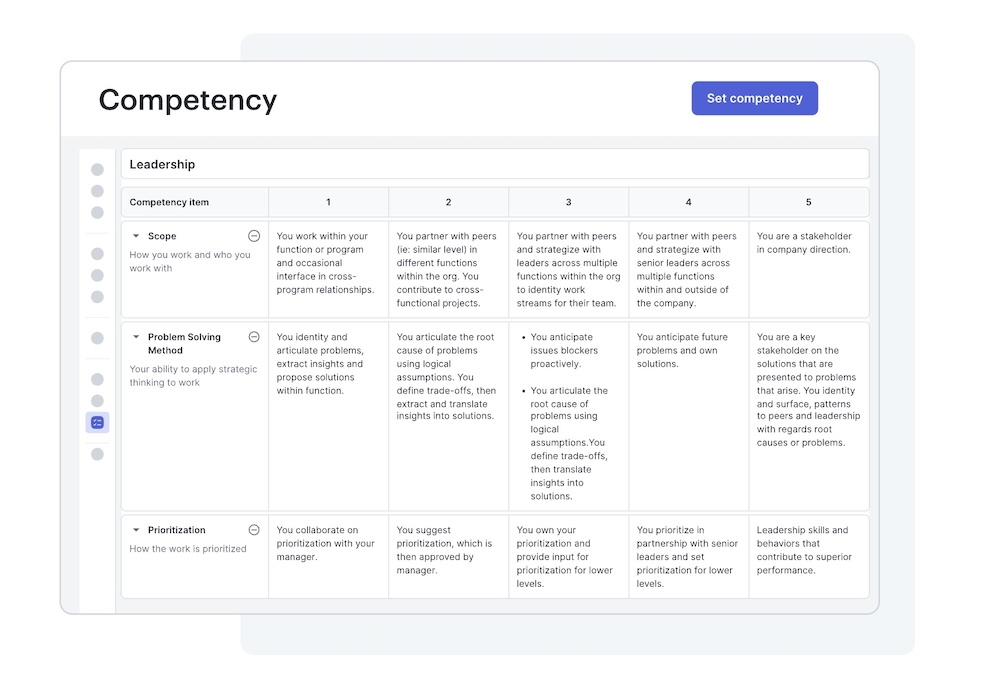
For example, a “Stakeholder Management” competency might be defined with five proficiency levels, each tied to a specific, observable behavior rather than a vague label like “good” or “excellent.”
This is the foundation everything else builds on, so it’s worth investing real time in getting the definitions precise before rolling it out company-wide.
2. Map competencies to job positions
Once the competency library exists, it needs to be connected to actual roles. A competency framework that lives in a spreadsheet disconnected from job positions is just documentation; it doesn’t drive decisions.
Through Competency → Assignment → Create Assignment, HR can map specific competency profiles directly to job positions across divisions.
Each position is then linked to a defined set of required competencies and target proficiency levels, giving every role a measurable capability benchmark rather than a static job description.
This step is what allows the system to automatically calculate gaps later: once a position has a defined competency profile, any employee assessed against that role generates a clear, quantified gap rather than a subjective impression.
3. Run competency assessments
With the framework and assignments in place, assessments can be conducted through the same review cycle used for performance evaluations, so HR isn’t running a separate, disconnected process.
Assessment results are visible on the Home menu under “See all employees,” where HR and managers can view individual and team-level competency scores.
A large multi-entity company, for example, can use this view to compare competency coverage for a critical function like Data & Analytics across business units, instead of relying on each regional HR team’s separate, inconsistent tracking.
4. Identify gaps and connect them to development action
Once assessment data is in the system, HR can see precisely where an employee or a team falls short of the target proficiency for their role or a target role they’re being developed toward.
This gap data feeds directly into Individual Development Plans (IDP), where development actions such as training, mentoring, and stretch assignments are assigned with specific timelines and measurable outcomes, rather than vague development notes.
Because competency data, performance reviews, and IDPs all sit in the same system, managers and employees can track development progress in one place instead of chasing updates across spreadsheets and emails.
5. Use competency data for succession and workforce planning
Competency scores feed into succession planning, where candidates for key roles are tracked by readiness level — “Ready Now” versus “Ready in 1–2 Years” — based on how closely their actual competency profile matches the target role’s requirements.
This turns succession planning from a subjective conversation about who a manager personally favors into a measurable, defensible process grounded in actual skill data.
Using Competency Mapping Across the Employee Lifecycle
A competency framework only pays off when it’s connected to actual HR processes, not treated as a standalone exercise. Here’s how it plugs into each stage of the employee lifecycle.
1. Recruitment and selection
Competency profiles give recruiters objective criteria to screen against, rather than relying purely on resume keywords or interviewer instinct.
Structured interview guides built from defined competencies also make hiring decisions more consistent across interviewers and locations, which matters a great deal when an enterprise is hiring at volume across multiple regions.
2. Learning and development
Competency gap data tells L&D exactly what to build training around. Instead of running a generic “leadership essentials” course for every manager, L&D can target the specific competency where a cohort is consistently underperforming, which produces a far better return on a limited training budget.
3. Performance management
Competency assessments add an objective, skill-based dimension to performance reviews that complements outcome-based metrics like KPIs and OKRs.
This combination gives a more complete picture of an employee: someone might be hitting targets through brute effort while a critical underlying skill gap goes unaddressed until it eventually caps their performance.
4. Career development and internal mobility
Employees can’t plan a move into a new role if they don’t know what that role actually requires. Competency frameworks make the gap between an employee’s current profile and a target role visible and specific, turning career conversations into a measurable checklist instead of a vague aspiration.
5. Succession planning
As covered above, competency data is what allows succession planning to move from subjective manager nomination to a structured, evidence-based readiness assessment.
This is particularly critical for enterprise organizations managing leadership pipelines across multiple business units simultaneously.
6. Workforce planning
At the portfolio level, aggregated competency data tells leadership where the organization is strong, where it’s exposed, and where future business priorities will require capability the company doesn’t currently have.
This is the data foundation strategic workforce planning depends on.
Competency Mapping Example
Seeing how this looks in practice makes the framework far more concrete than reading definitions alone.
1. Competency matrix example
A simplified competency matrix for a mid-level Marketing Manager role might look like this:
| Competency | Category | Target Level (1–5) |
|---|---|---|
| Campaign Strategy | Functional | 4 |
| Stakeholder Management | Core | 3 |
| Data-Driven Decision Making | Digital | 3 |
| Team Leadership | Leadership | 3 |
| Adaptability | Behavioral | 4 |
When an employee is assessed against this matrix, each competency receives an actual score, and the difference between actual and target becomes the visible gap.
A matrix like this, applied consistently across every Marketing Manager position company-wide, is what allows HR to compare capability across regions or business units in a meaningful way.
2. Competency gap analysis example
Suppose an employee being developed for that Marketing Manager role scores a 2 on Data-Driven Decision Making against a target of 3, and a 2 on Team Leadership against a target of 3.
The gap analysis immediately surfaces two clear development priorities rather than a generic “needs more experience” note.
From there, an IDP can be built with specific actions: an analytics certification course for the data gap, paired with a stretch assignment leading a small cross-functional project for the leadership gap, each with a defined timeline.
This is a far more actionable output than the kind of unstructured development conversation most performance reviews currently produce.
Common Challenges in Enterprise Competency Mapping
Most competency mapping initiatives don’t fail because the idea is wrong. They fail because of operational friction that’s predictable and avoidable once HR knows to look for it.
1. Inconsistent competency definitions across business units
In large enterprises, different divisions often develop their own informal definitions of the same competency.
“Strategic thinking” might mean something completely different to the finance team than it does to the product team. Without a centralized competency library, comparisons across the organization become meaningless.
2. Difficulty measuring behavioral competencies objectively
Technical competencies are relatively easy to assess against clear criteria. Behavioral competencies like collaboration or resilience are inherently more subjective, and a single manager’s rating is prone to bias.
This is why multi-rater input —manager, peer, and self-assessment combined— produces far more reliable behavioral competency data than relying on one evaluator alone.
3. Fragmented HR data across multiple systems
When competency data sits in one system, performance reviews in another, and learning records in a third, HR spends more time reconciling spreadsheets than acting on insights.
This fragmentation is one of the most commonly cited barriers to making any structured talent program actually work at scale.
4. Keeping competency frameworks aligned with changing business priorities
A framework built once and never revisited goes stale fast, especially given how quickly skill requirements are shifting.
Competency frameworks need a regular review cycle, typically annual, or tied to major strategic shifts, to stay relevant to what the business actually needs.
5. Scaling competency mapping across multiple entities and locations
Multinational or multi-entity enterprises need frameworks flexible enough to account for local role variations while still maintaining enough consistency to allow company-wide comparison.
Getting that balance wrong in either direction —too rigid or too fragmented— undermines the entire exercise.
Best Practices for Successful Competency Mapping
These practices consistently separate competency mapping initiatives that actually change how decisions get made from ones that end up as a one-time documentation project.
1. Adopt a skills-first approach
Rather than retrofitting competencies onto existing job descriptions, start by defining the skills the business actually needs and build roles around them.
This is the core principle behind the skills-based organization model, and it’s why Deloitte’s research found such a strong directional shift toward it: their global survey of executives and workers found a strong preference from both executives and workers for a skills-based model over one based on jobs.
2. Standardize competency language across the organization
A shared competency dictionary, used consistently across every business unit and region, is what makes enterprise-wide comparison possible in the first place. Without it, every division effectively runs its own incompatible system.
3. Use data and assessments to validate competency levels
Self-reported skill data alone is unreliable; people consistently overestimate or underestimate their own capability. Combining self-assessment with manager review and, where appropriate, structured testing produces far more dependable competency scores.
4. Integrate competency mapping with talent management processes
A competency framework that doesn’t connect to recruitment, performance, learning, and succession is just a static document.
The value comes specifically from the integration: gap data triggering development plans, development plans feeding succession readiness, and so on.
5. Leverage HR technology for continuous competency tracking
Annual, manual competency reviews go stale almost immediately in a fast-changing business. Technology that updates competency data continuously, alongside performance and learning records, keeps the framework genuinely useful rather than a once-a-year compliance exercise.
How HR Technology Enables Enterprise Competency Mapping
1. Centralizing competency frameworks
A single source of truth for competency definitions, proficiency scales, and role mappings eliminates the inconsistency that comes from every business unit maintaining its own informal version. This is the foundational requirement for any enterprise-scale competency initiative.
2. Automating competency assessments
Manual assessment processes don’t scale past a few hundred employees. Automated assessment cycles, integrated into existing performance review workflows, make it realistic to run consistent competency assessments across thousands of employees without overwhelming HR or managers.
3. Supporting learning recommendations
When competency gaps are visible in the system, relevant training can be assigned directly against the specific gap identified, rather than HR manually cross-referencing assessment results against a course catalog.
4. Improving workforce planning with competency insights
Aggregated, organization-wide competency dashboards give leadership the visibility needed to make workforce decisions —where to hire, where to upskill, where talent is concentrated or thin— based on actual data rather than anecdotal impressions from individual department heads.
5. Connecting competency data across the employee lifecycle
The real payoff of HR technology here isn’t any single feature; it’s the connection between recruitment, performance, learning, succession, and competency data living in one ecosystem. That connection is what turns competency mapping from an HR project into a continuously useful business asset.
Building a More Skills-Driven Enterprise with Mekari Talenta
As enterprises grow across multiple business units, regions, and entities, managing workforce capability manually becomes unsustainable.
HR teams need to track competency definitions, assessment cycles, development plans, succession readiness, and learning progress simultaneously, often across thousands of employees.
In practice, this complexity tends to produce the same recurring problems: inconsistent competency definitions between divisions, fragmented data spread across spreadsheets and disconnected systems, and competency assessments too subjective to support real workforce decisions.
As an integrated HCM platform, Mekari Talenta helps organizations build and operationalize competency mapping through connected talent management features within a single, centralized system.
With Mekari Talenta, companies can:
- Build a standardized, customizable competency library aligned with organizational structures and business goals.
- Map competencies directly to job positions for measurable, role-specific capability benchmarks.
- Connect competency assessments to performance reviews, IDPs, learning paths, and succession planning within one unified system.
- Improve enterprise-wide workforce visibility through centralized competency tracking and analytics.
- Reduce reliance on subjective, manager-only evaluations by grounding talent decisions in consistent, structured data.
This connected approach helps enterprise organizations move from a fragmented, job-based talent model toward a structured, skills-driven one, supporting more confident workforce planning, more targeted development investment, and stronger succession pipelines.
Schedule a consultation with the Mekari Talenta team to explore how a connected competency mapping framework can help your organization build a more skills-driven, future-ready workforce.
References:
World Economic Forum – Future of Jobs Report 2025
Deloitte – The Skills-Based Organization: A New Operating Model for Work and the Workforce
Deloitte – A New Age of Talent Agility
Frequently Asked Questions (FAQs)
What is the difference between competency mapping and skills mapping?
What is the difference between competency mapping and skills mapping?
Competency mapping evaluates a combination of skills, knowledge, behaviors, and proficiency levels required for successful job performance. Skills mapping focuses primarily on technical or functional skills without necessarily assessing behavioral competencies or expected proficiency. Competency mapping therefore provides a more comprehensive foundation for talent management.
How often should organizations update their competency framework?
How often should organizations update their competency framework?
Most organizations review their competency framework annually or whenever significant business, technological, or organizational changes occur. Regular reviews ensure competencies remain aligned with evolving business priorities and future workforce requirements. High-growth organizations may update specific competency models more frequently.
Who should be responsible for competency mapping?
Who should be responsible for competency mapping?
Competency mapping should be a collaborative effort between HR, business leaders, department managers, and subject matter experts. HR typically owns the framework and governance, while business leaders validate the competencies required for each role. This collaboration ensures the framework reflects actual business needs rather than theoretical job requirements.
Can competency mapping support internal mobility?
Can competency mapping support internal mobility?
Yes. Competency mapping provides visibility into employees’ current capabilities and compares them against the requirements of other roles within the organization. This allows HR to identify employees who are ready for lateral moves, promotions, or cross-functional opportunities while highlighting development areas needed before transitioning.