

Assessment: A Strategic Guide for Organizational Decision-Making


-
Assessment is a structured process of collecting and analyzing data to evaluate people, processes, or business performance and support objective decision-making.
-
Organizations commonly use talent assessment, market assessment, and business assessment to evaluate workforce capabilities, market opportunities, and organizational performance.
Making the right decision is no longer enough relying on intuition or experience alone.
Whether in the recruitment process, employee development, performance evaluation, or business strategy formulation, organizations need assessment to produce more objective and measurable decisions.
This trend shows that assessment is increasingly becoming the foundation of data-driven decision making across various organizational functions.
This article will discuss the meaning of assessment, functions, types, benefits, to ways to implement it effectively within the company.
What Is Assessment?
Simply put, the Oxford dictionary defines it as a process of assessment or decision making regarding something through a thought process that is already mature.
The keyword, “mature thinking” in the Oxford dictionary itself has also evolved among experts and academics. So that now assessment has a more specific meaning.
As an example, through looking up KBBI and Westminster College, this “mature thinking” means the assessment process is based on understanding data and information from the assessment object.
In other words, assessment is a process of understanding or assessing an entity, both individual and non-individual, based on information inherent in that entity.
This information is obtained through data or documentation related to the condition of that entity. For example, individual conditions include psychological, physical, achievement, or educational background.
Definition of Assessment in Business

Assessment is commonly done in various activities. For example, in the educational process, assessment is done to evaluate learning and to know students’ understanding.
Then how about in a business context?
In a business context, assessment is conducted to evaluate and identify what functions need to be repaired or developed based on current and future business conditions both internally and externally.
Assessment is conducted so that every company function such as HR, finance, marketing, product, or IT remains in line with the expectations of company goals.
In addition, according to Ted Hessing, a six sigma practitioner says that the assessment process in business is an ongoing process.
Opinions of Experts about Assessment
Due to the broad spectrum of assessment in various fields, several experts also have different opinions that further expand the function of the assessment itself, among which are as follows.
1. Robert M. Smith
This educational expert from the United States argues that the assessment process must prioritize aspects of trust and validity.
Therefore, when an organization conducts an assessment, its main focus is on the measuring instrument used so that the results are measurable and can be seen by everyone.
It can be said that Robert M. Smith’s opinion has become the foundation of current assessment activities.
2. Terry Overton
Who is a professor in the field of psychology as well as a children’s book author argues that assessment is a process carried out holistically.
This means that the assessment must be carried out thoroughly depending on its accompanying aspects. For example, psychological, background, to environment.
The author of the book Assessing Learners with Special Needs argues that every assessment must use different methods depending on the aforementioned accompanying aspects.
3. James A. McLoughlin
Through his book Assessing Special Students: Strategies and Procedures, James McLoughlin argues that assessment is conducted to improve the aspects being evaluated.
In an academic context, McLoughlin makes assessment a process to encourage the student teaching-learning system.
He also prioritizes the existence of feedback or self-assessment which became the forerunner of the modern assessment process commonly used by companies.
In a practical business context, McLoughlin’s assessment theory is not only aimed at employees or consumers, but also the company itself.
4. Rena B. Lewis
Who is the writing tandem of James A. McLoughlin essentially reinforces Terry Overton’s theory that the assessment process must consider elements of equality.
The assessment process must not be carried out discriminatively or biased toward certain social groups, especially minority groups.
Types of assessment functions
Seeing the broad spectrum of assessment, this process has several types of functions, which are as follows.
1. Initial Function
This one function is used to determine the ability and readiness of a person or a project before activities or programs are run.
This assessment is carried out by looking at the suitability of information and data of the assessment object with the required qualifications. It can be in the form of documents, pre-test, interview, or checklist.
Keep in mind, this type of assessment is only carried out at the beginning before the program or project is run.
In a business context, an example of an initial assessment is the employee recruitment process or business feasibility study.
2. Diagnosis Function
Actually, diagnostic assessment has similarities with initial assessment. The difference is, diagnostic assessment is not only carried out at the beginning, but in the middle or end of the activity period.
In addition, diagnostic assessment aims to discover the strengths, weaknesses, abilities, and knowledge of the assessment object.
3. Formative Function
An assessment process that takes place while the program is being run or conducted routinely within a program or work period.
In the context of business organizations, for example, formative assessment is often used to make findings that occur in operational processes.
In addition, formative assessment is a two-way assessment process, where both the organizer (company) and the participant (employee) mutually conduct assessments.Examples: 360-degree feedback, employee satisfaction, and one-on-one interview.
4. Summative Function
This function makes assessment a tool to evaluate a program or individual at the end of a period. The purpose of this assessment is to evaluate and understand how well the performance has been conducted during one ongoing period.
Examples in companies such as PDCA, employee performance evaluation, job training evaluation.
5. Ipsative Function
A function where assessment is conducted to measure an individual’s ability or performance over time. Usually this assessment is used by HR to measure employee performance trends from year to year.
6. Comparison Function (Norm-referenced Assessment)
An assessment function conducted to compare one object with another within the same group.In a business context, this assessment is conducted by companies that still use an employee reward system (employee of the month).
7. Criteria-based Function (Criterion-referenced Assessment)
An assessment function by conducting evaluations based on criteria that have been determined as benchmarks.
In a business context, this assessment is conducted to measure the level of market competition, sales performance, or job promotion assessment.
8. Holistic function
An assessment carried out by looking at various aspects of an individual. Whether psychological, background, physical, environmental influence, needs, and experience.
This assessment is usually conducted to increase the motivation or inclusivity of individuals. An example in HR is the one-on-one interview.
How does Assessment help Businesses Grow?
In practice, assessment in business always refers to the balanced scorecard, which is a management framework consisting of four areas: HR, finance, operations, and consumers.
All four are important areas or the heart of the company. In this case, business owners ensure that these four aspects are in line with company goals.
Here lies the role of assessment, which helps companies to identify which parts still have deficiencies or need to be developed so that business goals can be achieved.
In detail, the assessment process helps companies in the following matters:
- Helping management in making strategic decisions because of the clarity of which parts need to be a priority, both to be repaired or developed.
- From an HR perspective, assessment helps the company to obtain the best candidates in accordance with company needs.
- From an HR perspective, assessment helps the company develop employees both in terms of engagement, motivation, knowledge, and also expertise.
- From a financial perspective, assessment helps the company to make operational costs efficient.
- From a business operations perspective, assessment helps the company to streamline business processes to be more effective.
- From a consumer relations perspective, assessment helps the company understand consumer needs so that the products or services offered have more value for consumers.
Continuous assessment also helps the company to scale up, for example from a startup company to a medium-sized company.
Types of Assessment in Companies
Every organization uses assessments for different decision-making purposes. Some focus on evaluating people, while others assess market conditions or overall business performance.
Although the methods vary, each type of assessment helps organizations make more informed and objective decisions.
Below are the three most common types of assessments used in companies.
1. Talent Assessment
Talent assessment evaluates an employee’s or candidate’s abilities, competencies, potential, and overall suitability for a specific role.
It helps organizations make objective decisions throughout the employee lifecycle, from recruitment and employee development to promotions and succession planning.
Organizations commonly use talent assessments during hiring, internal promotions, organizational restructuring, and leadership development initiatives.
Common Talent Assessment Methods
The assessment methods vary depending on the organization’s objectives.
Some of the most commonly used methods include aptitude tests, psychometric assessments, technical or field skills tests, case study assessments, assessment centers, 360-degree feedback, employee satisfaction surveys, and performance evaluations.
Combining multiple methods enables organizations to gain a more comprehensive understanding of an individual’s strengths, development areas, and long-term potential.
2. Market Assessment
Market assessment helps organizations evaluate external business conditions and identify opportunities or risks within the marketplace.
The goal is to understand how market trends, customer behavior, and competitors may influence business performance and strategic planning.
Companies typically conduct market assessments before entering new markets, launching products, or adjusting their business strategies.
Common Market Assessment Methods
Market assessments often include SWOT analysis, STP (Segmentation, Targeting, and Positioning) analysis, customer satisfaction surveys, competitor benchmarking, and policy or regulatory analysis.
These methods provide valuable insights into market dynamics and support more informed strategic decisions.
3. Business Assessment
Business assessment evaluates an organization’s overall operational and financial health. According to Deloitte, this type of assessment helps organizations respond to technological developments, economic changes, and environmental or social issues that may affect long-term business growth.
The findings help business leaders identify operational challenges, improve efficiency, manage risks, and make better strategic decisions.
Common Business Assessment Methods
Business assessments may include cash flow assessments, working capital and liquidity assessments, funding structure assessments, enterprise risk assessments, and business impact assessments.
Together, these evaluations provide a comprehensive picture of the organization’s current performance and future readiness.
Choosing the Right Assessment for Your Organization
There is no universal assessment model that fits every organization. Each company develops its assessment process based on factors such as industry, business size, organizational maturity, and strategic objectives.
In practice, organizations often combine talent, market, and business assessments to obtain a more holistic understanding before making important business decisions. These three categories represent the most common assessment types used across modern organizations.
Tips for Conducting an Ideal Assessment
The assessment process must run effectively. If not, it will just waste time and money.
Assessment itself requires costs. This is because the assessment process does not only involve internal company but third parties such as consultants or assessment tools providers.
Therefore, you can follow these few tips so that the assessment process can run effectively and ideally:
- Identify problems in each function of your organization, whether current conditions and future possibilities are already aligned with your business goals.
- Sequence those problems into actionable goals. Example in the HR function: successfully recruiting candidates in the field of UX researcher in a certain month.
- Determine the type of assessment you want to use. Ensure it matches the problem and function that requires assessment.
- The assessment process certainly takes time, therefore make sure you create a time frame for the implementation of the assessment to monitor every process.
- Record assessment result data so that you can see changes in results over time. This is also done to evaluate the assessment approach that you use.
- Utilize assessment tools that match the initial goals.
Increase Recruitment Accuracy with Integrated Assessment from Mekari Talenta
Assessment helps companies make more objective decisions in various aspects, ranging from recruitment, employee development, performance appraisal, to talent planning.
With a structured assessment process, companies can reduce subjectivity, obtain deeper insights, and ensure every decision is based on relevant data.
One of the most crucial applications of assessment is in the recruitment process. In addition to assessing experience and qualifications through CVs, companies also need to understand candidates’ competence, potential, and suitability with position needs and work culture so that hiring decisions become more accurate.
Through Advance Recruitment, Mekari Talenta presents the Assessment feature which helps companies manage the candidate assessment process in one platform.
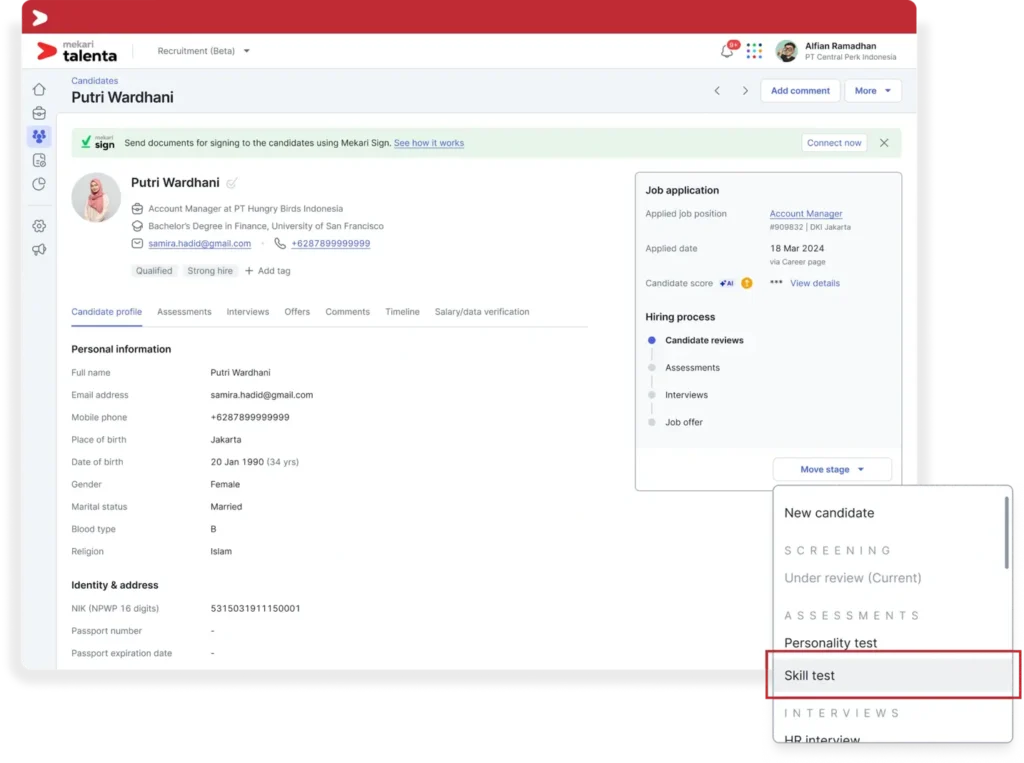
HR can create and send various types of assessment, monitor candidate completion in real-time, to view evaluation results without having to use separate tools.
In addition, companies can also utilize the MBTI Assessment to obtain insights regarding personality types, working styles, strengths, and candidate potential as consideration material in the selection process.
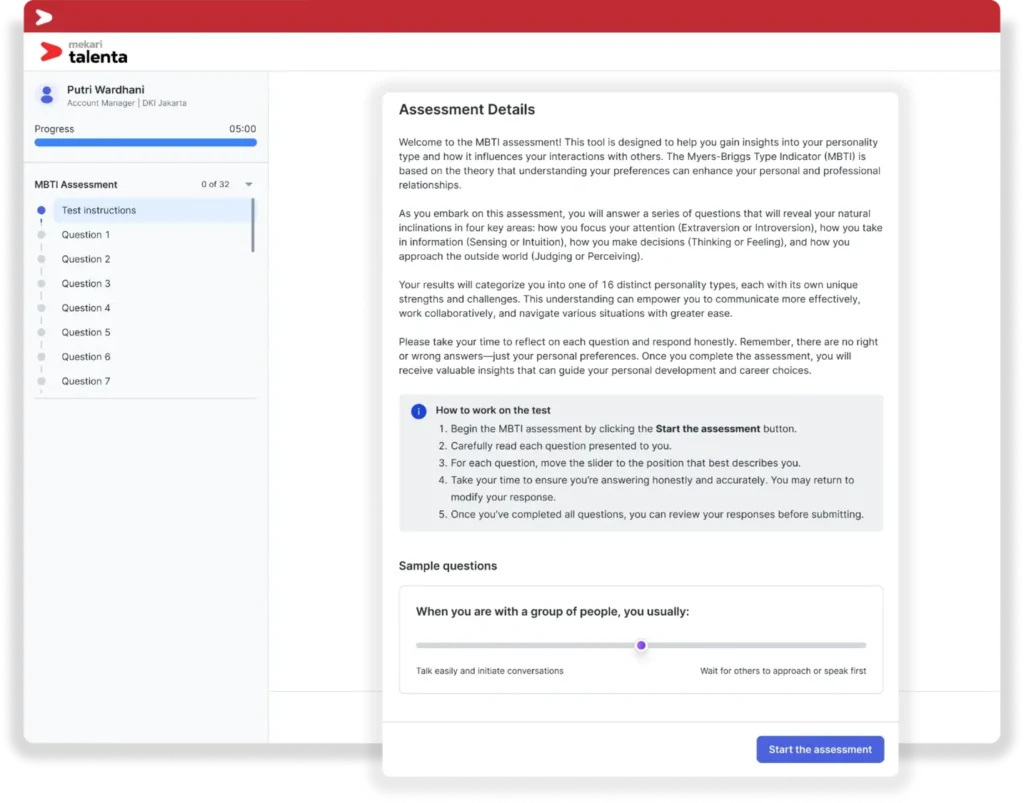
All assessment results are saved directly on the candidate profile and connected to the recruitment process, so that recruiters can compare candidates more objectively, accelerate the shortlisting process, and make hiring decisions with more confidence.
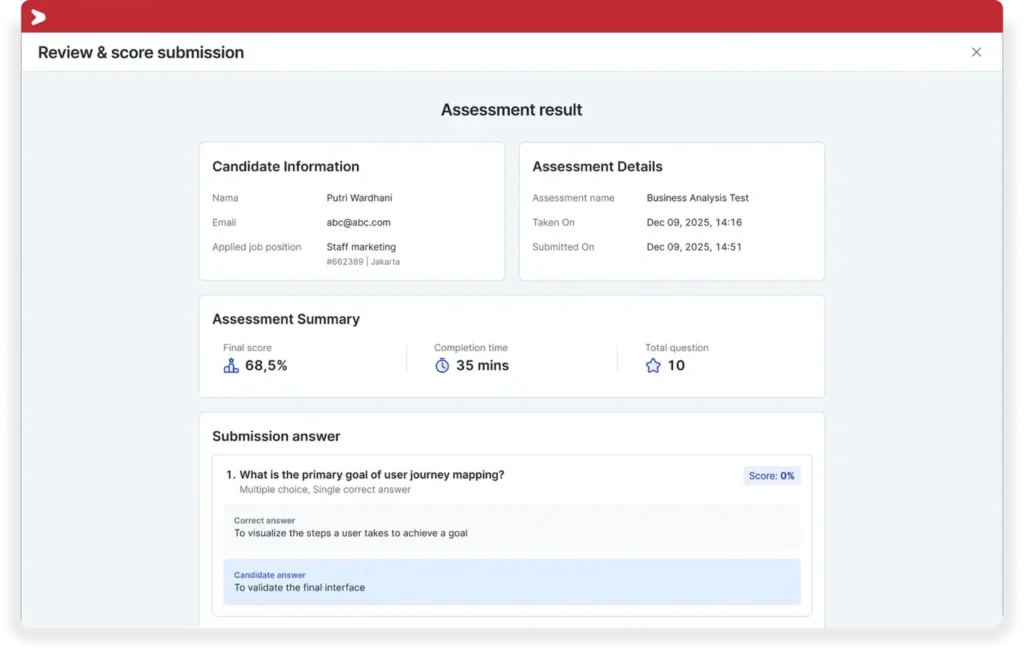
Want to build a more objective and structured recruitment process? Schedule a Mekari Talenta demo and see how the Assessment feature helps companies evaluate candidates more accurately in one integrated platform.
FAQ (Frequently Asked Questions)
When should an organization conduct an assessment?
When should an organization conduct an assessment?
Organizations should conduct assessments whenever important decisions require objective evidence rather than assumptions. Common situations include recruitment, promotions, organizational restructuring, business expansion, digital transformation, and annual strategic planning. Regular assessments also help organizations monitor progress and respond to changing business conditions proactively.
What are the characteristics of an effective assessment?
What are the characteristics of an effective assessment?
An effective assessment is objective, reliable, relevant to the business objective, and based on measurable criteria. It should use appropriate assessment methods, produce actionable insights, and minimize personal bias. Most importantly, the results should support decisions that align with organizational goals.
Can assessments be used beyond HR?
Can assessments be used beyond HR?
Yes. Although assessments are commonly associated with recruitment and employee development, they are also widely used in finance, operations, marketing, product management, and corporate strategy. Organizations rely on different assessment methods to evaluate performance, identify risks, improve efficiency, and support business growth.
What challenges do organizations face when implementing assessments?
What challenges do organizations face when implementing assessments?
Common challenges include unclear objectives, inconsistent evaluation criteria, insufficient data, and bias in the assessment process. Organizations may also struggle to integrate assessment results into decision-making. Establishing standardized frameworks and using digital assessment tools can help overcome these issues.