




- A talent pool is a curated and actively maintained group of internal and external candidates who may be suitable for future hiring needs.
- Build an effective talent pool by continuously updating candidate data, nurturing relationships, segmenting talent, and integrating internal mobility into your hiring strategy.
Every enterprise HR leader knows the panic of a critical vacancy. A senior engineering lead resigns. A regional director gives two weeks’ notice. The business is scaling into a new market and needs 50 hires in 60 days.
The first instinct? Open a new requisition, brief a recruiter, post on job boards, and start the clock.
But here’s the uncomfortable reality: the talent you needed was probably already in your system, filed away in a folder labeled “Past Applicants,” last touched 18 months ago.
This article is for HR leaders who are done with the cycle of scrambling. It’s a practical breakdown of why most talent pools fail, what a functioning one actually looks like, and how to build a system your recruiters will actually use.
The Contradiction: Talent Graveyard vs Active Pipeline
There’s a paradox at the heart of enterprise recruitment. Most large organizations have thousands of candidate records in their ATS.
They’ve invested in sourcing, job board subscriptions, agency fees, and recruitment campaigns. And yet, when a new role opens, the hiring process starts from scratch.
The database exists. The candidates don’t go anywhere. So why does the pipeline feel empty every single time?
The answer is that there’s a fundamental difference between storing candidates and maintaining a pipeline.
A talent graveyard is a folder of CVs sorted by date applied. An active pipeline is a living ecosystem where candidates are categorized by role fit, their data is kept current, and your relationship with them has been nurtured, even when you’re not actively hiring.
For large organizations, this distinction has a direct cost implication.
SHRM estimates that the average cost-per-hire sits between $4,000 and $7,000 USD —and that number climbs significantly for specialized or senior roles.
Every time a team reactivates a stale database instead of leveraging a warm pipeline, they’re essentially paying that bill again from scratch.
The companies that are winning the talent war aren’t just hiring faster, they’re maintaining continuity between hiring cycles. That’s the shift we need to talk about.
What Is a Talent Pool? (And Why Most Companies Get It Wrong)
A talent pool is a curated, segmented group of candidates (both external and internal) who have been assessed as potentially suitable for roles your organization may need to fill in the future.
It includes people who applied previously, were referred, sourced proactively, or identified through succession planning.
The operative word here is curated. A talent pool is not a raw dump of applications. It’s a structured, maintained, and categorized inventory of human potential that has been validated against your hiring criteria.
Most companies, however, treat their ATS like a filing cabinet. They collect CVs during active hiring cycles, close the requisition, and move on. The database grows bigger. The signal-to-noise ratio gets worse. Nobody maintains it. Nobody updates it.
When a new role opens, a recruiter might search the database, but what they find is often outdated, untagged, and impossible to trust. So they default to external sourcing. The cycle repeats.
The fundamental error is treating a talent pool as a destination a place where candidates land after applying. The correct model treats a talent pool as a relationship, something that requires ongoing investment, segmentation, and communication to remain valuable.
For enterprises managing hundreds or thousands of requisitions annually, the operational complexity of maintaining this relationship is real. That’s precisely why it requires a system, not a spreadsheet.
Talent Pool vs Talent Pipeline: Understanding the Difference
These two terms are often used interchangeably, but conflating them leads to strategic confusion and operational failure.
| Dimension | Talent Pool | Talent Pipeline |
|---|---|---|
| Definition | A broad database of potentially suitable candidates | A targeted, role-specific sequence of pre-assessed candidates ready for near-term hire |
| Scope | Wide, covers multiple roles, functions, and levels | Narrow, focused on specific critical or recurring roles |
| Readiness | Varies, may include early-stage or passive candidates | High, candidates are warm, pre-screened, and actively engaged |
| Time horizon | Long-term, built over months and years | Short-to-medium term, designed to fill roles within 30–90 days |
| Maintenance frequency | Quarterly or semi-annual refreshes | Continuous, active management |
| Primary use | Workforce planning and succession strategy | Active requisition fulfillment |
| Content | External applicants, referrals, sourced candidates, alumni | Pre-screened candidates who have progressed at least to initial assessment |
| Key metric | Pool size, coverage rate, data freshness | Pipeline velocity, conversion rate, time-to-offer |
In practice, a healthy talent pool feeds the talent pipeline. Your broad pool is where relationship-building happens. Your pipeline is where hiring happens.
The distinction matters because enterprises often invest in one at the expense of the other. They build a large pool with no pipeline discipline, or they manage active pipelines reactively without sustaining the broader pool that should be feeding them.
Both require investment. Both require governance. Neither works well in isolation.
The Core Failure: Inside the Dead Talent Pool
Let’s be specific about how talent pools die. It’s rarely a single catastrophic failure. It’s a slow decay caused by operational habits that feel harmless in isolation but compound into a system nobody trusts.
1. The “Silver Medalist” Loophole
Every hiring round produces silver medalists: the candidates who made it to the final round, impressed the panel, but lost out to an offer made to someone else, sometimes by a razor-thin margin.
These candidates are extraordinarily valuable. They’ve already passed screening. They’ve already demonstrated cultural alignment.
They know your organization. Rehiring them into a future role could save your team 60–70% of the typical sourcing and screening effort.
But what actually happens? The requisition closes. The feedback sits in someone’s interview notes. The silver medalist receives a generic rejection email and disappears. Six months later, when a similar role opens, nobody remembers they exist.
That’s not a small miss. It’s a structural hole in your talent strategy.
Fixing this requires one thing: a deliberate tagging and follow-up workflow triggered at the point of rejection, not left to a recruiter’s memory.
2. Stale Data: The Silent Killer
Candidate data has a shelf life. Skills evolve. People change industries. Contact details go stale. Someone who was an ideal junior analyst three years ago may now be a senior manager, and completely uninterested in the role you’d consider them for.
For an enterprise with 50,000 candidate records, that means 15,000 records become materially inaccurate every twelve months — without anyone noticing.
The danger isn’t just wasted outreach. It’s the false confidence it creates. HR teams assume their database is an asset.
They report high “talent pool coverage,” but when they actually reach into the pool, they find that the profiles don’t match the people anymore. The pool looks full; it’s actually hollow.
3. Ghosting Candidates — The Relationship Tax
Ghosting is a bilateral problem in recruitment. Much attention is paid to candidates who go silent after applying.
However, enterprise organizations are often guilty of the reverse: candidates apply, wait weeks or months for a response, receive a generic rejection, and are never contacted again.
This has a direct impact on future talent acquisition. More critically for talent pool strategy: a candidate who was ghosted is not a warm lead. They’re a hostile one. Every unacknowledged application is a relationship you’ve degraded, potentially permanently.
4. The “Set and Forget” ATS Configuration
Many organizations invest in an Applicant Tracking System (ATS) to centralize candidate data, but the talent pool often stops evolving the moment candidates enter the database.
Candidate records are stored, but rarely reviewed, refreshed, or re-engaged. There are no workflows to validate outdated information, reconnect with past applicants, or identify candidates whose skills and career interests have changed.
Over time, the ATS functions as a storage system rather than a talent intelligence system. The technology is capable of supporting proactive talent management, but the process surrounding it is designed only for record keeping.
5. No Ownership, No Accountability
A talent pool cannot remain healthy without someone actively managing it.
In many organizations, recruiters are measured on filling open roles, while HR teams focus on employee-related priorities. As a result, candidate relationships that exist between hiring cycles fall into an organizational blind spot.
When no team is responsible for maintaining candidate engagement, updating records, or monitoring talent pool quality, the database gradually deteriorates.
Candidates become inactive, information becomes outdated, and the talent pool loses its value long before the next hiring need arises.
Measuring Talent Pool Health: Is Your Talent Pool Actually Usable?
Before improving your talent pool, you need to answer a more fundamental question: Can you actually use it when hiring demand appears?
Most organizations have never done this systematically. They know the pool exists; they don’t know whether it’s functional.
Here are the five metrics that determine whether your talent pool is an asset or an archive:
- Data Freshness Rate. What percentage of your candidate records have been verified or updated within the last 12 months? Anything below 40% should be treated as a yellow flag. Below 20% is a critical failure state.
- Response Rate on Re-engagement. When you reach out to candidates who applied more than 12 months ago, what percentage respond? A healthy rate is 25–35%. If you’re seeing under 10%, your pool is functionally dead for those cohorts.
- Pool-to-Pipeline Conversion Rate. Of candidates contacted from your existing pool for a specific role, what percentage progress to first-round interview? This measures how well your pool was segmented in the first place. A benchmark to aim for: 15–20%.
- Internal vs External Fill Ratio. How many of your hires in the last 12 months came from previously known candidates (either previous applicants or internal mobility) versus entirely new external sources? If over 90% of hires are “net new” candidates, your pool is not functioning as a pipeline.
- Silver Medalist Reactivation Rate. Of final-round candidates from the previous 24 months who were not hired, what percentage have been re-engaged? If the answer is “we don’t track this,” that’s your answer.
Run these numbers honestly. For most organizations, this exercise will reveal a gap between the perception of talent pool health (we have thousands of candidates) and the reality (almost none are actionable without significant re-verification effort).
How to Shift from CV Storage to Active Talent Pool
Accepting that your database is an archive is the first step. The second is understanding why it decays, so you can design interventions that interrupt the decay cycle.
1. Treat Candidate Data as a Dynamic Asset
Candidate data doesn’t degrade uniformly. Different types of data age at different rates:
- Contact details (email, phone): roughly 20–25% inaccuracy rate per year as people change employers and update contact info
- Job title and seniority: 30–40% change meaningfully within 18 months due to promotions, pivots, and layoffs
- Skills and certifications: 15–20% become outdated per year in fast-moving technical fields
- Salary expectations: shift significantly with each market cycle; data older than 12 months is unreliable
This means a candidate record that is 24 months old has, on average, two to three major inaccuracies. An organizations reaching out to a candidate based on 2-year-old data is essentially cold-calling a stranger, except they don’t know it.
The practical implication: establish a mandatory “expiry date” for candidate records.
Any record that hasn’t been verified or updated in 18 months should be flagged for re-verification before being used in active sourcing. Records older than 36 months should be either refreshed or archived.
2. Build a System for Silver Medalists
One of the most overlooked segments in any talent pool is the group of candidates who progressed through multiple interview stages but were ultimately not selected.
These candidates have already demonstrated relevant skills, cultural alignment, and interest in the organization. Yet many organizations lose contact with them immediately after the hiring process ends.
Instead of treating rejection as the end of the relationship, organizations should view it as the beginning of a long-term talent relationship.
This can be achieved by:
- Step 1 — Personalized rejection with a future commitment. Not “we’ll keep your CV on file” (nobody believes this). Instead: a specific message acknowledging the candidate’s quality, naming the role category you’d consider them for in future, and setting an expectation of re-engagement.
- Step 2 — Tagging in the ATS. The candidate is tagged: “Silver Medalist — [Role Category] — [Date] — [Hiring Manager Notes].” This tag is searchable and should be prioritized in future sourcing for similar roles.
- Step 3 — Scheduled re-engagement touchpoint. Set a calendar reminder (or automated workflow) for 6 months post-rejection: a brief check-in, a relevant industry article, or notification of a new opening that matches their profile.
- Step 4 — Reactivation protocol. When a similar role opens, silver medalists from that category are the first cohort contacted — before external job posting.
This is not complicated. It requires discipline and tooling. For organizations processing hundreds of rejections per month, it requires automation.
3. Building a Verification and Refresh Protocol
Schedule a semi-annual talent pool audit. For each priority segment (defined by role category and seniority), pull the candidate cohort and run a three-step verification:
- Automated: Trigger an email re-engagement campaign asking candidates to update their profile. Offer an incentive (early access to role postings, a relevant industry report). Track open rate and response rate as health indicators.
- Semi-automated: For candidates who don’t respond to email, use LinkedIn cross-referencing to verify current role and employer. Update records accordingly.
- Manual: For high-priority candidates (silver medalists, critical role coverage), assign a recruiter to make direct contact — a brief call, not a pitch. Maintain the relationship; get current context.
How to Keep a Talent Pool Ecosystem Alive
Maintaining a talent pool at enterprise scale requires more than good intentions. It requires a deliberate operating model, covering how candidates are categorized, how relationships are sustained, and how external and internal talent are managed in an integrated way.
Here’s how to build that operating model with Mekari Talenta’s Advanced Recruitment features.
1. Smart Categorization and Tagging from Day One
The foundation of a usable talent pool is structured data.
Every candidate who enters your system should be tagged at the point of entry with at minimum: role family, seniority band, source channel, screening outcome, and recruiter notes.
With Mekari Talenta, your recruitment dashboard allows all candidate applications from LinkedIn, JobStreet, and your career site to flow into a single centralized system.
Recruiters can filter by education, experience, skills, and hiring stage without manually maintaining spreadsheets. When a candidate is rejected, their profile remains in the system with stage history intact, searchable and retrievable for future cycles.
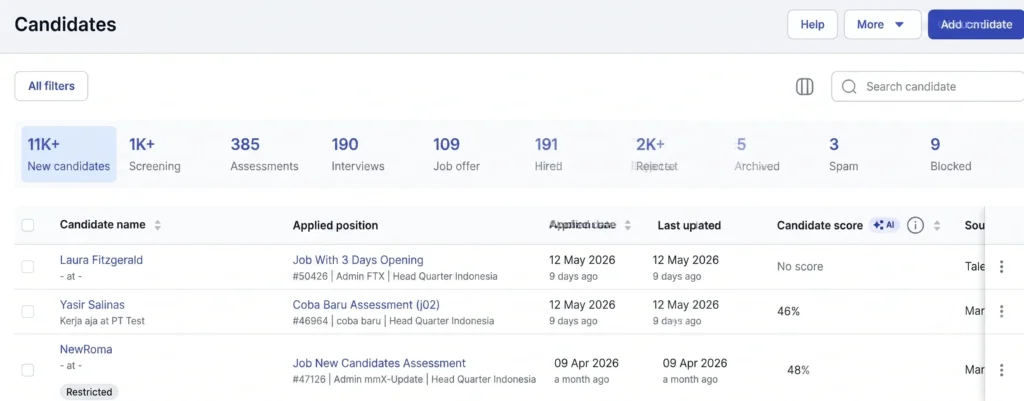
This eliminates the most common reason talent pools die: fragmented data spread across multiple systems and recruiter inboxes.
2. Automated Candidate Nurturing
Re-engagement doesn’t happen if it depends entirely on recruiter memory. The moment a candidate is moved to “Not Selected” status, a nurture sequence should automatically activate.
Mekari Talenta’s recruitment system automatically sends rejection notifications based on minimum score thresholds, and candidate progress at every hiring stage is tracked in the centralized dashboard.
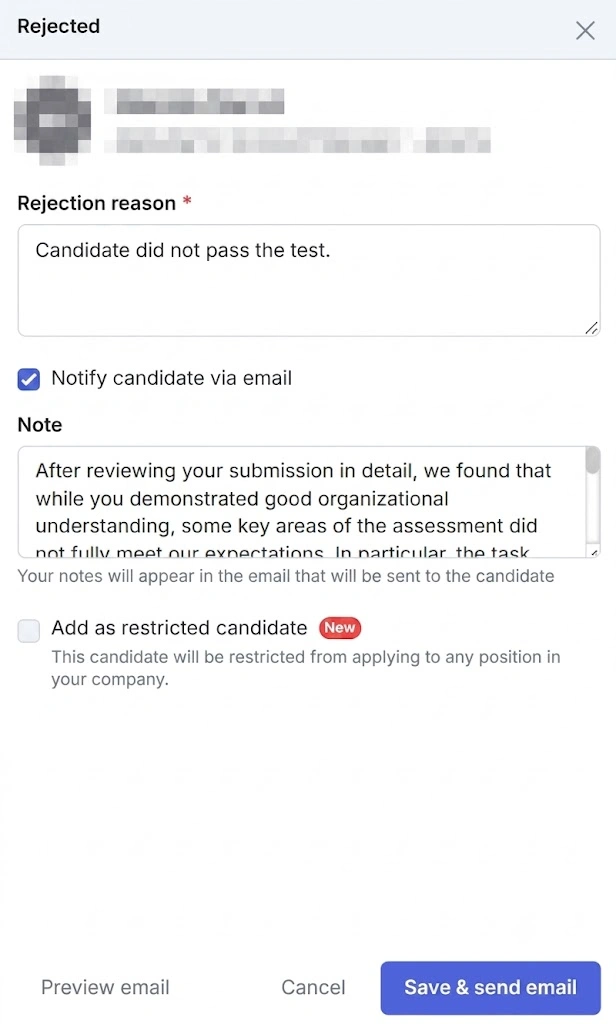
Recruiters have full visibility into where each candidate stands, so when a new role opens, they can filter by previous stage outcomes and surface silver medalists immediately, without starting from scratch.
For HR teams managing hundreds of concurrent requisitions, this kind of systematic pipeline visibility is what separates a functioning talent pool from a database that nobody trusts.
3. AI-Powered Screening to Identify the Right Profiles
One of the biggest reasons talent pools fail is poor segmentation at the point of entry.
When every applicant is treated as equivalent, the pool becomes noisy, and recruiters stop using it because searching it takes longer than posting a new job.
Mekari Talenta’s AI Candidate Scoring automatically evaluates candidate profiles based on experience, skills, and specific job requirements.
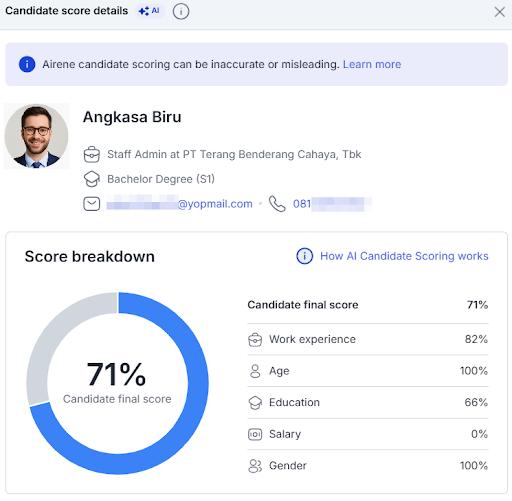
The top 2% of candidates are surfaced automatically. Candidates below the minimum threshold receive automated rejection, keeping the active pool focused and high-quality.
Over time, this creates a talent pool where the signal-to-noise ratio is high, which means recruiters actually use it when they need to hire, rather than defaulting to external sourcing every time.
4. Connecting External and Internal Talent in One System
Most enterprise talent pools have a structural blind spot: they track external candidates but remain disconnected from internal talent data.
This means that when a role opens, recruiters search the external database while the ideal internal candidate, someone whose performance history, skills, and career aspirations are all documented, is never surfaced.
Mekari Talenta addresses this through its integrated platform, connecting recruitment with Manpower Planning, performance management, and succession data.
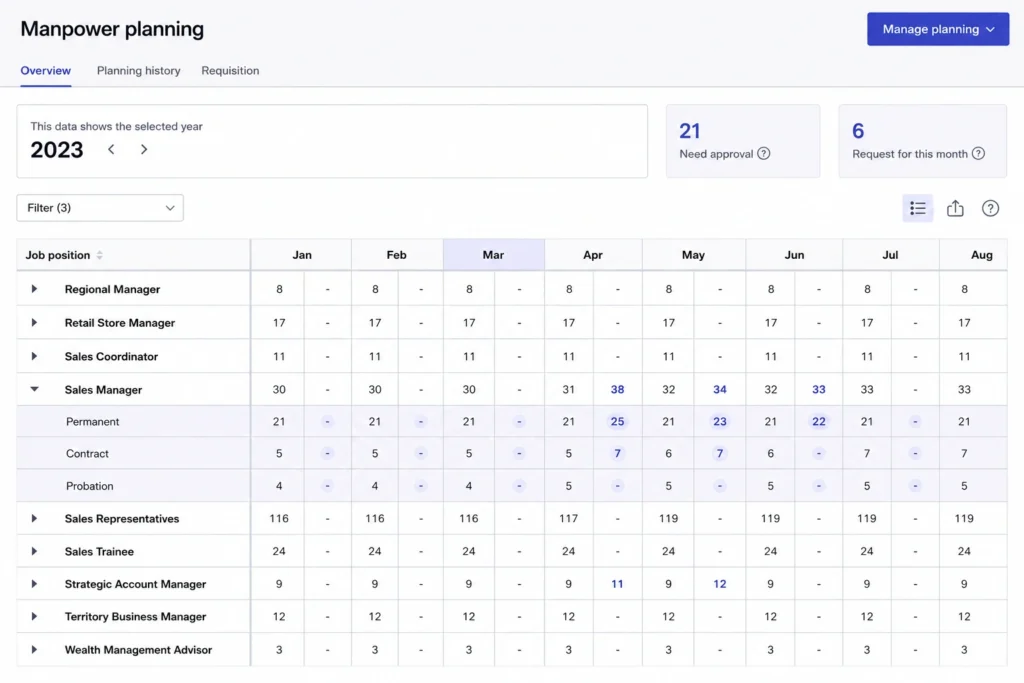
When an internal transfer or promotion is the right move, HR teams have the data to identify it quickly. When external hiring is required, the recruitment workflow picks up seamlessly.
The result is a genuine talent ecosystem: one where internal and external candidates compete on merit, with visibility across both.
5. Multi-Channel Job Posting Without the Administrative Overhead
Keeping a talent pool alive also means keeping it fed, continuously sourcing new candidates, especially for critical recurring roles.
At enterprise scale, this means publishing to LinkedIn, JobStreet, and your company career site simultaneously, without a separate workflow for each channel.
Mekari Talenta allows you to post once and publish automatically across all major channels. Applications from all sources are synchronized into a single dashboard.
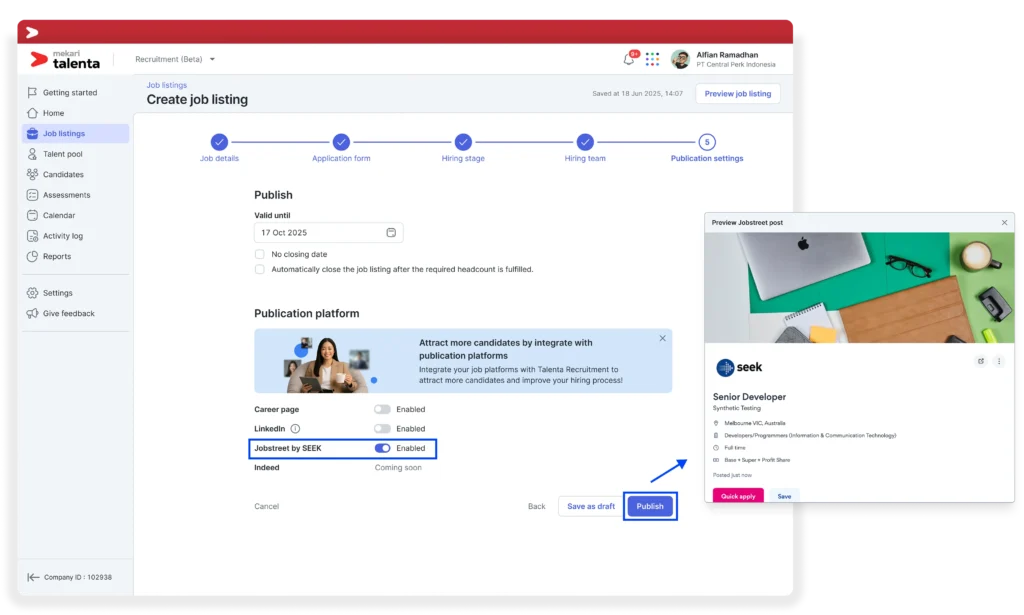
This isn’t just an efficiency gain. It ensures that new candidates are consistently entering the pool, tagged correctly, and reviewable in the same system as historical candidates.
6. Recruitment Insights That Drive Pool Strategy
A talent pool without measurement is just a database. HR leaders need to know: where are we sourcing our best hires from? What’s our time-to-fill trend across different role families? Where are candidates dropping out of our pipeline?
Mekari Talenta’s recruitment analytics tracks Time-to-Hire, Time-to-Fill, and Candidate Acceptance Rate through a centralized, intuitive dashboard.
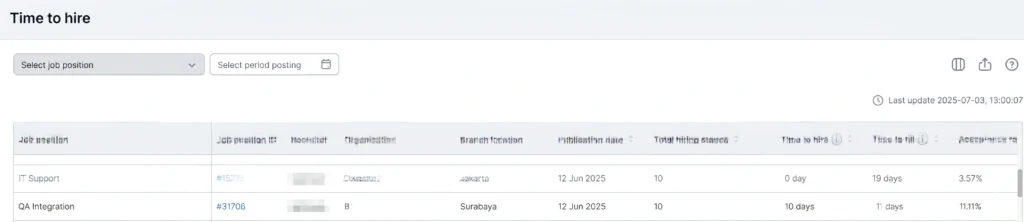
Custom report configurations allow HR leaders to analyze pipeline health by division, seniority level, or sourcing channel.
These insights are what enable continuous pool optimization, rather than running the same sourcing strategy repeatedly and wondering why results aren’t improving.
The Governance Imperative: Compliance, Consent, and Data Privacy
Talent pools create a specific category of regulatory risk that many HR teams underestimate. You are collecting, storing, and potentially processing the personal data of individuals who may not have actively consented to long-term data retention.
This has material implications under multiple regulatory frameworks, such as GDPR in the European Union, PDPA in Thailand and Singapore, PIPL in China, and equivalent legislation across most enterprise-relevant markets.
Non-compliance is not a theoretical risk; enforcement actions have resulted in fines exceeding millions of dollars for major employers.
The key governance requirements for talent pool compliance:
- Explicit, documented consent for talent pool inclusion. Your standard application consent language may not cover ongoing retention in a talent pool. Candidates should specifically consent to being held in a talent pool, for what purposes, and for how long. This needs to be documented and auditable.
- Defined data retention periods. You must have a policy specifying how long candidate data is retained, what happens at the end of that period, and how candidates can request deletion. Storing data indefinitely because “we might need it someday” is not compliant in most jurisdictions.
- The right to access and deletion. Any candidate must be able to request a copy of their data held by your organization and request its deletion. Your ATS must be configured to facilitate this, not just philosophically, but operationally.
- Purpose limitation. Candidate data collected for one role cannot automatically be used for a different role without re-consent in many jurisdictions. Your tagging and re-engagement workflows need to be designed with this in mind.
- Data minimization. You should only retain data that is necessary for legitimate talent acquisition purposes. Storing speculative data “just in case” creates compliance risk without corresponding value.
Practically, this means your talent pool strategy needs a governance layer: a written data retention policy, a consent capture workflow embedded in your ATS, a periodic audit process to delete expired records, and a clear process for handling deletion requests.
Organizations operating across multiple markets should conduct a regulatory mapping exercise, identifying which jurisdictions their candidate data is subject to and ensuring their ATS configuration meets the most stringent applicable standard.
The cost of getting this wrong is significant. The cost of getting it right is a process design exercise. There is no credible argument for deprioritizing governance.
The Untapped Talent Pool: Internal Talent Mobility
Most talent pool discussions focus exclusively on external candidates. This is a strategic error, and for enterprises, it’s often the most expensive mistake in the talent acquisition playbook.
Your internal workforce is your most qualified, context-rich, and cost-efficient talent pool. These are people who already understand your business, your culture, and your systems.
Their performance data is on record. Their development trajectory is known. Hiring them into a new role eliminates onboarding ramp time, reduces cultural risk, and sends a powerful signal to the broader workforce about what career growth actually looks like at your company.
Yet despite these advantages, many organizations continue to rely heavily on external hiring. The reasons are rarely a lack of internal talent. More often, they are structural barriers that make internal talent difficult to identify, assess, and mobilize.
- Departmental silos and manager hoarding. In large organizations, managers often resist losing top performers to internal transfers. The incentive structure rewards retaining talent, not developing it. This is a culture and policy problem — not a talent problem.
- Lack of skills visibility. HR teams frequently don’t have a centralized, up-to-date view of employee skills across the organization. An employee with data science skills who joined in a business analyst role may never be surfaced as a candidate for an analytics position, simply because nobody connected the dots.
- Absence of internal career visibility. Employees who don’t know internal roles exist can’t apply for them. Many enterprise organizations have no formal mechanism for communicating internal opportunities to employees before they go external.
- The “grass is greener” bias. Hiring managers sometimes assume external candidates bring more prestige or capability than internal ones. This assumption is rarely validated, and it’s expensive.
Practical Steps to Activate Your Internal Talent Pool
The good news is that these barriers are not caused by a shortage of talent. They are caused by a shortage of visibility, structure, and process.
Organizations do not need to create an internal talent pool from scratch—they already have one. The challenge is making that talent visible, accessible, and actionable when opportunities arise.
The following steps can help transform internal talent from a hidden workforce asset into an active source of mobility and succession.
- Step 1 — Build a skills inventory. Conduct a structured competency mapping exercise across critical role families. Identify employees who have skills beyond their current role scope. This is the foundation of internal sourcing.
- Step 2 — Establish an internal mobility policy. Define clear criteria for internal applications (minimum tenure in current role, manager consultation requirements, etc.). Make the policy visible and easy to navigate.
- Step 3 — Require internal posting before external. For non-specialized roles, mandate that positions are posted internally for at least two weeks before external sourcing begins. This ensures qualified internal candidates have first access.
- Step 4 — Create a succession-linked talent pool. For critical and leadership roles, maintain a specific internal pipeline of candidates who are actively being developed for those roles — not just identified, but supported with IDPs, mentorship, and stretch assignments.
- Step 5 — Track and report internal fill rate. Make the percentage of roles filled by internal candidates a visible HR metric, reported to leadership quarterly. This creates accountability and signals organizational commitment to internal career development.
Internal talent mobility is not a separate initiative from external talent pool management. It’s the most valuable segment of the same pool.
Organizations that manage both in an integrated system gain a decisive advantage in talent availability, cost-per-hire, and retention.
Read also: Organizations Are Investing More in Internal Talent Mobility Frameworks — Here’s Why and How
Stop Rebuilding From Scratch: Build a Talent Ecosystem with Mekari Talenta
Every enterprise HR leader reading this article knows what the status quo costs. It costs time. It costs money. And it costs organizational momentum.
The root cause is almost always the same: organizations treat recruitment as a series of isolated transactions rather than as a continuous talent relationship management function.
Every cycle starts from zero. Every requisition reinvents the wheel. And the talent that already exists in the system, external candidates who were assessed and engaged, internal employees who are ready for more, goes unmobilized.
Mekari Talenta’s Advanced Recruitment platform is built specifically to break this cycle. It’s an AI-powered, enterprise-grade recruitment solution that turns your candidate database into a functioning talent ecosystem — not just a filing system.
With Mekari Talenta, your HR team can:
- Post once, reach everywhere — publish job openings simultaneously to LinkedIn, JobStreet, and your career site from a single dashboard, with all applications centralized in one place
- Let AI do the heavy screening — AI Candidate Scoring automatically ranks applicants by profile fit, surfaces the top 2%, and handles rejection notifications for below-threshold candidates, saving your team up to 40% of screening time
- Track every candidate, every stage — full pipeline visibility across all requisitions, with candidate history preserved and searchable even after a requisition closes
- Connect recruitment to workforce planning — integrated with Manpower Planning (MPP), onboarding, and the broader Mekari Talenta HCM ecosystem, so the hire-to-productive timeline is shorter and less fragmented
- Measure what matters — Time-to-Hire, Time-to-Fill, Acceptance Rate, and customizable reports that give HR leadership the data to optimize, not just report
Trusted by 35,000+ businesses across Southeast Asia, Mekari Talenta is built for enterprise complexity, multi-entity structures, high-volume hiring, compliance requirements, and integration with existing HR infrastructure.
The talent you need is closer than you think. You just need a system that can find it.
Explore Mekari Talenta or schedule a consultation with our team to see how we can help you build a talent pool that actually works.
References: