
How to Start a Business in Indonesia: A Complete Setup Checklist for Foreign Companies


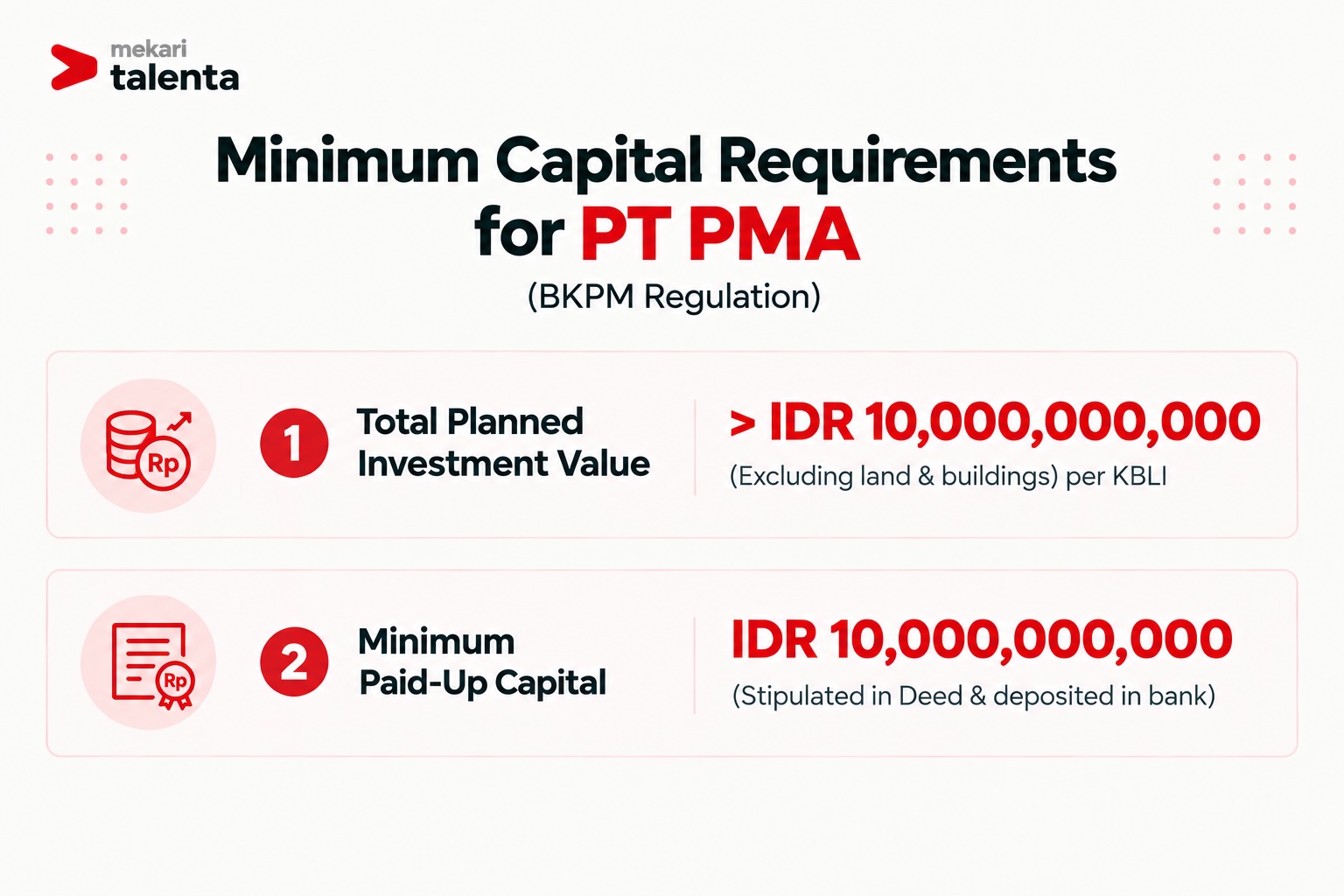
- Establishing a PT PMA requires a minimum paid-up capital of IDR 10 billion per KBLI code and risk-based licensing through the OSS RBA system for full commercial operations.
- Early operational success hinges on meeting local labor regulations, including expatriate (TKA) work permits, mandatory BPJS enrollment, and accurate statutory PPh 21/26 tax withholding.
As Southeast Asia’s largest economy with a Gross Domestic Product (GDP) exceeding USD 1.3 trillion and a population of over 280 million, Indonesia stands out as one of the most compelling expansion destinations for multinational enterprises and foreign investors.
Regulatory reforms under the Omnibus Law on Job Creation, coupled with the digitization of business licensing systems, have significantly smoothed the entry path for Foreign Direct Investment (FDI).
However, despite these immense market opportunities, foreign companies frequently encounter complex operational hurdles on the ground.
While many entities successfully navigate legal incorporation, they often stumble during early-stage operations: managing minimum capital requirements, securing expatriate work permits, and adapting to complex local payroll and tax structures.
How can a foreign enterprise legally establish and operate a business in Indonesia without getting bogged down in bureaucratic delays, hidden costs, and payroll or labor compliance risks? Let’s check the article below.
Understanding Foreign Business Entities in Indonesia
Selecting the appropriate legal entity is the foundational step for any foreign investor entering the Indonesian market. The Indonesian government primarily offers two structural pathways for foreign business presence: a PT PMA or a KPPA.
Comparison: PT PMA vs. KPPA
| Evaluation Dimension | PT PMA (Foreign Direct Investment Company) | KPPA (Foreign Representative Office) |
| Legal Status | Limited Liability Company (Indonesian Legal Entity) | Extension of the Overseas Parent Company |
| Commercial Activity | Permitted to generate revenue, issue invoices, and conduct full commercial operations. | Prohibited from engaging in direct sales or generating local revenue. |
| Foreign Ownership | Up to 100% foreign-owned (subject to KBLI regulations under the Positive Investment List). | 100% controlled by the overseas parent company. |
| Minimum Capital Requirement | Minimum paid-up capital of IDR 10 Billion (~USD 640,000) per KBLI. | No minimum paid-up capital requirement. |
| Expatriate Sponsorship | Permitted to sponsor Work Visas (ITAS) for foreign executives and technical experts. | Permitted to sponsor a Chief Representative Officer (CRO). |
| Tax Liabilities | Subject to Corporate Income Tax, PPh 21/26 withholding tax, VAT, and full tax filings. | Limited to withholding tax PPh 21/26 on employee salaries and office-related taxes. |
The Positive Investment List and KBLI Classification
Under Presidential Regulation No. 10 of 2021 (amended by Presidential Regulation No. 49 of 2021), Indonesia adopted the Positive Investment List. In principle, all business sectors are open to 100% foreign ownership unless explicitly listed as:
- Reserved entirely for the Central Government or closed to commercial activity (e.g., narcotics, weapons).
- Reserved for micro, small, and medium-sized enterprises (MSMEs) or subject to local partnership mandates.
- Subject to foreign ownership caps (e.g., maximum 49% or 67% foreign equity in specific defense or broadcasting sectors).
Every commercial activity must be assigned a specific 5-digit KBLI code (Standard Classification of Indonesian Business Fields). The assigned KBLI determines licensing requirements, risk levels, and capital commitments.
Read more: Employee of Record (EOR) vs Payroll Outsourcing: Which Is Right for Foreign Company?
Step-by-Step Legal Setup Checklist (Phase 1: Legal Incorporation)
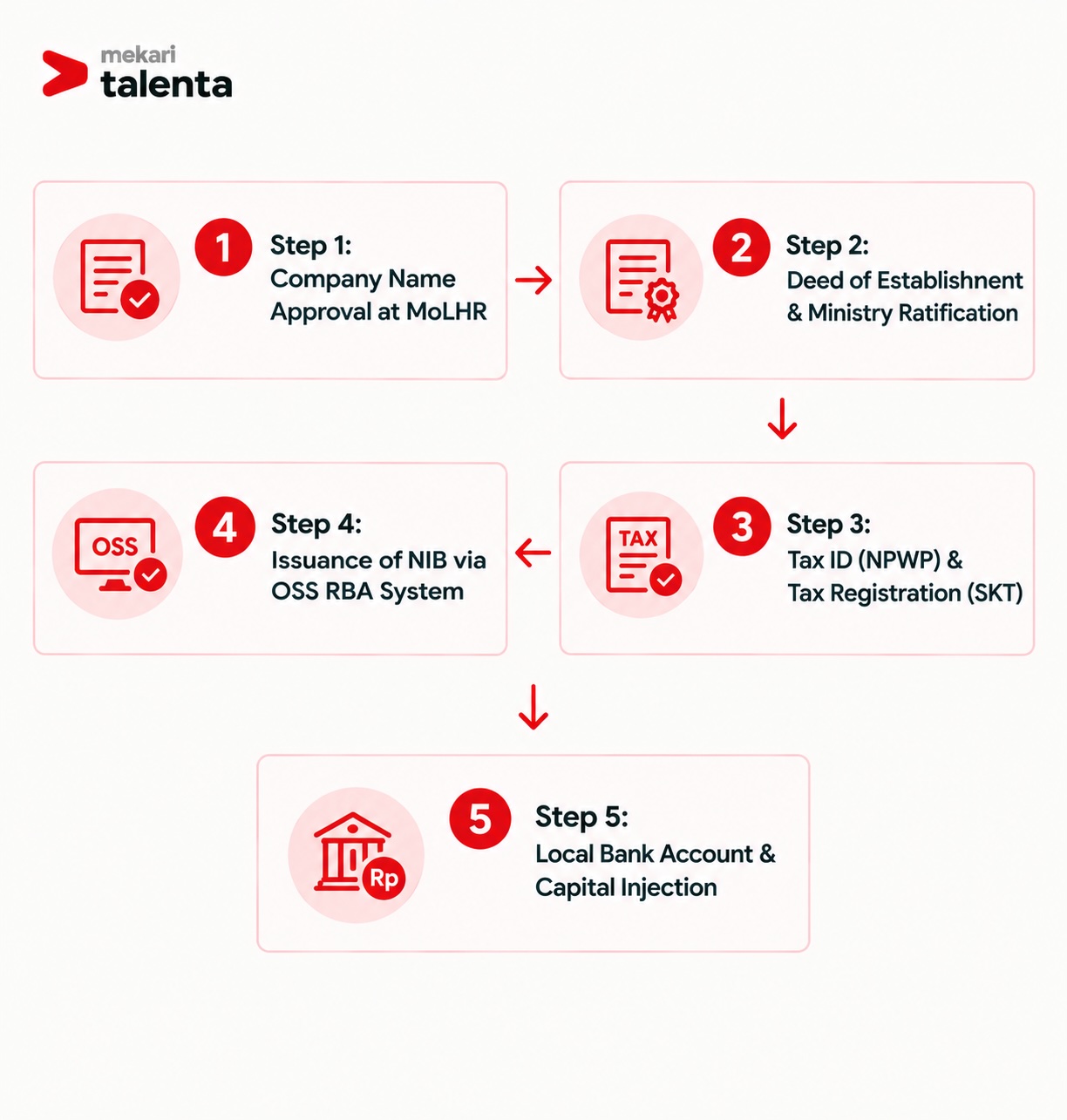
Formally incorporating a PT PMA in Indonesia requires meticulous legal and administrative execution. Foreign entities must complete five core legal phases:
Step 1: Company Name Approval
The proposed company name must be reserved through a licensed Indonesian notary and approved by the Ministry of Law and Human Rights (MoLHR). The name must consist of at least three words and must not infringe upon existing registered trademarks or entity names in Indonesia.
Step 2: Deed of Establishment and Legal Entity Approval
A local notary drafts the Deed of Establishment, containing the company’s Articles of Association, shareholder composition, Board of Directors, and Board of Commissioners. At least one Director or Commissioner should ideally reside in Indonesia or possess a valid long-term stay permit. Once signed, the notary submits the deed to MoLHR for formal legal entity ratification.
Step 3: Corporate Tax ID (NPWP) and Tax Registration
The entity must register with the local Tax Office (KPP) corresponding to its registered domicile to obtain a Corporate Tax Identification Number (NPWP) and a Tax Registration Letter (SKT). This identifier is mandatory for all corporate tax obligations in Indonesia.
Step 4: Business Identification Number (NIB) via OSS RBA
Indonesia consolidates business licensing through the Online Single Submission Risk-Based Approach (OSS RBA) platform managed by the Ministry of Investment/BKPM. Under this framework, the Business Identification Number (NIB) serves as the primary operational identity, categorized by business risk:
- Low Risk: NIB acts as the final license for commercial operations.
- Medium-Low / Medium-High Risk: Requires a Standard Certificate validated by the relevant ministry.
- High Risk: Requires full operational permits and verified site inspections before commercial activity begins.
Step 5: Opening a Local Corporate Bank Account
Once the NIB is issued, the PT PMA must open a corporate bank account with an authorized commercial bank in Indonesia to deposit the minimum paid-up capital of IDR 10 Billion. Proof of capital injection is required when submitting mandatory quarterly Investment Activity Reports (LKPM) to BKPM.
Step-by-Step Operational & Workforce Setup Checklist (Phase 2: Operations & Labor)
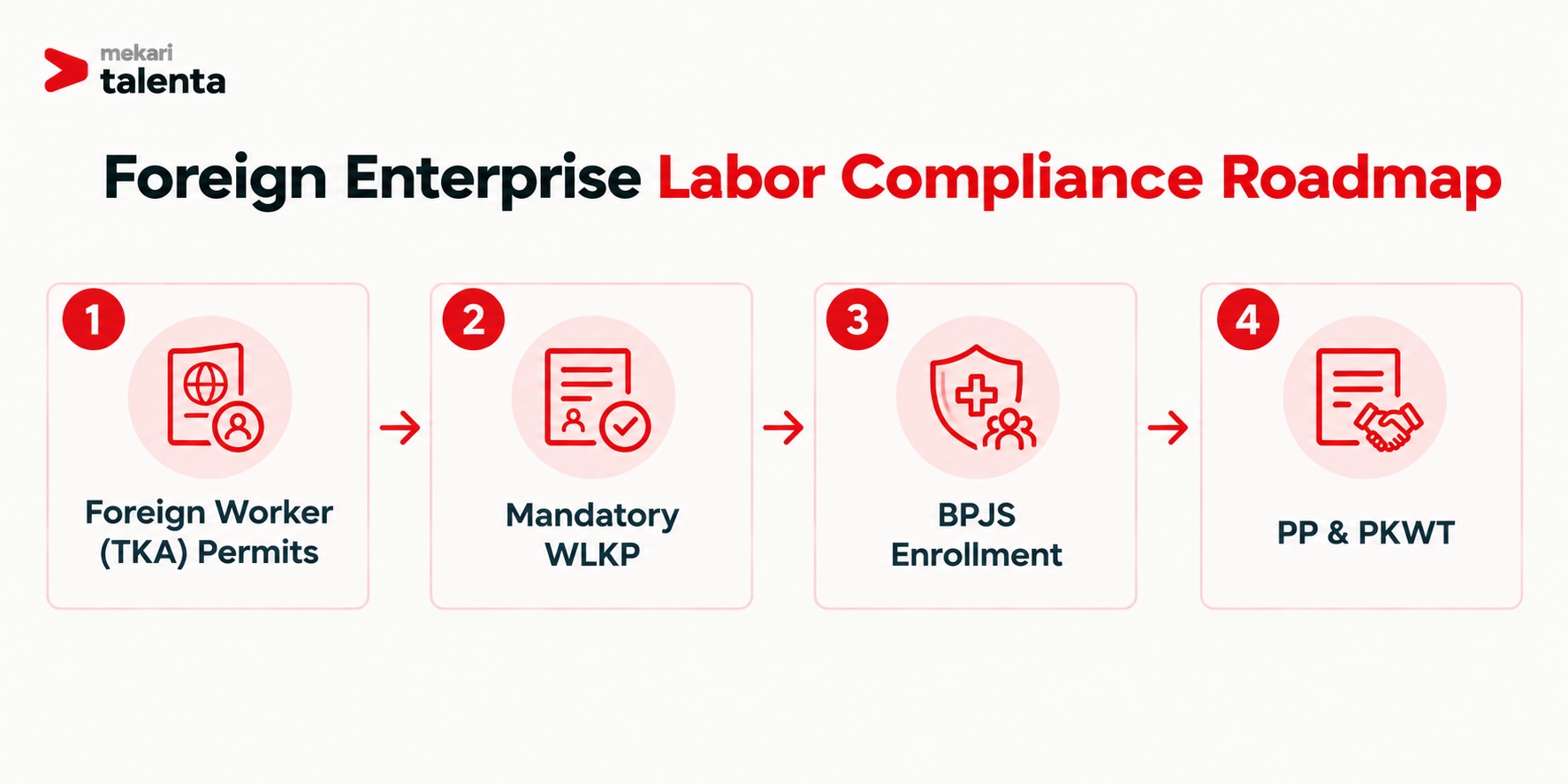
Securing legal status is only half the battle. Transitioning to full operational status requires strict compliance with Indonesia’s employment laws and workforce regulations.
1. Foreign Manpower (TKA) Regulations and Work Permits
If the company intends to deploy foreign executives or technical experts, it must comply with the foreign worker regulations enforced by the Ministry of Manpower (Kemnaker). Essential requirements include:
- RPTKA Approval: A formal Expatriate Utilization Plan approved by Kemnaker.
- DKPTKA Contribution: A mandatory Skill Development Fund payment of USD 100 per month per position.
- ITAS / Vitas Issuance: Obtaining a Temporary Stay Permit and Work Visa.
- Indonesian Companion Worker: Foreign enterprises must assign at least one Indonesian companion worker per expatriate for skills transfer.
2. Mandatory Labor Reporting (WLKP)
Under Law No. 7 of 1981, all new companies must file a Mandatory Labor Report (WLKP) through Kemnaker’s digital portal within 30 days of establishment, updating it annually.
3. Social Security Enrollment (BPJS)
Employers in Indonesia are legally mandated to enroll all employees, including foreign nationals working in Indonesia for at least 6 months, in national social security programs managed by BPJS Employment and BPJS Health. BPJS Employment covers five statutory protection programs: Work Accident (JKK), Death (JKM), Old Age (JHT), Pension (JP), and Job Loss (JKP) benefits.
4. Employment Contracts and Company Regulations
Indonesian labor law strictly governs employment relationships. Companies must prepare compliant documentation:
- Contract Types: Clear distinction between fixed-term (PKWT employment contracts) and permanent (PKWTT) contracts under the Job Creation Law, including mandatory compensation pay upon PKWT completion.
- Company Regulations (PP): Any entity employing 10 or more workers is legally required to draft Company Regulations registered with the local labor office.
Read more: Payroll Internal Controls: A Complete Guide to Strengthening Security
Payroll Management and Tax Compliance: The Primary Pitfall for Foreign Entities
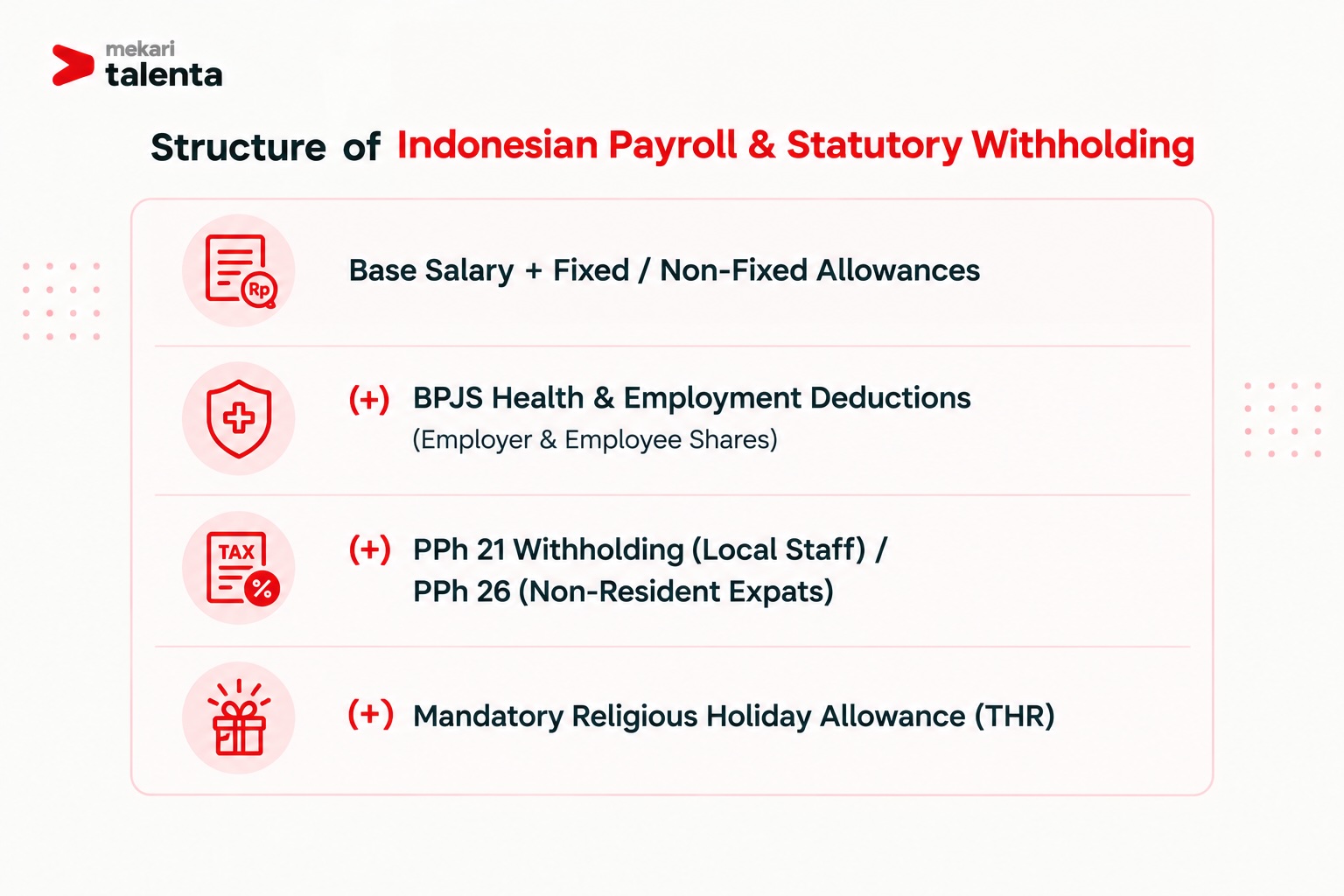
Managing local payroll and employee income tax withholding is one of the most error-prone areas for foreign enterprises entering Indonesia.
Calculation errors or late filings risk substantial penalties from the Directorate General of Taxes (DJP) and can spark industrial relations disputes with local staff.
1. Complexities of PPh 21 TER and PPh 26 Withholding
Indonesia introduced the PPh 21 Average Effective Rate (TER) scheme. This framework categorizes monthly income tax withholding into three brackets (TER A, B, and C) based on non-taxable income status (PTKP) and gross monthly earnings.
For foreign experts or executives who have not yet qualified as Domestic Tax Subjects (SPDN), employers must withhold PPh 26 at a flat 20% gross rate (unless reduced under an applicable Double Taxation Avoidance Agreement / DTAA).
2. Mandatory Religious Holiday Allowance (THR)
Indonesian labor law enforces a statutory Religious Holiday Allowance (THR). THR is a mandatory non-salary payment disbursed to employees no later than 7 days prior to their respective religious holiday. Employees with 12 months of continuous service receive one full month’s salary, while those with less than 12 months receive a pro-rated amount.
3. Mitigating Payroll Risks via Managed Payroll Solutions
The PwC Indonesia Tax Guide highlights that statutory payroll complexities in emerging markets frequently cause tax reporting errors during a foreign company’s first operational year.
Building an in-house payroll and HR compliance team from day one requires significant capital and a long ramp-up period. As a result, many multinational companies adopt automated payroll software or partner with local managed payroll providers to guarantee compliance from their first pay cycle.
Foreign Business Setup Checklist Matrix
Use this matrix as a project tracking tool to monitor your setup milestones in Indonesia:
| Setup Phase | Key Document / License | Relevant Authority | Responsible Team | Estimated Timeline | Compliance Notes |
| Phase 1: Legal | Name Reservation & Deed | MoLHR / Notary | Corporate Legal | 3–5 Business Days | Name must follow 3-word guidelines. |
| Phase 1: Legal | Tax ID (NPWP) & SKT Letter | Tax Office (KPP) | Legal / Finance | 1–2 Business Days | Must have a valid physical legal domicile. |
| Phase 1: Legal | Business ID (NIB) & Licenses | BKPM (OSS RBA System) | Legal / Licensing | 1–3 Business Days | Categorized by KBLI risk level. |
| Phase 1: Legal | Bank Account & Paid-up Capital | Commercial Bank | Finance / Director | 5–10 Business Days | Capital injection of IDR 10B required. |
| Phase 2: HR/Ops | RPTKA & Work Permit (ITAS) | Kemnaker / Immigration | HR / Mobility | 10–20 Business Days | Indonesian companion worker required. |
| Phase 2: HR/Ops | Mandatory WLKP Report | Kemnaker | HR Team | 1–2 Business Days | Must be filed online annually. |
| Phase 2: HR/Ops | BPJS Health & Employment | BPJS Authorities | HR / Payroll | 3–5 Business Days | Covers local staff & expats (>6 months). |
| Phase 2: HR/Ops | Company Regulations (PP) | Local Labor Office | HR / Legal | 14–30 Business Days | Mandatory for entities with >= 10 staff. |
| Phase 2: HR/Ops | Payroll & Tax System Setup | Tax Authority / Internal | HR / Finance | 3–7 Business Days | Configure PPh 21 TER, PPh 26, & THR calculations. |
Accelerating Business Operations with Mekari Talenta
Launching operations in a new jurisdiction shouldn’t be slowed down by administrative friction. As your company prepares to hire its first employees in Indonesia, maintaining strict compliance with local labor and tax laws is critical.
Mekari Talenta provides foreign enterprises expanding into Indonesia with seamless operational infrastructure. Through Mekari Talenta Payroll Service, your organization can outsource payroll management and local tax compliance to experienced local experts, eliminating the need to build a complex internal payroll team during early entry phases.
Mekari Talenta’s managed payroll and outsourcing services deliver:
- Accurate Tax & Payroll Processing: Automated calculations for base salary, PPh 21 TER tax rates, PPh 26 withholding for expatriates, and statutory BPJS contributions.
- Guaranteed Regulatory Compliance: Timely monthly tax filings and social security administration without penalty risk.
- Integrated HR Technology: Backed by an integrated HRIS platform to manage attendance tracking, leave requests, and digital payslip distribution via secure mobile apps.
By relying on Mekari Talenta to manage your payroll operations, executive teams can mitigate legal compliance risks and focus their energy on scaling their core business across Indonesia.
Discover how managed payroll solutions can streamline your expansion by visiting the Mekari Talenta Payroll Service Page.
If you want to explore more about our Payroll Service feature, you can contact our payroll outsourcing team for a closer look at how it works and try our product demo for free.
References:
Deloitte Indonesia. (2025). Indonesia Tax & Investment Guide 2025/2026. Deloitte Touche Tohmatsu Limited.
Ministry of Investment / BKPM. (2021). Presidential Regulation No. 10/2021 & No. 49/2021 on Investment Business Fields. Jakarta: BKPM.
Ministry of Manpower of the Republic of Indonesia. (2023). Ministerial Regulation on Expatriate Utilization and Mandatory Labor Reporting. Jakarta: Kemnaker RI.
PwC Indonesia. (2025). Doing Business and Investing in Indonesia. PriceWaterhouseCoopers Indonesia.
World Bank Group. (2024). Investment Competitiveness and Regulatory Risk Report in Emerging Markets. Washington, D.C.: World Bank.
FAQ
1. What is the fundamental difference between a PT PMA and a KPPA for foreign investors in Indonesia?
1. What is the fundamental difference between a PT PMA and a KPPA for foreign investors in Indonesia?
A PT PMA is a full-fledged Limited Liability Company authorized to engage in commercial operations, issue local invoices, and generate revenue in Indonesia. Conversely, a KPPA (Representative Office) serves purely as a liaison office for market research and coordination on behalf of the overseas parent company, and is strictly prohibited from generating local revenue or conducting direct sales.
2. What is the minimum capital requirement to establish a PT PMA in Indonesia?
2. What is the minimum capital requirement to establish a PT PMA in Indonesia?
The Indonesian government requires a total investment plan exceeding IDR 10 billion (excluding land and buildings) per 5-digit KBLI business classification code. Out of this total investment commitment, a minimum paid-up capital of IDR 10 billion must be deposited into the company’s local corporate bank account after initial legal incorporation.
3. How does the OSS RBA system determine operational licenses for new businesses?
3. How does the OSS RBA system determine operational licenses for new businesses?
The Online Single Submission Risk-Based Approach (OSS RBA) system issues a Business Identification Number (NIB) based on the assigned risk level of the chosen KBLI code. For low-risk sectors, the NIB acts as the final operational license. For medium- to high-risk sectors, companies must secure additional verified standard certificates or specific ministry permits before commencing commercial activities.
4. What requirements must a company fulfill to employ foreign workers (TKA)?
4. What requirements must a company fulfill to employ foreign workers (TKA)?
Companies must obtain an approved Expatriate Utilization Plan (RPTKA) from the Ministry of Manpower, pay a monthly Skill Development Fund (DKPTKA) contribution of USD 100 per position, and secure a valid Work Visa/Stay Permit (ITAS). Additionally, local labor regulations mandate appointing at least one Indonesian companion worker per expatriate for technology and skills transfer.
5. What are the main payroll and tax compliance challenges for newly established foreign entities?
5. What are the main payroll and tax compliance challenges for newly established foreign entities?
Key challenges include calculating local employee income tax under the PPh 21 Average Effective Rate (TER) scheme, withholding a 20% PPh 26 tax for non-resident expatriates, and enrolling all eligible staff in mandatory BPJS Health and Employment social security programs. Employers must also budget for the statutory Religious Holiday Allowance (THR) disbursed at least 7 days prior to religious holidays.