






-
A salary structure is a compensation framework that organizes pay ranges, grades, and salary progression across roles and job levels.
-
Building a salary structure requires job evaluation, salary grading, market benchmarking, governance rules, and continuous compensation review.
Salary structure decisions become increasingly difficult as organizations expand across multiple functions, job levels, and locations.
What initially starts as manageable compensation decisions often evolves into inconsistent salary positioning, fragmented grading practices, and rising payroll inefficiencies over time.
A well-designed salary structure helps organizations maintain compensation consistency while remaining competitive in rapidly changing labor markets.
It also creates stronger visibility into payroll planning, career progression, and long-term workforce sustainability across the organization.
This article will explain how salary structures work, how to build them effectively, common implementation challenges, and the best practices for maintaining scalable compensation frameworks.
What is a Salary Structure?
A salary structure, also known as a pay structure, is a framework that defines how compensation is organized across roles, job levels, departments, and career stages within a company.
It establishes salary ranges, pay grades, progression rules, and compensation positioning to ensure employees are paid consistently, competitively, and in alignment with business priorities.
In growing companies with multiple functions, locations, and reporting lines, a salary structure becomes the foundation for workforce planning, budgeting, promotion decisions, and long-term retention.
It helps leadership maintain internal pay consistency while remaining responsive to market movements, skill shortages, and changing business demands.
A well-designed pay structure also creates operational discipline. Managers can make compensation decisions within clear guardrails, finance teams gain better visibility into payroll forecasting, and employees understand how pay progression is determined across the organization.
Rather than treating compensation as isolated salary decisions, companies use salary structures to build a scalable compensation system that supports sustainable growth, workforce stability, and stronger governance across the employee lifecycle.
Benefits of Having a Salary Structure
A salary structure delivers long-term operational value beyond compensation administration alone.
Companies with structured pay frameworks are often better positioned to retain key talent, maintain compensation fairness, and reduce decision-making friction across hiring and promotion cycles.
The benefits below explain why salary structures have become a core foundation of sustainable workforce management.
1. Improves Employee Trust and Long-Term Retention
One of the most significant benefits of a salary structure is its ability to create stronger employee confidence in compensation decisions
When employees understand how pay ranges are determined, how promotions affect compensation, and how salary progression works across job levels, they are more likely to perceive the organization as fair and professionally managed.
This matters because retention problems are often tied less to absolute salary figures and more to perceived inconsistency.
Employees usually compare compensation decisions internally long before they compare them externally. When similar roles receive noticeably different pay without clear justification, trust begins to erode gradually across teams.
The finding highlights why structured compensation systems play an important role in workforce stability, particularly during promotion cycles, market adjustments, and periods of rapid hiring.
A well-defined pay structure helps organizations explain compensation decisions more consistently, which reduces unnecessary speculation, internal pay disputes, and avoidable turnover among high-performing employees.
2. Strengthens Payroll Control and Compensation Planning
Salary structures also improve financial discipline by giving leadership teams clearer visibility into payroll allocation and compensation growth.
Instead of allowing compensation decisions to develop independently across departments, organizations can manage salary increases, hiring budgets, and promotion adjustments within predefined pay ranges and compensation bands.
This becomes especially important during expansion periods, when hiring volumes increase and salary decisions need to remain aligned across multiple business functions.
Without compensation guardrails, organizations often experience salary compression, inconsistent hiring offers, and unpredictable payroll growth that becomes difficult to correct later.
The importance of compensation structure becomes even clearer when looking at broader employee sentiment around pay management.
These findings suggest that employees increasingly evaluate not only how much they are paid, but also whether compensation decisions appear structured, rational, and consistently managed across the organization.
Organizations with mature salary structures are generally better equipped to address these concerns proactively because compensation decisions are tied to role value, salary band positioning, and workforce planning objectives rather than short-term negotiation pressure alone.
3. Enhances Recruitment Competitiveness and Compensation Transparency
A structured salary framework also improves hiring efficiency by giving recruiters and hiring managers clearer compensation boundaries before recruitment discussions begin.
Defined salary ranges accelerate offer approvals, reduce negotiation friction, and create greater consistency across hiring decisions.
This has become increasingly valuable as workforce expectations around compensation transparency continue to rise.
Candidates today expect more clarity around salary progression, pay ranges, and career growth opportunities before accepting an offer.
A salary structure supports this transparency in a controlled and scalable way.
Rather than relying on ad hoc compensation discussions, organizations can communicate salary positioning, progression pathways, and promotion-related pay movement more confidently across the employee lifecycle.
Over time, this consistency strengthens employer branding, improves candidate confidence during recruitment, and helps organizations compete more effectively for highly skilled talent.
Types of Salary Structures
Organizations use different salary structure models depending on workforce composition, compensation philosophy, growth trajectory, and operational priorities.
Choosing the right pay structure affects far more than payroll administration. It influences hiring flexibility, promotion management, retention strategy, budgeting accuracy, and organizational agility over time.
In practice, most organizations do not choose a salary structure purely based on theory. They select a model based on how work is organized internally, how quickly roles evolve, how competitive the labor market is, and how much compensation flexibility managers require.
Below are three widely used salary structure models, along with practical implementation examples and operational considerations.
1. Market-Based Salary Structure
A market-based salary structure aligns compensation ranges with external labor market benchmarks. Organizations regularly evaluate salary surveys, hiring trends, competitor compensation data, and talent scarcity to determine how roles should be positioned in the market.
This structure is commonly used in industries where compensation movement changes quickly, such as technology, digital services, consulting, engineering, and data-related functions.
For example, a company hiring software engineers across Indonesia and Singapore may discover that market salaries for cloud engineers increased significantly within 12 months due to rising regional demand.
Under a market-based structure, the organization can revise salary bands specifically for those roles without redesigning compensation across unrelated departments.
In practical implementation, organizations usually begin by grouping similar roles into job families, such as engineering, finance, operations, sales, or HR. Each role is then benchmarked against external compensation data to determine an appropriate market position.
A simplified structure may look like this:
| Role | Market Midpoint | Salary Range |
|---|---|---|
| HR Executive | $1,200 | $1,000–$1,400 |
| Senior HR Executive | $1,800 | $1,500–$2,100 |
| HR Manager | $3,000 | $2,500–$3,500 |
Once ranges are established, organizations define compensation rules around:
- new hire offers
- annual increments
- promotion adjustments
- market corrections
- critical skill premiums
The biggest advantage of this model is responsiveness. Compensation can adapt more quickly to labor market realities.
However, companies using this approach need strong benchmarking discipline because outdated salary data can quickly create hiring and retention problems.
A common operational mistake is updating salary ranges only during annual reviews. In highly competitive talent markets, many organizations now review compensation benchmarks every 6 to 12 months for critical functions.
2. Traditional Salary Structure
A traditional salary structure organizes employees into clearly defined pay grades with relatively narrow salary ranges. Compensation progression is tied closely to hierarchy, tenure, job level, and promotion pathways.
This model works well in organizations with stable structures, formal reporting lines, and clearly differentiated levels of responsibility.
For example, a manufacturing company may organize compensation into structured grades:
| Grade | Position Examples | Salary Range |
|---|---|---|
| Grade 5 | Admin Officer, Payroll Officer | $800–$1,100 |
| Grade 6 | Senior Officer, Team Lead | $1,100–$1,500 |
| Grade 7 | Assistant Manager | $1,500–$2,200 |
| Grade 8 | Manager | $2,200–$3,200 |
Under this structure, promotion into a higher grade usually requires formal approval, expanded responsibilities, and role reclassification.
Implementation typically starts with job evaluation. Organizations assess each role based on factors such as:
- responsibility scope
- decision-making authority
- reporting complexity
- operational impact
- required expertise
Roles with similar organizational value are grouped into the same grade.
This structure creates strong compensation governance because salary movement follows predictable rules. Budget forecasting also becomes easier since promotion and salary increase patterns are more standardized.
However, traditional structures can become restrictive when specialized talent develops faster than the hierarchy itself.
For instance, a high-performing data analyst may reach the maximum salary range of their grade long before a managerial position becomes available.
To address this issue, some organizations create specialist career tracks that allow compensation growth without requiring managerial promotion.
3. Broadbanding Salary Structure
Broadbanding combines multiple narrow pay grades into wider salary bands. Instead of maintaining many rigid levels, organizations create broader compensation ranges that allow more flexibility in salary progression and role evolution.
This model is often adopted by organizations that want faster decision-making, flatter structures, and greater cross-functional mobility.
For example, instead of maintaining separate grades for Senior Executive, Assistant Manager, and Manager, a company may merge them into one broad professional band:
| Band | Position Examples | Salary Range |
|---|---|---|
| Professional Band B | Senior Executive to Manager | $2,000–$5,500 |
Under broadbanding, compensation movement depends more heavily on contribution level, skill depth, leadership impact, and business value rather than formal title progression alone.
Implementation requires much stronger managerial calibration compared to traditional structures. Organizations usually establish detailed compensation governance rules to prevent inconsistent salary decisions across departments.
In practice, companies using broadbanding often introduce:
- performance calibration sessions
- compensation review committees
- market adjustment guidelines
- role scope documentation
- salary band penetration controls
For example, an employee positioned at 80% of the salary band maximum may require stronger justification for further increases compared to someone positioned near the lower end of the band.
Broadbanding works particularly well in organizations where roles evolve rapidly and collaboration across functions is common.
Employees can take on expanded responsibilities, strategic projects, or regional oversight without requiring constant title changes.
However, without strong compensation governance, broadbanding can create pay inconsistencies because wider ranges give managers greater discretion in compensation decisions.
For that reason, organizations implementing broadbanding successfully usually invest heavily in manager training, compensation approval workflows, and periodic pay equity reviews to maintain long-term consistency across teams.
Methods for Developing Salary Structures and Pay Scales
Before organizations can build a salary structure, they first need a systematic way to determine the relative value of each role.
This process is commonly known as job evaluation. The goal is to create a rational foundation for compensation decisions by assessing which positions carry greater responsibility, complexity, business impact, or skill requirements.
Without a formal evaluation method, salary structures often become heavily influenced by negotiation pressure, legacy pay practices, urgent hiring situations, or inconsistent managerial judgment. Over time, this creates pay disparities that are difficult to justify internally.
To avoid this, organizations typically use structured methodologies to evaluate jobs before assigning salary grades and pay ranges.
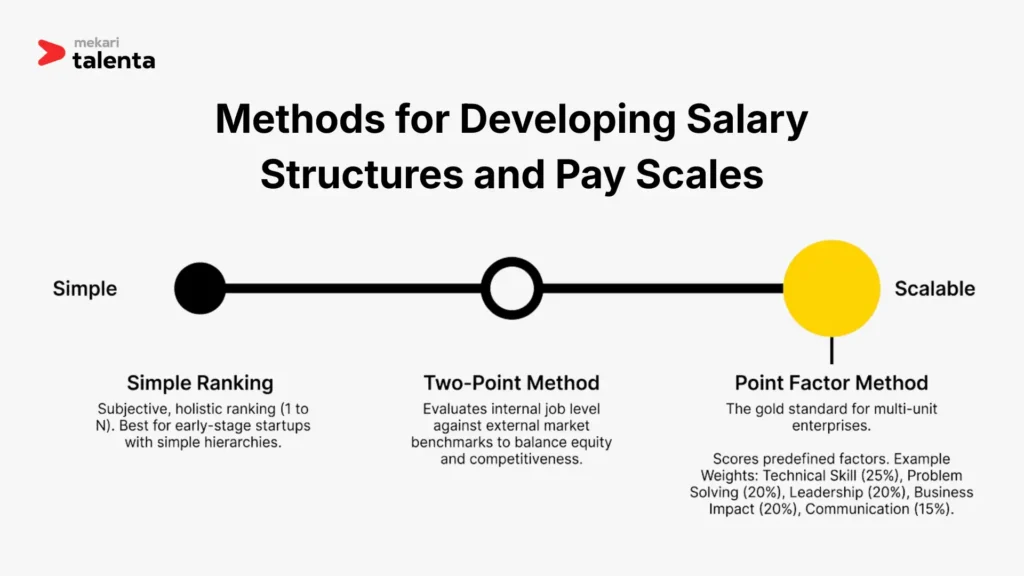
The three most commonly used approaches are the simple ranking method, the two-point method, and the point factor method.
1. Simple Ranking Method
The simple ranking method is the most basic approach to job evaluation. Roles are ranked from lowest to highest based on their overall importance, responsibility, or organizational value.
This method is usually applied in smaller organizations or companies with relatively straightforward organizational structures where role differentiation is still manageable manually.
For example, a company may rank positions like this:
| Rank | Position |
|---|---|
| 1 | Administrative Assistant |
| 2 | HR Officer |
| 3 | Senior Accountant |
| 4 | HR Manager |
| 5 | Finance Manager |
| 6 | Operations Director |
After ranking the positions, the organization groups similar roles into compensation grades and assigns salary ranges accordingly.
In practice, implementation often begins with leadership discussions involving HR, department heads, and finance teams. Each role is reviewed based on overall contribution, operational impact, and reporting scope.
The advantage of this method is simplicity. It is relatively fast, easy to understand, and requires minimal technical compensation expertise.
However, the method becomes difficult to maintain as organizations grow. Once companies have dozens or hundreds of specialized positions, ranking roles purely through subjective comparison becomes inconsistent and difficult to defend.
For example, comparing the organizational value of a cybersecurity specialist versus a procurement manager becomes increasingly complex when responsibilities differ significantly across functions.
Because of these limitations, the ranking method is typically used during early-stage organizational development or as a temporary foundation before implementing more sophisticated evaluation systems.
2. Two-Point Method
The two-point method evaluates jobs using two primary compensation dimensions, which are usually:
- job value
- market salary positioning
Organizations using this approach attempt to balance internal equity with external competitiveness simultaneously.
In practical implementation, HR teams first evaluate the relative importance of each role internally. After that, external salary benchmarking data is used to validate whether compensation levels remain competitive in the market.
For example:
| Position | Internal Job Level | Market Salary Benchmark |
|---|---|---|
| Payroll Specialist | Mid-Level | $2,000 |
| HR Business Partner | Mid-Level | $2,700 |
| Data Analyst | Mid-Level | $3,500 |
Although all three roles may sit at similar organizational levels internally, the market benchmark reveals that compensation expectations differ significantly across functions.
This method helps organizations avoid one of the most common compensation management problems: over-relying on internal hierarchy while ignoring labor market realities.
Implementation usually involves:
- grouping jobs into organizational levels
- conducting salary benchmarking
- comparing internal value against market demand
- adjusting salary bands accordingly
The two-point method is especially useful in organizations hiring both operational and highly specialized talent simultaneously.
For example, companies may maintain internal consistency across managerial levels while still offering premium compensation for difficult-to-fill technical roles such as software engineering, cybersecurity, data science, or regulatory compliance.
The challenge of this method lies in balance. Organizations must avoid creating excessive pay gaps between functions that could eventually weaken perceptions of internal fairness.
3. Point Factor Method
The point factor method is one of the most structured and widely used job evaluation systems in large organizations.
Instead of comparing jobs subjectively, each role is evaluated using predefined compensation factors with assigned numerical values.
Typical evaluation factors include:
- educational requirements
- technical expertise
- problem-solving complexity
- decision-making authority
- communication responsibility
- financial impact
- leadership scope
- operational risk
Each factor is assigned a weighted score based on organizational priorities.
For example:
| Evaluation Factor | Weight |
|---|---|
| Technical Skill | 25% |
| Problem Solving | 20% |
| Leadership Responsibility | 20% |
| Business Impact | 20% |
| Communication Complexity | 15% |
A role is then scored against each factor to generate a total job evaluation score.
Example:
| Position | Total Points |
|---|---|
| HR Officer | 320 |
| Senior Accountant | 420 |
| HR Manager | 580 |
| Operations Director | 900 |
Positions with similar scores are grouped into salary grades before compensation ranges are assigned.
In real-world implementation, the point factor method usually requires cross-functional calibration sessions involving HR, finance, and department leaders.
Organizations often spend several months building factor definitions, scoring guidelines, and validation frameworks before the system is fully operational.
Despite requiring more effort, this method creates much stronger compensation governance because salary decisions become easier to justify objectively.
It is particularly valuable in organizations with:
- multiple business units
- specialized professional roles
- large workforce populations
- regional operations
- complex reporting structures
The method also scales more effectively over time because new positions can be evaluated systematically using the same scoring framework.
However, one important operational reality is often overlooked: the effectiveness of the point factor method depends heavily on the quality of factor definitions and calibration discipline.
If scoring standards are inconsistent across departments, the structure may still produce compensation distortions despite having a sophisticated framework.
For that reason, organizations using point factor systems successfully usually conduct periodic job reevaluation exercises to ensure the structure remains aligned with evolving business needs and workforce complexity.
How to Create a Salary Structure
Building a salary structure requires far more than assigning salary ranges to job titles. A sustainable pay structure must balance internal equity, market competitiveness, workforce scalability, financial sustainability, and operational practicality at the same time.
Eventually, companies begin facing salary compression, inconsistent pay progression, budgeting difficulties, and growing employee dissatisfaction around compensation fairness.
An effective salary structure creates a standardized framework that allows compensation decisions to remain consistent as the organization grows.
Step 1: Define the Compensation Philosophy
Before creating salary grades or salary ranges, organizations need to establish a clear compensation philosophy. This becomes the strategic foundation that guides every compensation decision afterward.
The compensation philosophy defines:
- how competitive the company wants to be in the market
- how aggressively it wants to attract talent
- how much emphasis is placed on internal equity
- how salary progression should occur
- how performance should influence compensation
For example, some organizations intentionally position salaries around the 50th percentile of the market to maintain cost efficiency, while others target the 75th percentile for highly competitive roles.
Without this alignment, salary structures often become inconsistent because different leaders apply different compensation assumptions across departments.
In practice, HR and leadership teams should align early on several strategic questions:
- Will compensation prioritize market competitiveness or internal consistency?
- Will specialized roles receive premium pay positioning?
- How much salary flexibility should managers have?
- How frequently will salary bands be reviewed?
- How will performance affect compensation movement?
These decisions influence every later stage of salary structure design. Without a defined philosophy, salary structures often become fragmented because each department gradually develops its own compensation logic.
Step 2: Conduct Job Analysis and Role Mapping
Once the compensation philosophy is established, the next step is understanding how work is actually organized across the company.
This process involves reviewing roles in detail, including reporting relationships, responsibility scope, operational impact, decision-making authority, and required capabilities.
One operational issue many organizations overlook is that formal job descriptions are often outdated. Employees frequently absorb responsibilities far beyond their original role definitions, particularly during periods of rapid growth or restructuring.
Because of this, effective role mapping usually requires direct validation sessions with department leaders rather than relying solely on existing HR documentation.
At this stage, organizations typically organize roles into job families and career tracks. For example:
| Job Family | Roles |
|---|---|
| Finance | AP Officer, Accountant, Finance Manager |
| HR | HR Admin, HRBP, Talent Acquisition Manager |
| Technology | Software Engineer, DevOps Engineer, Engineering Lead |
This architecture later becomes the backbone for compensation grading and career progression planning.
Step 3: Evaluate the Relative Value of Each Role
After roles are mapped clearly, organizations need a systematic way to determine how positions compare against one another internally.
This is where job evaluation methods such as ranking, two-point evaluation, or point factor systems become important.
The objective is to assess the relative organizational value of each role using consistent criteria rather than subjective perception alone.
In practice, this stage becomes more complex than many organizations initially expect. Comparing operationally different roles often creates disagreement across departments.
For example, organizations must determine:
- whether an HR Business Partner should sit at the same level as a Finance Manager
- whether a cybersecurity specialist should be graded similarly to a legal counsel
- how managerial responsibility compares against technical specialization
Organizations with more mature compensation systems usually evaluate positions based on factors such as business impact, problem-solving complexity, technical expertise, leadership scope, communication responsibility, and operational risk.
Practical implementation usually includes:
- defining evaluation factors
- assigning scoring weights
- scoring each role
- validating scores across departments
- grouping similar roles into grades
At this stage, calibration discussions become extremely important. Different department heads often value roles differently based on operational priorities, so cross-functional review sessions help maintain consistency.
Step 4: Create Job Grades and Career Levels
Once jobs have been evaluated, organizations can group positions with similar organizational value into salary grades.
For example, HR officers, payroll officers, and procurement officers may sit within the same grade if their responsibility levels and business impact are relatively comparable.
Senior specialists or team leads may sit within a higher grade, followed by managerial and leadership levels above them.
Table below illustrates a simplified example of how organizations may group positions into salary grades based on job evaluation outcomes.
| Grade | Example Roles |
|---|---|
| Grade 5 | HR Officer, Payroll Officer |
| Grade 6 | Senior Analyst, Team Lead |
| Grade 7 | Assistant Manager |
| Grade 8 | Manager |
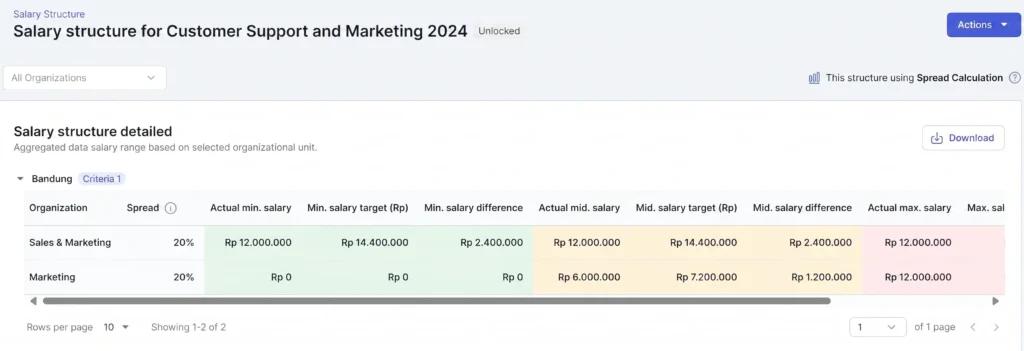
After grading is finalized, organizations can then establish salary ranges for each level. Most salary bands contain a minimum salary, midpoint, and maximum salary to define compensation progression boundaries within the grade.
Table below illustrates a simplified example of how salary ranges may be assigned across different grades:
| Grade | Minimum Salary | Midpoint | Maximum Salary |
|---|---|---|---|
| Grade 5 | $1,000 | $1,300 | $1,600 |
| Grade 6 | $1,700 | $2,200 | $2,700 |
| Grade 7 | $2,800 | $3,500 | $4,200 |
| Grade 8 | $4,500 | $5,500 | $6,500 |
The midpoint usually represents the organization’s target market positioning, while the spread between the minimum and maximum determines how much salary growth employees can experience before requiring promotion into a higher grade.
For example, an employee who consistently performs well may gradually move closer toward the upper end of the salary range over several review cycles, even without immediate promotion
Meanwhile, newly promoted employees often enter near the lower or middle portion of a new salary band before progressing further over time.
At this stage, organizations also need to decide how narrow or broad each grade should be. Structures with too many narrow grades often create excessive promotion dependency because employees begin associating career progression mainly with title movement rather than expanded contribution or capability growth.
To avoid this issue, many organizations eventually introduce broader career pathways, specialist tracks, or wider salary bands that allow compensation growth without requiring constant changes in job title or reporting level.
Step 5: Conduct Market Benchmarking
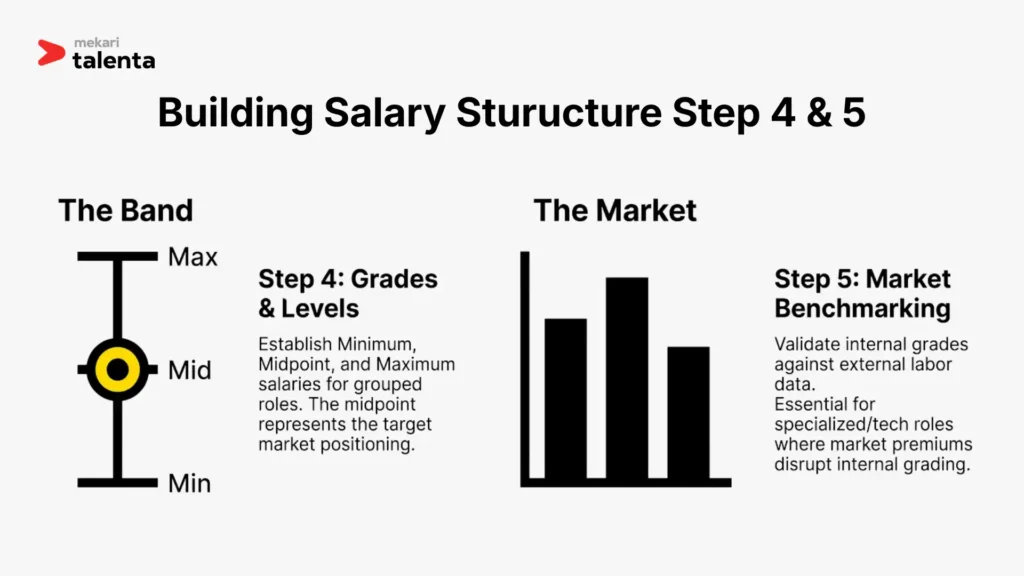
A salary structure cannot rely solely on internal evaluation. External labor market conditions must also be considered to ensure compensation remains competitive.
This stage involves comparing roles against market salary data using compensation surveys, recruitment trends, industry benchmarking reports, and talent availability insights.
Market benchmarking becomes especially important for specialized or high-demand positions. Organizations frequently discover that certain technical or strategic roles command significantly higher market premiums despite sitting at similar internal levels as other functions.
For example, a data engineer and a finance manager may hold equivalent organizational grades internally, yet market conditions may require substantially different salary positioning to remain competitive externally.
One common compensation mistake is applying identical salary movement assumptions across all functions without considering labor market realities.
Mature organizations typically review market benchmarks more aggressively for business-critical or difficult-to-hire positions rather than waiting for annual review cycles alone.
Read also: Compensation Benchmarking: Build a Competitive Salary Strategy
Step 6: Establish Compensation Governance Rules
Salary structures only remain effective when organizations define clear rules regarding how compensation movement occurs within the framework.
Without governance controls, managers gradually apply inconsistent salary decisions across departments, which weakens trust in the structure over time.
Organizations therefore need clear policies regarding promotion increases, annual increments, market adjustments, internal transfers, retention adjustments, and salary corrections.
For example:
- employees promoted to a higher grade may receive a minimum 10–15% increase
- employees already near salary maximums may receive lump-sum bonuses instead of base salary increases
- salary adjustments may require additional approval once employees exceed midpoint thresholds
These governance rules help maintain long-term consistency across departments.
Without them, managers often apply compensation decisions unevenly, which gradually weakens the integrity of the entire structure.
Step 7: Test Internal Equity and Financial Impact
Before implementation, organizations should test how the proposed structure affects both workforce equity and payroll cost.
This stage often reveals hidden compensation problems that accumulated gradually over time. Companies may discover salary compression between tenured employees and new hires, inconsistent pay positioning across departments, or outdated grading structures that no longer reflect actual operational complexity.
Financial simulation is equally important. Leadership teams need visibility into how much salary adjustment will be required, whether implementation should occur gradually, and how the structure may affect future payroll growth.
In many cases, organizations choose phased implementation strategies rather than correcting every compensation gap immediately.
This approach allows companies to improve compensation alignment while managing budget sustainability more effectively.
Step 8: Communicate and Maintain the Structure
Implementation success depends heavily on communication quality.
Even well-designed salary structures can create confusion if employees and managers do not understand how compensation decisions are made
For that reason, organizations should prepare clear guidance around salary ranges, promotion criteria, compensation reviews, and career progression expectations.
Manager training becomes especially important because employees often evaluate compensation systems through conversations with their direct supervisors rather than through policy documents alone.
Once implemented, salary structures should also be reviewed regularly. Labor markets evolve continuously, new skill demands emerge, and organizational priorities shift over time.
Companies that maintain effective compensation systems typically conduct periodic salary benchmarking, job reevaluation exercises, and compensation audits to ensure the structure remains relevant as the business grows.
Challenges in Managing Salary Structures
Managing a salary structure becomes significantly more difficult as organizations grow across multiple job levels, business units, operational sites, and reporting structures.
Compensation decisions that were once manageable through spreadsheets or manager discretion often become increasingly inconsistent once workforce complexity expands.
Below are some of the most common challenges organizations face when building and maintaining salary structures at scale.
1. Maintaining Consistency Across Salary Decisions
One of the biggest compensation challenges is maintaining consistency across departments and leadership teams.
Without standardized salary frameworks, managers often make compensation decisions using different assumptions regarding market competitiveness, performance value, or budget flexibility.
Over time, this creates situations where employees performing similar levels of work receive significantly different compensation outcomes.
In many organizations, these inconsistencies become most visible during promotion cycles, external hiring, or retention adjustments.
The issue becomes even more complex in organizations with multiple branches or business entities because compensation practices gradually evolve differently across locations.
HR teams then spend substantial time correcting salary compression, resolving internal equity concerns, and explaining compensation discrepancies that accumulated over several years.
What makes this challenge particularly difficult is that compensation inconsistency rarely appears immediately. The problem usually develops gradually through small exceptions that eventually weaken the credibility of the entire salary framework.
Read also: Multi Location Workforce Management: A Guide for Multi-Branch Teams
2. Limited Visibility Into Compensation and Payroll Data
As organizations scale, compensation data often becomes fragmented across spreadsheets, payroll systems, departmental trackers, and finance reports. This fragmentation limits visibility into how salaries are distributed across grades, functions, and locations.
As a result, leadership teams frequently struggle to evaluate whether compensation remains aligned with workforce strategy and financial capacity.
HR may not have clear visibility into which departments exceed salary ranges, where market gaps are emerging, or how payroll costs are evolving across business units.
Finance teams face similar difficulties when payroll forecasting depends on inconsistent or manually consolidated compensation data.
In large organizations, even small salary adjustments across multiple departments can significantly affect annual payroll expenditure if changes are not monitored systematically.
The challenge becomes more operationally sensitive during rapid hiring periods or organizational restructuring, when payroll costs can increase faster than expected without centralized compensation oversight.
3. Difficulty Keeping Salary Structures Competitive
Labor markets evolve continuously, particularly for specialized and business-critical roles. Organizations that do not regularly benchmark compensation against external market conditions often struggle to maintain hiring competitiveness and long-term retention stability.
This challenge is especially common in functions where talent demand changes rapidly, such as technology, engineering, data analytics, and regulatory roles. Internal grading structures may remain stable while market salaries shift aggressively within relatively short periods.
Eventually, organizations begin facing situations where newly hired employees receive compensation packages comparable to or higher than longer-tenured employees in similar grades. This creates additional pressure on internal equity and retention management.
Many organizations underestimate how quickly market gaps can develop when salary structures are reviewed only annually.
In highly competitive talent markets, compensation positioning can become outdated much faster than traditional review cycles anticipate.
4. Balancing Fairness, Governance, and Regulatory Compliance
Compensation management also becomes more sensitive as workforce expectations around pay transparency continue to increase.
Employees today have significantly greater access to salary benchmarks, compensation discussions, and market information than in previous years.
When organizations lack documented salary structures, clear grading systems, or standardized evaluation methods, compensation decisions become harder to justify consistently. This creates both fairness concerns internally and compliance risks externally.
In Indonesia, for example, organizations are expected to maintain structured wage frameworks aligned with regulations such as Permenaker No. 10/2017 and Kepmen No. 49/2004.
Similar expectations also exist across other markets. In Singapore, employers are expected to maintain compliant salary practices related to itemised payslips, overtime calculation, and statutory payroll obligations under the Employment Act.
Companies that continue relying heavily on informal salary practices or undocumented compensation decisions may face difficulties demonstrating compensation governance during audits or labor reviews.
Operationally, fairness concerns often emerge when salary adjustments depend too heavily on negotiation strength, manager preference, or isolated business pressure rather than structured compensation principles.
Read also: Payroll Compliance 2026: A Complete Guide for HR & Finance Teams
5. Scaling Compensation Management Across Growing Organizations
Compensation management becomes substantially more complex once organizations expand across multiple branches, subsidiaries, operational sites, or regional markets.
Different locations may operate under different market conditions, workforce structures, allowance policies, and salary competitiveness levels
Without centralized governance, compensation practices often evolve independently across business units, creating fragmented salary structures throughout the organization.
This challenge becomes particularly visible during periods of expansion, restructuring, mergers, or regional growth initiatives.
Organizations frequently discover that grading systems, role classifications, and compensation practices differ significantly between entities, making standardization far more difficult later.
At this stage, manual compensation management usually becomes unsustainable operationally. HR teams often struggle to maintain salary validation, payroll forecasting, compensation benchmarking, and governance consistency without centralized systems and structured compensation frameworks.
As workforce complexity increases, organizations generally require more data-driven and centralized approaches to compensation management in order to maintain consistency, financial control, market competitiveness, and long-term scalability.
Read also: Multi-Entity Payroll: Challenges, Strategies and Scalable Solutions
How to Choose the Best Pay Structure for Your Business
Choosing the right pay structure requires more than selecting a compensation model that appears competitive in the market.
An effective salary structure must align with how the organization operates, how quickly roles evolve, how compensation decisions are managed internally, and how workforce growth is expected to develop over time.
Below are several key considerations organizations should evaluate when selecting a pay structure.
1. Assess Organizational Complexity and Workforce Structure
The first factor organizations should evaluate is operational complexity.
Companies with stable hierarchies, highly standardized job scopes, and predictable career progression often benefit from more traditional salary structures because compensation movement can be controlled more consistently.
Meanwhile, organizations operating across multiple business units, technical functions, or rapidly evolving roles may require broader and more flexible compensation frameworks.
For example, companies managing multi-location operations, specialized technical teams, matrix reporting structures, regional workforces, or fast-changing project environments often encounter compensation challenges that traditional narrow grading systems struggle to support effectively.
The greater the organizational complexity, the more important it becomes to establish compensation structures that can scale without creating excessive administrative rigidity.
2. Evaluate Talent Market Competitiveness
Labor market conditions should heavily influence compensation structure decisions.
In highly competitive talent markets, organizations usually require stronger market responsiveness because salary expectations can shift rapidly within certain functions.
Relying solely on internally driven salary progression may eventually weaken hiring competitiveness and increase retention risk for business-critical roles.
This challenge is particularly visible in functions such as technology, engineering, cybersecurity, data analytics, and digital operations, where compensation benchmarks can change significantly within relatively short periods.
Organizations competing aggressively for specialized talent often prefer market-based structures or broader salary bands because they provide greater flexibility to adjust compensation without constantly redesigning the grading framework.
On the other hand, companies operating with more stable workforce profiles may prioritize consistency and cost predictability over aggressive market positioning.
3. Balance Internal Equity With Compensation Flexibility
One of the most difficult compensation decisions is determining how much flexibility managers should have when making salary adjustments.
Highly rigid structures improve governance and consistency but may reduce responsiveness when organizations need to address retention risk, emerging skill demand, or critical hiring gaps quickly.
At the opposite extreme, overly flexible compensation systems can gradually create internal inequities if salary decisions depend too heavily on negotiation outcomes or managerial discretion.
Organizations therefore need to determine where they want to position themselves between:
- standardized compensation governance
- flexible market-driven decision-making
This balance often changes as organizations grow. Companies in earlier growth stages may prioritize agility, while larger organizations usually require stronger governance to maintain compensation consistency across expanding workforces.
The most sustainable structures are typically the ones that allow controlled flexibility rather than unrestricted compensation discretion.
4. Consider Long-Term Scalability
A salary structure should support future organizational growth, not only current workforce conditions.
Many compensation systems work effectively when organizations are smaller but become increasingly difficult to manage as:
- headcount expands
- new business units emerge
- regional operations grow
- specialist roles increase
- reporting structures become more layered
For example, salary structures that depend heavily on manual approvals or spreadsheet-based tracking often become operationally unsustainable once organizations scale across multiple entities or locations.
Scalability also affects career progression design. Organizations need to evaluate whether employees can continue growing within the structure without requiring constant title inflation or unnecessary hierarchy expansion.
Companies planning regional growth or multi-entity operations generally require stronger compensation standardization and centralized governance much earlier than organizations operating within a single location.
5. Align the Structure With Financial and Business Strategy
Compensation structures should remain aligned with long-term financial sustainability and business priorities.
Organizations sometimes focus heavily on external competitiveness without fully evaluating whether payroll growth remains manageable operationally.
Over time, uncontrolled salary adjustments can create compensation costs that become difficult to sustain consistently across the workforce.
For that reason, finance and HR alignment becomes critical during salary structure selection.
Organizations should evaluate:
- projected payroll growth
- compensation budget capacity
- promotion cost impact
- market adjustment frequency
- long-term workforce expansion plans
An effective pay structure creates enough competitiveness to attract and retain talent while still maintaining financial discipline across future growth cycles.
The best salary structures are rarely the most aggressive or the most complex. They are the ones that remain explainable, scalable, operationally manageable, and adaptable as the organization evolves over time.
Best Practices for Maintaining an Effective Salary Structure
A salary structure should never remain static after implementation. Compensation frameworks that work effectively today may gradually lose relevance as labor markets shift, organizational structures evolve, and workforce expectations become more complex.
To prevent this, organizations need continuous compensation governance and regular structural evaluation. Below are several best practices that help maintain salary structures effectively over the long term.
1. Conduct Regular Market Benchmarking
One of the most important compensation maintenance practices is reviewing salary competitiveness regularly against external market conditions.
Labor markets rarely move uniformly across all functions. Certain positions, particularly in technology, engineering, digital operations, and regulatory roles, may experience rapid salary inflation within relatively short periods.
Organizations that rely on outdated benchmarking data often discover compensation gaps only after retention problems begin appearing.
Effective organizations usually review compensation benchmarks annually across all core functions while conducting more frequent reviews for highly competitive or business-critical roles.
Market benchmarking should also go beyond headline salary figures. Companies need to evaluate hiring difficulty, skill scarcity, regional salary differences, and shifting workforce expectations to maintain meaningful market competitiveness over time.
2. Maintain Clear Compensation Governance
Even well-designed salary structures can lose effectiveness when compensation decisions become overly dependent on managerial discretion.
As organizations grow, salary adjustments, promotions, retention increases, and hiring negotiations naturally become more frequent.
Without clear governance controls, exceptions begin accumulating across departments, eventually weakening compensation consistency throughout the organization.
Strong compensation governance helps ensure salary decisions remain aligned with established grades, salary bands, and business objectives.
Mature organizations usually maintain centralized review processes for compensation adjustments that fall outside standard guidelines, particularly for promotion increases, off-cycle adjustments, or high-impact hiring decisions.
Governance also becomes especially important during rapid expansion periods, when decentralized salary decisions can quickly create internal inequities that become difficult to reverse later.
3. Review Job Structures and Role Definitions Periodically
Organizations evolve continuously, and roles rarely remain identical over long periods of time.
Employees often absorb additional responsibilities as operations expand, new technologies emerge, or organizational priorities shift.
Over time, job scopes may change significantly even when titles remain unchanged. If organizations fail to reevaluate roles periodically, salary grades eventually stop reflecting actual operational complexity.
This issue is particularly common in growing organizations where teams scale rapidly and responsibilities expand faster than formal job documentation.
Regular job reevaluation helps organizations identify situations where:
- roles have outgrown their original grade
- specialist functions require repositioning
- reporting complexity has increased
- operational impact has shifted substantially
Without periodic review, compensation structures gradually become misaligned with operational reality, which weakens both internal equity and career progression credibility.
4. Strengthen Collaboration Between HR and Finance
Compensation management becomes more sustainable when HR and finance teams operate with shared visibility into workforce planning and payroll strategy.
Many compensation challenges emerge because salary decisions are evaluated independently from long-term financial planning.
HR may focus heavily on retention competitiveness, while finance prioritizes payroll control and cost predictability. Without alignment, organizations often struggle to balance talent competitiveness with financial sustainability.
Stronger collaboration improves payroll forecasting, workforce planning accuracy, and compensation budgeting consistency across the organization.
This alignment becomes increasingly important during expansion periods, mergers, restructuring initiatives, or large-scale hiring cycles, where compensation decisions can significantly affect operational costs over time.
Organizations with mature compensation governance typically treat salary structures as both a workforce management framework and a long-term financial planning mechanism rather than simply an HR administrative tool.
5. Use Technology to Improve Compensation Visibility and Control
As organizations scale, manual compensation management becomes increasingly difficult to maintain consistently.
Spreadsheet-based salary tracking may work temporarily in smaller environments, but larger organizations often require centralized systems to manage salary structures effectively across multiple grades, locations, and business units.
Technology improves compensation governance by providing clearer visibility into salary positioning, payroll distribution, market benchmarking, and compensation movement across the organization.
It also helps organizations maintain stronger validation controls during salary adjustments, promotion approvals, and payroll planning processes.
More importantly, centralized compensation systems create a single source of truth for salary data, reducing the risk of fragmented reporting and inconsistent compensation decisions across departments.
Organizations managing complex workforce structures generally achieve stronger long-term compensation consistency when salary governance, payroll visibility, and workforce planning are integrated within a centralized and data-driven framework.
Read also: Payroll Analytics: Definition, Benefits, Use Cases, and Tools
Reference
Developing a Competitive Salary Structure – Economic Research Institute