



-
Talent management is a strategic and integrated approach to attracting, developing, retaining, and deploying employees to achieve current and future business goals.
-
When implemented effectively, it strengthens leadership pipelines, reduces turnover risk, and ensures organizations have the right talent in the right roles at the right time.
Talent management is both a solution and a strategic approach to managing human resources in order to address employee career challenges within a company, often supported by an HRIS. The success of an organization is strongly influenced by the quality of its human resources.
According to Nurdin, Wawo, and Julia (2018), human resources are individuals who are ready, willing, and capable of contributing to the achievement of organizational goals, encompassing three key aspects: education, experience, and training.
As business environments continue to evolve, companies rely on a structured human capital management strategy to align workforce capability with long-term business objectives.
This is essential because employees generally seek career progression that aligns with their aspirations.
A survey conducted by Nugrahani and Wulansari (2018) involving 17,632 respondents in 2014 revealed that:
- 73% of employees were dissatisfied with their jobs
- 54% experienced a mismatch between their educational background and their current role
- 60% had no clear career path within their company
For this reason, talent management plays a critical role in addressing employee career issues and improving organizational performance.
Definition of Talent Management
Talent management is a strategic and integrated approach to attracting, identifying, developing, engaging, retaining, and deploying employees to meet both current and future organizational goals.
It goes beyond simple employee assessment. Talent management connects workforce planning, competency mapping, performance evaluation, succession planning, and leadership development into one continuous system aligned with business strategy.
At its core, talent management answers three critical business questions:
- Do we have the right people?
(Capability and competency alignment) - Are they in the right roles?
(Role fit and performance optimization) - Will we have the right talent in the future?
(Succession and workforce sustainability)
Benefits of Talent Management
Talent management is not merely an HR initiative. It is a strategic lever that directly impacts revenue growth, operational resilience, leadership continuity, and long-term competitiveness.
When implemented systematically, talent management drives measurable business outcomes across workforce productivity, retention, and succession readiness.
Below is a deeper breakdown of its benefits for both organizations and employees.
Benefits for the Company
In large organizations, workforce decisions compound quickly. A single hiring mistake, leadership gap, or retention failure can create ripple effects across productivity and profitability.
Effective talent management reduces these risks by introducing structure, visibility, and data-driven decision-making across the employee lifecycle.
1. Improves Quality of Hire and Reduces Mis-Hire Costs
Poor hiring decisions are expensive.
Research from the U.S. Department of Labor, as cited from LinkedIn, estimates that a bad hire can cost up to 30% of the employee’s first-year earnings.
In leadership roles, the cost can reach 2–3 times annual salary when factoring in disruption and opportunity loss.
Strategic talent management improves recruitment by:
- Using competency frameworks aligned with business goals
- Applying structured assessments
- Leveraging data-driven hiring decisions
- Building proactive talent pipelines
For large organizations hiring hundreds annually, even a 5–10% improvement in hiring accuracy can save millions in turnover and performance-related losses.
2. Reduces Voluntary Turnover and Retention Risk
Employee turnover is one of the most significant hidden costs in large organizations.
Replacing an employee typically costs 40%–200% of their annual salary, depending on role complexity, according to research from Gallup.
Meanwhile, McKinsey’s research indicates that high-performing employees are also 400% more productive than average performers (in highly complex roles). Losing them significantly affects performance.
Talent management reduces turnover by:
- Creating visible career paths
- Identifying high-potential employees early
- Offering targeted development programs
- Using predictive analytics to detect resignation risk
3. Strengthens Leadership Pipeline and Succession Planning
One of the biggest risks for large organizations is leadership gaps. Many companies lack ready successors for critical roles. Without talent management:
- Promotions become reactive
- External hiring costs increase
- Business continuity risks rise
A structured talent management strategy ensures:
- Identification of high-potential employees (HiPos)
- Leadership readiness tracking
- Structured succession planning
- Reduced dependency on external executive recruitment
Organizations with mature succession planning frameworks tend to demonstrate stronger leadership continuity and long-term performance stability.
4. Increases Productivity and Role Alignment
One core objective of talent management is optimal talent deployment. When employees are placed in roles aligned with their competencies:
- Performance increases
- Error rates decrease
- Collaboration improves
According to Gallup’s research, highly engaged teams show significant performance advantages: 78% lower absenteeism, 14% higher productivity, and 23% higher profitability compared to less engaged teams.
These outcomes highlight how stronger talent management, which drives engagement, can meaningfully improve organizational performance.
Benefits for Employees
While talent management is often discussed from a business performance perspective, its impact on employees is equally significant.
In large organizations, where career progression can easily become opaque and competitive, structured talent management provides clarity, development opportunities, and long-term professional security.
Below are the most critical ways talent management directly benefits employees.
1. Greater Career Mobility and Internal Promotion Opportunities
One of the most meaningful benefits of structured talent management for employees is clearer and faster career progression.
In many large organizations, promotion pathways are often informal, unclear, or influenced by visibility rather than measurable readiness.
This lack of transparency can create uncertainty and frustration among employees who are unsure how to advance.
Research shows that 49% of employees are willing to leave their current role due to a lack of professional development opportunities, indicating how strongly individuals value growth and progression in their careers.
Rather than leaving advancement to chance, talent management systems create structure and visibility by:
- Defining competency frameworks for each role
- Establishing transparent promotion criteria
- Mapping career progression pathways across functions
- Identifying and developing high-potential employees
For employees, this structure delivers tangible benefits:
- Clear understanding of what is required to move forward
- Measurable milestones for advancement
- Access to internal mobility opportunities
- Reduced dependence on informal networks or subjective decisions
In large organizations especially, structured talent management replaces ambiguity with clarity. Career progression becomes predictable, merit-based, and strategically supported — giving employees stronger control over their professional trajectory.
2. Higher Employability Through Continuous Skill Development
Modern labor markets are rapidly evolving due to automation, digital transformation, and AI adoption. Employees who are not continuously developing new competencies risk becoming obsolete.
Effective talent management integrates learning and development (L&D) directly into performance planning, ensuring development is not optional or reactive.
Employees benefit through:
- Targeted upskilling aligned with future business needs
- Leadership readiness programs
- Cross-functional mobility opportunities
- Formal Individual Development Plans (IDPs)
This structured approach strengthens employees’ long-term employability, both within the organization and in the broader labor market.
3. Increased Engagement and Psychological Investment
One of the most important employee-level benefits of structured talent management is stronger engagement and deeper psychological commitment to work.
Talent management improves clarity around expectations, increases feedback frequency, and creates visible development pathways — all of which are established drivers of employee engagement.
According to Gallup’s research, opportunities to learn and grow, ongoing feedback, and supportive management are core elements that consistently influence engagement levels.
In other words, development and growth are not peripheral benefits. They are embedded within the engagement model itself.
Engagement, however, is not merely an emotional state. It is associated with tangible employee outcomes. Gallup’s global findings show that engaged employees report:
- Lower daily stress and negative emotions
- Stronger sense of purpose at work
- Higher job satisfaction
- Greater overall well-being
When employees perceive that their organization invests in their development through structured career pathways, meaningful feedback, and growth opportunities, they are more likely to:
- Commit discretionary effort
- Demonstrate long-term organizational commitment
- Feel psychologically connected to their work
In large organizations especially, where employees may otherwise feel transactional or overlooked, structured talent management signals intentional investment. That perception of investment is a foundational driver of sustained engagement and psychological attachment.
The Role of Technology in Talent Management
Talent management is fundamentally a strategic discipline. However, without technology, it is extremely difficult to execute consistently at scale.
As organizations grow, workforce complexity increases: more roles, more locations, more reporting lines, more competency requirements. At that point, spreadsheets, isolated systems, and managerial intuition are no longer sufficient.
Technology transforms talent management from a conceptual HR framework into an operational system.
From Fragmented Processes to Integrated Workforce Visibility
In many large organizations, recruitment data sits in one system, performance reviews in another, learning records in a separate platform, and succession planning in presentation slides. This fragmentation limits leadership visibility into workforce capability.
An integrated talent management platform consolidates these elements into a single data ecosystem, supporting structured employee lifecycle management from recruitment and onboarding to performance evaluation and succession planning.
Leaders can view employee performance trends, competency alignment, promotion readiness, and development history in one place. This reduces subjectivity and enables more consistent decision-making across business units.
Instead of asking, “Who seems ready?” organizations can evaluate readiness using structured criteria supported by historical data.
Making Talent Measurable and Comparable
One of technology’s most significant contributions is measurability. Talent management becomes quantifiable rather than perception-based.
With the right system in place, organizations can leverage HR dashboards and analytics to track:
- Quality-of-hire trends and performance alignment
- Internal mobility rates across departments
- Succession readiness for critical roles
- Competency gaps against strategic objectives
This visibility allows HR and business leaders to move beyond administrative reporting and into predictive planning.
For example, if a division shows weak succession coverage for senior roles, leadership development efforts can be redirected proactively rather than reactively.
Enabling Predictive Workforce Planning
Technology also connects talent management to long-term workforce strategy through structured strategic workforce planning.
Strategic workforce planning ensures organizations anticipate future skill demands, leadership gaps, and evolving competency requirements before they become operational risks.
Through analytics and forecasting tools, organizations can model future skill requirements, identify emerging capability gaps, and estimate leadership pipeline risk.
This is particularly important in industries undergoing digital transformation. As automation and AI reshape skill demands, companies must anticipate which competencies will become obsolete and which will become mission-critical.
Without system-level insight, organizations risk overinvesting in outdated skills while underpreparing for future needs.
Reducing Bias and Increasing Governance
Structured digital systems also improve governance. Standardized competency models, calibrated performance scoring, and documented promotion criteria reduce inconsistency across managers and departments.
While technology does not eliminate bias entirely, it introduces transparency and traceability into talent decisions.
In large organizations, this governance layer is critical for compliance, fairness, and organizational trust.
Strategic Impact
Ultimately, technology does not replace strategic thinking. Instead, it enables it. By integrating recruitment, development, performance, and succession data, organizations create a continuous talent intelligence loop.
Decisions become faster, more aligned with business objectives, and less dependent on individual discretion.
In complex organizations, technology is not merely a support tool for talent management. It is the infrastructure that makes scalable, data-driven talent strategy possible.
Read also: Cloud-based HRIS vs On-Premise: Key Differences and How to Choose
Core Components of a Comprehensive Talent Management Process
A comprehensive talent management process must cover the entire workforce lifecycle, from attracting external talent to developing internal leaders and retaining critical capabilities over time.
At scale, each stage must be structured, measurable, and integrated across business units.
A mature talent management framework typically includes the following interconnected components:
1. Employer Branding and Reputation Management
Employer branding reflects how the organization is perceived by current employees, candidates, investors, and the broader labor market.
A strong employer brand:
- Attracts higher-quality candidates aligned with organizational values
- Reduces time-to-hire and cost-per-hire
- Strengthens employee pride and advocacy
Reputation management also plays a critical role in leadership hiring and executive attraction, particularly in competitive industries where employer credibility influences candidate decision-making.
2. Candidate Experience and Strategic Selection
Candidate experience must be consistent and structured. Selection processes should be competency-based and aligned with long-term workforce planning, not just immediate vacancy filling.
Effective selection includes:
- Standardized assessment criteria
- Structured interviews and evaluation scoring
- Alignment between hiring managers and HR
- Consideration of future leadership potential
This ensures hiring decisions contribute not only to short-term operational needs but also to long-term succession pipelines.
3. Onboarding and Internal Mobility
Onboarding is not simply administrative orientation. It is a structured integration process that accelerates productivity and cultural alignment.
Well-designed onboarding can reduces early turnover risk, improves time-to-productivity, and strengthens engagement in the first year
Internal mobility is equally critical. Organizations that actively promote cross-functional movement build stronger institutional knowledge and reduce dependency on external hiring for mid- to senior-level roles.
Internal mobility also signals career progression opportunities, which directly influence retention.
4. Employee Engagement and Retention Strategies
Sustaining engagement at scale requires systematic feedback mechanisms, leadership accountability, and transparent performance processes.
Retention strategies often include:
- Career path visibility
- Targeted development for high-potential employees
- Engagement surveys with action plans
- Data-driven turnover risk monitoring
When engagement and retention are actively managed, organizations reduce voluntary turnover among high performers and protect critical capabilities.
5. Learning and Development
Continuous skill development is essential in dynamic markets. Learning initiatives must align with business strategy and anticipated capability gaps.
A strategic learning function focuses on:
- Closing competency gaps identified through performance data
- Preparing successors for leadership roles
- Supporting digital transformation and reskilling initiatives
Rather than offering generic training programs, learning becomes targeted and performance-linked.
6. Performance Management and Succession Planning
Performance management systems must provide clarity, fairness, and measurable expectations. In large organizations, calibration processes ensure consistency across departments and leadership levels.
Succession planning involves mapping critical roles, evaluating leadership readiness, creating development pathways for successors, and monitoring bench strength. This reduces leadership gaps and strengthens long-term organizational resilience.
What Companies Must Do to Implement Talent Management Successfully
Implementing talent management successfully requires more than isolated HR programs. It demands alignment between business objectives, workforce planning, and long-term capability building.
Organizations that treat talent management as an integrated system rather than a series of disconnected initiatives are more likely to sustain performance and leadership continuity.
According to Dessler (2013), companies must begin by understanding the core responsibilities within talent management: recruiting the right people, developing employee capabilities, and managing compensation strategically. However, true implementation goes beyond these fundamentals.
Below are the critical pillars organizations must strengthen.
1. Align Talent Management with Business Strategy
Talent management should directly support organizational goals. This means workforce planning must reflect expansion plans, digital transformation initiatives, or market repositioning strategies.
Companies should ask:
- What skills will be critical in the next 3–5 years?
- Which roles are most business-critical?
- Where are succession gaps most likely to occur?
Without strategic alignment, talent initiatives risk becoming administrative rather than competitive drivers.
2. Use Standardized Competency Frameworks
Consistency is essential in large organizations. Using standardized competency profiles ensures that hiring, evaluation, promotion, and development decisions are aligned across departments.
When competency models are inconsistent:
- Performance assessments become subjective.
- Promotion criteria vary between teams.
- Leadership readiness becomes unclear.
A unified framework reduces bias and increases transparency in career progression.
3. Make Data-Driven Staffing and Development Decisions
Effective talent management requires informed decision-making. Companies should leverage performance data, skill assessments, and workforce analytics when determining:
- Who is ready for promotion
- Who requires development support
- Where skill gaps exist
- Which roles are succession risks
This shifts talent decisions from managerial intuition to measurable evaluation.
4. Segment and Proactively Manage Talent
Not all employees have the same organizational impact. High-potential employees, critical role holders, and emerging leaders require targeted development strategies.
Proactive talent segmentation allows companies to:
- Build leadership pipelines early
- Allocate training budgets strategically
- Reduce risk of losing high performers
- Strengthen succession planning
Without segmentation, development efforts become generic and less effective.
5. Integrate All Talent Management Functions
One of the most common implementation failures occurs when recruitment, performance management, learning and development, and succession planning operate in silos.
A comprehensive talent management system should connect:
Recruitment → Performance → Development → Engagement → Succession → Retention
When integrated, each stage informs the next. Recruitment data improves performance benchmarks. Performance insights guide development plans. Development outcomes feed succession readiness.
Integration creates continuity across the entire employee lifecycle.
Read also: How to Choose the Right HRIS Vendor: A Practical HR Guide
Supporting Long-Term Organization Growth Through Structured Talent Development
Talent management is no longer optional. It is a business-critical system that determines whether your organization can sustain growth, retain top performers, and prepare future leaders.
Without structured succession planning, competency mapping, and integrated development programs, companies risk:
- Leadership gaps during critical transitions
- High turnover among high-potential employees
- Misalignment between workforce capability and business strategy
If your organization is serious about building a sustainable leadership pipeline and improving employee retention, it’s time to move from theory to execution.
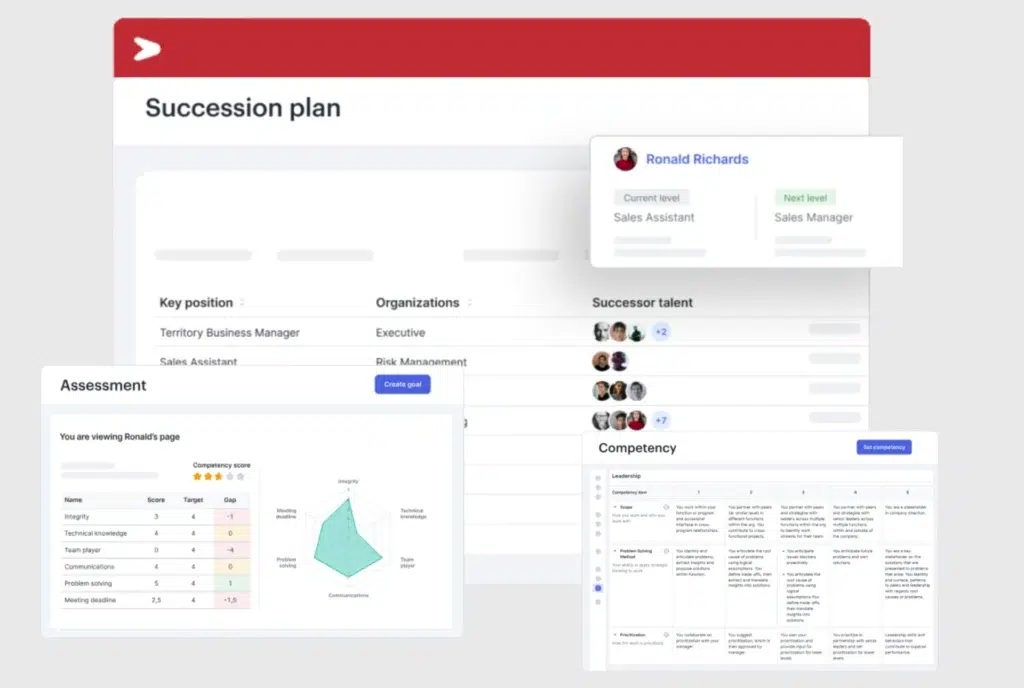
With Mekari Talenta’s Talent Development Feature, you can:
- Design structured succession plans. Identify critical roles, map successor readiness, and reduce leadership gaps to ensure business continuity during expansion, restructuring, or unexpected transitions.
- Build measurable Individual Development Plans (IDPs). Align employee growth with business priorities through clear development targets, skill tracking, and progress monitoring to accelerate readiness for strategic roles.
- Standardize competency management across divisions. Create unified competency frameworks to ensure consistent hiring, promotion, and performance evaluation standards to reduce bias and improve organizational alignment.
- Integrate performance, talent, and learning in one unified system. Connect appraisal results, skill gaps, training programs, and succession data—enabling data-driven decisions that support workforce productivity and long-term capability building.
As part of Mekari’s integrated software ecosystem, Mekari Talenta seamlessly connects with payroll, HRIS, and other business systems, allowing organizations to align talent strategy with operational execution.
Whether you are strengthening leadership continuity or accelerating employee growth, Mekari Talenta helps you operationalize talent management at scale.
Contact our sales and see how your organization can achieve stronger retention, clearer career pathways, and more resilient leadership succession.