




- Strategic workforce planning is a long-term, data-driven approach to aligning workforce capabilities with evolving business strategy and organizational growth.
- Steps include analyzing business goals, assessing current workforce capacity, forecasting future needs, identifying skill gaps, and executing continuous action planning.
In the context of Human Resources, organizations must carefully evaluate workforce requirements to ensure business objectives can be achieved effectively at scale.
This is the core of strategic workforce planning, a structured approach where companies analyze workforce alignment with organizational goals while preparing for operational complexity, future growth, and evolving business challenges.
The following article explains strategic workforce planning in more detail.
What Is Strategic Workforce Planning?
Strategic workforce planning is the process of designing a workforce strategy that aligns talent supply with long-term business objectives.
In practice, strategic workforce planning serves as a foundational pillar of broader talent management initiatives, ensuring leadership pipelines and capability development align with future business needs.
It involves a comprehensive analysis of required skills, organizational capacity, and competencies needed to support sustainable growth and enterprise transformation.
The primary goal is to ensure that organizations have the right people, with the right skills, in the right roles, at the right time, especially as operations expand and business structures become more complex.
Through this process, companies can anticipate future talent demands, identify skill gaps, and implement proactive solutions before workforce challenges disrupt performance.
Many organizations integrate workforce planning within a broader human capital management strategy, combining recruitment, performance, payroll, and talent analytics into a single digital ecosystem.
When executed effectively, strategic workforce planning reduces organizational risk, improves operational efficiency, and strengthens business readiness in rapidly changing markets.
Read also: What is HRIS and How It Supports Modern Workforce Management
Why HR Needs to Implement Strategic Workforce Planning
Below are several key reasons enterprise HR teams should implement strategic workforce planning.
1. Ensuring the Right Talent Availability
Strategic workforce planning enables HR leaders to forecast workforce needs based on corporate strategy rather than reactive hiring.
By understanding capability requirements and organizational capacity, HR teams can design recruitment, retention, and talent development strategies that scale with business growth.
To streamline recruitment complexity, companies can leverage an Applicant Tracking System (ATS) such as Mekari Talenta.
Mekari Talenta’s recruitment solution provides an integrated ATS that optimizes hiring workflows from job posting to onboarding.
Processes such as candidate screening, interview scheduling, and onboarding can be managed within a centralized dashboard, allowing HR teams to track recruitment progress more efficiently.
2. Managing Organizational Change
Strategic workforce planning helps HR anticipate and manage workforce transformation in dynamic business environments.
As companies face technological disruption, shifting market competition, and industry evolution, HR must continuously identify emerging skill gaps and reskill talent accordingly.
A structured workforce planning approach allows organizations to respond to change proactively rather than reactively.
3. Improving Workforce Efficiency
With strategic workforce planning, HR teams can optimize human capital allocation across departments and functions.
This includes preventing overstaffing or understaffing, managing workforce transitions, and maximizing productivity at scale.
These insights help leadership make faster, data-driven decisions while maintaining operational visibility across distributed teams.
Strategic workforce planning also connects closely with employee lifecycle management, ensuring that workforce insights span from recruitment and onboarding to performance evaluation through a structured performance management system, as well as long-term development.
4. Employee Development and Retention
Strategic workforce planning supports structured development strategies by integrating learning initiatives with workforce data.
Many enterprises enable employee self-service (ESS) capabilities within their HR systems, allowing employees to track performance goals, update skills profiles, and participate actively in career planning.
This transparency improves engagement while providing HR leaders with accurate data to support long-term workforce decisions.
5. Supporting Sustainable Corporate Responsibility
Workforce planning contributes to sustainable business practices and corporate responsibility initiatives.
HR teams can develop inclusive policies, strengthen diversity initiatives, and balance business growth with employee well-being and societal impact, ensuring long-term organizational resilience.
Overall, strategic workforce planning empowers HR to optimize workforce capabilities, navigate change, enhance efficiency, and maintain alignment with long-term strategic goals.
Strategic Workforce Planning Principles
In enterprise environments, where business structures are complex and growth trajectories evolve rapidly, workforce planning must operate as a continuous, data-driven framework rather than a one-time initiative.
Existing workforce structures serve as a critical baseline when designing future workforce models.
However, enterprise organizations must go beyond static planning by embedding flexibility, cross-functional collaboration, and long-term strategic alignment into their workforce strategy.
Below are the core principles that guide effective strategic workforce planning at scale.
1. Strategic Alignment with Long-Term Business Objectives
Enterprise workforce planning must be directly tied to corporate strategy, typically across a five-to-ten-year horizon.
This ensures talent investments support expansion plans, digital transformation initiatives, and organizational restructuring.
Rather than reacting to short-term hiring demands, HR leaders need to anticipate future capability requirements and align workforce structures with long-term value creation.
2. Flexibility and Organizational Agility
Modern enterprises operate in rapidly changing environments shaped by technology disruption, evolving market conditions, and shifting workforce expectations.
Strategic workforce planning should remain flexible enough to adapt to these changes. Agile workforce models enable organizations to reposition talent, redeploy skills, and scale teams without disrupting operational continuity.
This flexibility ensures the workforce remains strategically positioned to support evolving business priorities.
3. Data-Driven Identification of Inefficiencies and Skill Gaps
A core principle of enterprise workforce planning is leveraging analytics to uncover inefficiencies across departments and functions.
Recent research involving 50 tech-driven organizations found that companies adopting HR analytics achieved an average 85% talent retention rate and showed a strong positive correlation between analytics usage and employee satisfaction (r = 0.68), highlighting the strategic value of data-driven workforce planning.
Through continuous workforce analysis, organizations can identify skill shortages, role redundancies, and productivity bottlenecks.
This data-driven approach allows HR to prioritize high-impact roles, optimize resource allocation, and ensure the right capabilities are available to support future growth.
Read also: HR Analytics Explained: How Data Supports Strategic HR Decision-Making
4. Continuous Improvement and Workforce Quality Enhancement
Strategic workforce planning is an ongoing cycle, not a static framework.
Enterprises must continuously monitor workforce performance, evaluate talent readiness, and refine workforce strategies based on business outcomes.
By embedding regular evaluation into the planning process, organizations can maintain workforce quality and ensure talent remains aligned with strategic priorities.
5. Retention Through Development and Career Mobility
Workforce planning is closely tied to employee experience and long-term retention strategies.
When employees receive clear performance feedback, structured development pathways, and opportunities for internal mobility, engagement levels increase significantly.
Enterprise organizations that integrate workforce planning with talent development programs can reduce turnover risk while strengthening leadership pipelines.
6. Collaboration Across Leadership and Business Functions
Effective strategic workforce planning requires collaboration beyond HR.
Executive leadership, department heads, finance teams, and operational managers must align on workforce priorities to ensure planning decisions reflect real business needs.
Transparent communication across stakeholders builds organizational buy-in, accelerates execution, and minimizes resistance to workforce transformation initiatives.
7. Prioritizing Sustainable, High-Impact Decisions
Unlike short-term staffing plans, enterprise workforce planning focuses on sustainable outcomes that support long-term scalability.
This means prioritizing critical roles, high-value functions, and strategic capabilities that drive measurable organizational impact.
Workforce decisions should balance operational efficiency with future readiness, ensuring the organization remains competitive in the long run.
Strategic Workforce Planning Process
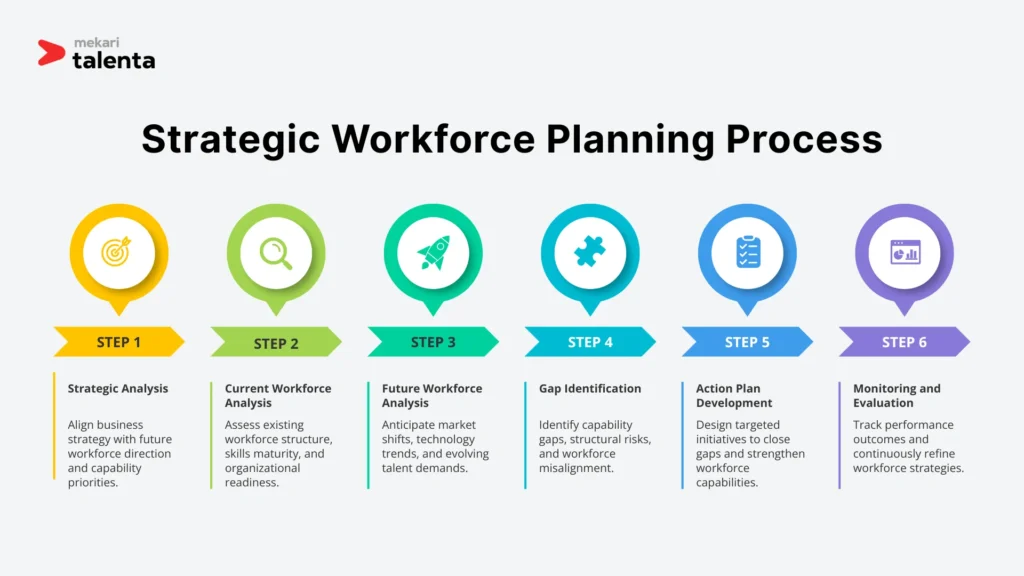
Strategic workforce planning is a structured, cyclical process that enables enterprises to align workforce capabilities with evolving business strategy.
Below are the key stages typically involved in an enterprise-level strategic workforce planning process.
1. Strategic Analysis
The process begins with translating business strategy into workforce implications.
At the enterprise level, this requires a deep understanding of corporate vision, market positioning, growth targets, and transformation initiatives such as digitalization or geographic expansion.
HR leaders must collaborate with executive stakeholders to identify which capabilities will be critical to achieving long-term objectives.
This stage shifts workforce planning from operational headcount management into a strategic capability discussion, defining not only how many people are needed, but what type of talent architecture will support future business models.
2. Current Workforce Analysis
Once strategic direction is clear, organizations must develop a comprehensive view of their existing workforce landscape.
This includes mapping workforce composition across departments, evaluating skills maturity, assessing productivity levels, and identifying structural dependencies within teams.
Advanced organizations often leverage workforce analytics to measure performance trends, mobility potential, and leadership readiness.
The goal is to understand workforce strengths and vulnerabilities, not just from a headcount perspective, but also from capability depth, succession risk, and organizational resilience.
3. Future Workforce Analysis
Enterprise workforce planning requires anticipating external forces that may reshape talent demand.
This stage involves analyzing industry trends, economic shifts, regulatory changes, technological disruption, and evolving workforce expectations.
Scenario planning becomes critical here, allowing organizations to model multiple future outcomes rather than relying on a single forecast.
By examining how automation, AI, or global market expansion may impact roles and skill requirements, HR leaders can proactively redefine workforce strategies before disruption occurs.
4. Gap Identification
After mapping current and future workforce states, organizations conduct a structured comparison to identify capability gaps.
These gaps may appear as skill shortages, leadership pipeline risks, inefficient team structures, or overreliance on certain roles.
At the enterprise level, gap analysis often examines organizational design, workforce scalability, and operational alignment across business units.
Clear visibility into these gaps enables leadership to prioritize high-impact workforce interventions rather than applying broad, reactive solutions.
5. Action Plan Development
With defined gaps, organizations develop targeted initiatives to close them through a mix of strategic interventions.
These may include redesigning recruitment strategies, investing in reskilling and upskilling programs, implementing internal mobility frameworks, or forming partnerships with external talent ecosystems.
For large enterprises, action planning also involves aligning HR initiatives with budgeting cycles, technology adoption plans, and change management strategies.
Effective action plans balance short-term workforce needs with long-term capability building to ensure sustainable growth.
6. Monitoring and Evaluation
Strategic workforce planning equires continuous monitoring and refinement.
Organizations must track workforce metrics such as performance outcomes, retention rates, skill progression, and hiring effectiveness to evaluate whether workforce strategies are delivering expected business value.
Regular review cycles allow HR and leadership teams to adjust plans as market conditions, technology landscapes, or organizational priorities evolve.
By embedding monitoring into the process, enterprises transform workforce planning into a dynamic system that continuously adapts to change while maintaining alignment with strategic goals.
Read also: What is Cloud-Based HR and Why Enterprises are Shifting from Traditional HR Systems
Real-World Example of Strategic Workforce Planning
A real enterprise example of strategic workforce planning can be seen in Siemens’ launch of the SiTecSkills Digitalization Academy.
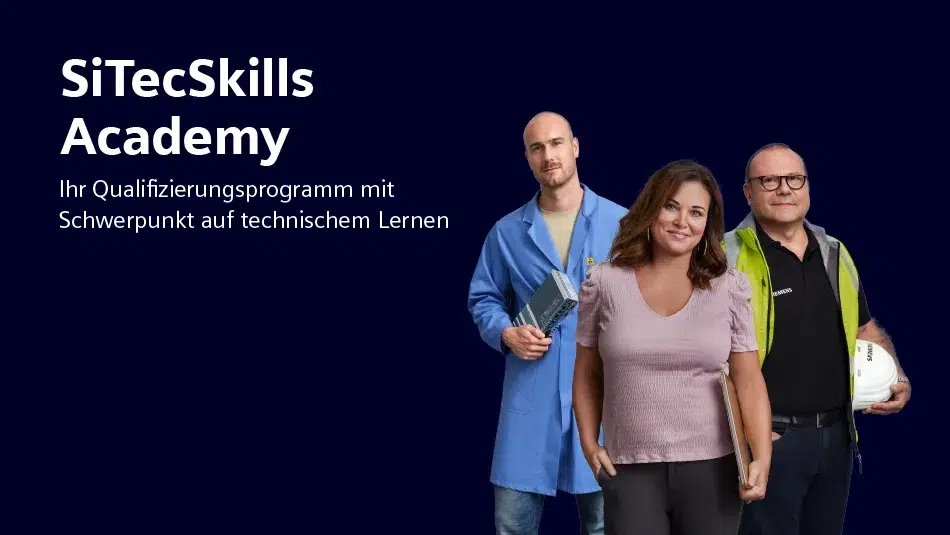
According to their official press release, Siemens applies its internal #NextWork® methodology to analyze job, task, and skill changes three to five years ahead, covering approximately 70,000 critical job profiles.
Based on this workforce analysis, the company introduced large-scale reskilling programs to prepare employees for digital transformation and structural changes in the labor market.
Executive leadership emphasized that continuous up- and reskilling is essential to ensure long-term employability and maintain organizational competitiveness.
This initiative demonstrates how enterprise organizations translate workforce insights into structured capability development, turning strategic workforce planning into actionable programs that support future business growth.
How to Build a Strategic Workforce Planning Framework
Building a strategic workforce planning framework requires more than evaluating headcount or hiring plans.
At the enterprise level, it involves aligning talent strategy with business transformation, operational scalability, and long-term capability development.
While every organization may approach workforce planning differently, most enterprise frameworks are built around three core stages: understanding the current workforce, anticipating future disruption, and designing a future-ready workforce model.
1. Assess the Current Workforce
The first stage focuses on building a comprehensive and data-driven view of the existing workforce landscape.
It requires analyzing workforce quality, quantity, and organizational risk across business units.
Workforce Quality
Workforce quality refers to both current performance and future potential. Enterprise HR teams typically apply structured talent frameworks such as the 9-box matrix to evaluate employee readiness, leadership pipeline strength, and succession risks.
Rather than using performance reviews solely for evaluation, organizations leverage these insights to guide strategic talent decisions.
High-potential employees may be prioritized for accelerated development programs, while high-performing managers may require advanced leadership capability building to prepare for future organizational complexity.
Roles with consistently low performance and low growth potential may signal structural inefficiencies that require redesign rather than individual intervention.
Workforce Quantity
Workforce quantity analysis focuses on workforce dynamics and operational resilience. HR teams examine hiring velocity, turnover trends, internal mobility patterns, and the distribution of critical roles across the organization.
For enterprise organizations, leadership turnover or the loss of niche technical talent can introduce significant operational risk.
Identifying these vulnerabilities early helps organizations prioritize succession planning, workforce stabilization initiatives, and targeted hiring strategies.
2. Anticipate Future Scenarios
Once the current workforce is mapped, organizations must shift toward future-oriented analysis.
Strategic workforce planning requires HR to collaborate closely with business leaders to explore multiple scenarios shaped by technological disruption, market expansion, regulatory change, or economic uncertainty.
Scenario planning allows enterprises to test how different future conditions may impact workforce demand.
For example, increased automation may reduce reliance on repetitive roles while accelerating demand for data-driven decision-making skills.
Similarly, global expansion strategies may require new leadership capabilities or cross-cultural talent mobility.
Rather than predicting a single future, leading organizations build flexible workforce strategies that remain resilient across multiple possible outcomes. This approach enables faster adaptation when unexpected shifts occur.
3. Design Future Workforce Structure
The final step is defining the future workforce model and evaluating whether expected workforce trends align with desired organizational outcomes.
For example, advancements in AI and automation may significantly reshape workforce structures, reducing reliance on certain roles while increasing demand for digital skills.
Understanding these shifts early allows organizations to prepare through reskilling, restructuring, and long-term workforce transformation initiatives.
Building a Future-Ready Workforce with the Right HR Foundation
Strategic workforce planning requires a technology foundation that can unify workforce data, automate processes, and support decision-making at scale.
As organizations grow more complex, HR leaders need a system that connects strategy with execution across the entire employee lifecycle.
As part of the Mekari integrated software ecosystem, Mekari Talenta is designed to help large organizations simplify HR complexity through a cloud-based platform that connects workforce planning, performance management, payroll, attendance, and recruitment within a unified environment.
By integrating HR operations with broader business workflows, organizations can gain more holistic visibility into their people strategy while maintaining operational efficiency.
Built for scalability, Mekari Talenta enables companies to manage thousands of employees, multiple entities, and evolving workforce structures while maintaining real-time visibility into organizational performance.
How Mekari Talenta supports strategic workforce planning:
- Centralized Workforce Data & HR Analytics. Consolidate recruitment, attendance, payroll, and performance data into one platform to support data-driven workforce planning and long-term talent strategy.
- End-to-End Employee Lifecycle Management. Manage workforce planning from hiring and onboarding to development, evaluation, and retention within an integrated system.
- Performance Management & KPI Tracking. Align individual performance with organizational goals through structured KPI monitoring, continuous evaluation, and personalized employee insights.
- Scalable Cloud Infrastructure for Enterprise Needs. Adapt quickly as your organization grows— add entities, users, or processes without disrupting operations.
- Integrated Attendance & Payroll Automation. Gain accurate workforce insights through real-time attendance tracking and automated payroll processes that reduce operational complexity.
- Flexible Configuration for Complex Organizational Structures. Support multi-branch operations, diverse policies, and enterprise-level workforce governance within a single platform.
By combining strategic workforce planning with a scalable HR platform, organizations can move beyond reactive HR management and build a future-ready workforce strategy.
Explore how Mekari Talenta can support your enterprise HR transformation. Consult with our team and request a personalized demo today.