




-
Talent development is a structured approach to building employee skills, capabilities, and readiness to support long-term business performance.
-
Common talent development programs include training, leadership development, mentoring, and job rotation aligned with real business needs.
Employee development can no longer be treated as an optional, add-on program. In many organizations, especially those that are continuously growing, talent development has become a strategic necessity to ensure employees can evolve alongside changing business needs.
The challenge is that as the workforce grows and organizational structures become more complex, it becomes increasingly difficult to maintain consistency in development processes across all levels and locations.
This is where strategic workforce planning and a well-defined human capital management strategy become essential to ensure development efforts remain aligned with long-term business direction.
Without a structured system, development programs often become uneven, difficult to measure, and disconnected from actual business priorities.
That’s why this article will explore the concept of talent development, how it differs from talent management, and why organizations need to approach it in a more structured and sustainable way.
What Is Talent Development?
Talent development refers to a structured approach to improving employees’ skills, capabilities, and performance to support both individual growth and business goals.
It includes various initiatives such as training, coaching, mentoring, and career development programs designed to help employees grow over time.
It goes beyond one-time training by aligning employee development with business needs. This includes identifying skill gaps, preparing employees for future roles, and building a strong leadership pipeline.
Talent development also contributes to higher engagement and retention. When employees see clear opportunities to grow, they are more likely to stay, perform better, and take on greater responsibilities.
Rather than being a one-off initiative, talent development is a continuous effort that evolves alongside business priorities, ensuring that both employees and the organization can grow together.
In practice, many organizations also leverage HR analytics or people analytics to continuously refine how development initiatives are designed and prioritized.
Talent Development vs. Talent Management
In HR practice, the terms talent development and talent management are often used interchangeably, and sometimes even considered the same. In reality, they have different focuses.
Talent management has a broader scope as it covers the entire employee lifecycle—from recruitment, onboarding, and performance management to retention and succession planning.
Talent development, on the other hand, focuses more on growth and capability building. It centers on how organizations help employees improve their skills, competencies, and career readiness.
Here’s a simple comparison:
| Aspect | Talent Development | Talent Management |
|---|---|---|
| Main Focus | Developing employee skills, competencies, and careers | Managing talent across the entire lifecycle |
| Scope | Learning, coaching, upskilling, career development | Recruitment, onboarding, performance, retention, succession |
| Objective | Improve employee capability and readiness | Ensure the right talent is in place at every stage |
| Orientation | Individual growth and capability building | End-to-end workforce strategy |
| Business Role | Prepare employees for future needs | Maintain a strong and sustainable talent pipeline |
From this comparison, it’s clear that talent development is actually a part of talent management. Talent management provides the overall framework for managing talent, while talent development is a key component that focuses on employee growth.
This means that without talent development, talent management cannot function effectively. Organizations may be able to hire and retain employees, but without continuous development, it becomes difficult to build the internal capabilities needed for long-term growth.
In many cases, this is supported by a talent management system that integrates different HR processes into a single workflow.
Read also: Talent Management vs Performance Management: 6 Key Differences
Why Is Talent Development Important for Long-Term Workforce Capability
Talent development is important not simply because organizations want employees to become “more skilled,” but because workforce capability directly impacts performance, stability, and competitiveness.
As businesses grow, employee development becomes a key foundation to reduce reliance on external hiring to fill capability gaps.
When talent development is implemented consistently, it not only builds skills but also strengthens readiness to adapt to change.
This is particularly relevant in environments where employee lifecycle management needs to be managed consistently, from hiring to development and retention.
1. Improves Individual and Team Performance
Talent development enhances employee capabilities, which often leads to immediate improvements in productivity and quality of work.
Employees who continuously develop their skills are better prepared to adapt to new technologies, evolving workflows, and higher performance expectations.
At a broader level, this impact extends beyond individuals and contributes to stronger team performance and overall operational efficiency.
Structured training programs play a key role in supporting this improvement.
While performance is influenced by multiple factors, strong learning and development initiatives are often linked to a more engaged workforce that is ready to perform.
2. Supports Succession Planning
Talent development plays a critical role in building a leadership pipeline and ensuring internal readiness for key roles. It helps organizations prepare employees to take on future leadership or strategic positions.
Without a strong internal pipeline, organizations tend to rely heavily on external hiring, which is often more costly, time-consuming, and carries higher risk due to onboarding and adaptation periods.
By developing talent internally, organizations can maintain continuity, reduce disruption, and ensure smoother transitions in leadership or critical roles.
3. Improves Employee Retention
Talent development is also a key driver of employee retention. Employees are more likely to stay in organizations that provide clear opportunities for learning, growth, and career progression.
When development opportunities are lacking, the impact is not only on employee satisfaction but also on business costs. such as increased turnover, recruitment expenses, onboarding time, and lost productivity.
Providing meaningful development opportunities helps create a more engaged and committed workforce over time.
4. Maintains Organizational Competitiveness
Talent development is essential for keeping workforce skills aligned with changing business needs. As technology and market demands evolve, organizations must ensure that employees continue to develop relevant capabilities.
Without continuous development, there is a risk of falling behind in innovation, productivity, and adaptability. On the other hand, organizations that actively invest in employee development are better prepared to respond to new challenges and opportunities.
Common Challenges in Talent Development
Talent development is becoming increasingly important as its challenges become more apparent. Many organizations recognize the need to develop their employees, but execution is often more difficult than expected.
The challenge is not just about providing training, but ensuring that development initiatives are relevant, consistent, accessible, and truly aligned with business needs.
As organizations grow, this complexity increases even further due to distributed teams, diverse roles, and varying levels of capability across the workforce.
1. Widening Skill Gaps in the AI Era
The rapid advancement of AI and digital technologies is making many existing skills obsolete, while demand for new capabilities—such as data literacy, AI literacy, and digital skills—continues to rise.
The challenge is not only about hiring new talent, but also about upskilling the existing workforce. Without accelerating internal capability development, the gap between business needs and employee skills will continue to widen and making it harder to innovate and stay competitive.
2. Uneven Access to Learning and Development
Another key challenge is unequal access to learning opportunities. In organizations with multiple locations or distributed teams, not all employees receive the same level of exposure to high-quality training, coaching, or mentoring.
Employees in central or headquarters roles often have greater access to development programs, while those in other locations may face limitations due to resources, infrastructure, or learning systems.
This creates disparities in capability development across teams, especially when organizations lack centralized HR dashboards and analytics to monitor development access and outcomes.
3. High Talent Mobility and the “War for Talent”
Many organizations face a paradox: while there is a large workforce available, the skills required by the business are not always aligned with available talent.
At the same time, highly skilled employees tend to be more mobile. They are more likely to move to other organizations that offer better development opportunities, compensation, or career progression.
This creates a highly competitive environment where retaining top talent becomes increasingly difficult. Without strong development programs, organizations risk losing their most valuable employees.
In this context, talent development is not only about building skills, but also about strengthening engagement, retention, and long-term employee commitment.
4. Development Programs Not Aligned with Business Needs
Another common issue is that development programs are often supply-driven—based on available training offerings rather than actual business needs.
As a result, employees may participate in multiple training programs, but the impact on performance and business outcomes remains limited.
This leads to internal skill mismatches, where employees gain knowledge that is not directly applicable to their roles.
To be effective, talent development must shift toward a more demand-driven approach—one that is closely aligned with business priorities, role requirements, and real performance gaps.
Key Factors That Determine the Effectiveness of Talent Development Strategy
Talent development does not become effective simply because training programs exist. Its impact depends on how well initiatives are designed, executed, and connected to real business needs.
In many organizations, development programs run regularly but deliver limited outcomes. This often happens when the focus is on activity rather than impact.
The following factors play a critical role in ensuring talent development drives measurable results instead of becoming a routine HR function.
1. Alignment with Business Priorities
Development initiatives must reflect actual business priorities, operational challenges, and capability gaps. When programs are disconnected from what teams need on the ground, employees may complete training without improving performance in their roles.
Effective organizations start by identifying critical roles, future skill requirements, and areas where capability gaps directly affect business outcomes.
For example, a company planning to expand into digital channels prioritizes training in data analytics, digital marketing, and product management instead of generic leadership workshops.
This ensures that development efforts are relevant and tied to real performance improvements rather than generic learning agendas.
2. Active Leadership Involvement
Management support goes beyond approval or budget allocation. The effectiveness of talent development increases significantly when leaders are actively involved in identifying talent needs, mentoring employees, and reinforcing development in day-to-day work.
For instance, a senior manager mentors high-potential employees to prepare them for future leadership roles.
Employees are more likely to take development seriously when leaders participate and set expectations. Without visible involvement from leadership, development programs often lose credibility and consistency across teams.
3. Data-Driven Decision Making
Talent development should be guided by data rather than assumptions. Key inputs include performance reviews, skill assessments, readiness levels, turnover patterns, and talent pipeline data.
For example, HR identifies that employees in a specific department consistently underperform in project delivery. Based on this, targeted training on project management and cross-functional collaboration is introduced.
Using data helps organizations prioritize the most critical development areas and allocate resources more effectively. It also enables continuous refinement of programs based on what delivers measurable results.
Read also: Data-Driven HR: Definition, Benefits, and Practical Implementation
4. Integration with Core HR Processes
Development efforts are more effective when connected with other HR processes such as performance management, succession planning, and career progression frameworks.
When these elements operate in isolation, development becomes fragmented and difficult to track. Integrated systems allow organizations to connect employee performance, potential, and development pathways in a more structured way, making execution more consistent.
5. Program Scalability
As organizations grow, development programs must remain consistent in quality across teams, functions, and locations.
Without scalability, the employee experience varies significantly depending on where someone is based or who manages them.
Scalable programs rely on standardized frameworks, digital learning platforms, and repeatable processes. This ensures that development remains accessible and consistent even as the organization expands.
6. Personalization of Development
Employees have different roles, career paths, and capability gaps. A one-size-fits-all approach often leads to low engagement and limited impact.
Effective strategies allow for personalization based on role requirements, seniority, potential, and individual development goals. This increases relevance and improves the likelihood that learning translates into performance.
7. Consistency and Standardization
While personalization is important, clear standards across business and entities are still required to maintain quality and fairness. Without standardization, development outcomes can vary widely depending on individual managers or departments.
Structured frameworks, defined competencies, and clear guidelines help ensure that development programs are implemented consistently across the organization.
8. Clear Measurement and Evaluation
Talent development must be measurable. Without defined metrics, it becomes difficult to assess whether programs improve skills, performance, readiness, or business outcomes.
Organizations need to track indicators such as skill progression, performance improvement, internal mobility, and readiness for key roles. Measurement provides visibility into what works and allows continuous improvement of development strategies.
Core Components of an Effective Talent Development System
Building an effective talent development strategy means creating a system that is fully connected to business needs, employee performance, and long-term growth priorities.
In practice, development should extend beyond training programs. It needs to include clear career pathways, leadership readiness, and continuous feedback mechanisms.
When these elements are aligned, talent development becomes more relevant, measurable, and easier to execute consistently.
1. Training & Learning Programs
Training is often the most visible component of talent development, but its effectiveness depends on relevance and focus. Generic programs delivered without clear priorities rarely lead to meaningful outcomes.
Effective learning initiatives are built around upskilling and reskilling that directly address current and future business needs.
This requires a clear understanding of existing skill gaps and how they relate to industry changes, digital transformation, and emerging technologies such as AI.
When designed properly, training does more than transfer knowledge. It helps employees build capabilities that improve performance and keep them relevant in a rapidly changing environment.
Read also: Top 15 Employee Training Software to Boost Revenue per Worker Up to 218%
2. Performance Management
Performance management plays a critical role as a foundation for development. It serves as a primary source of insight into employee strengths, gaps, and potential.
Through performance reviews, organizations can identify which capabilities need improvement, which roles require additional support, and which individuals are ready for further development. However, the value of performance management depends on how the data is used.
Evaluation should lead to clear follow-up actions. Development plans, training programs, and career progression decisions need to be directly linked to performance insights.
This approach transforms performance management into a strategic driver of talent development rather than a purely administrative process
3. Career Pathing & Succession Planning
Career pathing and succession planning help maintain a strong and sustainable talent pipeline. Clear career pathways give employees visibility into their growth opportunities while allowing organizations to map future talent needs.
Without structured career paths, employees may struggle to see long-term opportunities, which increases the risk of losing high-potential talent. At the same time, organizations become more dependent on external hiring to fill critical roles.
Succession planning reduces this risk by preparing internal candidates for key positions. It ensures continuity in critical roles and strengthens long-term organizational stability.
4. Leadership Development
Leadership development should not be limited to senior roles. Preparing future leaders across different levels is essential to support growth and maintain operational alignment.
Employees at supervisory, mid-management, and high-potential levels need structured opportunities to develop leadership capabilities early. This includes decision-making, communication, and team management skills.
As organizations grow, the need for capable leaders increases significantly. Without a structured approach to leadership development, it becomes difficult to build a strong internal leadership pipeline and maintain consistency in execution across teams.
Leadership readiness is often evaluated through structured methods such as 360-degree feedback, providing a more comprehensive view of employee capability.
5. Continuous Feedback & Coaching
Effective development requires continuous feedback rather than relying solely on periodic evaluations. Work environments, skill requirements, and performance expectations evolve quickly, making real-time feedback essential.
Ongoing feedback allows organizations to adjust development efforts based on current needs. Coaching further strengthens this process by providing personalized guidance that is directly relevant to an employee’s role.
Compared to formal training alone, employees often improve faster when they receive regular feedback, coaching, and practical guidance tied to their daily responsibilities. This creates a more dynamic and responsive development process.
Talent Development Process: How to Develop Talent Development Strategy
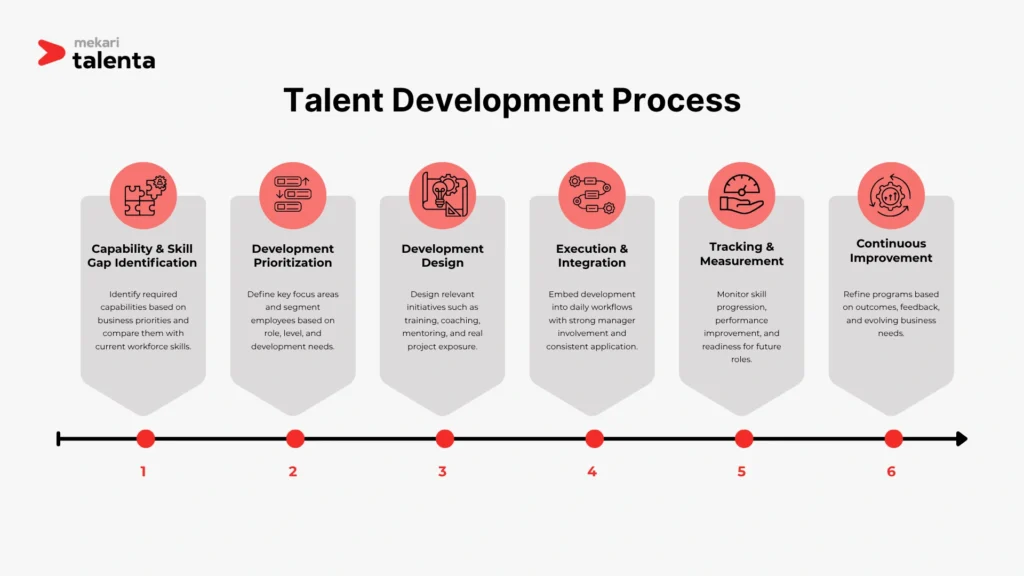
A talent development process should function as a structured, repeatable cycle, one that connects workforce needs, employee capabilities, and business priorities.
When executed well, it ensures development efforts are targeted, measurable, and consistently applied across teams and roles.
Many organizations support this process using HCM software to ensure data consistency and execution across different functions.
Below is a practical, end-to-end process that reflects how talent development is typically implemented in real-world environments.
1. Identifying Capability Needs and Skill Gaps
The starting point is understanding what the organization actually needs from its workforce. This involves translating business priorities into required capabilities, then comparing those needs with current employee skills.
This stage often draws from performance reviews, competency assessments, workforce data, and input from managers. The goal is to identify where gaps exist, which roles are most critical, and which capabilities need to be strengthened.
Rather than assessing everything at once, organizations usually focus on high-impact areas, such as roles that directly influence business performance or areas where capability gaps are already affecting results.
2. Defining Development Priorities and Target Groups
Once gaps are identified, the next step is to define what development should achieve and who it should focus on. Clear priorities help ensure that development efforts are aligned with real needs instead of being spread too broadly.
At this stage, employees are often grouped based on role, level, or potential. For example, early-career employees may need foundational skills, while more experienced employees may require leadership readiness or specialized capabilities.
This segmentation helps ensure that development efforts are relevant and actionable, rather than generic.
3. Designing Development Approaches
After priorities are set, organizations design how development will be delivered. This usually goes beyond formal training and includes a mix of approaches such as coaching, mentoring, job rotations, and project-based assignments.
The most effective development happens when learning is closely connected to real work. Employees are more likely to build meaningful skills when they can immediately apply what they learn in their day-to-day responsibilities.
Because of this, many organizations combine structured learning with practical experience, ensuring that development is both contextual and applicable.
4. Implementing and Embedding Development
Execution plays a critical role in determining whether development efforts succeed. Programs need to be integrated into daily workflows rather than treated as separate activities.
Managers are especially important at this stage, as they help reinforce development through regular check-ins, feedback, and task assignments. Without this connection, development can become disconnected from actual work.
Consistency in execution also matters. When development is applied unevenly across teams, the impact becomes difficult to scale.
5. Tracking Progress and Measuring Outcomes
To understand whether development is effective, organizations need to track progress and evaluate outcomes. This includes monitoring improvements in performance, skill development, readiness for new roles, and internal mobility.
Measurement should go beyond participation or completion rates. The real focus is whether employees are becoming more capable and whether those improvements translate into better business outcomes.
Insights from this stage help determine which programs are effective and which need adjustment.
6. Refining and Evolving the Process
Talent development is an ongoing process that needs to evolve over time. As business priorities shift and workforce needs change, development strategies must be updated accordingly.
Regular reviews allow organizations to refine programs, reallocate resources, and scale initiatives that deliver strong results. Over time, this creates a more adaptive and responsive development system.
Talent Development Program Examples from Leading Organizations
To make talent development more concrete, it’s useful to look at how programs are actually implemented. In practice, organizations rarely rely on a single type of program, as they combine multiple approaches depending on capability needs, talent segments, and business priorities.
Below are some of the most common types of talent development programs, along with real examples from companies that have implemented them.
1. Structured Training & Learning Programs
This is the most foundational type of program, focused on building technical, functional, or behavioral skills through formal learning.
Example: Adobe provides access to on-demand learning platforms such as LinkedIn Learning and Harvard ManageMentor, allowing employees to continuously build skills relevant to their roles. The company also supports external education by funding courses and academic programs.
2. Leadership Development Programs
These programs are designed to prepare employees for managerial or leadership roles, often through structured pathways.
Example: Adobe’s “Accelerate Adobe Life” designed for interns and university graduates. It focuses on helping new employees transition into the workplace through community building, professional development workshops, and exposure to leadership.
3. Mentorship and Coaching Programs
These programs focus on personalized development through guidance from more experienced employees or external coaches.
Example: Heineken implemented reverse mentoring programs where junior employees mentor senior leaders, helping leadership gain new perspectives while developing internal talent.
4. Career Development & Internal Mobility Programs
These programs focus on helping employees grow within the organization through structured career paths and internal opportunities.
Example: IBM uses a digital learning platform with personalized recommendations and skill-based progression. Employees who actively participate in learning programs have significantly higher chances of promotion.
5. Rotational & Experiential Development Programs
These programs allow employees to gain exposure to different roles, functions, or projects to build broader capabilities.
Example: Mastercard Launch Program offers rotational experiences and hands-on learning for early-career talent, helping participants understand different business functions while building practical skills.
How to Measure Talent Development Effectiveness
Measuring talent development is about understanding whether development efforts actually improve capability, performance, and readiness, not just whether programs were completed.
In many cases, organizations track training participation but struggle to link it to real outcomes. Effective measurement requires connecting development activities to changes in employee performance and business impact.
Below are key areas to measure, along with how they are typically evaluated in practice.
1. Skill Progression and Capability Improvement
One of the most direct indicators is how employee capabilities evolve over time. This can be seen through changes in how individuals perform their tasks, solve problems, or handle more complex responsibilities.
When development is effective, employees demonstrate stronger technical skills, better decision-making, and increased confidence in their roles.
These improvements are usually reflected in competency assessments or manager evaluations, but more importantly, they are visible in day-to-day work.
2. Performance Improvement
Development should lead to measurable improvements in performance. This can be observed through better achievement of targets, higher quality of work, or increased productivity at both individual and team levels.
When development initiatives are aligned with actual job requirements, performance improvements tend to follow. If performance remains unchanged, it often indicates that the development provided is not relevant enough or not effectively applied.
3. Internal Mobility and Promotion Readiness
An effective development system increases the readiness of employees to take on new roles. When employees are able to move across functions, step into more complex responsibilities, or be promoted internally, it shows that development efforts are building real capability.
Low internal mobility, on the other hand, often signals that employees are not being prepared adequately for the next stage in their careers.
4. Retention of High-Value Talent
Retention is closely linked to development. Employees who see clear opportunities to grow are more likely to stay and contribute over the long term.
When high-performing or high-potential employees continue to leave despite ongoing development programs, it suggests that the programs are not addressing what employees actually value in their growth.
5. Time to Readiness for Critical Roles
Another important measure is how quickly employees become ready for more advanced roles. When development is structured and effective, the time required to prepare someone for a critical position tends to decrease. This reflects a stronger pipeline of talent that is ready to step into key roles when needed.
6. Business Impact
Ultimately, talent development should contribute to business outcomes.
Improvements in operational efficiency, team productivity, or overall performance can often be linked back to stronger workforce capability.
While the connection may not always be immediate, consistent development efforts should lead to measurable improvements in how the organization performs over time.
Talent Development Software and Platforms to Support Execution
Executing talent development consistently requires the right system to connect performance, learning, and workforce data into one flow. Without proper tools, development efforts often become fragmented, manual, and difficult to scale.
Below are several platforms that support talent development execution, from integrated HCM systems to specialized analytics tools.
1. Mekari Talenta
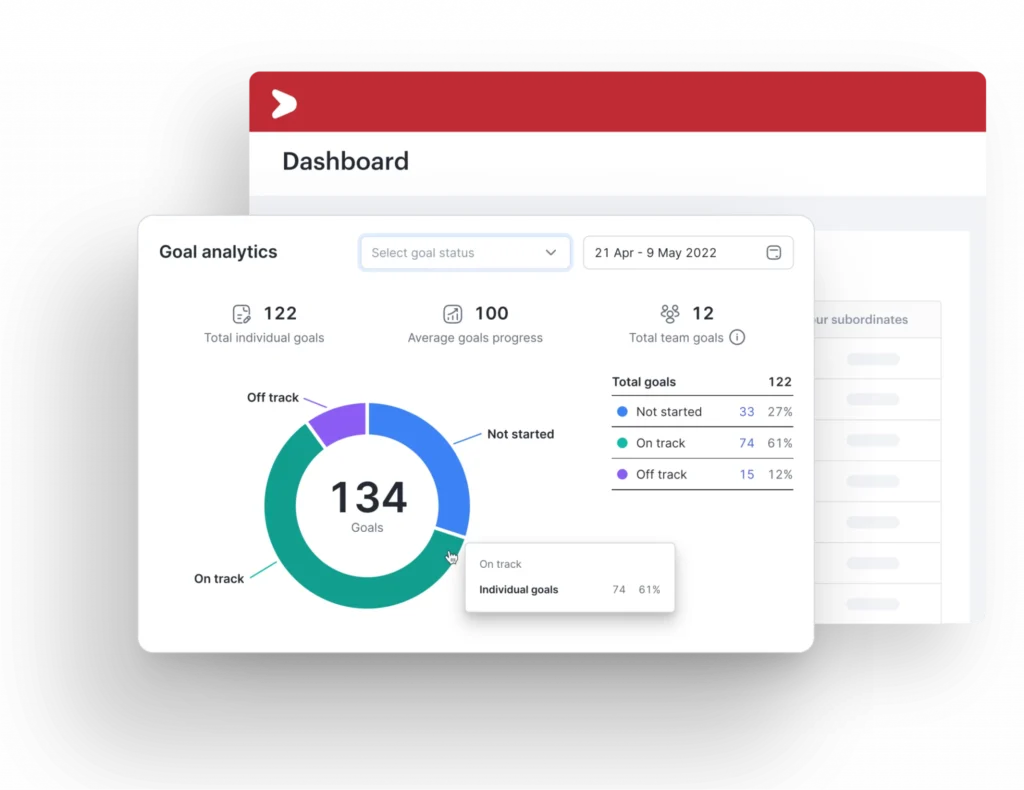
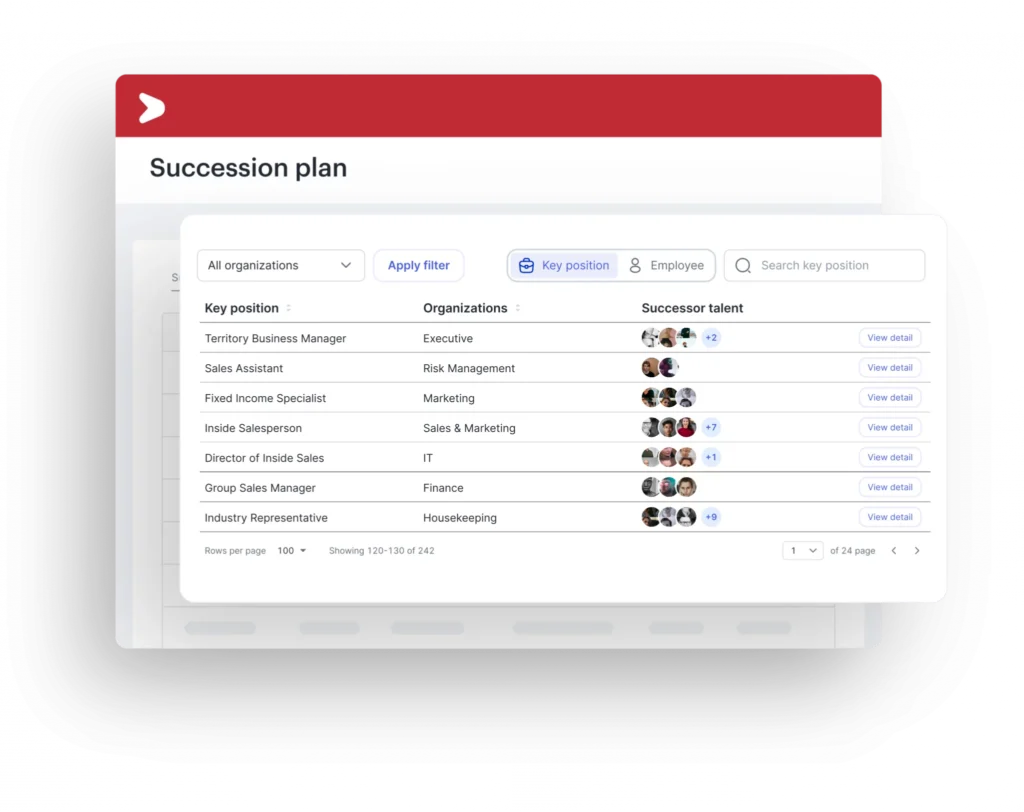
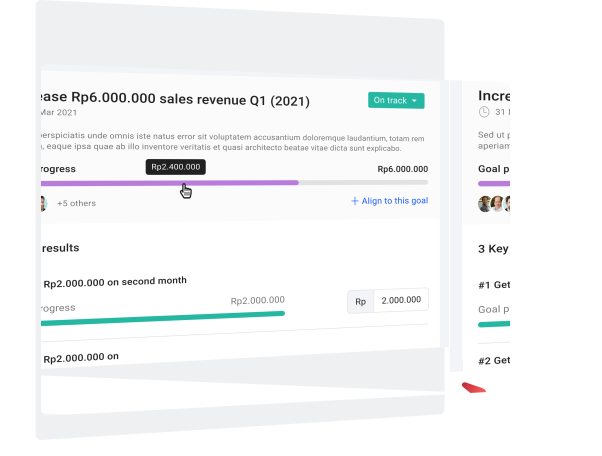
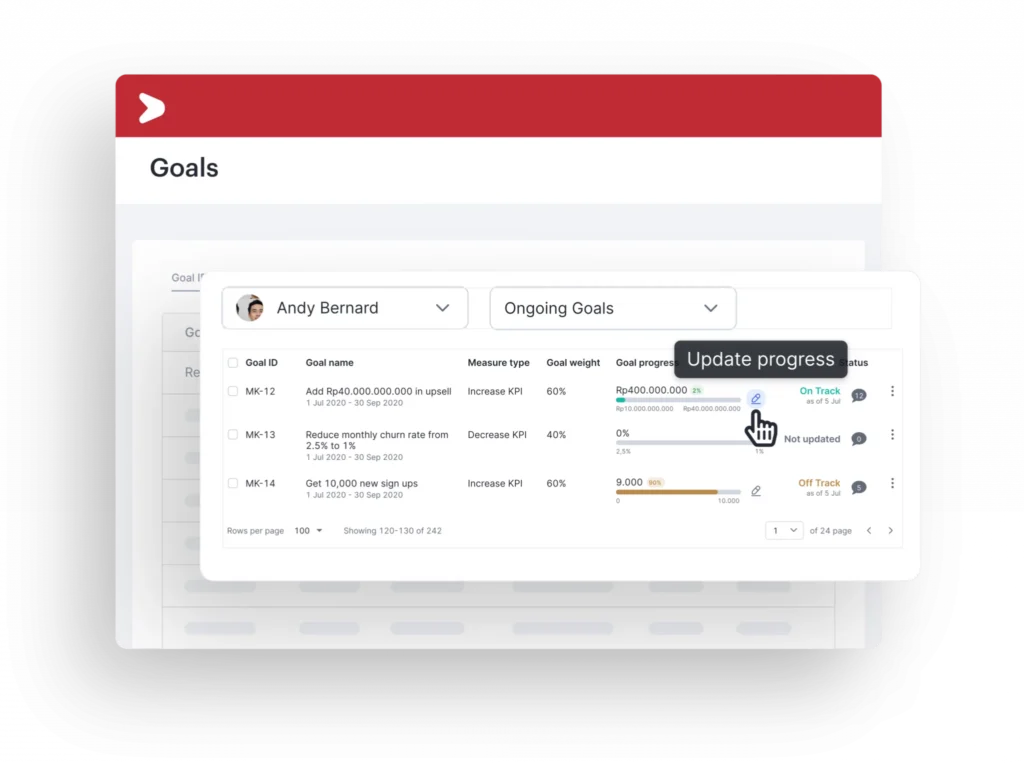
Mekari Talenta is an AI-centric, cloud-based HCM platform that provides integrated Talent Development capabilities to support employee growth and workforce readiness.
It combines Performance Management, Talent Management, and Learning Management System (LMS) capabilities, allowing organizations to manage the full development cycle without relying on disconnected tools.
Here’s how Mekari Talenta supports talent development in practice:
- Integrated performance and development system
Connect performance reviews, competency assessments, and training data in one platform to identify skill gaps and translate them into actionable development plans. - 360° performance review with AI support
Conduct multi-source evaluations (self, manager, peers) with AI-generated summaries to highlight strengths and development areas more objectively. - KPI & OKR tracking
Align individual and organizational goals with measurable targets that can be monitored continuously. - Competency assessment and skill mapping
Use structured frameworks to assess employee capabilities and define clear development priorities. - Individual Development Plan (IDP)
Create personalized development plans with clear goals, actions, and progress tracking for each employee. - Succession planning
Build a data-driven talent pipeline by identifying high-potential employees and preparing them for future roles. - Built-in Learning Management System (LMS)
Manage training programs end-to-end, including content delivery, participation tracking, and certification management. - AI-powered insights with Airene (Talenta AI)
Ask HR-related questions and get instant insights, automate performance review summaries, predict potential employee resignation risks, and generate data-driven recommendations to support faster decision-making. - Real-time workforce analytics
Monitor development progress, performance trends, and workforce insights without relying on manual reporting. - Flexible deployment within HR ecosystem
Can be used as a standalone talent development platform or integrated within the broader Mekari ecosystem for a more unified HR operation.
2. Workday Learning
Workday Learning is part of the Workday HCM suite and focuses on delivering learning experiences that are directly connected to performance and business needs.
It allows organizations to create personalized learning paths, track skill development, and align learning with role requirements.
Because it is integrated with Workday’s broader system, learning data is directly connected to performance, career progression, and workforce planning.
3. SAP SuccessFactors
SAP SuccessFactors provides a comprehensive suite that includes performance management, learning, and succession planning. It is designed to handle complex organizational structures and large-scale workforce data.
The platform is known for its strong analytics and benchmarking capabilities, allowing organizations to compare performance and development metrics across different teams or regions. It also supports structured competency frameworks and long-term talent planning.
4. Cornerstone OnDemand
Cornerstone OnDemand focuses heavily on learning and development, making it a strong choice for organizations prioritizing upskilling and reskilling initiatives.
It offers advanced LMS capabilities, content management, and personalized learning experiences. The platform also integrates performance and succession planning features, allowing development to be linked with career progression.
5. Degreed
Degreed is a skill-based learning and talent development platform that focuses on upskilling and reskilling employees.
It aggregates learning content from multiple sources and maps it to skill frameworks, helping organizations track skill development at an individual and organizational level. Degreed is often used to support continuous learning strategies and future skill readiness.
Conclusion
Talent development plays a central role in shaping how organizations build capability, sustain performance, and prepare for future demands.
Its effectiveness depends on how well it is connected to real business needs, supported by structured processes, and executed consistently across the organization.
When development is treated as an integrated system, linking performance, learning, and workforce planning, it becomes easier to identify gaps, prioritize actions, and track impact over time.
The combination of clear strategy, practical execution, and the right technology enables organizations to move beyond fragmented initiatives and build a more reliable development engine.
This creates stronger internal capability, improves talent readiness, and supports more consistent decision-making.
Over time, this approach strengthens both individual growth and organizational performance, creating a workforce that can adapt and evolve alongside changing business demands.