





- Talent development is a structured approach to continuously build employee capabilities, ensuring the workforce stays relevant and aligned with long-term business goals.
- Creating a talent development strategy involves translating business needs into capability requirements, prioritizing high-impact gaps, designing scalable programs, and executing them with clear ownership and measurable outcomes.
A talent development strategy is no longer optional in today’s fast-changing business environment. It’s a critical driver of long-term performance and workforce readiness.
As skills evolve rapidly and roles continue to shift, organizations need a structured approach to continuously build capabilities, not just fill gaps.
Without a clear strategy, development efforts often become reactive, fragmented, and disconnected from business priorities.
This is why companies are shifting from one-time training initiatives to a more systematic, future-focused approach.
In this guide, we’ll break down what a talent development strategy is, why it matters, and how to build one effectively.
Understanding Talent Development
Talent development is a structured, ongoing effort to build employees’ capabilities, skills, and leadership readiness in alignment with long-term business objectives.
It goes beyond one-time training by creating a system where people continuously grow alongside the organization’s evolving needs.
Rather than focusing only on immediate performance, talent development ensures the workforce is prepared for future roles, emerging challenges, and strategic shifts.
This includes initiatives such as upskilling, reskilling, leadership development, career pathing, and succession planning, all integrated into a cohesive approach.
At its core, talent development answers a critical question: “Do we have the right capabilities in place—not just today, but for what’s next?”
Talent Development vs Talent Management
Although often used interchangeably, talent development and talent management serve different but complementary roles in building a strong workforce.
So, what’s the difference?
Talent management is the end-to-end system of managing the entire employee lifecycle within an organization.
It covers the full employee journey, including:
- Workforce planning
- Recruitment and onboarding
- Performance management
- Compensation and rewards
- Succession planning
- Retention strategies
Talent development is a focused component within that system, specifically aimed at growing employee capabilities.
It sits within talent management and focuses specifically on:
- Upskilling and reskilling programs
- Leadership development initiatives
- Career pathing and internal mobility
- Learning and development (L&D) strategies
In simple terms:
- Talent management ensures you have and retain the right people
- Talent development ensures those people continue to grow and stay relevant
Read also: Performance Management System: Definition, Stages & Key Elements
The Importance of Designing a Strong Talent Development Strategy
A well-designed talent development strategy is a core driver of long-term business performance.
It also serves as a key component of a broader human capital management strategy, ensuring that workforce capabilities are developed in alignment with business priorities and future growth plans.
Without a clear and structured approach, development efforts often become fragmented, reactive, and disconnected from business priorities.
A strong strategy ensures that workforce capabilities evolve in sync with organizational goals, enabling sustainable growth and operational resilience.
1. Closes Critical Skill Gaps Before They Impact the Business
Without a proactive strategy, organizations are forced into reactive hiring—often too late and at a higher cost.
A structured talent development strategy enables continuous upskilling, ensuring the workforce remains relevant and capable before skill gaps begin to affect performance and growth.
2. Improves Retention by Providing Clear Growth Pathways
Employees today no longer stay in a role simply because of compensation. They stay when they see a clear path for growth and long-term relevance.
As skills evolve rapidly, the absence of structured development creates uncertainty, making employees more likely to look for opportunities elsewhere.
Without a defined strategy, development often becomes ad hoc, leaving employees without visibility into how they can progress.
A well-designed talent development strategy addresses this by aligning individual growth with business needs.
It provides clear direction on what skills to build, how to advance, and where opportunities exist internally, turning development into a deliberate system rather than a reactive effort.
3. Reduces Dependency on External Hiring
Relying on external hiring to fill capability gaps is increasingly inefficient, both in terms of cost and time.
Recruitment cycles are longer, competition for talent is higher, and new hires often require additional time to adapt before reaching full productivity.
A structured talent development strategy shifts this approach by building capabilities internally.
Instead of continuously sourcing talent from the market, organizations can develop existing employees to take on evolving roles, reducing time-to-fill and improving long-term workforce stability.
Over time, this also leads to better cultural alignment and stronger retention, as employees see opportunities to grow without needing to leave.
4. Ensures Leadership Continuity and Business Stability
One of the most critical risks in any organization is the absence of ready successors for key roles.
Without a clear development pipeline, leadership transitions can disrupt operations, slow decision-making, and impact overall performance.
A well-designed talent development strategy addresses this by systematically identifying and preparing high-potential employees for future leadership positions.
Rather than reacting to vacancies, organizations build a continuous leadership pipeline, ensuring that critical roles can be filled quickly with individuals who already understand the business context and expectations.
5. Aligns Workforce Capability with Business Strategy
A common challenge in many organizations is the disconnect between learning initiatives and actual business needs.
Training programs are often implemented without a clear link to strategic priorities, resulting in limited impact.
A strong talent development strategy ensures that capability-building efforts are directly aligned with where the business is heading.
Development is guided by future skill requirements, making it more targeted and measurable. As a result, learning is no longer treated as a standalone activity, but as a strategic lever to support growth, innovation, and competitive advantage.
How to Create a Talent Development Strategy
Creating a talent development strategy is about building a system that continuously produces the capabilities the business needs, at scale and across different functions, locations, and levels of complexity.
A practical way to approach this is to think of it as a structured process with four interconnected stages: understanding the business context, defining priorities, designing the system, and ensuring execution.
1. Start by Translating Business Strategy into Capability Demand
Most organizations fail at the very first step because they start from learning initiatives instead of business direction.
A talent development strategy should begin by translating strategic goals, such as expansion, digital transformation, or operational efficiency, into specific capability requirements.
You need to translate external changes into concrete capability impact.
For example:
- If AI is automating part of operations → which roles will shrink, and which new skills are needed?
- If the company is expanding to new regions → do you need leaders with cross-cultural management skills?
- If competition is increasing → do frontline teams need stronger commercial or problem-solving capability?
To arrive at this level of clarity, organizations need to connect three perspectives: external signals (what is changing in the market), internal gaps (where performance or capability is lacking), and current capability reality (what skills already exist and at what level).
Start from External Signals (What’s Changing)
External trends are directly determine whether your workforce will stay relevant.
For example:
- The World Economic Forum estimates that 44% of core skills will change within the next few years
- Meanwhile, McKinsey & Company highlights that 87% of companies are already experiencing or expect skill gaps in the near future
This means capability gaps are already happening. But the key is not listing trends like AI or digitalization. You need to translate them into:
- What will change in our workforce?
- Which roles are impacted?
- What new capabilities are required?
Read also: Data-Driven HR: Definition, Benefits, and Practical Implementation
Validate with Internal Reality (Where Are We Weak?)
After understanding what’s changing, you need to assess where your organization stands today vs. where it needs to be.
This is where many teams oversimplify by saying “we need upskilling.”
That’s too generic.
Instead, you need to identify:
- which roles are critical to business performance
- where capability gaps already exist
- which roles will face the biggest shift in the next 1–3 years
In practice, this often reveals uncomfortable truths, like:
- some teams are overperforming while others lag significantly
- some roles are becoming obsolete
- some critical roles don’t have enough ready talent
And importantly, this cannot be done at one level. Capability gaps must be mapped by talent segment (role, function, level, or location), because needs are rarely uniform across the organization.
To make this analysis more actionable, many organizations rely on HR analytics to identify patterns in skill gaps, performance trends, and workforce risks.
This allows decision-makers to move beyond assumptions and base development priorities on real data.
Compare with What Already Exists (Are We Solving the Right Problem?)
At this stage, the focus shifts to evaluating whether existing development efforts are actually solving the right problems.
Most organizations already have a range of initiatives in place, such as training programs, onboarding processes, leadership workshops, and learning platforms. However, having these initiatives does not automatically mean they are effective.
In many cases, development efforts fail to deliver measurable impact because they are not aligned with real business needs.
Programs may target the wrong roles, address low-priority skills, or continue running simply because they have always existed.
As a result, there is often a disconnect between what the organization needs and what development initiatives are actually delivering.
This is why it becomes critical to reassess the current portfolio of development programs against the capability gaps that have been identified.
The key question is whether these initiatives directly address the most important needs or not. If they do not, then adjustments are necessary.
Some programs may need to be redesigned to better align with priorities, others may need to be discontinued, and resources should be redirected toward higher-impact areas.
2. Identify Strategic Development Priorities
After mapping all capability gaps, the next step is to systematically filter and prioritize them.
At this stage, the goal is to make clear, defensible decisions on where to focus development efforts.
This process can be broken down into three practical steps: impact analysis, prioritization, and consolidation into a priority list.
Step 1: Conduct an Impact Analysis (Filter What Matters)
Start by listing all development needs identified earlier. These could come from skill gaps, workforce trends, or performance issues.
Then evaluate each item using two criteria:
- Business Impact → How critical is this capability to business performance?
- Implementation Readiness → How ready is the organization to address this now?
Instead of overcomplicating, use a simple rating system: High, Medium, Low.
What matters here is structured judgment. The discussion behind the rating is more valuable than the rating itself.
For example:
A capability like “advanced data analytics for product teams” may have high business impact, but low readiness if there are no internal trainers, tools, or budget yet.
In larger organizations, this step should be done per business unit or function first, then aggregated. This prevents central teams from missing context-specific needs.
By the end of this step, you should have a mapped view of all development needs with clear visibility on impact vs feasibility.
Step 2: Use a Prioritization Matrix (Force Strategic Choices)
Next, take the results from the impact analysis and plot them into a 2D matrix:
- X-axis → Implementation Readiness (Low → High)
- Y-axis → Business Impact (Low → High)
This creates four practical zones:
- High Impact + High Readiness → Act immediately (quick wins)
- High Impact + Low Readiness → Strategic investments (require preparation)
- Low Impact + High Readiness → Opportunistic (do only if resources allow)
- Low Impact + Low Readiness → Deprioritize
The purpose of this matrix is to force alignment and trade-offs. In real discussions, this is where tension happens:
- Business leaders push for impact
- HR pushes for feasibility
- Finance pushes for cost control
That tension is necessary. Without it, everything becomes “priority,” which means nothing actually is.
Step 3: Build a Clear Priority List (Translate Decisions into Action)
Once the matrix is complete, convert it into a focused priority list. This is where many teams go wrong because they stop at the matrix. In practice, you must translate it into:
- A ranked list of development priorities (high, medium, low)
- Each priority clearly linked to specific talent segments
For example, instead of “Improve digital skills”, tt should become “Upskill mid-level marketing managers in data-driven campaign optimization.”
This level of clarity is critical because it directly determines what programs will be designed, who the target audience ism and how resources will be allocated.
In more complex organizations, this list also acts as a alignment tool across business units, ensuring that development investments are not scattered.
Once priorities are clear, the next step is to translate them into a working system that can consistently build capability across different teams, roles, and locations.
In practice, this step is about answering: “How will development actually happen, at scale, and who is responsible for making it work?”
3. Design a Talent Development Framework
Once priorities are clear, the next step is to translate them into a working system that can consistently build capability across different teams, roles, and locations.
In practice, this step is about answering: “How will development actually happen, at scale, and who is responsible for making it work?”
Instead of treating all elements separately, you can simplify the framework into three core steps: direction, design, and delivery.
Step 1: Define Direction (Mission, Philosophy, and Rules of the Game)
Before building any program, you need to define how development is positioned in the organization. Without this, different teams will interpret development differently, leading to inconsistency.
This includes clarifying:
- what development is meant to achieve (e.g., closing skill gaps vs building future leaders)
- how learning should happen (formal training vs on-the-job vs self-driven)
- who owns development (HR, managers, employees, or shared responsibility)
This step acts as a decision filter. For example, if your philosophy emphasizes on-the-job learning, you won’t overinvest in classroom-heavy programs.
In complex organizations, this alignment is critical. Without it, one business unit may run structured programs, while another relies entirely on informal learning, resulting in uneven capability across the organization.
Step 2: Design Development Solutions (Programs & Structure)
Once the direction is clear, you translate priorities into specific development solutions. At this stage, avoid jumping straight into detailed content. Focus on defining the structure of each initiative:
- who the program is for (specific talent segment)
- what capability it is building
- how it will be delivered (e.g., blended learning, coaching, project-based)
- when it happens (onboarding, mid-career, leadership transition, etc.)
The key here is intentional design, not volume. Each program should exist because it solves a defined priority not because it has always existed.
For organizations with multiple branches or functions, this step also requires deciding 1) which programs are standardized (core capabilities), and 2) which are flexible (adapted locally).
This ensures consistency where needed, while still allowing relevance in different operational contexts.
Read also: Top 10 Employee Training Software to Boost Revenue per Worker Up to 218%
Step 3: Enable Delivery at Scale (Resources & Measurement)
Even well-designed programs fail if the organization cannot deliver them consistently. This step focuses on making the framework operational by ensuring:
- the right people are in place (designers, facilitators, managers)
- supporting systems exist (learning platforms, tools, assessments)
- resources are realistically allocated (budget, time, ownership)
Equally important is defining how success will be measured. Instead of only tracking participation, measurement should answer:
- are employees actually gaining the required capabilities?
- is performance improving in targeted areas?
- is development contributing to retention or internal mobility?
In larger organizations, this also requires consistency in how data is collected and interpreted across units. Otherwise, it becomes impossible to evaluate impact at scale.
At scale, this often requires the use of HR dashboards and analytics to monitor progress, track capability improvements, and evaluate the overall impact of development initiatives across different teams or business units.
4. Build the Go-Forward Implementation Plan
At this stage, the strategy needs to move from idea to execution. The goal is to make sure every development initiative can actually run, scale, and deliver impact.
To do that, you need to translate each priority into three things: clear structure, clear ownership, and a realistic rollout plan.
First, organize how the work will run.
Each development priority should be broken down into specific initiatives or programs, not treated as one big strategy.
Think of them as execution tracks. For example, leadership development, sales capability, or digital upskilling.
For each initiative, you need clarity on:
- how it will move from design → pilot → rollout
- which group will be targeted first
- how it fits into business timing (e.g., expansion, transformation phases)
In practice, especially in organizations with multiple teams or locations, you cannot launch everything at once.
Some initiatives need to start small, be tested, then expanded. This structure prevents chaos and ensures each program has a clear path forward.
Next, define ownership clearly.
This is where many strategies break. If no one clearly owns execution, nothing moves.
Each initiative should have:
- a sponsor who ensures it stays aligned with business priorities
- a program lead who is responsible for execution
Without this clarity, it’s common for teams to assume “someone else is handling it.” Clear ownership ensures accountability and keeps momentum going.
Managers also play a key role here. Even the best-designed program will fail if managers don’t support and drive adoption within their teams.
Finally, build a realistic rollout plan.
Execution should be phased. Each initiative should follow a simple flow:
- design the program
- test it with a smaller group (pilot)
- refine it
- then scale to a wider audience
This approach reduces risk and improves quality before full rollout.
In more complex environments, rollout may also differ by team or location. Some groups may be ready earlier, while others need more preparation.
A clear timeline helps everyone understand what happens first, who is impacted and how it connects to business priorities.
When done properly, this step turns strategy into coordinated execution. Instead of a set of planned programs, you now have a structured approach that defines how development will be delivered, who is responsible, and how it will scale over time.
This is what ensures that talent development moves beyond planning and becomes a consistent, repeatable driver of capability across the organization.
Turn Your Talent Development Strategy into Action with Mekari Talenta
Building a talent development strategy also requires a system that can execute, track, and scale development initiatives consistently.
However, without the right system in place, even the most well-designed talent development strategy will struggle to be executed consistently and at scale.
Mekari Talenta is a cloud-based HCM platform designed to help organizations manage their workforce end-to-end while supporting structured talent development at scale.
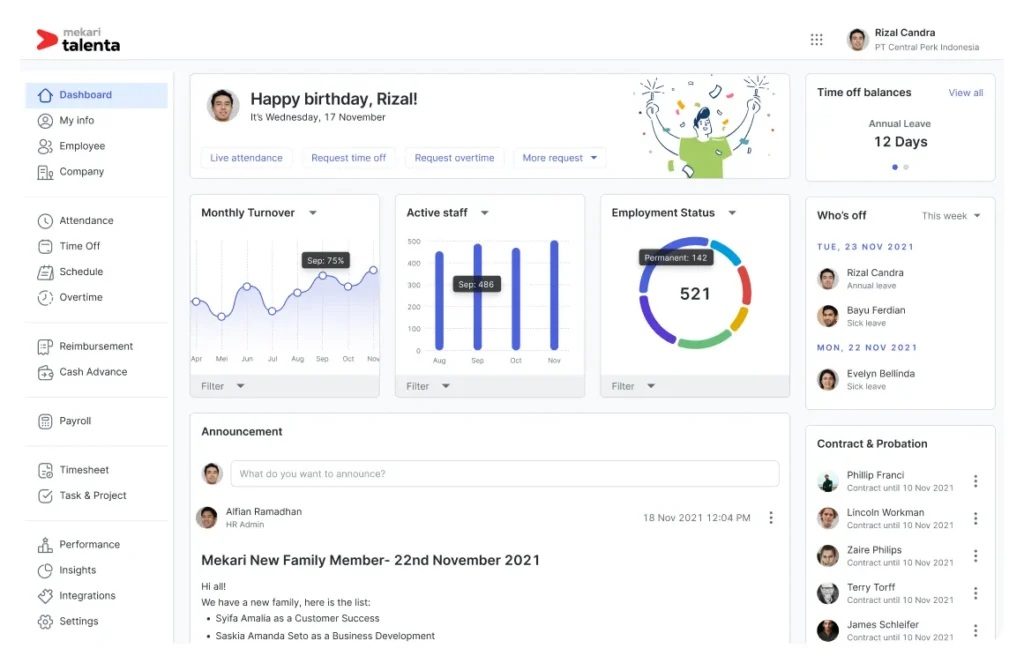
With an integrated system, you can move beyond manual processes and fragmented tools into a more data-driven and aligned approach to workforce growth.
Mekari Talenta supports your talent development strategy through integrated capabilities such as:
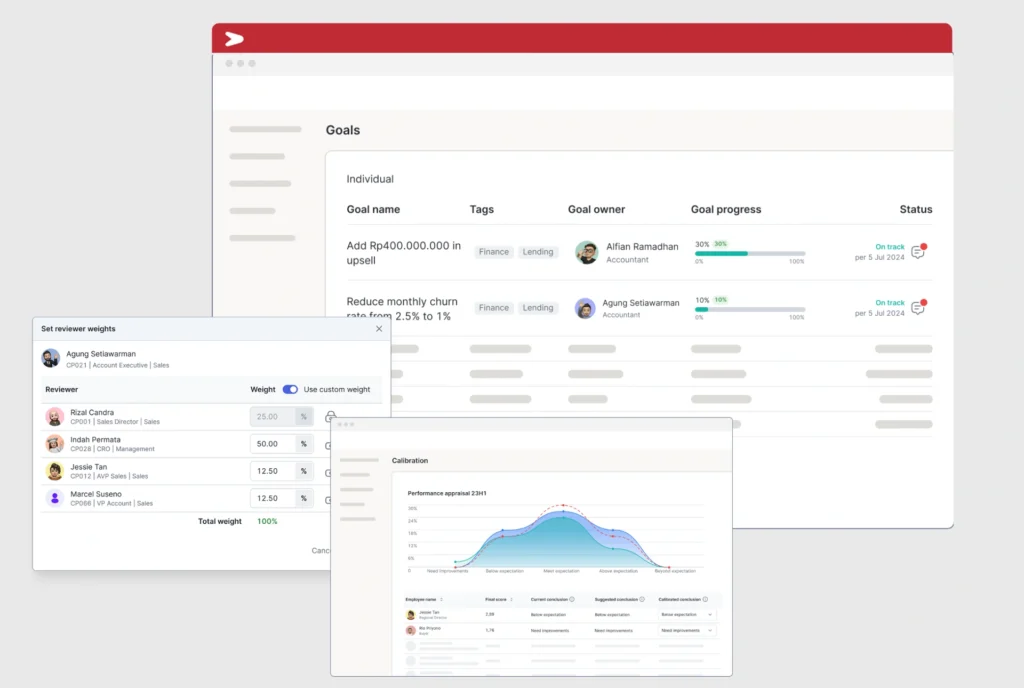
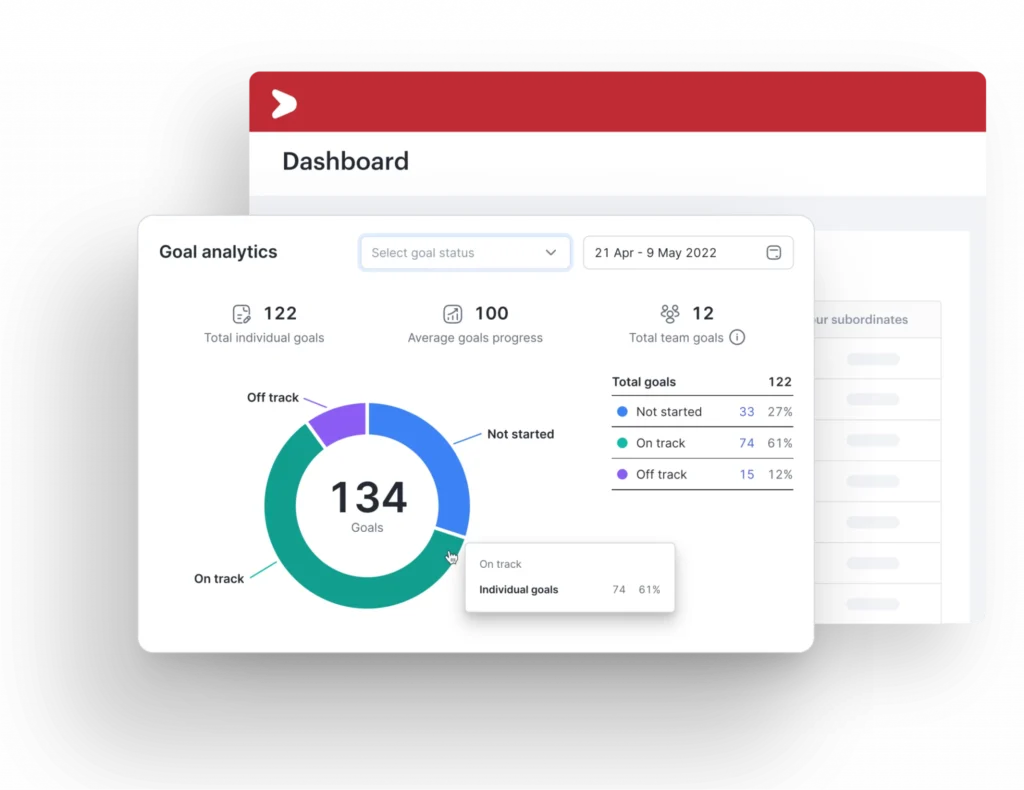
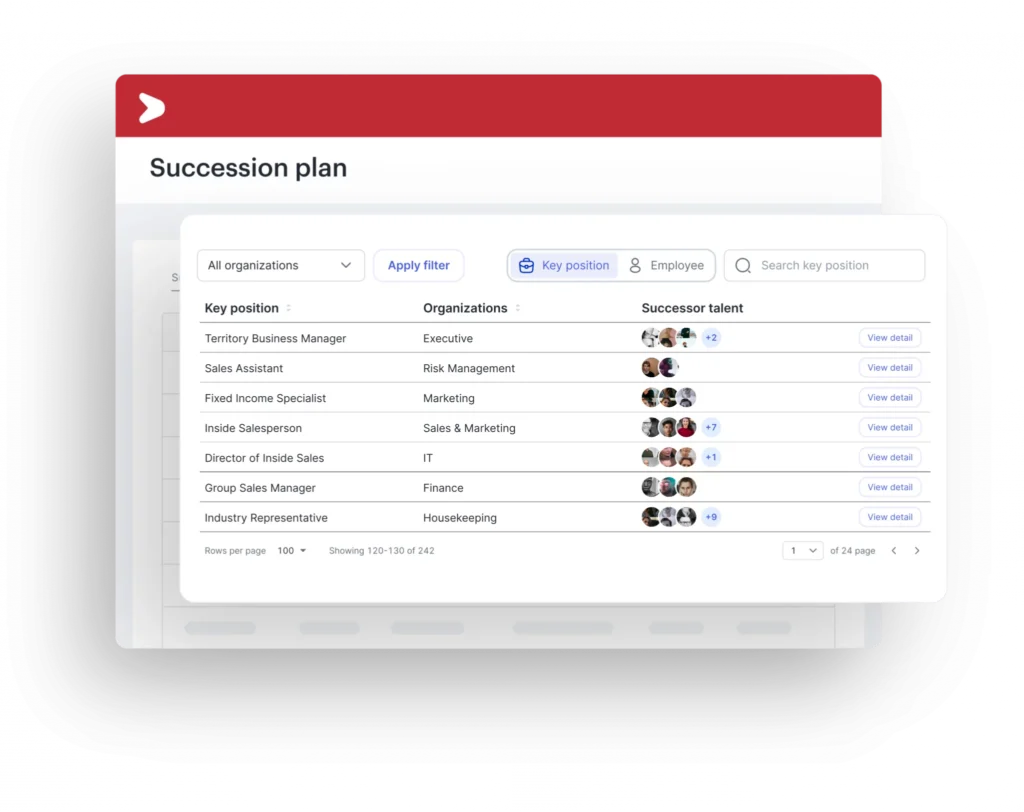
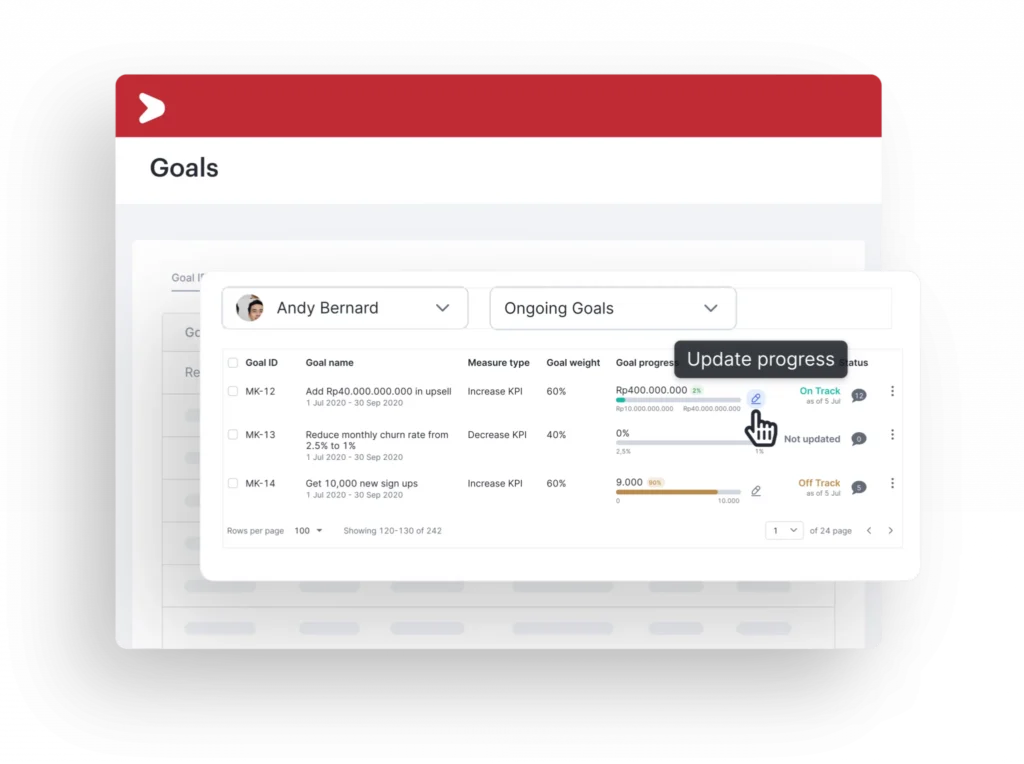
- Performance Management – align individual goals with business objectives, track performance, and drive continuous development
- Talent Management – centralize talent data and performance insights to support strategic workforce planning and decision-making
- Competency Assessment – identify capability gaps and define development priorities through structured evaluations
- Individual Development Plan (IDP) – create personalized development plans with clear goals, action steps, and measurable progress
- Succession Planning – build and manage a data-driven talent pipeline to ensure leadership continuity
- Learning Management System (LMS) – design, deliver, and manage training programs while tracking learning progress across the organization
- Training & Skill Progress Tracking – monitor capability development and measure learning effectiveness through centralized dashboards
- Attendance & Productivity Insights – analyze workforce behavior and productivity to identify performance improvement opportunities
- Analytics & Reporting – generate actionable insights on workforce trends, performance, and development impact
With Mekari Talenta, organizations can ensure that their talent development strategy is well-designed, consistently executed, measurable, and aligned with long-term business goals.
Connect with our experts to see how Mekari Talenta can help build a future-ready workforce.