




- A Performance Management System is a structured framework that helps organizations plan, monitor, evaluate, and improve employee performance in alignment with strategic business goals.
- An example of a Performance Management System includes integrated HR platforms such as Mekari Talenta, which enable companies to manage KPIs, conduct performance reviews, track employee development, and centralize workforce data within a unified system.
In today’s evolving business landscape, organizations are expected to manage employee performance in a more structured, measurable, and strategic way.
A Performance Management System serves as a comprehensive framework that helps companies align individual contributions with broader business objectives while maintaining operational consistency.
When implemented effectively, this system enables organizations to optimize workforce potential, strengthen accountability, and drive sustainable productivity growth.
Employees who consistently meet organizational expectations represent critical assets, yet performance levels often fluctuate due to changing business demands and workforce dynamics.
This article provides a detailed overview of performance management concepts that companies need to understand to build a high-performing organization.
What is a Performance Management System?
A Performance Management System is a structured and scalable framework designed to continuously manage, measure, and optimize employee performance in alignment with an organization’s strategic objectives and broader human capital management strategy.
Rather than functioning as a standalone evaluation tool, it operates as an integrated ecosystem supported by modern SaaS HRIS platforms that connect goal setting, performance tracking, and continuous feedback.
At a large-organization level, a Performance Management System supports complex organizational structures by enabling standardized performance frameworks while remaining flexible enough to accommodate different business units, roles, and operational models.
It facilitates cross-functional alignment by linking individual and team outcomes to broader business priorities, ensuring that performance initiatives scale consistently across departments and regions.
In practice, a Performance Management System acts as a strategic enabler that allows organizations to capture performance data in real time, identify performance gaps through analytics, and implement targeted improvement initiatives.
By leveraging a data-driven approach and advanced HR analytics, leadership teams can move beyond reactive evaluations toward proactive decision-making, workforce planning, and long-term capability building.
These insights also strengthen talent management initiatives by connecting performance data with leadership development and internal mobility strategies.
Importantly, the design and execution of a Performance Management System vary across organizations depending on their maturity level, governance structure, and operational complexity.
Large organization environments often require configurable workflows and scalable HRIS software to maintain consistency across multi-layered approval structures.
Read also: HRIS vs HRMS vs HCM: What’s the Difference & What to Consider?
The Purpose of Implementing a Performance Management System in Companies
The purpose of implementing a Performance Management System extends beyond maintaining employee performance.
It provides a structured framework that connects individual contributions with organizational priorities, ensuring that performance initiatives remain aligned with long-term business direction.
By integrating goal setting, feedback, evaluation, and development into one continuous cycle, organizations can create a more consistent and measurable approach to performance management.
1. Aligning Capabilities with Organizational Priorities
A key objective of a Performance Management System is to ensure that employee capabilities are mapped accurately to business needs.
Clear visibility into skills, strengths, and development areas allows managers to assign responsibilities more strategically and reduce the risk of misaligned roles.
Rather than relying solely on periodic reviews, structured performance data helps organizations understand how individuals and teams contribute to broader outcomes.
This level of alignment supports better resource allocation, clearer accountability, and more focused execution across functions.
2. Creating Continuous Feedback and Structured Communication
Another important purpose is strengthening communication between managers and employees through ongoing feedback loops.
A Performance Management System facilitates structured conversations around expectations, progress, and challenges, allowing both sides to address performance barriers earlier.
Consistent feedback also increases transparency within teams, as employees gain clarity on priorities and performance standards, while managers develop a deeper understanding of operational challenges.
Over time, this continuous dialogue encourages a culture of improvement rather than reactive evaluation.
3. Supporting Fair Recognition and Sustainable Career Development
Performance insights generated by a Performance Management System enable organizations to recognize achievements and performance improvements more objectively.
Data-backed evaluations help ensure reward decisions remain consistent and aligned with measurable outcomes.
Beyond recognition, performance data becomes a foundation for sustainable development planning.
By identifying recurring skill gaps and growth opportunities, organizations can design targeted development plans that support career progression while strengthening overall workforce capability.
Key Elements of Effective Performance Management System
A strong performance management approach is built on more than evaluation alone.
Organizations that sustain performance over time typically rely on several interconnected elements that guide how goals are set, how employees grow, and how progress is measured.
When these elements work together, performance management becomes a continuous system rather than a one-time process.
1. KPIs as Clear Performance Indicators
Key Performance Indicators (KPIs) provide a measurable foundation for understanding performance across teams and roles.
In complex organizations, clearly defined KPIs help reduce ambiguity by translating strategic priorities into tangible outcomes.
Instead of relying on subjective assessments, teams can track progress through consistent metrics that reflect both individual contributions and organizational objectives.
Well-designed KPIs also allow leadership to monitor performance trends through centralized HR dashboards, making it easier to identify areas that require attention.
2. Skill Development Strategies
Performance management becomes more sustainable when it connects directly with employee development.
Skill development strategies ensure that performance conversations go beyond short-term results and focus on building capabilities that support future business needs.
For example, organizations may introduce targeted learning programs or mentorship opportunities based on performance insights.
By linking performance outcomes with development planning, companies can strengthen workforce resilience while encouraging continuous learning.
3. Feedback Mechanisms That Encourage Ongoing Dialogue
Regular feedback plays an essential role in maintaining alignment between managers and employees.
Rather than waiting for formal review periods, structured feedback mechanisms create opportunities for ongoing conversations about progress, challenges, and expectations.
In larger organizations, consistent feedback helps maintain transparency across different teams and management layers.
Over time, this approach builds trust and supports a culture where improvement happens gradually instead of reactively.
4. Goal Alignment Across Organizational Levels
Aligning goals from leadership to individual contributors ensures that performance efforts remain connected to broader strategy.
Without clear alignment, teams may focus on objectives that do not fully support organizational priorities.
Cascading goals or shared performance frameworks help bridge this gap by connecting daily tasks with long-term outcomes.
This alignment also improves decision-making, as employees gain better visibility into how their work contributes to overall success.
5. Collaboration Strategies That Strengthen Team Performance
Performance management is not only about individual achievement; it also involves fostering collaboration across departments.
Collaboration strategies encourage cross-functional teamwork, shared accountability, and knowledge exchange.
For example, project-based reviews or peer feedback initiatives can highlight how collaboration contributes to performance outcomes.
6. Continuous Improvement Practices for Sustainable Performance
Finally, continuous improvement ensures that performance management evolves alongside organizational needs.
Instead of treating evaluation results as final, organizations use performance insights to refine goals, adjust processes, and support employee growth.
Continuous improvement practices may include regular reflection sessions, data-driven analysis, or iterative updates to performance frameworks.
By viewing performance management as an ongoing journey, organizations can maintain adaptability while building a more resilient workforce.
4 Important Stages of Performance Management System
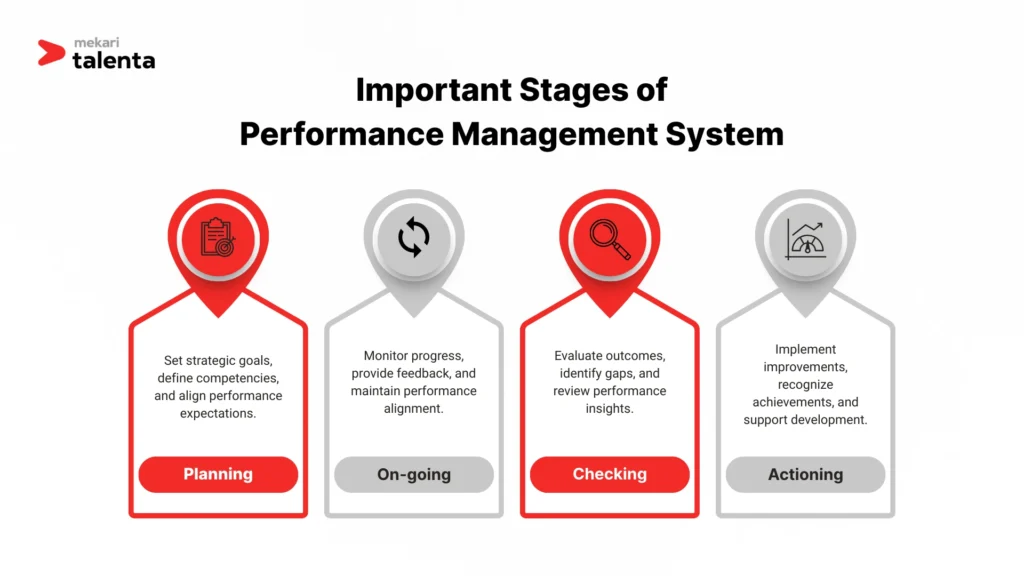
Performance Management System structures performance into several interconnected stages or key elements, from defining expectations and monitoring progress to evaluating results and implementing improvement actions.
Each stage plays a distinct role in maintaining performance consistency.
If summarized, there are four important stages in performance management:
1. Planning Phase
The planning phase is the foundation of a performance management cycle, where organizations define what success looks like before performance is measured or evaluated.
Rather than simply setting targets, this stage focuses on translating business priorities into clear performance expectations, competency requirements, and measurable outcomes.
During this phase, leaders establish strategic goals, define performance indicators, and identify the competencies required for each role or job level.
A well-structured planning process helps ensure that performance management is not reactive, but intentionally aligned with organizational direction.
Without clear planning, performance discussions often become subjective and disconnected from actual business impact.
Another important aspect of the planning phase is competency mapping. Organizations need visibility into the skills and capabilities required across different positions so that expectations remain consistent and scalable.
By defining competency standards early, managers can create clearer development paths and reduce ambiguity when evaluating performance later in the cycle.
2. Ongoing Phase
The ongoing phase centers on turning previously defined plans into consistent execution. At this stage, organizations focus on maintaining visibility into progress so that performance remains aligned with evolving priorities rather than treated as a one-time initiative.
Continuous monitoring helps teams stay on track while allowing adjustments to be made when challenges or shifting goals arise.
Supervision during this phase is less about control and more about providing direction and support.
Managers play a key role in facilitating regular conversations that clarify expectations, address obstacles, and encourage accountability.
Consistent feedback becomes an essential part of the process, helping employees understand where they stand while reinforcing motivation and sustaining performance momentum over time.
3. Checking Phase
The checking phase focuses on reviewing performance outcomes in relation to the goals and expectations that were established earlier.
Rather than serving as a one-time evaluation, this stage provides an opportunity to assess progress, identify performance patterns, and understand areas that may require adjustment or further support.
Evaluation during this phase typically involves multiple stakeholders, including leadership teams, managers, HR, and employees themselves.
This collaborative approach helps ensure that performance insights are viewed from different perspectives, reducing bias while creating a more balanced understanding of individual and team contributions.
By connecting evaluation results back to the original planning framework, organizations can maintain alignment between performance outcomes and broader organizational direction.
4. Actioning Phase
The actioning phase focuses on turning evaluation insights into meaningful follow-up actions. Rather than treating performance results as final outcomes, organizations use this stage to determine how recognition, development planning, or strategic adjustments should move forward.
Performance achievements may be acknowledged through rewards or career opportunities, while identified gaps can guide future learning initiatives or role alignment decisions.
At this stage, the emphasis shifts from assessment to improvement. Managers and HR teams collaborate to translate performance insights into practical next steps, ensuring that feedback leads to measurable progress rather than remaining as documentation.
When implemented effectively, the actioning phase closes the performance cycle by reinforcing accountability, supporting employee growth, and strengthening the connection between individual contributions and long-term organizational goals.
The Difference Between Performance Management and Performance Appraisal in Companies
In general, performance management has a similar concept to performance appraisal. However, there are several aspects that clearly differentiate the two.
Performance appraisal is an evaluation process carried out periodically with the aim of improving employee performance.
The differences between Performance Management System practices and performance appraisal are:
1. Management Concept
Performance appraisal focuses on standards to evaluate performance and provide direct feedback to employees so they can improve work achievements.
Meanwhile, performance management within a company’s system is the overall process to ensure employee performance aligns with company goals.
2. Duration
Performance appraisal is conducted periodically within a time range of three months or six months.
Meanwhile, performance management is carried out dynamically and continuously by supervisors toward their staff.
4. Purpose
The purpose of appraisal is to encourage employee performance and build a positive company culture.
Performance management aims to evaluate employee performance so improvements can be made in the future.
5. Employee Involvement
The evaluation process in appraisal management usually only involves supervisors or managers.
Meanwhile, in a Performance Management System, employees are also involved in planning, evaluation, and opportunities to discuss with their supervisors.
Roles and Responsibilities in Performance Management
Effective performance management requires collaboration between HR, managers, and employees, each contributing to different aspects of the process to ensure alignment between individual performance and organizational priorities.
- HR teams are responsible for designing the overall framework, defining performance standards, and ensuring that processes remain consistent and fair across departments. They also play a key role in ensuring performance management aligns with broader employee lifecycle management, from onboarding and development to succession planning.
- Managers act as the primary drivers of performance execution. Beyond evaluating results, they facilitate ongoing conversations, clarify expectations, and provide guidance that helps employees stay aligned with evolving business needs. Their role shifts from being evaluators to becoming performance enablers who support development throughout the cycle.
- Employees are active participants rather than passive recipients of feedback. By setting goals, tracking progress, and engaging in performance discussions, employees contribute to a more transparent and collaborative performance culture. When each role understands its responsibilities, performance management becomes a shared process rather than a top-down initiative.
Read also: Employee Self-Service (ESS) - Supporting Employee Participation in HR Processes
Best Practices for Building a Scalable Performance Management System
Building a performance management approach that remains effective as organizations grow requires designing practices that can adapt to evolving priorities, diverse teams, and increasing operational complexity.
1. Anchoring Performance Goals to Broader Organisational Direction
In large organizations, teams may operate with different priorities, making it easy for goals to become fragmented if they are not clearly connected to company strategy.
For example, a regional sales team and a product development unit might measure success differently, yet both should be able to trace their objectives back to shared business outcomes.
Establishing goal alignment frameworks — such as cascading objectives or shared performance indicators — helps ensure that local targets remain relevant to the bigger picture.
This approach reduces duplication of effort and gives leadership clearer visibility into how individual contributions support overall growth.
2. Making Performance Conversations Part of Normal Working Rhythms
Formal review cycles alone are often not enough to maintain clarity across large teams or multiple layers of management.
In practice, many organizations introduce lightweight check-ins during project milestones or monthly team discussions rather than adding new meetings solely for performance tracking.
For instance, a manager overseeing several cross-functional teams might integrate performance conversations into existing sprint reviews or operational updates.
This keeps feedback timely and practical while reducing the administrative burden often associated with large-scale performance programs.
3. Designing Frameworks That Can Evolve Alongside Organisational Change
Your organizations might frequently experience restructuring, new market priorities, or shifting project scopes, which can quickly make static performance frameworks outdated.
Instead of locking goals and competencies for an entire year, some companies revisit expectations quarterly to reflect business realities.
For example, when a company launches a new product line, teams may need to adjust performance indicators to reflect collaboration or innovation metrics rather than traditional output targets.
Building flexibility into the framework helps maintain relevance without requiring a full redesign each time priorities shift.
4. Connecting Evaluation Outcomes With Development Pathways
In complex environments, performance insights often come from multiple stakeholders, making it important to translate evaluation results into clear next steps.
Rather than ending the process with ratings, organizations can link outcomes to structured development plans or cross-team learning initiatives.
For example, an employee identified as a strong collaborator during evaluation may be invited to mentor new hires or participate in leadership development programs.
This approach ensures that performance management contributes to long-term capability building rather than functioning only as a reporting exercise.
5. Enabling Coordination Through an Integrated HR System
As organizations grow, performance data can become scattered across spreadsheets, emails, and separate tools, making alignment difficult to sustain.
An integrated HR system helps centralize goals, feedback, and review insights so managers across different departments can work from the same source of truth.
HR teams may use a unified platform to monitor goal progress while managers access real-time feedback and development plans in one place.
This kind of integration reduces manual coordination, improves transparency across stakeholders, and allows performance practices to scale without increasing administrative complexity.
To support performance management at scale, organizations can leverage integrated capabilities from platforms like Mekari Talenta that help connect performance processes with broader HR operations.
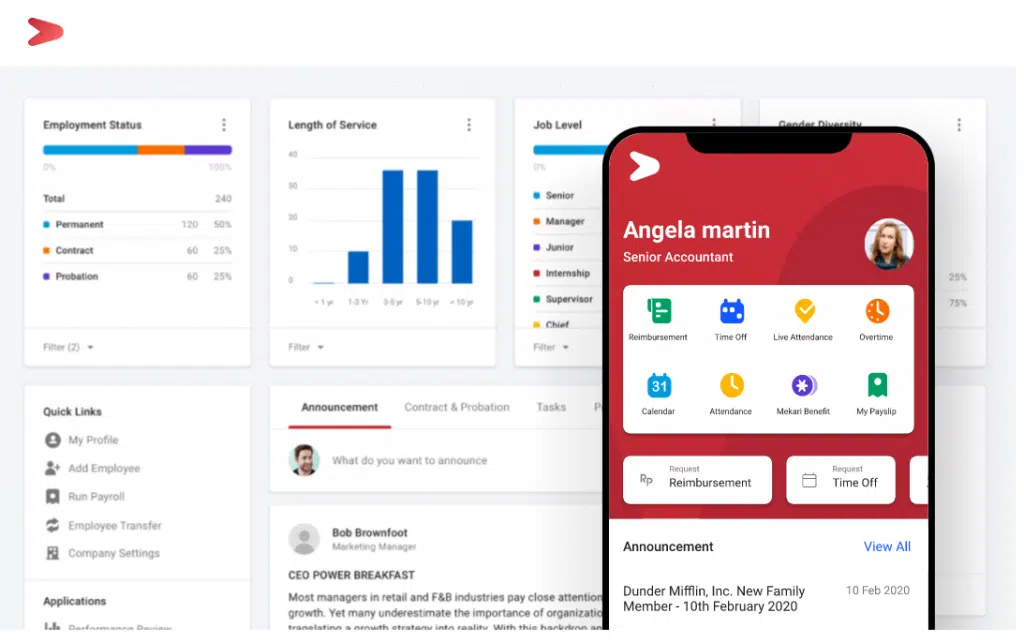
Mekari Talenta is part of the broader Mekari integrated software ecosystem that offers end-to-end HR solutions designed to support growing and complex organizational structures.
As an integrated HRIS platform, Mekari Talenta connects performance management with core HR functions such as employee data management, payroll, attendance, and workforce analytics, helping organizations maintain consistency across processes while reducing operational silos.
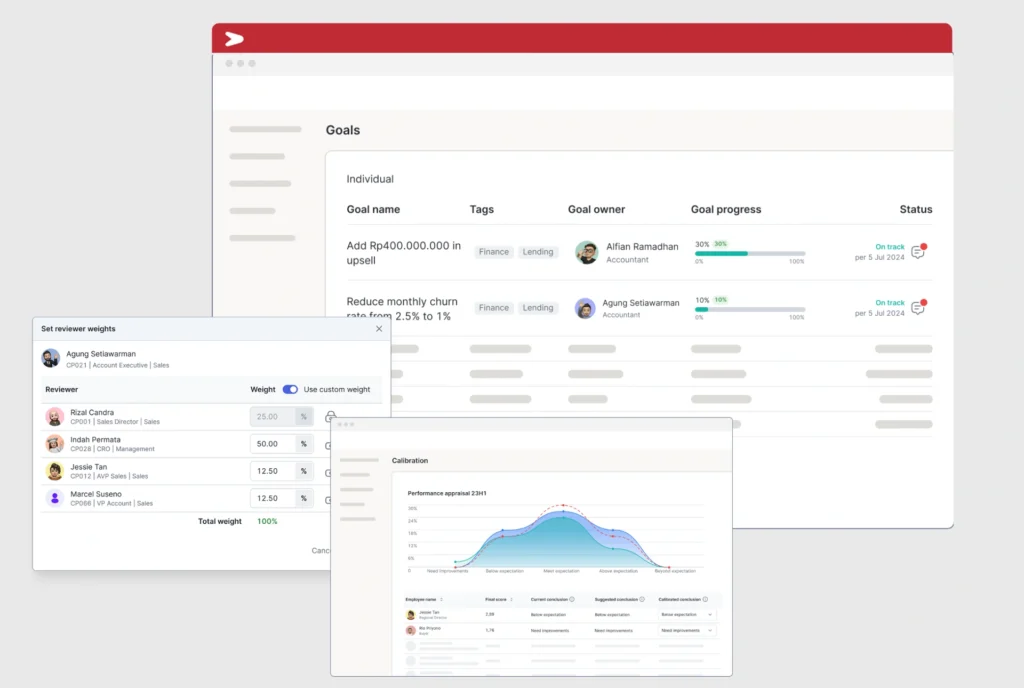
Some capabilities that are particularly relevant to performance management system include:
- Structured Goal & KPI Management. Define and cascade goals across teams while monitoring progress in real time. This helps leadership maintain alignment between business strategy and individual performance, even when multiple departments operate with different priorities.
- Flexible Performance Review Methods. Support various evaluation approaches such as manager review, self-assessment, or 360-degree feedback. This flexibility allows organizations with layered reporting structures to create fairer and more comprehensive performance insights.
- Integrated Performance Data With Payroll and HR Processes. Synchronize performance outcomes, feedback, and incentives with payroll or other HR workflows. By reducing manual reconciliation, organizations can maintain consistency and minimize administrative complexity as teams grow.
- Automated Scoring, Reporting, and Calibration Support. Configure weighting, generate performance summaries, and access structured reports that help HR and leadership evaluate workforce performance more objectively across divisions or job levels.
- Centralized Workforce Management in a Unified HRIS Environment. Manage attendance, employee data, approvals, analytics, and performance within one system. This integration helps organizations maintain visibility across functions, streamline collaboration between stakeholders, and scale performance practices without relying on disconnected tools.
To explore how Mekari Talenta can support a more scalable and structured performance management approach in your organization, you can connect directly with our team.
Discuss your current challenges, see how the platform fits into your existing workflows, and discover ways to streamline HR processes through an integrated system.
Contact our sales team to schedule a consultation and find the right solution for your business needs.