




Managing employees in a single office already requires strong coordination, but as companies expand across locations, complexity increases significantly.
In multi location workforce management, HR must ensure consistent policies, accurate data, and standardized processes across all branches.
At the same time, each location may have different operational needs, working hours, and team structures.
Without an integrated system, processes can become fragmented, with scattered data, limited real-time visibility, and increasingly complex payroll and reporting.
This article will explore how to implement effective multi location workforce management, including key challenges, best practices, and the right tools to manage teams across branches efficiently.
What Is Multi Location Workforce Management?
Multi location workforce management refers to the structured approach of managing human resources across organizations that operate in multiple locations, entities, or business units.
This structure may include regional branches, different business divisions, or even multiple entities within a holding group, each with its own operational setup, workforce policies, and reporting requirements.
In more complex organizations, managing a multi-location workforce goes beyond administrative tasks.
HR must orchestrate interconnected processes such as attendance tracking across distributed sites, payroll execution across entities, varying organizational structures, and centralized reporting for leadership visibility.
Each location may operate under different working schedules, labor conditions, and team compositions, requiring systems that can accommodate local flexibility while maintaining global consistency.
As a result, multi-location structures impact nearly every aspect of HR operations. Without a centralized and integrated system, data becomes fragmented across locations, processes lose standardization, and decision-making is delayed due to a lack of real-time, consolidated insights.
Challenges in Managing a Multi-Location Workforce
As organizations expand across multiple locations, managing a distributed workforce becomes increasingly complex. What once involved simple coordination within a single office now requires alignment across different branches, systems, and operational requirements.
In the context of multi location workforce management, these challenges are not only operational but also structural. Differences in processes, data handling, and workforce policies across locations can create inefficiencies if not managed properly.
Understanding these challenges is essential for building a scalable and consistent HR operation across all branches.

1. Maintaining Data Consistency Across Locations
In multi location workforce management, employee data often originates from different branches with varying standards and processes.
Without a unified system, inconsistencies in employee records, attendance logs, and organizational structures can quickly emerge.
This fragmentation makes it difficult to establish a single source of truth. Over time, it impacts reporting accuracy and strategic decision-making.
2. Standardizing Policies While Allowing Local Flexibility
Each location may operate under different working hours, labor conditions, or operational needs. HR must balance global policy standardization with local adaptability without creating conflicts or inefficiencies.
Over-standardization can reduce operational flexibility, while too much autonomy leads to inconsistency. Managing this balance requires configurable policy frameworks within the system.
3. Managing Payroll Across Multiple Entities or Regions
Payroll becomes significantly more complex when managing multiple locations or entities, each with different compensation structures, tax rules, and compliance requirements.
At scale, payroll is no longer a single process but multiple parallel operations with different rules, deadlines, and risks.
Errors in multi-location payroll can lead to serious consequences, including financial penalties, compliance violations, and operational disruptions.
Without an integrated system, HR teams are forced to reconcile data across locations manually, increasing the likelihood of inconsistencies and delays.
4. Limited Real-Time Visibility Across Operations
HR leaders often struggle to gain real-time insights into workforce activity across all locations. Data silos make it difficult to monitor attendance, productivity, and workforce trends holistically.
This lack of visibility slows down decision-making and reduces responsiveness. A centralized dashboard becomes critical for operational control.
5. Scaling Workforce Management as the Organization Grows
As organizations expand, the complexity of managing more locations, employees, and processes increases exponentially.
Systems that are not designed for scalability can quickly become bottlenecks. Manual workflows and fragmented tools fail to support growth effectively.
This forces organizations to re-evaluate and often rebuild their HR infrastructure.
Effective Strategies for Multi Location Workforce Management
Managing employees across multiple locations requires a strategic, system-driven approach rather than relying on fragmented operational practices.
As organizations scale, the challenge is no longer about execution alone, but about ensuring consistency, visibility, and control across distributed teams.
Below are key strategies that HR leaders should implement to build a more structured and scalable workforce management approach.
1. Standardize HR Policies Across Locations with Configurable Flexibility
Establishing standardized HR policies is critical, but rigid uniformity often fails in multi-location environments. The goal is to define a core policy framework that covers areas such as leave entitlements, overtime rules, and job grading, while allowing controlled flexibility at the local level.
For example, instead of creating separate leave policies for each branch, an organization can set a base policy of 12 annual leave days, then allow controlled adjustments based on location, role, or tenure.
This way, all branches follow the same framework, but still have flexibility to adapt to local operational needs without creating inconsistencies.
Without this structure, organizations often face internal disputes, inconsistent employee experiences, and compliance risks. Standardization also simplifies reporting, as data across branches becomes comparable and aligned.
From a practical standpoint, HR leaders should audit existing policies across locations, identify inconsistencies, and redesign them into a unified framework supported by system configuration rather than manual interpretation.
2. Centralize Employee Data into a Single Source of Truth
One of the most common issues in multi-location organizations is fragmented employee data stored across different systems, spreadsheets, or local databases. This creates inconsistencies, delays in reporting, and a high risk of data duplication.
To address this, organizations must establish a single source of truth where all employee data across locations and entities is centralized and continuously synchronized.
This includes not only basic employee information, but also attendance, payroll inputs, performance data, and organizational structures.
Centralization is not just about storage, but about data governance. HR teams need clear ownership, validation processes, and standardized data structures to ensure long-term accuracy.
In practice, this enables HR leaders to access real-time workforce insights without relying on manual consolidation from each branch. It also lays the foundation for automation, analytics, and more strategic decision-making.
3. Implement Automated Workflows for Cross-Location Approvals
Manual approval processes become a major bottleneck when organizations operate across multiple locations.
Requests such as leave, reimbursements, or employee data changes often get delayed due to unclear approval hierarchies or communication gaps.
By implementing automated workflow systems, organizations can ensure that every request follows a predefined approval path based on organizational structure rather than physical location.
This is especially important in complex setups where approvals may involve multiple stakeholders across different branches or entities.
Well-designed workflows also improve transparency and accountability, as every action is tracked and time-stamped.
This reduces dependency on informal communication channels such as email or chat, which are prone to miscommunication.
From an operational standpoint, HR leaders should map existing approval processes, identify delays or redundancies, and translate them into structured workflows within the system. The goal is to eliminate manual intervention while maintaining governance.
4. Enable Real-Time Attendance and Workforce Visibility
In multi-location environments, delayed visibility into attendance and workforce activity can directly impact operations.
Relying on manual reports from each branch creates blind spots that slow down decision-making and reduce responsiveness.
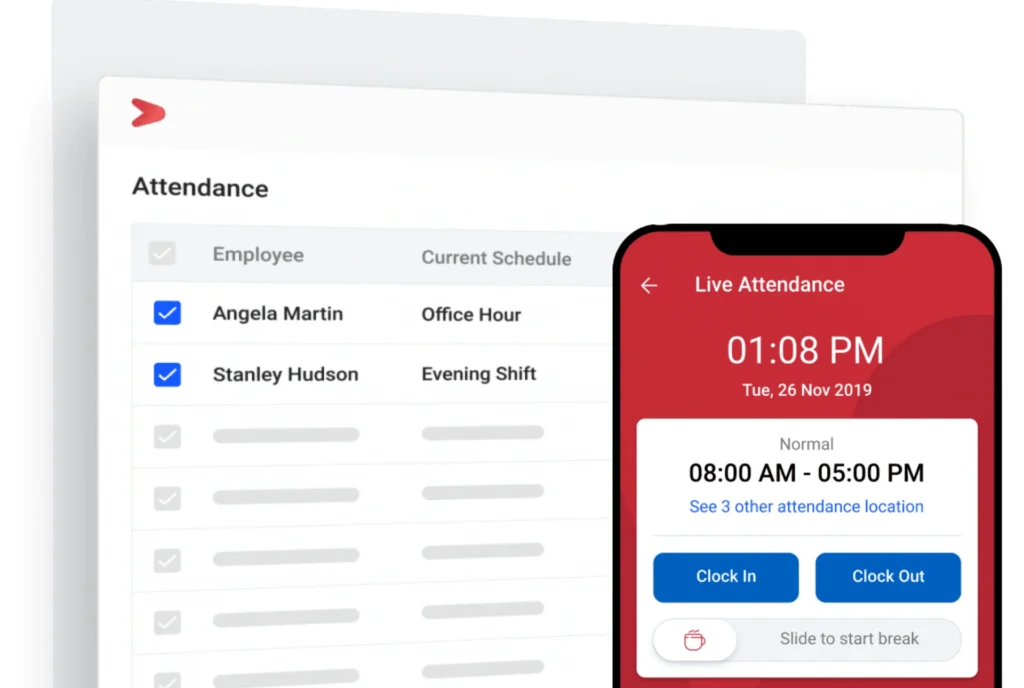
Organizations should implement systems that provide real-time attendance tracking and workforce visibility across all locations. This includes check-in and check-out data and insight into lateness, absenteeism, and workforce distribution.
For example, in an attendance system like Mekari Talenta, attendance insights are presented in a unified dashboard, allowing leaders to monitor workforce conditions across locations at a glance.
This eliminates the need for manual consolidation while enabling faster identification of operational issues such as understaffed locations or rising absenteeism trends.
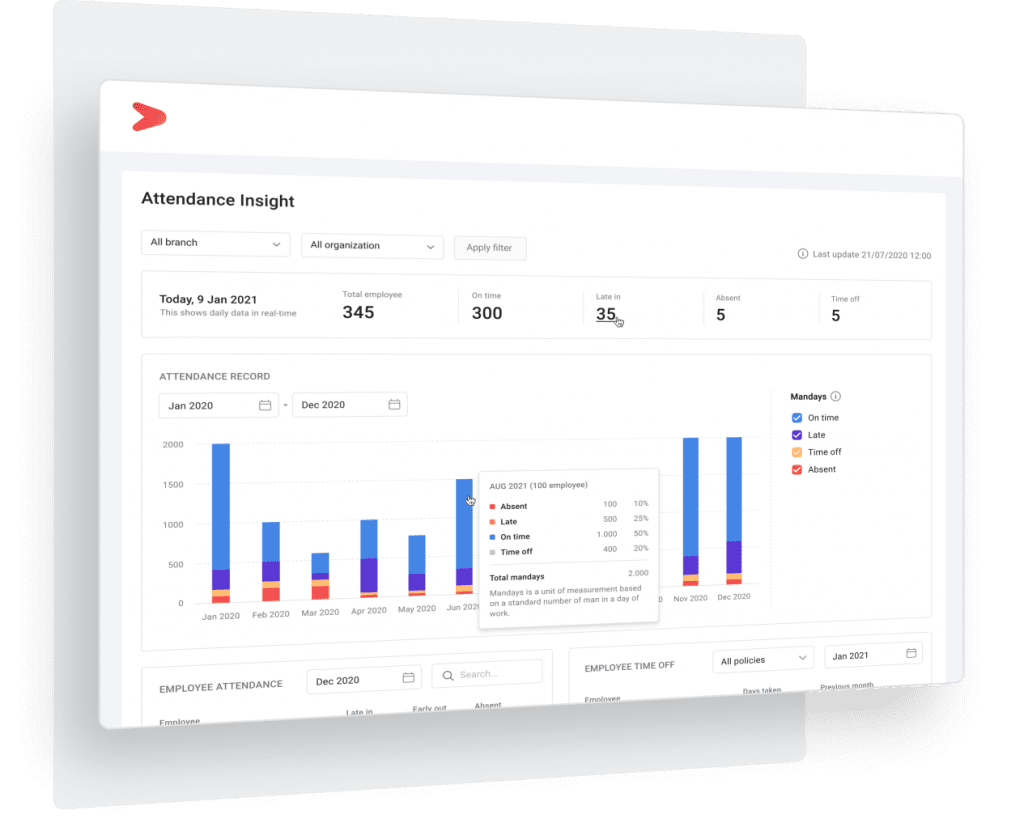
With this level of visibility, managers can proactively address issues like shift imbalances or operational disruptions while improving coordination between central teams and local branches.
In practice, this requires shifting from periodic reporting to live dashboards and automated alerts that surface anomalies as they happen.
5. Use Integrated HR Dashboards for Cross-Branch Performance Monitoring
Managing performance across multiple locations requires integrated, comparative insights. Without a unified view, leadership cannot accurately assess how each branch is performing relative to others.
HR dashboards should consolidate key metrics such as attendance rates, productivity levels, turnover, and labor costs across all locations.
More importantly, these dashboards must allow drill-down capabilities, enabling leaders to identify root causes behind performance variations.
For example, a high turnover rate in one branch may be linked to scheduling issues, compensation gaps, or management practices. Without integrated data, these insights remain hidden.
From a strategic perspective, HR leaders should define a set of standardized KPIs across all locations, ensuring that performance is measured consistently. This allows organizations to move from reactive management to data-driven optimization of workforce performance.
The Role of HRIS in Multi Location Workforce Management
HRIS (Human Resource Information System) serves as the central backbone of multi location workforce management by integrating employee data, processes, and policies across all locations into a single, unified platform.
Instead of operating in silos, organizations can manage workforce operations with greater consistency, visibility, and control across branches, entities, and business units.
With a cloud-based HRIS, organizations can:
- Access cross-location employee data in real time, enabling faster and more informed decision-making
- Manage payroll and attendance with higher accuracy, driven by standardized and synchronized data
- Generate centralized reports for leadership, providing visibility into workforce performance, costs, and trends across branches
- Improve collaboration across HR teams, ensuring aligned processes and communication between central and local teams
Beyond operational efficiency, a cloud-based HRIS eliminates reliance on local servers in each branch, allowing secure and scalable access from anywhere.
More importantly, it plays a critical role in enforcing policy consistency, maintaining organizational structure, and ensuring that all locations operate within the same governance framework.
Read also: Cloud-based HRIS vs On-Premise: Key Differences and How to Choose
Best Practices for Managing Multi-Location Workforce with HRIS

To fully leverage HRIS in a multi-location setup, organizations need to move beyond basic implementation and adopt practices that ensure scalability, consistency, and operational control.
1. Build a Structured Digital Organization Model
A digital organizational structure within HRIS allows companies to map relationships across branches, entities, departments, and job levels in a systematic way.
Without a clearly defined structure, workflows often become inconsistent, and approvals may bypass the intended hierarchy.
By maintaining a structured model, organizations ensure that processes remain aligned with governance, regardless of location.
In practice, HR leaders should continuously maintain and update organizational structures within the system to reflect business changes such as expansion, restructuring, or new entities.
2. Maximize Employee Self-Service Across Locations
Employee Self-Service (ESS) plays a critical role in reducing administrative dependency on central HR teams. By enabling employees across locations to access their personal data, submit leave requests, and view payslips independently, organizations can significantly streamline operational workflows.
This becomes especially important in multi-location environments where manual coordination between branches and headquarters can create delays. ESS shifts routine processes closer to employees while maintaining system control and data accuracy.
From a scalability perspective, ESS ensures that HR operations remain efficient even as the organization grows, without proportionally increasing administrative workload.
3. Leverage HR Analytics for Cross-Branch Insights
HR analytics transforms workforce data into actionable insights, allowing organizations to monitor performance across locations in a structured and comparative way.
Instead of relying on fragmented reports, leadership can access centralized dashboards that highlight key metrics such as attendance, turnover, productivity, and labor costs.
The real value lies in identifying patterns and anomalies across branches. For example, differences in productivity or turnover rates can signal deeper operational or management issues at specific locations.
To make analytics effective, organizations must define standardized KPIs across all branches, ensuring that performance is measured consistently and insights are comparable.
4. Integrate HRIS with Other Business Systems
One of the biggest limitations in many organizations is the existence of disconnected systems that create data silos.
HRIS should not operate in isolation, but as part of a broader ecosystem that includes payroll, attendance, finance, and collaboration tools.
By integrating HRIS with these systems, employee data flows automatically across functions, reducing manual input and ensuring consistency.
This is particularly important in multi-location environments where data discrepancies can quickly escalate across branches.
From an operational standpoint, integration improves efficiency, reduces errors, and enables end-to-end visibility across the organization.
It also ensures that HR becomes a connected function that supports broader business processes, rather than a standalone administrative unit.
Read also: How to Choose the Right HRIS Vendor: A Practical HR Guide
How Mekari Talenta Supports Multi Location Workforce Management
As part of a centralized HRIS, Mekari Talenta enables organizations to manage multi-branch structures within a single, integrated platform.
Instead of handling operations separately across locations, HR teams can orchestrate workforce management through a unified system that ensures consistency, visibility, and control.
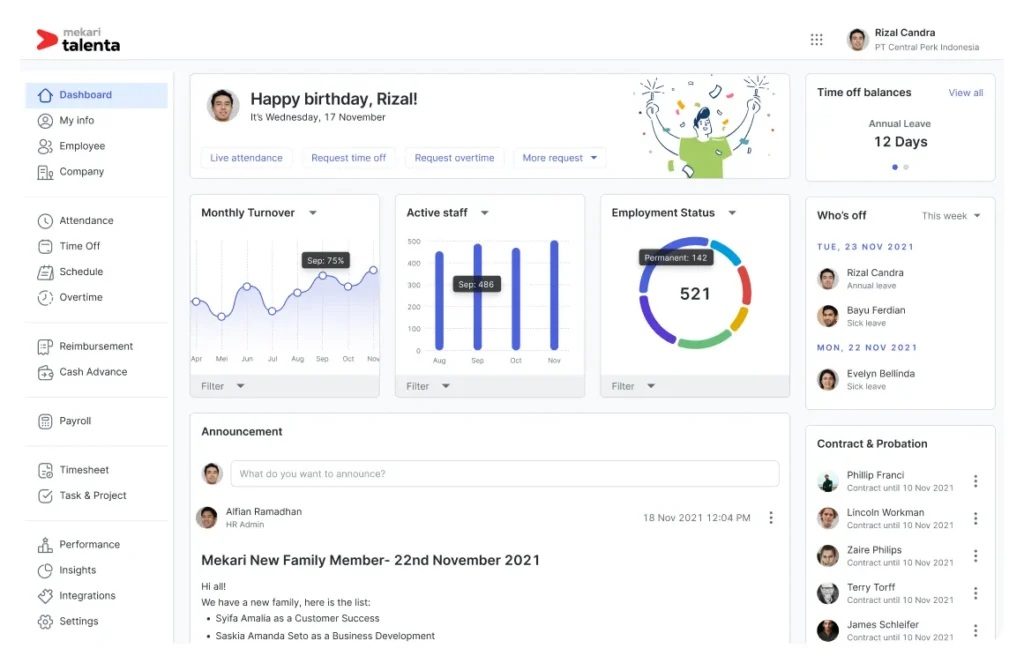
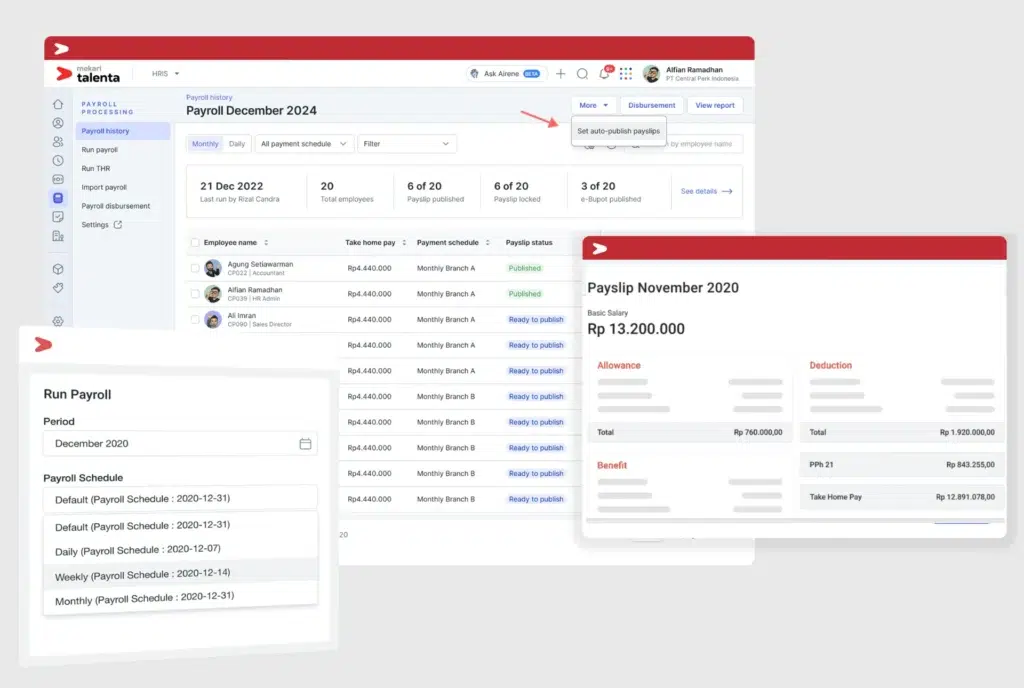
Mekari Talenta provides a set of capabilities designed to address the operational and structural challenges of managing multiple locations, including:
- Attendance Management to monitor workforce activity in real time across branches, helping detect lateness, absenteeism, and shift coverage issues instantly
- Payroll Software to manage payroll across branches or entities with consistent rules, reducing reconciliation efforts and minimizing compliance risks
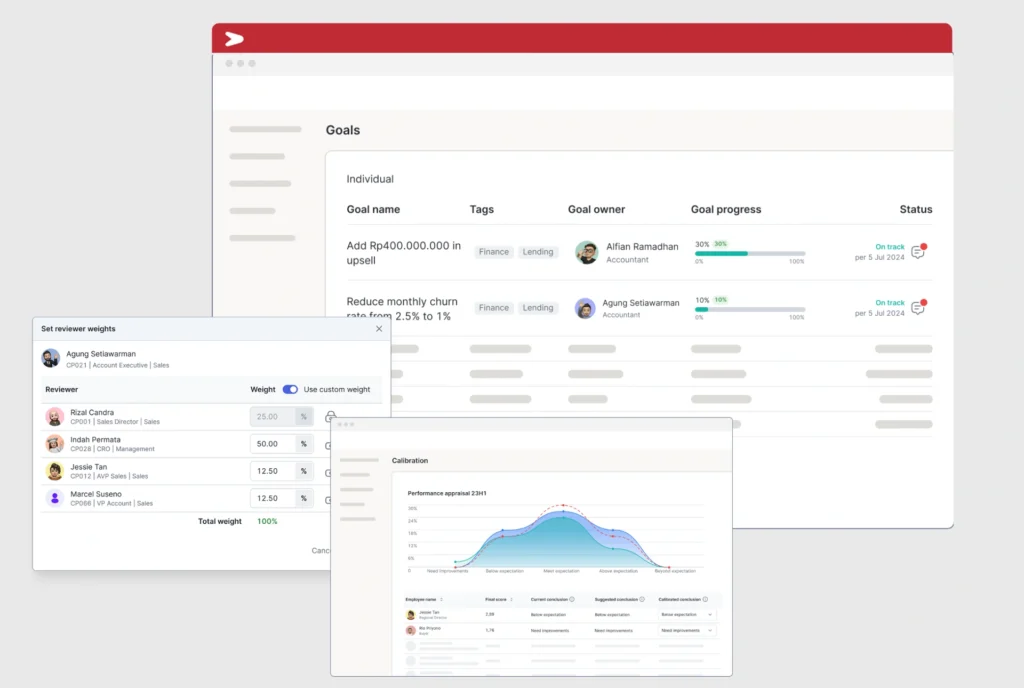
- Performance Management to evaluate team performance across locations using standardized frameworks, enabling fair and comparable assessments
- Employee Self-Service (ESS) to streamline employee interactions across locations, reducing dependency on central HR for routine processes
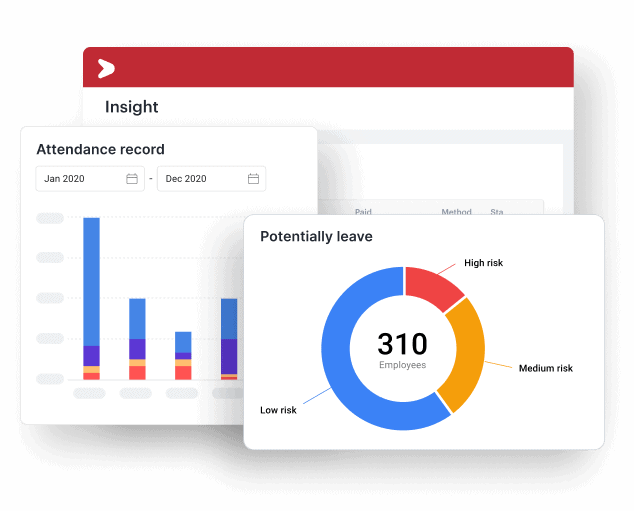
- HR Analytics & Dashboards to provide centralized visibility into workforce data, allowing leadership to monitor trends, performance, and operational efficiency across branches
- Enterprise-Grade Data Security (ISO 27001 Certified) to ensure that employee data is protected through globally recognized security standards, supporting compliance and reducing data risk across all locations
- Seamless Integration Capabilities to connect HR processes with the broader Mekari ecosystem as well as other business systems, enabling consistent data flow across departments and eliminating operational silos
Beyond individual features, the real value lies in how these capabilities work together within a single system. Mekari Talenta supports multi-company and multi-branch management, allowing organizations to:
- Structure and manage multiple entities and branches within one platform
- Configure organizational hierarchies and job levels across entities
- Control system access using role-based permissions across companies and locations
- Maintain end-to-end visibility of employee data through centralized dashboards
This integrated approach eliminates data silos and reduces manual reconciliation between branches. HR teams no longer need to consolidate reports from different locations, as all data is standardized and updated in real time within the same system.
As part of the broader Mekari ecosystem, HR data can also be connected with other business systems, enabling smoother workflows across finance, operations, and administrative functions.
This ensures that employee data flows consistently across departments, supporting more efficient and aligned business processes.
If you want to see how this system can support your multi-location operations, you can contact our sales team to explore its capabilities in more detail.