





-
KPI consultancy is a professional service that helps organizations design and align Key Performance Indicators (KPIs) with business strategy to ensure measurable and relevant performance outcomes.
-
KPI consultancy helps organizations define the right metrics, set realistic targets, and build structured systems to monitor, evaluate, and improve performance consistently.
In many organizations, KPIs (Key Performance Indicators) often become a formality within the performance evaluation process.
Many HR teams and management set KPIs annually, but struggle to ensure that these indicators truly reflect business objectives.
Without a clearly defined KPI framework, organizations frequently face challenges in measuring employee contributions toward organizational targets.
As a result, performance evaluations become less objective and fail to provide sufficient insight for decision-making.
This is where KPI consultancy is often required to help organizations build a more structured KPI system aligned with business strategy.
If you are not yet familiar with what KPI consultancy is and how it contributes to improving performance management systems, this article will help you understand it more comprehensively.
What Is KPI Consultancy?
KPI consultancy is a consulting service that helps organizations design, implement, and evaluate Key Performance Indicators (KPIs) so they align with overall business strategy.
Within the context of performance management or employee lifecycle management, KPIs are a critical component of the performance measurement process used to assess target achievement and strategic effectiveness.
In practice, many organizations encounter difficulties when developing KPIs that are truly relevant to business objectives. Some KPIs are too generic, not measurable, or lack a direct connection to strategy.
KPI consultants support organizations in building a more focused performance measurement system.
They typically collaborate with management and HR teams to understand business objectives, operational processes, and organizational structure before designing appropriate performance indicators.
In general, KPI consultancy aims to help organizations:
- Define performance metrics aligned with broader human capital management strategy
- Establish realistic and measurable targets
- Build a consistent performance monitoring system
With this approach, organizations not only have a list of KPIs, but also a performance measurement framework that can be used to continuously monitor organizational progress.
The Role of KPI Consultancy in Organizational Growth
Many organizations recognize the importance of KPIs, but not all have systems capable of linking performance indicators to strategic objectives.
KPI consultancy plays a role in helping organizations develop a more structured performance measurement system, ensuring each indicator accurately reflects contributions to business growth.
This also strengthens overall talent management by aligning individual performance with organizational priorities and long-term workforce objectives.
Below are several key roles of KPI consultancy within organizations.
1. Supporting the Development of a KPI Framework
One of the primary roles of KPI consultancy is to help organizations build a clear and systematic KPI framework.
In practice, KPIs are often derived from strategic objectives and translated into more specific targets through indicators such as key result areas (KRAs), which help teams understand their contribution to business goals.
Commonly used frameworks include:
- Balanced Scorecard, which measures performance from financial, customer, internal process, and learning perspectives
- OKR (Objectives and Key Results), which aligns strategic goals with measurable outcomes
- Cascading KPIs, where organizational targets are translated into team and individual KPIs
These frameworks help ensure that every KPI has a clear linkage to business objectives.
2. Translating Business Strategy into Performance Indicators
Business strategies are often conceptual, such as improving customer satisfaction or accelerating growth.
KPI consultants help translate these strategies into more concrete and measurable indicators, such as customer retention rate, revenue growth, operational efficiency, and team productivity, while ensuring alignment with workforce capacity and broader strategic workforce planning priorities.
Read also: A Comprehensive Guide to Manpower Planning: Process and Best Practices
3. Establishing Measurable and Realistic Metrics
Effective KPIs should follow the SMART principle (Specific, Measurable, Achievable, Relevant, Time-bound).
However, in practice, many organizations set targets that are either too ambitious or too low. KPI consultancy helps determine realistic targets by considering historical data, industry conditions, and organizational capacity.
This approach helps organizations avoid irrelevant or unattainable KPIs.
4. Supporting Performance Monitoring Implementation
After KPIs are defined, the next challenge is ensuring consistent performance tracking.
KPI consultancy can assist in building a structured monitoring system, including reporting processes, periodic evaluations, and integration with performance management systems.
With a robust monitoring system, organizations can track KPI progress more transparently and accurately.
Read also: What Is a KPI Management System? Definition, Benefits, and Elements
Benefits of KPI Consultancy
Beyond helping design more focused KPIs, KPI consultancy also provides strategic benefits for organizations.
With a more structured performance measurement system, organizations can improve operational effectiveness and make more informed business decisions.
Below are some of the key benefits.
1. Optimizing Operational Processes
When KPIs are well-designed, organizations can identify which areas of their processes require improvement.
For example, KPIs related to operational efficiency can help management identify bottlenecks in production or service delivery. These insights enable more targeted process improvements.
2. Providing a More Accurate Basis for Decision-Making
Measurable KPIs generate data that can be used as a foundation for decision-making.
Management can leverage performance data to evaluate business strategies, prioritize investments, or develop performance improvement initiatives. Without a clear KPI system, decisions are often based on assumptions or intuition.
Also, by integrating KPI data with broader HR analytics, organizations can gain deeper insights into workforce performance patterns, identify trends, and make more strategic, evidence-based decisions.
Read also: Data-Driven HR: Definition, Benefits, and Practical Implementation
3. Driving Team Productivity
When employees understand how their contributions are measured, they tend to have clearer direction in their work.
KPIs also help establish transparent performance expectations, ensuring that each team understands the targets they need to achieve.
This can enhance motivation and overall productivity, while also supporting a more structured and long-term talent development strategy.
With clearly defined indicators, organizations can evaluate employee performance more effectively and monitor individual contributions toward company goals.
Types of KPI Consultancy Services
Each organization has unique KPI requirements. Therefore, KPI consultancy typically offers a range of services to help build performance measurement systems in a structured manner.
Below are some commonly offered services.
1. Designing Performance Indicators Aligned with Business Objectives
A core service of KPI consultancy is helping organizations understand how to design effective KPIs that truly reflect strategic goals.
Studies show that many organizations still struggle to connect KPIs with their strategic objectives, resulting in indicators that fail to provide meaningful insights.
KPI consultancy helps organizations:
- Identify key business objectives
- Define relevant indicators
- Ensure KPIs can be consistently measured
This approach ensures that each indicator accurately reflects organizational performance.
2. Supporting KPI System Implementation
Designing KPIs is only the first step; the real challenge lies in implementation within daily operations.
Many organizations face difficulties because performance monitoring is still conducted manually.
KPI consultancy can support organizations by:
- Designing performance reporting processes
- Defining evaluation frequency
- Building KPI monitoring systems
This support ensures that KPIs function effectively as a performance management tool.
3. Training Programs for Management and HR Teams
Not all management teams share the same level of understanding regarding KPIs. Therefore, KPI consultancy often provides training programs for HR and management teams.
These programs typically cover:
- KPI and performance management concepts
- How to design effective indicators
- How to evaluate team performance
With proper training, organizations can strengthen internal capabilities in managing KPI systems.
4. Evaluation and Optimization of Existing KPI Systems
Some organizations already have KPI systems in place but have not fully optimized them.
Common issues include too many indicators, unrealistic targets, and inconsistent monitoring processes.
KPI consultancy can conduct KPI system audits to evaluate the effectiveness of existing indicators. The results are then used to refine the KPI system to better align with organizational needs.
Examples of KPI Consultancy Services
In practice, organizations often require KPI consultancy for specific performance measurement needs.
Below are common examples.
1. Designing Financial Performance Indicators
Organizations frequently need KPIs to monitor financial performance.
Examples include:
- Revenue growth rate
- Profit margin
- Operating cost efficiency
- Return on investment (ROI)
These indicators help management assess whether business strategies are generating financial growth.
2. Defining KPIs for Project Success Measurement
In project management, KPIs are essential to ensure projects stay on track. Common examples include:
- Project completion rate
- Project cost variance
- Timeline adherence
- Stakeholder satisfaction score
These KPIs help evaluate the effectiveness of project execution.
3. Designing HR Performance Indicators
KPI consultancy also supports organizations in developing HR-related indicators.
Examples include:
- Employee turnover rate
- Time-to-hire
- Employee engagement score
- Training effectiveness
If the objective is to improve employee retention, KPIs may include retention rate, employee satisfaction score, participation in career development programs, as well as leadership readiness and succession planning metrics.
4. Developing Digital KPI Monitoring Systems
Many organizations still track KPIs using spreadsheets or manual reports. KPI consultancy often helps build KPI monitoring dashboards that enable real-time performance tracking, typically integrated with broader HCM software systems to ensure data consistency and scalability.
With digital monitoring systems, organizations can:
- Track KPI progress transparently
- Identify issues more quickly
- Improve reporting accuracy
Tips for Choosing the Right KPI Consultancy
Selecting a KPI consultancy is a strategic decision that influences how an organization measures, evaluates, and drives business performance as a whole.
Choosing the wrong consultancy can result in irrelevant KPIs, poor adoption, and limited impact on decision-making.
Therefore, organizations need to understand the key considerations before selecting the right KPI consultancy partner.
1. Assess the Depth of Methodology and Framework Application
Selecting a KPI consultancy should go beyond reviewing credentials or client portfolios, and instead focus on understanding the depth of methodology they apply in designing KPIs.
A strong consultancy does not rely on a single framework such as Balanced Scorecard or OKR, but is capable of tailoring its approach to align with business context, organizational complexity, and the maturity level of existing performance management systems.
It is equally important to evaluate whether the consultancy has a structured process for translating strategy into operational indicators, including how KPIs are cascaded across organizational, team, and individual levels.
Overly generic approaches often result in KPIs that lack practical application, limiting their impact on execution.
2. Evaluate Execution Capability
While many KPI consultancies excel at designing well-structured indicators, fewer have the capability to ensure successful implementation.
Organizations should prioritize consultancies that can support end-to-end execution, including building monitoring systems, integrating with existing tools, and aligning performance evaluation processes.
Experienced consultants typically understand organizational change dynamics, including resistance from stakeholders.
Rather than delivering static recommendations, they actively support adoption, ensuring that KPIs are embedded into daily decision-making processes rather than remaining as formal documentation.
3. Prioritize Data-Driven and Industry-Relevant Approaches
Effective KPIs must be grounded in data. Therefore, it is critical to select a KPI consultancy that applies a data-driven approach in defining metrics and targets.
This includes the ability to analyze historical performance, conduct industry benchmarking, and incorporate sector-specific business dynamics into KPI design.
Consultancies that overlook industry context risk producing irrelevant or unattainable indicators.
In contrast, a data-driven and context-aware approach enables organizations to establish KPIs that are realistic, measurable, and capable of generating actionable insights to support sustainable growth.
When Should You Use KPI Consultancy?
Not every organization requires KPI consultancy at all times. However, there are specific situations where engaging a KPI consultant becomes highly valuable, particularly when internal systems are no longer sufficient to support business growth or strategic alignment.
Organizations should consider KPI consultancy when they face conditions such as:
- KPIs are already defined but lack alignment with business strategy. Many organizations have KPIs in place, but the indicators are too generic, inconsistent across teams, or fail to reflect actual strategic priorities, making them ineffective for decision-making.
- Difficulty translating strategy into measurable indicators. Business goals are often clearly defined at the leadership level, but organizations struggle to break them down into actionable and measurable KPIs at team and individual levels.
- Inconsistent KPI implementation across departments or entities. In larger or growing organizations, different teams may use different KPI standards, leading to misalignment, lack of comparability, and fragmented performance insights.
- Performance evaluations do not generate actionable insights. Reviews may be conducted regularly, but they fail to provide clarity on what needs to be improved, indicating that the KPI system is not effectively designed.
- Organizational scaling or transformation. During expansion, restructuring, or entering new markets, existing KPI frameworks often become outdated and unable to support new business complexities.
- Over-reliance on manual tracking or disconnected tools. KPI monitoring that relies on spreadsheets or multiple systems can lead to data inconsistencies, delays, and limited visibility into performance.
However, if the core KPI framework is already well-defined and the primary challenge lies in execution, monitoring, or data visibility, organizations may not necessarily need full consultancy support.
In such cases, implementing a KPI system through a performance management software can be a more efficient and scalable solution.
A structured performance management system enables organizations to centralize KPI tracking, automate evaluation processes, and gain real-time visibility into performance data.
This ensures that KPIs are not only well-designed, but also consistently executed and used to drive measurable business outcomes.
Implementing a More Effective KPI System with Mekari Talenta
Designing the right KPIs is only the first step, but ensuring consistent execution, visibility, and alignment across teams is where most organizations face challenges.
As operations scale and structures become more complex, managing KPIs manually or across fragmented tools often leads to misalignment, delayed insights, and limited accountability.
Mekari Talenta provides an integrated performance management platform that enables organizations to operationalize KPIs at scale that connect strategy, execution, evaluation, and rewards within a single system. This ensures that KPIs are actively used to drive performance and business outcomes.
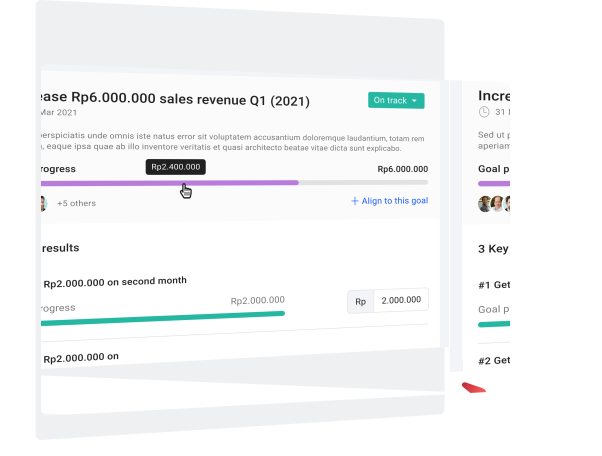
Key capabilities of Mekari Talenta to support KPI Management at scale include:
- End-to-End KPI & OKR Management. Align organizational goals with team and individual KPIs in one centralized system, enabling clear cascading of objectives across multiple business units and functions.
- Centralized Performance Dashboard & Real-Time Tracking. Monitor KPI progress in real time through a unified dashboard, allowing leadership to identify performance gaps early and take proactive action.
- Structured Performance Review & Calibration. Standardize evaluation processes with configurable review cycles, ensuring more objective, data-driven assessments across departments and locations.
- Seamless Integration with Payroll & Incentive Systems. Automatically link KPI achievement with compensation, enabling accurate and transparent calculation of bonuses, incentives, and rewards.
- Task Alignment with Strategic Goals. Connect daily activities and task management directly to organizational objectives, ensuring that execution remains aligned with strategic priorities.
- Automation of Performance Management Workflows. Reduce manual administrative workload through automated processes, from KPI tracking to performance reviews and reporting.
- Multi-Entity & Cross-Functional Scalability. Support complex organizational structures, including multi-branch, multi-entity, or matrix organizations, while maintaining consistency in KPI implementation.
- Data-Driven Insights & Reporting. Leverage comprehensive analytics and reports to evaluate performance trends, support strategic decision-making, and continuously optimize KPI frameworks.
- Secure & Reliable Infrastructure. Ensure data security and compliance with trusted, certified systems, enabling organizations to manage sensitive performance data with confidence.
With Mekari Talenta, organizations can build a performance management system that is dynamic, integrated, and scalable to ensure that every metric directly contributes to measurable business impact.
Ready to optimize your KPI system? Explore how Mekari Talenta can help you align goals, improve performance visibility, and drive organizational growth.
Request a demo or contact our sales team to see how Mekari Talenta can support your performance management strategy.