




-
Human Capital Management (HCM) software is an integrated digital platform that helps enterprises manage, optimize, and scale the entire employee lifecycle
-
Examples of HCM software include Mekari Talenta, Workday HCM, SAP SuccessFactors, and Oracle HCM Cloud, which support complex organizational structures through automation, analytics, and seamless system integration.
In today’s digital and highly competitive business environment, human resource management is no longer limited to data administration and manual record-keeping.
Organizations are expected to manage their workforce more strategically, from talent acquisition and onboarding to performance development and strategic workforce planning.
As HR complexity grows alongside business expansion, companies increasingly rely on HCM software to support scalable, data-driven operations.
This article will help you understand what HCM software is, and how modern technology supports end-to-end workforce management.
What Is HCM Software?
Human Capital Management (HCM) software is a comprehensive digital platform designed to manage, optimize, and scale the entire employee lifecycle
Cloud-based HCM software provides a modern technology framework that enables organizations to manage the entire employee lifecycle management process within an integrated ecosystem.
HCM Platforms such as Mekari Talenta, Workday HCM, SAP SuccessFactors, and Oracle HCM Cloud illustrate how HCM technology supports large-scale workforce management through automation, advanced analytics, and seamless system integration.
For enterprise organizations with complex structures, distributed teams, and high workforce volumes, HCM platforms help standardize processes, maintain compliance, and deliver real-time insights for leadership decisions.
Beyond operational efficiency, enterprise HCM solutions support scalability, cross-department collaboration, and data-driven decision-making, enabling HR to evolve from administrative support into a strategic business partner.
Read also: Human Capital Management Strategy: Definition, Benefits & Examples
HCM vs HRIS vs HRMS: What’s the Difference?
Although often used interchangeably, HCM, HRIS, and HRMS represent different scopes of HR technology maturity. Here’s the comparison:
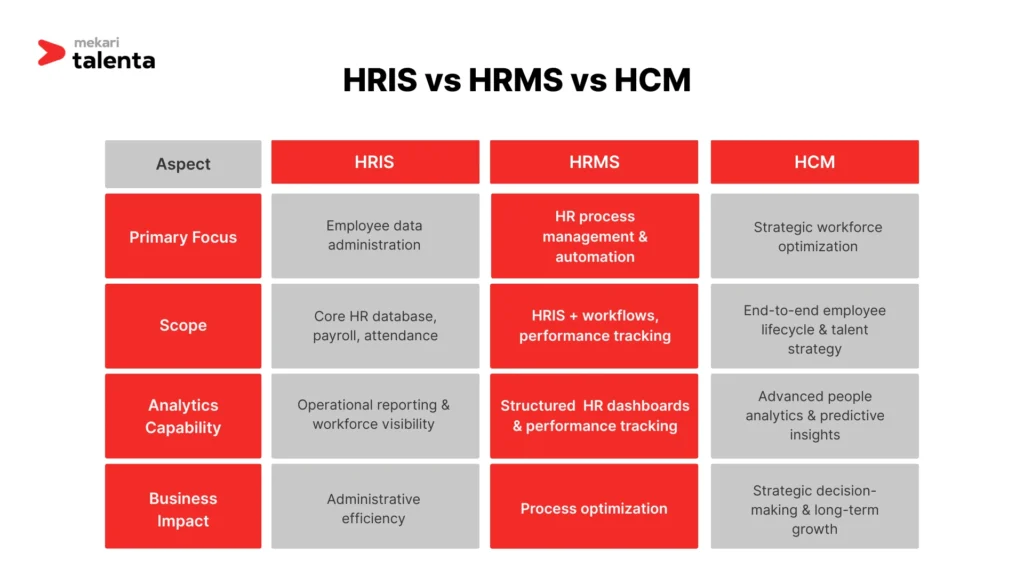
Key takeaways:
- HRIS (Human Resource Information System). Primarily focuses on core employee data management and administrative HR processes such as payroll, attendance, and employee records. HRIS is typically the foundational layer for HR digitalization.
- HRMS (Human Resource Management System). Extends HRIS capabilities by adding workflow automation, performance tracking, and operational management features. HRMS helps streamline HR operations but may still be process-centric.
- HCM (Human Capital Management). Represents a broader, strategic platform that combines HRIS and HRMS capabilities with advanced analytics, workforce planning, talent development, and AI-driven insights. For large organization, HCM software emphasizes scalability, integration, and long-term business impact rather than just administration.
Key Benefits of HCM Software
As organizations grow, HR operations must remain agile, data-driven, and seamlessly integrated across departments.
The following benefits highlight how modern HCM platforms help enterprises improve efficiency, enhance employee experience, and support strategic decision-making at scale.
1. Greater Efficiency Through HR Process Automation
One of the primary advantages of HCM software is its ability to automate repetitive administrative workflows that traditionally consume HR resources.
Payroll processing, attendance tracking, leave requests, and benefits management can now run within a centralized platform to reduce manual input and minimizing human error.
In large organizations, even a small delay in attendance data entry can affect payroll calculations across hundreds or thousands of employees.
Modern HCM platforms integrate technologies such as Robotic Process Automation (RPA) and Artificial Intelligence (AI) to automate administrative tasks at scale.
Attendance data from biometric devices or mobile apps, for example, can sync directly with payroll systems in real time.
For enterprise teams, automation enables HR to shift focus from operational tasks to strategic initiatives such as workforce planning, employee experience design, and organizational development — all of which directly influence productivity and retention.
2. Improved Employee Experience at Scale
Employee experience has become a critical success factor in modern organizations, especially those managing hybrid or remote workforces.
HCM software enhances this through employee self-service features that allow staff to access personal information independently, including leave applications, schedules, payslips, and reimbursements.
This reduces dependency on HR helpdesks while improving transparency and response time.
Cloud-based HCM platforms ensure employees remain connected to HR services regardless of location or device. This is particularly valuable for company operating across multiple regions or business units.
Integrated mobile apps, HR chatbots, and digital workflows create a more responsive workplace environment to help organizations foster engagement, trust, and a stronger employer brand.
3. More Structured and Data-Driven Performance Management
HCM software centralizes employee information and transforms it into actionable insights through HR dashboards and analytics.
It enables HR leaders to analyze turnover trends, productivity patterns, and employee engagement levels in real time while aligning workforce initiatives with long-term business objectives.
Managing performance across large teams requires consistent processes and measurable metrics.
Modern HCM platforms provide structured tools for goal setting, competency tracking, and continuous feedback to ensure performance evaluation remains objective and scalable.
Features such as KPI management, 360-degree reviews, and skills gap analysis allow managers to identify development opportunities earlier and support more personalized growth plans.
Instead of relying solely on annual reviews, organizations can implement continuous performance tracking aligned with business outcomes.
By consolidating performance data into a single ecosystem, companies gain deeper visibility into high-potential talent, leadership readiness, and overall workforce capability.
4. Data-Driven HR Decisions with Real-Time Analytics
One of the biggest challenges in workforce management is the lack of unified, accurate data. HCM software centralizes employee information and transforms it into actionable insights through analytics dashboards and predictive modeling.
HR leaders can analyze turnover trends, productivity patterns, and employee engagement levels in real time.
For example, attendance data can be correlated with performance metrics to identify early signs of disengagement or burnout.
Advanced platforms leverage AI to forecast workforce needs, promotion readiness, or training impact.
It empowers executives to make faster, evidence-based decisions. For enterprise leadership teams, this level of visibility supports strategic planning and aligns HR initiatives with overall business objectives.
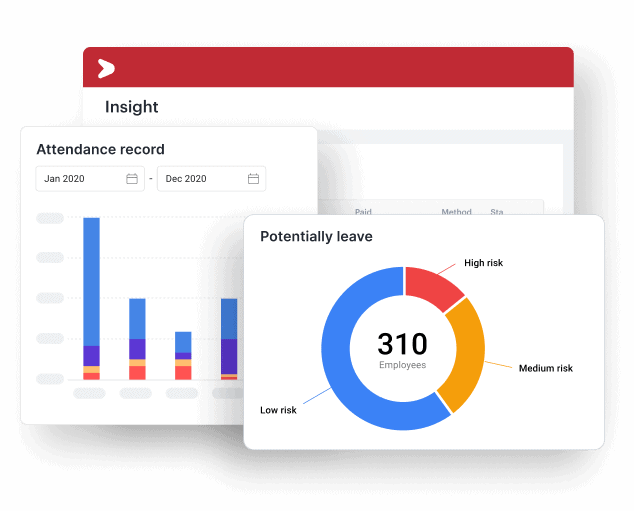
For example, in our software Mekari Talenta, built-in HR Analytics dashboards allow HR teams to visualize workforce trends, monitor attendance behavior, and identify potential risks through real-time data insights.
5. Stronger Compliance with Labor Regulations
Regulatory compliance is a critical priority for enterprises operating in dynamic legal environments.
Payroll rules, tax regulations, working hours, and benefits requirements can change frequently to increase operational risk if managed manually.
HCM software helps organizations maintain compliance through automated policy updates, audit trails, and standardized workflows aligned with local labor laws.
Payroll calculations, PPh 21 taxes, BPJS contributions, and reporting processes can be updated automatically according to regulatory changes.
By reducing compliance risks and ensuring accurate reporting, companies not only avoid penalties but also strengthen employer credibility and corporate governance — key factors in attracting and retaining top talent.
Core Features of Modern HCM Software
To support organization complexity and scalability, modern HCM platforms typically include:
- Core HR Management: centralized employee database and organizational structure management
- Payroll & Compliance Automation: tax calculations, benefits, and regulatory reporting
- Attendance & Workforce Scheduling: biometric, GPS, or mobile-based tracking
- Talent Acquisition & Onboarding: AI-assisted recruitment workflows
- Performance Management: KPI tracking, OKR frameworks, and continuous feedback
- Learning & Development: competency mapping and training recommendations
- People Analytics & Reporting: real-time dashboards and predictive insights
- Employee Self-Service Portal: mobile access to HR services and workflows
- Integration Capabilities: connection with finance, ERP, and collaboration tools
These features work together as a unified ecosystem to enable organizations to manage workforce operations end-to-end while maintaining flexibility for future growth.
Read also: How to Choose the Right HRIS Vendor: A Practical HR Guide
How to Choose the Right HCM Software
Choosing the right HCM software is about selecting a platform that can support long-term business growth, organizational complexity, and digital transformation goals.
Large companies need a solution that goes beyond basic HR automation and delivers scalability, integration, and strategic workforce insights.
Here are several key criteria you should consider when evaluating HCM software:
- Scalability for Organizational Growth. Choose a platform that can handle thousands of employees, multi-entity structures, and expanding business units without disrupting existing workflows.
- End-to-End Integration Capabilities. HCM software should integrate seamlessly with finance systems, payroll infrastructure, collaboration tools, and other enterprise software to create a unified ecosystem.
- Security and Compliance Standards. Data protection is critical for HR operations. Look for platforms with recognized certifications such as ISO 27001 and strong data governance frameworks.
- Automation and Advanced Analytics. HCM platforms should provide automation powered by AI or workflow engines, along with real-time analytics dashboards that support data-driven decision-making.
- Flexibility for Complex HR Policies. Large organizations often have different policies across departments or entities. The system should allow customizable workflows, approvals, and policy configurations.
- User Experience and Adoption. Even powerful enterprise software must remain easy to use. An intuitive interface ensures faster adoption by HR teams, managers, and executives.
As organizations continue to scale, selecting an HCM solution that meets these criteria becomes increasingly important to ensure that HR processes remain consistent, secure, and adaptable as workforce needs evolve.
Mekari Talenta is built to support growing organizations that manage large employee volumes, multiple business units, and diverse HR workflows within one centralized system.
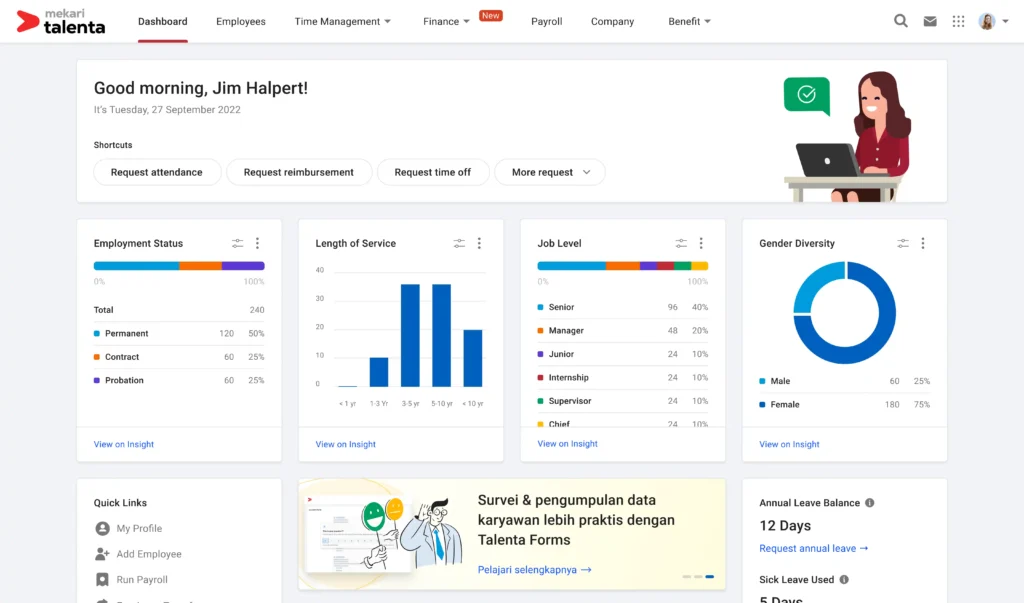
One of the key strengths of Mekari Talenta lies in its integrated ecosystem. As part of the Mekari integrated software ecosystem, Talenta can connect seamlessly with other business solutions such as finance, accounting, and productivity tools.
This integration helps eliminate data silos, allowing teams to synchronize payroll, attendance, reimbursement, and reporting processes across departments without manual duplication.
In addition, Talenta emphasizes security and data protection through internationally recognized ISO 27001 certification.
This ensures that sensitive employee information, payroll data, and organizational records are protected with strict governance standards, as it’s an essential factor for companies handling large-scale HR operations.
Mekari Talenta is also designed with flexibility and scalability in mind. Organizations can easily add new employees, entities, or operational policies as their structure evolves.
Whether managing multi-location attendance, layered approval workflows, or customized payroll configurations, the platform adapts without requiring complex system overhauls.
Another reason Talenta fits growing organizations is its focus on automation and real-time visibility.
HR teams can streamline repetitive tasks such as attendance tracking, payroll calculations, and performance monitoring while gaining access to centralized dashboards that provide actionable workforce insights.
This allows leadership teams to make faster, data-driven decisions while reducing administrative workload.
Combined with a user-friendly interface that supports quick adoption across HR teams, managers, and executives, Mekari Talenta offers a balanced approach between powerful functionality and ease of use.
If you’re looking to simplify complex HR operations while building a scalable digital foundation, now is the right time to explore the right HCM solution for your organization.
Contact the Mekari Talenta sales team to discuss your business needs, request a personalized consultation, and see how Talenta can help optimize your HR strategy for long-term growth.