





-
360 degree feedback is a multi-source performance evaluation method that collects input from managers, peers, subordinates, and self-assessments to provide a comprehensive view of employee performance.
-
It helps organizations uncover behavioral insights, reduce bias, and support more accurate development decisions through diverse and structured feedback.
When discussing performance appraisal, one method that consistently stands out as both widely discussed and strategically valuable is 360 degree feedback.
360 degree feedback is a performance appraisal method that emphasizes collecting input from multiple stakeholders to evaluate an individual’s performance more comprehensively.
Although this method may sound familiar and even somewhat informal at first glance, it has actually existed and been implemented for decades across various industries and organizational structures.
In many organizations, this approach is also closely connected to employee lifecycle management, where performance evaluation plays a key role across different stages of the employee journey.
So, what exactly is 360 degree feedback, and how effective is it in measuring employee performance in a structured and scalable environment? Below is a comprehensive explanation.
Understanding 360 Degree Feedback
“Hey, what do you think about this person?”
This type of question is something you may frequently hear in social environments or even during casual workplace conversations.
Typically, one individual asks others—one by one—about their perception of someone within the group.
Naturally, different people will provide different answers based on their experiences, interactions, and perspectives.
At its core, this simple interaction illustrates the fundamental concept of 360 degree feedback.
So, what is 360 degree feedback?
360 degree feedback is a performance evaluation method that gathers insights in the form of feedback from various individuals who directly interact with the person being evaluated.
For example, a manager is not only assessed by their direct supervisor but also by peers, subordinates, and themselves to identify both strengths and areas for improvement.
This method is typically qualitative in nature, relying on structured questions, rating scales, and descriptive feedback.
Because feedback is collected from multiple sources surrounding the individual, this method is referred to as 360 degree feedback or multi-rater feedback.
As part of a broader talent management approach, 360 degree feedback helps organizations align individual performance with long-term capability development.
In essence, 360 degree feedback is a multi-source evaluation tool used to assess interpersonal skills, communication effectiveness, leadership capabilities, collaboration, and overall workplace impact.
Read also: Talent Management System: Definition, Benefits, and Key Elements
Sources of Feedback in 360 Degree Feedback
In a structured implementation, feedback is collected from several key groups, each providing a unique perspective:
- Direct Manager: Evaluates strategic contribution, goal achievement, and alignment with organizational priorities
- Peers (Colleagues): Assess teamwork, collaboration, communication, and day-to-day working relationships
- Subordinates (Direct Reports): Evaluate leadership style, fairness, support, and ability to guide and empower teams
- Self-Assessment: Provides personal reflection on strengths, weaknesses, and perceived performance
- Clients or Customers (if relevant): Evaluate service quality, professionalism, and output delivery
The diversity of these perspectives enables a more balanced and nuanced understanding of performance.
Components Assessed in 360 Degree Feedback
Unlike traditional evaluation systems that focus heavily on output or key metrics, 360 degree feedback places greater emphasis on behavioral and interpersonal competencies.
Common components include:
- Leadership and decision-making ability
- Communication effectiveness
- Ability to motivate and empower others
- Work ethics and accountability
- Teamwork and collaboration
These competencies are critical in environments where cross-functional coordination, stakeholder alignment, and leadership influence play a significant role in overall performance outcomes.
Principles of 360 Degree Feedback
360 degree feedback is often perceived as a simple multi-rater evaluation method. However, its effectiveness is not determined by how many people are involved, but by the principles that shape how feedback is collected, interpreted, and applied.
1. Multi-Source Feedback (Contextual Accuracy Over Single Perspective)
The foundation of 360 degree feedback lies in collecting input from multiple stakeholders who interact with the individual in different contexts.
Unlike traditional evaluations that rely heavily on a direct manager’s perspective, this approach recognizes that performance is situational.
An individual may demonstrate different behaviors when working with peers, managing subordinates, or engaging with clients.
For example, an employee may appear highly effective from a managerial standpoint due to strong output delivery, but peers may experience challenges in collaboration or communication.
Similarly, subordinates may perceive gaps in leadership support that are not visible to upper management.
By integrating these varied perspectives, organizations gain a more context-rich and behaviorally accurate view of performance.
This reduces blind spots and prevents over-reliance on a single narrative, which is often influenced by limited interaction or hierarchical bias.
However, the value of multi-source feedback depends heavily on respondent relevance. Feedback must come from individuals who have sufficient exposure to the employee’s work. Without this, the process risks becoming speculative rather than evidence-based.
2. Holistic Assessment (Beyond Outcomes to Behavioral Drivers)
360 degree feedback is designed to go beyond evaluating what was achieved, and instead focus on how those results were accomplished.
Traditional performance metrics often prioritize outcomes such as targets, KPIs, or deliverables. While these are important, they do not fully capture the behaviors, decision-making processes, and interpersonal dynamics that contribute to those outcomes.
A holistic assessment considers dimensions such as:
- How effectively an individual communicates across teams
- How decisions are made under pressure or ambiguity
- How conflicts are managed within a team
- How influence is exercised without formal authority
This broader perspective is particularly important in environments where collaboration, cross-functional coordination, and leadership impact play a critical role in success.
By evaluating both outcomes and underlying behaviors, organizations can distinguish between short-term performance and long-term capability.
This distinction is essential for identifying individuals who are not only delivering results, but also contributing positively to team effectiveness and organizational sustainability.
3. Anonymity and Confidentiality (Psychological Safety as a Precondition for Honesty)
One of the most critical enablers of effective 360 degree feedback is psychological safety.
Respondents must feel confident that their input will not lead to negative consequences, particularly when providing constructive or critical feedback. Without this assurance, feedback tends to become overly positive, vague, or non-committal.
Anonymity plays a key role in creating this safety. When respondents know that their identity will not be disclosed, they are more likely to provide honest, specific, and balanced feedback.
However, anonymity alone is not sufficient. Organizations must also ensure:
- Clear communication about how feedback data will be used
- Safeguards to prevent misuse or retaliation
- Aggregation of responses to avoid identification of individuals
Confidentiality mechanisms should be supported by system design, such as minimum respondent thresholds or grouped reporting formats.
At the same time, it is important to balance anonymity with accountability. Feedback should still be constructive, behavior-based, and relevant, not personal or vague.
This requires proper guidance and, in some cases, training for respondents on how to provide effective feedback.
4. Development-Oriented Focus (From Evaluation to Capability Building)
While 360 degree feedback can be used as part of performance evaluation, its primary strength lies in supporting development.
The goal is not merely to assess performance, but to identify patterns that highlight strengths to be leveraged and areas that require improvement.
For instance, consistent feedback indicating strong collaboration but weak decision-making may suggest the need for targeted leadership development.
Similarly, gaps between self-assessment and external feedback can reveal perception misalignment, which is often a critical development area.
To maximize impact, feedback results should be translated into:
- Individual Development Plans (IDPs)
- Coaching or mentoring initiatives
- Targeted training programs
- Behavioral change goals
Without this follow-through, 360 degree feedback risks becoming a one-time exercise with limited long-term value.
These insights are often used to shape a more structured talent development strategy across teams.
5. Continuous and Constructive Feedback (From Periodic Review to Ongoing Dialogue)
Another key principle is shifting from one-time, periodic evaluations to a more continuous feedback approach.
Traditional performance reviews are often conducted annually or semi-annually, which can create delays between observed behavior and feedback delivery. This reduces relevance and limits the opportunity for timely improvement.
Equally important is the quality of feedback itself. Feedback must be:
- Specific: Focused on observable behaviors rather than general impressions
- Actionable: Providing clear direction on what can be improved
- Balanced: Highlighting both strengths and development areas
For example, instead of saying “communication needs improvement,” effective feedback would specify situations, behaviors, and impact, making it easier for the individual to understand and act on it.
In many cases, organizations complement structured 360 feedback with follow-up discussions such as one-on-one meetings, coaching sessions, or team reflections. These interactions help contextualize the feedback and turn insights into meaningful action.
When Should 360 Degree Feedback Be Used?
360 degree feedback is most effective when there is a clear need to understand performance from multiple perspectives, especially in situations where behavior, collaboration, and leadership impact matter as much as outcomes.
It is also commonly used as input for succession planning, especially when evaluating leadership readiness.
Here are the key situations where it is most appropriate to use:
- When evaluating leadership and managerial effectiveness. Particularly useful for roles that involve influencing others, managing teams, and making decisions that affect multiple stakeholders.
- When preparing employees for promotion or role expansion. Helps assess readiness beyond technical performance by capturing how individuals are perceived across different working relationships.
- When running leadership development or coaching programs. Provides a baseline before development begins and can be used again to measure behavioral progress over time.
- When there is a need to identify perception gaps. Useful in situations where there is a mismatch between how individuals see themselves and how others experience their behavior.
- When strengthening collaboration across teams or functions. Helps uncover friction points, communication gaps, and alignment issues that are not visible through standard performance metrics.
- When building or reinforcing a feedback-driven culture. Encourages more structured, consistent, and open feedback practices across the organization.
- When assessing behavioral competencies, not just outcomes. Particularly relevant for roles where success depends on communication, influence, and teamwork rather than individual output alone.
- When organizations need more balanced and less biased evaluations. Adds multiple perspectives to reduce over-reliance on a single evaluator’s judgment.
Functions and Benefits of 360 Degree Feedback
360 degree feedback is a mechanism that reshapes how performance is understood, discussed, and improved.
Its value lies in how it supports broader human capital management strategy, not just individual evaluation.
These insights can also support strategic workforce planning by identifying capability gaps and future talent needs across teams.
1. Improved Efficiency Through Technology
The evolution of digital systems has transformed 360 degree feedback from a manual, time-consuming process into a scalable and structured workflow.
What previously required extensive coordination can now be executed through automated distribution, tracking, and reporting within a single platform.
This shift allows organizations to run feedback cycles more frequently without increasing administrative burden.
As a result, the process becomes not only faster, but also more consistent and reliable across teams.
2. Deeper Insight Into Behavior
Unlike traditional evaluations that emphasize results, 360 degree feedback reveals the behavioral patterns behind those results.
It helps explain how decisions are made, how collaboration happens, and how individuals influence their environment.
This distinction is critical, because similar outcomes can be achieved through very different approaches.
By understanding these behavioral drivers, organizations can identify which patterns are sustainable and aligned with long-term performance.
3. Increased Self-Awareness
One of the most impactful outcomes of 360 degree feedback is the visibility it creates around perception gaps.
Individuals often assess themselves based on intent, while others evaluate based on observed impact.
When these perspectives are compared, it becomes easier to identify blind spots and overlooked strengths.
This awareness is a key starting point for meaningful behavioral change and professional growth.
4. Reduced Bias
Relying on a single evaluator often introduces bias due to limited exposure and subjective judgment.
By incorporating multiple perspectives, 360 degree feedback distributes evaluation across a wider context. This does not eliminate bias entirely, but it balances and reduces its influence.
Over time, the aggregation of feedback creates a more stable and representative view of performance.
5. Higher Engagement and Productivity
Involving employees in both giving and receiving feedback creates a stronger sense of participation.
When individuals feel their perspectives are valued, they are more likely to engage with the process and take ownership of outcomes.
This dynamic contributes to higher motivation and accountability within teams. As engagement improves, it often translates into better overall productivity and collaboration.
6. Better Communication
360 degree feedback acts as a trigger for structured conversations rather than a one-way evaluation.
The insights gathered often lead to follow-up discussions that clarify expectations and address misalignment. Over time, this builds a culture where feedback is not avoided, but normalized.
As communication becomes more open, teams are able to resolve issues earlier and work more effectively together.
Steps to Implement 360 Degree Feedback
To ensure that 360 degree feedback delivers objective and actionable insights, the process must be designed systematically.
A well-structured implementation typically spans multiple stages, from defining evaluation frameworks to translating insights into employee development plans.
1. Define the Competency Framework
The first step is to determine the competencies or behavioral indicators that will serve as the foundation of the evaluation.
This framework is typically aligned with internal standards such as core values, leadership models, or organizational behavior expectations.
Common competencies include communication and collaboration, leadership capability, decision-making, problem solving, and accountability.
A behavior-based framework helps respondents provide feedback that is more objective and grounded in observable day-to-day work situations.
2. Define Scope and Participants
Once competencies are established, the organization needs to determine who will be included in the 360 degree feedback process.
This method is often applied to roles with coordination or leadership responsibilities, such as supervisors, managers, or cross-functional contributors. In addition, organizations must define the evaluation cycle, whether conducted semi-annually or annually.
Clear scope and participation criteria ensure consistency and alignment with the broader performance management system.
3. Select Relevant Respondents
The effectiveness of 360 degree feedback depends heavily on selecting respondents who have meaningful working interactions with the individual being evaluated.
Respondents typically include direct managers, selected peers, and subordinates for those in leadership roles. In some cases, cross-functional stakeholders or external partners may also be included.
Careful selection ensures that feedback reflects actual working relationships and provides a balanced perspective.
4. Designing the Assessment Instrument
The assessment instrument is usually created in the form of a behavior-based questionnaire (behavior-based assessment) that allows respondents to provide evaluations in an objective and measurable way.
This approach is used so that the assessment is not only subjective, but truly based on behaviors that can be observed in daily work.
Each competency that has been previously defined is then translated into several behavioral indicators that are relevant to work activities.
These indicators function as a guide so that respondents understand what aspects should be evaluated.
Examples of indicators in the assessment instrument include:
- able to convey ideas clearly to the team
- open to input from colleagues
- able to make decisions in complex situations
- demonstrates the ability to collaborate across teams
These indicators are then converted into questions that can be assessed by respondents.
Example Questions in 360 Degree Feedback
Some examples of questions in the assessment instrument include:
- How effectively does this employee communicate ideas or information to the team in a clear and easy-to-understand manner?
- How open is this employee to input, criticism, or suggestions from colleagues?
- How well does this employee make decisions when facing complex or high-pressure work situations?
- How effectively does this employee collaborate with other team members, including those from different departments?
Typically, each question uses a specific rating scale, such as a scale of 1–5 or 1–7, to make the measurement process easier. For example:
- 1 = strongly disagree / very poor
- 3 = moderate / neutral
- 5 or 7 = strongly agree / very good
In addition to numerical scales, the assessment instrument generally also provides an open comment field.
This field allows respondents to provide examples of behavior, situational context, or additional input that cannot be fully explained through numbers alone.
Thus, organizations can obtain deeper qualitative insights to support quantitative evaluation results.
5. Conducting Socialization and Respondent Preparation
Before the assessment process begins, the company needs to conduct socialization to all parties involved.
This socialization aims to explain the purpose of the program, the assessment mechanism, and how the feedback results will be used.
At this stage, the organization can also provide guidance on how to give constructive and objective feedback.
With a shared understanding of the assessment process, respondents will be better prepared to provide honest and relevant feedback.
6. Collecting Feedback in a Structured Manner
After the respondents are determined and the assessment instrument is prepared, the feedback collection process can be carried out.
A structured system also helps maintain respondent confidentiality. This anonymity is important to ensure that respondents feel comfortable providing honest evaluations without worrying about affecting their working relationships with the employee being assessed.
In many organizations, the feedback collection process is carried out through an HCM software or system to make it more structured.
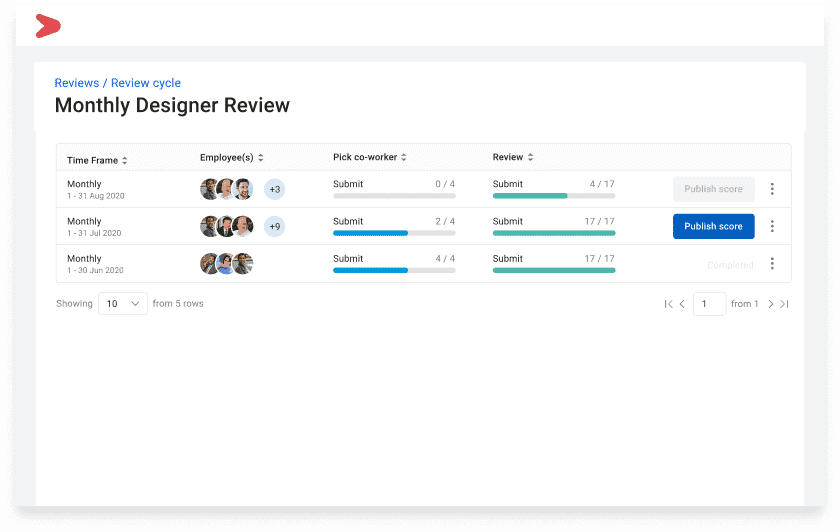
Through this system, HR can monitor the progress of review completion from various respondents in a single dashboard.
The Mekari Talenta performance management software enables HR to manage the 360 degree feedback process in a structured way and monitor the progress of review completion from various respondents in one dashboard.
7. Processing and Analyzing Assessment Results
After all feedback has been collected, the company needs to analyze the data obtained.
The assessment results are usually summarized in the form of reports that make it easier for HR and management to interpret.
Some components that are usually displayed in 360 degree feedback reports include:
- average scores for each competency
- comparison between self-assessment and evaluations from other parties
- distribution of ratings from different respondent groups
- qualitative comments from feedback providers
These insights can also be integrated into HR analytics to identify patterns and trends across teams, as well as employee strengths and areas that still need to be developed.
Through Mekari Talenta, the process of processing and analyzing 360 degree feedback results can be carried out through the Performance Management dashboard, which displays a centralized summary of evaluation results.

HR and management can easily view evaluation scores, comparison of assessments, and distribution of feedback from various respondents in one view.
Read also: Data-Driven HR: Definition, Benefits, and Practical Implementation
8. Delivering Feedback Results to Employees
The assessment results are then delivered to the respective employee through discussion sessions or feedback meetings.
In this session, the manager or HR usually helps explain the meaning of the assessment results and provides context for the feedback received.
A constructive approach is very important so that employees do not perceive the feedback results merely as criticism, but as an opportunity to improve their competencies and performance.
9. Developing Employee Development Plans
The final stage is to develop a development plan based on the evaluation results obtained.
This plan can take the form of training programs, mentoring, coaching, or the development of specific competencies that are relevant to the employee’s needs.
Limitations of 360 Degree Feedback
Despite its strengths, 360 degree feedback is not inherently effective. Its impact depends heavily on how well it aligns with the organization’s culture, structure, and level of readiness.
1. Potential for Negative or Dishonest Feedback
In environments where trust is low, feedback can become distorted by personal motives or workplace politics. Individuals may provide overly critical input or withhold honest opinions to avoid conflict.
In both cases, the quality of feedback declines and reduces its usefulness. Without a foundation of trust, the process risks becoming performative rather than insightful.
2. Dependence on Working Relationships
The accuracy of feedback is closely tied to how well respondents understand the individual being evaluated. Limited interaction often leads to assumptions rather than evidence-based input.
This becomes a challenge in teams with high turnover or minimal collaboration. As a result, feedback may lack depth and fail to reflect actual performance.
3. Emotional Bias
Personal relationships can influence how feedback is given, either positively or negatively. Close relationships may lead to overly favorable evaluations, while conflicts may result in harsher judgments.
These emotional factors can distort objectivity, even when the process is structured. Without proper calibration, such bias can affect the overall interpretation of results.
4. Reward Paradox
When 360 degree feedback is directly tied to rewards or penalties, respondents may adjust their input strategically. Instead of focusing on accuracy, they may prioritize outcomes that benefit themselves or others.
This creates a conflict between honesty and consequence. Over time, the feedback loses its reliability as a source of insight.
Tips for Implementing 360 Degree Feedback
You already understand the advantages and limitations of using 360 degree feedback. The next question is: how can this method be implemented effectively?
1. Do Not Rely on 360 Degree Feedback as the Only Method
360 degree feedback should not be used as the sole method for evaluating employee performance.
The insights gathered should be complemented with other approaches such as one-on-one meetings, interview sessions, or open discussions to clarify and validate the feedback results.
By combining multiple evaluation methods, organizations can gain a more comprehensive understanding of employee performance while ensuring that the feedback accurately reflects actual working conditions.
2. Build a Healthy Work Environment
The effectiveness of 360 degree feedback is heavily influenced by the organization’s work culture, including working arrangements, employee benefits, and access to development opportunities.
It is therefore essential to foster a supportive and healthy work environment.
Employees’ willingness to provide honest feedback is often shaped by how they are treated within the organization. Factors such as fair policies, clear benefits, and opportunities for growth play a significant role.
A positive work environment encourages employees to deliver feedback that is more objective, constructive, and aligned with actual experiences.
3. Leverage Data to Support Performance Analysis
360 degree feedback results should not stop at evaluation reports. Organizations need to utilize the data to monitor performance trends over time.
Today, various HR applications can help collect and manage employee data in a more structured way.
Through this data, organizations can track performance progress, identify changes in motivation or morale, and understand factors influencing performance outcomes.
Additional data such as attendance, productivity, and compensation can also provide deeper insights, enabling a more comprehensive performance analysis.
4. Ensure the Evaluation Process Is Easily Accessible
For 360 degree feedback to be effective, the evaluation process must be easily accessible to all employees.
Information regarding timelines, assessment mechanisms, and program objectives should be clearly communicated to everyone involved.
Ease of access and transparency help increase participation rates and ensure that all stakeholders understand their roles in providing meaningful feedback.
5. Use Performance Management Software to Streamline the Process
To ensure consistency and scalability, organizations should consider using performance management software to support the 360 degree feedback process.
A structured system helps automate feedback distribution, track completion, and consolidate results into a centralized dashboard.
This will reduces administrative workload and also improves data accuracy and reporting quality.
With the right system in place, organizations can manage feedback cycles more efficiently, generate actionable insights faster, and integrate evaluation results with broader performance and development strategies.
In some cases, organizations also complement this approach with KPI consultancy to ensure alignment between performance metrics and behavioral evaluation.
Common Mistakes in Implementing 360 Degree Feedback
Although 360 degree feedback can provide a more comprehensive view of employee performance, its implementation often falls short when the process is not carefully designed.
In organizations with complex team structures, flaws in design or execution can lead to biased insights or feedback that is not relevant for employee development.
Below are some common mistakes that frequently occur in 360 degree feedback implementation.
1. Assessment Instruments Are Too Generic or Not Role-Relevant
One of the most common issues is using overly generic questions that fail to reflect behaviors relevant to the individual’s role.
Without clear and specific indicators, respondents tend to rely on general impressions rather than actual observations.
This reduces the quality of feedback and makes it difficult to distinguish between meaningful insight and subjective opinion. As a result, the evaluation may not accurately represent real performance.
2. Incorrect Selection of Respondents
Feedback should come from individuals who have direct and meaningful working interactions with the person being evaluated.
If respondents lack sufficient exposure, their input becomes speculative rather than evidence-based.
On the other hand, involving too many respondents without clear relevance can dilute the quality of feedback. This ultimately affects the accuracy and credibility of the overall evaluation.
3. Lack of Anonymity Assurance
Respondents are often hesitant to provide honest feedback if they believe their identity can be traced.
Without proper anonymity safeguards, feedback tends to become overly cautious or politically safe. This limits the depth and honesty of the insights collected.
Ensuring anonymity is therefore essential to maintaining the integrity of the process.
4. Feedback Results Are Difficult to Interpret
Another common issue is presenting results as raw scores or unstructured comments without meaningful analysis.
Without clear insights, competency priorities, or development recommendations, the feedback becomes difficult to act upon. Managers and employees may struggle to translate the results into concrete actions.
As a result, the entire process risks becoming an administrative exercise rather than a driver of improvement.
To ensure consistency, many organizations implement a performance management system that supports structured feedback and evaluation cycles.
Read also: What Is a KPI Management System? Definition, Benefits, and Elements
Optimize Performance Evaluation with Mekari Talenta Performance Management System
The 360 degree feedback method can help companies obtain a more objective and comprehensive view of employee performance.
However, for this process to run effectively, companies need a system that is able to manage the evaluation cycle in a structured way, starting from feedback collection, analysis of evaluation results, to the development of employee development plans.
Through the Performance Management Features from Mekari Talenta, companies can manage the performance evaluation process end-to-end, from goal setting to analysis of evaluation results.
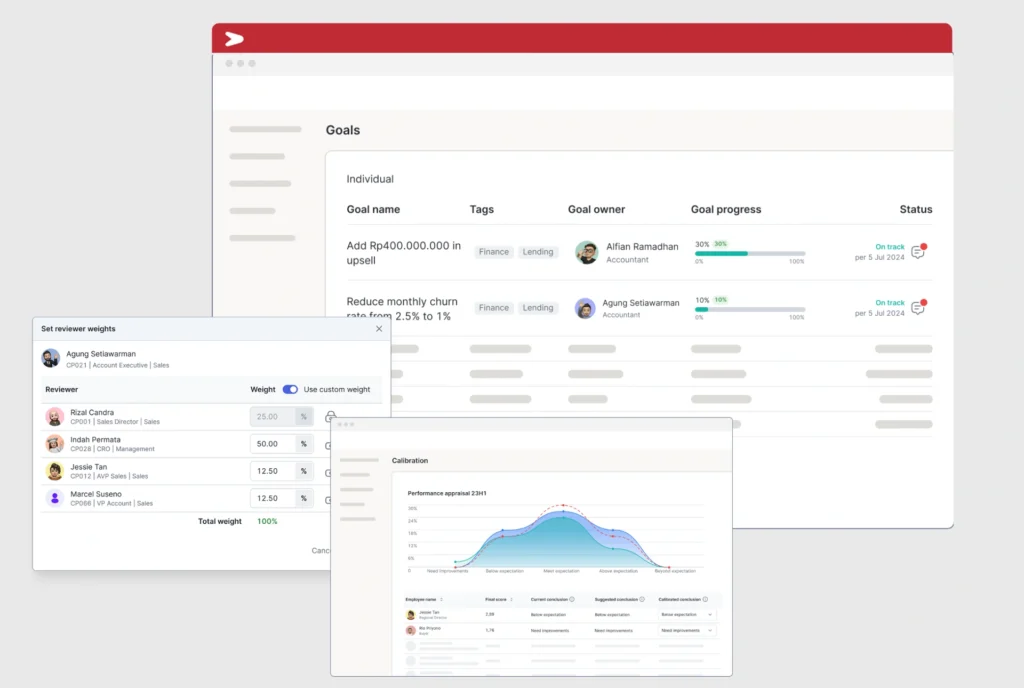
Some features that can support the performance review process include:
- OKR & KPI Management to align company goals down to the individual level
- Performance Review & 360 Degree Feedback to collect evaluations from multiple parties in an anonymous and structured manner
- AI Review Summary to summarize performance evaluation results more quickly
- Report & Calibration to analyze and compare employee evaluation results
- Integration with payroll and HRIS to connect performance results with bonuses, promotions, or career development
With an integrated system, companies can accelerate the appraisal process, improve evaluation objectivity, and drive continuous employee development.
Want to learn how Mekari Talenta helps manage performance management in your organization?
Contact our sales team to try a demo of the Mekari Talenta now and see how performance evaluation can be conducted faster, more objectively, and based on data.