


- Payroll tax in Indonesia refers to the income tax employers withhold from employees and other individual recipients, primarily through PPh 21.
- Employers generally use the TER mechanism for routine PPh 21 withholding, with the final tax period reconciled using the applicable annual progressive rates.
Expanding into Indonesia means payroll becomes a local compliance function, not simply an extension of the payroll process used at headquarters.
For foreign businesses, the challenge is particularly significant because Indonesian payroll combines employee classification, PPh 21 withholding, social security contributions, taxable benefits, and local reporting requirements within one process.
Indonesia’s regulatory environment is complex enough that PwC specifically describes it as a “complex regulatory environment” for inward investors, with payroll compliance among the non-core functions foreign companies commonly need to manage locally.
Tax is also a material concern for businesses operating in Indonesia.
This complete guide explains how Indonesian payroll tax works in practice, including who is subject to PPh 21, how taxable income is determined, how TER and Article 17 rates interact, and how employers handle benefits, deductions, and termination payments.
Understanding Payroll Tax in Indonesia
Before getting into rates and formulas, it helps to be clear on what “payroll tax” actually refers to under Indonesian law, since the term itself does not have a single formal equivalent.
Is There a Specific “Payroll Tax” in Indonesia?
Indonesia does not formally recognize a single tax called “payroll tax.” What employers withhold from employee income each month is technically an income tax mechanism, not a standalone payroll levy.
The primary instrument used for this purpose is Pajak Penghasilan (PPh) Pasal 21, or Income Tax Article 21, which governs the withholding of tax on income earned from employment, services, and other individual activities.
It is worth clarifying early on that employee social security contributions such as BPJS Ketenagakerjaan and BPJS Kesehatan often appear on the same payslip as PPh 21, but they are not income tax. They are social insurance contributions with their own separate rules.
What Is PPh 21?
PPh 21 is the income tax withheld by an employer on income received by an individual in connection with employment, services rendered, or certain other activities carried out within Indonesia.
It applies to a broad range of income types, including salary, allowances, bonuses, commissions, and other compensation paid to permanent employees, non-permanent workers, and non-employee recipients such as consultants.
The employer, as the party paying the income, is generally responsible for calculating, withholding, depositing, and reporting this tax on behalf of the recipient, which is why PPh 21 sits squarely inside the payroll function rather than a separate corporate tax process.
For employees, the PPh 21 withheld throughout the year functions as a tax credit against their final annual individual income tax liability, not as a separate, final tax in itself.
PMK 168/2023 expressly regulates withholding of PPh 21 and/or PPh 26 on income arising from employment, services, or activities of individuals.
What Employers Need to Know about PPh 26
Not every income recipient is treated as a resident taxpayer, and this distinction changes which withholding mechanism applies.
An individual is generally considered a non-resident taxpayer when they do not meet Indonesia’s tax residency criteria, most commonly based on the length and nature of their presence in the country.
Resident taxpayers are subject to PPh 21 using progressive rates, while payments to non-resident individuals fall under PPh 26 instead.
This distinction matters most for organizations that regularly engage foreign employees, expatriate consultants, or offshore contractors.
For payments to non-resident taxpayers, the statutory PPh 26 rate is generally 20% of gross income, unless a tax treaty provides a different applicable rate and the treaty requirements are satisfied.
Employers need a Certificate of Domicile and a completed DGT Form from the recipient before applying any treaty rate.
Because of this, foreign employees on the payroll typically require an additional layer of tax-status verification before their monthly withholding can be finalized, especially for organizations that assign staff across multiple countries.
Read More: A Comprehensive Guide to Payroll in Indonesia for Foreign Companies
Indonesian Payroll Tax Regulatory Framework
Payroll tax obligations in Indonesia are shaped by a layered set of laws and implementing regulations, each covering a different part of the calculation and administration process.
Income Tax Law and the Legal Basis for PPh 21
The foundation of individual income tax in Indonesia is the Income Tax Law (UU PPh), originally enacted as UU No. 7 of 1983 and amended several times since.
The most significant recent amendment came through UU No. 7 of 2021 on the Harmonizatio of Tax Regulations, commonly referred to as UU HPP.
Article 21 of this law is the statutory basis for withholding tax on employment-related income, while Article 17 sets out the progressive tax rate structure used for individual taxpayers. Together, these two articles anchor virtually every payroll tax calculation an employer performs.
Government Regulation No. 58 of 2023
Government Regulation No. 58 of 2023 (PP 58/2023) was introduced to simplify monthly PPh 21 withholding following the rate changes brought about by UU HPP.
PP 58/2023 was issued to adjust PPh 21 withholding rates following the changes to Article 17 under UU HPP.
It introduced effective tax rates, known as Tarif Efektif Rata-rata (TER), which are applied monthly and daily to simplify routine payroll calculations. These effective rates work alongside, not instead of, the annual progressive rates under Article 17.
Minister of Finance Regulation No. 168 of 2023
Minister of Finance Regulation No. 168 of 2023 (PMK 168/2023) is the primary technical regulation employers rely on when running PPh 21 and PPh 26 in practice.
It covers who is required to withhold, which recipients are taxable, what income counts as taxable employment income, and how calculations should be performed.
PMK 168/2023 took effect on January 1, 2024 and replaced several previous PPh 21 regulations.
It also sets out rules on withholding timing, the issuance of tax certificates, and the handling of over-withheld tax, all of which are used throughout this guide.
PMK 81/2024 and the Coretax Administration System
Minister of Finance Regulation No. 81 of 2024 (PMK 81/2024) governs the administrative side of tax compliance through Indonesia’s Coretax system, which consolidates tax payment, reporting, and SPT administration into a single electronic platform.
PMK 81/2024 provides the administrative framework for the Coretax system and has subsequently been amended, including by PMK 1/2026.
For payroll teams, this means employer obligations around tax deposit and reporting now run through Coretax, and payroll processes need to stay aligned with how that system expects data to be submitted.
Who Is Subject to Payroll Tax in Indonesia?
Payroll tax obligations do not treat every income recipient the same way. Whether someone is classified as an employee, an independent contractor, or another type of recipient materially changes how PPh 21 is calculated.
PMK 168/2023 specifically distinguishes between permanent employees, non-permanent employees, non-employees, participants, pensioners, former employees, and other recipient categories.
Getting this classification right at the start prevents downstream errors in every subsequent calculation step.
1. Resident Individual Taxpayers
An individual is generally treated as an Indonesian resident taxpayer when they reside in Indonesia, intend to reside in Indonesia, or are present in the country beyond a certain threshold within a twelve-month period.
Employees receiving employment income as resident taxpayers are subject to PPh 21, calculated using the progressive and TER mechanisms described later in this guide.
Residency status needs to be confirmed early, since it determines whether PPh 21 or PPh 26 applies to that individual.
2. Permanent Employees
A permanent employee is someone with an ongoing employment relationship with the company, typically receiving a regular salary along with fixed and variable compensation components each period.
This group makes up the bulk of most payroll tax calculations, since their income structure, salary, allowances, benefits, and periodic bonuses, tends to be the most consistent and the most heavily regulated under PMK 168/2023.
3. Non-Permanent Employees
Daily workers, temporary staff, and casual workers fall under this category, and they are typically compensated on a daily, weekly, or project-completion basis rather than through a fixed monthly salary.
Because their payment pattern is irregular, the calculation mechanism for this group differs from permanent employees, and it depends heavily on how much they are paid per period and how frequently they receive payment.
4. Non-Employees and Independent Service Providers
This category covers consultants, freelancers, agents, commission-based individuals, and other professionals who provide services without being formally employed by the company.
For non-employees, PPh 21 is generally calculated by applying the Article 17 progressive tax rates to 50% of the gross income received from the withholding agent.
This method applies to compensation such as honoraria, commissions, fees, and similar payments, subject to the applicable rules.
5. Foreign Employees and Non-Resident Individuals
Foreign nationals working in Indonesia may be classified as resident or non-resident taxpayers depending on the length and nature of their stay, which then determines whether PPh 21 or PPh 26 applies.
For multi-entity organizations that regularly bring in expatriate talent, this classification needs to be checked on a case-by-case basis, supported by proper documentation such as a Certificate of Domicile where a tax treaty is being applied.
What Income Is Subject to PPh 21?
Almost every form of compensation an employee receives in connection with their work is potentially subject to PPh 21, though the specific treatment can vary by income type.
1. Salary and Wages
This is the most straightforward category, covering basic salary along with monthly, hourly, or daily wages paid as the core of an employee’s compensation.
Regardless of the payment frequency, salary and wages form the base figure from which most PPh 21 calculations begin.
2. Allowances
Both fixed and variable allowances are generally included in taxable income, covering items such as transportation allowance, meal allowance, housing allowance, and communication allowance.
Because these allowances often differ by role, level, or location, payroll teams need a clear, consistent list of which allowance components are being paid, so the taxable base is not accidentally understated for some employees and overstated for others.
3. Bonuses, THR, and Other Irregular Income
Annual bonuses, performance bonuses, Tunjangan Hari Raya (THR/religious holiday allowances), incentive payments, commissions, and other one-time payments are all considered part of taxable employment income when received.
These irregular payments affect the PPh 21 calculation differently from regular monthly salary, since they can push an employee’s income into a different TER category or a higher progressive bracket for that period.
4. Overtime and Other Employment Payments
Overtime pay, shift allowances, attendance incentives, and similar employment-related compensation are also included in the gross income used for PPh 21 purposes.
For companies with large frontline or shift-based workforces, these components can meaningfully change an employee’s monthly taxable income from one period to the next.
5. Benefits in Kind and Employer-Provided Benefits
Benefits in kind (natura) and other forms of enjoyment (kenikmatan) provided by the employer, such as company facilities, are treated differently depending on the type and value of the benefit involved.
PMK 66/2023 changed the tax treatment of benefits in kind and employer-provided benefits, including circumstances in which such benefits form part of an employee’s taxable income.
This means some benefits that were previously excluded from taxable income may now need to be recognized in the PPh 21 calculation, depending on the type of facility and the recipient.
What Income Is Not Subject to PPh 21?
Not every payment or benefit that appears on a payslip automatically becomes taxable income, and treating everything as taxable by default can lead to over-withholding.
Tax-Exempt Income and Benefits
Indonesian regulations set out certain statutory exemptions, specific benefits, employer-provided facilities, and reimbursements that fall outside the scope of PPh 21 under prevailing rules.
Because these exemptions are defined narrowly and tied to specific conditions, employers should not assume a benefit is automatically exempt just because it seems non-cash or incidental in nature.
How Employers Should Determine Whether a Benefit Is Taxable
A practical way to work through this is to follow a consistent decision process for each compensation component before it is added to payroll:
- Identify the benefit or payment being provided to the employee.
- Determine whether it constitutes employment-related income under the applicable rules.
- Check whether a specific exemption applies to that particular benefit.
- Determine the correct valuation method if the benefit is taxable.
- Include the resulting taxable amount in the payroll tax calculation for that period.
Running every new compensation component through this sequence, rather than defaulting to how a similar item was treated in the past, reduces the risk of misclassifying income across different branches or business units.
Understanding PTKP in Indonesian Payroll Tax
Before applying any tax rate, employers first need to account for Penghasilan Tidak Kena Pajak (PTKP), the portion of income that is not subject to tax based on an employee’s personal circumstances.
What Is PTKP?
PTKP represents the non-taxable income threshold granted to each individual taxpayer, adjusted upward based on marital status and the number of dependents they are entitled to claim.
PTKP is taken into account in determining the employee’s annual taxable income and is also reflected in the employee’s applicable TER category for monthly PPh 21 withholding.
How Marital Status and Dependents Affect Payroll Tax
An employee’s PTKP status determines the amount of tax-free income they are entitled to before income tax is calculated.
In Indonesia, PTKP status is commonly represented using a combination of letters and numbers, such as TK/0, TK/1, K/0, or K/2.
- T stands for Tidak, meaning not married.
- K stands for Kawin, meaning married.
- The number after the slash (/) indicates the number of dependents claimed by the taxpayer, with a maximum of three dependents.
For example:
- TK/0 = unmarried, with no dependents
- TK/1 = unmarried, with one dependent
- TK/2 = unmarried, with two dependents
- K/0 = married, with no dependents
- K/1 = married, with one dependent
- K/2 = married, with two dependents
- K/3 = married, with three dependents
For example, an employee who is married and has two eligible dependents would have a PTKP status of K/2. An employee who is unmarried and has one eligible dependent would have a status of TK/1.
This status matters because it determines the employee’s PTKP amount and, for permanent employees, their applicable TER category for monthly PPh 21 withholding.
The employee’s status should therefore be collected and verified as part of payroll data management rather than assumed by the employer.
If an employee’s marital or dependent status changes, the payroll records should be updated accordingly.
Current PTKP Amounts
| Tax Status | Annual PTKP |
|---|---|
| TK/0 | Rp54,000,000 |
| TK/1 | Rp58,500,000 |
| TK/2 | Rp63,000,000 |
| TK/3 | Rp67,500,000 |
| K/0 | Rp58,500,000 |
| K/1 | Rp63,000,000 |
| K/2 | Rp67,500,000 |
| K/3 | Rp72,000,000 |
The underlying PTKP amounts remain Rp54 million for the taxpayer, plus Rp4.5 million for marriage and each qualifying dependent, up to three dependents.

Indonesian Progressive Income Tax Rates
Once PTKP has been deducted, the remaining taxable income is subject to Indonesia’s progressive individual income tax structure.
Is PPh 21 Progressive?
Yes. The annual PPh 21 calculation ultimately uses the progressive rates under Article 17(1)(a) of the Income Tax Law, while TER is used as the withholding mechanism during the year.
For permanent employees, the applicable TER rate is used to calculate PPh 21 during the relevant monthly tax periods.
In the final tax period, the employer recalculates PPh 21 based on the employee’s annual taxable income using the Article 17 progressive rates and reconciles the result against the PPh 21 already withheld during the year.
Current Individual Progressive Tax Rates
| Taxable Income (PKP) | Rate |
|---|---|
| Up to Rp60 million | 5% |
| Above Rp60 million – Rp250 million | 15% |
| Above Rp250 million – Rp500 million | 25% |
| Above Rp500 million – Rp5 billion | 30% |
| Above Rp5 billion | 35% |
These five brackets were introduced through UU HPP.
How Progressive Tax Rates Work
Consider an employee with an annual taxable income of Rp300,000,000 after PTKP has been deducted. The tax is calculated in layers, not as a single flat rate applied to the full amount.
The first Rp60,000,000 is taxed at 5%, the portion between Rp60,000,000 and Rp250,000,000 is taxed at 15%, and the remaining Rp50,000,000 up to Rp300,000,000 is taxed at 25%.
Adding these three brackets together gives the total annual tax due. It is worth emphasizing to employees, who sometimes misunderstand this point, that entering a higher bracket does not mean their entire income is suddenly taxed at that higher rate.
Understanding the PPh 21 Effective Tax Rate (TER)
TER is the mechanism most payroll teams interact with on a monthly basis, so it deserves its own closer look.
What Is TER?
TER, or Tarif Efektif Rata-rata, is a simplified effective rate applied to gross monthly income to determine how much PPh 21 should be withheld for that period. It was introduced to reduce the manual complexity of calculating progressive tax every single month.
Instead of running a full progressive calculation each pay period, payroll simply applies a pre-set effective percentage based on the employee’s income level and PTKP category, which considerably speeds up monthly processing.
Monthly TER Categories
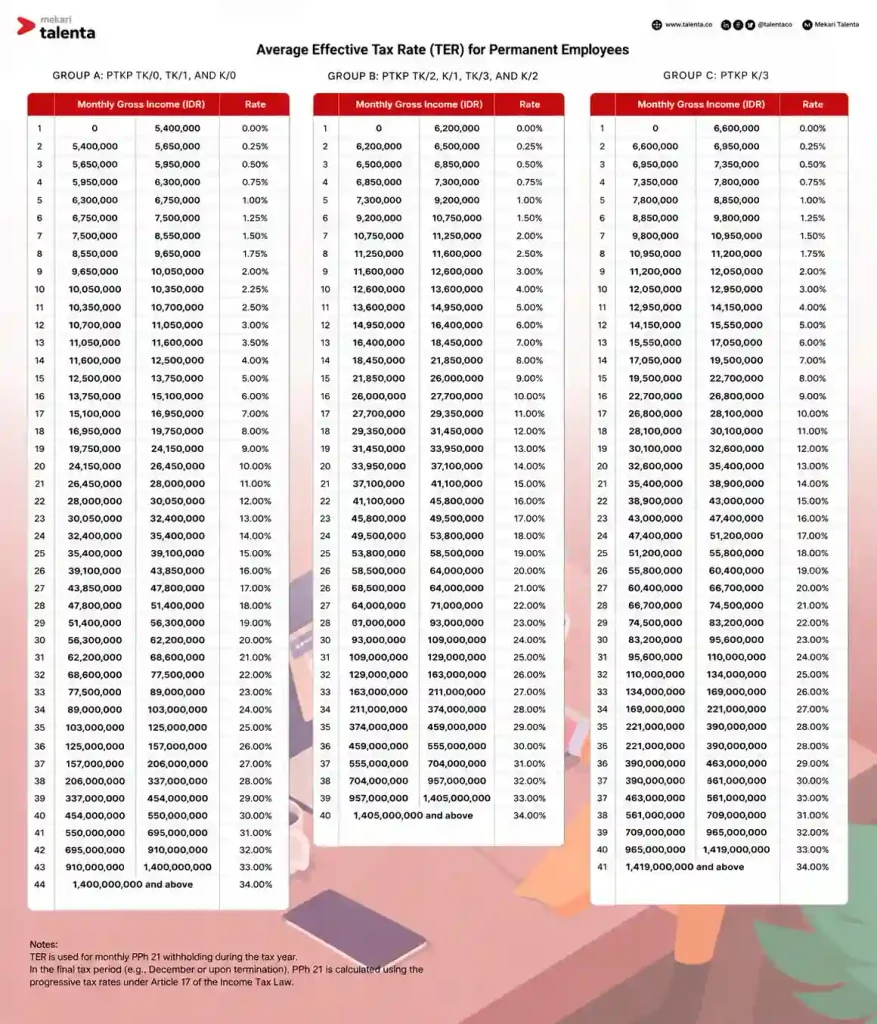
For permanent employees, the Average TER is divided into three categories: Category A, Category B, and Category C.
The applicable category is determined by the employee’s PTKP status, which reflects their marital status and number of eligible dependents.
The categories are grouped as follows:
- Category A: PTKP status TK/0, TK/1, and K/0
- Category B: PTKP status TK/2, TK/3, K/1, and K/2
- Category C: PTKP status K/3
For example, an employee with a TK/0 status falls under TER Category A, while an employee with a K/2 status falls under TER Category B. An employee with a K/3 status falls under TER Category C.
Once the applicable category is determined, the employer uses the corresponding TER table to calculate the employee’s monthly PPh 21 based on their gross monthly income.
The TER rate is applied during the relevant monthly tax periods, while the Article 17 progressive tax rates are used for the final tax calculation in the final tax period, such as December or when an employee leaves the company.
Because the TER category is linked to the employee’s PTKP status, employers should update payroll records whenever an employee’s marital status or number of eligible dependents changes. This ensures that the appropriate TER category is applied to subsequent payroll calculations.
Average Effective Tax (TER) Rates for Permanent Employees
The following table shows the TER applicable to permanent employees in Indonesia. The applicable rate depends on the employee’s TER category and monthly gross income. Use the table below to identify the appropriate rate for each PTKP category.
Daily TER for Non-Permanent Employees
For non-permanent employees, a separate Daily Effective Tax Rate (TER) applies when their income is not paid on a monthly basis.
This includes employees who are paid daily, weekly, by unit of output, or on a lump-sum basis. When income is not paid daily, the employer uses the employee’s average daily gross income to determine the applicable rate.
The daily TER has two rates:
| Daily Gross Income | Daily TER |
|---|---|
| Up to IDR 450,000 | 0% |
| More than IDR 450,000 to IDR 2.5 million | 0.5% |
For daily gross income above IDR 2.5 million, the daily TER no longer applies. Instead, PPh 21 is calculated using the Article 17 progressive tax rates, applied to 50% of the daily gross income.
For example, if a non-permanent employee earns IDR 2 million in one day, the PPh 21 withholding is:
IDR 2,000,000 × 0.5% = IDR 10,000
If the employee earns IDR 3 million in one day, the Article 17 method applies instead:
50% × IDR 3,000,000 = IDR 1,500,000 taxable base
At the first Article 17 rate of 5%, the PPh 21 withholding would be IDR 75,000.
Monthly TER vs Annual Progressive Calculation
| Monthly Payroll | Final Tax Period |
|---|---|
| Uses TER | Uses Article 17 |
| Simplified withholding | Annual reconciliation |
| Based on gross monthly income | Based on annual taxable income |
Understanding this distinction is essential, because relying only on the monthly TER figure throughout the year, without performing the final reconciliation, will almost always produce a result that does not match the employee’s actual annual tax liability.
Read More: Payroll Compliance 2026: A Complete Guide for HR & Finance Teams
How Employers Calculate PPh 21 for Permanent Employees
For permanent employees, the calculation generally follows six steps across the year.
Step 1: Determine Gross Employment Income
Start by adding up every component of taxable income for the period, including salary, allowances, bonuses, THR, commissions, taxable benefits, and any other employment-related income received.
Missing even one recurring component at this stage will understate the taxable base for every month that follows.
Step 2: Determine the Applicable TER Category
Match the employee’s PTKP status, taxpayer status, and payment period against the applicable TER category, since this determines which effective rate table is used for the monthly calculation.
Step 3: Calculate Monthly PPh 21
Conceptually, monthly withholding follows this formula:
PPh 21 = Applicable TER × Gross Monthly Income
This figure is what gets withheld from the employee’s pay for the relevant monthly tax period under the TER mechanism.
Step 4: Perform the Final-Period Recalculation
At year-end, at termination, at retirement, or at other final tax-period circumstances, the cumulative income for the year needs to be recalculated against the actual annual taxable income, rather than relying on the sum of monthly TER figures.
Step 5: Apply Article 17 Progressive Rates
The employee’s full annual taxable income, after PTKP, is run through the progressive brackets described earlier to determine the actual annual PPh 21 liability.
Step 6: Reconcile Withholding
Finally, compare the total tax already withheld throughout the year against the final annual liability calculated under Article 17.
The difference determines whether there has been under-withholding or over-withholding for that employee.
How to Calculate PPh 21 for Non-Permanent Employees
For non-permanent employees, the calculation follows a different process depending on how the employee is paid and whether the income is paid monthly.
Payroll teams should first identify the applicable payment pattern before determining the appropriate PPh 21 calculation method.
Step 1: Determine the Employee’s Payment Pattern
First, identify how the non-permanent employee receives their income. This may include daily, weekly, unit-based, lump-sum, or monthly payments.
The payment pattern determines which PPh 21 calculation method applies, so payroll should not automatically apply the Daily TER simply because the individual is classified as a non-permanent employee.
Step 2: Determine the Applicable Gross Income
Calculate the employee’s gross income for the relevant payment period, including taxable remuneration and other employment-related payments that must be included in the PPh 21 calculation.
For employees who are not paid daily, the applicable rules require payroll to determine the employee’s average daily gross income where relevant.
Step 3: Determine the Applicable Calculation Method
Match the employee’s payment pattern and gross income against the applicable PPh 21 rules.
Depending on the circumstances, the calculation may use:
- Daily TER for qualifying daily or non-monthly payments within the applicable threshold;
- Article 17 progressive rates applied to 50% of gross income when the applicable daily income exceeds the Daily TER threshold; or
- Monthly TER when the non-permanent employee is paid on a monthly basis.
Step 4: Calculate PPh 21 for the Relevant Payment Period
Apply the calculation method determined in the previous step to the employee’s taxable gross income for the relevant period.
The resulting amount is the PPh 21 that the employer must withhold from that payment.
How to Calculate PPh 21 for Non-Employees
Consultants, freelancers, agents, professionals, and other independent service providers are subject to a different PPh 21 calculation method from employees.
The calculation starts by determining the recipient’s classification and then applying the tax base and rate prescribed for non-employee income.
Step 1: Determine the Recipient’s Classification
First, confirm that the individual is a non-employee rather than an employee. The classification depends on the nature of the working relationship and how the individual provides their services.
This distinction is important because PPh 21 for non-employees is calculated differently from PPh 21 on employment income.
Step 2: Determine the Gross Income
Identify the gross amount paid to the non-employee for the services or activities performed.
This may include professional fees, service fees, commissions, or other payments related to the services provided.
Payroll or finance teams should ensure that all taxable payments covered by the applicable rules are included in the calculation.
Step 3: Determine the Applicable Tax Base
For non-employees, the tax base is generally 50% of gross income. Article 17 progressive individual income tax rates are then applied to this tax base.
The applicable tax base depends on the type of income and the recipient’s classification under the prevailing PPh 21 rules.
Step 4: Apply the Article 17 Progressive Tax Rates
Once the applicable tax base has been determined, apply the Article 17 progressive individual income tax rates to calculate the PPh 21 to be withheld.
Unlike permanent employees, non-employees do not use the standard Monthly TER categories based on PTKP status.
How to Calculate PPh 21 on Bonuses and THR
Irregular payments like bonuses and THR do not get their own separate tax rate. Instead, they are folded into that month’s gross income, which is what actually drives the change in withholding.
Why Bonus and THR Affect PPh 21
Under the TER mechanism, the applicable rate is looked up from a bracket table based on that month’s total gross income.
Adding a bonus or THR on top of regular salary pushes the employee into a higher bracket for that one month, which is why the withholding jumps noticeably in the month the payment is made.
How Irregular Income Is Included in Payroll Tax
The mechanics are straightforward: add the bonus or THR to the employee’s regular monthly gross income, look up the TER bracket that matches the new, higher total, then apply that single rate to the full combined amount. The calculation is not done by taxing the bonus separately from the salary.
Example: Monthly Salary + THR
Take an employee with TK/0 status (TER Category A) earning a regular monthly gross salary of Rp10,000,000.
Under Category A, that amount falls in the bracket above Rp9,650,000 up to Rp10,050,000, taxed at 2%, so the employee’s normal monthly PPh 21 is:
Rp10,000,000 × 2% = Rp200,000
In April, the same employee receives THR equal to one month’s salary, Rp10,000,000, alongside their regular pay.
That month’s combined gross income becomes Rp20,000,000, which falls in the Category A bracket above Rp19,750,000 up to Rp24,150,000, taxed at 4.5%. April’s PPh 21 is calculated as:
Rp20,000,000 × 4.5% = Rp900,000
Compared to a normal month, this employee’s withholding is Rp700,000 higher in April, entirely because of how the THR shifted them into a higher bracket for that period.
This is the number that tends to surprise employees on their April payslip if it hasn’t been explained to them in advance.
Example: Monthly Salary + Annual Bonus
The same logic applies to an annual bonus, regardless of its size relative to salary.
If the same TK/0 employee instead received an annual bonus of Rp15,000,000 in a single month on top of their Rp10,000,000 salary, that month’s gross income would be Rp25,000,000, which falls in the Category A bracket above Rp24,150,000 up to Rp26,450,000, taxed at 4.75%:
Rp25,000,000 × 4.75% = Rp1,187,500
Example: Salary + Bonus + Commission
When multiple irregular components land in the same period, all of them need to be added into that month’s gross income before the bracket is determined.
Consider a K/1 employee (TER Category B) with a regular monthly salary of Rp15,000,000, who in one month also receives a Rp10,000,000 bonus and a Rp5,000,000 sales commission.
Their normal monthly PPh 21, based on Category B’s bracket above Rp14,950,000 up to Rp16,400,000 at 2.75%, would be Rp412,500. But in the month all three components land together, combined gross income is:
Rp15,000,000 + Rp10,000,000 + Rp5,000,000 = Rp30,000,000
This falls in the Category B bracket above Rp29,350,000 up to Rp31,450,000, taxed at 4.25%, giving that month’s PPh 21 as:
Rp30,000,000 × 4.25% = Rp1,275,000
How to Calculate PPh 21 on Benefits in Kind
Non-cash compensation needs to be converted into a rupiah value before it can be added to an employee’s taxable income, and the valuation approach depends on what is actually being provided.
What Counts as Natura or Kenikmatan?
Natura refers to compensation given in the form of goods, such as groceries, products, or physical items handed directly to an employee.
Meanwhile, kenikmatan refers to the enjoyment of a facility or service the employer provides, such as free housing, a company car, or subsidized meals at the workplace.
Taxable vs Non-Taxable Benefits
Since PMK 66/2023 took effect, some benefits in kind that were previously outside the scope of PPh 21 are now recognized as taxable income, while others remain exempt depending on the type of benefit, its value, and the recipient’s role.
This is a meaningful shift from the pre-2023 approach, where most benefits in kind were broadly non-taxable regardless of type.
Common Employee Benefits That Require Tax Review
Employers should review each benefit against the applicable tax rules to determine whether it must be included in the employee’s taxable income.
Common benefits that may require tax review include:
- Company car provided for personal use, not just work-related travel
- Employer-provided housing or housing allowance paid in kind
- Meals or groceries provided at the workplace or subsidized canteens
- Insurance premiums paid by the employer beyond what is exempted
- Club, gym, or recreational facility memberships
- Recreational trips or retreats organized and funded by the company
- Other employer-provided facilities not otherwise exempted
Read More: A Practical Guide to Multi-Country Payroll in Southeast Asia Effectively
How to Value Taxable Benefits
The value of a taxable benefit depends on whether it is provided as natura, where ownership of the goods is transferred to the employee, or kenikmatan, where the employee receives the right to use or enjoy a facility or service.
For natura, the valuation generally follows the market value of the goods or the applicable valuation method prescribed under the prevailing regulations.
For kenikmatan, the taxable value is generally based on the cost incurred or that should have been incurred by the employer to provide the facility or benefit.
For example, if a company rents an apartment for an employee at IDR 15,000,000 per month and the housing benefit is taxable, the rental cost incurred by the company can form the basis for valuing the benefit:
IDR 15,000,000 monthly rental cost
That amount is then included as taxable employment income, subject to the applicable PPh 21 rules.
For an employer-owned facility, the valuation is based on the costs associated with providing the facility.
For example, the value of a company-provided vehicle may include depreciation, maintenance, fuel, driver costs, and other costs incurred by the employer in providing the facility.
How Benefits Should Be Reflected in Payroll
Once a benefit has been valued, it should appear on the payroll register as its own line item, for example “taxable benefit in kind, Rp1,500,000,” rather than being folded silently into an allowance or a general “other income” line.
This matters for two practical reasons: it lets payroll trace exactly which benefits are contributing to an employee’s taxable income, and it makes the annual reconciliation far easier to defend if a particular component is ever questioned.
Employer-Paid PPh 21: Gross-Up vs Tax-Borne Methods
Who ultimately funds the PPh 21 withheld from an employee’s income, the employee, the employer, or a structured allowance, changes both the payroll calculation and the employee’s take-home pay.
What Is Employer-Borne PPh 21?
Under an employer-borne arrangement, the employer pays the PPh 21 on behalf of the employee rather than deducting the amount from the employee’s take-home pay.
The employee receives their full gross salary as net pay, while the company absorbs the tax as a company cost.
However, for PPh 21 purposes, PPh 21 borne by the employer is treated as an addition to the employee’s gross income, similar to a tax allowance.
Therefore, it needs to be taken into account when determining the employee’s taxable income.
What Is a Gross-Up Method?
A gross-up arrangement sits between the two. The company adds a tax allowance on top of the employee’s salary, sized so that after PPh 21 is withheld on the higher, grossed-up figure, the employee still ends up with the intended net take-home pay.
How Gross-Up Affects Taxable Gross Income
Because the tax allowance is itself counted as taxable income, simply adding an allowance equal to the tax due does not fully solve the equation.
That allowance also increases the taxable base, which increases the tax due again by a smaller amount, and so on.
This is why gross-up calculations typically use an iterative formula, or a pre-built gross-up table, rather than a single-step calculation.
Example of Gross-Up Calculation
Suppose a company wants an employee to take home exactly Rp10,000,000 net per month, and the applicable TER rate at that general income level is 2%.
A first approximation might add a Rp204,082 allowance, calculated as Rp10,000,000 × 2% ÷ (100% – 2%), bringing gross income to roughly Rp10,204,082.
At that new gross figure, however, the employee may now fall into a slightly higher TER bracket, which means the allowance needs to be recalculated against the new bracket.
The process repeated until the resulting net pay, after the correct PPh 21 is withheld from the grossed-up figure, lands exactly on Rp10,000,000.
Most payroll systems automate this iteration rather than requiring manual recalculation each cycle.
How Payroll Systems Should Handle Tax Allowances
A tax allowance under the gross-up method and tax fully borne by the employer are not interchangeable in payroll.
Both a tax allowance under the gross-up method and PPh 21 borne directly by the employer are treated as additions to the employee’s gross income for PPh 21 purposes, although the two arrangements are handled differently in payroll.
Configuring these two methods identically in a payroll system is one of the more common sources of under- or over-withholding in companies that switch between the two approaches without adjusting their calculation logic.
PPh 26 for Foreign Employees and Non-Resident Individuals
For organizations with cross-border staff, PPh 26 runs alongside PPh 21 as a separate withholding track entirely.
When Does PPh 26 Apply?
PPh 26 generally applies to Indonesian-source income paid to a non-resident individual, subject to the applicable domestic rules and any tax treaty provisions.
This commonly covers offshore consultants, non-resident directors, and expatriates who have not met Indonesia’s residency threshold.
PPh 21 vs PPh 26
| Factor | PPh 21 | PPh 26 |
|---|---|---|
| Recipient | Resident individual | Non-resident taxpayer |
| Main rule | Progressive / TER mechanism | Generally 20% of gross income |
| Tax treaty | Relevant in specific circumstances | Potentially applicable |
| Tax certificate | PPh 21 withholding certificate | PPh 26 withholding certificate |
A Practical Example of PPh 26 Withholding
Consider a foreign consultant classified as a non-resident taxpayer who is paid a one-time fee of Rp150,000,000 for a project.
Without a valid tax treaty claim in place, the company withholds PPh 26 at the standard domestic rate:
Rp150,000,000 × 20% = Rp30,000,000
If, instead, the consultant’s country of residence has an applicable tax treaty with Indonesia, and the consultant provides a properly completed Certificate of Domicile and DGT Form confirming their eligibility, the treaty rate, commonly lower than 20% depending on the specific treaty, may be applied instead.
Without that documentation on file before the payment is made, the company should default to the standard 20% rate rather than assume the lower treaty rate applies.
Applying Tax Treaty Benefits
DJP states that treaty rates may apply when the non-resident satisfies the applicable treaty and documentation requirements; otherwise the domestic PPh 26 rate is generally 20%.
Confirming beneficial ownership and the recipient’s tax residency status before payment, not after, is what protects the company from having to correct a withholding shortfall later.
Payroll Considerations for Foreign Employees
Companies managing assignees across borders also need to track tax residency status, the length and nature of the assignment, and which legal entity is technically the employer of record.
They should also consider how cross-border compensation is structured, any tax equalization or tax reimbursement policy in place, whether a shadow payroll is being run in the home country, and whether the individual is technically employed across more than one country at once.
Payroll Tax for Employees Joining or Leaving Mid-Year
Employee turnover adds another layer of calculation on top of the standard monthly process, since a partial year of income needs to be handled correctly at both ends.
Employees Joining during the Year
When an employee joins the company during the year, payroll should collect the employee’s current tax information before the first payroll calculation, including their tax identification, PTKP status, employment status, and relevant PPh 21 withholding information from a previous employer where applicable.
The employee’s PPh 21 for the new employment is calculated from the income received from the new employer during the applicable tax periods.
Where income and withholding from a previous employer are relevant to the employee’s final tax position, the employer should use the appropriate supporting information and withholding certificate when performing the applicable final-period calculation.
For example, an employee who joins in July with a monthly salary of IDR 12,000,000 begins PPh 21 withholding based on their July income rather than being retrospectively taxed by the new employer from January.
Employees Leaving during the Year
For a departing employee, the final payroll run is not simply “last month’s calculation, one more time.”
It needs to incorporate any termination-related payments, run a cumulative check against everything the employee earned that year, and settle the final PPh 21 position before their last working day.
Final PPh 21 Calculation for Departing Employees
Practically, this means adding up all income the employee received from January through their termination date, running that total through the annual progressive calculation under Article 17, and comparing the result against the total PPh 21 already withheld through the TER mechanism during their working months.
If the cumulative withholding falls short of the final PPh 21 liability, the resulting shortfall must be settled in accordance with the applicable final-period rules.
If the cumulative withholding exceeds the final liability, the excess is returned in accordance with the applicable rules.
A withholding tax certificate reflecting this final position is then issued so the employee can use it for their own annual filing.
Payroll Tax on Severance and Retirement Payments
Termination-related payments carry a different tax treatment from regular monthly salary, and this is one of the areas where getting the calculation wrong has the most visible impact on a departing employee.
Severance Pay
Severance payments made upon termination are subject to a separate final PPh 21 regime, with specific rates and thresholds that differ from the regular PPh 21 calculation used for salary.
Because the applicable brackets and exemption thresholds for severance are set out in their own dedicated regulation and updated periodically, payroll teams should confirm the current thresholds before finalizing a severance calculation rather than relying on regular salary brackets or a prior year’s figures.
Retirement Benefits
Certain lump-sum retirement-related payments, including qualifying pension benefits, THT, or JHT payments, are subject to the specific final PPh 21 regime applicable to those payments.
The tax treatment depends on the type and payment structure of the benefit. Payroll should therefore distinguish lump-sum retirement-related payments from regular periodic pension payments before applying the applicable PPh 21 rules.
Pension Payments
Ongoing pension payments made to former employees are treated as their own distinct recipient category under PMK 168/2023, calculated differently from both active permanent employees and one-time termination payments.
Final Employment Income
Regardless of which form the final payment takes, severance, a retirement benefit, or a pension, it needs to be reconciled separately against the specific tax rules that apply to that payment type, rather than lumped into the same cumulative calculation used for the employee’s regular salary that year.
Payroll Tax Treatment of Employee Deductions and Contributions
Certain deductions reduce an employee’s taxable income before PPh 21 is calculated, and applying them correctly, or missing them, directly changes the withholding amount.
Employee Pension Contributions
Contributions an employee makes toward an approved pension program, deducted from their own salary rather than paid by the employer, are generally treated as a deduction from gross income before the taxable base is determined.
BPJS Contributions
BPJS contributions do not all receive the same PPh 21 treatment. The employee and employer portions must be classified according to the specific BPJS program.
Employee-paid contributions for BPJS Kesehatan, JKK, and JKM are not deductions from gross income for PPh 21 purposes.
Employee-paid JHT and JP contributions may be treated as deductions, subject to the applicable requirements.
Employer-paid BPJS contributions can form part of the employee’s gross income depending on the specific program. Payroll should therefore avoid applying one blanket tax treatment to all BPJS contributions.
Zakat and Other Permitted Deductions
Zakat paid through an officially recognized amil zakat institution may reduce an employee’s taxable income when the specific conditions under prevailing regulation are met.
Payroll should confirm that the receiving institution is on the recognized list and that supporting documentation is on file before applying this deduction, rather than accepting a zakat deduction request without verification.
Employer Payroll Tax Compliance Responsibilities
Running the calculation correctly is only part of the obligation. Employers, as withholding agents, carry a broader set of administrative duties that need to happen consistently every period.
1. Register the Company as a Tax Withholding Agent
Before withholding PPh 21, the company must have the appropriate taxpayer registration and status as a PPh 21 withholding agent.
The company’s taxpayer information can then be managed through Coretax DJP, the Directorate General of Taxes’ integrated tax administration system.
2. Maintain Accurate Employee Tax Data
Payroll teams need to maintain current tax information for every employee, including:
- NIK/NPWP used as the employee’s tax identification
- PTKP status
- Marital status and eligible dependents
- Tax residency status
- Employment status
- Salary and allowances
- Bonuses, THR, commissions, and other variable compensation
- Taxable benefits in kind
- Other income that must be included in the PPh 21 calculation
This information should be updated whenever an employee’s circumstances change because the data can directly affect the applicable PPh 21 calculation.
3. Calculate and Withhold PPh 21
For each payroll period, the employer calculates PPh 21 based on the employee’s applicable calculation method.
For permanent employees, this generally means applying the Monthly TER during the relevant tax periods and performing the final calculation using Article 17 progressive rates in the final tax period.
The calculated PPh 21 is then withheld from the employee’s payment. In other words, the employer deducts the tax from the employee’s salary or other taxable payment before paying the employee the net amount.
4. Create a Tax Billing Code
After determining the amount of PPh 21 that must be paid, the employer needs to generate the appropriate tax billing code (Kode Billing) through the tax administration system.
Under Coretax, tax billing related to an SPT can be generated through the SPT menu, while other types of tax payments can be generated through the relevant payment services.
The billing process requires the relevant tax account and deposit codes (KAP/KJS), tax period, tax year, and payment amount.
5. Pay the Withheld PPh 21
The employer then pays the amount of PPh 21 withheld from employees using the generated Kode Billing through an available tax payment channel.
Under the current Coretax framework, the payment deadline for PPh 21 withholding is generally the 15th of the following month.
For example, PPh 21 withheld from January payroll is generally paid by February 15.
The completed payment generates a payment validation/receipt that should be retained as part of the company’s tax records.
6. Report PPh 21 Through the Monthly Tax Return
Paying the tax is not the same as reporting the withholding.
The employer must submit the Monthly PPh 21/26 Tax Return (SPT Masa PPh 21/26) to report the PPh 21 and/or PPh 26 withheld during the tax period.
The reporting process is performed electronically through the applicable DJP system, using the e-Bupot PPh 21/26 functionality.
DJP’s guidance specifically identifies the Monthly PPh 21/26 SPT as the return used by withholding agents to report their PPh 21/26 withholding and related payments.
The general filing deadline for the Monthly PPh 21/26 SPT is 20 days after the end of the relevant tax period.
So, for a January tax period:
- PPh 21 payment → generally by February 15
- Monthly PPh 21/26 SPT → generally by February 20
7. Issue PPh 21 Withholding Certificates
Employers must also generate the appropriate PPh 21 withholding certificate (Bukti Potong PPh 21) for employees and other income recipients as required under the applicable rules.
The withholding certificate records the income received and PPh 21 withheld and serves as important documentation for the recipient’s own tax reporting.
The electronic withholding certificate and Monthly PPh 21/26 SPT are prepared using the applicable e-Bupot 21/26 system.
8. Maintain Payroll and Tax Records
Employers should retain the documents supporting each PPh 21 calculation and payment, including:
- Payroll registers
- Employee tax data
- Salary and compensation records
- PPh 21 calculation details
- TER category and applicable rate
- Withholding certificates
- Tax billing codes
- Payment receipts
- Monthly SPT submission records
- Supporting documentation for taxable benefits and other variable compensation
These records create an audit trail linking the employee’s gross income to the PPh 21 withheld, paid, and reported to DJP.
Read More: Payroll Audit Checklist: A Step-by-Step Guide for Accuracy and Compliance
PPh 21 Compliance Timeline
For a typical monthly payroll cycle, the process can be summarized as:
| Stage | What the Employer Does | Typical Deadline |
|---|---|---|
| 1. Calculate | Calculate PPh 21 based on the applicable rules | During payroll |
| 2. Withhold | Deduct PPh 21 from employee income | When payment is made |
| 3. Create Billing Code | Generate the Kode Billing | Before payment |
| 4. Pay | Pay withheld PPh 21 through the applicable payment channel | 15th of following month |
| 5. Report | Submit Monthly PPh 21/26 SPT | 20th of following month |
| 6. Issue Certificate | Provide/generate PPh 21 withholding certificate | According to applicable requirements |
| 7. Keep Records | Retain payroll and tax documentation | Ongoing |
Payroll Tax Reconciliation and Year-End Closing
Reconciliation is where the monthly estimates used throughout the year are checked against what each employee actually owed, and it is where most compliance gaps get caught before they become a bigger problem.
Why Payroll Tax Reconciliation Matters
Without a structured reconciliation step, small discrepancies between monthly TER withholding and an employee’s actual annual liability can accumulate quietly for months, only surfacing when an employee questions their December payslip or the tax authority flags an inconsistency.
Monthly vs Annual PPh 21
The monthly PPh 21 amount is a withholding amount calculated using the TER mechanism, while the final tax liability is determined in the final tax period using the Article 17 progressive rates.
The annual PPh 21 figure, calculated using the progressive rates under Article 17, is the actual liability that both employer and employee ultimately need to reconcile against.
Reconciling Employee Income
In practice, this means lining up four sets of numbers for every employee: what payroll paid them, what was recorded as their taxable income, how much PPh 21 was actually withheld, and what the issued tax certificates state, then confirming all four are consistent with each other before closing the year.
Handling Under-Withholding
Where the reconciliation shows the employee was under-withheld during the year, typically because of a raise, a promotion, or a change in PTKP status that wasn’t applied promptly, the shortfall generally needs to be collected and settled as part of the final tax period calculation.
Handling Over-Withholding
PMK 168/2023 provides for the return of excess PPh 21 withholding to permanent employees and pensioners, subject to the applicable rules.
In practice, this means an employee who was over-withheld, for example because their income dropped mid-year or a dependent was added, should have that excess returned or credited rather than absorbed silently by the company.
Employee Termination before December
For employees who leave before the year-end reconciliation period, their own final reconciliation is not deferred to December.
It happens at the point of termination, using their income up to that date rather than waiting for the standard year-end process.
December Year-End Reconciliation
For employees still active at year-end, December is the point where the standard progressive calculation under Article 17 is run against their full annual income, and the resulting figure is compared against everything withheld from January through November using TER.
Payroll Tax Compliance Risks and Penalties
Payroll tax errors can result in more than just a correction to the employee’s tax calculation. Depending on the type of non-compliance, an employer may face administrative interest, administrative fines, additional tax assessments, or other sanctions.
The exact sanction depends on whether the issue involves late payment, late filing, underpayment, or an incorrect tax return, as well as the applicable provision and period.
Risks of Under-Withholding
If an employer withholds less PPh 21 than required, the tax shortfall remains payable. The employer may need to correct the withholding and settle the additional tax.
Where the underpayment is identified through a tax assessment or other applicable mechanism, administrative interest may also apply.
The applicable interest rate is determined by the Minister of Finance and can change monthly. For example, for May 2026, the monthly interest rate under Article 13 of the KUP Law was 1.80%.
Risks of Late Tax Payment
PPh 21 that has been withheld from employees must be paid within the applicable deadline. If the employer pays late, an administrative interest sanction can apply.
The interest rate is not a single fixed annual rate. The Minister of Finance determines the applicable monthly rate periodically.
For example, the rates published for May 2026 included 0.97% per month for certain sanctions under Articles 8(2), 8(2a), 9(2a), 9(2b), and 14(3) of the KUP Law.
Therefore, employers should not simply assume that every late payment carries the same percentage. The applicable rate depends on the legal basis of the sanction and the relevant period.
Risks of Late PPh 21 Reporting
Employers must also submit the Monthly PPh 21/26 SPT within the applicable deadline. Failure to submit the return on time can trigger an administrative fine.
Under the general KUP provisions, late submission of an SPT Masa is subject to an administrative fine, although specific rules and exemptions can apply depending on the type of SPT and circumstances.
For example, DJP’s 2026 transition policy specifically provided a temporary waiver of the administrative fine for late filing of the December 2025 Monthly PPh 21 SPT until February 28, 2026. This was a specific transitional policy related to Coretax and should not be treated as the normal filing rule.
Risks of Incorrect Reporting
Submitting an SPT with incorrect withholding figures can create a separate compliance issue from simply paying late.
If the amount reported in the Monthly PPh 21/26 SPT does not match the actual amount withheld, the employer may need to correct the SPT and settle any resulting tax shortfall and applicable administrative sanctions.
This is why payroll records, withholding certificates, tax payments, and the reported SPT should be reconciled before filing.
Risks of Incorrect Tax Certificates
An incorrect PPh 21 withholding certificate (Bukti Potong) can also create problems for employees because the certificate is used as supporting documentation for their individual income tax reporting.
If the certificate contains incorrect income or withholding information, the employer may need to correct or replace the withholding certificate and, where necessary, amend the related tax reporting.
Read More: Payroll Risk Management: Challenges & Mitigation Guide
Administrative Interest and Tax Sanctions
The important point for employers is that Indonesian tax sanctions are not based on one universal penalty rate.
Depending on the type of non-compliance, sanctions can include:
| Compliance Issue | Potential Consequence |
|---|---|
| Under-withholding / underpayment | Additional tax payable + applicable administrative interest |
| Late payment | Administrative interest |
| Late SPT filing | Administrative fine, subject to applicable rules |
| Incorrect SPT | Correction + potential additional tax and sanctions |
| Incorrect withholding certificate | Certificate correction and potentially related SPT correction |
| Tax assessment identifying underpayment | Additional tax + applicable administrative sanction |
The interest rate used for administrative sanctions is periodically determined by the Minister of Finance, so employers should verify the rate applicable to the relevant month rather than relying on an outdated percentage.
For example, DJP’s published rates for May 2026 show different rates depending on the relevant KUP provision.
Employer Liability as a Tax Withholding Agent
The employer is responsible for carrying out its obligations as the PPh 21 withholding agent, including calculating, withholding, paying, reporting, and issuing the required withholding documentation.
An employee’s tax data or payroll error therefore should not simply be treated as an employee-level issue.
If the error causes PPh 21 to be under-withheld, underpaid, or incorrectly reported, the employer may need to correct the payroll calculation, amend the tax reporting, and settle the resulting tax and administrative sanctions.
How to Build a Compliant Payroll Tax Process
Everything covered so far comes together in a repeatable process, and it is this consistency, not any single calculation, that actually protects a growing organization from compliance risk.
Step 1: Maintain Accurate Employee Master Data
Every calculation downstream depends on current, accurate data on employment status, PTKP status, residency, and every compensation component an employee receives, kept up to date as changes happen rather than reconstructed at year-end.
Step 2: Classify Employees and Other Recipients Correctly
Permanent employees, non-permanent workers, non-employees, and foreign recipients each follow a different calculation path entirely, so classification needs to be confirmed before any number is run, not adjusted after the fact.
Step 3: Map All Compensation Components
Before running payroll, classify each compensation component according to its applicable PPh 21 treatment.
The table below provides a practical reference for determining which items should be included in taxable gross income.
| Compensation | Tax Treatment | Payroll Treatment |
|---|---|---|
| Basic salary | Taxable | Include in gross income |
| Fixed allowance | Generally taxable | Include |
| Bonus | Taxable | Include |
| THR | Taxable | Include |
| Commission | Depends on recipient classification | Review |
| Tax allowance | Taxable | Include |
| Taxable benefit | Taxable | Include |
| Exempt benefit | Subject to exemption | Exclude where applicable |
Step 4: Configure PPh 21 Calculation Rules
Translate the applicable TER categories, progressive brackets, and PTKP thresholds directly into the payroll system’s calculation logic, and revisit that configuration whenever a regulation changes rather than assuming last year’s setup still holds.
Step 5: Calculate Monthly Withholding
Run the monthly calculation the same way across every branch and business unit, using the same rules and the same underlying employee data, so results are comparable across locations.
Step 6: Reconcile Payroll and Tax Data
Check payroll figures against tax data on a regular cadence, rather than waiting until year-end to discover a discrepancy that has been quietly compounding for months.
Step 7: Deposit and Report Tax
Deposit and report the withheld tax within the applicable deadlines, using Coretax as the administrative channel for both steps.
Step 8: Issue Tax Certificates
Provide accurate withholding certificates to employees promptly after each relevant period, so they have what they need well ahead of their own annual filing deadline.
Step 9: Perform Year-End Reconciliation
Close out the year by reconciling cumulative withholding against the final annual liability for every employee, and resolve any under- or over-withholding identified before certificates are finalized.
Step 10: Maintain an Audit Trail
Keep supporting documentation for every step along the way. A clear audit trail is what actually makes it possible to defend a calculation, quickly and with confidence, if it is ever questioned by an employee or the tax authority.
Payroll Tax Compliance Checklist for Indonesian Employers
A practical way to operationalize the process above is to break it down by phase, so nothing depends on memory alone.
Before Payroll
- Verify employee tax identity
- Verify PTKP status
- Verify residency
- Review new joiners
- Review terminated employees
- Review salary changes
- Review allowances
- Review bonuses and THR
- Review taxable benefits
- Review foreign employees
During Payroll
- Calculate gross income
- Apply the correct TER
- Calculate PPh 21
- Validate deductions
- Validate employee and employer tax treatment
- Reconcile payroll data
After Payroll
- Deposit tax
- Submit tax reports
- Issue withholding certificates
- Reconcile tax payable
- Archive supporting documents
Year-End
- Recalculate annual PPh 21
- Apply Article 17 rates
- Reconcile cumulative withholding
- Resolve under- or over-withholding
- Issue final withholding documentation
Keeping up with this many moving regulatory pieces, across every branch, entity, and employee category a growing organization manages, is exactly the kind of ongoing burden that leads many companies to hand the process to a specialist.
Mekari Talenta’s payroll outsourcing service is built for that purpose, taking on the calculation, withholding, deposit, reporting, and reconciliation work so internal HR and finance teams do not have to track every regulatory change themselves.
If your organization is weighing whether to bring this complexity in-house or hand it to a dedicated team, feel free to contact our Mekari Talenta Payroll Service team to talk through what a managed payroll tax process would look like for your company.