

Understanding Singapore Payroll Compliance 2026: A Complete Guide

- The 2026 Singapore payroll landscape demands heightened vigilance as the CPF Ordinary Wage ceiling rises to SGD 8,000 alongside increased senior worker contribution rates, making strict adherence to MOM and IRAS timelines critical to avoiding statutory penalties.
- Moving away from manual, spreadsheet-based workflows to an automated, centralized platform like Mekari Talenta eliminates calculation errors, ensures seamless statutory compliance (CPF, SDL, and AIS), and effortlessly scales multi-entity workforce operations.
Payroll compliance in Singapore has become increasingly complex as businesses navigate tighter reporting requirements, shifting Central Provident Fund (CPF) contribution structures, and growing workforce administration demands in recent years.
Companies managing their payroll operations manually often struggle with fragmented data, missed compliance deadlines, calculation errors, and an expanding administrative workload, especially as workforce size and organizational complexity grow.
This year brings additional operational pressure for many Singapore employers due to critical CPF adjustments, ongoing workforce upskilling initiatives, and stricter payroll governance expectations.
As payroll compliance requirements continue to evolve, companies increasingly need structured and automated payroll management processes to reduce compliance risks, improve operational efficiency, and maintain workforce trust.
Understanding Payroll Compliance in Singapore
Payroll compliance in Singapore refers to the strict legal and administrative obligations that companies must follow when processing employee salaries, statutory contributions, payroll reporting, and workforce-related documentation.
Ensuring compliance means keeping operations fully aligned with multiple national regulations, including the Employment Act, the Central Provident Fund (CPF) Act, the Income Tax Act, and the Skills Development Levy (SDL) Act, alongside directives issued by the Ministry of Manpower (MOM) and the Inland Revenue Authority of Singapore (IRAS).
In their day-to-day operations, payroll teams are responsible for managing a wide array of moving parts. These include calculating different CPF contribution rates based on an employee’s specific age tier and permanent residency status, meeting monthly CPF submission deadlines, adhering to mandatory itemized payslip requirements, and computing overtime payments accurately.
Furthermore, companies employing foreign workers must manage Foreign Worker Levy (FWL) obligations and prepare for complex annual IRAS tax reporting cycles.
Failing to execute these workflows accurately can lead to severe consequences, including statutory CPF penalties, late payment interest charges, systemic payroll discrepancies, damaging employee disputes, negative audit findings, and regulatory non-compliance issues that can harm a company’s standing.
Read more: A Guide to Choosing the Right HR software in Singapore
Why Payroll Compliance Is Becoming More Complex

The administrative baseline for running payroll in Singapore has shifted significantly, making traditional tracking methods highly vulnerable to errors.
1. CPF Changes Increase Payroll Workload and Calculation Risk
Singapore employers are facing a significantly higher payroll workload due to updated CPF contribution rules and wage ceiling adjustments.
Effective January 2026, CPF contribution rates for senior employees aged above 55 to 65 have increased yet again as part of Singapore’s senior worker retirement adequacy roadmap.
Additionally, the CPF Ordinary Wage (OW) ceiling has officially risen to SGD 8,000 per month in 2026, which alters the monthly CPF calculation structure for mid-to-high-income earners.
Because of these updates, payroll teams must continuously manage complex operational variations. They have to track different CPF contribution rates across distinct age groups, manage the unique CPF eligibility transitions between Singapore Citizens and Permanent Residents (PRs), account for monthly wage ceiling limits, and perform manual recalculations when corrections are needed.
For companies with an aging workforce structure or a large headcount, this significantly increases the payroll verification workload and heightens calculation risks if handled manually.
2. IRAS and MOM Reporting Requirements Continue to Expand
Payroll compliance in Singapore now involves increasingly detailed reporting and documentation obligations throughout the year. Employers must ensure absolute accuracy when handling annual IR8A forms, Appendix 8A, Appendix 8B, and IR8S filings, alongside managing prompt IR21 tax clearance procedures for departing foreign employees.
They must also issue itemized payslips, maintain robust payroll record retention policies, document overtime hours meticulously, and track automated salary disbursements.
Crucially, employers with 5 or more employees are required to participate in the Auto-Inclusion Scheme (AIS) for employment income, mandating the electronic submission of tax data directly to IRAS.
Simultaneously, MOM enforces strict compliance regarding itemized payslips, which must explicitly detail salary breakdowns, fixed allowances, deductions, overtime hours worked, and CPF details. This expansion of duties means payroll teams require stronger documentation consistency, audit readiness, reporting accuracy, and total payroll traceability.
3. Workforce Structure and Payroll Operations Are Becoming Harder to Manage
As organizations adopt diverse workforce models, payroll operations become substantially harder to govern. Managing a mixed workforce across multiple corporate entities, separate geographic branches, and varying employment contracts introduces operational fragmentation.
Teams must handle localized hybrid work arrangements, dynamic multi-tiered allowance structures, shift-based overtime computations, and fluid Foreign Worker Levy tiers.
Reconciling attendance records and leave balances with monthly payroll cycles becomes highly complex, particularly for organizations experiencing high employee turnover or those employing a combination of local citizens, permanent residents, and foreign pass holders.
Key Payroll Compliance Requirements in Singapore
To maintain an unblemished compliance record, businesses must deeply understand the core statutory requirements that govern the Singapore employment ecosystem.
1. CPF Contributions
The Central Provident Fund (CPF) is Singapore’s mandatory, comprehensive social security savings scheme designed to secure the retirement, healthcare, and housing needs of citizens and permanent residents.
mployers are legally obligated to calculate and remit both the employer’s and the employee’s shares of CPF contributions every month. These contributions are determined by the employee’s age tier, residency status (Citizen vs. PR year 1, 2, or 3), and wages earned.
With the 2026 adjustments, the Ordinary Wage (OW) ceiling is capped at SGD 8,000 per month, while the total annual salary ceiling is capped at SGD 102,000. The Additional Wage (AW) ceiling—which applies to non-monthly wages like bonuses—is calculated using a standardized statutory formula:
AW Ceiling = Total Annual Salary Ceiling – Total OW Subject to CPF in the Year
Given that the total annual salary ceiling stands at SGD 102,000, the formula is expressed as:
AW Ceiling = $102,000 – Total OW Subject to CPF in the Year
All monthly CPF contributions must be submitted to the CPF Board no later than the 14th of the following month. Late payments or incorrect calculations attract automatic interest penalties and statutory fines.
2. Skills Development Levy (SDL)
The Skills Development Levy (SDL) is a mandatory employer-funded contribution collected by the CPF Board on behalf of the SkillsFuture Singapore agency. The funds collected are utilized to support national workforce upgrading initiatives, corporate reskilling programs, and professional development training grants.
Employers must pay an SDL rate of 0.25% of each employee’s total monthly remuneration, subject to a statutory minimum contribution of SGD 2 and a maximum cap of SGD 11.25 per employee per month.
Remuneration includes basic salary, overtime pay, commissions, bonuses, and cash allowances. This requirement applies to all employees under a contract of service, including part-time, temporary, local, and foreign workers.
Because SDL is processed alongside monthly CPF submissions and GIRO payment workflows, manual teams frequently overlook its exact reconciliation, leading to internal reporting discrepancies.
3. Itemised Payslip Requirements
Under the Employment Act and specific Ministry of Manpower (MOM) regulations, all employers are legally required to issue itemized payslips to their workers. These payslips can be distributed physically or digitally, provided the records remain easily accessible for compliance and internal audit purposes.
MOM mandates that payslips must be delivered together with the salary payment itself, or within 3 working days after the payment has been executed. The payslip must explicitly feature granular details, including:
- Full employee details and employer corporate name
- The exact salary period or breakdown dates
- Basic salary earned for the period
- Itemized fixed and variable allowances
- Any authorized salary deductions made
- Total overtime hours worked and relevant overtime pay rates
- The employee and employer CPF contribution breakdowns
- The final net salary transferred to the employee’s account
4. IR8A, AIS, and Annual Tax Reporting
Every year, employers must report the employment income of their workforce to IRAS to facilitate national income tax processing. This involves the meticulous preparation of Form IR8A, alongside Appendix 8A for non-cash benefits reporting (such as corporate housing, health insurance perks, or vehicle benefits), Appendix 8B for stock options, and Form IR8S if excess CPF contributions were made.
The statutory deadline for submitting these records electronically to IRAS is March 1st annually. Under the Auto-Inclusion Scheme (AIS), companies with 5 or more employees, or those explicitly notified by IRAS, must transmit this data directly via the electronic network, eliminating the practice of handing physical forms to workers. Maintaining clear year-end payroll reconciliation is vital to avoid filing delays or audit penalties.
5. MOM Payroll and Employment Rules
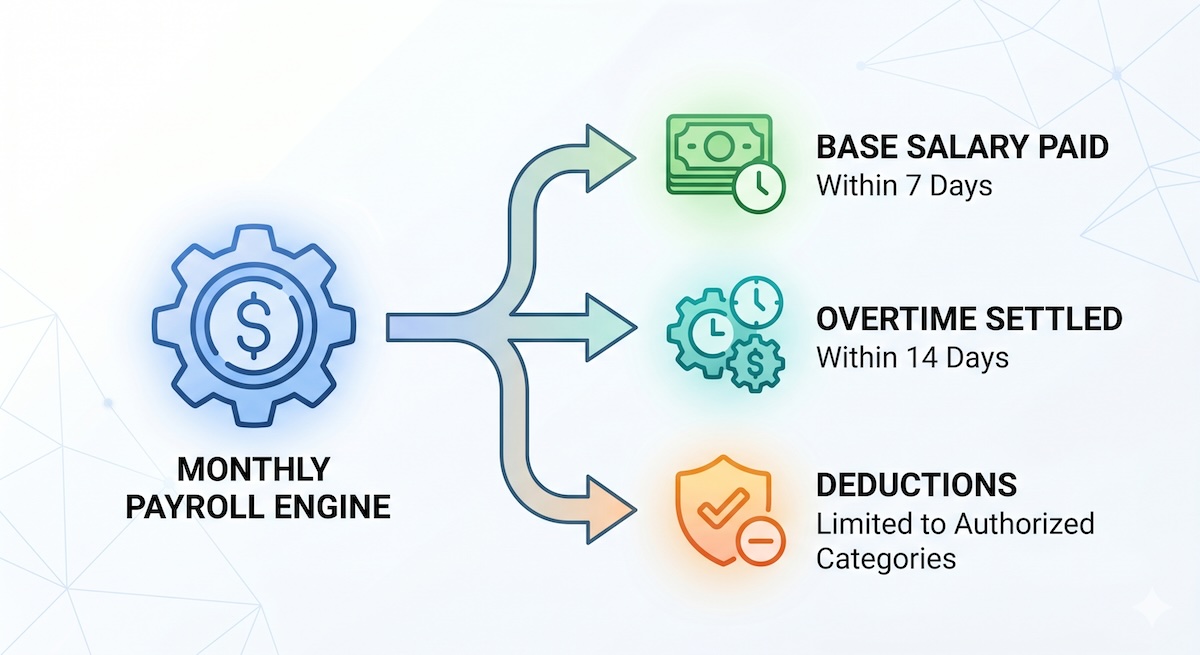
Payroll workflows must align perfectly with MOM employment rules specified under the Employment Act. Salaries must be paid to employees within 7 days after the end of the salary period, while any calculated overtime wages must be settled within 14 days after the specified period.
When employees onboard, resign, or take unpaid leave, payroll teams must calculate prorated salaries using the standard MOM formulas. Under the Employment Act, the prorated basic salary for an incomplete month of work is calculated as:
Prorated Salary = Monthly Base Salary/Total Working Days in that Month x Actual Days Worked
The law also restricts deductions to authorized categories only, including statutory CPF contributions, unpaid leave adjustments, recovery of salary advances, or deductions approved with explicit employee consent.
Furthermore, teams must manage variable wage components like the Annual Wage Supplement (AWS or 13th-month bonus), discretionary bonuses, and sales commissions while maintaining comprehensive payroll record retention for at least two years.
Most industrial payroll disputes occur precisely when overtime calculations, leave deductions, or salary prorations lack clear, consistent documentation.
Read more: A Complete Guide to HR Compliance in Singapore for Employers
Common Singapore Payroll Compliance Challenges

Operating within Singapore’s fast-moving business landscape poses several systematic payroll challenges for growing corporations that still rely on manual human workflows.
1. Manual Payroll Calculation Errors
Relying on manual data entry and spreadsheet formulas introduces severe human error risks. Minor typos can lead to incorrect age-tiered CPF calculations, missed SDL caps, inaccurate progressive overtime computations, and overall payroll discrepancies. These errors frequently cause late salary disbursements, exposing the company to regulatory fines.
2. Fragmented Payroll and HR Data
When attendance systems, leave management spreadsheets, expense claim tools, and core payroll engines exist in separate silos, data consolidation becomes highly inefficient. Spreadsheet-based workflows force teams to execute duplicate data entries, increasing processing times and causing reporting inconsistencies across entities.
3. Difficulty Keeping Up with Regulation Changes
Payroll teams must continuously monitor changing government tax bands, CPF wage ceiling adjustments, MOM labor law revisions, and foreign worker levy changes. Tracking these regulatory shifts manually consumes valuable administrative hours and increases audit risks if an update is overlooked.
4. Payroll Complexity Across Multi-Entity Businesses
For enterprise organizations operating across multiple corporate subsidiaries, separate branches, or regional teams, maintaining payroll governance is exceptionally difficult. Without centralized control, standardizing workflows, ensuring compliance consistency, and gaining complete visibility into holistic workforce costs becomes a major challenge.
Ultimately, payroll complexity increases exponentially as an organization scales, making manual payroll administration highly unsustainable over time.
How to Improve Payroll Compliance Management in Singapore
To protect the organization from operational friction and legal liabilities, corporate leadership should adopt structural best practices designed to optimize payroll governance.
1. Centralize Payroll and Employee Data
Companies should transition away from disconnected tools toward integrated HR ecosystems that manage attendance logs, leave balances, expense claims, overtime hours, and core salary processing within a unified system. This data centralization reduces duplicate administrative work, improves overall calculation accuracy, and provides leadership with clearer reporting visibility.
2. Automate Statutory Payroll Calculations
By deploying automated systems to handle monthly CPF contribution tiers, precise SDL percentages, authorized deduction caps, and overtime multipliers, the risk of human error is practically eliminated. Automation ensures that statutory deductions are calculated flawlessly, keeping the company safe from costly compliance penalties.
3. Maintain Proper Payroll Documentation
Organizations must build a disciplined habit of storing secure, auditable payroll records, itemized payslip histories, CPF contribution receipts, and tax reporting documents. Having an organized archive is crucial for swift dispute resolutions, seamless corporate audits, and regulatory inspections.
4. Regularly Monitor Regulatory Changes
HR managers must proactively track updates from the CPF Board, IRAS, and MOM. Staying informed about SkillsFuture-related payroll alterations or senior worker contribution updates ensures that the internal payroll framework is always audit-ready.
5. Use Payroll Software for Scalability and Compliance
Investing in modern payroll software allows companies to automate repetitive administrative tasks, ensure absolute consistency in annual reporting, protect sensitive data, and gain the scalability needed to handle workforce growth seamlessly. Payroll automation has transitioned into an absolute operational necessity for companies managing modern workforce structures in Singapore.
Managing Singapore Payroll Compliance More Efficiently with Mekari Talenta
As companies expand across entities, business units, and regional workforce structures, payroll processing can no longer rely on spreadsheets, fragmented payroll records, or manual calculations.
Incorrect CPF calculations, delayed IRAS submissions, inconsistent overtime calculations, or incomplete payroll documentation may lead to penalties, audit findings, employee disputes, or complications involving work pass and workforce compliance obligations.
To address these challenges, many organizations are now adopting integrated payroll and HR systems to improve both compliance management and operational scalability.
As an AI-centric cloud-based HRIS platform, Mekari Talenta helps companies manage payroll operations, workforce administration, and HR processes more efficiently within one centralized platform.
Through its integrated payroll management and HR capabilities, companies can:
- automate CPF contribution calculations based on employee age tier and residency status
- support payroll reporting workflows for the IRAS Auto-Inclusion Scheme (AIS)
- manage EA-compliant overtime and payroll calculations more consistently
- centralize payroll, attendance, leave, overtime, and employee administration data
- support multi-entity and regional workforce management more efficiently
- maintain structured payroll documentation and audit-ready workforce records
- improve workforce data security through cloud-based infrastructure and Role-Based Access Control (RBAC)
This integrated approach helps organizations reduce administrative workload, improve payroll accuracy, strengthen compliance visibility, and support more scalable workforce operations as payroll complexity continues to increase.
Consult with Mekari Talenta’s team to see how integrated payroll and HR automation can help your organization manage Singapore payroll compliance more efficiently.
Reference:
Ministry of Manpower – Paying Salary
FAQ
1. What are the key updates to CPF contributions in Singapore for 2026?
1. What are the key updates to CPF contributions in Singapore for 2026?
In 2026, the Central Provident Fund (CPF) Ordinary Wage (OW) ceiling officially increased to SGD 8,000 per month (affecting mid-to-high-income earners). Additionally, contribution rates for senior employees aged above 55 to 65 were raised to support Singapore’s senior worker retirement adequacy roadmap.
2. What are the legal timelines for paying regular salaries and overtime wages?
2. What are the legal timelines for paying regular salaries and overtime wages?
Under the Ministry of Manpower (MOM) employment rules, payments must follow separate statutory timelines:
-
Basic Salary: Must be paid to employees within 7 days after the end of the salary period.
-
Overtime Wages: Must be fully settled within 14 days after the end of the salary period.
3. Who is required to participate in the IRAS Auto-Inclusion Scheme (AIS) for tax filing?
3. Who is required to participate in the IRAS Auto-Inclusion Scheme (AIS) for tax filing?
Participation in the AIS is mandatory for all employers who have 5 or more employees during the calendar year, or those who have received an official notification from IRAS. Mandated employers must submit their workforce’s income data electronically to IRAS by the March 1st annual deadline.
4. Does the Skills Development Levy (SDL) apply to foreign employees?
4. Does the Skills Development Levy (SDL) apply to foreign employees?
Yes. Unlike CPF contributions which only apply to citizens and permanent residents, the SDL is a mandatory employer-funded levy that applies to all workers under a contract of service. This includes part-time, temporary, local, and foreign workers. The contribution rate is set at 0.25% of monthly remuneration, capped between a minimum of SGD 2 and a maximum of SGD 11.25 per month per employee.
5. When and how must itemized payslips be issued to employees?
5. When and how must itemized payslips be issued to employees?
According to MOM regulations, employers must issue itemized payslips either physically or digitally together with the salary payment, or within 3 working days after the payment has been made. The payslips must explicitly detail granular breakdowns such as basic salary, fixed allowances, authorized deductions, overtime hours worked with rates, CPF breakdowns, and the final net salary.
