
KPI (Key Performance Indicators): A Guide for Singapore Businesses

- A Key Performance Indicator (KPI) is a quantifiable metric used to evaluate how effectively an organization or individual achieves specific strategic goals.
- Essential components of a KPI include a clear objective, specific and measurable targets, a defined review period, reliable data sources, and designated ownership.
Many organizations define KPIs at the start of the year, yet rarely revisit them until review season arrives.
The same research found that employees who have quarterly progress checks are 90% more likely to be engaged, which shows that how often KPIs are reviewed matters as much as how they are set.
Without clearly defined and regularly tracked KPIs, teams risk working hard on the wrong priorities, while leaders lack a reliable basis for decisions on performance and rewards.
This article will explain what KPIs are, why they matter, the main types, and what makes a good KPI. It will also cover how to align KPIs with business goals, examples by department, performance measurement and monitoring, common mistakes to avoid, and the difference between KPIs and OKRs.
What Is a KPI?
A Key Performance Indicator (KPI) is a measurable value used to evaluate progress towards a specific business, departmental, team, or individual objective. It helps organisations assess whether their activities are delivering the intended results.
KPIs can measure revenue growth, customer satisfaction, employee turnover, or recruitment efficiency. For example, HR may track employee turnover to assess retention or Time to Hire to evaluate recruitment efficiency.
KPIs operate at different organisational levels. Company-wide KPIs track strategic outcomes, departmental KPIs measure functional objectives, and individual KPIs assess performance against specific responsibilities. Aligning them helps employees understand how their work supports broader business goals.
What Is the Difference Between a KPI and a Metric?
A KPI is a metric used to measure progress towards an important objective, while other metrics may simply track activities or data points.
| Aspect | KPI | Metric |
|---|---|---|
| Purpose | Measures progress towards an objective | Tracks an activity or data point |
| Priority | Linked to business goals | May not be strategically important |
| Example | Employee turnover rate against a retention target | Number of employee resignations |
For example, employee resignations show how many people leave, while the employee turnover rate accounts for workforce size and can help assess progress towards a retention target.
Why Are KPIs Important for Businesses?
KPIs turn business objectives into measurable outcomes, helping managers assess performance, identify gaps, and make data-informed decisions.
1. Align Business and Employee Goals
KPIs connect business objectives with departmental and individual targets, helping employees understand how their work supports organisational priorities.
When goals are not clearly aligned across the organisation, employees may struggle to see how their individual contributions translate into broader business outcomes.
2. Measure Performance Objectively
KPIs enable managers to compare actual results against agreed targets using consistent measures rather than relying solely on subjective judgement.
3. Identify Performance Gaps
KPI results help managers identify underperformance and investigate its causes. For example, rising absenteeism may prompt HR to review attendance patterns or workforce scheduling.
4. Support Business Decisions
KPI data helps leaders prioritise resources and improve processes. HR can use employee turnover and Time to Hire to identify areas requiring attention.
Also Read: How to Manage Employee Performance in Singapore: A Complete Guide
What Are the Different Types of KPIs?
KPIs can be classified by what they measure and how they help organisations assess performance. Two common distinctions are quantitative versus qualitative KPIs and leading versus lagging KPIs.
1. Quantitative KPIs
Quantitative KPIs use numerical values, percentages, rates, or ratios to measure performance against targets. Examples include revenue growth, employee turnover rate, absenteeism rate, and sales conversion rate.
2. Qualitative KPIs
Qualitative KPIs assess performance related to quality, experience, or perceptions, often using surveys, ratings, or feedback.
Examples include employee engagement scores and customer satisfaction ratings, which capture aspects of performance that numerical output alone may not reflect.
3. Leading KPIs
Leading KPIs track activities or conditions that may influence future outcomes, helping teams identify opportunities for improvement early. Examples include training participation rates and the number of qualified sales leads.
4. Lagging KPIs
Lagging KPIs measure outcomes that have already occurred, such as revenue generated, customer churn rate, and employee turnover rate. While they show whether objectives have been achieved, they may not explain the causes.
Combining leading and lagging KPIs helps organisations monitor both potential drivers and actual results.
What Makes a Good KPI?
An effective KPI should provide meaningful information about progress towards an objective. Consider these key components when establishing KPIs:
- Clear Objective: Define what the KPI aims to achieve. For example, employee retention can be measured using an indicator that tracks progress towards keeping employees in the organisation.
- Specific Indicator: Choose a measure that directly reflects the performance being evaluated, such as Time to Hire for recruitment efficiency.
- Measurable Target: Set an expected result against which actual performance can be evaluated, such as maintaining annual employee turnover below 10%.
- Defined Measurement Period: Specify whether the KPI is measured weekly, monthly, quarterly, or annually, depending on the indicator and its intended use.
- Reliable Data Source: Establish where the data comes from and how it will be collected to ensure consistent and reliable comparisons.
- Assigned Owner: Identify who is responsible for monitoring the KPI, interpreting results, and coordinating follow-up actions.
How to Set KPIs That Align With Business Goals
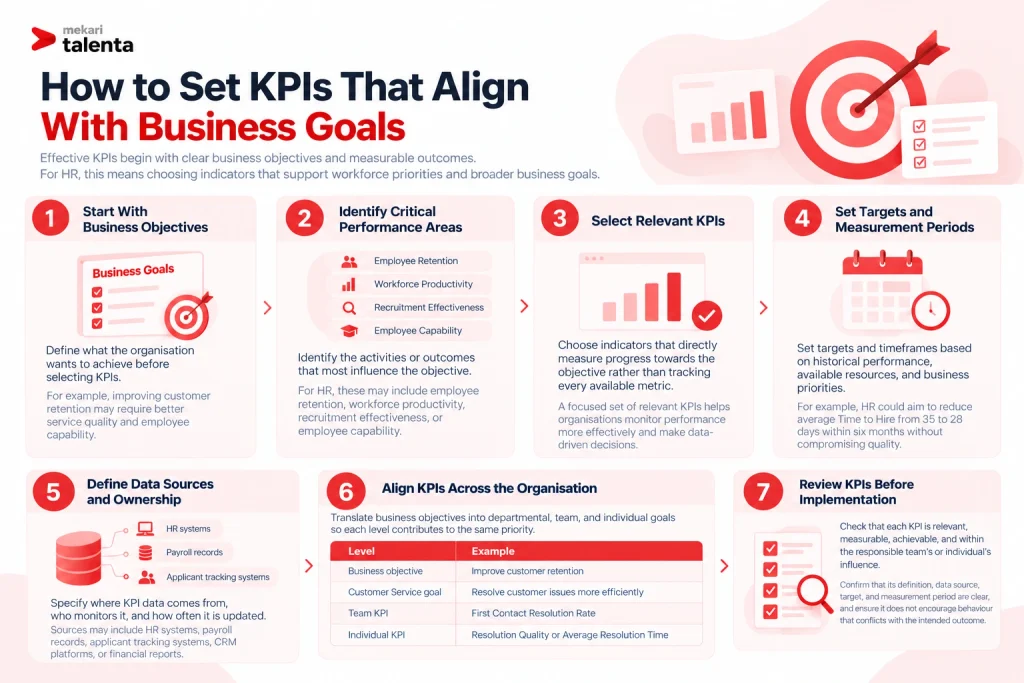
Effective KPIs begin with clear business objectives and measurable outcomes. For HR, this means choosing indicators that support workforce priorities and broader business goals.
1. Start With Business Objectives
Define what the organisation wants to achieve before selecting KPIs. For example, improving customer retention may require better service quality and employee capability.
2. Identify Critical Performance Areas
Identify the activities or outcomes that most influence the objective. For HR, these may include employee retention, workforce productivity, recruitment effectiveness, or employee capability.
If service quality depends on employee skills, HR could assess training effectiveness and how quickly new hires reach expected performance levels.
3. Select Relevant KPIs
Choose indicators that directly measure progress towards the objective rather than tracking every available metric. A focused set of relevant KPIs helps organisations monitor performance more effectively and make data-driven decisions.
4. Set Targets and Measurement Periods
Set targets and timeframes based on historical performance, available resources, and business priorities. For example, HR could aim to reduce average Time to Hire from 35 to 28 days within six months without compromising hiring quality.
5. Define Data Sources and Ownership
Specify where KPI data comes from, who monitors it, and how often it is updated. Sources may include HR systems, payroll records, applicant tracking systems, CRM platforms, or financial reports.
Clear ownership and consistent data definitions support reliable measurement.
6. Align KPIs Across the Organisation
Translate business objectives into departmental, team, and individual goals so each level contributes to the same priority.
| Level | Example |
| Business objective | Improve customer retention |
| Customer Service goal | Resolve customer issues more efficiently |
| Team KPI | First Contact Resolution Rate |
| Individual KPI | Resolution Quality or Average Resolution Time |
Each KPI should reflect the responsibilities of the relevant team or employee. Individual KPIs should be within employees’ influence and balanced with quality measures to avoid unintended behaviour.
7. Review KPIs Before Implementation
Before implementation, check that each KPI is relevant, measurable, achievable, and within the responsible team’s or individual’s influence.
Confirm that its definition, data source, target, and measurement period are clear, and ensure it does not encourage behaviour that conflicts with the intended outcome.
Also Read: Understanding Performance Management System: Why It Matters in Singapore?
Examples of KPIs by Department
Different departments require different KPIs because their responsibilities and expected outcomes vary. The following examples show how organisations can select indicators that reflect each function’s priorities.
| Department | KPI Example | What It Measures |
|---|---|---|
| HR | Employee Turnover Rate | Percentage of employees who leave the organisation during a given period |
| Recruitment | Time to Hire | Time taken to move a candidate through the recruitment process to hiring |
| Sales | Sales Conversion Rate | Percentage of leads converted into sales |
| Marketing | Cost per Lead | Average cost of generating a lead |
| Finance | Invoice Processing Time | Time required to process an invoice |
| Customer Service | First Response Time | Time taken to provide an initial response to a customer |
| Operations | On-Time Delivery Rate | Percentage of deliveries completed on schedule |
HR KPI Examples
HR KPIs help teams evaluate workforce trends, recruitment efficiency, attendance, and employee development. The most relevant indicators depend on the organisation’s workforce priorities and operational challenges.
- Employee Turnover Rate: Measures the percentage of employees who leave during a specific period. HR can use it to identify retention challenges and assess retention initiatives.
- Absenteeism Rate: Tracks employee absence patterns that may affect workforce availability and operational continuity.
- Time to Hire: Measures the time taken to hire a candidate, helping HR assess recruitment process efficiency.
- Time to Fill: Measures the time between opening a vacancy and filling the position, helping HR understand how quickly workforce gaps are addressed.
- Training Completion Rate: Tracks whether employees complete required learning programmes and helps HR monitor training participation.
- Employee Engagement Score: Measures employee perceptions of their work experience and helps HR identify areas for improvement.
HR should interpret these indicators together where appropriate. For example, reducing Time to Hire may improve recruitment efficiency, but it does not necessarily indicate better hiring outcomes if new employees leave shortly after joining.
How to Measure KPI Performance
Measuring KPI performance involves calculating results and assessing progress towards an objective. Follow these steps to evaluate KPIs consistently:
- Establish the baseline: Record performance before introducing changes.
- Collect actual data: Gather information from agreed data sources.
- Apply a consistent formula: Use the same calculation method for each period.
- Compare results against the target: Determine whether performance meets expectations.
- Identify the performance gap: Calculate the difference between actual results and the target.
- Investigate the cause: Examine factors that may explain the result.
- Determine corrective action: Decide what changes are needed and who is responsible.
For example, if the annual employee turnover target is 10% or lower but the actual rate reaches 12%, HR needs to investigate why the target was missed.
Exit interview feedback, employee tenure patterns, and survey results can help identify contributing factors and inform corrective action.
How to Monitor and Review KPIs
Regular monitoring helps ensure KPIs remain relevant as business conditions, workforce needs, and organisational priorities change.
1. Set the Right Review Frequency
Choose a review cycle based on how quickly the KPI changes and how urgently action may be needed. Attendance metrics may require frequent monitoring, while employee engagement trends may be reviewed quarterly or annually.
2. Use a KPI Dashboard
A KPI dashboard consolidates targets, actual results, variances, and trends, helping managers identify areas that need attention and reduce time spent compiling reports manually.
3. Conduct Regular Performance Reviews
Discuss KPI results throughout the performance cycle rather than waiting for the annual appraisal. Regular conversations help managers and employees assess progress, address obstacles, and adjust priorities.
4. Update KPIs When Business Priorities Change
Reassess KPIs when business objectives or operating priorities shift. Ensure that performance measures capture meaningful contributions and business outcomes rather than focusing solely on activity counts.
Also Read: Performance Analytics: Tools for Evaluating Employees in Singapore
What Are the Common KPI Mistakes to Avoid?
Even well-defined KPIs can become ineffective when poorly selected or managed. Avoid these common mistakes:
1. Setting Too Many KPIs
Too many indicators can obscure key priorities. Focus on measures that provide meaningful insight into the objective.
2. Choosing KPIs That Are Not Linked to Business Goals
Ensure every KPI supports a relevant business, departmental, or individual objective rather than tracking metrics simply because they are easy to measure.
3. Using Unrealistic Targets
Set targets based on historical performance, available resources, and expected operating conditions. Targets that are too ambitious or too easy can distort performance assessments.
4. Measuring What Employees Cannot Influence
Consider whether employees can meaningfully influence the outcomes they are assessed on. Combine outcome measures with indicators of their contribution where appropriate.
5. Focusing Only on the Numbers
Interpret KPI results in context. Missed targets may reflect process limitations, resource constraints, or changing business conditions rather than poor individual performance.
6. Never Reviewing the KPI
Review KPIs periodically to ensure they remain relevant as organisational objectives and priorities change.
KPI vs. OKR: What Is the Difference?
KPIs and Objectives and Key Results (OKRs) both support performance management but serve different purposes.
| Aspect | KPI | OKR |
|---|---|---|
| Main focus | Performance measurement | Goal setting and outcomes |
| Structure | Indicator and target | Objective and Key Results |
| Purpose | Monitor ongoing performance | Drive progress towards focused goals |
KPIs track important performance indicators, while OKRs define an objective and the key results used to assess progress.
They can work together: OKRs establish strategic improvement goals, while KPIs monitor ongoing performance related to those goals.
Improve KPI Management and Employee Performance with Mekari Talenta
Key Performance Indicators (KPIs) help businesses measure progress towards their goals and evaluate how effectively employees contribute to organisational performance. To make KPI implementation more effective, HR teams need a structured approach to tracking performance and supporting employee development.
With Mekari Talenta’s Talent Development, businesses can support employee growth through performance management and talent development processes. This helps HR teams align employee development initiatives with the competencies and performance expectations required by the organisation.
By connecting performance evaluation with employee development, businesses can identify areas for improvement and provide more targeted development opportunities. This enables managers to make better-informed decisions about employee growth and performance improvement.
Mekari Talenta offers an integrated HR platform to help businesses manage employee information and support key HR processes more efficiently.
Looking to strengthen your KPI management and employee development processes? Contact Mekari Talenta to explore solutions that fit your business needs.
Reference:
- APQC. (2025, January 24). 2025 operational KPI priorities & challenges survey report.
- Stanchak, J. (2026, January 28). HR leaders, are you sure your employees have the right goals? SHRM.
- Duda, J., Flynn, J., Cantrell, S., Scoble-Williams, N., & Sanford, A. (2025, March 23). Reinventing performance management processes won’t unlock human performance. Here’s what will. Deloitte Insights.
FAQ (Frequently Asked Questions)
How should managers handle KPI targets that become unrealistic during the performance cycle?
How should managers handle KPI targets that become unrealistic during the performance cycle?
Managers should review the circumstances that have affected the original targets, such as changes in business priorities, resource availability, or market conditions. They should distinguish between challenges that employees can influence and factors beyond their control. If a target needs to change, the adjustment should be discussed with relevant stakeholders and documented clearly. This helps maintain fair performance expectations without compromising accountability.
Should employees be involved in setting their individual KPIs?
Should employees be involved in setting their individual KPIs?
Yes, involving employees can help ensure that individual KPIs reflect their actual responsibilities and the resources available to them. Managers can explain how each KPI connects to team objectives while inviting employees to identify potential obstacles or conflicting priorities. This discussion also helps clarify how performance will be measured and what support may be needed. Final expectations should be agreed upon and documented so both parties have a shared understanding of success.
What should managers do when an employee meets their KPIs but overall performance remains poor?
What should managers do when an employee meets their KPIs but overall performance remains poor?
Managers should assess the employee’s performance beyond the KPI results alone. Meeting numerical targets may not reflect work quality, collaboration, compliance, or the impact of the employee’s actions on other teams. Reviewing qualitative feedback and relevant performance evidence can help identify gaps that the indicators do not capture. Managers should then discuss these findings with the employee and determine whether the KPIs or performance expectations need to be refined.
How can organisations prevent employees from manipulating results to meet their KPIs?
How can organisations prevent employees from manipulating results to meet their KPIs?
Organisations should review both the results achieved and the methods used to achieve them. For example, a recruitment KPI focused only on Time to Hire could encourage faster hiring at the expense of candidate quality. Pairing efficiency measures with relevant quality indicators can help reduce this risk. Clear measurement definitions, reliable data, and regular reviews also make it easier to identify unusual patterns or unintended behaviour.
When should an organisation discontinue or replace an existing KPI?
When should an organisation discontinue or replace an existing KPI?
An organisation should reconsider a KPI when it no longer reflects business priorities, provides useful insight, or supports meaningful decisions. A measure may also need to be replaced if its data becomes unreliable or the team can no longer influence the outcome it is intended to assess. Before removing it, managers should consider whether the underlying objective remains important and whether another indicator would measure progress more effectively. Any changes should be communicated to relevant employees and stakeholders to maintain consistency in performance evaluation.
