
How to Conduct Performance Reviews for Singapore Businesses

- Conducting a performance review involves setting clear criteria, gathering factual data, conducting two-way discussions, and establishing actionable goals.
- The evaluation session focuses on delivering constructive feedback, addressing workplace challenges, and determining the necessary support for employees.
Performance reviews are often seen as an annual routine for HR to complete, yet how they are conducted shapes how clearly employees understand their direction and development.
Gallup also found that meaningful weekly feedback is the strongest driver of employee engagement, yet it is also the lowest-rated manager behaviour.
This perception gap shows that an effective performance review goes beyond scheduling appraisal sessions. It has to be conducted in a way that employees genuinely find useful.
This article will explain what performance reviews are and how to conduct one in eight steps. It will also cover fair evaluations, post-review actions, and common mistakes to avoid.
What Is a Performance Review?
A performance review is a structured process for assessing an employee’s performance over a specific period. It evaluates their achievements, work quality, responsibilities, competencies, and progress towards agreed goals.
A typical review involves assessing performance against established criteria, discussing strengths and areas for improvement, exchanging feedback, and identifying future development needs.
Although organisations may use different formats, the purpose remains similar: to understand an employee’s contributions and agree on practical ways to support future performance.
Performance Review vs. Performance Appraisal vs. Performance Management
These terms are related, but they refer to different aspects of employee performance.
| Term | Meaning |
| Performance review | A meeting or process for evaluating performance and discussing feedback. |
| Performance appraisal | A formal assessment that may include ratings and documented outcomes. |
| Performance management | An ongoing process covering goal-setting, monitoring, feedback, evaluation, and employee development. |
Performance review and performance appraisal are often used interchangeably, depending on an organisation’s policies. Performance management, however, covers a broader cycle of activities throughout the year.
Also Read: How to Manage Employee Performance in Singapore: A Complete GuideWhy Should Performance Reviews Be Conducted Systematically?
A consistent review process helps managers evaluate employees against clear expectations instead of relying on personal impressions. It also gives employees a better understanding of how their work contributes to organisational priorities.
Three benefits are particularly relevant to growing businesses.
Align Individual Performance with Business Goals
Performance reviews help managers assess whether employees are contributing to team targets and wider business objectives.
For example, a customer service employee may be evaluated on response times, resolution quality, and customer feedback. Reviewing these outcomes together provides a clearer picture than measuring the number of enquiries handled alone.
Improve Feedback Quality and Employee Development
Regular, specific feedback helps employees understand which practices are effective and where improvement is needed. It also gives managers an opportunity to identify training needs before performance gaps become more difficult to address.
Constructive and relevant feedback helps employees understand their strengths, identify areas for improvement, and take actionable steps to develop their skills.
Support More Consistent Employment Decisions
Documented assessments can help HR identify development opportunities, training requirements, and potential career progression.
They can also provide useful evidence when considering performance-related decisions. However, these decisions should still follow established criteria and account for relevant circumstances, rather than relying on ratings alone.
Also Read: Understanding Performance Management System: Why It Matters in Singapore?How to Conduct Performance Reviews in 8 Steps
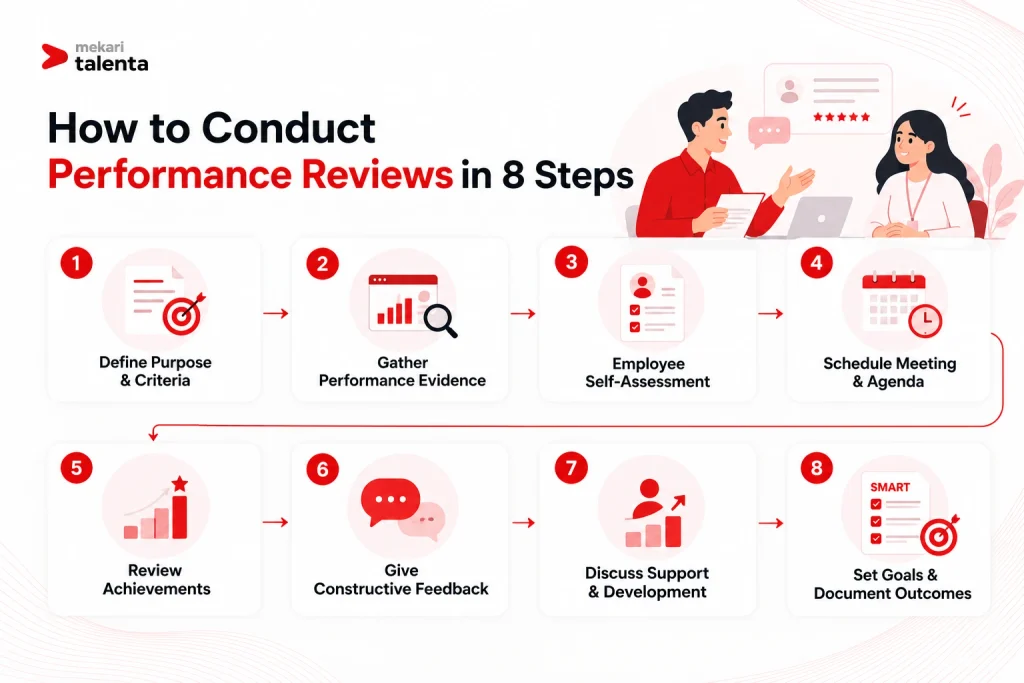
A structured performance review process helps managers assess employees consistently, discuss performance, and agree on improvement actions. These eight steps can be adapted to the organisation’s size, roles, and policies.
1. Define the Purpose and Assessment Criteria
Clarify whether the review aims to recognise achievements, address performance gaps, identify development needs, or set future priorities.
Set criteria based on:
- Job responsibilities and expectations.
- Agreed targets or key performance indicators (KPIs).
- Work quality and accuracy.
- Relevant competencies and workplace behaviours.
- Contributions to team and organisational goals.
Criteria should reflect each role. Sales employees may be assessed on target achievement and customer relationships, while operational employees may be evaluated on accuracy, timeliness, and service standards.
Communicate the criteria in advance so employees understand how their performance will be assessed.
2. Gather Performance Data and Evidence
Collect evidence from the entire review period rather than focusing only on recent events. Relevant information includes KPI results, project achievements, work quality, missed deadlines, customer feedback, and previous performance discussions.
Employee self-assessments can provide additional context, particularly when targets were affected by changing priorities, limited resources, or external factors.
Distinguish documented facts from assumptions, and consider quantitative results alongside the circumstances in which the work was completed.
3. Ask Employees to Complete a Self-Assessment
A self-assessment allows employees to reflect on their achievements, challenges, and development needs before the meeting.
Provide a simple template with consistent questions for employees in comparable roles. Give them sufficient preparation time and use their responses to identify differences between their perspectives and the manager’s evaluation. These differences can become useful discussion points during the review.
4. Schedule the Meeting and Prepare an Agenda
Schedule the meeting in advance, explain its purpose, and share the assessment criteria. Give employees time to prepare examples, questions, and concerns.
Managers should prepare a performance summary, supporting evidence, and discussion points. Choose a private location or suitable online platform to protect confidentiality.
A simple agenda can cover:
- Achievements and progress against goals.
- Strengths and areas for improvement.
- Feedback and workplace challenges.
- Development needs and future priorities.
- Agreed actions and follow-up dates.
Allow sufficient time for two-way discussion rather than simply presenting a final rating.
5. Open with a Dialogue and Review Achievements
Explain the meeting’s purpose, acknowledge relevant contributions, and invite the employee to share their perspective.
Review achievements against agreed targets and supporting evidence. If goals were not met, discuss contributing factors before drawing conclusions.
Listen carefully and ask follow-up questions to understand the context behind the results. This helps managers recognise achievements fairly and avoid making assumptions about performance.
6. Deliver Specific and Constructive Feedback
Effective feedback describes observable behaviour or work outcomes, explains their impact, and identifies practical next steps.
Avoid vague personality judgements and use specific examples instead.
Less effective: “You are not detail-oriented enough.”
More constructive: “The last two reports contained figures that needed correction before submission. Let’s review the data-checking process and agree on a verification step for the next report.”
The second example identifies the issue and suggests an improvement without labelling the employee.
Positive feedback should also explain which contributions were valuable and why. Allow employees to respond and discuss solutions, and address serious concerns through timely conversations rather than raising them for the first time during a formal review.
7. Discuss Challenges, Support, and Development Needs
Performance can be affected by unclear priorities, heavy workloads, limited tools, inefficient processes, or skills gaps.
Discuss these factors with employees to identify the support, training, or experience they need to improve. For businesses in Singapore, these discussions can also inform workforce upskilling plans.
Align development activities with employees’ current responsibilities, career goals, and the organisation’s needs.
8. Set Goals and Document the Review Outcomes
Conclude the meeting by documenting clear outcomes and agreed actions. Record:
- Key achievements and areas for improvement.
- Goals for the next review period.
- Agreed development activities and required support.
- Responsibilities, deadlines, and follow-up dates.
Goals should be specific, relevant, and measurable where appropriate. The SMART framework can help clarify objectives, although not every contribution needs to be measured numerically.
Before closing the meeting, ensure both parties understand the outcomes. Allow employees to raise concerns or disagree with the assessment, and explain the organisation’s process for reviewing disputed results. the outcomes. Allow employees to raise concerns or disagree with the assessment, and explain the organisation’s process for reviewing disputed results.
Also Read: KPI (Key Performance Indicators): A Guide for Singapore BusinessesPerformance Review Questions to Ask Employees
The right questions help managers understand what influences an employee’s performance, identify development needs, and agree on future priorities. Use the questions below as a guide, selecting those most relevant to the employee’s role and review objectives.
Questions About Achievements and Performance
- What were your key achievements during this review period?
- Which targets were not met, and what contributed to the outcome?
- How did your work support the team’s objectives?
- Which aspect of your performance would you most like to improve?
Questions About Feedback and Challenges
- What was the biggest challenge you faced during this period?
- What feedback has helped you improve your work?
- What support from your manager would help you perform better?
- Are any work processes making it harder to achieve your targets?
Questions About Development and Future Goals
- Which skills would you like to develop?
- What are your priorities for the next review period?
- What training or experience would help you progress?
- How should we monitor your progress and follow up on your goals?
Also Read: How to Handle Employee Performance Issues Fairly in SingaporeHow to Keep Performance Reviews Objective and Fair
A consistent process reduces the risk of employees being assessed according to different expectations. HR should establish clear guidelines and help managers apply them throughout the organisation.
Apply Consistent Assessment Standards
Set evaluation criteria before the review period and communicate them clearly. Employees in comparable roles should be assessed against relevant, consistent standards.
In Singapore, employers should use clear, measurable performance standards, apply assessment criteria fairly, and maintain appropriate performance records to support consistent evaluations.
Recognise and Minimise Performance Rating Bias
Common assessment risks include:
- Recency bias: Giving too much weight to recent events.
- Halo effect: Allowing one positive attribute to influence the entire assessment.
- Leniency or severity bias: Consistently assigning ratings that are too high or too low.
- Personal bias: Allowing preferences or assumptions to influence a rating.
Managers can reduce these risks by maintaining performance records throughout the year, referring to specific examples, and checking assessments against agreed criteria.
Use Calibration to Align Assessment Standards
Calibration involves managers reviewing assessments together to check whether ratings are supported by consistent criteria and evidence. HR can facilitate these discussions by providing guidelines and helping managers resolve differences in interpretation.
Calibration should improve consistency, not force employees into predetermined rating categories without evidence. The aim is to ensure that ratings reflect actual performance rather than differences in how individual managers assess their teams.
What Should Happen After a Performance Review?
The review process should continue after the meeting. HR and managers need to follow through on agreed actions and check whether employees receive the support required to meet their goals.
Create a Performance Improvement or Development Plan
A development plan focuses on building skills or preparing an employee for new responsibilities. A performance improvement plan addresses identified gaps through clear expectations, actions, support, and deadlines.
Choose the plan according to the employee’s needs. Both should identify responsibilities and provide a practical way to monitor progress.
Conduct Regular Check-Ins
Schedule follow-up conversations to review progress, discuss new challenges, and provide feedback. Managers can adjust goals when business priorities or working conditions change, provided the revised expectations are communicated clearly.
Evaluate the Effectiveness of the Review Process
HR can assess whether the process leads to meaningful action by tracking indicators such as:
- Percentage of reviews completed on schedule.
- Completion of agreed development activities.
- Progress against performance goals.
- Employee perceptions of feedback clarity and usefulness.
Form completion rates alone do not show whether reviews are effective. Consider whether the process helps employees understand expectations and make progress towards agreed outcomes.
Common Performance Review Mistakes to Avoid
Several practices can reduce the usefulness of performance reviews:
- Focusing only on performance during the last few weeks.
- Giving feedback without specific examples.
- Treating the meeting as a one-way conversation.
- Applying inconsistent criteria without justification.
- Raising serious concerns for the first time during a formal appraisal.
- Setting targets without considering available resources.
- Failing to document discussions or follow up on agreed actions.
To avoid these issues, integrate formal reviews with regular performance conversations throughout the year.
Also Read: Performance Analytics: Tools for Evaluating Employees in SingaporeConnect Employee Performance and Payroll Management with Mekari Talenta
Conducting effective performance reviews helps organisations evaluate employee contributions, identify development needs, and align individual performance with business goals. However, performance reviews are only one part of effective people management. HR teams also need reliable processes to manage employee compensation and payroll in line with company policies.
When performance review outcomes influence salary adjustments, bonuses, or other compensation decisions, having organised employee and payroll data can help HR manage these processes more consistently. Connecting performance management with payroll administration also helps reduce manual coordination between HR and payroll teams.
Mekari Talenta’s Payroll Management solution helps organisations manage payroll processes more efficiently. By streamlining payroll administration, HR teams can spend less time on repetitive tasks and focus more on strategic priorities, including employee performance and development.
Explore Mekari Talenta to discover solutions that support your organisation’s HR and payroll needs. Contact our team to learn how Mekari Talenta can help simplify payroll management and support your broader people management goals.
References
- Indeed. (n.d.). How to conduct performance evaluations (with definition). Indeed Singapore.
- Reeracoen Singapore. (n.d.). Effective performance review strategies for businesses in Singapore.
- Tripartite Alliance for Fair and Progressive Employment Practices. (n.d.). Implementing a fair performance management system (for employers).
- Chartered Institute of Personnel and Development. (n.d.). Performance feedback: An evidence review.
- Gallup. (n.d.). How effective feedback fuels performance.
FAQ (Frequently Asked Questions)
What should HR do if an employee disagrees with their performance review outcome?
What should HR do if an employee disagrees with their performance review outcome?
HR should provide a clear process for employees to raise concerns about their assessment. The employee should be given an opportunity to explain their perspective and provide relevant evidence. The reviewing manager or an appropriate HR representative can then examine whether the assessment followed the organisation’s criteria and procedures. If an error or inconsistency is identified, the outcome should be reconsidered where appropriate. Keeping a record of the review helps ensure the process remains transparent and consistent.
How should performance reviews be handled when an employee changes roles or managers during the review period?
How should performance reviews be handled when an employee changes roles or managers during the review period?
The review should account for the employee’s responsibilities and expectations before and after the change. Where possible, the previous manager should provide relevant feedback and documented evidence of the employee’s earlier performance. The current manager can then assess performance in the new role based on the applicable expectations and available evidence. HR should establish guidelines for these situations so that employees are not disadvantaged by changes in reporting lines. This is particularly useful in organisations with frequent internal transfers or project-based assignments.
Should employees on probation or those who have recently joined the company follow the same performance review process?
Should employees on probation or those who have recently joined the company follow the same performance review process?
New employees may require a different review schedule because they have had less time to demonstrate their capabilities. HR can establish separate guidelines for probation reviews, including role-specific expectations, feedback milestones, and confirmation criteria. Managers should consider the onboarding and training provided, as well as the time available to perform the assigned responsibilities. Expectations should be communicated from the beginning so employees understand how their progress will be assessed. The process should remain consistent with the organisation’s employment policies and applicable requirements.
How can HR ensure performance reviews are conducted consistently across departments?
How can HR ensure performance reviews are conducted consistently across departments?
HR can establish organisation-wide guidelines covering review timelines, documentation requirements, rating definitions, and approval responsibilities. Managers should receive guidance on applying these standards to different roles without treating all roles as if they have identical responsibilities. HR can also review completion patterns and assessment outcomes to identify departments that may need additional support. Where significant differences appear, the organisation should examine whether they reflect genuine performance differences or inconsistent practices. This helps improve consistency while preserving the relevance of role-specific assessments.
What should HR consider when selecting a performance review system for a growing business?
What should HR consider when selecting a performance review system for a growing business?
The system should support the organisation’s review process without creating unnecessary administrative work. Consider whether it can accommodate different roles, assessment criteria, review cycles, and approval workflows. It should also provide appropriate access controls to protect confidential employee information and allow HR to retrieve records when needed. Integration with existing HR systems may reduce duplicate data entry and make relevant employee information easier to access. Before implementation, HR should confirm that the system supports the organisation’s actual requirements and that managers and employees can use it effectively.
