

A Guide to Skills Development Levy (SDL): Rates & Calculation


- Skills Development Levy (SDL) is a mandatory employer levy that supports workforce training and skills development in Singapore.
- To calculate SDL, apply 0.25% to each employee’s monthly total wages, subject to the S$2 minimum and S$11.25 maximum.
As businesses adapt to changing workforce needs, developing the right skills has become an increasingly important part of staying competitive in Singapore.
One mechanism that supports this focus on workforce development is the Skills Development Levy (SDL), a compulsory levy paid by employers for employees working in Singapore, including foreign employees.
The levy is channelled to the Skills Development Fund, which supports workforce upgrading programmes and training grants for eligible employee training.
Understanding how SDL is calculated, who it applies to, and how it should be paid is essential for managing statutory payroll obligations accurately.
What Is the Skills Development Levy?
The Skills Development Levy (SDL) is a compulsory levy that employers in Singapore pay for all employees working in Singapore, including foreign employees.
It is an employer-paid statutory obligation, meaning the levy is not deducted from an employee’s salary. SDL is calculated based on each employee’s monthly wages and is paid in addition to applicable CPF contributions.
The levy supports Singapore’s workforce development efforts through the Skills Development Fund (SDF). SDL collections help fund workforce upgrading programmes and training grants, supporting employers in developing the skills and capabilities of their workforce through eligible training.
In practice, SDL therefore serves two related purposes: it is a statutory payroll obligation for employers and a mechanism for supporting skills development across Singapore’s workforce.
Read also: A Guide to Employment Pass Salary: Requirements & Rates
What Are the Benefits Behind the SDL Scheme?
The Skills Development Levy is designed not only to collect employer contributions, but also to support Singapore’s broader efforts to build a skilled and adaptable workforce.
1. Support Employee Upskilling
One of the main benefits of the SDL scheme is that it helps create funding for employees to develop new skills or strengthen existing capabilities.
Through supported training programmes, employees can continue building skills that are relevant to their current roles and changing workplace requirements.
2. Reduce the Cost of Workforce Training
Training can require significant investment, particularly for small and medium-sized businesses. The SDF provides training grants to employers for eligible employee training, helping reduce some of the costs associated with workforce development.
This allows employers to invest in training while receiving financial support through the broader skills development system.
3. Encourage Continuous Skills Development
The SDL scheme also encourages employers to treat skills development as an ongoing part of workforce management rather than a one-time activity.
By supporting training and upgrading programmes, the scheme helps create opportunities for employees to continually improve their capabilities as job requirements and industries evolve.
How Does the Skills Development Levy Work?
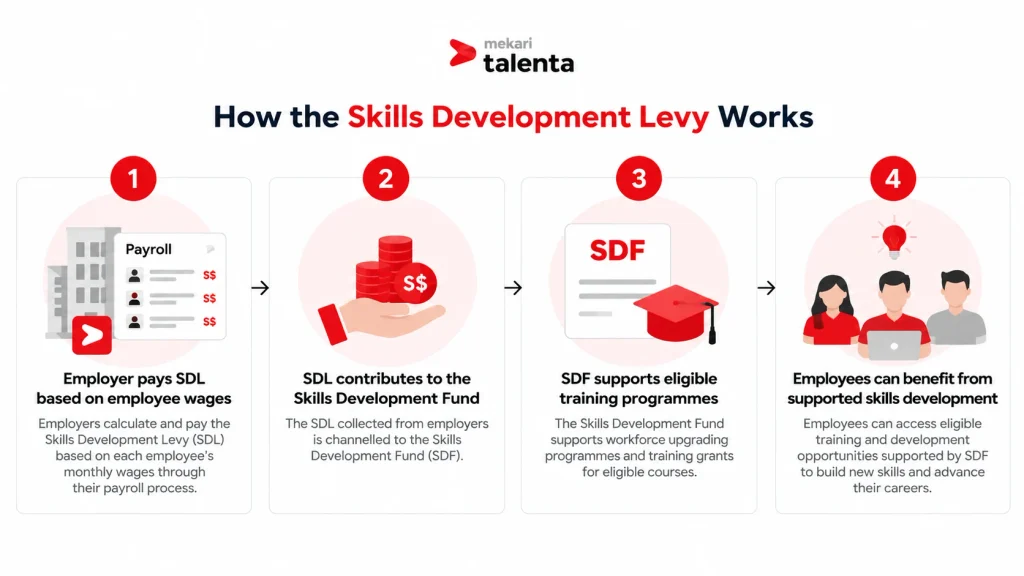
Employers pay the levy as part of their statutory payroll obligations, and the cost is not deducted from employees’ salaries.
The SDL then collected contributes to the Skills Development Fund (SDF), which supports workforce upgrading programmes and training grants.
Through this funding, employers and employees can access eligible training and skills development opportunities that support workforce upskilling and reskilling in Singapore.
In simple terms, the process works as follows:
Read also: A Complete Guide of Progressive Wage Model (PWM) in Singapore
Who Needs to Pay the Skills Development Levy in Singapore?
Employers are required to pay the SDL for all employees working in Singapore, including both local and foreign employees, employed on full-time, casual, part-time, or temporary basis.
This means SDL applies regardless of whether an employee is a Singapore Citizen, Singapore Permanent Resident, or foreign employee.
Some common employee categories covered by SDL include:
| Employee category | SDL applicable? |
|---|---|
| Singapore Citizen | Yes |
| Singapore Permanent Resident | Yes |
| S Pass holder | Yes |
| Employment Pass holder | Yes |
| Work Permit holder | Yes |
How Much Is the Skills Development Levy Employers Need to Pay?
SDL is calculated at 0.25% of an employee’s monthly total wages, subject to the following minimum and maximum amounts:
| Monthly total wages | SDL payable per employee |
|---|---|
| Below S$800 | S$2 minimum |
| S$800 to S$4,500 | 0.25% of monthly total wages |
| Above S$4,500 | S$11.25 maximum |
How to Calculate the Skills Development Levy
To make the calculation clearer, here are a few examples of how SDL is calculated based on an employee’s monthly total wages:
Step 1: Calculate SDL for each employee
First, calculate the SDL payable for each employee based on their monthly total wages. This generally includes wage components such as basic salary, overtime pay, allowances, bonuses, commissions, and cash incentives.
Apply the 0.25% rate, while taking into account the S$2 minimum and S$11.25 maximum explained above.
For example, if an employee receives S$2,000 in basic salary and S$300 in overtime pay during the month, their monthly total wages would be S$2,300 for the calculation:
S$2,300 × 0.25% = S$5.75 SDL
If the calculated amount is below S$2, the minimum applies. Likewise, if the calculated amount exceeds S$11.25, the SDL is capped at S$11.25.
Step 2: Add the SDL for all employees
Once SDL has been calculated for each employee, the employer adds all individual SDL amounts to determine the total levy for the month.
For example, if a company has three employees with SDL amounts of S$5, S$7.50, and S$11.25:
S$5 + S$7.50 + S$11.25 = S$23.75
Step 3: Round down the total SDL
The total SDL is rounded down to the nearest dollar.
S$23.75 → S$23 SDL payable
When and How Do Employers Pay SDL?
Employers must calculate and pay SDL within 14 days after the end of each month. For example, SDL payable on September wages must be paid by 14 October.
Where employers are also making CPF contributions, they can pay SDL together with their CPF contributions through CPF EZPay, a digital service provided by the CPF Board.
CPF EZPay can automatically calculate SDL for Singapore Citizen and Permanent Resident employees, while employers need to enter the applicable SDL amount for foreign employees. Employers that only employ foreign employees must pay SDL directly to the Skills and Workforce Development Agency (SWDA).
To simplify administration, employers can pay SDL and monthly CPF contributions through the same payment channels, including internet banking, direct debit, and CPF Board online services. This allows employers to manage statutory contributions through a single process and maintain a consistent monthly payment schedule.
Employers can also manage SDL-related matters through the GoBusiness Dashboard, where they can view SDL payment history, retrieve notification letters, and access account-related information.
If an employer has overpaid SDL, a refund may be requested from SkillsFuture Singapore (SSG), subject to the applicable requirements and supporting documentation.
For businesses managing payroll at scale, payroll software like Mekari Talenta can further streamline SDL compliance by automating calculations, maintaining payroll records, and reducing manual administrative work associated with recurring statutory contributions.
Read also: CPF Contribution Rates 2026: Complete Guide for Singapore Employers
What Happens If an Employer Pays SDL Late?
Late SDL payments may be subject to a penalty of 10% per annum on the outstanding amount, calculated on a monthly basis. Employers should therefore include SDL payment in their regular monthly payroll compliance process to avoid additional charges.
Connect SDL Management With Employee Development
The Skills Development Levy (SDL) supports Singapore’s broader efforts to encourage workforce training and skills development. For HR teams, managing SDL accurately is therefore part of a wider process of supporting employee learning and development.
Managing SDL calculations manually can add recurring administrative work, especially as employee numbers grow.
With payroll software Mekari Talenta, HR teams can streamline payroll processes and simplify the calculation and management of recurring statutory obligations such as SDL.
Beyond payroll administration, Mekari Talenta also helps HR teams connect employee learning with broader talent development, supporting continuous employee growth and development.
By managing employee development in an integrated platform, HR teams can maintain a clearer view of employees’ skills, development needs, and progression.
Connect workforce development with smarter payroll management. Book a demo to explore how Mekari Talenta can support your payroll and talent development processes.
Reference
- Ministry of Manpower. (2026). Overqualification in Singapore 2025.
- Ministry of Manpower. (2026). Labour Force in Singapore 2025.
- Central Provident Fund Board. (2026). Skills Development Levy.
- Singapore Statutes Online. (2020). Skills Development Levy Regulations.
Frequently Asked Questions (FAQs)
Is every employee subject to the Skills Development Levy?
Is every employee subject to the Skills Development Levy?
SDL generally applies to employees working in Singapore, including local and foreign employees. However, certain categories of employees or workers may be exempt from SDL under specific rules. Employers should check the CPF Board’s SDL exemption guidance when dealing with non-standard employment arrangements.
Can employers make back-payments for unpaid SDL?
Can employers make back-payments for unpaid SDL?
Yes. Employers can make back-payments for SDL through the GoBusiness platform. If an employer has missed previous SDL payments, they should settle the outstanding amount rather than leave the contribution unpaid. Late contributions may also be subject to a 10% per annum penalty on the outstanding amount.
Can SDL be paid separately from CPF contributions?
Can SDL be paid separately from CPF contributions?
Yes. Employers can pay SDL together with CPF contributions through CPF EZPay. CPF EZPay can automatically calculate SDL for Singapore Citizens and Permanent Residents, while employers need to enter the applicable SDL amount for foreign employees. Employers that only employ foreign employees pay SDL directly to the Skills and Workforce Development Agency (SWDA).
Who collects the Skills Development Levy?
Who collects the Skills Development Levy?
The CPF Board acts as the collecting agent for SDL on behalf of the Skills and Workforce Development Agency (SWDA). Employers can therefore submit SDL through CPF payment channels when applicable. The levy itself is administered as part of Singapore’s workforce skills development framework.
What happens to the SDL paid by employers?
What happens to the SDL paid by employers?
SDL collections are channelled to the Skills Development Fund (SDF). The fund supports workforce upgrading programmes and provides training grants for eligible employee training. This allows the levy to contribute to broader workforce skills development rather than functioning only as a payroll compliance requirement.
